Consider a dripping faucet, where the faucet is 10 cm above the sink. The time between drops is such that when one drop hits the sink, one is in the air and another is about to drop. At what height above the sink will the drop in the air be right as a drop hits the sink?
- A. Between 0 and 2 cm
- B. Between 2 and 4 cm
- C. Between 4 and 6 cm
- D. Between 6 and 8 cm
- E. Between 8 and 10 cm
Topic: Newtonian Mechanics Metodi: Kinematic Equations Competenze: Physical Reasoning Objects: Droplet Fonte: Testo (PDF) - p.2
Considerate un rubinetto gocciolante, dove il rubinetto è a 10 cm sopra il lavandino. Il tempo tra le gocce è tale che quando una goccia colpisce il lavandino, una è in aria e l’altra sta per cadere. A che altezza sopra il lavandino la goccia nell’aria sarà giusta come una goccia colpisce il lavandino?
- A. Tra 0 e 2 cm
- B. Tra 2 e 4 cm
- C. Tra 4 e 6 cm
- D. Tra 6 e 8 cm
- E. Tra 8 e 10 cm
Topic: Newtonian Mechanics Metodi: Kinematic Equations Competenze: Physical Reasoning Objects: Droplet Fonte: Testo (PDF) - p.2
A cannonball is launched with initial velocity of magnitude over a horizontal surface. At what minimum angle above the horizontal should the cannonball be launched so that it rises to a height which is larger than the horizontal distance that it will travel when it returns to the ground?
- A.
- B.
- C.
- D.
- E. There is no such angle, as for all range problems.
Topic: Newtonian Mechanics Metodi: Kinematic Equations, Vector Decomposition Competenze: Physical Reasoning Objects: Projectile Fonte: Testo (PDF) - p.2
Una palla di cannone viene lanciata con una velocità iniziale di magnitudo su una superficie orizzontale. A quale angolo minimo sopra l’orizzontale dovrebbe essere lanciato il cannone in modo che si elevi ad un’altezza superiore alla distanza orizzontale che percorrerà quando ritornerà a terra?
- A.
- B.
- C.
- D.
- E. Non esiste un angolo come per tutti i problemi di raggio.
Topic: Newtonian Mechanics Metodi: Kinematic Equations, Vector Decomposition Competenze: Physical Reasoning Objects: Projectile Fonte: Testo (PDF) - p.2
An equilateral triangle is sitting on an inclined plane. Friction is too high for it to slide under any circumstance, but if the plane is sloped enough it can “topple” down the hill. What angle incline is necessary for it to start toppling?
- A. 30 degrees
- B. 45 degrees
- C. 60 degrees
- D. It will topple at any angle more than zero
- E. It can never topple if it cannot slide
Topic: Rigid Body Statics Metodi: Torque & Angular Momentum Analysis, Free-Body Diagram Competenze: Physical Reasoning Objects: Inclined Plane Fonte: Testo (PDF) - p.2
Un triangolo equilaterale è seduto su un piano inclinato. La frizione è troppo alta per poter scivolare in qualsiasi circostanza, ma se l’aereo è abbastanza inclinato può “sbattersi” giù per la collina. Quale angolo di inclinamento è necessario per iniziare a ribaltare?
- A. 30 gradi
- B. 45 gradi
- C. 60 gradi
- D. Si rovescia in qualsiasi angolo superiore a zero
- E. Non può mai cadere se non può scivolare
Topic: Rigid Body Statics Metodi: Torque & Angular Momentum Analysis, Free-Body Diagram Competenze: Physical Reasoning Objects: Inclined Plane Fonte: Testo (PDF) - p.2
A particle at rest explodes into three particles of equal mass in the absence of external forces. Two particles emerge at a right angle to each other with equal speed . What is the speed of the third particle?
- A.
- B.
- C.
- D.
- E. The third particle can have a range of different speeds.
Topic: Conservation of Momentum Metodi: Conservation of Momentum, Vector Decomposition Competenze: Physical Reasoning Objects: - Fonte: Testo (PDF) - p.2
Una particella in riposo esplode in tre particelle di massa uguale in assenza di forze esterne. Due particelle emergono ad angolo retto l’una dall’altra con velocità uguale . Qual è la velocità della terza particella?
- A.
- B.
- C.
- D.
- E. La terza particella può avere una gamma di velocità diverse.
Topic: Conservation of Momentum Metodi: Conservation of Momentum, Vector Decomposition Competenze: Physical Reasoning Objects: - Fonte: Testo (PDF) - p.2
A 12 kg block moving east at 4 m/s collides head on with a 6 kg block that is moving west at 2 m/s. The two blocks move together after the collision. What is the loss in kinetic energy in this collision?
- A. 36 J
- B. 48 J
- C. 60 J
- D. 72 J
- E. 96 J
Topic: Conservation of Momentum Metodi: Conservation of Momentum, Conservation of Energy Competenze: Physical Reasoning Objects: Block Fonte: Testo (PDF) - p.2
Un blocco di 12 kg che si muove ad est a 4 m/s si schianta contro un blocco di 6 kg che si muove ad ovest a 2 m/s. I due blocchi si muovono insieme dopo la collisione. Qual è la perdita di energia cinetica in questa collisione?
- A. 36 J
- B. 48 J
- C. 60 J
- D. 72 J
- E. 96 J
Topic: Conservation of Momentum Metodi: Conservation of Momentum, Conservation of Energy Competenze: Physical Reasoning Objects: Block Fonte: Testo (PDF) - p.2
The following information applies to questions 6 and 7.
Two cannons are arranged vertically, with the lower cannon pointing upward (towards the upper cannon) and the upper cannon pointing downward (towards the lower cannon), 200 m above the lower cannon. Simultaneously, they both fire. The muzzle velocity of the lower cannon is 25 m/s and the muzzle velocity of the upper cannon is 55 m/s.
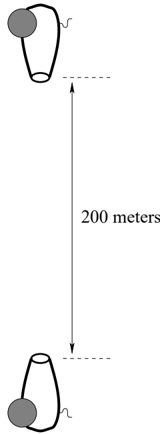
How long after the cannons fire do the projectiles collide?
- A. 2.2 s
- B. 2.5 s
- C. 3.6 s
- D. 6.7 s
- E. 8.0 s
Topic: Newtonian Mechanics Metodi: Kinematic Equations Competenze: Physical Reasoning Objects: Projectile Fonte: Testo (PDF) - p.3
Le seguenti informazioni si applicano alle domande 6 e 7.
Due cannoni sono disposti verticalmente, con il cannone inferiore puntato verso l’alto (verso il cannone superiore) e il cannone superiore puntato verso il basso (verso il cannone inferiore), a 200 m sopra il cannone inferiore. Allo stesso tempo, sparano entrambi. La velocità di muffa del cannone inferiore è di 25 m/s e la velocità di muffa del cannone superiore è di 55 m/s.
Quanto tempo dopo il fuoco dei cannoni i proiettili si schiantano?
- A. 2.2 s
- B. 2.5 s
- C. 3.6 s
- D. 6.7 s
- E. 8.0 s
Topic: Newtonian Mechanics Metodi: Kinematic Equations Competenze: Physical Reasoning Objects: Projectile Fonte: Testo (PDF) - p.3
The following information applies to questions 6 and 7.
Two cannons are arranged vertically, with the lower cannon pointing upward (towards the upper cannon) and the upper cannon pointing downward (towards the lower cannon), 200 m above the lower cannon. Simultaneously, they both fire. The muzzle velocity of the lower cannon is 25 m/s and the muzzle velocity of the upper cannon is 55 m/s.
How far beneath the top cannon do the projectiles collide?
- A. 31 m
- B. 67 m
- C. 110 m
- D. 140 m
- E. 170 m
Topic: Newtonian Mechanics Metodi: Kinematic Equations Competenze: Physical Reasoning Objects: Projectile Fonte: Testo (PDF) - p.3
Le seguenti informazioni si applicano alle domande 6 e 7.
Due cannoni sono disposti verticalmente, con il cannone inferiore puntato verso l’alto (verso il cannone superiore) e il cannone superiore puntato verso il basso (verso il cannone inferiore), a 200 m sopra il cannone inferiore. Allo stesso tempo, sparano entrambi. La velocità di muffa del cannone inferiore è di 25 m/s e la velocità di muffa del cannone superiore è di 55 m/s.
Quanto sotto il cannone superiore si schiantano i proiettili?
- A. 31 m
- B. 67 m
- C. 110 m
- D. 140 m
- E. 170 m
Topic: Newtonian Mechanics Metodi: Kinematic Equations Competenze: Physical Reasoning Objects: Projectile Fonte: Testo (PDF) - p.3
A block of mass kg is moving on a horizontal surface towards a massless spring with spring constant N/m. The coefficient of kinetic friction between the block and the surface is . The block has a speed of 2.0 m/s when it first comes in contact with the spring. How far will the spring be compressed?
- A. 0.19 m
- B. 0.24 m
- C. 0.39 m
- D. 0.40 m
- E. 0.61 m
Topic: Conservation of Energy Metodi: Conservation of Energy, Hooke’s Law Competenze: Physical Reasoning Objects: Spring, Block Fonte: Testo (PDF) - p.3
Un blocco di massa kg si muove su superficie orizzontale verso una sorgente senza massa con costante sorgente N/m. Il coefficiente di attrito cinetico tra il blocco e la superficie è . Il blocco ha una velocità di 2,0 m/s quando viene a contatto per la prima volta con la sorgente. Quanto sarà compresso il guadagno?
- A. 0.19 m
- B. 0.24 m
- C. 0.39 m
- D. 0.40 m
- E. 0.61 m
Topic: Conservation of Energy Metodi: Conservation of Energy, Hooke’s Law Competenze: Physical Reasoning Objects: Spring, Block Fonte: Testo (PDF) - p.3
A uniform spherical planet has radius and the acceleration due to gravity at its surface is . What is the escape velocity of a particle from the planet’s surface?
- A.
- B.
- C.
- D.
- E. The escape velocity cannot be expressed in terms of and alone.
Topic: Gravitation Metodi: Conservation of Energy, Newton’s Law of Gravitation Competenze: Physical Reasoning Objects: Planet Fonte: Testo (PDF) - p.3
Un pianeta sferico uniforme ha un raggio e l’accelerazione dovuta alla gravità sulla sua superficie è . Qual è la velocità di fuga di una particella dalla superficie del pianeta?
- A.
- B.
- C.
- D.
- E. La velocità di fuga non può essere espressa in termini di e da soli.
Topic: Gravitation Metodi: Conservation of Energy, Newton’s Law of Gravitation Competenze: Physical Reasoning Objects: Planet Fonte: Testo (PDF) - p.3
Four objects are placed at rest at the top of an inclined plane and allowed to roll without slipping to the bottom in the absence of rolling resistance and air resistance.
- Object A is a solid brass ball of diameter .
- Object B is a solid brass ball of diameter .
- Object C is a hollow brass sphere of diameter .
- Object D is a solid aluminum ball of diameter . (Aluminum is less dense than brass.)
The balls are placed so that their centers of mass all travel the same distance. In each case, the time of motion is measured. Which of the following statements is correct?
- A.
- B.
- C.
- D.
- E.
Topic: Rotational Dynamics Metodi: Conservation of Energy, Torque & Angular Momentum Analysis Competenze: Physical Reasoning Objects: Ball, Sphere, Inclined Plane Fonte: Testo (PDF) - p.3
Quattro oggetti sono posti a riposo in cima a un piano inclinato e consentito di rotolare senza scivolare verso il basso in assenza di resistenza al rotolamento e resistenza all’aria.
- L’oggetto A è una palla di ottone solida di diametro .
- L’oggetto B è una palla di ottone solida di diametro .
- L’oggetto C è una sfera di ottone vuota di diametro .
- L’oggetto D è una palla di alluminio solida di diametro . (L’alluminio è meno denso del ottone.)
Le palle sono posizionate in modo che i loro centri di massa viaggiino tutte la stessa distanza. In ogni caso, si misura il tempo di movimento . Quale delle seguenti affermazioni è corretta?
- A.
- B.
- C.
- D.
- E.
Topic: Rotational Dynamics Metodi: Conservation of Energy, Torque & Angular Momentum Analysis Competenze: Physical Reasoning Objects: Ball, Sphere, Inclined Plane Fonte: Testo (PDF) - p.3
As shown below, Lily is using the rope through a fixed pulley to move a box with constant speed . The kinetic friction coefficient between the box and the ground is ; assume that the fixed pulley is massless and there is no friction between the rope and the fixed pulley. Then, while the box is moving, which of the following statements is correct?
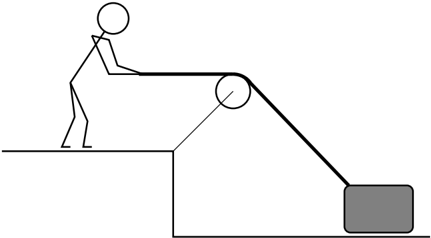
- A. The magnitude of the force on the rope is constant.
- B. The magnitude of friction between the ground and the box is decreasing.
- C. The magnitude of the normal force of the ground on the box is increasing.
- D. The pressure of the box on the ground is increasing.
- E. The pressure of the box on the ground is constant.
Topic: Newtonian Mechanics Metodi: Free-Body Diagram, Vector Decomposition Competenze: Physical Reasoning Objects: Pulley, String, Block Fonte: Testo (PDF) - p.4
Come mostrato di seguito, Lily usa la corda attraverso una polla fissa per spostare una scatola con velocità costante . Il coefficiente di attrito cinetico tra la scatola e il terreno è ; supponiamo che la polla fissa sia senza massa e che non vi sia attrito tra la corda e la polla fissa. Quindi, mentre la scatola si muove, quale delle seguenti affermazioni è corretta?
- A. La forza sulla corda è costante.
- B. L’entità della frizione tra il terreno e la scatola sta diminuendo.
- C. L’entità della forza normale del terreno sulla scatola è in aumento.
- D. La pressione della scatola sul terreno aumenta.
- E. La pressione della scatola sul terreno è costante.
Topic: Newtonian Mechanics Metodi: Free-Body Diagram, Vector Decomposition Competenze: Physical Reasoning Objects: Pulley, String, Block Fonte: Testo (PDF) - p.4
A rigid hoop can rotate about the center. Two massless strings are attached to the hoop, one at A, the other at B. These strings are tied together at the center of the hoop at O, and a weight is suspended from that point. The strings have a fixed length, regardless of the tension, and the weight is only supported by the strings. Originally OA is horizontal.
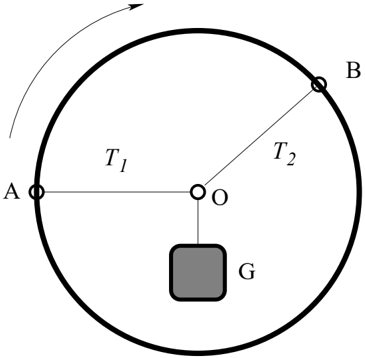
Now, the outer hoop will start to slowly rotate clockwise until OA will become vertical, while keeping the angle between the strings constant and keeping the object static. Which of the following statements about the tensions and in the two strings is correct?
- A. always decreases.
- B. always increases.
- C. always increases.
- D. will become zero at the end of the rotation.
- E. first increases and then decreases.
Topic: Rigid Body Statics Metodi: Free-Body Diagram, Vector Decomposition Competenze: Physical Reasoning, Diagrammatic Reasoning Objects: String Fonte: Testo (PDF) - p.4
Un cerchio rigido può ruotare intorno al centro. Due stringhe senza massa sono attaccate al cerchio, una a A, l’altra a B. Queste corde sono legate insieme al centro del cerchio a O, e da quel punto viene sospeso un peso . Le corde hanno una lunghezza fissa, indipendentemente dalla tensione, e il peso è supportato solo dalle corde. Originariamente l’OA era orizzontale.
Ora, l’orlo esterno inizierà a ruotare lentamente in senso orario fino a quando OA diventerà verticale, mantenendo l’angolo tra le corde costante e mantenendo l’oggetto statico. Quale delle seguenti affermazioni sulle tensioni e nelle due stringhe è corretta?
- A. diminuisce sempre.
- B. aumenta sempre.
- C. aumenta sempre.
- D. diventerà zero alla fine della rotazione.
- E. aumenta prima e poi diminuisce.
Topic: Rigid Body Statics Metodi: Free-Body Diagram, Vector Decomposition Competenze: Physical Reasoning, Diagrammatic Reasoning Objects: String Fonte: Testo (PDF) - p.4
Shown below is a graph of the component of force versus position for a 4.0 kg cart constrained to move in one dimension on the axis. At the cart has a velocity of m/s (in the negative direction). Which of the following is closest to the maximum speed of the cart?
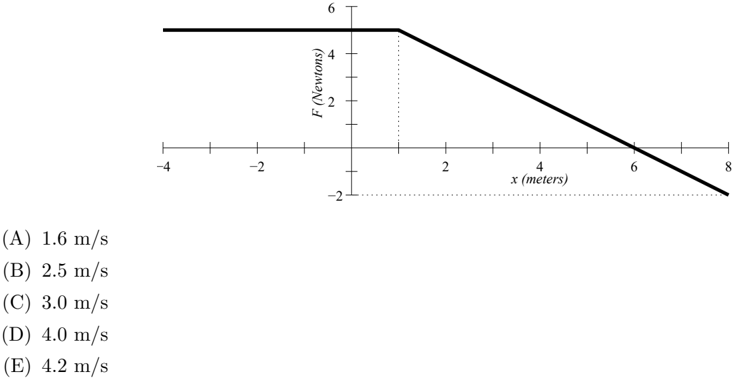
- A. 1.6 m/s
- B. 2.5 m/s
- C. 3.0 m/s
- D. 4.0 m/s
- E. 4.2 m/s
Topic: Conservation of Energy Metodi: Conservation of Energy, Calculus-Integration Competenze: Physical Reasoning, Graph Linearization Objects: Cart Fonte: Testo (PDF) - p.4
In seguito è mostrato un grafico della componente di forza contro posizione per un carrello di 4,0 kg costretto a muoversi in una dimensione sull’asse . Al il carrello ha una velocità di m/s (in direzione negativa). Quale delle seguenti è la velocità massima del carrello?
- A. 1.6 m/s
- B. 2.5 m/s
- C. 3.0 m/s
- D. 4.0 m/s
- E. 4.2 m/s
Topic: Conservation of Energy Metodi: Conservation of Energy, Calculus-Integration Competenze: Physical Reasoning, Graph Linearization Objects: Cart Fonte: Testo (PDF) - p.4
A uniform cylinder of radius originally has a weight of 80 N. After an off-axis cylinder hole at was drilled through it, it weighs 65 N. The axes of the two cylinders are parallel and their centers are at the same height.
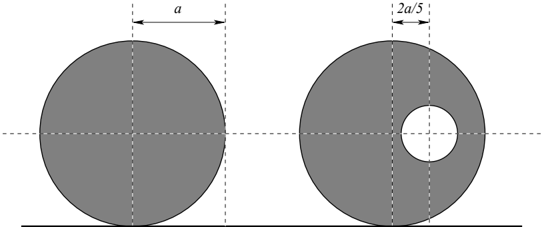
A force is applied to the top of the cylinder horizontally. In order to keep the cylinder at rest, the magnitude of the force is closest to:
- A. 6 N
- B. 10 N
- C. 15 N
- D. 30 N
- E. 38 N
Topic: Rigid Body Statics Metodi: Torque & Angular Momentum Analysis, Free-Body Diagram Competenze: Physical Reasoning Objects: Cylinder Fonte: Testo (PDF) - p.4
Un cilindro uniforme di raggio ha originariamente un peso di 80 N. Dopo aver perforato un buco di cilindro fuori asse a , pesa 65 N. Gli assi dei due cilindri sono paralleli e i loro centri sono a stessa altezza.
Una forza viene applicata orizzontalmente sulla parte superiore del cilindro. Per mantenere il cilindro in riposo, la forza è più vicina a:
- A. 6 N
- B. 10 N
- C. 15 N
- D. 30 N
- E. 38 N
Topic: Rigid Body Statics Metodi: Torque & Angular Momentum Analysis, Free-Body Diagram Competenze: Physical Reasoning Objects: Cylinder Fonte: Testo (PDF) - p.4
A car of mass has an engine that provides a constant power output . Assuming no friction, what is the maximum constant speed that this car can drive up a long incline that makes an angle with the horizontal?
- A.
- B.
- C.
- D. There is no maximum constant speed.
- E. The maximum constant speed depends on the length of the incline.
Topic: Newtonian Mechanics Metodi: Free-Body Diagram, Physical Modeling Competenze: Physical Reasoning Objects: Inclined Plane Fonte: Testo (PDF) - p.5
Un’auto di massa ha un motore che fornisce una potenza di uscita costante . Se non si assume attrito, qual è la velocità massima costante che questa vettura può guidare su una lunga pendenza che fa un angolo con l’orizzontale?
- A.
- B.
- C.
- D. Non esiste una velocità massima costante.
- E. La velocità massima costante dipende dalla lunghezza dell’inclinazione.
Topic: Newtonian Mechanics Metodi: Free-Body Diagram, Physical Modeling Competenze: Physical Reasoning Objects: Inclined Plane Fonte: Testo (PDF) - p.5
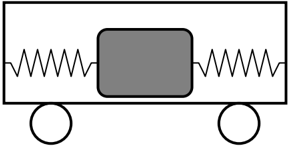
Inside a cart that is accelerating horizontally at acceleration , there is a block of mass connected to two light springs of force constants and . The block can move without friction horizontally. Find the vibration frequency of the block.
- A.
- B.
- C.
- D.
- E.
Topic: Oscillations & Waves Metodi: Simple Harmonic Motion Analysis, Hooke’s Law Competenze: Physical Reasoning Objects: Spring, Block, Cart Fonte: Testo (PDF) - p.5
All’interno di un carrello che accelera orizzontalmente ad accelerazione , c’è un blocco di massa collegato a due sorgenti luminose di costanti di forza e . Il blocco può muoversi senza attrito orizzontalmente. Trova la frequenza di vibrazione del blocco.
- A.
- B.
- C.
- D.
- E.
Topic: Oscillations & Waves Metodi: Simple Harmonic Motion Analysis, Hooke’s Law Competenze: Physical Reasoning Objects: Spring, Block, Cart Fonte: Testo (PDF) - p.5
Shown below is a log/log plot for the data collected of amplitude and period of oscillation for certain non-linear oscillator.
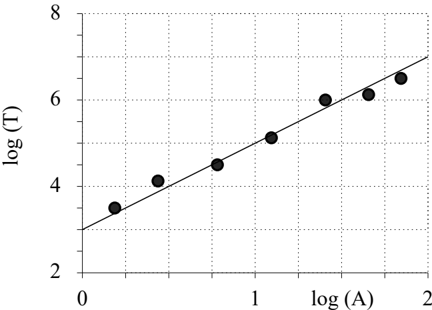
According to the data, the relationship between period and amplitude is best given by
- A.
- B.
- C.
- D.
- E. Period is independent of amplitude for oscillating systems
Topic: Oscillations & Waves Metodi: Graph Linearization, Curve Fitting Competenze: Physical Reasoning, Graph Linearization, Experimental Data Analysis Objects: - Fonte: Testo (PDF) - p.5
In seguito è mostrato un diagramma log/log per i dati raccolti di amplitudine e periodo di oscillazione per determinati oscillatori non lineari.
Secondo i dati, la relazione tra periodo e amplitudine è meglio data da
- A.
- B.
- C.
- D.
- E. Il periodo è indipendente dall’ampiezza per i sistemi oscillanti
Topic: Oscillations & Waves Metodi: Graph Linearization, Curve Fitting Competenze: Physical Reasoning, Graph Linearization, Experimental Data Analysis Objects: - Fonte: Testo (PDF) - p.5
A mass hangs from the ceiling of a box by an ideal spring. With the box held fixed, the mass is given an initial velocity and oscillates with purely vertical motion. When the mass reaches the lowest point of its motion, the box is released and allowed to fall. To an observer inside the box, which of the following quantities does not change when the box is released? Ignore air resistance.
- A. The amplitude of the oscillation
- B. The period of the oscillation
- C. The maximum speed reached by the mass
- D. The height at which the mass reaches its maximum speed
- E. The maximum height reached by the mass
Topic: Oscillations & Waves Metodi: Simple Harmonic Motion Analysis Competenze: Physical Reasoning Objects: Spring Fonte: Testo (PDF) - p.5
Una massa appesa al soffitto di una scatola da una sorgente ideale. Con la scatola tenuta fissa, la massa riceve una velocità iniziale e oscilla con un movimento puramente verticale. Quando la massa raggiunge il punto più basso del suo movimento, la scatola viene rilasciata e lasciata cadere. Per un osservatore all’interno della scatola, quale delle seguenti quantità non cambia quando la scatola viene rilasciata? Ignora la resistenza dell’aria.
- A. L’ampiezza dell’oscillazione
- B. Il periodo di oscillazione
- C. La velocità massima raggiunta dalla massa
- D. L’altezza alla quale la massa raggiunge la velocità massima
- E. L’altezza massima raggiunta dalla massa
Topic: Oscillations & Waves Metodi: Simple Harmonic Motion Analysis Competenze: Physical Reasoning Objects: Spring Fonte: Testo (PDF) - p.5
A 1,500 Watt motor is used to pump water a vertical height of 2.0 meters out of a flooded basement through a cylindrical pipe. The water is ejected through the end of the pipe at a speed of 2.5 m/s. Ignoring friction and assuming that all of the energy of the motor goes to the water, which of the following is the closest to the radius of the pipe? The density of water is kg/m.
- A. 1/3 cm
- B. 1 cm
- C. 3 cm
- D. 10 cm
- E. 30 cm
Topic: Fluid Mechanics Metodi: Continuity Equation, Conservation of Energy Competenze: Physical Reasoning Objects: Tube Fonte: Testo (PDF) - p.6
Un motore da 1.500 watt viene utilizzato per pompare acqua di 2.0 metri di altezza verticale da un seminterrato inondato attraverso un tubo cilindrico. L’acqua viene espulsa attraverso l’estremità del tubo a una velocità di 2,5 m/s. Ignorando l’attrito e supponendo che tutta l’energia del motore vada all’acqua, quale delle seguenti è il più vicino al raggio del tubo? La densità dell’acqua è kg/m.
- A. 1/3 cm
- B. 1 cm
- C. 3 cm
- D. 10 cm
- E. 30 cm
Topic: Fluid Mechanics Metodi: Continuity Equation, Conservation of Energy Competenze: Physical Reasoning Objects: Tube Fonte: Testo (PDF) - p.6
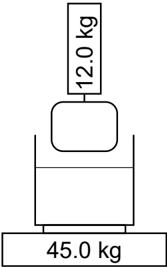
A container of water is sitting on a scale. Originally, the scale reads kg. A block of wood is suspended from a second scale; originally the scale read kg. The density of wood is 0.60 g/cm; the density of the water is 1.00 g/cm. The block of wood is lowered into the water until half of the block is beneath the surface. What is the resulting reading on the scales?
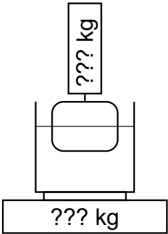
- A. kg and kg.
- B. kg and kg.
- C. kg and kg.
- D. kg and kg.
- E. kg and kg.
Topic: Fluid Mechanics Metodi: Hydrostatic Equilibrium Competenze: Physical Reasoning Objects: Container, Block Fonte: Testo (PDF) - p.6
Un contenitore d’acqua è seduto sulla scala. In origine la scala è kg. Un blocco di legno viene sospeso da una seconda scala; originariamente la scala si leggeva kg. La densità del legno è di 0,60 g/cm; la densità dell’acqua è di 1,00 g/cm. Il blocco di legno viene abbassato nell’acqua fino a quando la metà del blocco è sotto la superficie. Qual è la lettura che ne deriva sulle scale?
- A. kg e kg.
- B. kg e kg.
- C. kg e kg.
- D. kg e kg.
- E. kg e kg.
Topic: Fluid Mechanics Metodi: Hydrostatic Equilibrium Competenze: Physical Reasoning Objects: Container, Block Fonte: Testo (PDF) - p.6
A spring system is set up as follows: a platform with a weight of 10 N is on top of two springs, each with spring constant 75 N/m. On top of the platform is a third spring with spring constant 75 N/m. If a ball with a weight of 5.0 N is then fastened to the top of the third spring and then slowly lowered, by how much does the height of the spring system change?
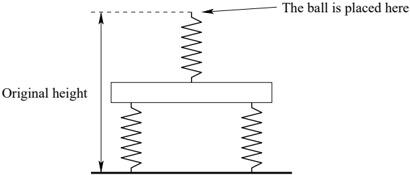
- A. 0.033 m
- B. 0.067 m
- C. 0.100 m
- D. 0.133 m
- E. 0.600 m
Topic: Newtonian Mechanics Metodi: Hooke’s Law Competenze: Physical Reasoning Objects: Spring, Ball Fonte: Testo (PDF) - p.6
Un sistema di molla è montato come segue: una piattaforma di peso di 10 N è posta sopra due molle, ciascuna con una costante molla di 75 N/m. In cima alla piattaforma si trova una terza sorgente con una costante sorgente di 75 N/m. Se una palla di peso di 5,0 N viene quindi fissata alla parte superiore della terza molla e poi abbassata lentamente, quanto cambia l’altezza del sistema di molla?
- A. 0.033 m
- B. 0.067 m
- C. 0.100 m
- D. 0.133 m
- E. 0.600 m
Topic: Newtonian Mechanics Metodi: Hooke’s Law Competenze: Physical Reasoning Objects: Spring, Ball Fonte: Testo (PDF) - p.6
The softest audible sound has an intensity of W/m. In terms of the fundamental units of kilograms, meters, and seconds, this is equivalent to
- A. kg/s
- B. kg/s
- C. kg m/s
- D. kg m/s
- E. kg/(ms)
Topic: Mathematics Metodi: Dimensional Analysis Competenze: Physical Reasoning, Unit Conversion Objects: - Fonte: Testo (PDF) - p.6
Il suono più tenero ha un’intensità W/m. In termini di unità fondamentali di chilogrammi, metri e secondi, questo è equivalente a
- A. kg/s
- B. kg/s
- C. kg m/s
- D. kg m/s
- E. kg/(ms)
Topic: Mathematics Metodi: Dimensional Analysis Competenze: Physical Reasoning, Unit Conversion Objects: - Fonte: Testo (PDF) - p.6
Which of the following sets of equipment cannot be used to measure the local value of the acceleration due to gravity ()?
- A. A spring scale (which reads in force units) and a known mass.
- B. A rod of known length, an unknown mass, and a stopwatch.
- C. An inclined plane of known inclination, several carts of different known masses, and a stopwatch.
- D. A launcher which launches projectiles at a known speed, a projectile of known mass, and a meter stick.
- E. A motor with a known output power, a known mass, a piece of string of unknown length, and a stopwatch.
Topic: Newtonian Mechanics Metodi: Dimensional Analysis, Physical Modeling Competenze: Physical Reasoning, Measurement & Instrumentation Objects: - Fonte: Testo (PDF) - p.7
Quale delle seguenti serie di apparecchiature non può essere utilizzata per misurare il valore locale dell’accelerazione a causa della gravità ()?
- A. Una scala di molla (che si legge in unità di forza) e una massa nota.
- B. Una barra di lunghezza nota, di massa sconosciuta e un orologio fermo.
- C. Un piano inclinato di inclinazione nota, diversi carri di diverse masse note e un orologio fermo.
- D. Un lanciatore che lancia proiettili a velocità nota, un proiettile di massa nota e un bastone di misura.
- E. Un motore con potenza di uscita nota, una massa nota, un pezzo di corda di lunghezza sconosciuta e un orologio fermo.
Topic: Newtonian Mechanics Metodi: Dimensional Analysis, Physical Modeling Competenze: Physical Reasoning, Measurement & Instrumentation Objects: - Fonte: Testo (PDF) - p.7
Three point masses are attached together by identical springs. When placed at rest on a horizontal surface the masses form a triangle with side length . When the assembly is rotated about its center at angular velocity , the masses form a triangle with side length . What is the spring constant of the springs?
- A.
- B.
- C.
- D.
- E.
Topic: Newtonian Mechanics Metodi: Hooke’s Law, Free-Body Diagram Competenze: Physical Reasoning Objects: Spring Fonte: Testo (PDF) - p.7
Le tre masse puntate sono collegate tra loro da sorgenti identiche. Quando posizionate in riposo su una superficie orizzontale, le masse formano un triangolo con lunghezza laterale . Quando l’assemblaggio è rotato intorno al suo centro a velocità angolare , le masse formano un triangolo con lunghezza laterale . Qual è la costante di primavera delle sorgenti?
- A.
- B.
- C.
- D.
- E.
Topic: Newtonian Mechanics Metodi: Hooke’s Law, Free-Body Diagram Competenze: Physical Reasoning Objects: Spring Fonte: Testo (PDF) - p.7
Consider the two orbits around the sun shown below. Orbit P is circular with radius , orbit Q is elliptical such that the farthest point is between and , and the nearest point is between and . Consider the magnitudes of the velocity of the circular orbit , the velocity of the comet in the elliptical orbit at the farthest point , and the velocity of the comet in the elliptical orbit at the nearest point . Which of the following rankings is correct?
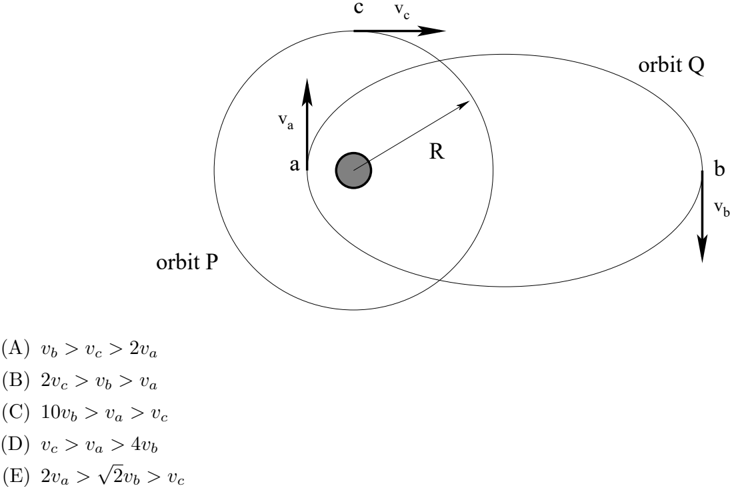
- A.
- B.
- C.
- D.
- E.
Topic: Gravitation Metodi: Kepler’s Laws, Conservation of Energy Competenze: Physical Reasoning Objects: Star, Satellite Fonte: Testo (PDF) - p.7
Considerate le due orbite intorno al Sole mostrate qui sotto. L’orbita P è circolare con raggio , l’orbita Q è ellittica in modo tale che il punto più lontano sia tra e , e il punto più vicino sia tra e . Considera le magnitudini della velocità dell’orbita circolare , la velocità della cometa nell’orbita ellittica al punto più lontano e la velocità della cometa nell’orbita ellittica al punto più vicino . Quale delle seguenti classifiche è corretta?
- A.
- B.
- C.
- D.
- E.
Topic: Gravitation Metodi: Kepler’s Laws, Conservation of Energy Competenze: Physical Reasoning Objects: Star, Satellite Fonte: Testo (PDF) - p.7