Question A1
A newly discovered subatomic particle, the meson, has a mass . When at rest, it lives for exactly seconds before decaying into two identical particles called mesons (peons?) that each have a mass of .
a. In a reference frame where the meson is at rest, determine
- i. the kinetic energy,
- ii. the momentum, and
- iii. the velocity
of each meson particle in terms of , , the speed of light , and any numerical constants.
b. In a reference frame where the meson travels 9 meters between creation and decay, determine
- i. the velocity and
- ii. kinetic energy of the meson.
Write the answers in terms of , the speed of light , and any numerical constants.
Topic: Special Relativity Metodi: Relativistic Energy-Momentum Metodi: Mass-Energy Equivalence Metodi: Lorentz Transformation Competenze: Physical Reasoning Competenze: Mathematical Modeling Objects: Particle Fonte: Testo (PDF) - p.3
La domanda A1
Una particella subatomica appena scoperta, il mesone , ha una massa . Quando è a riposo, vive esattamente secondi prima di decadere in due particelle identiche chiamate mesoni (pioni?) che hanno ognuna una massa di .
a. In un quadro di riferimento in cui il mesone è a riposo, determinare
- i. l’energia cinetica,
- ii. l’impulso; e
- III. la velocità
di ogni particella di mesone in termini di , , velocità di luce e di eventuali costanti numeriche.
b. In un quadro di riferimento in cui il mesone percorre 9 metri tra la creazione e il decadimento, determinare
- i. la velocità e
- ii. energia cinetica del mesone .
Scrivere le risposte in termini di , velocità della luce e qualsiasi costante numerica.
Topic: Special Relativity Metodi: Relativistic Energy-Momentum Metodi: Mass-Energy Equivalence Metodi: Lorentz Transformation Competenze: Physical Reasoning Competenze: Mathematical Modeling Objects: Particle Fonte: Testo (PDF) - p.3
Question A2
An ideal (but not necessarily perfect monatomic) gas undergoes the following cycle.
- The gas starts at pressure , volume and temperature .
- The gas is heated at constant volume to a pressure , where .
- The gas is then allowed to expand adiabatically (no heat is transferred to or from the gas) to pressure .
- The gas is cooled at constant pressure back to the original state.
The adiabatic constant is defined in terms of the specific heat at constant pressure and the specific heat at constant volume by the ratio .
a. Determine the efficiency of this cycle in terms of and the adiabatic constant . As a reminder, efficiency is defined as the ratio of work out divided by heat in.
b. A lab worker makes measurements of the temperature and pressure of the gas during the adiabatic process. The results, in terms of and are
| Pressure (units of ) | 1.21 | 1.41 | 1.59 | 1.73 | 2.14 |
|---|---|---|---|---|---|
| Temperature (units of ) | 2.11 | 2.21 | 2.28 | 2.34 | 2.49 |
Plot an appropriate graph from this data that can be used to determine the adiabatic constant.
c. What is for this gas?
Topic: Thermodynamics Metodi: Thermodynamic Cycle Analysis Metodi: First Law of Thermodynamics Metodi: Graph Linearization Competenze: Physical Reasoning Competenze: Graph Linearization Competenze: Experimental Data Analysis Objects: Gas Objects: Heat Engine Fonte: Testo (PDF) - p.3
Question A2
Un gas ideale (ma non necessariamente monatomo perfetto) subisce il ciclo seguente.
- Il gas inizia a pressione , volume e temperatura .
- Il gas viene riscaldato a volume costante a una pressione , dove .
- Il gas può poi espandersi adiabaticamente (non viene trasferito calore da o verso il gas) fino a una pressione .
- Il gas viene raffreddato a pressione costante, tornando allo stato originale.
La costante adiabatica è definita in termini di calore specifico a pressione costante e calore specifico a volume costante nel rapporto .
a. Determinare l’efficienza di questo ciclo in termini di e costante adiabatica . Per ricordare, l’efficienza è definita come il rapporto tra lavoro e calore.
b. Un lavoratore di laboratorio fa le misurazioni della temperatura e della pressione del gas durante il processo adiabatico. I risultati, in termini di e sono:
| Pressure (units of ) | 1.21 | 1.41 | 1.59 | 1.73 | 2.14 |
|---|---|---|---|---|---|
| Temperature (units of ) | 2.11 | 2.21 | 2.28 | 2.34 | 2.49 |
Tracciare un grafico appropriato da questi dati che può essere utilizzato per determinare la costante adiabatica.
c. Qual è per questo gas?
Topic: Thermodynamics Metodi: Thermodynamic Cycle Analysis Metodi: First Law of Thermodynamics Metodi: Graph Linearization Competenze: Physical Reasoning Competenze: Graph Linearization Competenze: Experimental Data Analysis Objects: Gas Objects: Heat Engine Fonte: Testo (PDF) - p.3
Question A3
This problem inspired by the 2008 Guangdong Province Physics Olympiad.
Two infinitely long concentric hollow cylinders have radii and . Both cylinders are insulators; the inner cylinder has a uniformly distributed charge per length of ; the outer cylinder has a uniformly distributed charge per length of .
An infinitely long dielectric cylinder with permittivity , where is the dielectric constant, has an inner radius and outer radius and is also concentric with the insulating cylinders. The dielectric cylinder is rotating about its axis with an angular velocity , where is the speed of light. Assume that the permeability of the dielectric cylinder and the space between the cylinders is that of free space, .
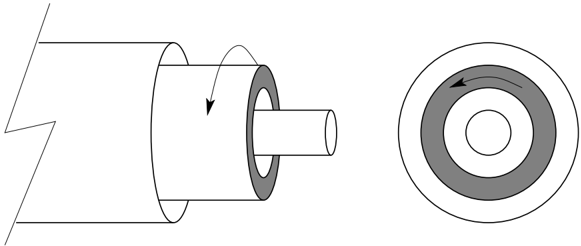
a. Determine the electric field for all regions.
b. Determine the magnetic field for all regions.
Topic: Electromagnetism Metodi: Gauss’s Law Metodi: Ampere’s Law Competenze: Physical Reasoning Competenze: Diagrammatic Reasoning Objects: Cylinder Fonte: Testo (PDF) - p.4
La domanda A3
Questo problema è stato ispirato dalla Olimpiada di Fisica della provincia del Guangdong del 2008.
Due cilindri vuoti concentrici infinitamente lunghi hanno i raggi e . Entrambi i cilindri sono isolanti; il cilindro interno ha una carica uniformemente distribuita per lunghezza ; il cilindro esterno ha una carica uniformemente distribuita per lunghezza .
Un cilindro dielettrico infinitamente lungo con la permissività , dove è la costante dielettrica, ha un raggio interno e un raggio esterno ed è anche concentrico con i cilindri isolanti. Il cilindro dielettrico ruota intorno al suo asse con una velocità angolare , dove è la velocità della luce. Supponiamo che la permeabilità del cilindro dielettrico e dello spazio tra i cilindri sia quella dello spazio libero, .
a. Determinare il campo elettrico per tutte le regioni.
b. Determinare il campo magnetico per tutte le regioni.
Topic: Electromagnetism Metodi: Gauss’s Law Metodi: Ampere’s Law Competenze: Physical Reasoning Competenze: Diagrammatic Reasoning Objects: Cylinder Fonte: Testo (PDF) - p.4
Question A4
Two masses separated by a distance are given initial velocities as shown in the diagram. The masses interact only through universal gravitation.
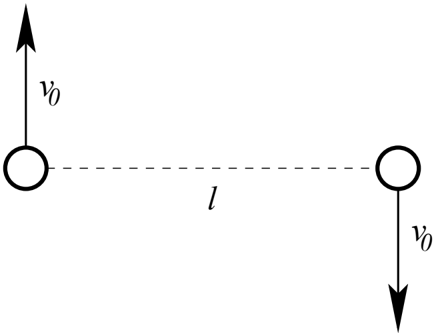
a. Under what conditions will the masses eventually collide?
b. Under what conditions will the masses follow circular orbits of diameter ?
c. Under what conditions will the masses follow closed orbits?
d. What is the minimum distance achieved between the masses along their path?
Topic: Gravitation Metodi: Newton’s Law of Gravitation Metodi: Conservation of Energy Metodi: Conservation of Momentum Competenze: Physical Reasoning Objects: - Fonte: Testo (PDF) - p.4
La domanda A4
Due masse separate da una distanza ricevono velocità iniziali come mostrato nel diagramma. Le masse interagiscono solo attraverso la gravita’ universale.
a. In quali condizioni le masse si colpiranno alla fine?
b. In quali condizioni le masse seguiranno orbite circolari di diametro ?
c. In quali condizioni le masse seguiranno orbite chiuse?
d. Qual è la distanza minima raggiunta tra le masse lungo il loro percorso?
Topic: Gravitation Metodi: Newton’s Law of Gravitation Metodi: Conservation of Energy Metodi: Conservation of Momentum Competenze: Physical Reasoning Objects: - Fonte: Testo (PDF) - p.4
Question B1
A particle of mass moves under a force similar to that of an ideal spring, except that the force repels the particle from the origin:
In simple harmonic motion, the position of the particle as a function of time can be written
Likewise, in the present case we have
for some appropriate functions and .
a. and can be chosen to have the form . What are the two appropriate values of ?
b. Suppose that the particle begins at position and with velocity . What is ?
c. A second, identical particle begins at position with velocity . The second particle becomes closer and closer to the first particle as time goes on. What is ?
Topic: Newtonian Mechanics Metodi: Differential Equations Metodi: Simple Harmonic Motion Analysis Competenze: Physical Reasoning Competenze: Mathematical Modeling Objects: Spring Objects: Particle Fonte: Testo (PDF) - p.6
La domanda B1
Una particella di massa si muove con una forza simile a quella di una molla ideale, tranne che la forza respinga la particella dall’origine:
In semplice movimento armonico, la posizione della particella come funzione del tempo può essere scritta
In questo caso, abbiamo
per alcune funzioni appropriate e .
a. e possono essere scelti per avere la formula . Quali sono i due valori appropriati di ?
b. Supponiamo che la particella inizia alla posizione e alla velocità . Che cos’è ?
c. Una seconda particella identica inizia alla posizione con velocità . La seconda particella si avvicina sempre di più alla prima con il passare del tempo. Che cos’è ?
Topic: Newtonian Mechanics Metodi: Differential Equations Metodi: Simple Harmonic Motion Analysis Competenze: Physical Reasoning Competenze: Mathematical Modeling Objects: Spring Objects: Particle Fonte: Testo (PDF) - p.6
Question B2
For this problem, assume the existence of a hypothetical particle known as a magnetic monopole. Such a particle would have a ‘magnetic charge’ , and in analogy to an electrically charged particle would produce a radially directed magnetic field of magnitude
and be subject to a force (in the absence of electric fields)
A magnetic monopole of mass and magnetic charge is constrained to move on a vertical, nonmagnetic, insulating, frictionless U-shaped track. At the bottom of the track is a wire loop whose radius is much smaller than the width of the ‘U’ of the track. The section of track near the loop can thus be approximated as a long straight line. The wire that makes up the loop has radius and resistivity . The monopole is released from rest a height above the bottom of the track.
Ignore the self-inductance of the loop, and assume that the monopole passes through the loop many times before coming to a rest.
a. Suppose the monopole is a distance from the center of the loop. What is the magnetic flux through the loop?
b. Suppose in addition that the monopole is traveling at a velocity . What is the emf in the loop?
c. Find the change in speed of the monopole on one trip through the loop.
d. How many times does the monopole pass through the loop before coming to a rest?
e. Alternate Approach: You may, instead, opt to find the above answers to within a dimensionless multiplicative constant (like or ). If you only do this approach, you will be able to earn up to 60% of the possible score for each part of this question.
You might want to make use of the integral
or the integral
Topic: Electromagnetic Induction Metodi: Faraday’s Law of Induction Metodi: Lenz’s Law Metodi: Calculus-Integration Competenze: Physical Reasoning Competenze: Mathematical Modeling Objects: Coil Objects: Wire Fonte: Testo (PDF) - p.7
La domanda B2
Per questo problema, supponiamo l’esistenza di una particella ipotetica nota come un monopolio magnetico. Una tale particella avrebbe una “carica magnetica” , e in analogia a una particella carica elettricamente produrrebbe un campo magnetico radialmente diretto di magnitudine
e sono soggetti a una forza (in assenza di campi elettrici)
Un monopole magnetico di massa e carica magnetica è costretto a muoversi su una pista verticale, non magnetica, isolante e senza attrito a forma di U. In fondo alla pista si trova un circuito di filo il cui raggio è molto inferiore alla larghezza della “U” della pista. La sezione di pista vicino al circuito può quindi essere approssimata come una lunga linea retta. Il filo che costituisce il circuito ha un raggio e una resistività . Il monopole viene rilasciato dal riposo ad un’altezza sopra la parte inferiore della pista.
Ignorare l’auto-induzione del ciclo, e supporre che il monopolio passa attraverso il ciclo molte volte prima di venire a un riposo.
a. Supponiamo che il monopolio sia una distanza dal centro del ciclo. Qual è il flusso magnetico attraverso il ciclo?
b. Supponiamo inoltre che il monopole stia viaggiando a una velocità . Qual è l’emf nel ciclo?
c. Trova la variazione della velocità del monopolio in un solo viaggio attraverso il ciclo.
d. Quante volte il monopolio passa attraverso il ciclo prima di riposare?
e. Approccio alternativo: invece, è possibile scegliere di trovare le risposte sopra indicate all’interno di una costante moltiplicativa senza dimensioni (come o ). Se si effettua solo questo approccio, si potrà ottenere fino al 60% del punteggio possibile per ciascuna parte di questa domanda.
Potrebbe essere meglio usare l’integrale
o l’integrale
Topic: Electromagnetic Induction Metodi: Faraday’s Law of Induction Metodi: Lenz’s Law Metodi: Calculus-Integration Competenze: Physical Reasoning Competenze: Mathematical Modeling Objects: Coil Objects: Wire Fonte: Testo (PDF) - p.7