Two planets X and Y travel counterclockwise in circular orbits around a star as shown in the figure below. The radii of their orbits are in the ratio 3 : 1. At some time, they are aligned as in Fig. 1, making a straight line with the star. After five Earth years, the angular displacement of planet X is , as in Fig. 2. What is the angular displacement of planet Y at this time?
- A.
- B.
- C.
- D.
- E.
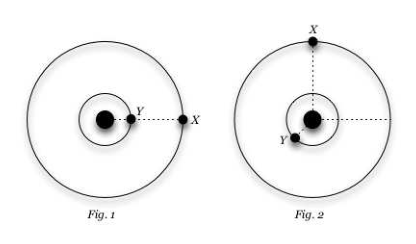 Two planets in circular orbits around star
Topic: Gravitation, Astrophysics Metodi: Kepler’s Laws, Kinematic Equations Competenze: Physical Reasoning, Mathematical Modeling Objects: Planet, Star Fonte: Testo (PDF) — p.2
Due pianeti X e Y viaggiano in senso contrario all’orologio in orbite circolari attorno a una stella come mostrato nella figura di seguito. I raggi delle loro orbite sono in rapporto 3: 1. A volte, sono allineati come in Figura. 1, facendo una linea retta con la stella. Dopo cinque anni terrestri, il spostamento angolare del pianeta X è , come in Figura. 2. Qual è il spostamento angolare del pianeta Y in questo momento?
- A.
- B.
- C.
- D.
- E.
Due pianeti in orbite circolari attorno alla stella
Topic: Gravitation, Astrophysics Metodi: Kepler’s Laws, Kinematic Equations Competenze: Physical Reasoning, Mathematical Modeling Objects: Planet, Star Fonte: Testo (PDF) — p.2
You are holding a bottle of sparkling water inside a car moving forward. When the driver applies the brakes:
- A. Bubbles in the middle of the liquid will start to move forward with respect to the bottle.
- B. Bubbles will start to move backward with respect the bottle.
- C. Bubbles will stay at the same horizontal location in the water.
- D. Depending on the speed of the car, bubbles might move forward or backward.
Topic: Fluid Mechanics, Newtonian Mechanics Metodi: Free-Body Diagram, Physical Modeling Competenze: Physical Reasoning, Diagrammatic Reasoning Objects: Bubble Fonte: Testo (PDF) — p.2
Tieni una bottiglia di acqua scintillante dentro una macchina che va avanti. Quando il conducente applique i freni:
- A. Le bolle nel mezzo del liquido inizieranno a muoversi in avanti rispetto alla bottiglia.
- B. Le bolle inizieranno a muoversi verso l’ indietro rispetto alla bottiglia.
- C. Le bolle rimangono nella stessa posizione orizzontale nell’acqua.
- D. A seconda della velocità dell’auto, le bolle possono muoversi in avanti o in indietro.
Topic: Fluid Mechanics, Newtonian Mechanics Metodi: Free-Body Diagram, Physical Modeling Competenze: Physical Reasoning, Diagrammatic Reasoning Objects: Bubble Fonte: Testo (PDF) — p.2
An Earth satellite revolves in a circular orbit at a height from the surface of the Earth. If is the Earth’s radius and is the acceleration due to gravity at the surface of the Earth, then the speed of the satellite is given by:
- A.
- B.
- C.
- D.
Topic: Gravitation, Newtonian Mechanics Metodi: Newton’s Law of Gravitation, Kinematic Equations Competenze: Physical Reasoning, Mathematical Modeling Objects: Satellite, Planet Fonte: Testo (PDF) — p.2
Un satellite terrestre ruota in orbita circolare ad un’altezza dalla superficie terrestre. Se è il raggio di radio della Terra e è l’accelerazione dovuta alla gravità sulla superficie della Terra, la velocità del satellite è data da:
- A.
- B.
- C.
- D.
Topic: Gravitation, Newtonian Mechanics Metodi: Newton’s Law of Gravitation, Kinematic Equations Competenze: Physical Reasoning, Mathematical Modeling Objects: Satellite, Planet Fonte: Testo (PDF) — p.2
Assume that sodium produces monochromatic light with a wavelength of . At what approximate rate would a 10 watt sodium-vapour light be emitting photons? Assume that the efficiency of the light bulb is about 30%.
- A. photons/sec.
- B. photons/sec.
- C. photons/sec.
- D. photons/sec.
Topic: Modern-Quantum Physics Metodi: Photon Energy Relation, Order-of-Magnitude Estimation Competenze: Physical Reasoning, Estimation & Approximation Objects: Photon Fonte: Testo (PDF) — p.2
Supponiamo che il sodio produca luce monocromatica con una lunghezza d’onda . A che velocità approssimativa emetterebbe una luce a vapore di sodio da 10 watt fotoni? Supponiamo che l’efficienza della lampadina sia del 30%.
- A. fotoni/sec.
- B. fotoni/sec.
- C. fotoni/sec.
- D. fotoni/sec.
Topic: Modern-Quantum Physics Metodi: Photon Energy Relation, Order-of-Magnitude Estimation Competenze: Physical Reasoning, Estimation & Approximation Objects: Photon Fonte: Testo (PDF) — p.2
Three batteries are placed in series. Each battery has an internal resistance . If one of the batteries is placed the wrong way around as shown in the picture, what will be the total resistance of the three cells now?
- A.
- B.
- C.
- D.
- E.
Topic: Circuits Metodi: Kirchhoff’s Laws, Equivalent Circuit Reduction Competenze: Physical Reasoning, Diagrammatic Reasoning Objects: Battery Fonte: Testo (PDF) — p.3
Tre batterie sono poste in serie. Ogni batteria ha una resistenza interna . Se una delle batterie viene posizionata in modo sbagliato, come mostrato in questa foto, quale sarà la resistenza totale delle tre celle?
- A.
- B.
- C.
- D.
- E.
Topic: Circuits Metodi: Kirchhoff’s Laws, Equivalent Circuit Reduction Competenze: Physical Reasoning, Diagrammatic Reasoning Objects: Battery Fonte: Testo (PDF) — p.3
At the designed intensity, the two beams circulating in the Large Hadron Collider (LHC) at CERN consist of 5616 bunches (2808 in each direction) of approximately protons per bunch. A small commercial hydrogen cylinder contains 40 L of gas at a pressure of 10 MPa and a temperature of C. Assuming an injection efficiency of 70%, how many times could the LHC be filled at the designed intensity using a single, perfectly hermetic cylinder?
- A.
- B.
- C.
- D.
- E.
Topic: Kinetic Theory, Order-of-Magnitude Estimation Metodi: Ideal Gas Law, Order-of-Magnitude Estimation Competenze: Estimation & Approximation, Mathematical Modeling Objects: Particle Beam, Gas, Container Fonte: Testo (PDF) — p.3
L’intensità progettata indica che i due raggi circolanti nel Grande Collider di Hadroni (LHC) del CERN sono costituiti da 5616 gruppi (2808 in ogni direzione) di protoni circa per gruppo. Un piccolo cilindro commerciale di idrogeno contiene 40 L di gas a una pressione di 10 MPa e a una temperatura di C. Supponendo un’efficienza di iniettazione del 70%, quante volte l’LHC potrebbe essere riempito all’intensità progettata utilizzando un singolo cilindro perfettamente ermetico?
- A.
- B.
- C.
- D.
- E.
Topic: Kinetic Theory, Order-of-Magnitude Estimation Metodi: Ideal Gas Law, Order-of-Magnitude Estimation Competenze: Estimation & Approximation, Mathematical Modeling Objects: Particle Beam, Gas, Container Fonte: Testo (PDF) — p.3
The Earth is constantly receiving energy from the Sun. To stay at approximately the same temperature, the Earth loses energy by:
- A. Conduction
- B. Radiation
- C. Convection
- D. Evaporation
- E. The Earth does not lose energy, this is why we have global warming.
Topic: Thermodynamics, Astrophysics Metodi: Physical Modeling Competenze: Physical Reasoning Objects: Planet, Star Fonte: Testo (PDF) — p.3
La Terra riceve costantemente energia dal Sole. Per rimanere a circa la stessa temperatura, la Terra perde energia:
- A. Conduczione
- B. Radiazione
- C. Convezione
- D. Evaporazione La Terra non perde energia, ecco perché il riscaldamento globale.
Topic: Thermodynamics, Astrophysics Metodi: Physical Modeling Competenze: Physical Reasoning Objects: Planet, Star Fonte: Testo (PDF) — p.3
A car starts to move at time . If the engine of the car is able to provide constant power, which of the following statements is correct about the speed of the car at the beginning of the motion?
- A. The speed is constant.
- B. The speed increases proportionally to time passed ().
- C. The speed increases as the square root of time ().
- D. The speed increases as time squared ().
Topic: Newtonian Mechanics Metodi: Kinematic Equations, Energy Conservation Method Competenze: Physical Reasoning, Mathematical Modeling Objects: — Fonte: Testo (PDF) — p.3
Una macchina inizia a muoversi in tempo . Se il motore della macchina è in grado di fornire una potenza costante, quale delle seguenti affermazioni è corretta sulla velocità della macchina all’inizio del movimento?
- A. La velocità è costante.
- B. La velocità aumenta proporzionalmente al tempo trascorso ().
- C. La velocità aumenta con la radice quadrata del tempo ().
- D. La velocità aumenta con il tempo al quadrato ().
Topic: Newtonian Mechanics Metodi: Kinematic Equations, Energy Conservation Method Competenze: Physical Reasoning, Mathematical Modeling Objects: — Fonte: Testo (PDF) — p.3
A detector far away from the source of a wave is detecting pulses of that wave every 0.2 second. If the detector starts to move towards the source at a speed of 6.0 km/h, then it would detect a total of 18200 pulses per hour. What is the speed of the wave?
- A. 100 m/s
- B. 150 m/s
- C. 200 m/s
- D. 300 m/s
Topic: Oscillations & Waves Metodi: Wave Equation, Kinematic Equations Competenze: Physical Reasoning, Mathematical Modeling Objects: — Fonte: Testo (PDF) — p.3
Un rilevatore lontano dalla fonte di un’onda sta rilevando i pulsi di quell’onda ogni 0,2 secondi. Se il rilevatore inizia a muoversi verso la fonte a una velocità di 6,0 km/h, allora rileverebbe un totale di 18200 impulsi all’ora. Qual è la velocità dell’onda?
- A. 100 m/s
- B. 150 m/s
- C. 200 m/s
- D. 300 m/s
Topic: Oscillations & Waves Metodi: Wave Equation, Kinematic Equations Competenze: Physical Reasoning, Mathematical Modeling Objects: — Fonte: Testo (PDF) — p.3
There are three different liquids, with densities , and , in a U-shaped container as shown in the picture. The lengths shown are and . Which of the following equations gives the correct relation between the densities of the fluids in the container?
- A.
- B.
- C.
- D.
Topic: Fluid Mechanics Metodi: Hydrostatic Equilibrium Competenze: Physical Reasoning, Mathematical Modeling Objects: Container Fonte: Testo (PDF) — p.3
Sono presenti tre liquidi diversi, con densità , e , in un contenitore a forma di U come mostrato nella figura. Le lunghezze indicate sono e . Quale delle seguenti equazioni dà la corretta relazione tra le densità dei fluidi nel contenitore?
- A.
- B.
- C.
- D.
Topic: Fluid Mechanics Metodi: Hydrostatic Equilibrium Competenze: Physical Reasoning, Mathematical Modeling Objects: Container Fonte: Testo (PDF) — p.3
The intensity of light from a source decreases with the distance from the source, as . In the following picture, the intensity of light from the source S at point A on a curtain is where is some unit. We then add a big mirror parallel to the curtain at point B. The distances AS and SB are equal, and the points A, S and B are in line perpendicular to the curtain and the mirror. What is the intensity of light reaching point A now?
- A.
- B.
- C.
- D.
Topic: Geometric Optics, Wave Optics Metodi: Superposition Principle, Ray Tracing Competenze: Physical Reasoning, Mathematical Modeling Objects: Mirror, Screen Fonte: Testo (PDF) — p.3
L’intensità della luce proveniente da una fonte diminuisce con la distanza dalla fonte, come . Nella figura seguente, l’intensità della luce della fonte S al punto A su una tenda è , mentre è una certa unità. Poi aggiungiamo un grande specchio parallelo alla tenda al punto B. Le distanze AS e SB sono uguali e i punti A, S e B sono in linea perpendicolare alla tenda e allo specchio. Qual è l’intensità della luce che raggiunge il punto A?
- A.
- B.
- C.
- D.
Topic: Geometric Optics, Wave Optics Metodi: Superposition Principle, Ray Tracing Competenze: Physical Reasoning, Mathematical Modeling Objects: Mirror, Screen Fonte: Testo (PDF) — p.3
Which of the following is the correct free-body diagram for a cylinder floating in water?
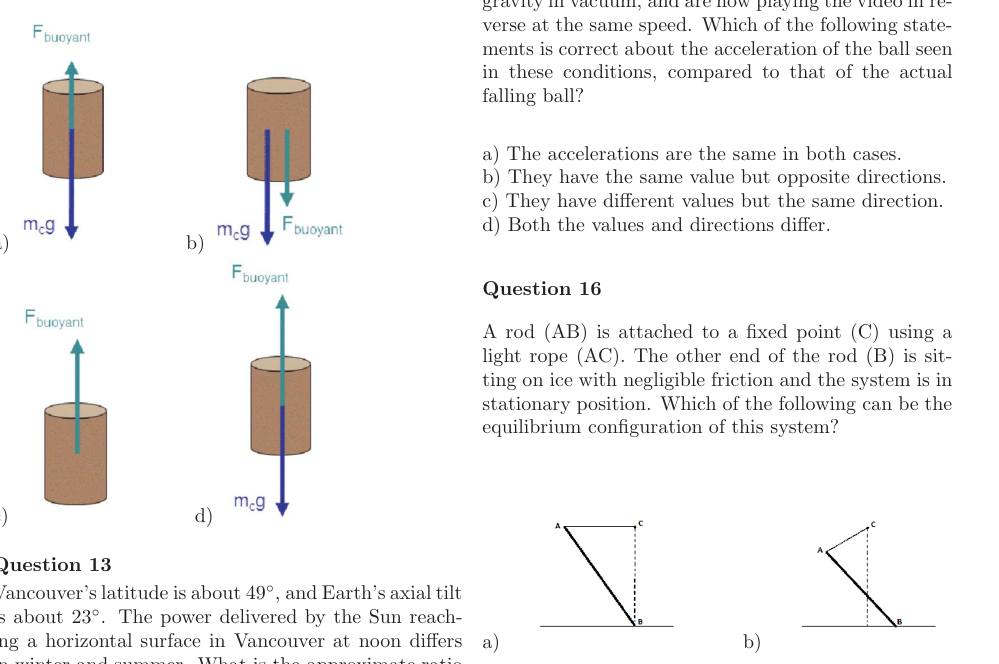 Four free-body diagrams for floating cylinder
Topic: Fluid Mechanics, Newtonian Mechanics Metodi: Free-Body Diagram, Hydrostatic Equilibrium Competenze: Diagrammatic Reasoning, Physical Reasoning Objects: Cylinder Fonte: Testo (PDF) — p.4
Quale di queste è il corretto diagramma di corpo libero per un cilindro galleggiante in acqua?
Quattro diagrammi di corpo libero per cilindro galleggiante
Topic: Fluid Mechanics, Newtonian Mechanics Metodi: Free-Body Diagram, Hydrostatic Equilibrium Competenze: Diagrammatic Reasoning, Physical Reasoning Objects: Cylinder Fonte: Testo (PDF) — p.4
Vancouver’s latitude is about , and Earth’s axial tilt is about . The power delivered by the Sun reaching a horizontal surface in Vancouver at noon differs in winter and summer. What is the approximate ratio of this quantity measured in winter, compared to that measured in summer?
- A.
- B.
- C.
- D.
Topic: Astrophysics, Order-of-Magnitude Estimation Metodi: Order-of-Magnitude Estimation, Vector Decomposition Competenze: Estimation & Approximation, Physical Reasoning Objects: Planet, Star Fonte: Testo (PDF) — p.4
La latitudine di Vancouver è di circa , e l’inclinazione asiale della Terra è di circa . L’energia fornita dal Sole che raggiunge una superficie orizzontale a Vancouver a mezzogiorno differisce in inverno e in estate. Qual è il rapporto approssimativo di questa quantità misurata in inverno rispetto a quella misurata in estate?
- A.
- B.
- C.
- D.
Topic: Astrophysics, Order-of-Magnitude Estimation Metodi: Order-of-Magnitude Estimation, Vector Decomposition Competenze: Estimation & Approximation, Physical Reasoning Objects: Planet, Star Fonte: Testo (PDF) — p.4
Consider a metal rod firmly attached to a wall. When you strike the rod with a hammer, which kind of wave will you excite?
- A. A longitudinal wave.
- B. A transverse wave.
- C. Either kind, or both, depending on where and how you hit the rod.
- D. No wave will be excited, the metal is too strong.
Topic: Oscillations & Waves, Elasticity & Materials Metodi: Physical Modeling, Wave Equation Competenze: Physical Reasoning Objects: Rod Fonte: Testo (PDF) — p.4
Considerate un bastone di metallo saldamente attaccato a un muro. Quando colpisci la canna con un martello, che tipo di onda ecciterai?
- A. Un’onda longitudinale.
- B. Un’onda trasversale.
- C. Entrambi i tipi, o entrambi, a seconda di dove e come si colpisce la canna. Nessuna onda sarà eccitata, il metallo è troppo forte.
Topic: Oscillations & Waves, Elasticity & Materials Metodi: Physical Modeling, Wave Equation Competenze: Physical Reasoning Objects: Rod Fonte: Testo (PDF) — p.4
Assume that you videotaped the fall of a ball due to gravity in vacuum, and are now playing the video in reverse at the same speed. Which of the following statements is correct about the acceleration of the ball seen in these conditions, compared to that of the actual falling ball?
- A. The accelerations are the same in both cases.
- B. They have the same value but opposite directions.
- C. They have different values but the same direction.
- D. Both the values and directions differ.
Topic: Newtonian Mechanics Metodi: Kinematic Equations, Physical Modeling Competenze: Physical Reasoning, Diagrammatic Reasoning Objects: Ball Fonte: Testo (PDF) — p.4
Supponiamo che tu abbia filmato la caduta di una palla a causa della gravità nel vuoto, e che ora stia riproducendo il video in senso inverso alla stessa velocità. Quale delle seguenti affermazioni è corretta sull’accelerazione della palla osservata in queste condizioni, rispetto a quella della palla che cade?
- A. Le accelerazioni sono le stesse in entrambi i casi.
- B. Hanno lo stesso valore ma direzioni opposte.
- C. Hanno valori diversi ma la stessa direzione.
- D. Sia i valori che le direzioni differiscono.
Topic: Newtonian Mechanics Metodi: Kinematic Equations, Physical Modeling Competenze: Physical Reasoning, Diagrammatic Reasoning Objects: Ball Fonte: Testo (PDF) — p.4
A rod (AB) is attached to a fixed point (C) using a light rope (AC). The other end of the rod (B) is sitting on ice with negligible friction and the system is in stationary position. Which of the following can be the equilibrium configuration of this system?
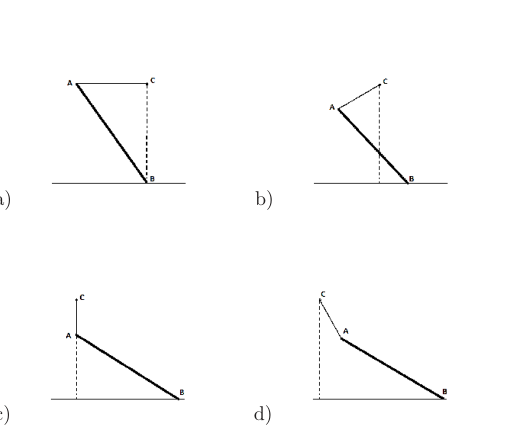 Four equilibrium configurations of rod-rope system
Topic: Rigid Body Statics, Newtonian Mechanics Metodi: Free-Body Diagram, Torque & Angular Momentum Analysis Competenze: Diagrammatic Reasoning, Physical Reasoning Objects: Rod, String Fonte: Testo (PDF) — p.4
Un bastone (AB) è attaccato a un punto fisso (C) utilizzando una corda leggera (AC). L’altra estremità della canna (B) è seduta sul ghiaccio con un attrito trascurabile e il sistema è in posizione fermata. Quale delle seguenti può essere la configurazione di equilibrio di questo sistema?
Quattro configurazioni di equilibrio del sistema di corda-gamma
Topic: Rigid Body Statics, Newtonian Mechanics Metodi: Free-Body Diagram, Torque & Angular Momentum Analysis Competenze: Diagrammatic Reasoning, Physical Reasoning Objects: Rod, String Fonte: Testo (PDF) — p.4
Which of the following is the closest to the total mass of the atmosphere around the Earth?
- A.
- B.
- C.
- D.
Topic: Order-of-Magnitude Estimation, Fluid Mechanics Metodi: Order-of-Magnitude Estimation, Hydrostatic Equilibrium Competenze: Estimation & Approximation, Physical Reasoning Objects: Planet, Gas Fonte: Testo (PDF) — p.4
Quale delle seguenti è il più vicino alla massa totale dell’atmosfera attorno alla Terra?
- A.
- B.
- C.
- D.
Topic: Order-of-Magnitude Estimation, Fluid Mechanics Metodi: Order-of-Magnitude Estimation, Hydrostatic Equilibrium Competenze: Estimation & Approximation, Physical Reasoning Objects: Planet, Gas Fonte: Testo (PDF) — p.4
At shallow depth, , the pressure in the ocean is simply given by , in which is the density of water and is the air pressure. As we go deeper, the high pressure causes the water to compress and become denser. Which of the following sketches illustrates the correct dependence of the pressure on the depth ?
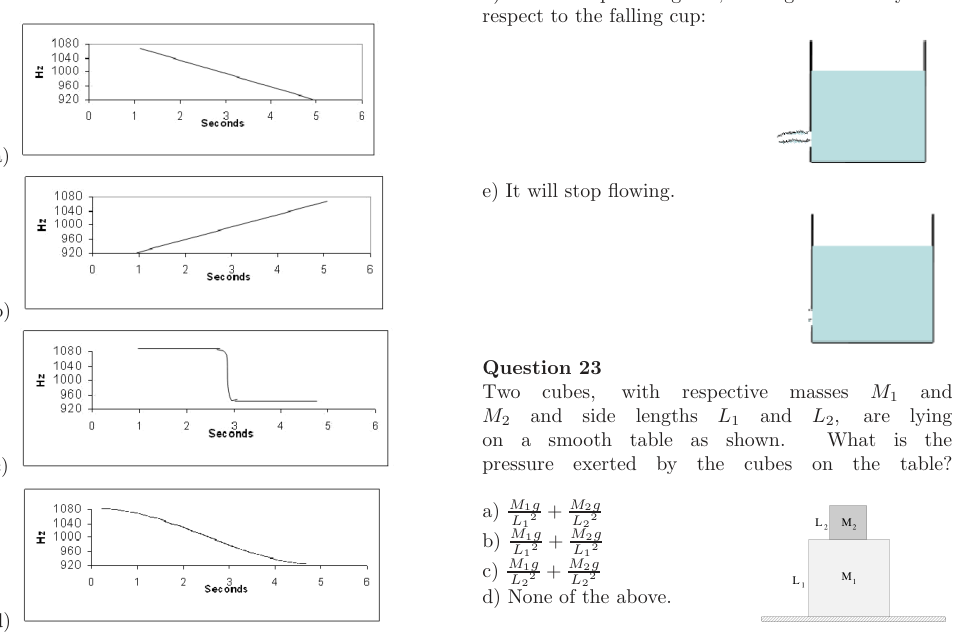 Four pressure vs depth graphs for ocean
Topic: Fluid Mechanics, Thermodynamics Metodi: Hydrostatic Equilibrium, Differential Equations Competenze: Physical Reasoning, Diagrammatic Reasoning Objects: — Fonte: Testo (PDF) — p.4
A bassa profondità, , la pressione nell’oceano viene semplicemente data da , in cui è la densità dell’acqua e è la pressione dell’aria. Quando ci avviciniamo, l’alta pressione fa comprimere l’acqua e la rende più densa. Quale dei seguenti schizzi illustra la corretta dipendenza della pressione sulla profondità ?
Quattro grafici di pressione vs profondità per l’oceano
Topic: Fluid Mechanics, Thermodynamics Metodi: Hydrostatic Equilibrium, Differential Equations Competenze: Physical Reasoning, Diagrammatic Reasoning Objects: — Fonte: Testo (PDF) — p.4
An aluminium plate and a glass plate are left in a room for a long time. Putting one ice cube on each plate, you notice that the ice melts faster on the aluminium plate. Why?
- A. The ice is in thermal equilibrium with the glass plate, but not with the aluminium plate.
- B. Aluminium conducts heat to the ice more rapidly than glass.
- C. The aluminium plate holds more heat.
- D. The aluminium plate is warmer.
Topic: Thermodynamics Metodi: First Law of Thermodynamics, Physical Modeling Competenze: Physical Reasoning Objects: — Fonte: Testo (PDF) — p.5
Una piastra in alluminio e una piastra in vetro vengono lasciate in una stanza per molto tempo. Mettendo un cubo di ghiaccio su ogni piastra, si nota che il ghiaccio si scioglie più velocemente sulla piastra di alluminio. - Perché? - Perché?
- A. Il ghiaccio è in equilibrio termico con la piastra di vetro, ma non con la piastra di alluminio.
- B. L’alluminio conduce il calore al ghiaccio più rapidamente del vetro.
- C. La piastra di alluminio contiene più calore.
- D. La piastra in alluminio è più calda.
Topic: Thermodynamics Metodi: First Law of Thermodynamics, Physical Modeling Competenze: Physical Reasoning Objects: — Fonte: Testo (PDF) — p.5
You are on the side of the highway, listening to the siren of a fast-approaching ambulance. When the ambulance is not moving the frequency of its siren is 1000 Hz. Which of the following graphs best describes the frequency that you hear as the ambulance approaches and then passes you?
Topic: Oscillations & Waves Metodi: Wave Equation, Physical Modeling Competenze: Physical Reasoning, Diagrammatic Reasoning Objects: — Fonte: Testo (PDF) — p.5
Sei sul lato dell’autostrada, ascoltando la sirena di un’ambulanza che si avvicina velocemente. Quando l’ambulanza non si muove, la frequenza della sirena è di 1000 Hz. Quale dei seguenti grafici descrive meglio la frequenza che senti quando l’ambulanza si avvicina e poi ti passa?
Topic: Oscillations & Waves Metodi: Wave Equation, Physical Modeling Competenze: Physical Reasoning, Diagrammatic Reasoning Objects: — Fonte: Testo (PDF) — p.5
Which of the following radiation types has the longest wavelength?
- A. Radio waves
- B. Visible light
- C. X rays
- D. Infrared light
- E. They all have the same wavelength
Topic: Oscillations & Waves, Electromagnetism Metodi: Physical Modeling Competenze: Physical Reasoning Objects: — Fonte: Testo (PDF) — p.5
Quale dei seguenti tipi di radiazioni ha la lunghezza d’onda più lunga?
- A. onde radio
- B. Luce visibile
- C. raggi X
- D. Luce infrarossa
- E. Tutti hanno la stessa lunghezza d’onda
Topic: Oscillations & Waves, Electromagnetism Metodi: Physical Modeling Competenze: Physical Reasoning Objects: — Fonte: Testo (PDF) — p.5
A cup filled with water has a hole in the side, through which the liquid is flowing out. If the cup is dropped from a height, what will happen to the water flowing from the cup?
- A. It will keep coming out, flowing at the same rate as before.
- B. It will keep coming out, but it will flow a bit slower than before.
- C. It will keep coming out, but start to flow upwards relative to the cup.
- D. It will keep coming out, flowing horizontally with respect to the falling cup.
- E. It will stop flowing.
Topic: Fluid Mechanics, Newtonian Mechanics Metodi: Free-Body Diagram, Bernoulli’s Equation Competenze: Physical Reasoning, Diagrammatic Reasoning Objects: Container Fonte: Testo (PDF) — p.5
Una tazza piena di acqua ha un buco al lato, attraverso il quale il liquido scorre. Se la coppa viene abbassata da un’altezza, cosa accadrà all’acqua che scorre dalla coppa?
- A. Continuerà a uscire, fluendo allo stesso ritmo di prima.
- B. Continuerà a uscire, ma fluirà un po’ più lentamente di prima.
- C. Continuerà a uscire, ma inizierà a scorrere verso l’alto rispetto alla tazza.
- D. Continuerà a uscire, fluendo orizzontalmente rispetto alla tazza cadente.
- E. Si fermerà il flusso.
Topic: Fluid Mechanics, Newtonian Mechanics Metodi: Free-Body Diagram, Bernoulli’s Equation Competenze: Physical Reasoning, Diagrammatic Reasoning Objects: Container Fonte: Testo (PDF) — p.5
Two cubes, with respective masses and and side lengths and , are lying on a smooth table as shown. What is the pressure exerted by the cubes on the table?
- A.
- B.
- C.
- D. None of the above.
 Two cubes of different sizes on table
Topic: Newtonian Mechanics, Rigid Body Statics Metodi: Free-Body Diagram, Physical Modeling Competenze: Physical Reasoning, Mathematical Modeling Objects: Block Fonte: Testo (PDF) — p.5
Due cubetti, rispettivamente di massa e e lunghezze laterali e , si trovano su una tavola liscia come mostrato. Qual è la pressione esercitata dai cubi sul tavolo?
- A.
- B.
- C.
- D. Nessuna delle seguenti.
Due cubetti di dimensioni diverse sul tavolo
Topic: Newtonian Mechanics, Rigid Body Statics Metodi: Free-Body Diagram, Physical Modeling Competenze: Physical Reasoning, Mathematical Modeling Objects: Block Fonte: Testo (PDF) — p.5
Consider an object that floats in water but sinks in oil. When the object floats in water, half of it is submerged. If we slowly pour oil on top of the water so it completely covers the object, the object:
- A. moves up
- B. stays in the same place
- C. moves down
Topic: Fluid Mechanics Metodi: Hydrostatic Equilibrium, Physical Modeling Competenze: Physical Reasoning Objects: — Fonte: Testo (PDF) — p.6
Considerate un oggetto che galleggia in acqua ma affonda nell’olio. Quando l’oggetto galleggia nell’acqua, la metà è sommersa. Se versamo lentamente olio sulla superficie dell’acqua, così che copra completamente l’oggetto, l’oggetto:
- A. si muove in su
- B. rimane nello stesso luogo
- C. si sposta verso il basso
Topic: Fluid Mechanics Metodi: Hydrostatic Equilibrium, Physical Modeling Competenze: Physical Reasoning Objects: — Fonte: Testo (PDF) — p.6
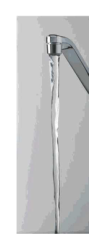
The pressure in a stream of water flowing out of a faucet is:
- A. largest at the bottom
- B. largest near the faucet
- C. the same everywhere in the stream
Topic: Fluid Mechanics Metodi: Bernoulli’s Equation, Hydrostatic Equilibrium Competenze: Physical Reasoning Objects: Tube Fonte: Testo (PDF) — p.6
La pressione in un flusso d’acqua che esce dal rubinetto è:
- A. più grande in fondo
- B. più grande vicino al rubinetto
- C. uguale ovunque nel flusso
Topic: Fluid Mechanics Metodi: Bernoulli’s Equation, Hydrostatic Equilibrium Competenze: Physical Reasoning Objects: Tube Fonte: Testo (PDF) — p.6
Problem 1 (10 points)
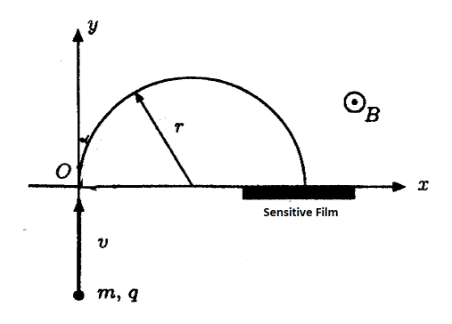
Mass spectrometry is a way of measuring the mass-to-charge ratio of charged particles as well as distinguishing different components of a beam of particles. As an example of such an experiment, consider ions of two isotopes of Potassium, and , with positive charge entering as a beam of particles into a region with magnetic field in the direction, as shown in the picture. The beam is injected at point O. Due to the magnetic field, all the ions travel in a circle with radius given by , in which is the velocity of ions, is the mass of ions and is the charge. After these two types of ions travel through the magnetic field, they reach a sensitive film and record bright spots on it as shown in the picture.
Consider the distance from point O to the bright spot produced by ion to be , and the distance to the spot recorded by ion to be . We use for the average of and .
(a) Assuming that the energy of both isotopes is the same, compute the ratio .
(b) Since these ions have different masses, one can distinguish them by observing the two bright spots on the film. However, some experimental uncertainties can complicate the situation. For example, tuning the energy of the beam to a specific value is impossible. If the energy of particles in the beam varies from to , is it possible to distinguish these two types of ions?
(c) Furthermore, adjusting the ions to enter exactly in the direction, as shown in the picture, is also impossible. Assuming that the beam enters at a small angle from the direction, compute as a function of .
(d) Now assume that the particles in the incident beam can have any angle between and from the direction, due to the uncertainty in the angle. Is it possible to distinguish the two types of ions in this case?
 Mass spectrometer setup with magnetic field
Topic: Magnetism, Modern-Quantum Physics Metodi: Lorentz Force Analysis, Approximation & Series Expansion Competenze: Mathematical Modeling, Physical Reasoning Objects: Particle Beam, Nucleus Fonte: Testo (PDF) — p.6
Problema 1 (10 punti)
La spettrometria di massa è un modo di misurare il rapporto massa-carica delle particelle cariche e di distinguere i diversi componenti di un fascio di particelle. Come esempio di tale esperimento, consideriamo gli ioni di due isotopi di potassio, e , con carica positiva che entrano come fascio di particelle in una regione con campo magnetico nella direzione , come mostrato nella figura. Il raggio viene iniettato al punto O. A causa del campo magnetico, tutti gli ioni viaggiano in un cerchio con raggio dato da , in cui è la velocità degli ioni, è la massa degli ioni e è la carica. Dopo che questi due tipi di ioni attraversano il campo magnetico, raggiungono un film sensibile e registrano punti brillanti su di esso come mostrato nell’immagine.
Considera che la distanza dal punto O al punto luminoso prodotto dall’ion sia e la distanza dal punto registrato dall’ion sia . Utilizziamo per la media di e .
a) Supponendo che l’energia di entrambi gli isotopi sia la stessa, calcolare il rapporto .
(b) Poiché questi ioni hanno masse diverse, si possono distinguerli osservando le due macchie luminose del film. Tuttavia, alcune incertezze sperimentali possono complicare la situazione. Per esempio, è impossibile regolare l’energia del fascio ad un valore specifico. Se l’energia delle particelle del fascio varia da a , è possibile distinguere questi due tipi di ioni?
(c) Inoltre, è impossibile regolare gli ioni in modo da entrare esattamente nella direzione , come mostrato nell’immagine. Supponendo che il fascio entri a un angolo piccolo dalla direzione , calcolare come funzione di .
(d) Ora supponiamo che le particelle del fascio incidente possano avere qualsiasi angolo tra e dalla direzione , a causa dell’incertezza nell’angolo. È possibile distinguere i due tipi di ioni in questo caso?
Configurazione dello spettrometro di massa con campo magnetico
Topic: Magnetism, Modern-Quantum Physics Metodi: Lorentz Force Analysis, Approximation & Series Expansion Competenze: Mathematical Modeling, Physical Reasoning Objects: Particle Beam, Nucleus Fonte: Testo (PDF) — p.6
Problem 2 (10 points)
Andrzej’s electric bike is equipped with a motor built into the front wheel hub. The stator of the electric motor (stationary part with the coils) is fixed solidly to the axle and the magnets are attached to the wheel. He made the following measurements on the bike:
- If he runs it on a horizontal road at 20 km/h and then switches the motor off, it takes the bike 50 m to stop.
- At full power, it can accelerate up a slope from 5 to 20 km/h in 6 seconds.
- The total mass of the bike plus the rider, is 106 kg.
- The diameter of the wheels is 66 cm.
- The diameter of the front wheel axle is 11 mm.
- The bike uses a 48 V battery with a capacity of 8 Ah (ampere-hour).
- The motor is 85% efficient.
Find out:
(a) What is the current flowing through the motor when the bike is driven at 20 km/h on a horizontal road without pedaling?
(b) How far can it go on one battery charge at 20 km/h?
(c) What is the net torque acting on the front axle?
(d) What is the current flowing through the motor when the bike is accelerating up a slope from 0 to 20 km/h in 20 seconds?
(e) What is the full mechanical power of this motor?
(f) What is the maximum slope one can bike up at constant speed using the motor only (not pedaling)?
(g) What is the current flowing through the motor at maximum power?
(h) What was the most important simplifying assumption that you had to make in order to solve this problem?
Topic: Newtonian Mechanics, Circuits Metodi: Kinematic Equations, Energy Conservation Method, Torque & Angular Momentum Analysis Competenze: Mathematical Modeling, Physical Reasoning Objects: Wheel, Battery, Coil, Magnet Fonte: Testo (PDF) — p.6
Il problema 2 (10 punti)
La moto elettrica di Andrzej è dotata di un motore integrato nel centro della ruota anteriore. Il statore del motore elettrico (parte stazionaria con bobine) è fissato saldamente all’asse e i magneti sono attaccati alla ruota. Ha fatto le seguenti misure sulla moto:
- Se la guida su una strada orizzontale a 20 km/h e poi spegne il motore, la moto deve fermarsi 50 metri.
- A piena potenza può accelerare fino ad una pendenza da 5 a 20 km/h in 6 secondi.
- La massa totale della moto più il pilota è di 106 kg.
- Il diametro delle ruote è di 66 cm.
- Il diametro dell’asse della ruota anteriore è di 11 mm.
- La moto utilizza una batteria da 48 V con una capacità di 8 Ah (ampere-ora).
- Il motore è efficace all’85%.
Scopri:
a) Qual è la corrente che attraversa il motore quando la moto è guidata a 20 km/h su una strada orizzontale senza pedali?
b) Quanto può andare con una batteria a 20 km/h?
c) Qual è la coppia netta che agisce sull’asse anteriore?
d) Qual è la corrente che scorre attraverso il motore quando la moto accelera a una pendenza da 0 a 20 km/h in 20 secondi?
e) Qual è la potenza meccanica completa di questo motore?
f) Qual è la pendenza massima che si può percorrere a velocità costante solo con il motore (non pedalando)?
g) Qual è la corrente che scorre attraverso il motore a potenza massima?
h) Qual è stata la più importante ipotesi semplificatrice che doveste fare per risolvere questo problema?
Topic: Newtonian Mechanics, Circuits Metodi: Kinematic Equations, Energy Conservation Method, Torque & Angular Momentum Analysis Competenze: Mathematical Modeling, Physical Reasoning Objects: Wheel, Battery, Coil, Magnet Fonte: Testo (PDF) — p.6
Problem 3A (5 points)
A Russian nuclear icebreaker named 50 Let Pobedy has a length of 160 m, a width of 30 m and two nuclear reactors, each delivering about 30 MW of power. It can clear a path 35 m wide in 2 m thick ice (at C) at a speed of 5 knots (2.5 m/s). Somebody suggested that instead of breaking the ice, one should melt it with a gigantic heater mounted at the front of the ship.
(a) For this to work, what power should this heater have, in order to achieve the same performance as the icebreaker?
(b) Explain in one sentence whether such a heater would work or not on this icebreaker.
Topic: Thermodynamics, Order-of-Magnitude Estimation Metodi: First Law of Thermodynamics, Order-of-Magnitude Estimation Competenze: Estimation & Approximation, Mathematical Modeling Objects: — Fonte: Testo (PDF) — p.7
Problema 3A (5 punti)
Un rompicoglielo nucleare russo denominato 50 Let Pobedy ha una lunghezza di 160 m, una larghezza di 30 m e due reattori nucleari, ciascuno di cui fornisce circa 30 MW di potenza. Può scaricare un percorso largo 35 m in ghiaccio speso di 2 m (a C) a una velocità di 5 nodi (2,5 m/s). Qualcuno suggerì che invece di spezzare il ghiaccio, si dovrebbe sciogliere con un gigantesco riscaldatore montato sulla parte anteriore della nave.
(a) Per poter funzionare, quale potenza dovrebbe avere questo riscaldatore, per ottenere le stesse prestazioni del rompiglio?
b) Spiegare in una frase se un tale riscaldatore funzionerebbe o meno su questo rompicoglielo.
Topic: Thermodynamics, Order-of-Magnitude Estimation Metodi: First Law of Thermodynamics, Order-of-Magnitude Estimation Competenze: Estimation & Approximation, Mathematical Modeling Objects: — Fonte: Testo (PDF) — p.7
Problem 3B (5 points)
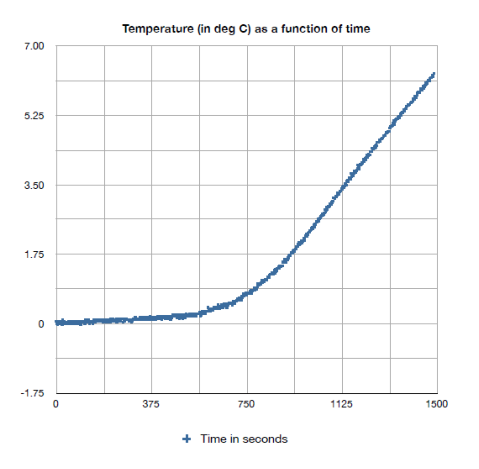
You are given a graph of temperature as a function of time of a container with a mixture of ice and water slowly heated at constant rate. When all the ice melts, there is 850 mL of water in the container. In the following questions, neglect the evaporation of water.
(a) At which rate is the container heated?
(b) How much ice was initially present?
 Temperature vs time graph for ice-water mixture
Topic: Thermodynamics Metodi: First Law of Thermodynamics, Experimental Data Analysis Competenze: Experimental Data Analysis, Graph Linearization Objects: Container Fonte: Testo (PDF) — p.7
Problema 3B (5 punti)
Vi viene dato un grafico della temperatura in funzione del tempo di un contenitore con una miscela di ghiaccio e acqua che si riscaldano lentamente a velocità costante. Quando tutto il ghiaccio si scioglie, c’è 850 ml di acqua nel contenitore. Nelle seguenti domande, trascurare l’evaporazione dell’acqua.
a) A che velocità si riscaldano i contenitori?
b) Quanto ghiaccio era presente all’inizio?
Grafico temperale contro tempo per la miscela di acqua ghiacciata
Topic: Thermodynamics Metodi: First Law of Thermodynamics, Experimental Data Analysis Competenze: Experimental Data Analysis, Graph Linearization Objects: Container Fonte: Testo (PDF) — p.7