Q1
In this question you are asked to make reasoned estimates, assumptions and explanations. These must be clearly stated.
(a)
(i) The planet Venus orbits the Sun and is nearer the Sun than the Earth is. Viewed through weak binoculars Venus can often seem to be crescent shaped. Its size and shape appear to change some time later. Why is this?
(ii) The planet Venus does not appear to change in this way viewed by the naked eye. However, its brightness does vary throughout its orbit. How and why?
(iii) It was realised in the 18th century that if two telescopes on different parts of the Earth measured the position of Venus at the same time, the distance of the Earth to Venus could be determined and hence the scale of the Solar System. The radius of the Earth was quite well known. With the backing of the Royal Society, Captain Cooke performed the experiment when an eclipse of the Sun by Venus occurred (appearing as a black dot crossing the surface of the Sun). Why did he need the eclipse of the Sun? Why did he go to the South Pacific? Explain.
(iv) A long hose is connected to a tap. If the end of the hose is partially covered by a thumb, the water seems to squirt out much faster. Explain.
(v) Alpha radiation is observed and photographed digitally in a cloud chamber. The density of the track, (‘light’ pixels/per unit length ), is plotted against distance from the source (). Explain the shape of the graph in Figure 1.1.
(b)
A beam of electrons is accelerated through a p.d. of 100 V in a high vacuum tube, Figure 1.2. There is no external magnetic field. The beam current is . The diameter of the cross section of the circular beam is . Assume the electrons are constant density per unit area across the beam. Calculate:
(i) The maximum velocity of the electrons.
(ii) The velocity of electrons after they have travelled half the distance in the accelerating field.
(iii) The magnetic field a distance of from the centre of the beam.
(iv) What happens if the accelerating p.d. is increased to ?
(c)
(i) Figure 1.3 shows an active four terminal device (it has internal power supplies). is very small and the output behaves as if it is of p.d. and internal resistance , where is a constant. Draw a very simple circuit that will behave in this way.
(ii) Show that if the resistance is large compared to the resistance of the subsequent resistors in a complete circuit then the current will be constant and the device will act as a constant current source. What is the condition for a constant voltage source? Suggest a circuit for a constant voltage source.
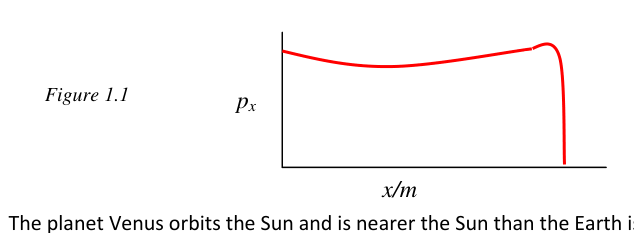 grafico densità pixel vs distanza
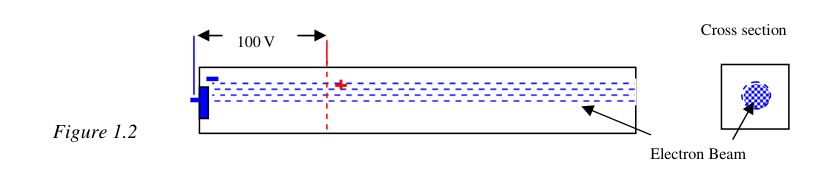 tubo acceleratore fascio elettroni
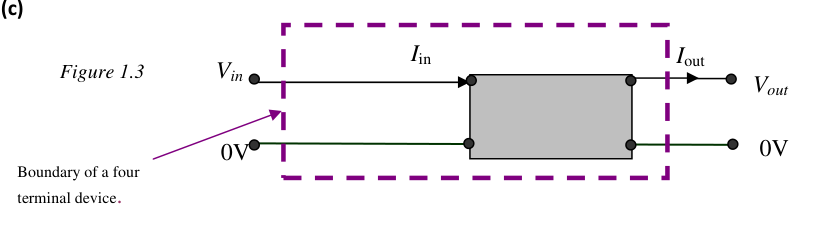 dispositivo attivo a quattro terminali
Topic: Magnetism, Circuits, Nuclear & Particle Physics Metodi: Ampère’s Law, Kinematic Equations, Bernoulli’s Equation, Kirchhoff’s Laws Competenze: Physical Reasoning, Estimation & Approximation, Diagrammatic Reasoning Objects: Planet, Particle Beam Fonte: Testo (PDF) — p.2
Q1
In questa domanda vi viene chiesto di fare stime, ipotesi e spiegazioni motivate. Questi devono essere chiaramente
- E’ stato detto.
(a)
(i) Il pianeta Venere orbita intorno al Sole ed è più vicino al Sole di quanto non lo sia la Terra. Visto con un binocolo debole Venere può spesso sembrare a forma di mezzaluna. La sua dimensione e forma sembrano cambiare dopo un po’. Perché ?
- Questo?
(ii) Il pianeta Venere non sembra cambiare in questo modo visto a occhio nudo. Tuttavia, la sua luminosità varia in tutta la sua orbita. Come e perché?
(iii) Nel XVIII secolo si è realizzato che se due telescopi in parti diverse della Terra misurassero il La posizione di Venere allo stesso tempo, la distanza della Terra da Venere potrebbe essere determinata e quindi la scala del Sistema Solare. Il raggio della Terra era ben noto. Con il sostegno del Royal Societa’, il capitano Cooke ha eseguito l’esperimento quando si e’ verificata un’eclissi del Sole da parte di Venere. (appare come un punto nero che attraversa la superficie del Sole). Perché aveva bisogno dell’eclissi solare? Perché ?
- E’ andato nel Pacifico Sud? - Spiegami.
(iv) Un tubo lungo è collegato a un rubinetto. Se l’estremità del tubo è parzialmente coperta da un pollice, l’acqua sembra
- Per spruzzare molto più velocemente. - Spiegami.
(v) La radiazione alfa è osservata e fotografata digitalmente in una camera di nuvole. La densità della pista, (light) pixel/per lunghezza ), è tracciato in base alla distanza dalla fonte (). Spiegare la forma del grafico in Figura 1.1.
(b)
Un raggio di elettroni viene accelerato attraverso un P.D. di 100 V in un tubo a alto vuoto, figura 1.2. Non c’è campo magnetico esterno. La corrente del fascio è . Il diametro della sezione trasversale del fascio circolare è . Supponiamo che gli elettroni abbiano una densità costante per unità di area del fascio. Calcola:
(i) La velocità massima degli elettroni.
(ii) La velocità degli elettroni dopo aver percorso metà della distanza nel campo di accelerazione.
(iii) Il campo magnetico a una distanza di dal centro del fascio.
(iv) Che cosa succede se il P.D. accelerante è aumentato a ?
(c)
(i) La figura 1.3 mostra un dispositivo a quattro terminali attivo (ha un alimentatore interno). La misura è molto piccola e la La produzione si comporta come se fosse di p.d. e resistenza interna , dove è una costante. Disegna una semplice circuito che si comporterà in questo modo.
(ii) Indicare che se la resistenza è grande rispetto alla resistenza delle resistenze successive in un sistema completo di Circuito, quindi la corrente sarà costante e il dispositivo agirà come fonte di corrente costante. Che cos’è condizione per una fonte di tensione costante? Suggerire un circuito per una fonte di tensione costante.
grafico densità pixel vs distanza
tubo acceleratore fascio elettroni
dispositivo attivo a quattro terminali
Topic: Magnetism, Circuits, Nuclear & Particle Physics Metodi: Ampère’s Law, Kinematic Equations, Bernoulli’s Equation, Kirchhoff’s Laws Competenze: Physical Reasoning, Estimation & Approximation, Diagrammatic Reasoning Objects: Planet, Particle Beam Fonte: Testo (PDF) — p.2
Q2
(a) In cosmology it is thought that the Universe is expanding and this results in an apparent velocity of recession . This velocity is related to the distance from the observer by the equation:
is Hubble’s constant. A very distant galaxy at present (time ) is observed to be away. How would you expect the distance of the galaxy to change with time?
(b) It can be shown that in the case of a number of atoms with one electronic energy level , of value above the ground state, the number of electrons, in is related to the number in the ground state by the equation:
Where is the absolute temperature and is the Boltzman constant. Show that if the atom has two electronic levels and of energy and above the ground state then if and then:
Topic: Astrophysics, Thermodynamics, Kinetic Theory Metodi: Approximation & Series Expansion, Statistical Averaging, Ideal Gas Law Competenze: Mathematical Modeling, Physical Reasoning, Estimation & Approximation Objects: Atom, Electron Fonte: Testo (PDF) — p.3
Q2
(a) In cosmologia si pensa che l’universo si stia espandendo e questo si traduca in una velocità apparente di recessione . Questa velocità è correlata alla distanza dall’osservatore con l’equazione:
è costante di Hubble. Una galassia molto lontana al momento (tempo ) è osservata ad essere lontana. Come farebbe si aspetta che la distanza della galassia cambi con il tempo?
b) Si può dimostrare che nel caso di un numero di atomi con un livello di energia elettronica , di valore superiore a lo stato di base, il numero di elettroni, in è correlato al numero nello stato di base da Equazione:
In cui è la temperatura assoluta e è la costante di Boltzman. Mostrare che se l’atomo ha due i livelli elettronici e di energia e sopra lo stato di terra, quindi se e :
Topic: Astrophysics, Thermodynamics, Kinetic Theory Metodi: Approximation & Series Expansion, Statistical Averaging, Ideal Gas Law Competenze: Mathematical Modeling, Physical Reasoning, Estimation & Approximation Objects: Atom, Electron Fonte: Testo (PDF) — p.3
Q3
(a) Figure 3.1 shows a diagram of the Earth and the Moon. Assume a very simple model that the whole smooth Earth is covered with a layer of water depth . Find an expression that relates the gravitational field due to the Moon at A and B (assume ). Hence give a reasoned estimate of the height of the tides at the equator. Ignore the effects of continents, ocean currents etc. Comment on your estimate and the assumptions you make.
(b) The Moon is slowly coming towards the Earth. The gravitational tidal effect on the Moon will become greater. The Roche limit is the value of the radius of an orbit at which the tidal effect on a body, in this case the Moon, will disrupt the body if it has no internal tensile strength, eg composed of sand or loose rock. What would be the Roche limit for a neutron star radius and mass about the mass of the Sun?
(c) The year is 3500 AD. Captain Amabo is steering his space ship Enterprise X11. He is searching for Dark Matter Asteroid VII which could be a hazard to space navigation. Dark matter interacts with ordinary matter through the exchange of gravitons that are the quanta of gravity. Gravitons were first detected in 2035 AD. The normal electromagnetic interaction does not react with dark matter. Enterprise X11 photon rocket engines are switched off. Design a very simple apparatus that he could carry that would warn him of the possible hazard. What is the nature of the hazard?
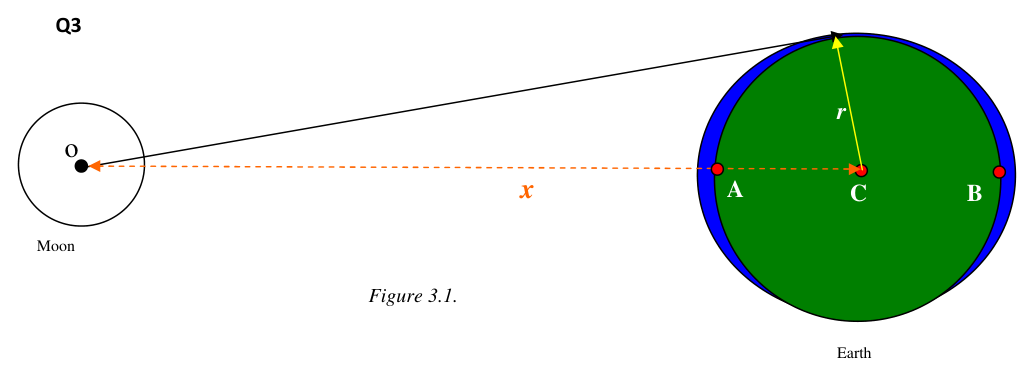 diagramma Luna-Terra maree
Topic: Gravitation, Astrophysics, Modern-Quantum Physics Metodi: Newton’s Law of Gravitation, Approximation & Series Expansion, Physical Modeling Competenze: Estimation & Approximation, Mathematical Modeling, Physical Reasoning Objects: Planet, Satellite, Star Fonte: Testo (PDF) — p.4
Q3
(a) La figura 3.1 mostra un diagramma della Terra e della Luna. Supponiamo un modello molto semplice che l’intero la terra liscia è coperta da uno strato di profondità d’acqua . Trova un’espressione che relati le campo gravitazionale dovuto alla Luna a A e B (presumere ). In tal caso, si deve dare una stima ragionevole dell’altezza delle maree all’equatore. Ignorare gli effetti dei continenti, delle correnti oceaniche, ecc. Commento sulla sua
- E’ un’idea che non si può fare.
b) La Luna si avvicina lentamente alla Terra. L’effetto delle maree gravitazionali sulla Luna diventerà
- Più grande. Il limite di Roche è il valore del raggio di un’orbita a cui l’effetto delle maree su un corpo, in questo caso La Luna, si disturberà il corpo se non ha resistenza alla trazione interna, ad esempio composto di sabbia o roccia sciolta. Qual sarebbe il limite di Roche per un raggio di stella di neutroni e la massa circa la massa del Sole?
c) L’anno è il 3500 d.C. Il capitano Amabo sta guidando la sua nave spaziale Enterprise X11. Sta cercando Dark . C’è un asteroide VII che potrebbe essere un pericolo per la navigazione spaziale. La materia oscura interagisce con la materia ordinaria . la materia attraverso lo scambio di gravitoni che sono i quantisti di gravità. I gravitoni sono stati rilevati per la prima volta nel 2035 AD. L’interazione elettromagnetica normale non reagisce con la materia oscura. Fotone Enterprise X11 I motori dei razzi sono spenti. Progettare un semplice apparecchio che potesse portare che lo avverterebbe il possibile pericolo. Qual è la natura del pericolo?
diagramma Luna-Terra maree
Topic: Gravitation, Astrophysics, Modern-Quantum Physics Metodi: Newton’s Law of Gravitation, Approximation & Series Expansion, Physical Modeling Competenze: Estimation & Approximation, Mathematical Modeling, Physical Reasoning Objects: Planet, Satellite, Star Fonte: Testo (PDF) — p.4
Q4
(a) In 1971 Leon Chua formulated the theory of the memristor. It is a passive two terminal device. He realised that he could relate the circles labelled , , , diagrammatically, as shown in Figure 4.1. Figure 4.1 is not a circuit diagram. The resistor in square 1 relates and . The capacitor in square 2 relates and . The inductor in square 3 relates and . However, a device seems to be needed in square 4 to complete the symmetry. The name memristor was suggested for this device. In April 2008 HP Labs announced the development of a switching semiconductor memristor.
(i) Are the equations in Figure.4.1 dimensionally consistent?
(ii) The team that first produced a memristor on a chip suggested that it could revolutionise the fabrication and use of computer memories. How?
(b)
A student has been given the task of making a practical analogue of a memristor. She thinks that she could make a bar magnet from lightly magnetised steel filings covered in a thin layer of slippery plastic placed in a suitable tube. Explain how this set up is an analogue of a memristor. Her idea is illustrated in Figure 4.2. Comment briefly on the suggested analogue, being careful to explain the physics involved.
(c)
(i) A magnet will set itself along the field lines if it is able to rotate in the plane of the paper (Figures 4.3). There is a torque on the magnet due to the magnet’s interaction with the Earth’s field. The magnetic moment of a magnet, is the maximum torque on it in a field of . Find an expression for the torque on the magnet illustrated in Figure 4.3.
(ii) It is possible to imagine a model of a magnet as a dipole where the pole strength is . See Figure 4.4. The poles are apart. The force between two isolated magnetic poles is similar to that between two isolated charges i.e. where is the magnetic permeability of the intervening medium.
What is the relationship between and ?
(d)
(i) Figure 4.5 illustrates two “isolated” magnetic poles. The other two poles can be regarded as too far away to interact or contribute to the field. How can you find the direction of the field lines using a Hall probe?
(ii) Show that for a small isolated magnet, the magnetic field at a large distance away from the magnet will be proportional to .
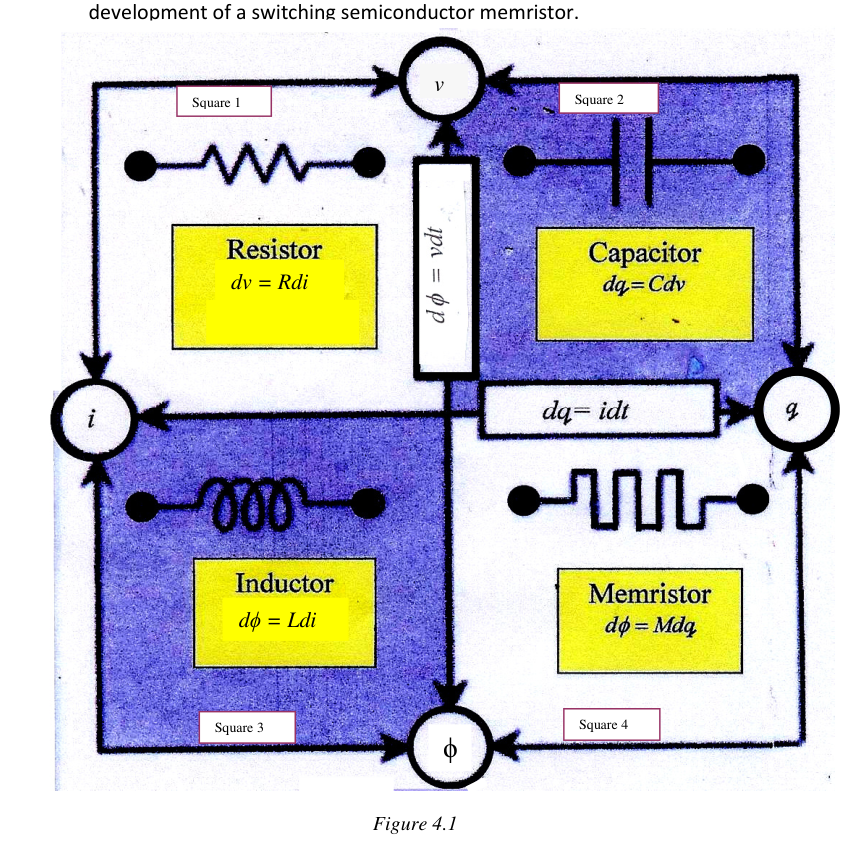 relazioni circuitali memristor quattro quadranti
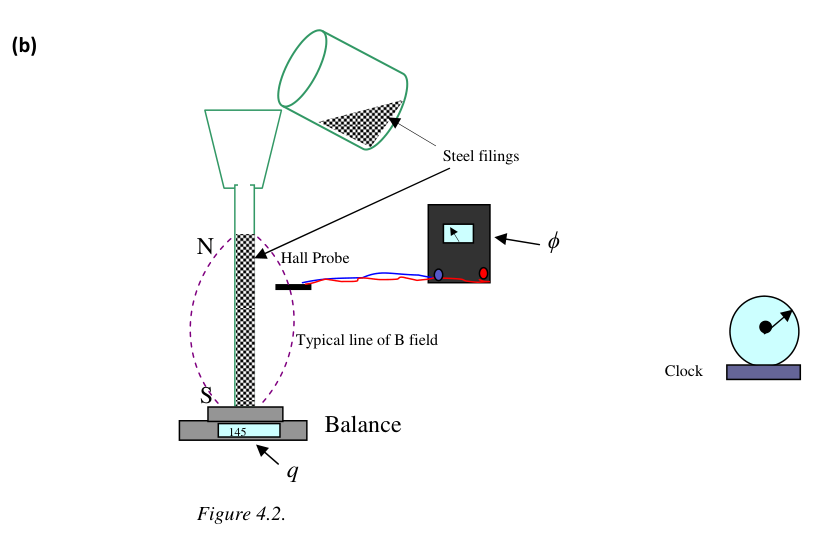 apparato analogico memristor magnete sonda Hall
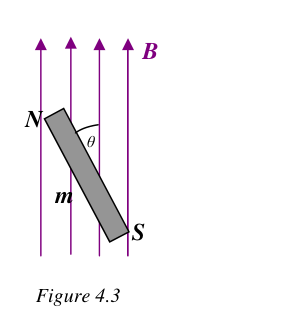 magnete in campo B esterno
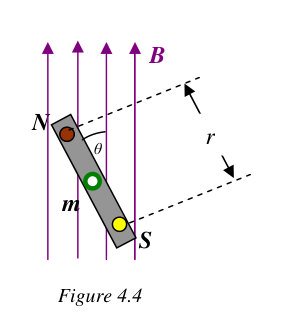 due poli magnetici separati distanza r
 due poli magnetici isolati su asta
Topic: Magnetism, Circuits, Electrostatics Metodi: Dimensional Analysis, Torque & Angular Momentum Analysis, Coulomb’s Law Competenze: Diagrammatic Reasoning, Mathematical Modeling, Physical Reasoning Objects: Magnet, Magnetic Dipole, Capacitor, Inductor, Resistor Fonte: Testo (PDF) — p.5
Q4
(a) Nel 1971 Leon Chua formulò la teoria del memristore. E’ un dispositivo terminale passivo a due. Si è reso conto che possa collegare diagrammaticamente i cerchi etichettati , , , , come mostrato alla figura 4.1. La figura 4.1 non è un diagramma di circuito. La resistenza nel quadrato 1 si riferisce a e . Il condensatore nel quadrato 2 si riferisce a e . Il l’induttore nel quadrato 3 si riferisce a e . Tuttavia, sembra essere necessario un dispositivo nel quadrato 4 per completare il
- Simmetria. Il nome memristor è stato suggerito per questo dispositivo. Nell’ aprile 2008 HP Labs ha annunciato la sviluppo di un memristore di semiconduttori di commutazione.
(i) Le equazioni della figura 4.1 sono dimensionalmente coerenti?
(ii) Il team che ha prodotto per la prima volta un memristor su un chip ha suggerito che potrebbe rivoluzionare la fabbricazione e l’uso delle memorie del computer. - Come? - Come?
(b)
Uno studente ha ricevuto il compito di fare un analogo pratico di un memristore. Pensa che potrebbe realizzare un magnete a barre a partire da archivi di acciaio leggero magnetizzati coperti da un sottile strato di plastica scivolosa inserito in un tubo adatto. Spiegate come questa configurazione sia un analogo di un memristor. La sua idea è illustrata nella figura 4.2. Commenta brevemente l’analogio suggerito, facendo attenzione a spiegare la fisica coinvolta.
(c)
- un magnete si posiziona lungo le linee di campo se è in grado di ruotare nel piano della carta (Figure 4.3). C’è una coppia sul magnete a causa dell’interazione del magnete con il campo terrestre. Il magnetico momento di un magnete, è la coppia massima su di esso in un campo di . Trova un’espressione per la coppia di il magnete illustrato alla figura 4.3.
(ii) È possibile immaginare un modello di magnete come dipolo dove la resistenza dei poli è . V. Figura 4.4. Il i poli sono separati. La forza tra due poli magnetici isolati è simile a quella tra due poli magnetici isolati
- le spese, cioè dove è la permeabilità magnetica del mezzo intermedio.
Qual è la relazione tra e ?
(d)
(i) La figura 4.5 illustra due poli magnetici isolati. Gli altri due poli possono essere considerati troppo lontani interagire o contribuire al campo. Come si può trovare la direzione delle linee di campo usando una sonda Hall?
(ii) Indicare che per un piccolo magnete isolato, il campo magnetico a grande distanza dal magnete essere proporzionale a .
relazioni circuitali memristor quattro quadranti
apparecchio analogo memristore magneto sonda Hall
Magnete in campo B esterno
- dovuta poli magnetici separati distanza r *
- dovute alle isolazioni magnetiche
Topic: Magnetism, Circuits, Electrostatics Metodi: Dimensional Analysis, Torque & Angular Momentum Analysis, Coulomb’s Law Competenze: Diagrammatic Reasoning, Mathematical Modeling, Physical Reasoning Objects: Magnet, Magnetic Dipole, Capacitor, Inductor, Resistor Fonte: Testo (PDF) — p.5
Q5
In the late 19th century the American student, Edwin Hall, was given the problem of observing the effect of a magnetic field on electrons travelling in a conductor. This is known as the Hall effect and the probe has been used in Q4.
Figure 5.1. Illustrates the experiment. A current is passed through a strip of gold leaf and the current carriers (usually electrons) pass through the gold leaf. The current passes through the gold leaf in the direction shown. The magnetic field acts on the moving current carriers and these carriers are pulled to the left. One thin edge of the gold leaf becomes positive (coloured pink/grey), relative to the other side. The Hall voltage, is the p.d. between points on the pink/grey face and the side opposite.
(i) The number density of the carriers is , the cross sectional area of the strip is , the charge on the current carrier (electrons) is . Derive or write down an expression for the drift velocity, in terms of .
(ii) Draw a circuit diagram that shows a practical circuit that could measure the Hall effect in a strip of gold leaf. The effect is very small.
(iii) The charge carriers in semiconductors are fewer - therefore they move more rapidly for the same current density. How does this make the sensors based on Hall voltage more sensitive? In some materials the polarity of the voltage is reversed. Comment.
(iv) Measuring the thickness of the gold leaf is difficult. A student knows that when viewing a strong white light through a piece of gold leaf the light appears green - blue. He has also read that if 1 g of gold is beaten out as thin as possible it covers an area of . Are these facts consistent? Explain.
(v) The highest field available is . The length of the gold leaf is , the width and the current is . What is the drift velocity of the free electrons (one per atom)? What would be the Hall voltage?
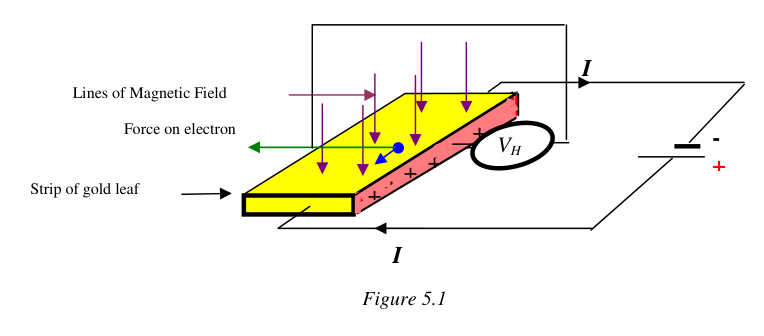 effetto Hall lamina d’oro in campo B
Topic: Magnetism, Electromagnetism, Circuits Metodi: Lorentz Force Analysis, Kinematic Equations, Kirchhoff’s Laws Competenze: Mathematical Modeling, Diagrammatic Reasoning, Estimation & Approximation Objects: Electron, Magnet Fonte: Testo (PDF) — p.7
Q5
Alla fine del XIX secolo lo studente americano Edwin Hall ebbe il problema di osservare l’effetto di un campo magnetico su elettroni che viaggiano in un conduttore. Questo è noto come l’effetto Hall e la sonda è stata utilizzato nella Q4.
Figura 5.1. Ilustra l’esperimento. Una corrente è passata attraverso una striscia di foglia d’oro e i portatori correnti (di solito elettroni) passano attraverso la foglia d’oro. La corrente passa attraverso la foglia d’oro nella direzione indicata. Il campo magnetico agisce sui portatori di corrente in movimento e questi portatori sono tirati a sinistra. Un lato sottile di la foglia d’oro diventa positiva (pizzone rosa/grigio), rispetto all’altro lato. La tensione di Hall, è la p.d. tra i punti della faccia rosa/grigio e il lato opposto.
(i) La densità numerica dei vettori è , la superficie trasversale della striscia è , la carica sulla corrente il vettore (elettroni) è . Derivare o annotare un’espressione per la velocità di deriva, in termini di .
(ii) Disegnare un diagramma di circuito che mostra un circuito pratico che potrebbe misurare l’effetto Hall in una striscia d’oro
-
La foglia. L’effetto è molto piccolo.
-
i portatori di carica nei semiconduttori sono minori, quindi si muovono più rapidamente per la stessa corrente densità. Come fa a rendere i sensori basati sulla tensione di Hall più sensibili? In alcuni materiali la polarità della tensione è inversa. Commento.
(iv) Misurare lo spessore della foglia d’oro è difficile. Uno studente sa che quando vede una luce bianca forte attraverso un pezzo di foglia d’oro la luce appare verde - blu. Ha anche letto che se 1 g di oro viene battuto fuori il più sottile possibile, copre una superficie di . Questi fatti sono coerenti? - Spiegami.
(v) Il campo più alto disponibile è . La lunghezza della foglia d’oro è , la larghezza e la corrente è . Qual è la velocità di deriva degli elettroni liberi (uno per atomo)? Qual sarebbe la tensione di Hall?
*effetto Hall lamina d’oro in campo B *
Topic: Magnetism, Electromagnetism, Circuits Metodi: Lorentz Force Analysis, Kinematic Equations, Kirchhoff’s Laws Competenze: Mathematical Modeling, Diagrammatic Reasoning, Estimation & Approximation Objects: Electron, Magnet Fonte: Testo (PDF) — p.7