- PRISM (8 points) i) (4 points) A right prism that has an equilateral triangular base with length is placed in a horizontal slit between two tables, so that one of the side faces is vertical. How small can the width of the slit be made before the prism falls out of the slit? There is no friction between the prism and the tables and the prism is made of a homogeneous material. The edges of the slit are parallel. ii) (4 points) Now the prism is placed in the slit so that one of its side faces is horizontal. How small can the width of the slit be made before that position becomes unstable? i) a d ii) a l
Topic: Rigid Body Statics, Rotational Dynamics Metodi: Free-Body Diagram, Torque & Angular Momentum Analysis, Vector Decomposition, Symmetry Argument Competenze: Diagrammatic Reasoning, Mathematical Modeling, Physical Reasoning Objects: Prism Fonte: Testo (PDF) — p.1
- PRISM (8 punti) (i) (4 punti) Un prisma destro che ha un base triangolare equilaterale con lunghezza è collocato in una fessura orizzontale tra due tavole, in modo che una delle facce laterali sia verticale. Come La larghezza della fessura può essere realizzata prima che il prisma cadga dalla fessura? Non c’è l’attrito tra il prisma e le tavole e il prisma è costituito da un materiale omogeneo. I bordi della fessura sono paralleli. (ii) (4 punti) Ora il prisma è collocato nella fuso in modo che una delle sue facce laterali sia orizzontale. Quanta piccola larghezza della fessura può essere realizzata prima che la posizione diventi instabile? i) a d ii) a l
Topic: Rigid Body Statics, Rotational Dynamics Metodi: Free-Body Diagram, Torque & Angular Momentum Analysis, Vector Decomposition, Symmetry Argument Competenze: Diagrammatic Reasoning, Mathematical Modeling, Physical Reasoning Objects: Prism Fonte: Testo (PDF) — p.1
- CELLPHONE CAMERA (6 points) A photographer focussed his camera to distance and took a photo. On the photo, all farther objects (up to infinity) turned also out to be sharp. Additionally, all closer objects down to distance were sharp. i) (4 points) What is the minimum possible ? ii) (2 points) Find the corresponding . Background. We consider the image of a pointlike object to be sharp if its image is smaller than one pixel on the sensor. Otherwise the image is blurry. The lens of the camera may be viewed as a convex lens. The camera is focussed by changing the distance between the sensor and the lens. Parameters. Calculate the answer for a cellphone made by a well-known company. The focal length of its camera and the diameter of the lens . The sensor is wide corresponding to pixels.
Topic: Geometric Optics Metodi: Thin Lens & Mirror Equation, Ray Tracing, Physical Modeling Competenze: Mathematical Modeling, Physical Reasoning Objects: Lens, Screen Fonte: Testo (PDF) — p.1
- CELFONE CAMERA (6 punti) Un fotografo ha focalizzato la sua fotocamera a distanza E ho fatto una foto. Nella foto, tutto più lontano Gli oggetti (fino all’infinito) si sono rivelati anche
- No, non è così. Inoltre, tutti gli oggetti più vicini sono abbassati. La distanza era nitida. (i) (4 punti) Qual è la minima possibile ? ii) (2 punti) Trova la corrispondente .
- Il passato. Considerando l’immagine di un oggetto puntoso da essere nitido se la sua immagine è inferiore a un pixel sul sensore. Altrimenti l’immagine è sfocata. L’obiettivo della la fotocamera può essere vista come un obiettivo convex. Il la fotocamera è focalizzata modificando la distanza tra il sensore e l’obiettivo.
- Parametri. Calcolare la risposta per un un cellulare di una società nota. La distanza focale della sua telecamera e il diametro della lente . Il il sensore è larghezza corrispondente a pixel.
Topic: Geometric Optics Metodi: Thin Lens & Mirror Equation, Ray Tracing, Physical Modeling Competenze: Mathematical Modeling, Physical Reasoning Objects: Lens, Screen Fonte: Testo (PDF) — p.1
- MISSION TO MARS (7 points) A crew of astronauts is going to be sent to explore the polar region of Mars and search for buried water ice. Their spaceship will travel from Earth to Mars along an elliptic transfer orbit tangential to the orbits of both planets. Despite its shortcomings, this orbit is commonly used in space travel due to its relatively good fuel economy. Future manned missions to Mars are very likely based on this kind of transfer. In this problem you will examine some aspects of this orbit. The mean orbital radius of Mars is . The mean orbital radius of Earth is . Mars has a mean radius of and surface gravity . Earth has a mean radius of . i) (1 point) Find the orbital period of Mars, i.e. find the length of Martian “year” in Earth years. ii) (1.5 points) How long () does a one-way trip to Mars take? iii) (1.5 points) The spaceship is put into this orbit by using a powerful rocket. It is more efficient to burn fuel as a short burst when the spaceship is still near Earth. How much additional speed () does the booster have to be able to give to the spaceship to enter the transfer orbit, starting from the north pole? Neglect the air resistance. iv) (1.5 points) Estimate the needed to enter a circular orbit close to Mars. v) (1.5 points) What is the minimal duration of the trip to Mars and back?
Topic: Gravitation, Astrophysics Metodi: Kepler’s Laws, Newton’s Law of Gravitation, Energy Conservation Method, Conservation of Energy Competenze: Mathematical Modeling, Estimation & Approximation Objects: Planet, Satellite Fonte: Testo (PDF) — p.1
- MISSIONE AL MARS (7 punti) Un equipaggio di Gli astronauti saranno inviati per esplorare il Regione polare di Marte e ricerca di sepolti ghiaccio d’acqua. La loro nave spaziale partirà da Terra a Marte lungo un’orbita di trasferimento ellittica tangenziale alle orbite di entrambi i pianeti. Nonostante le sue carenze, questa orbita è comunemente utilizzato nei viaggi spaziali per il suo rapporto di qualità
- l’economia dei combustibili. Missioni future a bordo Marte è molto probabile basato su questo tipo di
- Trasferimento. In questo problema esaminerai alcuni aspetti di questa orbita. Il raggio orbitale medio di Marte è . Il raggio orbitale medio della Terra is . Marte ha un radius medio di e superficie gravità . La Terra ha un mezzo radius di . i) (1 punto) Trova il periodo orbitale di Marte, cioè Trova la lunghezza di Marte
- Gli anni terrestri. ii) (1,5 punti) Quanto tempo () fa un’operazione a senso unico
- Viaggio su Marte? iii) (1,5 punti) La nave spaziale è inserita in questo orbitare usando un potente razzo. E ’ piu ’ efficaci per bruciare combustibile in breve esplosione quando La nave spaziale è ancora vicino alla Terra. Quanto ? la velocità aggiuntiva () che il booster ha per poter dare alla nave spaziale di entrare nel Orbita di trasferimento, partendo dal polo nord?
- Non si deve prendere in considerazione la resistenza. (iv) (1,5 punti) Valutare il necessario per Entrare in orbita circolare vicino a Marte. v) (1,5 punti) Qual è la durata minima del viaggio su Marte e di ritorno?
Topic: Gravitation, Astrophysics Metodi: Kepler’s Laws, Newton’s Law of Gravitation, Energy Conservation Method, Conservation of Energy Competenze: Mathematical Modeling, Estimation & Approximation Objects: Planet, Satellite Fonte: Testo (PDF) — p.1
- MAGNETIC DIPOLES (7 points) Let us consider the following model for a magnetic dipole. Some wire with no resistance has been bent into the shape of a square with side length . At some point on the wire is a small ideal current source that keeps current flowing in the circuit in all situations. The magnetic moment of a planar circuit is given by the relation , with vector pointing in the normal direction of the circuit according to the right hand rule ( is the area bounded by the circuit). i) (3 points) The dipole is placed inside a homogeneous magnetic field , so that the angle between and is . Find the angles and that correspond to stable and unstable equilibria, respectively. Calculate the amount of work () needed to rotate the dipole from to . Give your answer in terms of and . We can use this model to calculate the magnetic properties of materials containing unpaired electrons that have negligibly weak interactions with one another. Let us consider a sample of material with such unpaired electrons per unit volume, placed inside a homogeneous magnetic field . Due to spin, each unpaired electron acts as a small magnetic dipole. However, owing to the quantum nature the electron, the projection of its magnetic moment along can only be or ( is called the Bohr magneton). ii) (4 points) Calculate , the magnetic moment per unit volume of the sample, if the temperature of the material is and the external magnetic field is .
Topic: Magnetism, Thermodynamics Metodi: Energy Conservation Method, Statistical Averaging, Physical Modeling Competenze: Mathematical Modeling, Physical Reasoning Objects: Magnetic Dipole, Wire, Electron Fonte: Testo (PDF) — p.1
- DIPOLI MAGNETICHI (7 punti) Considerare il modello seguente per un magnetico
- Il dipolo. Un filo senza resistenza ha sono state piegate in forma di quadrato con lunghezza laterale . A un certo punto il filo è una piccola fonte di corrente ideale che mantiene il flusso di corrente nel circuito in tutte le situazioni. Il momento magnetico di un circuito piatto è data dalla relazione , con vettore che indica la direzione normale del circuito secondo la regola della mano destra ( è la direzione normale del circuito) area delimitata dal circuito). i) (3 punti) Il dipolo è collocato all’interno di un campo magnetico omogeneo , in modo che la L’angolo tra e è . Trova gli angoli e che corrispondono rispettivamente a equilibri stabili e instabili. Calcolare il quantità di lavoro () necessaria per ruotare il dipolo da a . Rispondi in termini di e . Possiamo usare questo modello per calcolare il proprietà magnetiche dei materiali contenenti elettroni non accoppiati che hanno un’attenua debolezza interazioni tra loro. Consideriamo un campione di materiale con tali elettroni non accoppiati per unità di volume, posizionato all’interno di un campo magnetico omogeneo . Due per ruotare, ogni elettrone non accoppiato agisce come un piccolo dipolo magnetico. Tuttavia, a causa del natura quantistica l’elettrone, la proiezione di un momento magnetico lungo può essere solo o ( è chiamato magnetone di Bohr). (I) (4 punti) Calcolare , il momento magnetico per unità di volume del campione, se il la temperatura del materiale è e il campo magnetico esterno è .
Topic: Magnetism, Thermodynamics Metodi: Energy Conservation Method, Statistical Averaging, Physical Modeling Competenze: Mathematical Modeling, Physical Reasoning Objects: Magnetic Dipole, Wire, Electron Fonte: Testo (PDF) — p.1
FRICTION OF A STRING (8 points) Measure the dynamic coefficient of friction between the ballpoint pen and the string. Estimate the uncertainty. It might help that the dynamic coefficient of friction between the pencil and the same string was measured beforehand and was obtained. Equipment: dynamometer, string, ballpoint pen, pencil and weight. Estonian-Finnish Olympiad 2013
Topic: Newtonian Mechanics Metodi: Free-Body Diagram, Physical Modeling, Experimental Data Analysis Competenze: Experimental Data Analysis, Error Propagation, Measurement & Instrumentation Objects: String Fonte: Testo (PDF) — p.1
Friczione di una corda (8 punti) Misurare il coefficiente dinamico di attrito tra la penna a sfera e la corda.
- Stima l’incertezza. Potrebbe aiutare . il coefficiente dinamico di attrito tra la matita e la stessa corda sono state misurate è stato ottenuto in anticipo e . Attrezzature: dinamometro, corda, penna a sfera, matita e peso. Olimpiada estone-finlandese 2013
Topic: Newtonian Mechanics Metodi: Free-Body Diagram, Physical Modeling, Experimental Data Analysis Competenze: Experimental Data Analysis, Error Propagation, Measurement & Instrumentation Objects: String Fonte: Testo (PDF) — p.1
- SPHERE AND CYLINDER (7 points) A sphere and a cylinder are lying on an inclined surface with inclination angle . Both have mass and radius . The bodies are released from equal initial heights . The moments of inertia of the sphere and the cylinder are, respectively, and . The coefficient of friction between the surface and the bodies is . i) (2 points) Which of the bodies comes down faster? What was the relative lag of the slower body ? The times and , respectively, denote the traveling times of the faster or the slower body. Assume that the rolling occurs without slipping. ii) (2.5 points) Find the minimal angle of inclination for which the cylinder starts to slide in addition to rolling. iii) (2.5 points) If , the bodies obviously lose contact with the surface and fall down in free fall with equal times. What is the minimal angle of inclination , for which both the sphere and the cylinder come down with equal times?
Topic: Rotational Dynamics, Newtonian Mechanics Metodi: Free-Body Diagram, Torque & Angular Momentum Analysis, Kinematic Equations, Energy Conservation Method Competenze: Diagrammatic Reasoning, Mathematical Modeling, Physical Reasoning Objects: Sphere, Cylinder, Inclined Plane Fonte: Testo (PDF) — p.2
- Sfera e cilindro (7 punti) A la sfera e un cilindro si trovano su un inclinato superficie con angolo di inclinazione . Entrambi hanno massa e raggio . I corpi sono rilasciati . da altezza iniziale uguale . I momenti di l’inerzia della sfera e del cilindro sono rispettivamente e . Il coefficiente di attrito tra la superficie e i corpi sono . i) (2 punti) Quale dei corpi si abbatte
- Più veloce? Qual è stato il ritardo relativo del corpo più lento ? Le ore e , rispettivamente, indicano i tempi di viaggio di più veloce o più lento il corpo. Supponiamo che il rotolamento si verifica senza scivolare. ii) (2,5 punti) Trova l’angolo minimo di inclinamento per il quale il cilindro inizia per scivolare oltre al rotolamento. iii) (2,5 punti) Se , i corpi perdono ovviamente il contatto con la superficie e cadono
- In caduta libera, con tempi uguali. Che cosa ? è l’angolo minimo di inclinazione , per che sia la sfera che il cilindro
- E’ stato un’equivalente?
Topic: Rotational Dynamics, Newtonian Mechanics Metodi: Free-Body Diagram, Torque & Angular Momentum Analysis, Kinematic Equations, Energy Conservation Method Competenze: Diagrammatic Reasoning, Mathematical Modeling, Physical Reasoning Objects: Sphere, Cylinder, Inclined Plane Fonte: Testo (PDF) — p.2
- BURNING WITH A LENS (7 points) Sunrays are focused with a lens of diameter and focal length of to a black thin plate. Behind the plate is a mirror. Angular diameter of the Sun is and its intensity on the surface of the Earth is , Stefan-Boltzmann constant . i) (4 points) Find the temperature of the heated point of the plate. ii) (3 points) Using thermodynamic arguments, estimate the maximal diameter of the lens for which this model can be used.
Topic: Geometric Optics, Thermodynamics Metodi: Ray Tracing, Thin Lens & Mirror Equation, First Law of Thermodynamics, Thermodynamic Cycle Analysis Competenze: Mathematical Modeling, Physical Reasoning, Estimation & Approximation Objects: Lens, Mirror, Star Fonte: Testo (PDF) — p.2
- BRUNNING WITH A LENS (7 punti) I raggi del sole sono focalizzati con una lente di diametro e distanza focale di a
- Tela nera sottile. Dietro il piatto c’è uno specchio. Il diametro angolare del Sole è e La sua intensità sulla superficie terrestre è , costante di Stefan-Boltzmann . (i) (4 punti) Trova la temperatura del punto riscaldato della piastra. ii) (3 punti) Usando argomenti termodinamici, stimare il diametro massimo del lenti per le quali può essere utilizzato questo modello.
Topic: Geometric Optics, Thermodynamics Metodi: Ray Tracing, Thin Lens & Mirror Equation, First Law of Thermodynamics, Thermodynamic Cycle Analysis Competenze: Mathematical Modeling, Physical Reasoning, Estimation & Approximation Objects: Lens, Mirror, Star Fonte: Testo (PDF) — p.2
- ZENER DIODE (7 points) An inductance and a capacitor are connected in series with a switch. Initially the switch is open and the capacitor is given a charge . Now the switch is closed. i) (1 point) What are the charge on the capacitor and the current in the circuit as functions of time? Draw the phase diagram of the system — the evolution of the system on a graph — and note the curve’s parameters. Note the direction of the system’s evolution with arrow(s). A Zener diode is a non-linear circuit element that acts as a bi-directional diode: it allows the current to flow in the positive direction when a forward voltage on it exceeds a certain threshold value, but it also allows a current to flow in the opposite direction when exposed to sufficiently large negative voltage. Normally the two voltage scales are quite different, but for our purposes we will take a Zener diode with the following voltampere characteristics: for forward currents, the voltage on the diode is , for reverse currents, the voltage on the diode is , for zero current the voltage on the diode is . Now we connect the inductance , the capacitor all in series with a switch and a Zener diode. The switch is initially open. The capacitor is again given the charge and the switch is then closed. ii) (2 points) Make a drawing of the phase diagram for the system. Note the direction of the system’s evolution with arrow(s). iii) (2 points) Does the evolution of the system only necessarily stop for ? Find the range of values of on the capacitor for which the evolution of the system will necessarily come to a halt. iv) (2 points) Find the decrease in the maximum positive value of the capacitor’s charge after one full oscillation. How long does it take before oscillation halts?
Topic: Circuits, Oscillations & Waves Metodi: Simple Harmonic Motion Analysis, Kirchhoff’s Laws, Energy Conservation Method, Differential Equations Competenze: Mathematical Modeling, Diagrammatic Reasoning, Physical Reasoning Objects: Inductor, Capacitor, Switch Fonte: Testo (PDF) — p.2
- ZENER DIODE (7 punti) Induttanza e un condensatore sono collegati in serie con un interruttore. Inizialmente il interruttore è aperto e il condensatore riceve una carica . Ora … Il interruttore è chiuso. i) (1 punto) Qual è la tassa sulla condensatore e corrente nel circuito come funzioni del tempo? Disegnare il diagramma di fase di sistema l’evoluzione del sistema su un grafico e nota i parametri della curvas. Nota la direzione del sistemas evoluzione con frecce (s). Un diodo Zener è un elemento di circuito non lineare che agisce come diodo bidirezionale: permette al corrente di fluire nella direzione positiva quando una tensione in avanti sopra esso supera un certo valore soglia, ma consente anche una corrente che scorre nella direzione opposta quando esposti a livelli sufficientemente negativi
- La tensione. Normalmente le due scale di tensione sono
- Non è così. prendere un diodo Zener con le seguenti caratteristiche di voltampere: per le correnti anteriori, la tensione della dioda è , per inverso corrente, la tensione del diodo è , per la corrente zero la tensione del diodo è . Ora colleghiamo l’induttanza , il condensatore tutti in serie con uno switch e un Diodo Zener. L’interruttore è inizialmente aperto. Il il condensatore viene nuovamente caricato e il interruttore viene chiuso. ii) (2 punti) Fare un disegno della fase diagramma per il sistema. Nota la direzione di l’evoluzione del sistema con frecce. iii) (2 punti) L’evoluzione del sistema si ferma necessariamente solo per ? Trova il gamma di valori sul condensatore per il quale l’evoluzione del sistema sarà necessariamente
- Si fermi. (I) (2 punti) Trova la diminuzione nel valore massimo positivo dei condensatoris carica dopo una oscillazione completa. - Quanto tempo ?
- Ci vuole prima che l’oscillazione si ferma?
Topic: Circuits, Oscillations & Waves Metodi: Simple Harmonic Motion Analysis, Kirchhoff’s Laws, Energy Conservation Method, Differential Equations Competenze: Mathematical Modeling, Diagrammatic Reasoning, Physical Reasoning Objects: Inductor, Capacitor, Switch Fonte: Testo (PDF) — p.2
- GLASS CYLINDER (7 points) In the following figure, there is a half-cylinder, made of glass and put on a paper with stripes (the inter-stripe distance is everywhere the same). Find the coefficient of refraction of the glass.
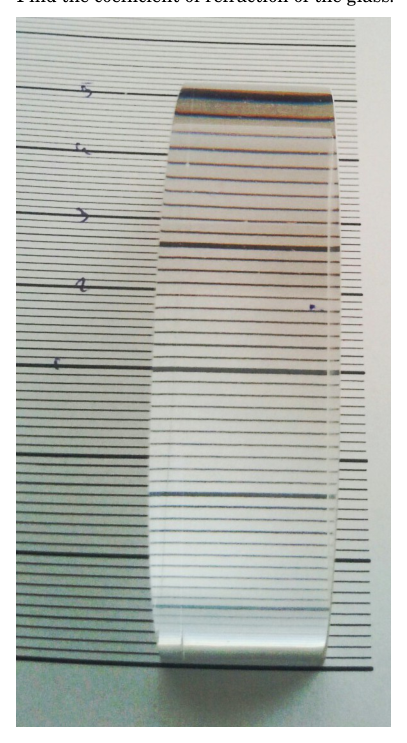 Semicilindro di vetro su carta rigata
Topic: Geometric Optics Metodi: Snell’s Law, Ray Tracing, Experimental Data Analysis Competenze: Measurement & Instrumentation, Physical Reasoning, Experimental Data Analysis Objects: Cylinder Fonte: Testo (PDF) — p.2
- CILINDRO DI VISO (7 punti) Nella figura seguente si trova un semicilindro, realizzato di vetro e riposato su carta con strisce (il La distanza tra le strisce è uguale ovunque). Trova il coefficiente di rifrazione del vetro.
Semicilindro di vetro su carta rigata
Topic: Geometric Optics Metodi: Snell’s Law, Ray Tracing, Experimental Data Analysis Competenze: Measurement & Instrumentation, Physical Reasoning, Experimental Data Analysis Objects: Cylinder Fonte: Testo (PDF) — p.2
- RESISTIVE HEATING (8 points) Measure the resistor. You are not asked to estimate the uncertainty. Equipment: resistor, voltage source (batteries), ammeter, calorimeter, thermometer, stopwatch. The calorimeter has of water and of aluminum, specific heat capacity of water and of aluminum . Internal resistance of the batteries will vary. Your set of batteries may become depleted, spares are available.
Topic: Circuits, Thermodynamics Metodi: Kirchhoff’s Laws, First Law of Thermodynamics, Experimental Data Analysis Competenze: Experimental Data Analysis, Measurement & Instrumentation, Mathematical Modeling Objects: Resistor, Battery, Calorimeter Fonte: Testo (PDF) — p.2
- RISISTENTE SCHIFFARE (8 punti) Misurare la resistenza. Non vi viene chiesto di valutare l’incertezza. Attrezzature: resistore, fonte di tensione (batterie), ammetro, calorimetro, termometro,
- Un orologio fermo. Il calorimetro ha di acqua e di alluminio, capacità termico specifica dell’acqua e dell’alluminio . Resistenza interna Le batterie variano. Il tuo set di batterie se le materie prime possono essere esaurite, sono disponibili dei ricambi.
Topic: Circuits, Thermodynamics Metodi: Kirchhoff’s Laws, First Law of Thermodynamics, Experimental Data Analysis Competenze: Experimental Data Analysis, Measurement & Instrumentation, Mathematical Modeling Objects: Resistor, Battery, Calorimeter Fonte: Testo (PDF) — p.2