- An observer stands on the side of the front of a stationary train. When the train starts moving with constant acceleration, it takes 5 seconds for the first car to pass the observer. How long will it take for the 10th car to pass?
- A. 1.07s
- B. 0.98s
- C. 0.91s
- D. 0.86s
- E. 0.81s
Topic: Newtonian Mechanics Metodi: Kinematic Equations Competenze: Physical Reasoning Objects: — Fonte: Testo (PDF) — p.2
- Un osservatore si trova sul lato anteriore di un treno stazionario. Quando il treno inizia a muoversi con costante velocità l’accelerazione, ci vogliono 5 secondi per la prima auto di passare l’osservatore. Quanto ci vorrà per passare la decima macchina?
- A. 1.07s
- B. 0.98s
- C. 0.91s
- D. 0.86s
- E. 0.81s
Topic: Newtonian Mechanics Metodi: Kinematic Equations Competenze: Physical Reasoning Objects: — Fonte: Testo (PDF) — p.2
- Jordi stands 20 m from a wall and Diego stands 10 m from the same wall. Jordi throws a ball at an angle of above the horizontal, and it collides elastically with the wall. How fast does Jordi need to throw the ball so that Diego will catch it? Consider Jordi and Diego to be the same height, and both are on the same perpendicular line from the wall.
- A. 11 m/s
- B. 15 m/s
- C. 19 m/s
- D. 30 m/s
- E. 35 m/s
Topic: Newtonian Mechanics Metodi: Kinematic Equations, Vector Decomposition Competenze: Physical Reasoning, Mathematical Modeling Objects: Ball Fonte: Testo (PDF) — p.2
- Jordi è a 20 metri da un muro e Diego a 10 metri dallo stesso muro. Jordi lancia una palla ad un angolo di sopra l’orizzontale, e colpisce elasticamente il muro. Quanto veloce deve lanciare la palla Jordi per far sì che Diego lo prenderà? Considera che Jordi e Diego siano della stessa altezza, e che entrambi sono sulla stessa linea perpendicolare
- Da quel muro.
- A. 11 m/s
- B. 15 m/s
- C. 19 m/s
- D. 30 m/s
- E. 35 m/s
Topic: Newtonian Mechanics Metodi: Kinematic Equations, Vector Decomposition Competenze: Physical Reasoning, Mathematical Modeling Objects: Ball Fonte: Testo (PDF) — p.2
- Tom throws a football to Wes, who is a distance away. Tom can control the time of flight of the ball by choosing any speed up to and any launch angle between and . Ignore air resistance and assume Tom and Wes are at the same height. Which of the following statements is incorrect?
- A. If , the ball cannot reach Wes at all.
- B. Assuming the ball can reach Wes, as increases with held fixed, the minimum value of decreases.
- C. Assuming the ball can reach Wes, as increases with held fixed, the maximum value of increases.
- D. Assuming the ball can reach Wes, as increases with held fixed, the minimum value of increases.
- E. Assuming the ball can reach Wes, as increases with held fixed, the maximum value of increases.
Topic: Newtonian Mechanics Metodi: Kinematic Equations, Physical Modeling Competenze: Physical Reasoning, Mathematical Modeling Objects: Ball Fonte: Testo (PDF) — p.2
- Tom lancia una palla a Wes, che è a una distanza . Tom can control the time of flight of the ball by choosing qualsiasi velocità fino a e qualsiasi angolo di lancio tra e . Ignorare la resistenza dell’aria e assumere Tom e Wes sono alla stessa altezza. Quale delle seguenti affermazioni è errata?
- A. Se , la palla non può raggiungere Wes.
- B. Supponendo che la palla possa raggiungere Wes, poiché aumenta con mantenuto fisso, il valore minimo di diminuisce.
- C. Supponendo che la palla possa raggiungere Wes, poiché aumenta con mantenuto fisso, il valore massimo di aumenta.
- D. Supponendo che la palla possa raggiungere Wes, poiché aumenta con mantenuto fisso, il valore minimo di aumenta.
- E. Supponendo che la palla possa raggiungere Wes, poiché aumenta con mantenuto fisso, il valore massimo di aumenta.
Topic: Newtonian Mechanics Metodi: Kinematic Equations, Physical Modeling Competenze: Physical Reasoning, Mathematical Modeling Objects: Ball Fonte: Testo (PDF) — p.2
- The sign shown below consists of two uniform legs attached by a frictionless hinge. The coefficient of friction between the ground and the legs is . Which of the following gives the maximum value of such that the sign will not collapse? L
- A.
- B.
- C.
- D.
- E.
The following information applies to questions 5 and 6 A student steps onto a stationary elevator and stands on a bathroom scale. The elevator then travels from the top of the building to the bottom. The student records the reading on the scale as a function of time.
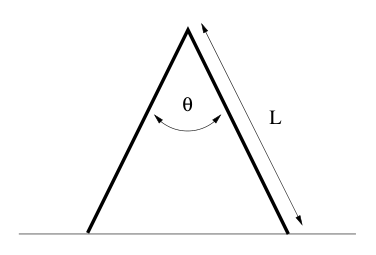 segno a V con due gambe incernierate
Topic: Rigid Body Statics, Newtonian Mechanics Metodi: Free-Body Diagram, Torque & Angular Momentum Analysis, Vector Decomposition Competenze: Diagrammatic Reasoning, Mathematical Modeling Objects: Rod Fonte: Testo (PDF) — p.2
- Il segno mostrato di seguito è costituito da due gambe uniformi collegate da una cerniera senza attrito. Coefficiente di attrito tra il terreno e le gambe è . Qual è il valore massimo di di cui il segnale non crollare? L
- A.
- B.
- C.
- D.
- E.
Le seguenti informazioni si applicano alle domande 5 e 6 Uno studente sale su un ascensore stazionario e si trova su una scala del bagno. L’ ascensore viaggia poi dall’ alto dall’edificio alla base. Lo studente registra la lettura sulla scala in funzione del tempo.
segno a V con dovuta contaggio incerto
Topic: Rigid Body Statics, Newtonian Mechanics Metodi: Free-Body Diagram, Torque & Angular Momentum Analysis, Vector Decomposition Competenze: Diagrammatic Reasoning, Mathematical Modeling Objects: Rod Fonte: Testo (PDF) — p.2
- At what time(s) does the student have maximum downward velocity?
- A. At all times between 2 s and 4 s
- B. At 4 s only
- C. At all times between 4 s and 22 s
- D. At 22 s only
- E. At all times between 22 s and 24 s
Topic: Newtonian Mechanics Metodi: Kinematic Equations, Free-Body Diagram, Experimental Data Analysis Competenze: Graph Linearization, Physical Reasoning Objects: — Fonte: Testo (PDF) — p.3
- A che ora il studente ha la velocità massima verso il basso?
- A. In ogni momento tra 2 e 4 s
- B. Solo a 4 secondi
- C. In ogni momento tra 4 e 22 secondi
- D. Solo a 22 secondi
- E. In ogni momento tra 22 e 24 secondi
Topic: Newtonian Mechanics Metodi: Kinematic Equations, Free-Body Diagram, Experimental Data Analysis Competenze: Graph Linearization, Physical Reasoning Objects: — Fonte: Testo (PDF) — p.3
- How tall is the building?
- A. 50 m
- B. 80 m
- C. 100 m
- D. 150 m
- E. 400 m
Topic: Newtonian Mechanics Metodi: Kinematic Equations, Experimental Data Analysis, Calculus-Integration Competenze: Graph Linearization, Mathematical Modeling Objects: — Fonte: Testo (PDF) — p.3
- Quanto è alta l’edificio?
- A. 50 m
- B. 80 m
- C. 100 m
- D. 150 m
- E. 400 m
Topic: Newtonian Mechanics Metodi: Kinematic Equations, Experimental Data Analysis, Calculus-Integration Competenze: Graph Linearization, Mathematical Modeling Objects: — Fonte: Testo (PDF) — p.3
- A light car and a heavy truck have the same momentum. The truck weighs ten times as much as the car. How do their kinetic energies compare?
- A. The truck’s kinetic energy is larger by a factor of 100
- B. They truck’s kinetic energy is larger by a factor of 10
- C. They have the same kinetic energy
- D. The car’s kinetic energy is larger by a factor of 10
- E. The car’s kinetic energy is larger by a factor of 100
The following information applies to questions 8 and 9 A truck is initially moving at velocity . The driver presses the brake in order to slow the truck to a stop. The brake applies a constant force to the truck. The truck rolls a distance before coming to a stop, and the time it takes to stop is .
Topic: Conservation of Momentum, Conservation of Energy Metodi: Conservation of Energy, Conservation of Momentum, Conservation Laws Competenze: Physical Reasoning, Mathematical Modeling Objects: — Fonte: Testo (PDF) — p.3
- Una macchina leggera e un camion pesante hanno lo stesso impulso. Il camion pesa dieci volte più della macchina. Come si fa le loro energie cinetiche si confrontano?
- A. L’energia cinetica del camion è maggiore di un fattore 100
- B. L’energia cinetica del camion è maggiore di un fattore 10
- C. Hanno la stessa energia cinetica
- D. L’energia cinetica dell’auto è maggiore di un fattore 10
- E. L’energia cinetica dell’auto è maggiore di un fattore 100
Le seguenti informazioni si applicano alle domande 8 e 9 Un camion inizia a muoversi a velocità . Il conducente premere il freno per rallentare il camion fino a fermarsi. Il il freno applica una forza costante al camion. Il camion si snoda una distanza prima di arrivare a un punto di sospensione, e il tempo il tempo necessario per fermarsi è .
Topic: Conservation of Momentum, Conservation of Energy Metodi: Conservation of Energy, Conservation of Momentum, Conservation Laws Competenze: Physical Reasoning, Mathematical Modeling Objects: — Fonte: Testo (PDF) — p.3
- Which of the following expressions is equal the initial kinetic energy of the truck (i.e. the kinetic energy before the driver starts braking)?
- A.
- B.
- C.
- D.
- E. Both (a) and (b) are correct
Topic: Conservation of Energy, Newtonian Mechanics Metodi: Energy Conservation Method, Conservation Laws, Kinematic Equations Competenze: Physical Reasoning, Mathematical Modeling Objects: — Fonte: Testo (PDF) — p.4
- Qual è l’espressione di cui sopra che equivale all’energia cinetica iniziale del camion (cioè: l’energia cinetica prima della il conducente comincia a frenare)?
- A.
- B.
- C.
- D.
- E. Entrambe le lettere a) e b) sono corrette
Topic: Conservation of Energy, Newtonian Mechanics Metodi: Energy Conservation Method, Conservation Laws, Kinematic Equations Competenze: Physical Reasoning, Mathematical Modeling Objects: — Fonte: Testo (PDF) — p.4
- Which of the following expressions is equal the initial momentum of the truck (i.e. the momentum before the driver starts braking)?
- A.
- B.
- C.
- D.
- E.
Topic: Conservation of Momentum, Newtonian Mechanics Metodi: Impulse-Momentum Theorem, Conservation Laws, Kinematic Equations Competenze: Physical Reasoning, Mathematical Modeling Objects: — Fonte: Testo (PDF) — p.4
- Qual è la seguente espressione che equivale al momento iniziale del camion (cioè: l’impulso davanti al conducente comincia a frenare)?
- A.
- B.
- C.
- D.
- E.
Topic: Conservation of Momentum, Newtonian Mechanics Metodi: Impulse-Momentum Theorem, Conservation Laws, Kinematic Equations Competenze: Physical Reasoning, Mathematical Modeling Objects: — Fonte: Testo (PDF) — p.4
- Which of the following can be used to distinguish a solid ball from a hollow sphere of the same radius and mass?
- A. Measurements of the orbit of a test mass around the object.
- B. Measurements of the time it takes the object to roll down an inclined plane.
- C. Measurements of the tidal forces applied by the object to a liquid body.
- D. Measurements of the behavior of the object as it floats in water.
- E. Measurements of the force applied to the object by a uniform gravitational field.
Topic: Rotational Dynamics, Newtonian Mechanics Metodi: Torque & Angular Momentum Analysis, Physical Modeling Competenze: Physical Reasoning, Diagrammatic Reasoning Objects: Ball, Sphere, Inclined Plane Fonte: Testo (PDF) — p.4
- Quale di queste caratteristiche può essere usato per distinguere una palla solida da una sfera vuota dello stesso raggio e della stessa massa?
- A. Misure dell’orbita di una massa di prova attorno all’oggetto.
- B. Misure del tempo necessario per far rotolare l’oggetto in un piano inclinato.
- C. Misure delle forze di marea applicate dall’oggetto ad un corpo liquido.
- D. Misure del comportamento dell’oggetto mentre galleggia in acqua.
- E. Misure della forza applicata all’oggetto da un campo gravitazionale uniforme.
Topic: Rotational Dynamics, Newtonian Mechanics Metodi: Torque & Angular Momentum Analysis, Physical Modeling Competenze: Physical Reasoning, Diagrammatic Reasoning Objects: Ball, Sphere, Inclined Plane Fonte: Testo (PDF) — p.4
- A right-triangular wooden block of mass is at rest on a table, as shown in figure. Two smaller wooden cubes, both with mass , initially rest on the two sides of the larger block. As all contact surfaces are frictionless, the smaller cubes start sliding down the larger block while the block remains at rest. What is the normal force from the system to the table? 90 m m M
- A.
- B.
- C.
- D.
- E.
Topic: Newtonian Mechanics Metodi: Free-Body Diagram, Vector Decomposition, Conservation Laws Competenze: Diagrammatic Reasoning, Mathematical Modeling Objects: Wedge, Block Fonte: Testo (PDF) — p.4
- Un blocco di legno triangolare retto di massa è a riposo su un tavolo, come mostrato nella figura. Due cubetti di legno più piccoli, entrambe con massa , inizialmente appoggiate sui due lati del blocco più grande. Poiché tutte le superfici di contatto sono senza attrito, il i cubetti più piccoli iniziano a scivolare verso il blocco più grande mentre il blocco rimane a riposo. Qual è la forza normale di Il sistema al tavolo? 90 m m M
- A.
- B.
- C.
- D.
- E.
Topic: Newtonian Mechanics Metodi: Free-Body Diagram, Vector Decomposition, Conservation Laws Competenze: Diagrammatic Reasoning, Mathematical Modeling Objects: Wedge, Block Fonte: Testo (PDF) — p.4
- A spherical shell of mass and radius is completely filled with a frictionless fluid, also of mass . It is released from rest, and then it rolls without slipping down an incline that makes an angle with the horizontal. What will be the acceleration of the shell down the incline just after it is released? Assume the acceleration of free fall is . The moment of inertia of a thin shell of radius and mass about the center of mass is ; the moment of inertia of a solid sphere of radius and mass about the center of mass is .
- A.
- B.
- C.
- D.
- E.
Topic: Rotational Dynamics, Newtonian Mechanics Metodi: Torque & Angular Momentum Analysis, Free-Body Diagram, Energy Conservation Method Competenze: Mathematical Modeling, Diagrammatic Reasoning Objects: Sphere, Inclined Plane Fonte: Testo (PDF) — p.5
- Un guscio sferico di massa e di raggio è completamente riempito di un fluido senza attrito, anche di massa . È rilasciato di riposo, e poi ruota senza scivolare verso il basso, che fa un angolo con l’orizzontale. Che cosa l’accelerazione della conchiglia verso il basso, appena rilasciata? Supponiamo che l’accelerazione della caduta libera sia . Il momento di inerzia di una sottile conchiglia di raggio e massa circa il centro di massa è ; il momento di inerzia di una sfera solida di raggio e massa circa il centro di massa è .
- A.
- B.
- C.
- D.
- E.
Topic: Rotational Dynamics, Newtonian Mechanics Metodi: Torque & Angular Momentum Analysis, Free-Body Diagram, Energy Conservation Method Competenze: Mathematical Modeling, Diagrammatic Reasoning Objects: Sphere, Inclined Plane Fonte: Testo (PDF) — p.5
- There is a ring outside of Saturn. In order to distinguish if the ring is actually a part of Saturn or is instead part of the satellites of Saturn, we need to know the relation between the velocity of each layer in the ring and the distance of the layer to the center of Saturn. Which of the following statements is correct?
- A. If , then the layer is part of Saturn.
- B. If , then the layer is part of the satellites of Saturn.
- C. If , then the layer is part of Saturn.
- D. If , then the layer is part of Saturn.
- E. If , then the layer is part of the satellites of Saturn.
Topic: Gravitation, Astrophysics Metodi: Newton’s Law of Gravitation, Kepler’s Laws Competenze: Physical Reasoning, Mathematical Modeling Objects: Planet, Satellite Fonte: Testo (PDF) — p.5
- C’è un anello fuori di Saturno. Per distinguere se l’anello è effettivamente una parte di Saturno o è invece parte di di tutti i satelliti di Saturno, dobbiamo conoscere la relazione tra la velocità di ogni strato nell’anello e la velocità Distanza dello strato al centro di Saturno. Quale delle seguenti affermazioni è corretta?
- A. Se , allora lo strato fa parte di Saturno.
- B. Se , allora lo strato fa parte dei satelliti di Saturno.
- C. Se , allora lo strato fa parte di Saturno.
- D. Se , allora lo strato fa parte di Saturno.
- E. Se , allora lo strato fa parte dei satelliti di Saturno.
Topic: Gravitation, Astrophysics Metodi: Newton’s Law of Gravitation, Kepler’s Laws Competenze: Physical Reasoning, Mathematical Modeling Objects: Planet, Satellite Fonte: Testo (PDF) — p.5
- A cart of mass moving at 12 m/s to the right collides elastically with a cart of mass 4.0 kg that is originally at rest. After the collision, the cart of mass moves to the left with a velocity of 6.0 m/s. Assuming an elastic collision in one dimension only, what is the velocity of the center of mass () of the two carts before the collision?
- A. m/s
- B. m/s
- C. m/s
- D. m/s
- E. m/s
Topic: Conservation of Momentum, Conservation of Energy Metodi: Conservation of Momentum, Conservation of Energy, Conservation Laws Competenze: Physical Reasoning, Mathematical Modeling Objects: Cart Fonte: Testo (PDF) — p.5
- Un carrello di massa che si muove a 12 m/s a destra si schianta elasticamente con un carrello di massa di 4,0 kg che è originariamente
- In riposo. Dopo la collisione, il carrello di massa si sposta a sinistra con una velocità di 6,0 m/s. Supponendo un’elastica collisione in una dimensione soltanto, qual è la velocità del centro di massa () dei due carri prima della collisione?
- A. m/s
- B. m/s
- C. m/s
- D. m/s
- E. m/s
Topic: Conservation of Momentum, Conservation of Energy Metodi: Conservation of Momentum, Conservation of Energy, Conservation Laws Competenze: Physical Reasoning, Mathematical Modeling Objects: Cart Fonte: Testo (PDF) — p.5
- A uniform rod is partially in water with one end suspended, as shown in figure. The density of the rod is 5/9 that of water. At equilibrium, what portion of the rod is above water?
- A. 0.25
- B. 0.33
- C. 0.5
- D. 0.67
- E. 0.75
Topic: Fluid Mechanics, Rigid Body Statics Metodi: Hydrostatic Equilibrium, Torque & Angular Momentum Analysis, Free-Body Diagram Competenze: Physical Reasoning, Mathematical Modeling Objects: Rod Fonte: Testo (PDF) — p.5
- Una canna uniforme è parzialmente immersa in acqua con un’estremità sospesa, come mostrato nella figura. La densità della canna è di 5/9 che di acqua. In equilibrio, quale parte della canna è sopra l’acqua?
- A. 0.25
- B. 0.33
- C. 0.5
- D. 0.67
- E. 0.75
Topic: Fluid Mechanics, Rigid Body Statics Metodi: Hydrostatic Equilibrium, Torque & Angular Momentum Analysis, Free-Body Diagram Competenze: Physical Reasoning, Mathematical Modeling Objects: Rod Fonte: Testo (PDF) — p.5
- Inspired by a problem from the 2012 International Physics Olympiad, Estonia. A very large number of small particles forms a spherical cloud. Initially they are at rest, have uniform mass density per unit volume , and occupy a region of radius . The cloud collapses due to gravitation; the particles do not interact with each other in any other way. How much time passes until the cloud collapses fully? (The constant 0.5427 is actually .)
- A.
- B.
- C.
- D.
- E.
Topic: Gravitation, Astrophysics Metodi: Newton’s Law of Gravitation, Dimensional Analysis, Energy Conservation Method Competenze: Mathematical Modeling, Estimation & Approximation Objects: — Fonte: Testo (PDF) — p.6
- Ispirato da un problema della Olimpiada Internazionale di Fisica del 2012, in Estonia. Un gran numero di piccole particelle forma una nuvola sferica. Inizialmente sono a riposo, hanno una densità di massa uniforme per unità di volume , e occupano una regione di raggio . La nuvola crolla a causa della gravità; le particelle non interagire tra loro in qualsiasi altro modo. Quanto tempo passa prima che la nuvola crolla completamente? (La costante 0,5427 è in realtà .)
- A.
- B.
- C.
- D.
- E.
Topic: Gravitation, Astrophysics Metodi: Newton’s Law of Gravitation, Dimensional Analysis, Energy Conservation Method Competenze: Mathematical Modeling, Estimation & Approximation Objects: — Fonte: Testo (PDF) — p.6
- Two small, equal masses are attached by a lightweight rod. This object orbits a planet; the length of the rod is smaller than the radius of the orbit, but not negligible. The rod rotates about its axis in such a way that it remains vertical with respect to the planet. • Is there a force in the rod? If so, is it tension or compression? • Is the equilibrium stable, unstable, or neutral with respect to a small perturbation in the angle of the rod? (Assume this perturbation maintains the rate of rotation, so that in the co-rotating frame the rod is still stationary but at an angle to the vertical.)
- A. There is no force in the rod; the equilibrium is neutral.
- B. The rod is in tension; the equilibrium is stable.
- C. The rod is in compression; the equilibrium is stable.
- D. The rod is in tension; the equilibrium is unstable.
- E. The rod is in compression; the equilibrium is unstable.
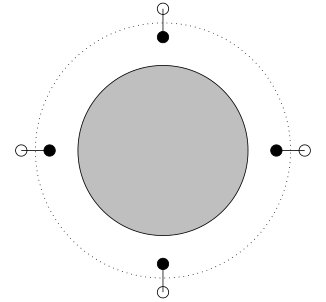 orbita due masse attorno a pianeta
Topic: Gravitation, Newtonian Mechanics Metodi: Newton’s Law of Gravitation, Free-Body Diagram, Physical Modeling Competenze: Physical Reasoning, Mathematical Modeling Objects: Rod, Planet Fonte: Testo (PDF) — p.6
- Due piccole masse uguali sono attaccate da una canna leggera. Questo oggetto orbita intorno a un pianeta; la lunghezza della canna è inferiore al raggio orbitale, ma non trascurabile. La canna ruota intorno al suo asse in modo tale che rimanga Verticale rispetto al pianeta. • C’è una forza nella canna? Se sì, è tensione o compressione? • L’equilibrio è stabile, instabile o neutrale rispetto a una piccola perturbazione nell’angolo del
- La canna? (Supponiamo che questa perturbazione mantenga il tasso di rotazione, in modo che nel quadro di rotazione co- è ancora fermo ma in angolo verso la verticale.)
- A. Non c’è forza nella canna; l’equilibrio è neutrale.
- B. La canna è in tensione; l’equilibrio è stabile.
- C. La canna è in compressione; l’equilibrio è stabile.
- D. La canna è in tensione; l’equilibrio è instabile.
- E. La canna è in compressione; l’equilibrio è instabile.
orbita dovuta a massa attorno a una pianeta
Topic: Gravitation, Newtonian Mechanics Metodi: Newton’s Law of Gravitation, Free-Body Diagram, Physical Modeling Competenze: Physical Reasoning, Mathematical Modeling Objects: Rod, Planet Fonte: Testo (PDF) — p.6
- Two point particles, each of mass 1 kg, begin in the state shown below. 1.0 m/s 1.0 m/s x (m) y (m) The system evolves through internal forces only. Which of the following could be the state after some time has passed? (A) (B) (C) (D) (E)
The following information applies to questions 19, 20, and 21. A simple pendulum experiment is constructed from a point mass attached to a pivot by a massless rod of length in a constant gravitational field. The rod is released from an angle at rest and the period of motion is found to be . Ignore air resistance and friction.
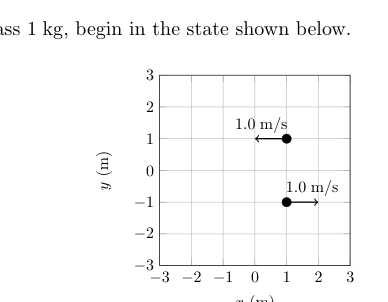 stato iniziale due particelle puntiformi
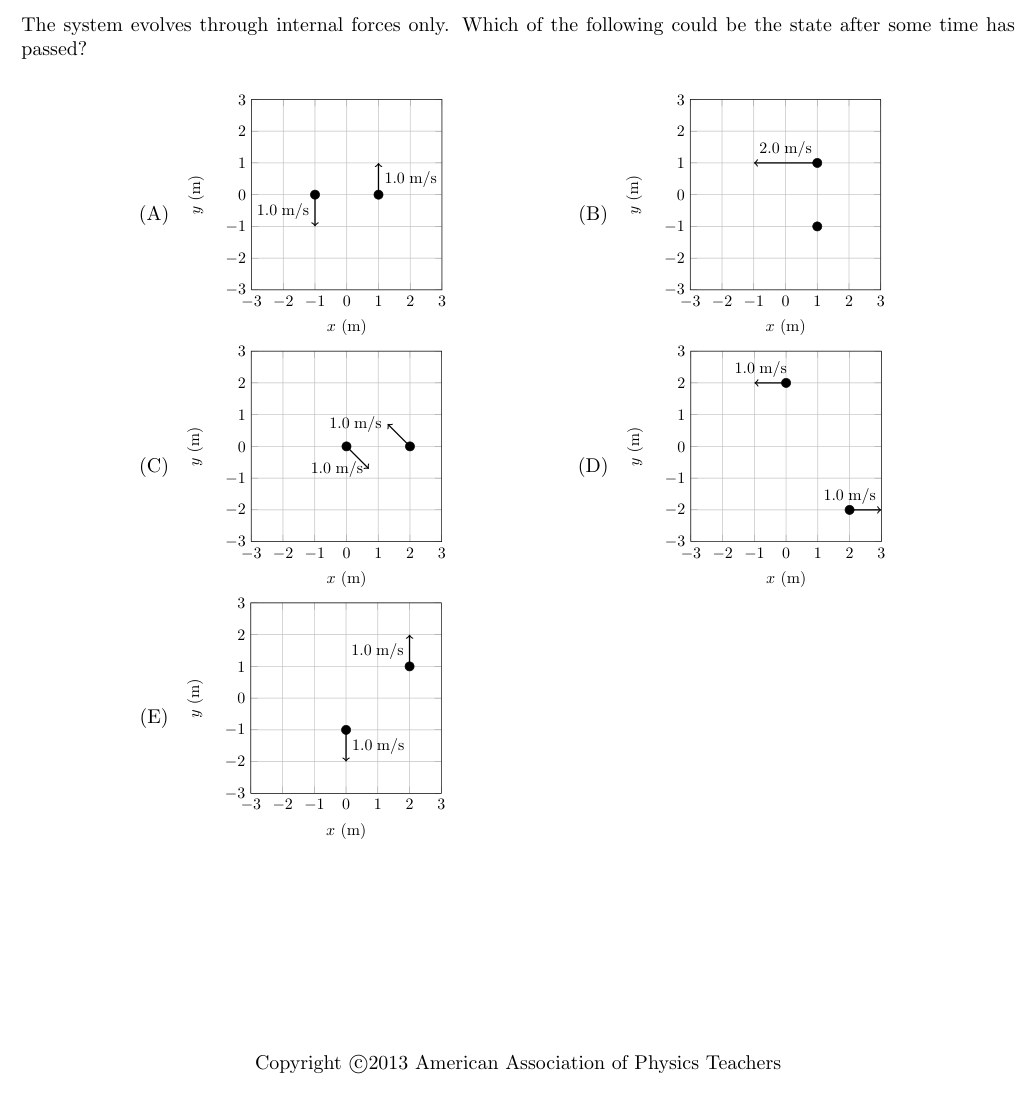 scelte A-E stato finale due particelle
Topic: Conservation of Momentum, Conservation of Energy Metodi: Conservation of Momentum, Conservation of Energy, Conservation Laws Competenze: Physical Reasoning, Diagrammatic Reasoning Objects: — Fonte: Testo (PDF) — p.7
- Due particelle puntate, ciascuna di massa di 1 kg, iniziano nello stato indicato di seguito. 1.0 m/s 1.0 m/s x (m) y (m) Il sistema si evolve solo attraverso le forze interne. Qual è lo stato dopo un certo tempo che ha
- Passato? (A) (B) (C) (D) (E)
Le seguenti informazioni si applicano alle domande 19, 20 e 21. Un semplice esperimento di pendolo viene costruito da una massa puntaria attaccata a un pivot da una barra senza massa di lunghezza in un campo gravitazionale costante. La canna viene rilasciata da un angolo in riposo e il periodo di movimento è risultato . Ignora la resistenza e l’attrito dell’aria.
statuto iniziale dovute particelle puntiformi
cellula A-E stato finale particella dovuta
Topic: Conservation of Momentum, Conservation of Energy Metodi: Conservation of Momentum, Conservation of Energy, Conservation Laws Competenze: Physical Reasoning, Diagrammatic Reasoning Objects: — Fonte: Testo (PDF) — p.7
- At what angle during the swing is the tension in the rod the greatest?
- A. The tension is the greatest at the point .
- B. The tension is the greatest at the point .
- C. The tension is the greatest at an angle with .
- D. The tension is constant.
- E. None of the above is true for all values of with .
Topic: Oscillations & Waves, Newtonian Mechanics Metodi: Simple Harmonic Motion Analysis, Free-Body Diagram, Energy Conservation Method Competenze: Physical Reasoning, Mathematical Modeling Objects: Pendulum Fonte: Testo (PDF) — p.8
- A quale angolo durante lo swing è la tensione della canna maggiore?
- A. La tensione è maggiore al punto .
- B. La tensione è maggiore al punto .
- C. La tensione è maggiore ad un angolo con .
- ** D.** La tensione è costante.
- E. Nessuno di questi elementi è valido per tutti i valori di con .
Topic: Oscillations & Waves, Newtonian Mechanics Metodi: Simple Harmonic Motion Analysis, Free-Body Diagram, Energy Conservation Method Competenze: Physical Reasoning, Mathematical Modeling Objects: Pendulum Fonte: Testo (PDF) — p.8
- What is the maximum value of the tension in the rod?
- A.
- B.
- C.
- D.
- E.
Topic: Oscillations & Waves, Newtonian Mechanics Metodi: Simple Harmonic Motion Analysis, Energy Conservation Method, Free-Body Diagram Competenze: Mathematical Modeling, Physical Reasoning Objects: Pendulum Fonte: Testo (PDF) — p.8
- Qual è il valore massimo della tensione nella canna?
- A.
- B.
- C.
- D.
- E.
Topic: Oscillations & Waves, Newtonian Mechanics Metodi: Simple Harmonic Motion Analysis, Energy Conservation Method, Free-Body Diagram Competenze: Mathematical Modeling, Physical Reasoning Objects: Pendulum Fonte: Testo (PDF) — p.8
- The experiment is repeated with a new pendulum with a rod of length , using the same angle , and the period of motion is found to be . Which of the following statements is correct?
- A. regardless of the value of .
- B. with if .
- C. with if .
- D. for some values of and for other values of .
- E. and are undefined because the motion is not periodic unless .
Topic: Oscillations & Waves Metodi: Simple Harmonic Motion Analysis, Small-Angle Approximation, Physical Modeling Competenze: Physical Reasoning, Mathematical Modeling Objects: Pendulum, Rod Fonte: Testo (PDF) — p.8
- L’esperimento viene ripetuto con un nuovo pendolo con una barra di lunghezza , utilizzando lo stesso angolo , e il periodo di movimento è risultato essere . Quale delle seguenti affermazioni è corretta?
- A. indipendentemente dal valore di .
- B. con se .
- C. con se .
- D. per alcuni valori di e per altri valori di .
- E. e sono indefiniti perché il movimento non è periodico a meno che .
Topic: Oscillations & Waves Metodi: Simple Harmonic Motion Analysis, Small-Angle Approximation, Physical Modeling Competenze: Physical Reasoning, Mathematical Modeling Objects: Pendulum, Rod Fonte: Testo (PDF) — p.8
- A simplified model on the foot is shown. When a student of mass kg stands on a single toe, the tension in the Achilles Tendon is closest to 0 4 8 12 16 20 24 28 32 36 40 Leg Bone Approximation of Foot Bone Toe Outline of Foot Ankle Joint Centimeter Rule Tendon Achilles
- A. N
- B. N
- C. N
- D. N
- E. N
The following information applies to questions 23 and 24 A man with mass jumps off of a high bridge with a bungee cord attached to his ankles. The man falls through a maximum distance at which point the bungee cord brings him to a momentary rest before he bounces back up. The bungee cord is perfectly elastic, obeying Hooke’s force law with a spring constant , and stretches from an original length of to a final length . The maximum tension in the Bungee cord is four times the weight of the man.
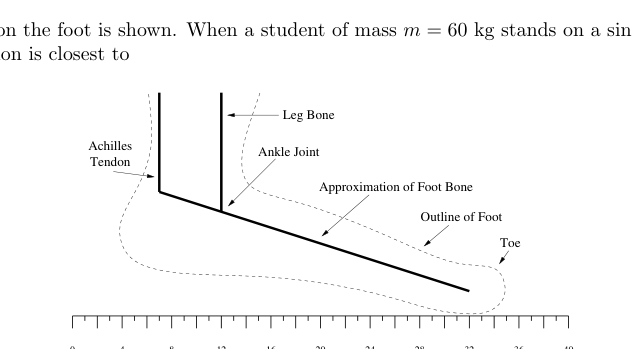 modello biomeccanico piede tendine Achille
Topic: Rigid Body Statics, Newtonian Mechanics Metodi: Torque & Angular Momentum Analysis, Free-Body Diagram, Experimental Data Analysis Competenze: Diagrammatic Reasoning, Estimation & Approximation Objects: — Fonte: Testo (PDF) — p.8
- Un modello semplificato è mostrato sul piede. Quando uno studente di massa kg si trova su un solo dito, la tensione nel tendone di Achille è il più vicino a 0 4 8 12 16 20 24 28 32 36 40 Osso delle gambe Approcisione dell’osso del piede Il piede Conto di piede Articolo articolare Regolamento del centimetro Tendole Achille
- A. N
- B. N
- C. N
- D. N
- E. N
Le seguenti informazioni si applicano alle domande 23 e 24 Un uomo di massa salta da un ponte alto con un cordone di bungee attaccato alle caviglie. L’ uomo cade una distanza massima al quale il cordone bungee lo porta a un momento di riposo prima di rimbalzare up. Il cordone bungee è perfettamente elastico, obbedendo alla legge di forza di Hooke con una costante di molla , e si estende da una lunghezza originale di fino a una lunghezza finale . La tensione massima del cavo Bungee è quattro volte quella di Il peso dell’uomo.
modello biomeccanico piede tendine Achille
Topic: Rigid Body Statics, Newtonian Mechanics Metodi: Torque & Angular Momentum Analysis, Free-Body Diagram, Experimental Data Analysis Competenze: Diagrammatic Reasoning, Estimation & Approximation Objects: — Fonte: Testo (PDF) — p.8
- Determine the spring constant .
- A.
- B.
- C.
- D.
- E.
Topic: Conservation of Energy, Oscillations & Waves Metodi: Hooke’s Law, Energy Conservation Method, Conservation Laws Competenze: Physical Reasoning, Mathematical Modeling Objects: Spring, String Fonte: Testo (PDF) — p.9
- Determinare la costante di primavera .
- A.
- B.
- C.
- D.
- E.
Topic: Conservation of Energy, Oscillations & Waves Metodi: Hooke’s Law, Energy Conservation Method, Conservation Laws Competenze: Physical Reasoning, Mathematical Modeling Objects: Spring, String Fonte: Testo (PDF) — p.9
- Find the maximum extension of the bungee cord .
- A.
- B.
- C.
- D.
- E.
Topic: Conservation of Energy, Oscillations & Waves Metodi: Hooke’s Law, Energy Conservation Method, Conservation Laws Competenze: Mathematical Modeling, Physical Reasoning Objects: Spring, String Fonte: Testo (PDF) — p.9
- Trova la massima estensione del cavo di bungee .
- A.
- B.
- C.
- D.
- E.
Topic: Conservation of Energy, Oscillations & Waves Metodi: Hooke’s Law, Energy Conservation Method, Conservation Laws Competenze: Mathematical Modeling, Physical Reasoning Objects: Spring, String Fonte: Testo (PDF) — p.9
- A box with weight will slide down a incline at constant speed under the influence of gravity and friction alone. If instead a horizontal force is applied to the box, the box can be made to move up the ramp at constant speed. What is the magnitude of ?
- A.
- B.
- C.
- D.
- E.
Topic: Newtonian Mechanics, Rigid Body Statics Metodi: Free-Body Diagram, Vector Decomposition, Kinematic Equations Competenze: Diagrammatic Reasoning, Mathematical Modeling Objects: Block, Inclined Plane Fonte: Testo (PDF) — p.9
- Una scatola con peso scivola in basso a una pendenza a velocità costante sotto l’influenza della gravità e dell’attrito
- Solo. Se invece viene applicata una forza orizzontale alla scatola, la scatola può essere fatta salire sulla rampa a una velocità costante
- Velocità. Qual è la magnitudine di ?
- A.
- B.
- C.
- D.
- E.
Topic: Newtonian Mechanics, Rigid Body Statics Metodi: Free-Body Diagram, Vector Decomposition, Kinematic Equations Competenze: Diagrammatic Reasoning, Mathematical Modeling Objects: Block, Inclined Plane Fonte: Testo (PDF) — p.9