Question A1
The flow of heat through a material can be described via the thermal conductivity . If the two faces of a slab of material with thermal conductivity , area , and thickness are held at temperatures differing by , the thermal power transferred through the slab is
A heat exchanger is a device which transfers heat between a hot fluid and a cold fluid; they are common in industrial applications such as power plants and heating systems. The heat exchanger shown below consists of two rectangular tubes of length , width , and height . The tubes are separated by a metal wall of thickness and thermal conductivity . Originally hot fluid flows through the lower tube at a speed from right to left, and originally cold fluid flows through the upper tube in the opposite direction (left to right) at the same speed. The heat capacity per unit volume of both fluids is .
The hot fluid enters the heat exchanger at a higher temperature than the cold fluid; the difference between the temperatures of the entering fluids is . When the fluids exit the heat exchanger the difference has been reduced to . (It is possible for the exiting originally cold fluid to have a higher temperature than the exiting originally hot fluid, in which case .)
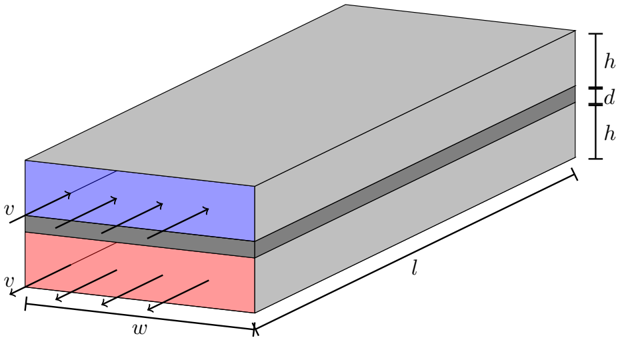
Assume that the temperature in each pipe depends only on the lengthwise position, and consider transfer of heat only due to conduction in the metal and due to the bulk movement of fluid. Under the assumptions in this problem, while the temperature of each fluid varies along the length of the exchanger, the temperature difference across the wall is the same everywhere. You need not prove this.
Find in terms of the other given parameters.
Topic: Thermodynamics Metodi: Differential Equations, Conservation of Energy, Calculus-Integration Competenze: Physical Reasoning, Mathematical Modeling Objects: Tube, Gas Fonte: Testo (PDF) - p.3
Domanda A1
Il flusso di calore attraverso un materiale può essere descritto mediante la conducibilità termica . Se le due facce di una lastra di materiale con conducibilità termico , superficie e spessore sono tenute a temperature diverse di , la potenza termico trasferita attraverso la lastra è
Lo scambio di calore è un dispositivo che trasmette il calore tra un fluido caldo e un fluido freddo; sono comuni nelle applicazioni industriali come centrali elettriche e sistemi di riscaldamento. L’eschangitore di calore mostrato di seguito è costituito da due tubi rettangolari di lunghezza , larghezza e altezza . I tubi sono separati da una parete di metallo di spessore e di conduttività termica . Originariamente il fluido caldo scorre attraverso il tubo inferiore a una velocità da destra a sinistra, e originariamente il fluido freddo scorre attraverso il tubo superiore nella direzione opposta (da sinistra a destra) alla stessa velocità. La capacità termico per unità di volume di entrambi i fluidi è .
Il liquido caldo entra nello scambiatore di calore ad una temperatura superiore a quella del liquido freddo; la differenza tra le temperature dei liquidi che entrano è . Quando i fluidi usciranno dallo scambiatore di calore, la differenza è stata ridotta a . (È possibile che il fluido uscente, originariamente freddo, abbia una temperatura superiore a quella del fluido uscente originariamente caldo, nel qual caso .)
Supponiamo che la temperatura di ciascun tubo dipenda solo dalla posizione longitudinale e consideriamo il trasferimento di calore solo a causa della conduzione nel metallo e a causa del movimento a granellamento del fluido. Secondo le ipotesi di questo problema, mentre la temperatura di ogni fluido varia lungo la lunghezza dello scambio, la differenza di temperatura attraverso la parete è la stessa ovunque. Non devi provarlo.
Trova in termini di altri parametri dati.
Topic: Thermodynamics Metodi: Differential Equations, Conservation of Energy, Calculus-Integration Competenze: Physical Reasoning, Mathematical Modeling Objects: Tube, Gas Fonte: Testo (PDF) - p.3
Question A2
A solid round object of radius can roll down an incline that makes an angle with the horizontal. Assume that the rotational inertia about an axis through the center of mass is given by . The coefficient of kinetic and static friction between the object and the incline is . The object moves from rest through a vertical distance .
a. If the angle of the incline is sufficiently large, then the object will slip and roll; if the angle of the incline is sufficiently small, then the object will roll without slipping. Determine the angle that separates the two types of motion.
b. Derive expressions for the linear acceleration of the object down the ramp in the case of
- i. Rolling without slipping, and
- ii. Rolling and slipping.
Topic: Rotational Dynamics Metodi: Torque & Angular Momentum Analysis, Free-Body Diagram, Vector Decomposition Competenze: Physical Reasoning, Diagrammatic Reasoning Objects: Inclined Plane, Sphere Fonte: Testo (PDF) - p.4
# Domanda A2
Un oggetto rotondo solido di raggio può rullare in discesa una pendenza che fa un angolo con l’orizzontale. Supponiamo che l’inerzia di rotazione intorno ad un asse attraverso il centro di massa sia data da . Il coefficiente di attrito cinetico e statico tra l’oggetto e l’inclinazione è . L’oggetto si muove dal riposo attraverso una distanza verticale .
a. Se l’angolo di inclinazione è sufficientemente grande, l’oggetto scivola e rulla; se l’angolo di inclinazione è sufficientemente piccolo, l’oggetto rulla senza scivolare. Determinare l’angolo che separa i due tipi di movimento.
b. Espressioni derivate per l’accelerazione lineare dell’oggetto lungo la rampa nel caso di
- i. Rolle senza scivolare, e
- ii. Rolla e scivola.
Topic: Rotational Dynamics Metodi: Torque & Angular Momentum Analysis, Free-Body Diagram, Vector Decomposition Competenze: Physical Reasoning, Diagrammatic Reasoning Objects: Inclined Plane, Sphere Fonte: Testo (PDF) - p.4
Question A3
A beam of muons is maintained in a circular orbit by a uniform magnetic field. Neglect energy loss due to electromagnetic radiation.
The mass of the muon is kg, its charge is C, and its half-life is .
a. The speed of the muons is much less than the speed of light. It is found that half of the muons decay during each full orbit. What is the magnitude of the magnetic field?
b. The experiment is repeated with the same magnetic field, but the speed of the muons is increased; it is no longer much less than the speed of light. Does the fraction of muons which decay during each full orbit increase, decrease, or stay the same?
The following facts about special relativity may be useful:
- The Lorentz factor for a particle moving at speed is
- The Lorentz factor gives the magnitude of time dilation; that is, a clock moving at speed in a given reference frame runs slow by a factor in that frame.
- The momentum of a particle is given by
where does not depend on .
- The Lorentz force law in the form
continues to hold.
Topic: Special Relativity, Magnetism Metodi: Lorentz Force Analysis, Radioactive Decay Law, Lorentz Transformation Competenze: Physical Reasoning, Mathematical Modeling Objects: Particle Beam Fonte: Testo (PDF) - p.4
Domanda A3
Un raggio di muoni è mantenuto in orbita circolare da un campo magnetico uniforme. Trascurare la perdita di energia dovuta alle radiazioni elettromagnetiche.
La massa del muone è kg, la sua carica è C e la sua emivita è .
a. La velocità dei muoni è molto inferiore alla velocità della luce. Si scopre che la metà dei muoni decompone durante ogni orbita completa. Qual è la magnitudine del campo magnetico?
b. L’esperimento viene ripetuto con lo stesso campo magnetico, ma la velocità dei muoni è aumentata; non è più molto inferiore alla velocità della luce. La frazione di muoni che decompongono durante ogni orbita completa aumenta, diminuisce o rimane la stessa?
I seguenti fatti sulla relatività speciale possono essere utili:
- Il fattore Lorentz per una particella che si muove a velocità è
- Il fattore Lorentz dà la grandezza della dilatazione temporale; cioè, un orologio che si muove a velocità in un determinato quadro di riferimento corre lentamente di un fattore in quel quadro.
- L’impulso di una particella è dato da
in cui non dipende da .
- La legge della forza di Lorentz nella forma
continua a resistere.
Topic: Special Relativity, Magnetism Metodi: Lorentz Force Analysis, Radioactive Decay Law, Lorentz Transformation Competenze: Physical Reasoning, Mathematical Modeling Objects: Particle Beam Fonte: Testo (PDF) - p.4
Question A4
A graduated cylinder is partially filled with water; a rubber duck floats at the surface. Oil is poured into the graduated cylinder at a slow, constant rate, and the volume marks corresponding to the surface of the water and the surface of the oil are recorded as a function of time.
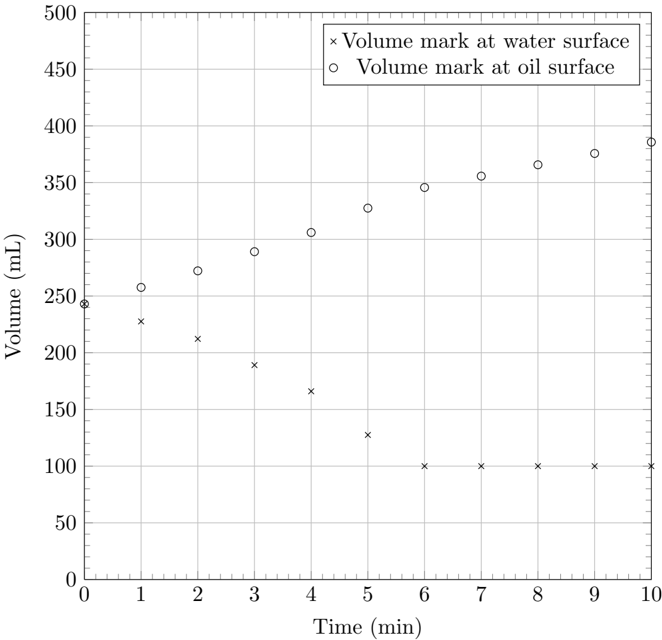
Water has a density of ; the density of air is negligible, as are surface effects. Find the density of the oil.
Topic: Fluid Mechanics Metodi: Hydrostatic Equilibrium, Experimental Data Analysis, Graph Linearization Competenze: Physical Reasoning, Experimental Data Analysis, Graph Linearization Objects: Container Fonte: Testo (PDF) - p.5
# Domanda A4
Un cilindro graduato è parzialmente riempito di acqua; un anato di gomma galleggia alla superficie. L’olio viene versato nel cilindro graduato a velocità lenta e costante e i segni di volume corrispondenti alla superficie dell’acqua e della superficie dell’olio vengono registrati in funzione del tempo.
L’acqua ha una densità di ; la densità dell’aria è trascurabile, così come gli effetti superficiali. Trova la densità dell’olio.
Topic: Fluid Mechanics Metodi: Hydrostatic Equilibrium, Experimental Data Analysis, Graph Linearization Competenze: Physical Reasoning, Experimental Data Analysis, Graph Linearization Objects: Container Fonte: Testo (PDF) - p.5
Question B1
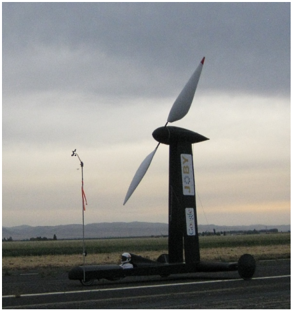
Shown below is the Blackbird, a vehicle built in 2009.
There is no source of stored energy such as a battery or gasoline engine; all of the power used to move the car comes from the wind. The only important mechanism in the car is a gearbox that can transfer power between the wheels and the propeller.
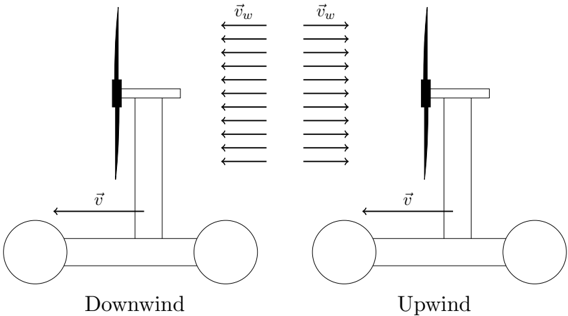
The Blackbird was driven both directly downwind and directly upwind, as shown below. In each case the car remained exactly parallel (or anti-parallel) to the wind without turning. The tests were conducted on level ground, in steady, uniform wind, and continued long enough to reach the steady state.
Source: fasterthanthewind.org
When driving downwind, the builders claim that they were able to drive “faster than the wind”: that is, with , so that the car experienced a relative headwind while traveling. Commenters on the Internet claimed, often angrily, that this was physically impossible and that the Blackbird was a hoax. Some commenters also claimed that the upwind case was physically impossible.
a. Consider first the downwind faster than the wind case.
- Is the motion actually possible as claimed? If not, offer a brief explanation!
- If the motion is possible, is power transferred from the propeller to the wheels or vice versa?
- If the motion is possible, what ground speed is attained? For this question, suppose that when transferring power in either direction between the propeller and the wheels, a fraction of the useful work is lost; let the wind speed be . Neglect all other losses of energy.
b. Answer the previous questions for the upwind case.
Topic: Conservation of Energy, Newtonian Mechanics Metodi: Conservation of Energy, Physical Modeling, Free-Body Diagram Competenze: Physical Reasoning, Estimation & Approximation Objects: Wheel, Cart Fonte: Testo (PDF) - p.7
Domanda B1
Sotto è il Blackbird, un veicolo costruito nel 2009.
Non c’è fonte di energia immagazzinata come una batteria o un motore a benzina; tutta la potenza utilizzata per muovere l’auto proviene dal vento. L’unico meccanismo importante dell’auto è una scatola di ingranaggi che può trasferire potenza tra le ruote e l’elica.
Il Blackbird fu spinto sia direttamente verso il vento che verso l’alto, come mostrato di seguito. In ogni caso la macchina rimase esattamente parallela (o antiparallel) al vento senza girare. Le prove sono state effettuate su terreno piatto, con vento stabile e uniforme, e sono state continuate abbastanza a lungo da raggiungere lo stato di stabilità.
Fonte: fasterthanthewind.org
Quando si guida verso il vento, i costruttori sostengono di essere in grado di guidare “più velocemente del vento”: cioè con , in modo che l’auto abbia sperimentato un relativo vento contrario durante il viaggio. I commentatori su Internet sostenevano, spesso con rabbia, che questo era fisicamente impossibile e che il Blackbird era una farsa. Alcuni commentatori sostenevano anche che il caso del vento al rialzo era fisicamente impossibile.
a. Considerate prima il vento a bassa più veloce del vento.
- La mozione è davvero possibile come si dice? Se no, offri una breve spiegazione!
- Se il movimento è possibile, la potenza viene trasferita dalla ecrina alle ruote o viceversa?
- Se il movimento è possibile, che velocità di terra si raggiunge? Per questa domanda, supponiamo che quando si trasferisce potenza in entrambe le direzioni tra l’elica e le ruote, si perda una frazione del lavoro utile; la velocità del vento sia . Lasciare perdere tutte le altre perdite di energia.
b. Rispondi alle domande precedenti per il caso di vento.
Topic: Conservation of Energy, Newtonian Mechanics Metodi: Conservation of Energy, Physical Modeling, Free-Body Diagram Competenze: Physical Reasoning, Estimation & Approximation Objects: Wheel, Cart Fonte: Testo (PDF) - p.7
Question B2
This problem concerns three situations involving the transfer of energy into a region of space by electromagnetic fields. In the first case, that energy is stored in the kinetic energy of a charged object; in the second and third cases, the energy is stored in an electric or magnetic field.
In general, whenever an electric and a magnetic field are at an angle to each other, energy is transferred; for example, this principle is the reason electromagnetic radiation transfers energy. The power transferred per unit area is given by the Poynting vector:
In each part of this problem, the last subpart asks you to verify that the rate of energy transfer agrees with the formula for the Poynting vector. Therefore, you should not use the formula for the Poynting vector before the last subpart!
a. A long, insulating cylindrical rod has radius and carries a uniform volume charge density . A uniform external electric field exists in the direction of its axis. The rod moves in the direction of its axis at speed .
- i. What is the power per unit length delivered to the rod?
- ii. What is the magnetic field at the surface of the rod? Draw the direction on a diagram.
- iii. Compute the Poynting vector, draw its direction on a diagram, and verify that it agrees with the rate of energy transfer.
b. A parallel plate capacitor consists of two discs of radius separated by a distance . The capacitor carries charge , and is being charged by a small, constant current .
- i. What is the power delivered to the capacitor?
- ii. What is the magnetic field just inside the edge of the capacitor? Draw the direction on a diagram. (Ignore fringing effects in the electric field for this calculation.)
- iii. Compute the Poynting vector, draw its direction on a diagram, and verify that it agrees with the rate of energy transfer.
c. A long solenoid of radius has turns of wire per unit length. The solenoid carries current , and this current is increased at a small, constant rate .
- i. What is the power per unit length delivered to the solenoid?
- ii. What is the electric field just inside the surface of the solenoid? Draw its direction on a diagram.
- iii. Compute the Poynting vector, draw its direction on a diagram, and verify that it agrees with the rate of energy transfer.
Topic: Electromagnetism Metodi: Ampere’s Law, Faraday’s Law of Induction, Gauss’s Law Competenze: Physical Reasoning, Diagrammatic Reasoning, Mathematical Modeling Objects: Capacitor, Solenoid, Wire Fonte: Testo (PDF) - p.7
Domanda B2
Questo problema riguarda tre situazioni che coinvolgono il trasferimento di energia in una regione dello spazio da campi elettromagnetici. Nel primo caso, tale energia viene immagazzinata nell’energia cinetica di un oggetto carico; nel secondo e nel terzo caso, l’energia viene immagazzinata in un campo elettrico o magnetico.
In generale, ogni volta che un campo elettrico e magnetico sono all’angolo l’uno dell’altro, l’energia viene trasferita; ad esempio, questo principio è il motivo per cui la radiazione elettromagnetica trasferisce energia. La potenza trasferita per unità di superficie è data dal vettore di Poynting:
In ogni parte di questo problema, l’ultima sottoparte ti chiede di verificare che il tasso di trasferimento di energia sia conforme alla formula per il vettore di Poynting. Pertanto, non è opportuno utilizzare la formula per il vettore di Poynting prima dell’ultima sottoparte!
a. Una lunga canna cilindrica isolante ha un raggio e una densità di carica di volume uniforme . Un campo elettrico esterno uniforme esiste nella direzione del suo asse. La canna si muove nella direzione del suo asse a velocità .
- i. Qual è la potenza per unità di lunghezza fornita alla canna?
- ii. Qual è il campo magnetico sulla superficie della canna? Disegna la direzione su un diagramma.
- III. Calcolare il vettore di Poynting, disegnare la sua direzione su un diagramma e verificare che sia conforme al tasso di trasferimento di energia.
b. Un condensatore di piastre parallele è costituito da due dischi di raggio separati da una distanza . Il condensatore porta carica e viene caricato da una corrente costante .
- i. Qual è la potenza fornita al condensatore?
- ii. Qual è il campo magnetico proprio all’interno del bordo del condensatore? Disegna la direzione su un diagramma. (In questo calcolo non si devono considerare gli effetti di frangimento nel campo elettrico.)
- III. Calcolare il vettore di Poynting, disegnare la sua direzione su un diagramma e verificare che sia conforme al tasso di trasferimento di energia.
c. Un solenoide lungo di raggio ha giri di filo per unità di lunghezza. Il solenoide porta corrente e questa corrente è aumentata a un ritmo piccolo e costante .
- i. Qual è la potenza per unità di lunghezza fornita al solenoide?
- ii. Qual è il campo elettrico appena all’interno della superficie del solenoide? Disegna la sua direzione su un diagramma.
- III. Calcolare il vettore di Poynting, disegnare la sua direzione su un diagramma e verificare che sia conforme al tasso di trasferimento di energia.
Topic: Electromagnetism Metodi: Ampere’s Law, Faraday’s Law of Induction, Gauss’s Law Competenze: Physical Reasoning, Diagrammatic Reasoning, Mathematical Modeling Objects: Capacitor, Solenoid, Wire Fonte: Testo (PDF) - p.7