A small block of mass is released from rest at the top of a curve-shaped, frictionless wedge of mass which sits on a frictionless horizontal surface as shown. When the block leaves the wedge its velocity is measured to be 4.00 m/s to the right as shown in the figure. If the mass of the block is doubled to become , what can be said about the speed with which it leaves the wedge?
- A. Its speed is less than 4.00 m/s
- B. Its speed is equal to 4.00 m/s
- C. Its speed is greater than 4.00 m/s
- D. Not enough information is given.
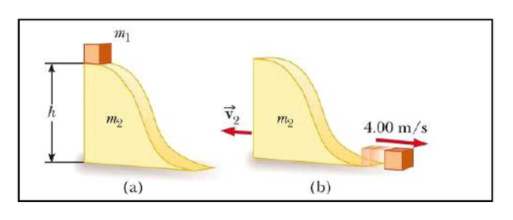 Block on frictionless wedge on surface
Topic: Conservation of Momentum, Newtonian Mechanics Metodi: Conservation of Momentum, Conservation of Energy Competenze: Physical Reasoning, Mathematical Modeling Objects: Block, Wedge Fonte: Testo (PDF) — p.2
Un piccolo blocco di massa viene rilasciato dal riposo nella parte superiore di una cucina senza attrito a forma di curva di massa che si trova su una superficie orizzontale senza attrito come mostrato. Quando il blocco lascia la cucina, la sua velocità è misurata a 4,00 m/s a destra come mostrato nella figura. Se la massa del blocco è raddoppiata per diventare , che si può dire della velocità con cui lascia la cuccia?
- A. La sua velocità è inferiore a 4,00 m/s
- B. La sua velocità è pari a 4,00 m/s
- C. La sua velocità è superiore a 4,00 m/s
- D. Non sono fornite informazioni sufficienti.
Block su una cucina senza attrito sulla superficie
Topic: Conservation of Momentum, Newtonian Mechanics Metodi: Conservation of Momentum, Conservation of Energy Competenze: Physical Reasoning, Mathematical Modeling Objects: Block, Wedge Fonte: Testo (PDF) — p.2
Consider the electric charges A, B, C shown in the figure below, where is a positive number. Which answer correctly describes the magnitude of the net force experienced by the charges?
- A.
- B.
- C.
- D.
- E.
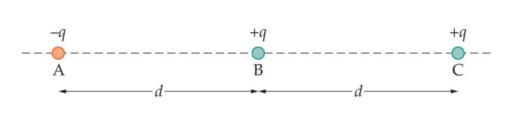 Three electric charges A, B, C configuration
Topic: Electrostatics Metodi: Coulomb’s Law, Superposition Principle Competenze: Physical Reasoning, Diagrammatic Reasoning Objects: Point Charge Fonte: Testo (PDF) — p.2
Considerate le cariche elettriche A, B, C mostrate nella figura seguente, dove è un numero positivo. Quale risposta descrive correttamente l’entità della forza netta sperimentata dalle cariche?
- A.
- B.
- C.
- D.
- E.
Tre cariche elettriche A, B, C configurazione
Topic: Electrostatics Metodi: Coulomb’s Law, Superposition Principle Competenze: Physical Reasoning, Diagrammatic Reasoning Objects: Point Charge Fonte: Testo (PDF) — p.2
A long, straight wire carries a current that decreases linearly with time. What is the direction of the induced electric field outside the wire?
- A. Parallel to the current in the wire, in the same direction.
- B. Parallel to the current in the wire, in the opposite direction.
- C. Pointing radially outward from the wire.
- D. Pointing radially inward toward the wire.
- E. There is no induced electric field outside the wire.
Topic: Electromagnetic Induction, Electromagnetism Metodi: Faraday’s Law of Induction, Ampère’s Law Competenze: Physical Reasoning, Diagrammatic Reasoning Objects: Wire Fonte: Testo (PDF) — p.2
Un filo lungo e retto porta una corrente che diminuisce linearmente nel tempo. Qual è la direzione del campo elettrico indotto al di fuori del filo?
- A. Parallelamente al corrente del filo, nella stessa direzione.
- B. Parallelamente al corrente del filo, nella direzione opposta.
- C. Indicando radialmente verso l’esterno dal filo.
- D. Indicando radicalmente verso l’interno verso il filo.
- E. Al di fuori del filo non esiste un campo elettrico indotto.
Topic: Electromagnetic Induction, Electromagnetism Metodi: Faraday’s Law of Induction, Ampère’s Law Competenze: Physical Reasoning, Diagrammatic Reasoning Objects: Wire Fonte: Testo (PDF) — p.2
A car driven at a constant speed turns left. Which force makes the car turn?
- A. The force of friction, directed towards the left.
- B. The force of friction, directed towards the right.
- C. The force with which the driver is turning the steering wheel, directed towards the left.
- D. The force with which the driver is turning the steering wheel, directed towards the right.
Topic: Newtonian Mechanics Metodi: Free-Body Diagram, Physical Modeling Competenze: Physical Reasoning, Diagrammatic Reasoning Objects: — Fonte: Testo (PDF) — p.3
Una macchina guidata a una velocità costante gira a sinistra. Quale forza fa girare l’auto?
- A. La forza di attrito, diretta verso sinistra.
- B. La forza di attrito, diretta verso destra.
- C. La forza con cui il conducente gira il volante, rivolto verso sinistra.
- D. La forza con cui il conducente gira il volante, rivolto a destra.
Topic: Newtonian Mechanics Metodi: Free-Body Diagram, Physical Modeling Competenze: Physical Reasoning, Diagrammatic Reasoning Objects: — Fonte: Testo (PDF) — p.3
A cyclist stops pedaling at a velocity km/h and notices that her bike keeps moving for m before it stops. The total mass of the bike, the biker and her camping equipment is kg. What is the average combined force on the bicycle due to friction and drag?
- A. 10 N
- B. 20 N
- C. 130 N
- D. 260 N
Topic: Newtonian Mechanics, Conservation of Energy Metodi: Kinematic Equations, Energy Conservation Method Competenze: Physical Reasoning, Mathematical Modeling Objects: — Fonte: Testo (PDF) — p.3
Un ciclista smette di pedalare a velocità km/h e nota che la sua moto continua a muoversi per m prima di fermarsi. La massa totale della moto, del motociclista e delle sue attrezzature per campeggio è kg. Qual è la forza media combinata sulla bicicletta a causa dell’attrito e della trazione?
- A. 10 N
- B. 20 N
- C. 130 N
- D. 260 N
Topic: Newtonian Mechanics, Conservation of Energy Metodi: Kinematic Equations, Energy Conservation Method Competenze: Physical Reasoning, Mathematical Modeling Objects: — Fonte: Testo (PDF) — p.3
A child is swinging to and fro on a playground swing. At the instant the chains of the swing are vertical, what is the direction of the child’s acceleration?
- A. Downwards.
- B. Upwards.
- C. In the direction of motion.
- D. Opposite to the direction of motion.
- E. At that moment, the acceleration is zero.
Topic: Newtonian Mechanics, Oscillations & Waves Metodi: Free-Body Diagram, Kinematic Equations Competenze: Physical Reasoning, Diagrammatic Reasoning Objects: Pendulum Fonte: Testo (PDF) — p.3
Un bambino si sta svingendo in giro su uno swing di un parco giochi. Nel momento in cui le catene dello swing sono verticali, quale è la direzione dell’accelerazione del bambino?
- **A ** In basso.
- B. Alti.
- C. In direzione di movimento.
- D. Opposta alla direzione di movimento.
- E. In quel momento, l’accelerazione è zero.
Topic: Newtonian Mechanics, Oscillations & Waves Metodi: Free-Body Diagram, Kinematic Equations Competenze: Physical Reasoning, Diagrammatic Reasoning Objects: Pendulum Fonte: Testo (PDF) — p.3
A bullet of mass 5 g is accelerated in a rifle barrel with an approximately constant force of 2500 N. The mass of the rifle is 5 kg. What is the force pushing the rifle back?
- A. 2.5 N
- B. 2 500 N
- C. 2 500 000 N
- D. 0 N
Topic: Newtonian Mechanics Metodi: Free-Body Diagram, Physical Modeling Competenze: Physical Reasoning, Mathematical Modeling Objects: Projectile Fonte: Testo (PDF) — p.3
Un proiettile di massa 5 g viene accelerato in un fucile con una forza costante di 2500 N. La massa del fucile è di 5 kg. Qual è la forza che spinge il fucile indietro?
- A. 2.5 N
- B. 2 500 N
- C. 2 500 000 N
- D. 0 N
Topic: Newtonian Mechanics Metodi: Free-Body Diagram, Physical Modeling Competenze: Physical Reasoning, Mathematical Modeling Objects: Projectile Fonte: Testo (PDF) — p.3
Two balls of different masses collide head-on. After the collision, the balls remain at rest, and no external forces act on them. Which statement is true about the speeds of the balls before the collision?
- A. They must have been different, and the collision was inelastic.
- B. They must have been different, and the collision was elastic.
- C. They must have been identical, and the collision was inelastic.
- D. They must have been identical, and the collision was elastic.
- E. No combination of speed values could have caused both balls to stop after the collision.
Topic: Conservation of Momentum, Newtonian Mechanics Metodi: Conservation of Momentum, Conservation of Energy Competenze: Physical Reasoning, Mathematical Modeling Objects: Ball Fonte: Testo (PDF) — p.3
Due palle di diverse masse si schierano di testa in testa. Dopo la collisione, le palle restano a riposo e nessuna forza esterna agisce su di loro. Quale affermazione è vera riguardo le velocità delle palle prima della collisione?
- A. Devono essere stati diversi e la collisione non è stata elastica.
- B. Devono essere stati diversi e la collisione è stata elastica.
- C. Devono essere stati identici e la collisione non è stata elastica.
- D. Devono essere stati identici e la collisione è stata elastica.
- E. Nessuna combinazione di valori di velocità avrebbe potuto causare l’arresto di entrambe le palle dopo la collisione.
Topic: Conservation of Momentum, Newtonian Mechanics Metodi: Conservation of Momentum, Conservation of Energy Competenze: Physical Reasoning, Mathematical Modeling Objects: Ball Fonte: Testo (PDF) — p.3
A Ferris wheel is turning about a horizontal axis through its center. The linear speed of a passenger sitting on the rim is constant. Which one of the following sentences about the passenger’s acceleration is correct?
- A. Its magnitude at the highest point is higher than at the lowest point, and it is downwards at both points.
- B. Both its magnitude and direction are the same at the highest and at the lowest points.
- C. Its magnitude is the same at the highest and at the lowest points, but the directions are opposite.
- D. Its magnitude at the highest point is smaller than at the lowest point, and it is downwards at both points.
Topic: Newtonian Mechanics, Rotational Dynamics Metodi: Kinematic Equations, Free-Body Diagram Competenze: Physical Reasoning, Diagrammatic Reasoning Objects: Wheel Fonte: Testo (PDF) — p.3
Una ruota di Ferris gira intorno ad un asse orizzontale attraverso il suo centro. La velocità lineare di un passeggero seduto sul bordo è costante. Quale delle seguenti frasi sull’accelerazione del passeggero è corretta?
- A. La sua magnitudine al punto più alto è superiore a quella del punto più basso, ed è verso il basso in entrambi i punti.
- B. Sia la sua magnitudine che la sua direzione sono uguali nei punti più alti che nei più bassi.
- C. La sua magnitudine è uguale nei punti più alti e più bassi, ma le direzioni sono opposte.
- D. La sua magnitudine al punto più alto è inferiore al punto più basso e è verso il basso in entrambi i punti.
Topic: Newtonian Mechanics, Rotational Dynamics Metodi: Kinematic Equations, Free-Body Diagram Competenze: Physical Reasoning, Diagrammatic Reasoning Objects: Wheel Fonte: Testo (PDF) — p.3
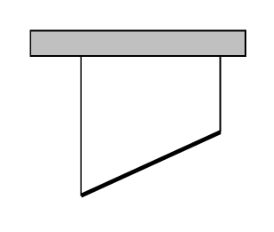
A uniform rod is suspended on two thin strings as shown below. Which string has a larger tension force?
- A. The right one
- B. The left one
- C. The tension force is the same on both
- D. It depends on the angle
Topic: Rigid Body Statics, Newtonian Mechanics Metodi: Torque & Angular Momentum Analysis, Free-Body Diagram Competenze: Physical Reasoning, Diagrammatic Reasoning Objects: Rod, String Fonte: Testo (PDF) — p.3
Una canna uniforme è sospesa su due fini corde come mostrato di seguito. Quale corda ha una forza di tensione maggiore?
- A. Il giusto
- B. La sinistra
- C. La forza di tensione è uguale su entrambe le parti
- D. Dipende dall’angolo
Topic: Rigid Body Statics, Newtonian Mechanics Metodi: Torque & Angular Momentum Analysis, Free-Body Diagram Competenze: Physical Reasoning, Diagrammatic Reasoning Objects: Rod, String Fonte: Testo (PDF) — p.3
Two point charges and are placed on the x-axis with at and at . Which of the following statements is true?
- A. There is no point on the x-axis where the electric field is zero.
- B. There is a point on the x-axis, at , where the electric field is zero.
- C. There is a point on the x-axis, between the charges (), where the electric field is zero.
- D. There is a point on the x-axis, at , where the electric field is zero.
Topic: Electrostatics Metodi: Coulomb’s Law, Superposition Principle Competenze: Physical Reasoning, Mathematical Modeling Objects: Point Charge Fonte: Testo (PDF) — p.3
Due cariche a punto e sono posizionate sull’asse x con a e a . Quale delle seguenti affermazioni è vera?
- A. Non c’è punto sull’asse x dove il campo elettrico sia zero.
- B. C’è un punto sull’asse x, a , dove il campo elettrico è zero.
- C. C’è un punto sull’asse x, tra le cariche (), dove il campo elettrico è zero.
- D. C’è un punto sull’asse x, a , dove il campo elettrico è zero.
Topic: Electrostatics Metodi: Coulomb’s Law, Superposition Principle Competenze: Physical Reasoning, Mathematical Modeling Objects: Point Charge Fonte: Testo (PDF) — p.3
In a lab experiment, a laser beam hits a semicircular glass object off the centre axis. The ray enters perpendicularly to the surface, and the environment is air. Which ray diagram is correct?
(A), (B), (C), (D), (E), (F) [see figure — six ray diagram options shown]
 Semicircular glass and incident ray
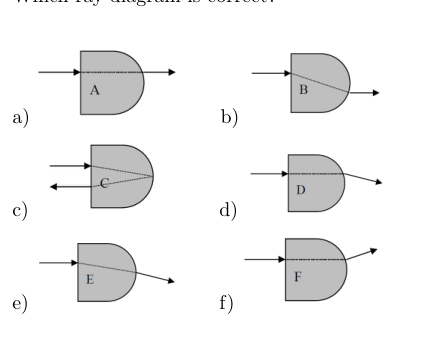 Ray diagram options A–F for glass
Topic: Geometric Optics Metodi: Snell’s Law, Ray Tracing Competenze: Diagrammatic Reasoning, Physical Reasoning Objects: — Fonte: Testo (PDF) — p.3
In un esperimento di laboratorio, un raggio laser colpisce un oggetto di vetro semicircolare fuori dall’asse centrale. Il raggio entra perpendicolare alla superficie e l’ambiente è l’aria. Quale diagramma di raggi è corretto?
(A), (B), (C), (D), (E), (F) [vedi figura opzioni di diagramma a sei raggi mostrate]
Vaso semicircolare e raggi incidenti
Opzioni di diagramma a raggi AF per vetro
Topic: Geometric Optics Metodi: Snell’s Law, Ray Tracing Competenze: Diagrammatic Reasoning, Physical Reasoning Objects: — Fonte: Testo (PDF) — p.3
You put two identical ice cubes on plates of different materials. One cube is put on an aluminum plate, and the other on a glass plate. Both plates have been in the room for a long time prior to the experiment. You notice that the ice melts faster on the metal plate. Why?
- A. The ice is in thermal equilibrium with the plastic plate, but not with the metal plate.
- B. The metal plate conducts heat to the ice more rapidly than the plastic plate.
- C. The metal plate holds more heat than the plastic plate.
- D. The metal plate was warmer than the plastic plate initially.
Topic: Thermodynamics Metodi: Physical Modeling, First Law of Thermodynamics Competenze: Physical Reasoning, Estimation & Approximation Objects: — Fonte: Testo (PDF) — p.4
Metti due cubetti di ghiaccio identici su piatti di materiali diversi. Un cubo viene messo su una piastra di alluminio e l’altro su una piastra di vetro. Entrambe le piastre sono state nella stanza molto tempo prima dell’esperimento. Si nota che il ghiaccio si scioglie più velocemente sulla piastra metallica. - Perché? - Perché?
- A. Il ghiaccio è in equilibrio termico con la piastra di plastica, ma non con la piastra metallica.
- B. La piastra metallica conduce il calore al ghiaccio più rapidamente della piastra in plastica.
- C. La piastra metallica contiene più calore della piastra in plastica.
- D. La piastra metallica era inizialmente più calda della piastra in plastica.
Topic: Thermodynamics Metodi: Physical Modeling, First Law of Thermodynamics Competenze: Physical Reasoning, Estimation & Approximation Objects: — Fonte: Testo (PDF) — p.4
Two black objects of the same diameter, a sphere and a flat disk, are placed in a parallel beam of light. The plane of the disk is perpendicular to the beam. What can be said about the force acting on them?
- A. The force is zero.
- B. The force is larger on the disk than on the sphere.
- C. The force is larger on the sphere than on the disk.
- D. The force is the same on both objects.
Topic: Modern-Quantum Physics, Electromagnetism Metodi: Physical Modeling, Photon Energy Relation Competenze: Physical Reasoning, Estimation & Approximation Objects: Sphere, Disk, Photon Fonte: Testo (PDF) — p.4
Due oggetti neri dello stesso diametro, una sfera e un disco piatto, sono posizionati in un fascio di luce parallelo. Il piano del disco è perpendicolare al fascio. Cosa si può dire della forza che agisce su di loro?
- A. La forza è zero.
- B. La forza sul disco è maggiore di quella sulla sfera.
- C. La forza è maggiore sulla sfera che sul disco.
- D. La forza è la stessa su entrambi gli oggetti.
Topic: Modern-Quantum Physics, Electromagnetism Metodi: Physical Modeling, Photon Energy Relation Competenze: Physical Reasoning, Estimation & Approximation Objects: Sphere, Disk, Photon Fonte: Testo (PDF) — p.4
Adrianne has a device that emits photons with a wavelength of km. Kwan has a similar device that emits photons at a frequency of kHz. Whose device emits photons in air at the highest frequency?
- A. Adrianne’s
- B. Kwan’s
- C. The frequencies are the same.
- D. There is not enough information to compare.
Topic: Oscillations & Waves, Modern-Quantum Physics Metodi: Photon Energy Relation, Physical Modeling Competenze: Physical Reasoning, Unit Conversion Objects: Photon Fonte: Testo (PDF) — p.4
Adrianne ha un dispositivo che emette fotoni con una lunghezza d’onda di km. Kwan ha un dispositivo simile che emette fotoni a una frequenza di kHz. Di chi è il dispositivo che emette i fotoni nell’aria con la frequenza più alta?
- A. La mia madre, Adrianne.
- B. Kwan’s
- C. Le frequenze sono le stesse.
- D. Non ci sono informazioni sufficienti per confrontare.
Topic: Oscillations & Waves, Modern-Quantum Physics Metodi: Photon Energy Relation, Physical Modeling Competenze: Physical Reasoning, Unit Conversion Objects: Photon Fonte: Testo (PDF) — p.4
A girl sitting on a floating mattress in a small pool holds a model of a motorboat in her hands. When she puts it in the water to start driving it with her remote control, what happens to the water level in the pool?
- A. It rises by a small amount.
- B. It drops by a small amount.
- C. It stays the same.
- D. The qualitative result depends on the weight of the model boat.
Topic: Fluid Mechanics Metodi: Hydrostatic Equilibrium, Physical Modeling Competenze: Physical Reasoning, Estimation & Approximation Objects: — Fonte: Testo (PDF) — p.4
Una ragazza seduta su un materasso galleggiante in una piccola piscina tiene in mano un modello di una barca a motore. Quando la mette nell’acqua per iniziare a guidare con il suo telecomando, cosa succede al livello dell’acqua nella piscina?
- A. Si eleva di una piccola quantità.
- B. Si riduce di una piccola quantità.
- C. rimane lo stesso.
- D. Il risultato qualitativo dipende dal peso del modello di imbarcazione.
Topic: Fluid Mechanics Metodi: Hydrostatic Equilibrium, Physical Modeling Competenze: Physical Reasoning, Estimation & Approximation Objects: — Fonte: Testo (PDF) — p.4
Which of the accompanying – diagrams best represents an isothermal process, that is a process occurring at constant temperature?
(A), (B), (C), (D), (E) [see figure — five – curve options]
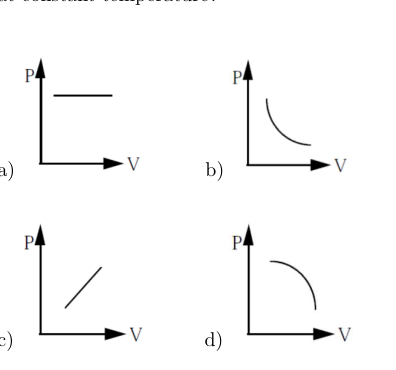 P-V diagrams options A–E isothermal
Topic: Thermodynamics Metodi: Ideal Gas Law, Thermodynamic Cycle Analysis Competenze: Physical Reasoning, Diagrammatic Reasoning Objects: Gas Fonte: Testo (PDF) — p.4
Quale dei diagrammi P$$V che accompagnano rappresenta meglio un processo isotermico, cioè un processo che si verifica a temperatura costante?
(A), (B), (C), (D), (E) [vedi figura cinque P$$V opzioni curve]
P-V opzioni di diagrammi AE isotermica
Topic: Thermodynamics Metodi: Ideal Gas Law, Thermodynamic Cycle Analysis Competenze: Physical Reasoning, Diagrammatic Reasoning Objects: Gas Fonte: Testo (PDF) — p.4
Two identical objects of mass are connected to a massless string which is hung over two frictionless pulleys as shown below. If everything is at rest, what is the tension in the cord?
- A. Less than .
- B. Exactly .
- C. More than , but less than .
- D. Exactly .
- E. More than .
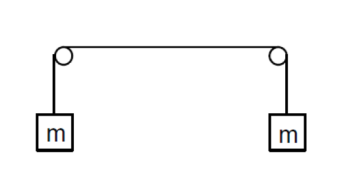 Two masses on string over two pulleys
Topic: Newtonian Mechanics, Rigid Body Statics Metodi: Free-Body Diagram, Torque & Angular Momentum Analysis Competenze: Physical Reasoning, Diagrammatic Reasoning Objects: Block, String, Pulley Fonte: Testo (PDF) — p.4
Due oggetti identici di massa sono collegati a una corda senza massa che è appesa su due polliere senza attrito come mostrato di seguito. Se tutto è a riposo, qual è la tensione del cavo?
- A. Meno di .
- B. Esattamente .
- C. Più di , ma inferiore a .
- D. Esattamente .
- E. Più di .
Due masse su corda su due polli
Topic: Newtonian Mechanics, Rigid Body Statics Metodi: Free-Body Diagram, Torque & Angular Momentum Analysis Competenze: Physical Reasoning, Diagrammatic Reasoning Objects: Block, String, Pulley Fonte: Testo (PDF) — p.4
Car A and car B are both traveling down a straight highway at 90 km/h. Car A is only 6.0 meters behind car B. The driver of car B brakes, slowing down with a constant deceleration of 2.0 m/s². After 1.2 seconds, the driver of car A begins to brake, also at 2.0 m/s², but this is insufficient and the cars eventually collide, both still moving forward. What is the relative velocity of the two cars at the moment of the collision?
- A. 2.4 m/s
- B. 5.0 m/s
- C. 9.5 m/s
- D. 21 m/s
- E. 24 m/s
Topic: Newtonian Mechanics Metodi: Kinematic Equations, Physical Modeling Competenze: Mathematical Modeling, Physical Reasoning Objects: Cart Fonte: Testo (PDF) — p.5
La macchina A e la macchina B sono entrambe in un’autostrada dritta a 90 km/h. La macchina A e’ solo a 6,0 metri di distanza dalla macchina B. Il guidatore di freni della vettura B, rallenta con una decelerazione costante di 2,0 m/s2. Dopo 1,2 secondi, il conducente della vettura A inizia a frenare, anche a 2,0 m/s2, ma questo non è sufficiente e le auto alla fine si scontrano, entrambe continuando a muoversi in avanti. Qual è la velocità relativa delle due auto al momento della collisione?
- A. 2.4 m/s
- B. 5.0 m/s
- C. 9.5 m/s
- D. 21 m/s
- E. 24 m/s
Topic: Newtonian Mechanics Metodi: Kinematic Equations, Physical Modeling Competenze: Mathematical Modeling, Physical Reasoning Objects: Cart Fonte: Testo (PDF) — p.5
Two interfering waves have the same wavelength, frequency, and amplitude. They are traveling in the same direction but are 90 degrees out of phase. Compared to the individual waves, what can be said about the resultant wave?
- A. It will have the same amplitude and velocity, but a different wavelength.
- B. It will have the same amplitude and wavelength, but a different velocity.
- C. It will have the same wavelength and velocity, but a different amplitude.
- D. It will have the same amplitude and frequency, but a different velocity.
- E. It will have the same frequency and velocity, but a different wavelength.
Topic: Oscillations & Waves, Wave Optics Metodi: Superposition Principle, Wave Equation Competenze: Physical Reasoning, Mathematical Modeling Objects: — Fonte: Testo (PDF) — p.5
Due onde interferenti hanno la stessa lunghezza d’onda, frequenza e amplitudine. Sono in viaggio nella stessa direzione, ma sono fuori fase a 90 gradi. Che cosa si può dire dell’onda che ne deriva, rispetto alle singole onde?
- A. avrà la stessa amplitudine e velocità, ma una lunghezza d’onda diversa.
- B. Avra’ la stessa amplitudine e lunghezza d’onda, ma una velocità diversa.
- C. Avra’ la stessa lunghezza d’onda e velocità, ma un’ampiezza diversa.
- D. Avra’ la stessa amplitudine e frequenza, ma una velocità diversa.
- E. Avra’ la stessa frequenza e velocità, ma una lunghezza d’onda diversa.
Topic: Oscillations & Waves, Wave Optics Metodi: Superposition Principle, Wave Equation Competenze: Physical Reasoning, Mathematical Modeling Objects: — Fonte: Testo (PDF) — p.5
A spinning ice skater has an initial kinetic energy . She pulls in her outstretched arms, decreasing her moment of inertia to . What is her new angular speed?
- A.
- B.
- C.
- D.
- E.
Topic: Rotational Dynamics Metodi: Torque & Angular Momentum Analysis, Conservation Laws Competenze: Physical Reasoning, Mathematical Modeling Objects: — Fonte: Testo (PDF) — p.5
Un pattinatore a ghiaccio a rotazione ha un’energia cinetica iniziale . Si tira le braccia estese, riducendo il suo momento di inerzia a . Qual è la sua nuova velocità angolare?
- A.
- B.
- C.
- D.
- E.
Topic: Rotational Dynamics Metodi: Torque & Angular Momentum Analysis, Conservation Laws Competenze: Physical Reasoning, Mathematical Modeling Objects: — Fonte: Testo (PDF) — p.5
A ball of mass is thrown vertically upward. Instead of neglecting air resistance, assume that the force of air resistance has a magnitude proportional to the ball’s velocity, but pointing in the opposite direction. What is the ball’s acceleration at the highest point?
- A. 0
- B. Less than .
- C.
- D. Greater than .
Topic: Newtonian Mechanics Metodi: Free-Body Diagram, Physical Modeling Competenze: Physical Reasoning, Mathematical Modeling Objects: Ball Fonte: Testo (PDF) — p.5
Una palla di massa viene lanciata verticalmente verso l’alto. Invece di trascurare la resistenza dell’aria, supponiamo che la forza della resistenza dell’aria abbia una magnitudine proporzionale alla velocità della palla, ma che punta nella direzione opposta. Qual è l’accelerazione della palla al punto più alto?
- A. 0
- B. Menore di .
- C.
- D. Più grande di .
Topic: Newtonian Mechanics Metodi: Free-Body Diagram, Physical Modeling Competenze: Physical Reasoning, Mathematical Modeling Objects: Ball Fonte: Testo (PDF) — p.5
A hypothetical planet has density , radius , and surface gravitational acceleration . What would be the acceleration due to gravity at the surface of a planet with double the radius, and the same planetary density?
- A.
- B.
- C.
- D.
- E.
Topic: Gravitation, Newtonian Mechanics Metodi: Newton’s Law of Gravitation, Dimensional Analysis Competenze: Physical Reasoning, Mathematical Modeling Objects: Planet Fonte: Testo (PDF) — p.5
Un pianeta ipotetico ha densità , raggio e accelerazione gravitazionale superficiale . Qual sarebbe l’accelerazione dovuta alla gravità alla superficie di un pianeta con il doppio di raggio e la stessa densità planetaria?
- A.
- B.
- C.
- D.
- E.
Topic: Gravitation, Newtonian Mechanics Metodi: Newton’s Law of Gravitation, Dimensional Analysis Competenze: Physical Reasoning, Mathematical Modeling Objects: Planet Fonte: Testo (PDF) — p.5
You are given two lenses placed close together: a converging lens with focal length cm, and a diverging lens with focal length cm. Which of the following would produce a virtual image that is larger than the object?
- A. Placing the object 5 cm from the converging lens.
- B. Placing the object 15 cm from the converging lens.
- C. Placing the object 25 cm from the converging lens.
- D. Placing the object 15 cm from the diverging lens.
- E. Placing the object 25 cm from the diverging lens.
Topic: Geometric Optics Metodi: Thin Lens & Mirror Equation, Ray Tracing Competenze: Mathematical Modeling, Physical Reasoning Objects: Lens Fonte: Testo (PDF) — p.5
Vi vengono forniti due obiettivi posizionati vicini: un obiettivo convergente con lunghezza focale cm e un obiettivo divergente con lunghezza focale cm. Quale delle seguenti immagini potrebbe produrre un’immagine virtuale più grande dell’oggetto?
- A. Mettendo l’oggetto a 5 cm dalla lente convergente.
- B. Mettendo l’oggetto a 15 cm dalla lente convergente.
- C. Mettendo l’oggetto a 25 cm dalla lente convergente.
- D. Mettendo l’oggetto a 15 cm dalla lente divergente.
- E. Mettendo l’oggetto a 25 cm dalla lente divergente.
Topic: Geometric Optics Metodi: Thin Lens & Mirror Equation, Ray Tracing Competenze: Mathematical Modeling, Physical Reasoning Objects: Lens Fonte: Testo (PDF) — p.5
An electromagnetic wave is propagating in vacuum in the positive direction. At an instant when its magnetic field at a certain position is in the positive direction and getting stronger, what happens to its electric field at that same position?
- A. is in the positive direction and getting weaker.
- B. is in the negative direction and getting stronger.
- C. is in the positive direction and getting weaker.
- D. is in the negative direction and getting stronger.
- E. is zero.
Topic: Electromagnetism, Oscillations & Waves Metodi: Faraday’s Law of Induction, Wave Equation Competenze: Physical Reasoning, Diagrammatic Reasoning Objects: — Fonte: Testo (PDF) — p.5
Un’onda elettromagnetica si propaga nel vuoto nella direzione positiva . In un istante in cui il suo campo magnetico in una certa posizione è nella direzione positiva e diventa più forte, cosa succede al suo campo elettrico in quella stessa posizione?
- A. è in direzione positiva e si sta indebolendo.
- B. è in direzione negativa e si sta rafforzando.
- C. è in direzione positiva e si sta indebolendo.
- D. è in direzione negativa e si sta rafforzando.
- E. è zero.
Topic: Electromagnetism, Oscillations & Waves Metodi: Faraday’s Law of Induction, Wave Equation Competenze: Physical Reasoning, Diagrammatic Reasoning Objects: — Fonte: Testo (PDF) — p.5
Problem 1
A light emitting diode (LED) is connected in series with a super capacitor of capacity 3000 F and internal resistance mΩ, and a microprocessor-controlled resistor. The capacitor is charged to 5 V. The LED requires constant current of 800 mA. At this current, the voltage drop over the LED is 2.7 V.
(a) What should be the dependence of the variable resistor on time for the current to remain constant?
(b) What should be the initial value of the resistor? Does the value of the resistor stabilize after some time, and if so, to which resistance?
(c) How long can the LED operate at full brightness before the capacitor needs to be recharged?
Topic: Circuits Metodi: Kirchhoff’s Laws, Equivalent Circuit Reduction, Differential Equations Competenze: Mathematical Modeling, Physical Reasoning Objects: Capacitor, Resistor, Battery Fonte: Testo (PDF) — p.6
Il problema 1
Un diodo di emissione luminosa (LED) è collegato in serie con un supercondensatore di capacità 3000 F e resistenza interna mΩ e una resistenza controllata da microprocessore. Il condensatore è carico a 5 V. Il LED richiede una corrente costante di 800 mA. A questa corrente, la caduta di tensione sul LED è di 2,7 V.
a) Qual è la dipendenza della resistenza variabile dal tempo per mantenere la corrente costante?
b) Qual è il valore iniziale della resistenza? Il valore della resistenza si stabilizza dopo un certo tempo, e se sì, a quale resistenza?
c) Per quanto tempo il LED può funzionare a piena luminosità prima che il condensatore debba essere ricaricato?
Topic: Circuits Metodi: Kirchhoff’s Laws, Equivalent Circuit Reduction, Differential Equations Competenze: Mathematical Modeling, Physical Reasoning Objects: Capacitor, Resistor, Battery Fonte: Testo (PDF) — p.6
Problem 2
A light spring with a force constant of 3.85 N/m is compressed by 8.00 cm and held between two blocks. The block on the left has a mass of 250 g, while the block on the right has a mass of 500 g. Both blocks are initially held at rest on a horizontal surface, and are then released simultaneously so that the spring pushes them apart.
What is the maximum velocity each block attains if the coefficient of kinetic friction between each block and the surface is 0.100 and the coefficient of static friction is 0.120?
Topic: Conservation of Momentum, Conservation of Energy, Newtonian Mechanics Metodi: Energy Conservation Method, Conservation of Momentum, Hooke’s Law Competenze: Mathematical Modeling, Physical Reasoning Objects: Spring, Block Fonte: Testo (PDF) — p.6
Problema 2
Una sorgente di luce con una costante di forza di 3,85 N/m è compressa di 8,00 cm e tenuta tra due blocchi. Il blocco a sinistra ha una massa di 250 g, mentre il blocco a destra ha una massa di 500 g. Entrambi i blocchi vengono inizialmente tenuti a riposo su una superficie orizzontale, e poi rilasciati contemporaneamente in modo che la primavera li spinga a parte.
Qual è la velocità massima raggiunta da ogni blocco se il coefficiente di attrito cinetico tra ogni blocco e la superficie è di 0,100 e il coefficiente di attrito statico di 0,120?
Topic: Conservation of Momentum, Conservation of Energy, Newtonian Mechanics Metodi: Energy Conservation Method, Conservation of Momentum, Hooke’s Law Competenze: Mathematical Modeling, Physical Reasoning Objects: Spring, Block Fonte: Testo (PDF) — p.6
Problem 3
The luminosity of a star is defined as the energy it emits per unit time. We know from astronomical observations that the luminosity of the stars that have a mass is approximately related to their mass as:
where and are the luminosity and mass of the Sun.
Furthermore, we know from Einstein’s theory of relativity that the energy released from converting a mass into energy is given by . In this problem, we assume that all stars burn almost the same fraction of their mass during their active life.
(a) If the fraction of the mass converted into energy is , first find an expression for the lifetime of a star in terms of its mass, luminosity, and physical constants.
(b) Using the luminosity-mass equation, find the lifetime of a star as a function of its mass.
(c) If we know that the lifetime of our Sun is about 10 billion years, what is the lifetime of a star with a mass ?
Topic: Astrophysics, Special Relativity Metodi: Mass-Energy Equivalence, Dimensional Analysis, Approximation & Series Expansion Competenze: Mathematical Modeling, Physical Reasoning Objects: Star Fonte: Testo (PDF) — p.6
**Problema 3 **
La luminosità di una stella è definita come l’energia emessa per unità di tempo. Sappiamo dalle osservazioni astronomiche che la luminosità delle stelle che hanno una massa è approssimativamente correlata alla loro massa come:
dove e sono la luminosità e la massa del Sole.
Inoltre, sappiamo dalla teoria della relatività di Einstein che l’energia rilasciata dalla conversione di una massa in energia viene data da . In questo problema, supponiamo che tutte le stelle bruciano quasi la stessa frazione della loro massa durante la loro vita attiva.
(a) Se la frazione di massa convertita in energia è , prima trovi un’espressione per la vita di una stella in termini di massa, luminosità, e costanti fisiche.
b) Usando l’equazione luminosità-massa, si trova la durata di vita di una stella in funzione della sua massa.
(c) Se sappiamo che la vita del nostro Sole è di circa 10 miliardi di anni, quanto è la vita di una stella con una massa ?
Topic: Astrophysics, Special Relativity Metodi: Mass-Energy Equivalence, Dimensional Analysis, Approximation & Series Expansion Competenze: Mathematical Modeling, Physical Reasoning Objects: Star Fonte: Testo (PDF) — p.6