Observations show that the speed of light in a vacuum is always the same whatever the speed of the source relative to that of the observer.
Figure 1.1
a) Light, illustrated by green arrows, bounces up and down in the box that has perfect mirrors at each end. Observer B is in the box and Observer A is outside the box. The box is observed by A to be moving past at a speed of v.
(i) How far does Observer B think the light has travelled?
(ii) How far does Observer A think the light has travelled?
(iii) How long does Observer B think the light takes to travel this distance?
(iv) How long does Observer A think the light takes to travel this distance?
b) Two copper wires carry a current of I amps, Figure 1.2. The wires are 1mm in diameter and you may assume that there is one free electron per atom.
Figure 1.2
Find the speed at which the electrons drift down the wire (ignore thermal effects). Use a semi-quantitative argument to show that there will be a force between the wires when a current I flows in each wire - without bringing in the concept of magnetism.
v Observer A Observer B I I Observer B v Length of the box L 3
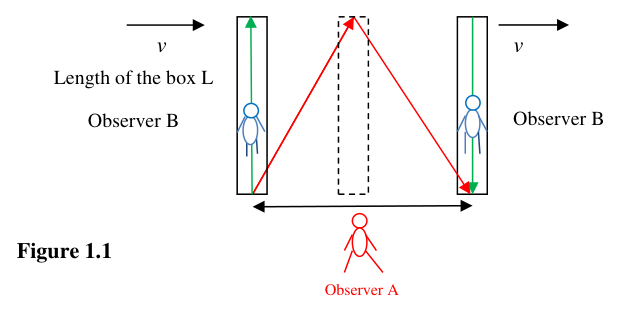 scatola con specchi e osservatori
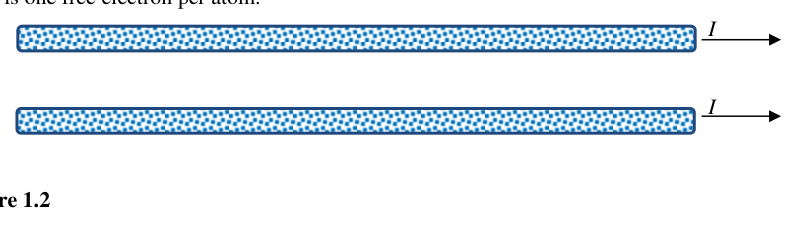 due fili paralleli con corrente I
Topic: Special Relativity, Electromagnetism, Newtonian Mechanics Metodi: Lorentz Transformation, Kinematic Equations, Lorentz Force Analysis Competenze: Physical Reasoning, Mathematical Modeling, Diagrammatic Reasoning Objects: Mirror, Wire, Electron Fonte: Testo (PDF) — p.2
Le osservazioni mostrano che la velocità della luce nel vuoto è sempre la stessa indipendentemente dalla velocità della fonte rispetto a quello dell’osservatore.
Figura 1.1
a) La luce, illustrata da frecce verdi, rimbalza su e giù nella scatola che ha specchi perfetti a ogni estremità. L’osservatore B è nella scatola e l’osservatore A è fuori dalla scatola. La casella è osservata da A per essere in movimento oltre a velocità di v.
(i) Quanto lontano l’osservatore B pensa che la luce sia andata?
(ii) Quanto lontano l’Osservatore A pensa che la luce sia andata?
(iii) Quanto tempo l’osservatore B pensa che la luce debba percorrere questa distanza?
(iv) Quanto tempo l’Osservatore A pensa che la luce debba percorrere questa distanza?
b) Due fili di rame portano una corrente di I ampi, Figura 1.2. I fili hanno un diametro di 1 mm e si può supporre che c’è un elettrone libero per atomo.
Figura 1.2
Trova la velocità con cui gli elettroni scendono lungo il filo (ignora gli effetti termici). Utilizzare un semicantifico argomento per dimostrare che ci sarà una forza tra i fili quando una corrente I scorre in ogni filo - senza che introduce il concetto di magnetismo.
v Osservatore A Osservatore B I I Osservatore B v Lunghezza della casella L 3
scatola con specchi e osservatori
- dovuta fili paralleli con corrente I *
Topic: Special Relativity, Electromagnetism, Newtonian Mechanics Metodi: Lorentz Transformation, Kinematic Equations, Lorentz Force Analysis Competenze: Physical Reasoning, Mathematical Modeling, Diagrammatic Reasoning Objects: Mirror, Wire, Electron Fonte: Testo (PDF) — p.2
Figure 2.1
The photo, Figure 2.1, was taken at Broadhaven, Pembrokeshire. The road that is damaged crossed a small stream flowing into the sea. The tidal range is about 8 m. The previous day at another location a wave hitting a harbour wall was observed to be producing a splash that rose 6 m high.
(i) Calculate the speed at which the water was moving vertically upwards when it was about 3.5 m above the normal surface of the stream – that is about the level of the under surface of the bridge. Assume that an unrestricted splash would have been 6 m high.
(ii) Find the force on a square stone in the under surface of the bridge that is 0.5 m 0.5 m and with a thickness 100 mm as illustrated in Figure 2.2.
Figure 2.2
(iii) The density of the stone is 4000 kg m-3. What is the lowest speed of the water splash at which you might expect the bridge to fail?
0.5 m 100 mm 0.5 m 0.5 m 4
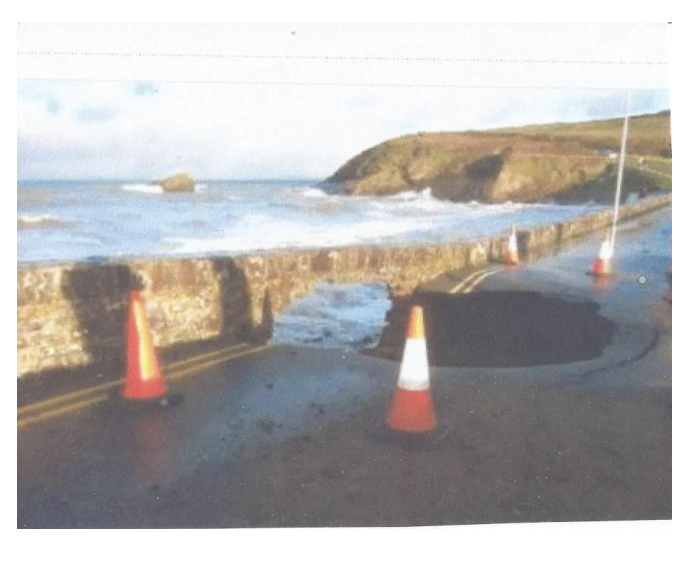 foto strada danneggiata dal mare
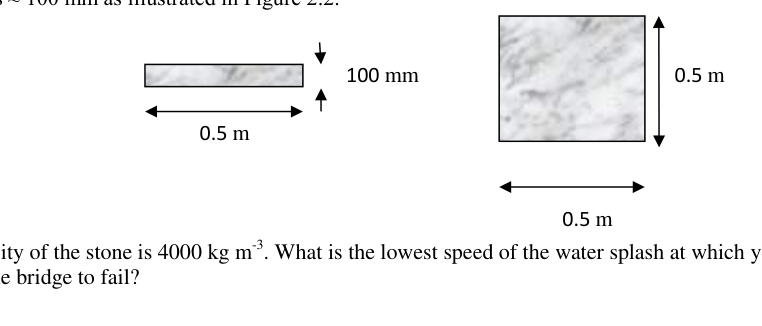 lastra di pietra con dimensioni
Topic: Newtonian Mechanics, Fluid Mechanics Metodi: Kinematic Equations, Free-Body Diagram, Energy Conservation Method Competenze: Physical Reasoning, Mathematical Modeling, Estimation & Approximation Objects: — Fonte: Testo (PDF) — p.3
Figura 2.1
La foto, figura 2.1, è stata scattata a Broadhaven, Pembrokeshire. La strada danneggiata attraversa un piccolo ruscello che scorre nel mare. L’area delle maree è di circa 8 m. Il giorno prima in un altro luogo un’onda ha colpito un porto Il muro ha prodotto uno spruzzo che è salito 6 metri di altezza.
(i) Calcolare la velocità con cui l’acqua si muoveva verticalmente verso l’alto quando era a circa 3,5 m sopra il superficie normale del torrente che è circa il livello della superficie sotterranea del ponte. Supponiamo che un Una spillare senza restrizioni sarebbe stata alta 6 metri.
(ii) Trova la forza su una pietra quadrata nella superficie inferiore del ponte che è di 0,5 m 0,5 m e con un spessore 100 mm come illustrato alla figura 2.2.
Figura 2.2
(iii) La densità della pietra è di 4000 kg m-3. Qual è la velocità più bassa della spilla d’acqua a cui potresti
- E’ che il ponte non funziona?
0.5 m 100 mm 0.5 m 0.5 m 4
Foto strada danneggiata dal mare
*lastra di pietra con dimensioni *
Topic: Newtonian Mechanics, Fluid Mechanics Metodi: Kinematic Equations, Free-Body Diagram, Energy Conservation Method Competenze: Physical Reasoning, Mathematical Modeling, Estimation & Approximation Objects: — Fonte: Testo (PDF) — p.3
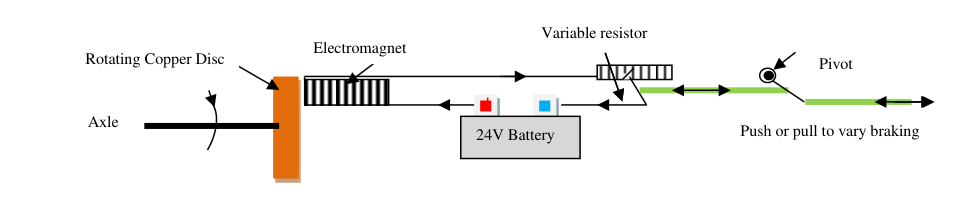
Most heavy vehicles are equipped with retarders that have a copper disc on a rotating axle. An electromagnet produces a magnetic field and this produces a force on the moving disc. .
Figure 3.1
The gradient of the road is 20% (take this as the height lost/distance gone). The truck has a mass of 10 tonnes. The diameter of the copper disc is 0.5 m, the thickness of the disc 15 mm. Ignore other forms of braking such as engine braking, normal disc brakes, air resistance, etc.
(i) Find an expression that would give the rate of heat generated in the copper disc.
(ii) Find the initial rate of rise of temperature of the copper disc. The electromagnetic braking is designed to allow the lorry to descend a slope of 20% at a steady 5 ms-1 without using engine braking or normal friction brakes.
(iii) Estimate the final temperature of the disc assuming that the heat is lost only through radiation. Stefan’s law states that the power radiated by a black body is where A is the area of the radiating body and is the Stefan-Boltzmann constant. You may assume that the disc approximates to a black body in this case.
Pivot Push or pull to vary braking Electromagnet Variable resistor 24V Battery Axle Rotating Copper Disc Pivot Electromagnet Variable resistor Rotating Copper Disc 5
 schema ritardatore elettromagnetico su camion
Topic: Electromagnetic Induction, Thermodynamics, Newtonian Mechanics Metodi: Faraday’s Law of Induction, First Law of Thermodynamics, Free-Body Diagram Competenze: Physical Reasoning, Mathematical Modeling, Diagrammatic Reasoning Objects: Disk, Magnet, Battery, Resistor Fonte: Testo (PDF) — p.4
La maggior parte dei veicoli pesanti sono dotati di ritardatori che hanno un disco di rame su un asse rotante. Un elettromagneto produce un campo magnetico e questo produce una forza sul disco in movimento. .
Figura 3.1
La gradienza della strada è del 20% (si prenda come l’altezza perduta/distanza perduta). Il camion ha una massa di 10 tonnellate. Il diametro del disco di rame è di 0,5 m, lo spessore del disco di 15 mm. Ignorare altre forme di frenata come: frenatura del motore, frenatura normale del disco, resistenza all’aria, ecc.
(i) Trova un’espressione che indichi il tasso di calore generato nel disco di rame.
(ii) Trova il tasso iniziale di aumento della temperatura del disco di rame. Il frenaggio elettromagnetico è progettato per: consentire al camion di scendere a pendenza del 20% a un ritmo costante di 5 ms-1 senza usare il frenamento del motore o la normalità freni di attrito.
(iii) Calcolare la temperatura finale del disco, supponendo che il calore venga perso solo attraverso la radiazione. Stefan La legge stabilisce che la potenza irradiata da un corpo nero è dove A è l’area del corpo irradiante e è la costante di Stefan-Boltzmann. Potete presumere che il disco si avvicini a un corpo nero in questo
- Il caso.
Pivot Spingere o tirare per variare il frenaggio Magnete elettrico Resistenza variabile Batteria 24V Artigliere Disco di rame rotante Pivot Magnete elettrico Resistenza variabile Disco di rame rotante 5
- schema ritardatore elettromagnetico su camion *
Topic: Electromagnetic Induction, Thermodynamics, Newtonian Mechanics Metodi: Faraday’s Law of Induction, First Law of Thermodynamics, Free-Body Diagram Competenze: Physical Reasoning, Mathematical Modeling, Diagrammatic Reasoning Objects: Disk, Magnet, Battery, Resistor Fonte: Testo (PDF) — p.4
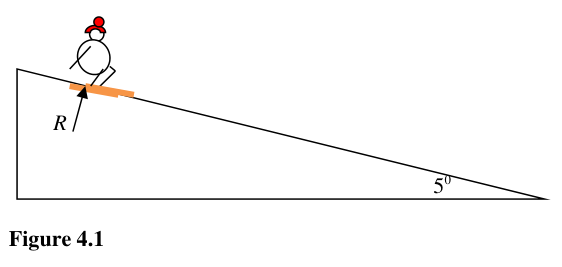
Figure 4.1
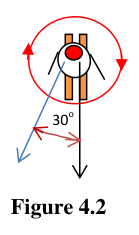
Figure 4.2
a) Figure 4.1 shows a skier, mass 70 kg, going down a snow slope of 5o that is covered in firm hard snow, temperature -4o C. His skis are initially parallel, close together and going down the line of steepest slope. He intends to go down the slope in a series of sweeping curves. His first turn is 30o to the steepest slope and his next turn is through 60o. You are asked to answer the following questions as quantitatively as possible using estimated numerical values where appropriate. Ski jargon is not appropriate!
(i) How can he reduce the normal reaction R? His mass is 70 kg. Give a numerical estimate of the maximum percentage of R it would be reasonable to achieve.
(ii) How can he rotate his skis in a clockwise direction? How can he stop the rotation?
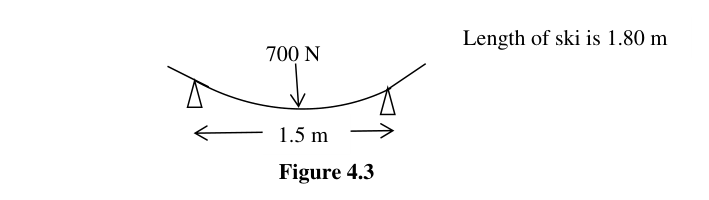
b) Another way of turning (carving) depends on the skis bending to form a curve which enables the skier to follow a curved path. He decides to test the stiffness of the skis Figure 4.3. He uses a weight of 700 N.
Figure 4.3
(i) The skis are tested using the setup illustrated in Figure 4.3. A force of 700 N deflects the centre of the ski 50 mm. What speed should the skier be going to achieve a turn with a radius of curvature of 25 m? Comment.
(ii) Illustrate your solution with a force diagram. Is this the only consideration that concerns the skier? Ignore the presence of other skiers!
R 50
30o
Length of ski is 1.80 m 1.5 m
700 N 6
 sciatore su pendio con reazione R
 pendio con angolo 30 gradi
 sci deflesso da peso 700 N
Topic: Newtonian Mechanics, Rotational Dynamics, Elasticity & Materials Metodi: Free-Body Diagram, Vector Decomposition, Hooke’s Law Competenze: Physical Reasoning, Estimation & Approximation, Mathematical Modeling Objects: Inclined Plane Fonte: Testo (PDF) — p.5
Figura 4.1
Figura 4.2
a) La figura 4.1 mostra uno sciatore, di massa 70 kg, scendendo su una pendicia di neve di 5° che è coperta da una forte neve dura, temperatura -4o C. Gli sci sono inizialmente paralleli, vicini e scendono lungo la linea della pendenza più ripida. He intenzione di scendere la pendice in una serie di curve spazzanti. La sua prima curva è di 30° verso la pendice più ripida e la sua La prossima volta è a 60°. Vi viene chiesto di rispondere al massimo alle seguenti domande, utilizzando se del caso, valori numerici stimati. Il gergo di sci non è appropriato!
(i) Come può ridurre la reazione normale R? Ha una massa di 70 kg. Indicare una stima numerica del massimo Per quanto riguarda il tasso di cambio, la Commissione ha adottato una decisione che prevede che il tasso di cambio di cambio di prezzo di mercato sia inferiore a quello di R.
(ii) Come può girare gli sci in senso orario? Come può fermare la rotazione?
b) Un altro modo di girare (cartazione) dipende dalla piega degli sci per formare una curva che consente allo sciatore di seguite un sentiero curvo. Decide di testare la rigidità degli sci, figura 4.3. Utilizza un peso di 700 N.
Figura 4.3
- gli sci sono testati con la configurazione illustrata alla figura 4.3. Una forza di 700 N devia il centro dello sci 50 mm. Che velocità dovrebbe raggiungere lo sciatore quando si gira con un raggio di curvatura di 25 m? Commento.
(ii) Illustrare la soluzione con un diagramma di forza. È questo l’unico punto di vista che riguarda lo sciatore? Ignorare la presenza di altri sciatori!
R 50
30o
Lunga di sci è di 1,80 m 1.5 m
700 N 6
Sciatore su pendio con reazione R
*pendio con angolo 30 gradi *
*sci deflesso da peso 700 N *
Topic: Newtonian Mechanics, Rotational Dynamics, Elasticity & Materials Metodi: Free-Body Diagram, Vector Decomposition, Hooke’s Law Competenze: Physical Reasoning, Estimation & Approximation, Mathematical Modeling Objects: Inclined Plane Fonte: Testo (PDF) — p.5
a) A particle of electromagnetic radiation is called a photon. A photon has an energy of hf where h is Planck’s constant. Write down an expression for the wavelength of the photon if it is emitted from a body moving away from the observer at a speed of u where u is much less than c. However, Einstein’s theory of general relativity predicts another effect. On leaving the star the photon gains potential energy due to the star’s gravitational field. Derive an expression that gives the change in wavelength due to this gravitational effect when light of frequency f leaves a star of mass M, radius R. For the purposes of this derivation you can assume that a photon has a fictional mass of m that will (should!) disappear from your final equation.
b) Among the animals that appear in the zoo of the Universe there are black holes and neutron stars. The mass of each of these is often the order of the mass of the Sun. The radius of a neutron star is about 10 km and a certain neutron star rotates at about s-1. Calculate the ratio of the polar diameter to the equatorial diameter for a typical neutron star. Assume that liquid or solid neutron material is incompressible. How do we know that it is rotating at this frequency?
c) Why are space rockets launched from positions near the equator? In order to launch a space probe out of the solar system, it is decided to send the probe close to Jupiter. Explain why this route reduces the fuel needed.
Topic: Astrophysics, Gravitation, Modern-Quantum Physics Metodi: Energy Conservation Method, Newton’s Law of Gravitation, Photon Energy Relation Competenze: Physical Reasoning, Mathematical Modeling, Estimation & Approximation Objects: Photon, Star, Black Hole, Planet Fonte: Testo (PDF) — p.6
a) Una particella di radiazione elettromagnetica è chiamata fotone. Un fotone ha un’energia di hf dove h è Plancks costante. Scrivi un’espressione per la lunghezza d’onda del fotone se emesso da un corpo in movimento lontano dall’osservatore a una velocità di u dove u è molto inferiore a c. Tuttavia, la teoria di Einstein di generale La relatività prevede un altro effetto. Al lasciare la stella il fotone guadagna energia potenziale a causa delle stelle campo gravitazionale. Derivare un’espressione che dà il cambiamento di lunghezza d’onda dovuto a questo effetto gravitazionale quando la luce di la frequenza f lascia una stella di massa M, raggio R. Per la definizione di questa derivazione si può presumere che un Il fotone ha una massa immaginaria di m che (dovrebbe!) scomparire dalla sua equazione finale.
b) Tra gli animali che appaiono nello zoo dell’Universo ci sono buchi neri e stelle di neutroni. La massa di ognuno di questi è spesso l’ordine della massa del Sole. Il raggio di una stella di neutroni è di circa 10 km e un alcune stelle di neutroni ruotano a circa s-1. Calcolare il rapporto tra il diametro polare e il diametro equatoriale di una tipico stella di neutroni. Supponiamo che il materiale neutrone liquido o solido è incompressibile. Come sappiamo che sta girando a questa frequenza?
c) Perché i razzi spaziali vengono lanciati da posizioni vicine all’equatore? Per lanciare una sonda spaziale fuori dal Sistema solare, si decide di inviare la sonda vicino a Giove. Spiegate perché questo percorso riduce il consumo di carburante.
Topic: Astrophysics, Gravitation, Modern-Quantum Physics Metodi: Energy Conservation Method, Newton’s Law of Gravitation, Photon Energy Relation Competenze: Physical Reasoning, Mathematical Modeling, Estimation & Approximation Objects: Photon, Star, Black Hole, Planet Fonte: Testo (PDF) — p.6