A chain of resistors, Figure 1.a.i, is composed of units, each consisting of three resistors, each resistor of resistance , Figure 1.a.ii. A unit is attached to the left hand end of the chain in order to increase the number of units from to .
(i) Calculate the resistance (between A and B) across a chain with two units, , and the resistance , across a chain with three units.
(ii) A unit is attached to a long chain. The resistance of the chain, , is not altered by this addition. Determine the resistance of the chain.
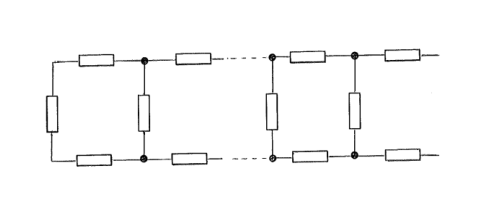 Figure 1.a.i: resistor chain n units
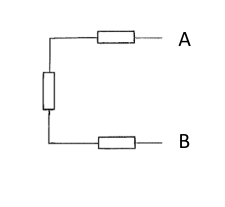 Figure 1.a.ii: single unit three resistors
Topic: Circuits Metodi: Equivalent Circuit Reduction, Kirchhoff’s Laws Competenze: Mathematical Modeling, Physical Reasoning Objects: Resistor Fonte: Testo (PDF) — p.3
Una catena di resistenze, figura 1.a.i., è composta da unità , ciascuna costituita da tre resistenze, ciascuna resistente di resistenza , figura 1.a.ii. Un’unità è attaccata all’estremità sinistra della catena per aumentare il numero di unità da a .
(i) Calcolare la resistenza (tra A e B) su una catena con due unità, , e la resistenza , su una catena con tre unità.
- un’unità è attaccata a una lunga catena. La resistenza della catena, , non viene alterata da questa aggiunta. Determina la resistenza della catena.
Figura 1.a.i: unità n della catena di resistenza
Figura 1.a.ii: unità singola a tre resistori
Topic: Circuits Metodi: Equivalent Circuit Reduction, Kirchhoff’s Laws Competenze: Mathematical Modeling, Physical Reasoning Objects: Resistor Fonte: Testo (PDF) — p.3
(i) A satellite is in orbit just above a spherical planet of radius and uniform density . If the periodic time for each orbit is , find an expression for . Comment on the result.
(ii) A man with a mass of 75 kg stands at the end of a diving board, depressing it by 0.30 m. What would be the period of his motion if he was to jump lightly in rhythm with the harmonic motion of the diving board?
Topic: Gravitation, Oscillations & Waves Metodi: Newton’s Law of Gravitation, Simple Harmonic Motion Analysis, Kinematic Equations Competenze: Mathematical Modeling, Physical Reasoning Objects: Satellite, Planet Fonte: Testo (PDF) — p.3
(i) Un satellite è in orbita poco sopra un pianeta sferica di raggio e densità uniforme . Se il tempo periodico per ciascuna orbita è , trovare un’espressione per . Commenta il risultato.
- un uomo di 75 kg si trova alla fine di una tavola di immersione, abbassandola di 0,30 m. Qual sarebbe il periodo del suo movimento se fosse stato a saltare leggero nel ritmo con il movimento armonico della tavola di immersione?
Topic: Gravitation, Oscillations & Waves Metodi: Newton’s Law of Gravitation, Simple Harmonic Motion Analysis, Kinematic Equations Competenze: Mathematical Modeling, Physical Reasoning Objects: Satellite, Planet Fonte: Testo (PDF) — p.3
(i) A uniform vertical tube, open at the lower end and sealed at the upper end, is lowered into sea water, trapping air in the tube. When the tube is submerged to a depth of 10.0 m, sea water has exactly filled the lower half of the tube. To what depth must the tube be lowered so that sea water fills 90% of the tube?
(ii) A mercury barometer has some air above the mercury, Figure 1.c.i. The top of the barometer is 1.000 m above the level of the mercury in the reservoir. When the tube is vertical the height of the mercury column is 0.700 m. When the tube is inclined at to the vertical, Figure 1.c.ii, the reading of the mercury level is 0.950 m. What is the atmospheric pressure in mm of mercury?
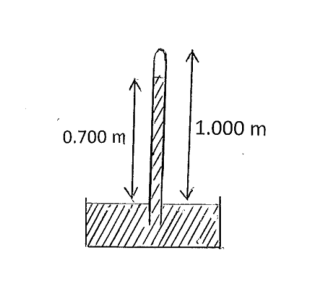 Figure 1.c.i: vertical mercury barometer
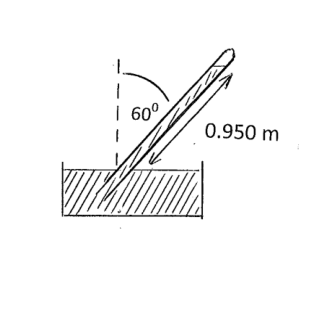 Figure 1.c.ii: inclined mercury barometer
Topic: Fluid Mechanics, Thermodynamics Metodi: Ideal Gas Law, Hydrostatic Equilibrium Competenze: Mathematical Modeling, Physical Reasoning Objects: Tube, Gas, Manometer Fonte: Testo (PDF) — p.3
(i) Un tubo verticale uniforme, aperto alla fine inferiore e sigillato alla fine superiore, viene abbassato nell’acqua marina, intrappoandone l’aria nel tubo. Quando il tubo è sommerso a una profondità di 10,0 m, l’acqua di mare ha riempito esattamente la metà inferiore del tubo. A che profondità deve essere abbassato il tubo affinché l’acqua di mare riempia il 90% del tubo?
(ii) Un barometro del mercurio ha un po’ di aria sopra il mercurio, figura 1.c.i. La parte superiore del barometro è a 1.000 m sopra il livello del mercurio nel serbatoio. Quando il tubo è verticale, l’altezza della colonna del mercurio è di 0,700 m. Quando il tubo è inclinato a verso la verticale, figura 1.c.ii, la lettura del livello di mercurio è di 0,950 m. Qual è la pressione atmosferica in mm di mercurio?
Figura 1.c.i: barometro verticale del mercurio
Figura 1.c.ii: barometro inclinato del mercurio
Topic: Fluid Mechanics, Thermodynamics Metodi: Ideal Gas Law, Hydrostatic Equilibrium Competenze: Mathematical Modeling, Physical Reasoning Objects: Tube, Gas, Manometer Fonte: Testo (PDF) — p.3
A car travels along a horizontal road starting at time , and finishing at . At time it has travelled a distance , has a speed and an acceleration given by
where is a constant.
Determine the average speed and average acceleration .
Topic: Newtonian Mechanics Metodi: Kinematic Equations, Calculus-Integration Competenze: Mathematical Modeling, Physical Reasoning Objects: — Fonte: Testo (PDF) — p.4
Una vettura percorre una strada orizzontale che inizia all’ora e termina all’ora . Al tempo ha percorso una distanza , ha una velocità e un’accelerazione data da
in cui è una costante.
Determinare la velocità media e l’accelerazione media .
Topic: Newtonian Mechanics Metodi: Kinematic Equations, Calculus-Integration Competenze: Mathematical Modeling, Physical Reasoning Objects: — Fonte: Testo (PDF) — p.4
One gram of hydrogen atoms is separated into electrons and protons. The electrons are deposited on the Moon, the protons remaining on the Earth. What, numerically, is the force that results? The Earth–Moon distance is m.
Topic: Electrostatics Metodi: Coulomb’s Law Competenze: Estimation & Approximation, Mathematical Modeling Objects: Electron Fonte: Testo (PDF) — p.4
Un grammo di atomi di idrogeno è separato in elettroni e protoni. Gli elettroni sono depositati sulla Luna, i protoni rimangono sulla Terra. Qual è, numericamente, la forza che ne deriva? La distanza della TerraLuna è m.
Topic: Electrostatics Metodi: Coulomb’s Law Competenze: Estimation & Approximation, Mathematical Modeling Objects: Electron Fonte: Testo (PDF) — p.4
Determine the half life of uranium given that g of radium is found per gram of uranium in ancient minerals. The half life of radium is 1,600 years. The atomic weights of uranium and radium are 238 and 226 respectively. All the radium arises from the uranium.
Topic: Nuclear & Particle Physics Metodi: Radioactive Decay Law Competenze: Mathematical Modeling, Physical Reasoning Objects: Nucleus Fonte: Testo (PDF) — p.4
Determinare la semivita’ dell’uranio dato che g di radio si trova per grammo di uranio nei minerali antichi. La mezza vita del radio è di 1600 anni. I pesi atomici dell’uranio e del radio sono rispettivamente 238 e 226. Tutto il radio deriva dall’uranio.
Topic: Nuclear & Particle Physics Metodi: Radioactive Decay Law Competenze: Mathematical Modeling, Physical Reasoning Objects: Nucleus Fonte: Testo (PDF) — p.4
A mixed beam of deuterons (an isotope of hydrogen, ) and protons, which have been accelerated through V, enter a uniform magnetic field of 0.500 T in a direction at right angles to the field. Calculate the separation of the proton beam from the deuteron beam when each has described a semicircle in the field.
Topic: Magnetism, Modern-Quantum Physics Metodi: Lorentz Force Analysis, Conservation of Energy Competenze: Mathematical Modeling, Physical Reasoning Objects: Particle Beam Fonte: Testo (PDF) — p.4
Un fascio misto di deuteroni (isotopo di idrogeno, ) e protoni, accelerati attraverso V, entra in un campo magnetico uniforme di 0,500 T in direzione ad angolo retto rispetto al campo. Calcolare la separazione del fascio di protoni dal fascio di Deuteron quando ciascuno ha descritto un semicircolo nel campo.
Topic: Magnetism, Modern-Quantum Physics Metodi: Lorentz Force Analysis, Conservation of Energy Competenze: Mathematical Modeling, Physical Reasoning Objects: Particle Beam Fonte: Testo (PDF) — p.4
A sound source, frequency and velocity , is moving along a straight line towards an observer who is approaching the sound source with velocity . Determine the frequency heard by the observer if the speed of sound is .
A moving sound source S has velocity of and frequency 200 Hz. An observer P, speed , and S are approaching a point Q along paths inclined at to each other, Figure 1.h. What frequency is heard by the observer when S and P are equidistant from Q? The speed of sound is .
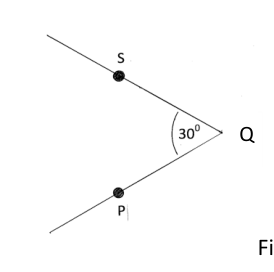 Figure 1.h: S and P approaching point Q
Topic: Oscillations & Waves Metodi: Wave Equation, Vector Decomposition Competenze: Mathematical Modeling, Physical Reasoning Objects: — Fonte: Testo (PDF) — p.5
Una fonte sonora, frequenza e velocità , si muove lungo una linea retta verso un osservatore che si avvicina alla fonte sonora con velocità . Determinare la frequenza udita dall’osservatore se la velocità del suono è .
Una fonte sonora in movimento S ha una velocità e una frequenza di 200 Hz. Un osservatore P, velocità , e S si avvicinano a un punto Q lungo percorsi inclinati a l’uno verso l’altro, figura 1.h. Quale frequenza viene ascoltata dall’osservatore quando S e P sono a uguale distanza da Q? La velocità del suono è .
Figura 1.h: S e P che si avvicinano al punto Q
Topic: Oscillations & Waves Metodi: Wave Equation, Vector Decomposition Competenze: Mathematical Modeling, Physical Reasoning Objects: — Fonte: Testo (PDF) — p.5
A beaker, containing some water, has a total mass of 0.300 kg. The beaker rests on a weighing scale. A 250 g copper sphere, density , is suspended so that it is completely immersed in the water, but does not touch the bottom of the beaker. What is the reading on the weighing scale in newtons? The density of water is .
Topic: Fluid Mechanics, Newtonian Mechanics Metodi: Hydrostatic Equilibrium, Free-Body Diagram Competenze: Physical Reasoning, Mathematical Modeling Objects: Container, Sphere Fonte: Testo (PDF) — p.5
Un bicchiere, contenente acqua, ha una massa totale di 0,300 kg. Il calice si fonda su una bilancia. Una sfera di rame di 250 g, densità , è sospesa in modo che sia completamente immersa nell’acqua, ma non tocchi il fondo del calice. Qual è la lettura della bilancia in newtoni? La densità dell’acqua è .
Topic: Fluid Mechanics, Newtonian Mechanics Metodi: Hydrostatic Equilibrium, Free-Body Diagram Competenze: Physical Reasoning, Mathematical Modeling Objects: Container, Sphere Fonte: Testo (PDF) — p.5
A capacitor, capacitance , with a charge , is connected in a closed (loop) series circuit with an uncharged capacitor, capacitance , and a switch, which is initially open. Compare the energy stored in the capacitors before and after the switch is closed by considering the potential across each capacitor. What can one conclude?
Topic: Circuits, Electrostatics Metodi: Kirchhoff’s Laws, Electric Potential Method Competenze: Physical Reasoning, Mathematical Modeling Objects: Capacitor, Switch Fonte: Testo (PDF) — p.5
Un condensatore, con capacità , con carica , è collegato in un circuito di serie chiuso (loop) con un condensatore non caricato, con capacità , e uno switch, che è inizialmente aperto. Confrontare l’energia immagazzinata nei condensatori prima e dopo la chiusura del switch considerando il potenziale di ciascun condensatore. Che conclusione si può trarre?
Topic: Circuits, Electrostatics Metodi: Kirchhoff’s Laws, Electric Potential Method Competenze: Physical Reasoning, Mathematical Modeling Objects: Capacitor, Switch Fonte: Testo (PDF) — p.5
A uniform sphere, radius and mass kg, is pulled up an inclined plane, inclination to the horizontal, by a string of tension , which is attached to a point P on its surface, making an angle with the line joining the centre of the sphere, O, and its contact point with the plane, C. The string is parallel to the plane. The coefficient of friction between the sphere and the plane . The sphere is about to slide up the plane. The frictional force is and the normal reaction is , Figure 1.k.
Determine, numerically:
(i) , by resolving the forces along and perpendicular to the slope
(ii) .
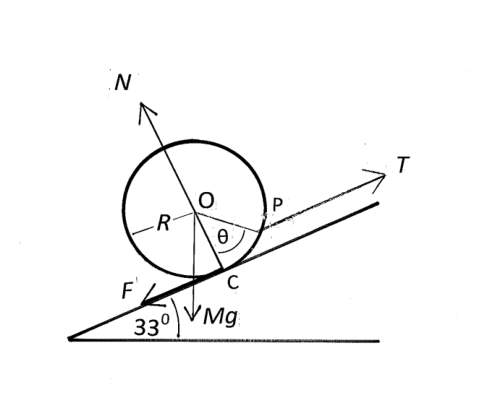 Figure 1.k: sphere on inclined plane
Topic: Rigid Body Statics, Newtonian Mechanics Metodi: Free-Body Diagram, Torque & Angular Momentum Analysis, Vector Decomposition Competenze: Diagrammatic Reasoning, Mathematical Modeling Objects: Sphere, Inclined Plane, String Fonte: Testo (PDF) — p.6
Una sfera uniforme, di raggio e di massa kg, viene trascinata su un piano inclinato, inclinato verso l’orizzontale, da una corda di tensione , che è attaccata a un punto P sulla sua superficie, formando un angolo con la linea che unisce il centro della sfera, O, e il suo punto di contatto con il piano, C. La corda è parallela al piano. Il coefficiente di attrito tra la sfera e il piano . La sfera sta per scivolare verso l’alto. La forza di attrito è e la reazione normale è , figura 1.k.
Determina numericamente:
(i) , risolvendo le forze lungo e perpendicolare alla pendenza
(ii) .
Figura 1.k: sfera in piano inclinato
Topic: Rigid Body Statics, Newtonian Mechanics Metodi: Free-Body Diagram, Torque & Angular Momentum Analysis, Vector Decomposition Competenze: Diagrammatic Reasoning, Mathematical Modeling Objects: Sphere, Inclined Plane, String Fonte: Testo (PDF) — p.6
Three boats start at time from the corners of an equilateral triangle, of side 50 km, and maintain constant speeds of during the subsequent motion. They each maintain a heading, clockwise, towards the neighbouring boat. They all eventually meet at P.
Determine:
(i) qualitatively, the evolution of the triangle formed by the three boats
(ii) the velocity components of the three boats in the direction of P, as a function of time , and in the perpendicular directions
(iii) the time at which they all meet
(iv) the distance travelled by each boat, .
Topic: Newtonian Mechanics Metodi: Kinematic Equations, Vector Decomposition, Differential Equations Competenze: Mathematical Modeling, Physical Reasoning Objects: — Fonte: Testo (PDF) — p.6
Tre imbarcazioni partono a tempo dagli angoli di un triangolo equilaterale, di lato 50 km, e mantengono velocità costanti di durante il movimento successivo. Ognuno di essi mantiene una direzione, nel senso orario, verso la barca vicina. Si incontrano tutti alla fine a P.
Determinazione:
-
qualitativamente, l’evoluzione del triangolo formato dalle tre imbarcazioni
-
le componenti di velocità dei tre imbarcazioni in direzione di P, in funzione del tempo , e nelle direzioni perpendicolari
(iii) the time at which they all meet
- la distanza percorsa da ciascuna barca, .
Topic: Newtonian Mechanics Metodi: Kinematic Equations, Vector Decomposition, Differential Equations Competenze: Mathematical Modeling, Physical Reasoning Objects: — Fonte: Testo (PDF) — p.6
A bicycle tyre has a volume of when fully inflated. The barrel of the bicycle pump has a working volume of . How many strokes of the pump are needed to completely inflate the flat tyre to a total pressure of Pa? The atmospheric pressure is Pa. Assume the air is pumped in slowly, so that the temperature remains constant.
Topic: Thermodynamics Metodi: Ideal Gas Law Competenze: Mathematical Modeling, Physical Reasoning Objects: Gas, Piston Fonte: Testo (PDF) — p.7
Un pneumatico di bicicletta ha un volume di quando è completamente gonfiato. Il barile della pompa per biciclette ha un volume di lavoro di . Quanti colpi della pompa sono necessari per gonfiare completamente il pneumatico piatto a una pressione totale di Pa? La pressione atmosferica è Pa. Supponiamo che l’aria venga pompata lentamente, in modo che la temperatura rimanga costante.
Topic: Thermodynamics Metodi: Ideal Gas Law Competenze: Mathematical Modeling, Physical Reasoning Objects: Gas, Piston Fonte: Testo (PDF) — p.7