Q1.
Figure 1.1 The above circuit, Figure 1.1, has resistors with resistance R and 2R, a cell with emf E, and currents i1 and i2 along PQ and PT respectively. (a) By reversing the cell’s polarity determine the current in QS, iQ, and in TS, iT. [2] (b) Determine the currents, iQT and i SUP , in QT and SUP, respectively, using the result that the sum of the currents entering any junction is equal to the sum of the currents leaving the junction. [2] (c) The sum of the clockwise products of current and resistance around any closed path is equal to the source of emf in the closed path. Use this result for paths PQTP and PTSUP to obtain two independent equations. [4] (d) Hence determine the resistance, RPS , across PS, in terms of R, and the currents i1 and i2 in terms of E and R . If the cell has resistance 3R , how is RPS altered? [5] (e) If the resistance across QT is replaced by a variable resistance, X , what is the possible range of values for RPS ? [7] 5
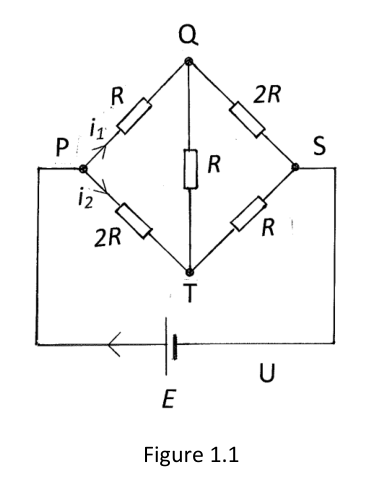 Rete resistori con emf E
Topic: Circuits Metodi: Kirchhoff’s Laws, Equivalent Circuit Reduction, Free-Body Diagram Competenze: Mathematical Modeling, Diagrammatic Reasoning, Physical Reasoning Objects: Resistor, Battery Fonte: Testo (PDF) — p.4
Q1.
Figura 1.1 Il circuito di cui sopra, figura 1.1, ha resistori con resistenza R e 2R, una cellula con emf E, e i) i correnti i1 e i2 lungo il PQ e il PT rispettivamente. (a) Invertendo la polarità della cellula, determinare la corrente in QS, iQ e in TS, iT. [2] b) Determinare le correnti, iQT e i SUP , rispettivamente in QT e SUP, utilizzando il risultato che la somma delle correnti che entrano in qualsiasi giunzione è uguale alla somma delle correnti lasciando la croce. [2] c) La somma dei prodotti di corrente e di resistenza in senso orario attorno a qualsiasi percorso chiuso è uguale alla fonte di emf nel percorso chiuso. Utilizzi questo risultato per i percorsi PQTP e PTSUP per ottenere due equazioni indipendenti. [4] (d) Determina quindi la resistenza, RPS , in PS, in termini di R, e le correnti i1 e i2 in termini di E e R . Se la cellula ha resistenza 3R, come viene alterato il RPS? [5] (e) Se la resistenza di QT viene sostituita da una resistenza variabile, X , qual è la probabilità che la resistenza di QT sia gamma di valori per RPS ? [7] 5
*Rete resistori con emf E *
Topic: Circuits Metodi: Kirchhoff’s Laws, Equivalent Circuit Reduction, Free-Body Diagram Competenze: Mathematical Modeling, Diagrammatic Reasoning, Physical Reasoning Objects: Resistor, Battery Fonte: Testo (PDF) — p.4
Q2.
Figure 2.1 (a) A Hookian spring, with spring constant k1 , is cut into n identical springs, each with a spring constant k2 . Determine the relation between k1 and k2. [4] (b) A spring, with spring constant k1, is attached to small sphere of mass m. The other end is hung from a rigid support. A spring, with spring constant k2 as in part (a), is attached to the bottom of the sphere and the lower end of the spring is attached to a rigid base and has zero tension. The two springs and the mass lie in a vertical line, Figure 2.1. Determine the equilibrium extension of the upper spring, x10.
[1] (c) If the mass is displaced vertically downwards from equilibrium, by a distance x, show that it will perform simple harmonic motion and determine its frequency, f. [6] (d) Derive an expression for the total energy, E, of the system in terms of the downward displacement, x of the mass , from its equilibrium position, and its velocity v. Show that E depends only on the variables v2 and x2. [6] (e) If the system is arranged horizontally on a smooth table, so that the sphere oscillates, in a straight line, along the direction of the springs, determine the frequency of oscillation, fH. [3] 6
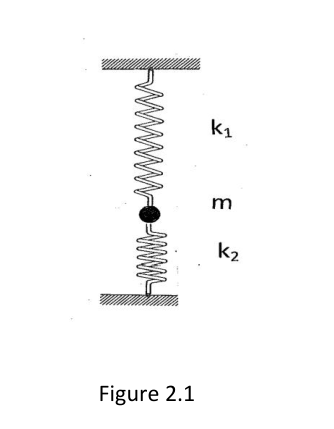 Massa tra due molle in serie
Topic: Oscillations & Waves, Elasticity & Materials, Conservation of Energy Metodi: Hooke’s Law, Simple Harmonic Motion Analysis, Energy Conservation Method Competenze: Mathematical Modeling, Physical Reasoning Objects: Spring, Sphere Fonte: Testo (PDF) — p.5
Q2.
Figura 2.1 (a) Una sorgente Hookiana, con costante sorgente k1, è tagliata in n sorgenti identiche, ciascuna con una Costante di primavera k2 . Determinare la relazione tra k1 e k2. [4] (b) Una molla, con una costante di molla k1, è attaccata a una piccola sfera di massa m. L’altro la fine è appesa a un supporto rigido. Una molla, con una costante di molla k2 come nella parte (a), è attaccata al fondo della sfera e l’estremità inferiore della molla è attaccata a una base rigida e non ha tensione. Le due sorgenti e la massa si trovano in una linea verticale, Figura 2.1. Determinare l’estensione dell’equilibrio della primavera superiore, x10.
[1] (c) Se la massa è spostata verticalmente verso il basso dall’equilibrio, per una distanza x, mostrare che eseguirà un semplice movimento armonico e determinerà la sua frequenza, f. [6] (d) Derivare un’espressione per l’energia totale, E, del sistema in termini di spostamento, x della massa, dalla sua posizione di equilibrio, e la sua velocità v. - Spettacolo che E dipende solo dalle variabili v2 e x2. [6] (e) Se il sistema è disposto orizzontalmente su una tavola liscia, in modo che la sfera L’oscillazione, in linea retta, lungo la direzione delle sorgenti, determina la frequenza di oscillazione, fH. [3] 6
Massa tra due molle in serie
Topic: Oscillations & Waves, Elasticity & Materials, Conservation of Energy Metodi: Hooke’s Law, Simple Harmonic Motion Analysis, Energy Conservation Method Competenze: Mathematical Modeling, Physical Reasoning Objects: Spring, Sphere Fonte: Testo (PDF) — p.5
Q3. (a) What is an electrostatic (i) field line and (ii) equipotential surface? [2] (b) An electrostatic field is produced by a charge +4Q at A and -Q at B. The distance AB = a. Determine the position, C , of the neutral point/s, where the electrostatic field is zero. [4] (c) Write down, in its simplest form, an equation for a point on the equipotential surface, with potential V, in terms of the distances, rA and rB, respective from A and B. [2] (d) Sketch, in a plane containing AB, (i) the field lines and (ii) the equipotentials. [6] (e) Three equal charges, each of charge +Q , are situated at the corners of a right angled triangle , with sides of length 3a, 4a and 5a. Determine the potential and electric field vector at the mid-point, M, of the side of length 3a. [6] 7
Topic: Electrostatics Metodi: Coulomb’s Law, Electric Potential Method, Superposition Principle Competenze: Mathematical Modeling, Diagrammatic Reasoning, Physical Reasoning Objects: Point Charge Fonte: Testo (PDF) — p.6
Q3. (a) Che cos’è un’elettrostatica (i) linea di campo e (ii) superficie equipotenziale? [2] (b) Un campo elettrostatico è prodotto da una carica +4Q a A e -Q a B. La distanza AB = a. Determinare la posizione, C , del punto/s neutro, dove l’elettrostatico campo è zero. [4] (c) Scrivi, nella sua forma più semplice, un’equazione per un punto sull’equotenziale superficie, con potenziale V, in termini di distanze, rA e rB, rispettivamente da A e B. [2] (d) Sketch, in un piano contenente AB, i) le linee di campo e ii) gli equipotenziali. [6] (e) Tre cariche uguali, ciascuna di carica + Q , sono situate negli angoli di un angolo retto triangolo, con lati di lunghezza 3a, 4a e 5a. Determinare il vettore del potenziale e del campo elettrico al punto medio, M, del lato di lunghezza 3a. [6] 7
Topic: Electrostatics Metodi: Coulomb’s Law, Electric Potential Method, Superposition Principle Competenze: Mathematical Modeling, Diagrammatic Reasoning, Physical Reasoning Objects: Point Charge Fonte: Testo (PDF) — p.6
Q4. Two identical balls, A and B, each of mass m, undergo a collision. Initially B is stationary and A has velocity u0. After the collision A has velocity vA and B has velocity vB. (a) For an elastic collision along a straight line, determine the motion of the masses after impact. [4] (b) In an inelastic, two dimensional, collision, A has an initial kinetic energy of 8.00 J and 2.00 J is converted into heat on collision. After impact the directions of A and B make equal angles, Ө, with the direction of u0 . Determine: (i) the energy conservation equation (ii) the momentum conservation equation/s (iii) Ө (iv) the change in momentum of A. [16] 8
Topic: Conservation of Momentum, Conservation of Energy, Newtonian Mechanics Metodi: Conservation of Momentum, Conservation of Energy, Vector Decomposition Competenze: Mathematical Modeling, Physical Reasoning Objects: Ball Fonte: Testo (PDF) — p.7
Q4. Due palle identiche, A e B, ognuna di massa m, subiscono una collisione. Inizialmente B è stazionario e A ha velocità u0. Dopo la collisione A ha velocità vA e B ha velocità vB. (a) Per una collisione elastica lungo una linea retta, determinare il movimento delle masse dopo l’impatto. [4] (b) In una collisione inelastica bidimensionale, A ha un’energia cinetica iniziale di 8,00 J e 2,00 J viene convertito in calore in collisione. Dopo l’impatto le direzioni di A e B fare angoli uguali, Ө, con la direzione di u0 . Determinazione: (i) l’equazione di risparmio energetico (ii) l’equazione/s di conservazione del momento (iii) Ө (iv) il cambiamento di impulso di A. [16] 8
Topic: Conservation of Momentum, Conservation of Energy, Newtonian Mechanics Metodi: Conservation of Momentum, Conservation of Energy, Vector Decomposition Competenze: Mathematical Modeling, Physical Reasoning Objects: Ball Fonte: Testo (PDF) — p.7
Q5.
Figure 5.1 A diffraction grating, with period d, consists of slits, of equal width, Figure 5.1. Monochromatic light, wavelength , incident normally on the diffraction grating, is diffracted by an angle . (a) Determine the condition for: (i) constructive interference (ii) destructive interference. [3] (b) When monochromatic red and monochromatic violet light are incident on the diffraction grating, it is found that the fourth line observed, not counting the undiffracted zero order line, is a superposition of red and violet light. Explain this observation and specify the first four lines. [4] (c) If the grating has 500 lines per mm, and the diffraction angle for the composite line is 43.6o, determine the wavelengths of the red and violet lines. [6] (d) What is the fifth line in the spectrum and its associated diffraction angle? [4] (e) Indicate, graphically, how the intensity of the lines varies with order n. [3] 9
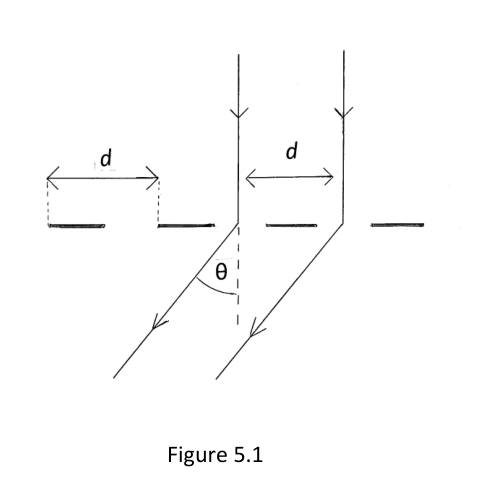 Reticolo di diffrazione con angolo theta
Topic: Wave Optics, Oscillations & Waves Metodi: Interference & Diffraction Analysis, Superposition Principle, Wave Equation Competenze: Mathematical Modeling, Physical Reasoning, Diagrammatic Reasoning Objects: Diffraction Grating, Slit Fonte: Testo (PDF) — p.8
Q5.
Figura 5.1 Una griglia di diffrazione, con periodo d, è costituita da fessure di larghezza uguale, figura 5.1. Luce monocromatica, lunghezza d’onda , che incide normalmente sulla griglia di diffrazione, è diffrazione da un angolo . (a) Determinare la condizione per: (i) interferenza costruttiva (ii) interferenza distruttiva. [3] (b) Quando la luce rossa monocromatica e la luce viola monocromatica si incidono sulla La linea di diffrazione è stata osservata, senza contare la linea di ordine zero indifferente, è una sovrapposizione di luce rossa e viola. Spiegami questo. osservazione e specifica le prime quattro righe. [4] (c) Se la griglia ha 500 linee per mm, e l’angolo di diffrazione della linea composta è di 43,6o, determinare le lunghezze d’onda delle linee rosse e violate. [6] (d) Qual è la quinta linea dello spettro e il suo angolo di diffrazione associato? [4] (e) Indicare, in modo grafico, come l’intensità delle linee varia con l’ordine n. [3] 9
*Reticolo di diffrazione con angolo theta *
Topic: Wave Optics, Oscillations & Waves Metodi: Interference & Diffraction Analysis, Superposition Principle, Wave Equation Competenze: Mathematical Modeling, Physical Reasoning, Diagrammatic Reasoning Objects: Diffraction Grating, Slit Fonte: Testo (PDF) — p.8
Q6
Figure 6.1 Liquid, density , is slowly poured , beginning at time t = 0, from a beaker into a tall measuring cylinder of height H, cross-sectional area A and weight WMC, that stands on weighing scales , Figure 6.1. The initial volume of liquid in the beaker will just fill the cylinder. The liquid is poured, at a volume rate of v, from a height H above the bottom of the cylinder. (a) Derive an equation for the weight registered on the weighing scales, w, as a function of the height of liquid in the cylinder, h. [4] (b) Determine the maximum reading on the scales. (It may be helpful to express the result in (a) in terms of the variable y, where y2 = H - h). [6] (c) Deduce the difference between the result in (b) and the weight of liquid in the cylinder plus WMC at the time of the maximum reading. [2] (d) Express w as a function of time t, from t = 0 until the time when the liquid in the beaker is exhausted, tE. [4] (e) Sketch a graph of the weighing scale reading, w , against time, t, from t = 0 until the beaker is empty. [4] [ ax2 + bx + c = a(x + b/2a) 2 +c - b2/4a ] 10
End of Questions
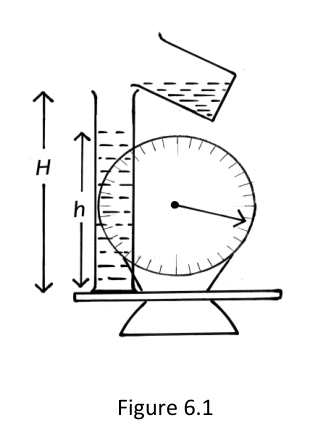 Cilindro graduato su bilancia
Topic: Newtonian Mechanics, Fluid Mechanics Metodi: Impulse-Momentum Theorem, Hydrostatic Equilibrium, Physical Modeling Competenze: Mathematical Modeling, Physical Reasoning, Graph Linearization Objects: Container Fonte: Testo (PDF) — p.9
Q6
Figura 6.1 L’acqua, densità , viene versata lentamente, a partire dal momento t = 0, da un bicchiere in un alto cilindro di misurazione di altezza H, area di sezione trasversale A e peso WMC, che si trova su Scale di pesatura , figura 6.1. Il volume iniziale di liquido nel bicchiere riempirà solo il
- Il cilindro. Il liquido viene versato, a un volume di v, da un’altezza H sopra il fondo di il cilindro. (a) Derivare un’equazione per il peso registrato sulle pesanti, w, come funzione dell’altezza del liquido nel cilindro, h. [4] (b) Determina la lettura massima delle scale. (Potrebbe essere utile esprimere la risultano a) in termini di variabile y, dove y2 = H - h. [6] (c) Riduzione della differenza tra il risultato di (b) e il peso del liquido nel cilindro più WMC al momento della lettura massima. [2] (d) Esprimere w come funzione del tempo t, da t = 0 fino al momento in cui il liquido nel
- Il beaker è esaurito, tE. [4] (e) Segna un grafico della lettura della scala di pesatura, w , contro il tempo, t, da t = 0 fino alla
- Il bicchiere è vuoto. [4] [ ax2 + bx + c = a(x + b/2a) 2 +c - b2/4a ] 10
Fine delle domande
Cilindro graduato su bilancia
Topic: Newtonian Mechanics, Fluid Mechanics Metodi: Impulse-Momentum Theorem, Hydrostatic Equilibrium, Physical Modeling Competenze: Mathematical Modeling, Physical Reasoning, Graph Linearization Objects: Container Fonte: Testo (PDF) — p.9