Question 1 A cricketer leaps into the air and catches a ball while both are in mid air. Which of the cricketer or the ball undergoes the smaller change in momentum?
- A. The cricketer does.
- B. The ball does.
- C. The change in momentum is the same for both the cricketer and the ball.
- D. You can’t tell without knowing the final velocity of the combined cricketer-ball mass.
- E. The result depends on the energy absorbed by the cricketer’s hands while catching the ball.
Topic: Conservation of Momentum, Newtonian Mechanics Metodi: Conservation of Momentum, Impulse-Momentum Theorem Competenze: Physical Reasoning Objects: Ball Fonte: Testo (PDF) — p.2
Domanda 1 Un giocatore di cricket salta in aria e prende una palla mentre entrambi sono in aria. Chi di voi è il giocatore di cricket o il La palla subisce il minor cambiamento di impulso?
- Il giocatore di cricket lo fa.
- La palla lo fa.
- C. Il cambiamento di impulso è lo stesso sia per il giocatore di cricket che per la palla. Non si può dire senza conoscere la velocità finale della massa del cricket-ball combinato.
- E. Il risultato dipende dall’energia assorbita dalle mani del giocatore durante la cattura della palla.
Topic: Conservation of Momentum, Newtonian Mechanics Metodi: Conservation of Momentum, Impulse-Momentum Theorem Competenze: Physical Reasoning Objects: Ball Fonte: Testo (PDF) — p.2
Question 2 Just before the cricketer caught the ball her kinetic energy was the same as the ball’s kinetic energy. Just before the cricketer catches the ball, which of the following statements is true?
- A. The ball has a greater speed than the cricketer.
- B. The cricketer has a greater speed than the ball.
- C. The cricketer and the ball have the same speed.
- D. The kinetic energy cannot give information about their speeds.
- E. The directions of the cricketer and the ball must be taken into account to compare their speeds.
Topic: Newtonian Mechanics, Conservation of Energy Metodi: Conservation Laws Competenze: Physical Reasoning Objects: Ball Fonte: Testo (PDF) — p.2
Domanda 2 Poco prima che il giocatore di cricket catturasse la palla la sua energia cinetica era la stessa dell’energia cinetica della palla. - Solo che… prima che il giocatore di cricket catturi la palla, quale delle seguenti affermazioni è vera?
- A. La palla ha una velocità superiore a quella del giocatore di cricket.
- B. Il giocatore di cricket ha una velocità superiore alla palla.
- C. Il giocatore di cricket e la palla hanno la stessa velocità.
- D. L’energia cinetica non può fornire informazioni sulle loro velocità.
- E. Per confrontare le loro velocità, occorre tenere conto delle direzioni del giocatore di cricket e della palla.
Topic: Newtonian Mechanics, Conservation of Energy Metodi: Conservation Laws Competenze: Physical Reasoning Objects: Ball Fonte: Testo (PDF) — p.2
Question 3 Tara likes playing with bubbles and watching the bright colours in them change. She notices that bubbles which have dark patches pop sooner than those with no dark patches. She concludes that dark patches cause bubbles to pop. Which of the following is the best statement of the flaw in Tara’s argument?
- A. It ignores the effects of bubbles colliding with other objects.
- B. It assumes that because dark patches occur just before popping, dark spots cause popping.
- C. It ignores the fact that some bubbles pop when there are no dark patches.
- D. It ignores the effects of other colours on whether bubbles pop.
- E. There is no flaw in Tara’s argument. Dark patches cause popping.
Topic: Fluid Mechanics Metodi: Physical Modeling Competenze: Physical Reasoning Objects: Bubble Fonte: Testo (PDF) — p.2
Domanda 3 A Tara piace giocare con le bolle e guardare i colori luminosi che cambiano. Si accorge che le bolle che hanno macchie scure che appaiono prima di quelle senza macchie scure. Ha concluso che le macchie scure
- Fa saltare le bolle. Quale delle seguenti dichiarazioni è la migliore sulla mancanza dell’argomento di Tara?
- A. Ignora gli effetti delle bolle che si schiantano con altri oggetti.
- B. Si presume che, poiché le macchie scure si verificano poco prima della comparsa, le macchie scure causino la comparsa.
- C. Ignora il fatto che alcune bolle si scoppiano quando non ci sono macchie scure.
- D. Ignora gli effetti di altri colori sulla presenza di bolle.
- E. Non vi è alcun difetto nell’argomento di Tara. Le macchie scure causano la spalla.
Topic: Fluid Mechanics Metodi: Physical Modeling Competenze: Physical Reasoning Objects: Bubble Fonte: Testo (PDF) — p.2
Question 4 A large truck breaks down on the freeway and receives a push to the nearest exit by a small car as shown below. While the car, still pushing the truck, is speeding up to get to cruising speed a. the amount of force with which the car pushes on the truck is equal to that with which the truck pushes back on the car. b. the amount of force with which the car pushes on the truck is smaller than that with which the truck pushes back on the car. c. the amount of force with which the car pushes on the truck is greater than that with which the truck pushes back on the car. d. the car’s engine is running so the car pushes against the truck, but the truck’s engine is not running so the truck cannot push back against the car. The truck is pushed forward simply because it is in the way of the car. e. neither the car nor the truck exert any force on the other. The truck is pushed forward simply because it is in the way of the car.
Topic: Newtonian Mechanics Metodi: Free-Body Diagram Competenze: Physical Reasoning Objects: Cart Fonte: Testo (PDF) — p.3
Domanda 4 Un grosso camion si è rotto sulla strada e viene spinto verso l’uscita più vicina da una piccola macchina come mostrato
- Qui sotto. Mentre l’auto, che spinge ancora il camion, si sta accelerando per raggiungere la velocità di crociera a. la forza con cui l’auto spinge sul camion è pari a quella con cui il camion spinge indietro l’auto. b. la forza con cui l’auto spinge il camion è inferiore a quella con cui il Il camion spinge indietro l’auto. c. la forza con cui l’auto spinge il camion è superiore a quella con cui il Il camion spinge indietro l’auto. d. il motore della macchina è in funzione, quindi la macchina spinge contro il camion, ma il motore del camion non è in funzione Quindi il camion non può spingere contro l’auto. Il camion viene spinto in avanti semplicemente perché è in
- La strada della macchina. e. né l’auto né il camion esercitano alcuna forza l’uno sull’altro. Il camion viene spinto avanti semplicemente Perche’ sta in mezzo alla macchina.
Topic: Newtonian Mechanics Metodi: Free-Body Diagram Competenze: Physical Reasoning Objects: Cart Fonte: Testo (PDF) — p.3
Question 5 An elevator is being lifted up an elevator shaft at a constant speed by a steel cable as shown in the figure below. All frictional effects are negligible. In this situation, the forces on the elevator are such that:
- A. the upwards force of the cable is greater than the downward force of gravity.
- B. the upward force of the cable is equal to the downward force of gravity.
- C. the upward force of the cable is smaller than the downward force of gravity.
- D. the upward force of the cable is greater than the sum of the downward force of gravity and a downward force due to air. e. none of the above. (The elevator goes up because the cable is being shortened, not because an upwards force is exerted on the elevator by the cable.) steel cable Elevator going up at constant speed
Topic: Newtonian Mechanics Metodi: Free-Body Diagram Competenze: Physical Reasoning, Diagrammatic Reasoning Objects: String Fonte: Testo (PDF) — p.3
Domanda 5 Un ascensore viene sollevato su un asciugamano a velocità costante da un cavo in acciaio come mostrato nella figura
- Qui sotto. Tutti gli effetti di attrito sono trascurabili. In questa situazione, le forze dell’ascensore sono tali che:
- A. la forza verso l’alto del cavo è superiore alla forza di gravità verso il basso.
- B. la forza ascendente del cavo è uguale alla forza gravitazionale discendente.
- C. la forza ascendente del cavo è inferiore alla forza gravitazionale discendente.
- D. la forza ascendente del cavo è superiore alla somma della forza gravitazionale discendente e forza verso il basso a causa dell’aria. e. nessuna delle cose sopra. (L’ascensore sale perché il cavo viene abbreviato, non perché un la forza verso l’alto viene esercitata sull’ascensore dal cavo.) cavi in acciaio Ascensione a velocità costante
Topic: Newtonian Mechanics Metodi: Free-Body Diagram Competenze: Physical Reasoning, Diagrammatic Reasoning Objects: String Fonte: Testo (PDF) — p.3
Question 6 A donkey pulls a wooden box along rough flat ground at a constant speed by means of a force (magnitude ) as shown. In the diagram, is the magnitude of the frictional force, is the magnitude of the normal force, and is the magnitude of the force of gravity. Which of the following options must be true?
- A. and
- B. and
- C. and
- D. and
- E. none of these.
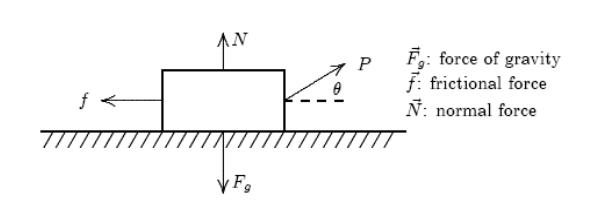 blocco trainato con forze N, f, Fg
Topic: Newtonian Mechanics Metodi: Free-Body Diagram, Vector Decomposition Competenze: Diagrammatic Reasoning, Physical Reasoning Objects: Block Fonte: Testo (PDF) — p.4
Domanda 6 Un asino tira una scatola di legno lungo un terreno piatto e in condizioni di durazione a velocità costante con una forza (magnitude ) come indicato. Nel diagramma, è la magnitudine della forza di attrito, è la magnitudine di la forza normale e è la magnitudine della forza di gravità. Qual è l’opzione che deve essere
- E’ vero?
- A. e
- B. e
- C. e
- D. e
- E. nessuna di queste.
- blocco di formazione con forza N, f, Fg *
Topic: Newtonian Mechanics Metodi: Free-Body Diagram, Vector Decomposition Competenze: Diagrammatic Reasoning, Physical Reasoning Objects: Block Fonte: Testo (PDF) — p.4
Question 7 The donkey of Question 6 now pulls harder and doubles the magnitude of the force . Which of the following options must be true?
- A. and remain constant but increases to counter the increase in .
- B. , and all remain constant despite the increase in .
- C. and remain constant but decreases due to the increase in .
- D. remains constant but and hence decrease due to the increase in .
- E. none of these.
Topic: Newtonian Mechanics Metodi: Free-Body Diagram, Vector Decomposition Competenze: Physical Reasoning Objects: Block Fonte: Testo (PDF) — p.4
Domanda 7 L’asino della domanda 6 tira ora più forte e raddoppia la forza . Qual è il numero di le seguenti opzioni devono essere vere?
- A. e rimangono costanti ma aumenta per contrastare l’ aumento di .
- B. , e restano tutti costanti nonostante l’ aumento di .
- C. e rimangono costanti ma diminuisce a causa dell’ aumento di .
- D. rimane costante ma e quindi diminuiscono a causa dell’aumento di .
- E. nessuna di queste.
Topic: Newtonian Mechanics Metodi: Free-Body Diagram, Vector Decomposition Competenze: Physical Reasoning Objects: Block Fonte: Testo (PDF) — p.4
Question 8 The positions of two runners, Helen and Con, are shown below. The runners are shown at successive 0.20 second intervals, and they are moving towards the right. Do Helen and Con ever have the same speed?
- A. No.
- B. Yes, at instant 2.
- C. Yes, at instant 7.
- D. Yes, at instants 2 and 7.
- E. Yes, at some time during the interval 4 to 5.
Topic: Newtonian Mechanics Metodi: Kinematic Equations Competenze: Physical Reasoning, Diagrammatic Reasoning Objects: — Fonte: Testo (PDF) — p.5
Domanda 8 Le posizioni di due corridori, Helen e Con, sono mostrate sotto. I corridori sono mostrati in successivi 0,20 secondi, e si muovono a destra. Helen e Con hanno mai la stessa velocità?
- A. No.
- B. Sì, all’ istante 2.
- C. Sì, all’ istante 7.
- D. Sì, nei momenti 2 e 7.
- E. Sì, in qualche momento nell’intervallo da 4 a 5.
Topic: Newtonian Mechanics Metodi: Kinematic Equations Competenze: Physical Reasoning, Diagrammatic Reasoning Objects: — Fonte: Testo (PDF) — p.5
Question 9 The positions of two runners, Helen and Con, are shown below. The runners are shown at successive 0.20 second intervals, and they are moving towards the right. Which of the following statements best describes how the accelerations of the runners are related.
- A. The acceleration of Con in greater than the acceleration of Helen.
- B. The acceleration of Helen is greater than the acceleration of Con.
- C. The accelerations of Helen and Con are equal. Both accelerations are equal to zero.
- D. The accelerations of Helen and Con are equal. Both accelerations are greater than zero.
- E. Not enough information is given to answer the question.
Topic: Newtonian Mechanics Metodi: Kinematic Equations Competenze: Physical Reasoning, Diagrammatic Reasoning Objects: — Fonte: Testo (PDF) — p.5
Domanda 9 Le posizioni di due corridori, Helen e Con, sono mostrate sotto. I corridori sono mostrati in successivi 0,20 secondi, e si muovono a destra. Quale delle seguenti affermazioni descrive meglio come le accelerazioni dei corridori sono correlate.
- A. L’accelerazione di Con in maggiore dell’accelerazione di Helen.
- ** B.** L’accelerazione di Helen è maggiore dell’accelerazione di Con.
- C. Le accelerazioni di Helen e Con sono uguali. Entrambe le accelerazioni sono uguali a zero.
- ** D.** Le accelerazioni di Helen e Con sono uguali. Entrambe le accelerazioni sono superiori a zero.
- E. Non sono fornite informazioni sufficienti per rispondere alla domanda.
Topic: Newtonian Mechanics Metodi: Kinematic Equations Competenze: Physical Reasoning, Diagrammatic Reasoning Objects: — Fonte: Testo (PDF) — p.5
Question 10 Which of the following is the best estimate of the volume of an orange.
- A.
- B.
- C.
- D.
- E.
SECTION B: WRITTEN ANSWER QUESTIONS USE THE ANSWER BOOKLET PROVIDED Note: Suggested times are given for section B as a general guide only. You may take more or less time on any question – everyone is different.
Topic: Order-of-Magnitude Estimation Metodi: Order-of-Magnitude Estimation Competenze: Estimation & Approximation Objects: — Fonte: Testo (PDF) — p.5
Domanda 10 Qual è la migliore stima del volume di un’arancia?
- A.
- B.
- C.
- D.
- E.
PARTE B: Risposte scritte Utilizzate il volantino di risposta fornito Nota: I tempi suggeriti sono forniti per la sezione B solo come guida generale. Potresti prendere più o meno tempo per Domanda: tutti sono diversi.
Topic: Order-of-Magnitude Estimation Metodi: Order-of-Magnitude Estimation Competenze: Estimation & Approximation Objects: — Fonte: Testo (PDF) — p.5
Question 11 Suggested Time: 35 min Maria is a connoisseur of fine teas. She is preparing her new tea with boiling water in her cylindrical mug with inner radius and height . Her mug has a lid for better insulation. In a short time the amount of heat which flows out of the tea is given by
where in the inner surface area of the mug and is the thickness of the mug walls. As heat flows from the tea the change in its temperature given by
where is the mass of the water. Data Temperature of boiling water: Thermal conductivity of mug: Room temperature: Density of water: Specific heat capacity of water: Maria pours her tea, filling her mug completely, and immediately places the lid on her mug. a) (i) Find the temperature of Maria’s tea after 30 seconds have elapsed and fill in the first line of the table on p. 2 of the Answer Booklet. (ii) Complete the rest of the table on p. 2 of the Answer Booklet. Hint: use your answers from one line to help you with the next line. (iii) Plot a graph of vs. time on p. 3 of the Answer Booklet. Include times from 0 s up to and including 5 min.
- B. Find the time it takes Maria’s tea to reach .
- C. Maria decides to reheat her tea from to with a small 1.1 kW heater she places into the tea. How long will it take the tea to reach ? You may neglect the heat flow out of the tea. d) Estimate the size of the error in your answer to part (c) due to neglecting heat flow out of the tea. Use your estimate to comment on whether your answer to part (c) is reasonable.
Topic: Thermodynamics Metodi: Differential Equations, First Law of Thermodynamics, Approximation & Series Expansion Competenze: Mathematical Modeling, Error Propagation, Graph Linearization Objects: Container Fonte: Testo (PDF) — p.6
Domanda 11 Tempo di programmazione: 35 minuti Maria è una conoscitrice dei bei tè. Sta preparando il suo nuovo tè con acqua bollente nel suo cilindrico la tazza con raggio interno e altezza . La sua tazza ha un coperchio per un’isolamento migliore. In breve tempo la quantità di calore che scorre dal tè viene data da
dove nella superficie interna della tazza e è lo spessore delle pareti della tazza. Quando il calore scorre dal tè, la variazione della sua temperatura viene data da
dove è la massa dell’acqua. Dati Temperatura dell’acqua bollente: Conducibilità termica della tazza: Temperatura ambientale: Densità dell’acqua: Capacità termica specifica dell’acqua: Maria versò il suo tè, riempì completamente la tazza e immediatamente impostò il coperchio sulla tazza. a) (i) Trova la temperatura del tè di Maria dopo il termine di 30 secondi e compila la prima riga della tabella di p. 2 del libretto delle risposte.
- Completa il resto della tabella a p. 2 del libretto delle risposte. Suggerimento: usa le tue risposte da una riga per aiutarti con la prossima riga. (iii) Tracciare un grafico di vs. tempo su p. 3 del libro di risposte. Include i tempi da 0 s fino a e 5 minuti compresi.
- B. Trova il tempo necessario per raggiungere il tè di Maria.
- C. Maria decide di riscaldare il suo tè da a con un piccolo riscaldatore da 1,1 kW che mette nel
- Il tè. Quanto tempo ci vorrà per raggiungere il ? Potresti trascurare il flusso di calore del tè. d) Estimare l’entità dell’errore nella risposta alla parte c) dovuta alla trascurata corrente di calore fuori dal tè. Usa la tua stima per commentare se la tua risposta alla parte (c) è ragionevole.
Topic: Thermodynamics Metodi: Differential Equations, First Law of Thermodynamics, Approximation & Series Expansion Competenze: Mathematical Modeling, Error Propagation, Graph Linearization Objects: Container Fonte: Testo (PDF) — p.6
Question 12 Suggested Time: 30 min A block of mass sits against an unextended spring with spring constant on a frictionless surface as shown below. A short distance beyond the mass, there is a vertical cliff of height that drops off to a rough surface with kinetic friction coefficient . When compressed or extended, the spring exerts a restoring force
where is the spring constant and is the change in length of the spring. The elastic potential energy stored in the spring during this deformation is given by
The block is pushed against the spring with displacement and then released at time .
- A. What is the velocity of the block immediately after it loses contact with the spring?
- B. After reaching the cliff, the block continues to move through the air until it hits the rough surface below. Once it hits the rough surface, a frictional force acts against the horizontal motion of the block. On the axes given on p. 4 of the Answer Booklet sketch as functions of time, starting when the block is released and ending when the block is at rest again, the (i) kinetic energy, (ii) gravitational potential energy, and (iii) elastic potential energy. Use the same axes for all three sketches and label each line clearly. c) A section of the rough ground a distance from the cliff is made smooth (frictionless) and a second spring, with constant is placed on it, as shown below. (i) On the axes on p. 5 of the Answer Booklet, sketch the maximum compression of the new spring as a function of the maximum compression of the launching spring. Only consider compressions causing the block to land before the second spring. (ii) Find an expression for the largest possible maximum compression of the second spring that you marked on your sketch for part (c)(i).
Topic: Newtonian Mechanics, Conservation of Energy Metodi: Energy Conservation Method, Kinematic Equations, Hooke’s Law, Free-Body Diagram Competenze: Mathematical Modeling, Diagrammatic Reasoning, Physical Reasoning Objects: Block, Spring Fonte: Testo (PDF) — p.7
Domanda 12 Tempo di programmazione: 30 minuti Un blocco di massa si trova contro una sorgente non estesa con costante sorgente su una superficie senza attrito come Le informazioni sono riportate in appresso. A breve distanza dal massaggio, si trova una scogliera verticale di altezza che scende a un superficie rugosa con coefficiente di attrito cinetico . Quando viene compresso o esteso, la molla esercita una forza di ripristino
in cui è la costante della molla e è il cambiamento della lunghezza della molla. L’energia potenziale elastica la presenza di una di queste forme di deformazione è data da
Il blocco viene spinto contro la molla con spostamento e quindi rilasciato al tempo .
- A. Qual è la velocità del blocco subito dopo aver perso il contatto con la molla?
- B. Dopo aver raggiunto la scogliera, il blocco continua a muoversi attraverso l’aria fino a raggiungere la superficie rugosa
- Qui sotto. Una volta che colpisce la superficie rugosa, una forza di attrito agisce contro il movimento orizzontale della Blocco. Sulle assi indicate a p. 4 della scheda del libro delle risposte come funzioni del tempo, a partire dal momento in cui il il blocco viene rilasciato e termina quando il blocco è di nuovo a riposo, il
- energia cinetica,
- l’energia potenziale gravitazionale;
- energia potenziale elastica. Utilizzare gli stessi assi per tutti e tre gli schizzi e etichettare chiaramente ogni riga. c) Una sezione di terreno accidentato a una distanza dalla scogliera è ridotta liscia (senza frizione) e una sezione di terra la seconda molla, con costante è collocata su di essa, come mostrato di seguito.
- sugli assi di p. 5 del libro di risposte, disegna la compressione massima del nuovo la molla in funzione della compressione massima della molla di lancio. Solo considerare le compressioni che causano l’atterraggio del blocco prima della seconda primavera.
- Trovare un’espressione per la massima compressione possibile della seconda primavera che ha segnato sul suo disegno la parte (c) ((i).
Topic: Newtonian Mechanics, Conservation of Energy Metodi: Energy Conservation Method, Kinematic Equations, Hooke’s Law, Free-Body Diagram Competenze: Mathematical Modeling, Diagrammatic Reasoning, Physical Reasoning Objects: Block, Spring Fonte: Testo (PDF) — p.7
Question 13 Suggested Time: 18 min A lolly factory produces shiny delicious spherical chocolates of radius . It packs the chocolates in layers arranged as shown in Figure 1; each layer is stacked directly on top of the one below. Figure 1: Neatly packed chocolates. The packing fraction is defined to be the ratio of the volume of some objects divided by the total volume of space which they occupy. When arranged randomly the chocolates have a packing fraction of 0.64. a) Find the packing fraction of the chocolates when they are neatly packed in stacked layers with the arrangement shown in Figure 1. b) Do the same number of chocolates occupy more space when neatly packed as in Figure 1 or when randomly arranged? To sell the chocolates the factory packs them into bags which are filled through funnels like that shown in Figure 2. As the bags are filled chocolates are added into the top of the funnel at an average rate of 5 chocolates per second and the level in of chocolates in the top of the funnel is steady. c) (i) How many bags of 30 can be filled per minute through each funnel? (ii) How fast do the chocolates shoot out of the funnel into a bag? (iii) What is the average downwards speed of the chocolates in the top of the funnel? Figure 2: Funnel for filling bags.
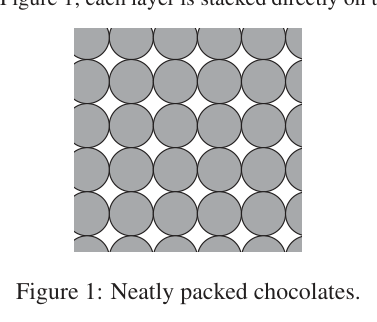 cioccolatini sferici impilati ordinatamente
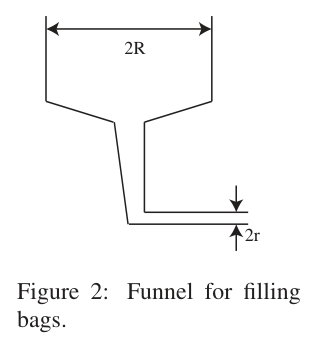 imbuto conico per riempire sacchi
Topic: Fluid Mechanics, Newtonian Mechanics Metodi: Continuity Equation, Physical Modeling Competenze: Mathematical Modeling, Physical Reasoning Objects: Sphere Fonte: Testo (PDF) — p.9
Domanda 13 Tempo di programmazione: 18 minuti Una fabbrica di dolci produce splendenti deliziosi cioccolatini sferici di raggio . - Incapaca i cioccolatini . strati disposti come mostrato alla figura 1; ogni strato è impilato direttamente sopra quello di sotto. Figura 1: cioccolatini ben imballati. La frazione di imballaggio è definita come il rapporto del volume di alcuni oggetti diviso per il volume totale di spazio che occupano. Quando sono organizzati in modo casuale, i cioccolati hanno una frazione di imballaggio di 0,64. a) Trova la frazione di imballaggio dei cioccolatini quando sono accuratamente imballati in strati a piombo con il Disposizioni illustrate alla figura 1. b) Se il numero di cioccolatini è uguale a quello della figura 1 occupi più spazio quando sono ben imballati o quando organizzato casualmente? Per vendere i cioccolati la fabbrica li imballa in sacchetti che vengono riempiti attraverso funelli come quello mostrato nella figura 2. Quando le sacche sono riempite, i cioccolatini vengono aggiunti in cima al funnel a un tasso medio di 5 cioccolati al secondo e il livello di cioccolati nella parte superiore del funnel è costante. c) (i) Quanti sacchi di 30 possono essere riempiti al minuto attraverso ogni funile? (ii) Quanto velocemente i cioccolati saltano fuori dal funnel ?
- In una borsa? (iii) Qual è la velocità media verso il basso dei cioccolati nella parte superiore del funnel? Figura 2: Funnel di riempimento
- Le borse.
*cioccolatini sferici impilati ordinatamente *
imbuto conico per riempire sacchi
Topic: Fluid Mechanics, Newtonian Mechanics Metodi: Continuity Equation, Physical Modeling Competenze: Mathematical Modeling, Physical Reasoning Objects: Sphere Fonte: Testo (PDF) — p.9
Question 14 Suggested Time: 18 min Astrophysical systems such as galaxies (which contain large numbers of stars) are generally very far from the Earth and solar system, and are moving away from us with some relative velocity . Individual stars can be moving with respect to the galaxy; the velocity of this motion is known as the peculiar velocity. Figure 3 shows a galaxy which is moving away from us as a whole; stars in this galaxy orbit its centre and have peculiar velocities. velocity of galaxy away from Earth peculiar velocity of star relative to host galaxy peculiar velocity of star relative to host galaxy Figure 3: Peculiar velocities of a stars in a galaxy. The energy from the peculiar motion within a galaxy, rather than its overall movement, is interesting. One way to measure the typical peculiar speed of a star, is to look at the spread in velocities. The standard deviation of the peculiar speeds is called the velocity dispersion, , and it becomes an estimate of the typical peculiar speed of a star. a) The virial theorem applied to an astrophysical system with very large mass gives that
where is the average speed of an object orbiting at a radius , and is the universal gravitational constant. Use the virial theorem to estimate the mass of a galaxy, where a population of stars at radius from the centre of the galaxy are observed to have velocity dispersion . When the source of a wave is approaching or retreating from an observer the wavelength changes. The size of this change is proportional to the speed of the source. This is known as the Doppler effect and is useful in astrophysics because elements emit light within narrow wavelength regions meaning peaks are observed in objects’ spectra. Figure 4: Hydrogen alpha emission spectrum. b) (i) Explain, with sketches, how the Doppler effect causes broadening of the Hydrogen alpha emission lines in the fast-rotating broad-line regions of galaxies. On the diagram on p. 8 of the Answer Booklet, draw what the Hydrogen alpha peak in Figure 4 would look like if its source is gas in the broad-line region of a galaxy. (ii) Hence, explain how observations of spectra can be used to measure the velocity dispersion of stars in a galaxy. Most galaxies have supermassive black holes at their centres, which can be a billion times more massive than the Sun. Sometimes a violent event in the supermassive black hole causes changes throughout the fast-rotating region around the centre, called the broad-line region; these changes appear some time later. A technique called reverberation mapping uses the time it takes light to travel across the broad-line region to estimate its radius. The light travel time is the measured time between observing changes in the front and in the back of the region. The speed of light is and the velocity dispersion of the broad-line region is . c) (i) Find an expression for the radius of the broad-line region. (ii) Estimate the mass of a supermassive black hole using reverberation mapping and the virial theorem. You may assume that supermassive black holes are so massive that they account for most of the mass in the centre of a galaxy.
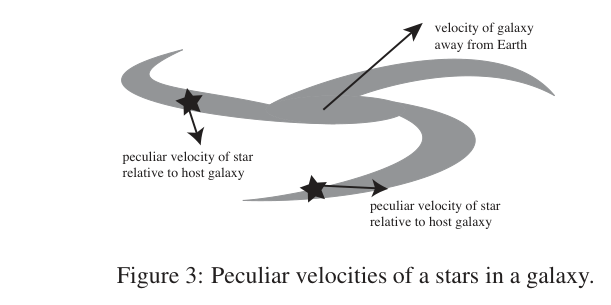 velocità peculiari di stelle in galassia
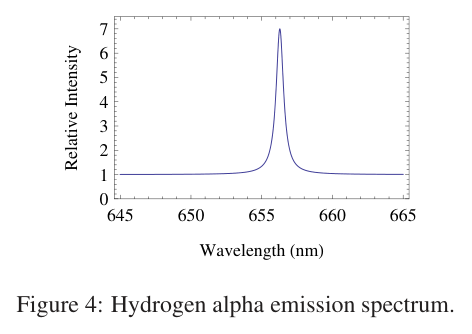 spettro emissione idrogeno alfa
Topic: Astrophysics, Oscillations & Waves, Gravitation Metodi: Newton’s Law of Gravitation, Statistical Averaging, Physical Modeling Competenze: Mathematical Modeling, Physical Reasoning, Estimation & Approximation Objects: Star, Black Hole Fonte: Testo (PDF) — p.10
Domanda 14 Tempo di programmazione: 18 minuti I sistemi astrofisici come le galassie (che contengono un gran numero di stelle) sono generalmente molto lontani dalla Terra e dal sistema solare, e si allontanano da noi con una velocità relativa . Individualità Le stelle possono muoversi rispetto alla galassia; la velocità di questo movimento è nota come la peculiare velocità di movimento. velocità. La figura 3 mostra una galassia che si sta allontanando da noi nel suo insieme; le stelle in questa galassia orbitano intorno al suo La velocità è molto alta. velocità della galassia lontano dalla Terra velocità peculiare di stella relativa alla galassia ospitante velocità peculiare di stella relativa alla galassia ospitante Figura 3: velocità peculiari di una stella in una galassia. L’energia proveniente dal peculiare movimento all’interno di una galassia, piuttosto che dal suo movimento generale, è interessante. Un modo per misurare la velocità tipica peculiare di una stella, è guardare la diffusione nelle velocità. Il La deviazione standard delle velocità particolari è chiamata dispersione della velocità, , e diventa una stima della velocità tipica peculiare di una stella. a) Il teorema virile applicato a un sistema astrofisico con una massa molto grande dà che
dove è la velocità media di un oggetto in orbita ad un raggio , e è la gravità universale costante. Utilizzare il teorema virile per stimare la massa di una galassia, dove una popolazione di stelle a Il raggio dal centro della galassia è osservato per avere una dispersione di velocità . Quando la fonte di un’onda si avvicina o si ritira da un osservatore, la lunghezza d’onda cambia. Il la dimensione di tale variazione è proporzionale alla velocità della fonte. Questo è noto come l’effetto Doppler ed è utile nell’astrofisica perché gli elementi emettono luce all’interno di regioni di lunghezza d’onda strette, il che significa che i picchi sono osservati negli oggetti spettri. Figura 4: Spettro di emissioni di alfa idrogeno. b) (i) Spiegare, con schizzi, come l’effetto Doppler provoca l’allargamento dell’alfa di idrogeno linee di emissione nelle regioni a larghe linee in rapida rotazione delle galassie. Sul diagramma di p. 8 of Il libro delle risposte, disegnare come sarebbe il picco alfa idrogeno nella figura 4 se il suo La fonte è il gas nella regione a larga linea di una galassia. (ii) Spiega quindi come le osservazioni dello spettro possano essere utilizzate per misurare la dispersione della velocità di stelle in una galassia. La maggior parte delle galassie ha buchi neri supermasivi al centro, che possono essere un miliardo di volte più massivi
- più del Sole. A volte un evento violento nel buco nero supermassiccio provoca cambiamenti in tutto il La regione che ruota rapidamente intorno al centro, chiamata regione a larga linea; questi cambiamenti appaiono qualche tempo dopo. Una tecnica chiamata mappatura di reverberazione utilizza il tempo necessario per viaggiare attraverso la linea larga la regione per stimare il suo raggio. Il tempo di viaggio della luce è il tempo misurato tra l’osservazione di variazioni di la parte anteriore e posteriore della regione. La velocità della luce è e la velocità di dispersione della la regione di linea larga è . c) (i) Trovare un’espressione per il raggio della regione a larga linea. (ii) Estimare la massa di un buco nero supermassiccio utilizzando la mappatura a reverberazione e la Teorema virile. Potreste supporre che i buchi neri supermasivi siano così massivi che rappresentano la maggior parte della massa nel centro di una galassia.
velocità peculiari di stelle in galassia
- spettro emissione idrogeno alfa*
Topic: Astrophysics, Oscillations & Waves, Gravitation Metodi: Newton’s Law of Gravitation, Statistical Averaging, Physical Modeling Competenze: Mathematical Modeling, Physical Reasoning, Estimation & Approximation Objects: Star, Black Hole Fonte: Testo (PDF) — p.10