Fonte: gare di altri paesi/Nordic-Baltic/all/2014 est-fin_2014sol.pdf · Apri PDF · apri PDF p.1
Cluster: Meccanica
Soluzioni (stessa cartella): ·
Problema 1
1. DC-DC CONVERTER (8 points)
In order to obtain high voltage supply using a battery, the following circuit is used. An electromagnetic switch connects a battery of electromotive force to an inductor of inductance : it is closed if there is no current in the inductor (a spring keeps it closed), but if the inductor current reaches a critical value , magnetic field created by the inductor pulls it open. Due to inertia, once the key is open, it takes a certain time to close again even if the current falls to zero.
For the diode D you may assume that its current is zero for any reverse voltage (), and also for any forward voltage smaller than the opening voltage (i.e. for ). For any non-zero forward current, the diode voltage remains equal to .
You may express your answers in terms of , , , , and the capacitance (see figure).
i) (1 point) At first, let the key be open. If the initial inductor current is zero, how long time will it take to open the key ?
ii) (1 point) Assuming (here and in what follows) that , plot the inductor current as a function of time (for ).
iii) (1 point) What is the maximal voltage on the resistor ?
iv) (2 points) Assuming that , what is the average power dissipation on the diode?
v) (2 points) Now, let the key be closed, and let us assume simplifyingly that ; also, and . Suppose that the circuit has been operated for a very long time. Find the average voltage on the resistor.
vi) (1 point) Find the amplitude of voltage variations on the resistor.
 DC-DC converter circuit diagram
Topic: Circuits, Electromagnetic Induction Metodi: Kirchhoff’s Laws, Faraday’s Law of Induction, Energy Conservation Method Competenze: Physical Reasoning, Mathematical Modeling Fonte: Testo (PDF) — p.1
Problema 2
2. WASTE PROJECT (8 points)
In 2114, Europarliament decided that all radioactive wastes need to be sent to the Sun, so as to avoid contamination of Earth and orbital space. In what follows, you can use the following numerical data: duration of one year days, orbital speed on Earth km/s, angular diameter of Sun as seen from the Earth , radius of the Earth km, free fall acceleration at the Earth’s surface m/s².
According to the project, the waste is sent to the Sun using ballistic spaceships: the engine operates only during a short period of time during which the displacement of the spaceship remains much shorter than the radius of Earth. In the Earth’s frame of reference, the spaceship obtains a velocity opposite to the orbital velocity of Earth in the Sun’s frame of reference. Further, the ship moves along a ballistic trajectory until it hits the Sun. The trajectory is such as to minimize the consumption of fuel.
i) (1 point) Sketch the trajectory of the spaceship.
As a first approximation, calculations can be done when neglecting the angular size of the Sun (i.e. by putting ); you can use this approach for the next two questions.
ii) (1.5 points) How long will it take for the spaceship to travel from the Earth to the Sun?
iii) (1.5 points) What is the speed of the spaceship in the Earth’s frame of reference when the distance from the Earth is much larger than the Earth’s radius, but still much shorter than the distance to the Sun?
iv) (2.5 points) Answer the previous question without making the approximation .
v) (1.5 points) What is the speed of the spaceship in the Earth’s frame of reference when the distance from the Earth is much smaller than the Earth’s radius?
Topic: Gravitation, Newtonian Mechanics Metodi: Kepler’s Laws, Conservation of Energy, Newton’s Law of Gravitation Competenze: Physical Reasoning, Mathematical Modeling Fonte: Testo (PDF) — p.1
Problema 3
3. MAGNETS (6 points)
To explore the force between two small magnets, the following experiment is performed. One of the magnets is hanged from a thread with length m. Other magnet is moved slowly closer while keeping the axes of the magnets always on the same horizontal line. At the moment when the distance between the magnets is cm and the hanged magnet has moved cm from initial position, balance is lost and the magnets pull together. By making the assumption that the pulling force between the magnets depends on the distance according to the relation , find the value of the exponent .
Topic: Magnetism, Newtonian Mechanics Metodi: Free-Body Diagram, Physical Modeling, Symmetry Argument Competenze: Physical Reasoning, Mathematical Modeling Fonte: Testo (PDF) — p.1
Problema 4
4. SUPERBALLS (5 points)
elastic balls are dropped so that they are exactly above each other, with a very small gap between each. Bottom ball has a mass of , the one above has a mass of , next and so on, until the topmost ball with mass , where . At the moment when the bottom ball touches the ground, all the balls are moving with the speed .
i) (1 point) After the collision between the two bottommost balls, what is the speed of the second ball from the bottom?
ii) (3 points) What is the speed of the topmost ball after all collisions?
iii) (1 point) How many times higher would that ball fly compared to the initial drop height ? Take and .
It may be useful that the sequence , has a general term , where and are constants.
Topic: Conservation of Momentum, Newtonian Mechanics Metodi: Conservation of Momentum, Conservation of Energy, Kinematic Equations Competenze: Mathematical Modeling, Physical Reasoning Fonte: Testo (PDF) — p.1
Problema 5
5. PLANCK’S CONSTANT (8 points)
In a simplistic model, light emitting diodes can be considered to only pass current when lit, and then they have a constant voltage drop across them. is the energy of the light quanta emitted and C is the elementary charge. Speed of light in vacuum m/s.
You have an assorted set of light emitting diodes numbered 1–6, each with a series resistor. From the datasheets it is known for the peak wavelengths of the diodes to be 940 nm, 620 nm, 590 nm, 525 nm, 470 nm, and 450 nm.
i) (2 points) Find out which wavelength corresponds to which diode.
ii) (4 points) Measure the Planck’s constant that corresponds to our simplistic model. This does not have to correspond to real Planck’s constant.
iii) (2 points) Estimate the uncertainty.
Equipment: voltage source (batteries) with an unknown voltage, ammeter, assorted light emitting diodes with series resistor. Take care not to short the battery with the ammeter. You may ignore the internal resistances of the batteries and the ammeter.
Topic: Modern-Quantum Physics, Circuits Metodi: Photon Energy Relation, Graph Linearization, Experimental Data Analysis Competenze: Experimental Data Analysis, Graph Linearization Fonte: Testo (PDF) — p.1
Problema 6
6. RUNNING ON ICE (4 points)
A boy is running on a large field of ice with velocity m/s toward the north. The coefficient of friction between his feet and the ice is . Assume as a simplification that the reaction force between the boy and the ice stays constant (in reality it varies with every push, but the assumption is justified by the fact that the value averaged over one step stays constant).
i) (2 points) What is the minimum time necessary for him to change his moving direction to point towards the east so that the final speed is also m/s?
ii) (2 points) What is the shape of the optimal trajectory called?
Topic: Newtonian Mechanics Metodi: Free-Body Diagram, Kinematic Equations, Vector Decomposition Competenze: Physical Reasoning, Mathematical Modeling Fonte: Testo (PDF) — p.2
Problema 7
7. SPIN SYSTEM (8 points)
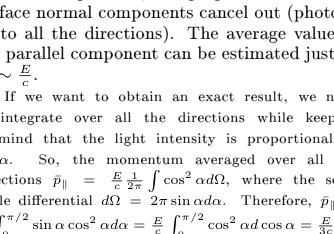
Let us consider a system of independent magnetic dipoles (spins) in a magnetic field and temperature . Our goal is to determine some properties of this system by using statistical physics. It is known that the energy of a single spin is , where and .
i) (2 points) What is the probability for a spin to be in excited state, i.e. have positive energy?
ii) (2 points) What is the average value of the total energy of the spin system as a function of and ?
iii) (2 points) Using high temperature approximation , simplify the expression of .
iv) (2 points) Using high temperature approximation , find the heat capacity of the spin system.
Topic: Thermodynamics, Magnetism Metodi: Statistical Averaging, Approximation & Series Expansion, Kinetic Theory of Gases Competenze: Mathematical Modeling, Physical Reasoning Fonte: Testo (PDF) — p.2
Problema 8
8. MIRROR INTERFERENCE (5 points)
A point source emits coherent light of wavelength isotropically in all directions; thus, the wavefronts are concentric spheres. The waves reflect from a dielectric surface placed at a distance (where is a large integer) from the point source, and the interference pattern is observed on a screen which is placed to a distance from the point source (see figure).
In what follows we use the , , and coordinates as defined in the figure. The screen is parallel to the mirror and lies in the –-plane.
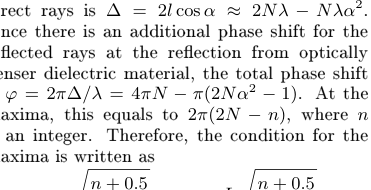
i) (2 points) At which values of the -coordinate (for ) are the interference maxima observed on the screen? You may assume that .
ii) (1 point) Sketch the shape of a few smallest-sized interference maxima on the screen (in –-plane).
iii) (2 points) Now the flat screen is replaced with a spherical screen of radius , centred around the point source. How many interference maxima can be observed?
 Mirror interference geometry diagram
Topic: Wave Optics Metodi: Interference & Diffraction Analysis, Superposition Principle, Small-Angle Approximation Competenze: Physical Reasoning, Mathematical Modeling Fonte: Testo (PDF) — p.2
Problema 9
9. THERMAL ACCELERATION (9 points)
Consider a cube of side length cm, made of aluminium (density g/cm³, molar mass g/mol). The heat capacitance of one mole of aluminium is given as a function of temperature in the graph below. The speed of light m/s, universal gas constant J/(kg·K). The initial temperature of the cube is K.
(Graph: vs (K), showing rising from 0 at to approximately at K, with values , , marked on vertical axis and K on horizontal axis.)
i) (1 point) What is the total heat energy of such a cube at the initial temperature ?
ii) (3 points) Now, the cube has 5 faces painted in white (reflects all relevant wavelengths) and one face painted in black (absorbs all these waves). The cube is surrounded by vacuum at a very low temperature (near absolute zero); there is no gravity field. Initially, the cube is at rest; as it cools down due to heat radiation, it starts slowly moving. Estimate its terminal speed .
iii) (2 points) At very low temperatures, the heat capacitance of aluminium is proportional to , where is its temperature. Which functional dependence describes the temperature as a function of time [, where and are constants] for such very low temperatures under the assumptions of the previous question?
iv) (3 points) Now, the cube has 5 faces covered with a thermal insulation layer (you may neglect heat transfer through these faces). One face is left uncovered. The cube is surrounded by hydrogen atmosphere at a very low temperature (molar mass of hydrogen molecules g/mol). The cube starts cooling down due to heat transfer to the surrounding gas; you may neglect the heat radiation. Initially, the cube is at rest; as it cools down, it starts slowly moving. Estimate the order of magnitude of its terminal speed . Assume that the surrounding gas is sparse, so that the mean free path of the molecules is much larger than . Assume that where is the speed of sound in the atmosphere surrounding the cube.
 Heat capacity of aluminium vs temperature
Topic: Thermodynamics, Kinetic Theory Metodi: Conservation of Momentum, First Law of Thermodynamics, Kinetic Theory of Gases Competenze: Estimation & Approximation, Physical Reasoning Fonte: Testo (PDF) — p.2
Problema 10
10. YOUNG’S MODULUS OF RUBBER (12 points)
The linear Hooke’s law for a rope made from an elastic material is supposed to hold for small relative deformations (which is also called “strain”), where is the undeformed length of the rope, and is the deformation. Once becomes too large, the force-deformation relationship is no longer linear; what is “too large” depends on the material. For very elastic materials which can reach relative deformations considerably larger than one, it may happen that the linear Hooke’s law with a constant stiffness fails, but if we take into account the change of the cross-sectional area of the rope with , where is the Young’s modulus of the elastic material, such a non-linear Hooke’s law remains valid. In that case we can say that there is still a linear stress-strain relationship , where the stress .
i) (7 points) Measure the relationship between the stress and strain in a rubber string and plot it.
ii) (5 points) From your plot determine the Young’s modulus with its uncertainty, and the maximum strain until which it applies.
Note: the diameter of the thread is to be measured using the diffraction of laser light.
Equipment: rubber thread, stand, measuring tape, 15 hex nuts with a known mass, a plastic bag for hanging a set of nuts to the thread, a green laser ( nm), a screen.
WARNING: AVOID LOOKING INTO A LASER BEAM, THIS MAY DAMAGE YOUR EYES!
Topic: Elasticity & Materials, Wave Optics Metodi: Stress-Strain Analysis, Hooke’s Law, Interference & Diffraction Analysis Competenze: Experimental Data Analysis, Error Propagation Fonte: Testo (PDF) — p.2