Question A1
A unicyclist of total height goes around a circular track of radius while leaning inward at an angle to the vertical. The acceleration due to gravity is .
a. Suppose . What angular velocity must the unicyclist sustain?
b. Now model the unicyclist as a uniform rod of length , where is less than but not negligible. This refined model introduces a correction to the previous result. What is the new expression for the angular velocity ? Assume that the rod remains in the plane formed by the vertical and radial directions, and that is measured from the center of the circle to the point of contact at the ground.
 Unicyclist leaning on circular track
Topic: Newtonian Mechanics, Rotational Dynamics, Rigid Body Statics Metodi: Free-Body Diagram, Torque & Angular Momentum Analysis, Kinematic Equations Competenze: Physical Reasoning, Mathematical Modeling Objects: Wheel, Rod Fonte: Testo (PDF) — p.3
La domanda A1
Un monovolume di altezza totale circonda una pista circolare di raggio inclinandosi verso l’interno ad un angolo verso la verticale. L’accelerazione dovuta alla gravità è .
a. Supponiamo che . Quale velocità angolare deve sostenere il monovolante?
b. Ora modellare il monovolume come una barra uniforme di lunghezza , dove è inferiore a ma non trascurabile. Questo modello raffinato introduce una correzione del risultato precedente. Qual è la nuova espressione per la velocità angolare ? Supponiamo che la canna rimanga nel piano formato dalle direzioni verticale e radiale e che sia misurata dal centro del cerchio al punto di contatto al suolo.
Uniciciclisto appoggiato su pista circolare
Topic: Newtonian Mechanics, Rotational Dynamics, Rigid Body Statics Metodi: Free-Body Diagram, Torque & Angular Momentum Analysis, Kinematic Equations Competenze: Physical Reasoning, Mathematical Modeling Objects: Wheel, Rod Fonte: Testo (PDF) — p.3
Question A2
A room air conditioner is modeled as a heat engine run in reverse: an amount of heat is absorbed from the room at a temperature into cooling coils containing a working gas; this gas is compressed adiabatically to a temperature ; the gas is compressed isothermally in a coil outside the house, giving off an amount of heat ; the gas expands adiabatically back to a temperature ; and the cycle repeats. An amount of energy is input into the system every cycle through an electric pump. This model describes the air conditioner with the best possible efficiency.
Assume that the outside air temperature is and the inside air temperature is . The air-conditioner unit consumes electric power . Assume that the air is sufficiently dry so that no condensation of water occurs in the cooling coils of the air conditioner. Water boils at 373 K and freezes at 273 K at normal atmospheric pressure.
a. Derive an expression for the maximum rate at which heat is removed from the room in terms of the air temperatures , , and the power consumed by the air conditioner . Your derivation must refer to the entropy changes that occur in a Carnot cycle in order to receive full marks for this part.
b. The room is insulated, but heat still passes into the room at a rate , where is the temperature difference between the inside and the outside of the room and is a constant. Find the coldest possible temperature of the room in terms of , , and .
c. A typical room has a value of . If the outside temperature is , what minimum power should the air conditioner have to get the inside temperature down to ?
Topic: Thermodynamics Metodi: Thermodynamic Cycle Analysis, First Law of Thermodynamics Competenze: Physical Reasoning, Mathematical Modeling Objects: Heat Engine, Gas Fonte: Testo (PDF) — p.3
La domanda A2
Un condizionatore d’aria di stanza è modellato come un motore termico a funzione inversa: una quantità di calore viene assorbita dalla stanza a una temperatura in bobine di raffreddamento contenenti un gas di lavoro; questo gas viene compresso adiabaticamente a una temperatura ; il gas viene compresso isotermicamente in una bobina fuori casa, emettendo una quantità di calore ; il gas si espandono adiabaticamente a una temperatura ; e il ciclo si ripete. Ogni ciclo viene inserito nel sistema una quantità di energia tramite una pompa elettrica. Questo modello descrive il condizionatore con la migliore efficienza possibile.
Supponiamo che la temperatura dell’aria esterna sia e la temperatura dell’aria interna . L’unità di condizionamento dell’aria consuma energia elettrica . Supponiamo che l’aria sia sufficientemente secca in modo che non si verifichi alcuna condensazione dell’acqua nelle bobine di raffreddamento del condizionatore d’aria. L’acqua bolle a 373 K e congela a 273 K a pressione atmosferica normale.
a. Derivare un’espressione per la velocità massima con cui il calore viene rimosso dalla stanza in termini di temperature dell’aria , e di potenza consumata dal condizionatore . La derivazione deve riferirsi ai cambiamenti di entropia che si verificano in un ciclo di Carnot per ricevere i punteggi completi per questa parte.
b. La stanza è isolata, ma il calore passa comunque nella stanza a una velocità , dove è la differenza di temperatura tra l’interno e l’esterno della stanza e è una costante. Trova la temperatura più fredda possibile della stanza in termini di , e .
c. Una stanza tipica ha un valore di . Se la temperatura esterna è , quale potenza minima deve avere il condizionatore per abbassare la temperatura interna a ?
Topic: Thermodynamics Metodi: Thermodynamic Cycle Analysis, First Law of Thermodynamics Competenze: Physical Reasoning, Mathematical Modeling Objects: Heat Engine, Gas Fonte: Testo (PDF) — p.3
Question A3
When studying problems in special relativity it is often the invariant distance between two events that is most important, where is defined by
where m/s is the speed of light.
a. Consider the motion of a projectile launched with initial speed at angle of above the horizontal. Assume that , the acceleration of free fall, is constant for the motion of the projectile.
i. Derive an expression for the invariant distance of the projectile as a function of time as measured from the launch, assuming that it is launched at . Express your answer as a function of any or all of , , , , and .
ii. The radius of curvature of an object’s trajectory can be estimated by assuming that the trajectory is part of a circle, determining the distance between the end points, and measuring the maximum height above the straight line that connects the endpoints. Assuming that we mean “invariant distance” as defined above, find the radius of curvature of the projectile’s trajectory as a function of any or all of , , , and . Assume that the projectile lands at the same level from which it was launched, and assume that the motion is not relativistic, so , and you can neglect terms with compared to terms without.
b. A rocket ship far from any gravitational mass is accelerating in the positive direction at a constant rate , as measured by someone inside the ship. Spaceman Fred at the right end of the rocket aims a laser pointer toward an alien at the left end of the rocket. The two are separated by a distance such that ; you can safely ignore terms of the form .
i. Sketch a graph of the motion of both Fred and the alien on the space-time diagram provided in the answer sheet. The graph is not meant to be drawn to scale. Note that and are reversed from a traditional graph. Assume that the rocket has velocity at time and is located at position . Clearly indicate any asymptotes, and the slopes of these asymptotes.
ii. If the frequency of the laser pointer as measured by Fred is , determine the frequency of the laser pointer as observed by the alien. It is reasonable to assume that .
Topic: Special Relativity, Newtonian Mechanics Metodi: Lorentz Transformation, Kinematic Equations, Approximation & Series Expansion Competenze: Physical Reasoning, Mathematical Modeling Objects: Projectile Fonte: Testo (PDF) — p.4
La domanda A3
Quando si studiano problemi di special relativity spesso è la distanza invariante tra due eventi che è più importante, dove è definita da
dove m/s è la velocità della luce.
a. Considerare il movimento di un proiettile lanciato con velocità iniziale all’angolo di sopra l’orizzontale. Supponiamo che , l’accelerazione della caduta libera, sia costante per il movimento del proiettile.
i. Derivare un’espressione per la distanza invariante del proiettile come funzione del tempo misurato dal lancio, supponendo che venga lanciato a . Esprimere la risposta come funzione di una o tutte le , , , e .
ii. Il raggio di curvatura della traiettoria di un oggetto può essere stimato supponendo che la traiettoria sia parte di un cerchio, determinando la distanza tra i punti di fine e misurando l’altezza massima sopra la linea retta che collega i punti di fine. Supponendo che intendiamo “distanza invariante” come definito sopra, trovare il raggio di curvatura della traiettoria del proiettolo come funzione di alcuni o tutti , , e . Supponiamo che il proiettile atterri allo stesso livello da cui è stato lanciato, e supponiamo che il movimento non sia relativistico, quindi , e si possono trascurare termini con rispetto ai termini senza.
b. Una nave missilistica lontana da qualsiasi massa gravitazionale accelera nella direzione positiva a un ritmo costante , misurato da qualcuno all’interno della nave. L’astronauta Fred, alla fine destra del razzo, punta un puntatore laser verso un alieno alla fine sinistra del razzo. Le due sono separate da una distanza tale che ; si possono ignorare in modo sicuro i termini del modulo .
i. Segna un grafico del movimento di Fred e dell’alieno sul diagramma spazio-tempo fornito nella scheda di risposta. Il grafico non è destinato a essere disegnato su scala. Si noti che e sono invertiti da un grafico tradizionale. Supponiamo che il razzo abbia velocità al tempo e sia situato alla posizione . Indicare chiaramente eventuali asintot e le pendici di questi asintot.
ii. Se la frequenza del puntatore laser misurata da Fred è , determinare la frequenza del puntatore laser osservata dall’alieno. È ragionevole supporre che .
Topic: Special Relativity, Newtonian Mechanics Metodi: Lorentz Transformation, Kinematic Equations, Approximation & Series Expansion Competenze: Physical Reasoning, Mathematical Modeling Objects: Projectile Fonte: Testo (PDF) — p.4
Question A4
A positive point charge is located inside a neutral hollow spherical conducting shell. The shell has inner radius and outer radius ; is not negligible. The shell is centered on the origin.
a. Assume that the point charge is located at the origin in the very center of the shell.
i. Determine the magnitude of the electric field outside the conducting shell at .
ii. Sketch a graph for the magnitude of the electric field along the axis on the answer sheet provided.
iii. Determine the electric potential at .
iv. Sketch a graph for the electric potential along the axis on the answer sheet provided.
b. Assume that the point charge is now located on the axis at a point .
i. Determine the magnitude of the electric field outside the conducting shell at .
ii. Sketch a graph for the magnitude of the electric field along the axis on the answer sheet provided.
iii. Determine the electric potential at .
iv. Sketch a graph for the electric potential along the axis on the answer sheet provided.
v. Sketch a figure showing the electric field lines (if any) inside, within, and outside the conducting shell on the answer sheet provided. You should show at least eight field lines in any distinct region that has a non-zero field.
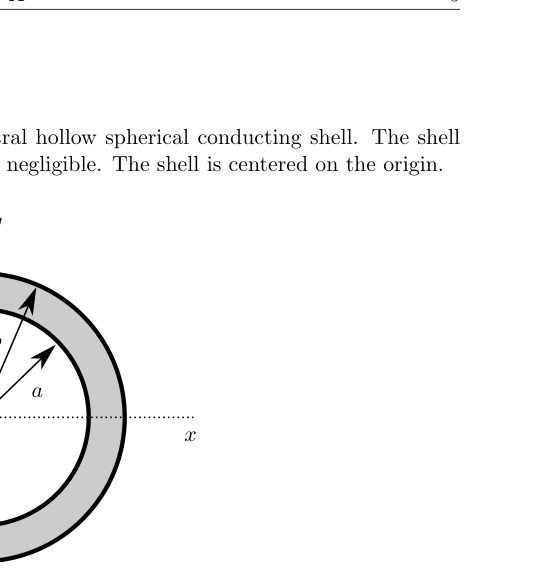 Hollow spherical conducting shell with charge
Topic: Electrostatics Metodi: Gauss’s Law, Electric Potential Method, Coulomb’s Law Competenze: Physical Reasoning, Diagrammatic Reasoning Objects: Point Charge, Conducting Sphere Fonte: Testo (PDF) — p.5
La domanda A4
Una carica di punto positivo si trova all’interno di una conchiglia di conduttore sferica vuota neutrale. Il rivestimento è di radius interno e radius esterno ; non è trascurabile. Il guscio è incentrato sull’origine.
a. Supponiamo che la carica puntologica sia situata all’origine nel centro stesso del guscio.
i. Determinare la grandezza del campo elettrico al di fuori della conchiglia conduttrice a .
ii. Segnare un grafico della grandezza del campo elettrico lungo l’asse sulla scheda di risposta fornita.
iii. Determinare il potenziale elettrico a .
iv. Segnare un grafico del potenziale elettrico lungo l’asse sulla scheda di risposta fornita.
b. Supponiamo che la carica puntaria sia ora situata sull’asse in un punto .
i. Determinare la grandezza del campo elettrico al di fuori della conchiglia conduttrice a .
ii. Segnare un grafico della grandezza del campo elettrico lungo l’asse sulla scheda di risposta fornita.
iii. Determinare il potenziale elettrico a .
iv. Segnare un grafico del potenziale elettrico lungo l’asse sulla scheda di risposta fornita.
v. Segnare una figura che mostra le linee di campo elettrico (se del caso) all’interno, all’interno e all’esterno della conchiglia conduttrice sulla scheda di risposta fornita. Dovresti mostrare almeno otto linee di campo in qualsiasi regione distinta che abbia un campo non zero.
Coscoletta di conduttori sferiche vuoto con carica
Topic: Electrostatics Metodi: Gauss’s Law, Electric Potential Method, Coulomb’s Law Competenze: Physical Reasoning, Diagrammatic Reasoning Objects: Point Charge, Conducting Sphere Fonte: Testo (PDF) — p.5
Question B1
A block of mass has a hole drilled through it so that a ball of mass can enter horizontally and then pass through the block and exit vertically upward. The ball and block are located on a frictionless surface; the block is originally at rest.
a. Consider the scenario where the ball is traveling horizontally with a speed . The ball enters the block and is ejected out the top of the block. Assume there are no frictional losses as the ball passes through the block, and the ball rises to a height much higher than the dimensions of the block. The ball then returns to the level of the block, where it enters the top hole and then is ejected from the side hole. Determine the time for the ball to return to the position where the original collision occurs in terms of the mass ratio , speed , and acceleration of free fall .
b. Now consider friction. The ball has moment of inertia and is originally not rotating. When it enters the hole in the block it rubs against one surface so that when it is ejected upwards the ball is rolling without slipping. To what height does the ball rise above the block?
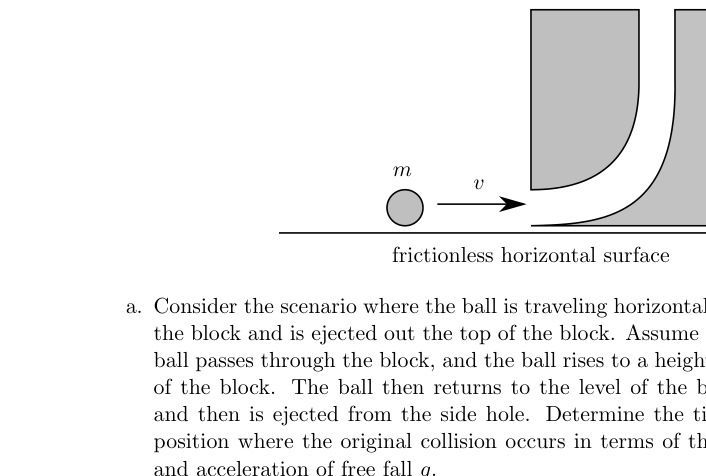 Ball entering block on frictionless surface
Topic: Conservation of Momentum, Newtonian Mechanics, Rotational Dynamics Metodi: Conservation of Momentum, Conservation of Energy, Kinematic Equations Competenze: Physical Reasoning, Mathematical Modeling Objects: Block, Ball Fonte: Testo (PDF) — p.7
La domanda B1
Un blocco di massa ha un foro perforato in modo che una palla di massa possa entrare orizzontalmente e poi passare attraverso il blocco ed uscire verticalmente verso l’alto. La palla e il blocco si trovano su una superficie senza attrito; il blocco è originariamente a riposo.
a. Considerate lo scenario in cui la palla si muove orizzontalmente con una velocità . La palla entra nel blocco ed è espulsa dalla parte superiore del blocco. Supponiamo che non ci siano perdite di attrito mentre la palla passa attraverso il blocco e la palla si alza ad una altezza molto superiore alle dimensioni del blocco. La palla ritorna poi al livello del blocco, dove entra nel buco superiore e viene poi espulsa dal buco laterale. Determinare il tempo per il ritorno della palla nella posizione in cui si verifica la collisione originale in termini di massa , velocità e accelerazione della caduta libera .
b. Ora consideriamo l’attrito. La palla ha un momento di inerzia e non ruota originariamente. Quando entra nel buco del blocco si strofinano contro una superficie in modo che quando viene espulsa verso l’alto la palla ruota senza scivolare. A che altezza la palla si alza sopra il blocco?
Bolo che entra nel blocco su superficie senza attrito
Topic: Conservation of Momentum, Newtonian Mechanics, Rotational Dynamics Metodi: Conservation of Momentum, Conservation of Energy, Kinematic Equations Competenze: Physical Reasoning, Mathematical Modeling Objects: Block, Ball Fonte: Testo (PDF) — p.7
Question B2
In parts a and b of this problem assume that velocities are much less than the speed of light , and therefore ignore relativistic contraction of lengths or time dilation.
a. An infinite uniform sheet has a surface charge density and has an infinitesimal thickness. The sheet lies in the plane.
i. Assuming the sheet is at rest, determine the electric field (magnitude and direction) above and below the sheet.
ii. Assuming the sheet is moving with velocity (parallel to the sheet), determine the electric field (magnitude and direction) above and below the sheet.
iii. Assuming the sheet is moving with velocity , determine the magnetic field (magnitude and direction) above and below the sheet.
iv. Assuming the sheet is moving with velocity (perpendicular to the sheet), determine the electric field (magnitude and direction) above and below the sheet.
v. Assuming the sheet is moving with velocity , determine the magnetic field (magnitude and direction) above and below the sheet.
b. In a certain region there exists only an electric field (and no magnetic field) as measured by an observer at rest. The electric and magnetic fields and as measured by observers in motion can be determined entirely from the local value of , regardless of the charge configuration that may have produced it.
i. What would be the observed electric field as measured by an observer moving with velocity ?
ii. What would be the observed magnetic field as measured by an observer moving with velocity ?
c. An infinitely long wire on the axis is composed of positive charges with linear charge density which are at rest, and negative charges with linear charge density moving with speed in the direction.
i. Determine the electric field (magnitude and direction) at points outside the wire.
ii. Determine the magnetic field (magnitude and direction) at points outside the wire.
iii. Now consider an observer moving with speed parallel to the axis so that the negative charges appear to be at rest. There is a symmetry between the electric and magnetic fields such that a variation to your answer to part b can be applied to the magnetic field in this part. You will need to change the multiplicative constant to something dimensionally correct and reverse the sign. Use this fact to find and describe the electric field measured by the moving observer, and comment on your result.
Topic: Electrostatics, Electromagnetism, Special Relativity Metodi: Gauss’s Law, Ampère’s Law, Lorentz Transformation Competenze: Physical Reasoning, Mathematical Modeling Objects: Wire Fonte: Testo (PDF) — p.8
La domanda B2
In parti a e b di questo problema si assume che le velocità siano molto inferiori alla velocità della luce , e quindi si ignora la contrazione relativistica delle lunghezze o della dilatazione temporale.
a. Un foglio uniforme infinito ha una densità di carica superficiale e un spessore infinitesimale. Il foglio si trova nel piano .
i. Se il foglio è a riposo, determinare il campo elettrico (magnitude e direzione) sopra e sotto il foglio.
ii. Supponendo che il foglio si muova a velocità (parallelmente al foglio), determinare il campo elettrico (magnitude e direzione) sopra e sotto il foglio.
iii. Supponendo che il foglio si muova a velocità , determinare il campo magnetico (magnitude e direzione) sopra e sotto il foglio.
iv. Supponendo che il foglio si muova a velocità (perpendicolare al foglio), determinare il campo elettrico (magnitude e direzione) sopra e sotto il foglio.
v. Supponendo che il foglio si muova a velocità , determinare il campo magnetico (magnitude e direzione) sopra e sotto il foglio.
b. In una determinata regione esiste solo un campo elettrico (e nessun campo magnetico) misurato da un osservatore in riposo. I campi elettrici e magnetici e misurati da osservatori in movimento possono essere determinati interamente dal valore locale di , indipendentemente dalla configurazione di carica che l’ha prodotto.
i. Qual sarebbe il campo elettrico osservato misurato da un osservatore in movimento a velocità ?
ii. Qual è il campo magnetico osservato misurato da un osservatore in movimento a velocità ?
c. Un filo infinitamente lungo sull’asse è composto da cariche positive con densità di carica lineare che sono a riposo e cariche negative con densità di carica lineare che si muovono con velocità nella direzione .
i. Determinare il campo elettrico (magnitude e direzione) nei punti al di fuori del filo.
ii. Determinare il campo magnetico (magnitude e direzione) nei punti al di fuori del filo.
iii. Ora, consideriamo un osservatore che si muove a velocità parallela all’asse in modo che le cariche negative sembrino essere a riposo. C’è una simmetria tra i campi elettrici e magnetici tale che una variazione della tua risposta alla parte b può essere applicata al campo magnetico in questa parte. Dovrai cambiare la costante moltiplicativa in qualcosa di dimensionalmente corretto e invertire il segno. Utilizzate questo fatto per trovare e descrivere il campo elettrico misurato dall’osservatore in movimento e commentate il risultato.
Topic: Electrostatics, Electromagnetism, Special Relativity Metodi: Gauss’s Law, Ampère’s Law, Lorentz Transformation Competenze: Physical Reasoning, Mathematical Modeling Objects: Wire Fonte: Testo (PDF) — p.8