P1 Solución
a) Dado que el satélite describe una órbita circular de radio en torno a la Tierra, se verifica que
Donde es la masa de la Tierra, la masa del satélite, la constante de Gravitación universal y , siendo el periodo de revolución del satélite. Como la aceleración de la gravedad en la superficie de la Tierra es , en la que es el radio de la Tierra, la expresión (1) se puede escribir
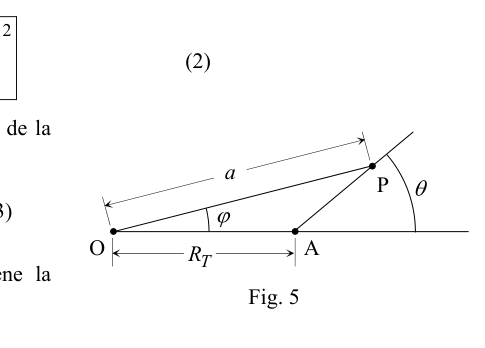
b) De la figura 5, que es una ampliación de una parte de la figura 4, se deduce
Dividiendo miembro a miembro en (3), se obtiene la relación buscada
c) La distancia entre la Tierra y cualquiera de las constelaciones del zodiaco es muchísimo mayor que el radio de la Tierra (). Por ejemplo, la estrella Aldebarán, representativa de Tauro, está a 65 años luz, que equivale a . En consecuencia, las direcciones de las visuales a Tauro desde A y desde el centro de la Tierra, pueden considerarse paralelas. Por otra parte, tal como indica el enunciado, las casas del zodiaco están regularmente espaciadas cada . En definitiva, se tiene que
d) De (4) se deduce que
Con , y , resulta
e) Como la velocidad angular orbital del satélite es constante, el tiempo que transcurrirá desde que el observador A ve pasar el satélite por P hasta que lo hace por Q, viene dado por
El valor numérico del periodo se obtiene de (2)
En total
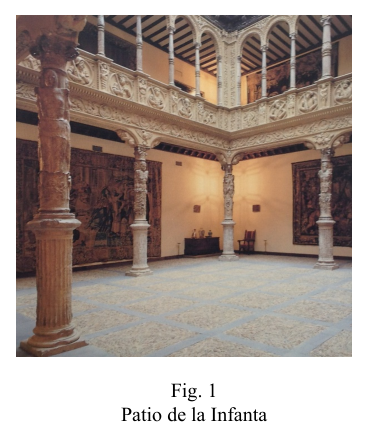 Foto Patio de la Infanta con simboli zodiacali
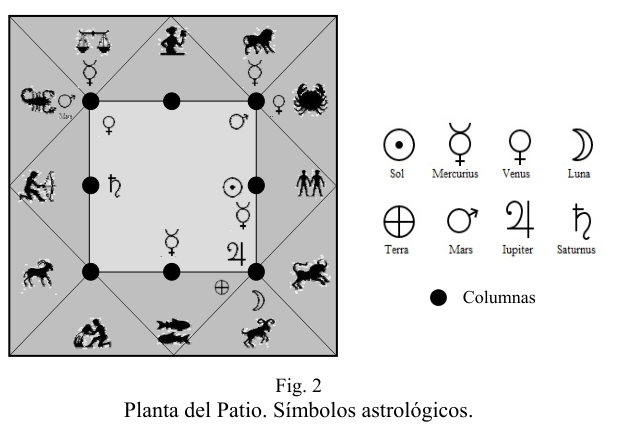 Tabella simboli astrologici pianeti e segni
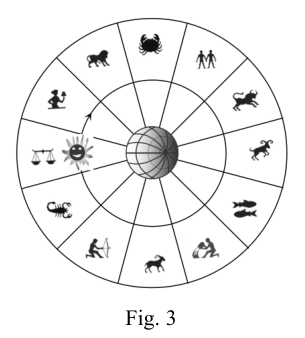 Ruota zodiacale con costellazioni eclittica
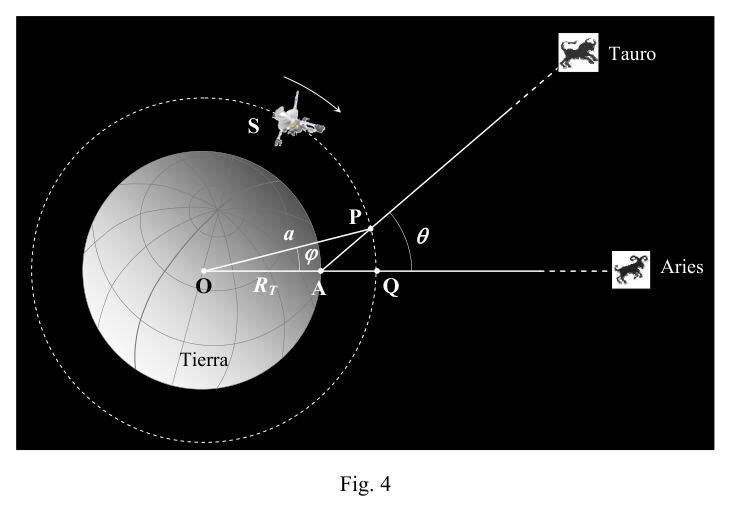 Schema Terra satellite orbita costellazione Ariete
 Geometria vettori osservatore satellite angolo theta
Topic: Gravitation, Newtonian Mechanics Metodi: Newton’s Law of Gravitation, Kinematic Equations, Vector Decomposition, Kepler’s Laws Competenze: Mathematical Modeling, Diagrammatic Reasoning, Physical Reasoning Objects: Satellite, Planet Fonte: Testo (PDF) — p.4
P1 Soluzione
a) Poiché il satellite descrive un’orbita radiocircolare intorno alla Terra, si verifica che
Dove è la massa della Terra, la massa del satellite, la costante di Gravità Universale e , essendo il periodo di rivoluzione del satellite. Poiché l’accelerazione della gravità sulla superficie della Terra è , in cui è il raggio della Terra, l’espressione (1) può essere scritta
b) Dalla figura 5, che è un’ampliamento di una parte della figura 4, si deduce che
Dividendo membro a membro in (3), si ottiene la relazione richiesta
c) La distanza tra la Terra e qualsiasi costellazione del zodiaco è molto più grande del raggio della Terra (). Ad esempio, la stella Aldebaran, rappresentativa di Tauro, è a 65 anni luce, che equivale a . Di conseguenza, le direzioni delle visioni a Toro da A e dal centro della Terra, possono essere considerate parallele. Inoltre, come indicato nella frase, le case del zodiaco sono regolarmente spaziate ogni . In definitiva, bisogna
d) (4) si deduce che
Con , e , si ottiene
e) Como la velocidad angular orbital del satélite es constante, el tiempo que transcurrirá desde que el observador A ve pasar el satélite por P hasta que lo hace por Q, viene dado por
Il valore numerica del periodo è ottenuto da (2)
Complessivamente
Foto Patio de la Infanta con simboli zodiacali
Tabella dei simboli astrologici pianeti e segni
Ruota zodiacale con costellazioni eclittica
Schema Terra satellite orbita costellazione Ariete
Geometria vettori osservatore satellite angolo theta
Topic: Gravitation, Newtonian Mechanics Metodi: Newton’s Law of Gravitation, Kinematic Equations, Vector Decomposition, Kepler’s Laws Competenze: Mathematical Modeling, Diagrammatic Reasoning, Physical Reasoning Objects: Satellite, Planet Fonte: Testo (PDF) — p.4
P1 Solution
a) Since the satellite describes a circular radius orbit around the Earth, it is verified that
Where is the mass of the Earth, the mass of the satellite, the universal gravitational constant and , being the revolution period of the satellite. Since the acceleration of gravity on the Earth’s surface is , where is the Earth’s radius, the expression (1) can be written
b) Figure 5 is an extension of part of Figure 4.
Dividing member by member in (3) gives the desired ratio
c) The distance between Earth and any of the constellations in the zodiac is much greater than the radius of the Earth (). For example, the star Aldebaran, representative of Taurus, is 65 light-years away, which equals . Consequently, the directions of the views to Taurus from A and from the center of the Earth can be considered parallel. Furthermore, as the statement indicates, the zodiac houses are regularly spaced each . In short, it is necessary to
d) It follows from (4) that
With , and , it is
e) Since the orbital angular velocity of the satellite is constant, the time that will pass from the time that observer A sees the satellite pass by P until it does so by Q, is given by
The numerical value of the period is obtained from (2)
Total of the
The infant’s courtyard with zodiac signs
The following table shows the number of stars in the sky:
The following table shows the number of rows of rows:
The following is a list of the countries of the European Union and of the countries of Central and Eastern Europe.
The Commission has also adopted a proposal for a regulation on the protection of the environment.
Topic: Gravitation, Newtonian Mechanics Metodi: Newton’s Law of Gravitation, Kinematic Equations, Vector Decomposition, Kepler’s Laws Competenze: Mathematical Modeling, Diagrammatic Reasoning, Physical Reasoning Objects: Satellite, Planet Fonte: Testo (PDF) — p.4
P2 Solución
En primer lugar, haciendo uso de la regla de la figura 1, pueden determinarse las distancias características del proceso de caída de la gota: la longitud de la traza de la gota durante la exposición, , la distancia recorrida por la gota hasta el instante del disparo de la cámara, , y la altura de la gruta, . Estas distancias se indican en la figura 2 y sus medidas, expresadas en unidades arbitrarias (u.a.), van a ser los datos del problema. Los resultados de las medidas son:
Expresadas en metros, las anteriores longitudes son, respectivamente,
Donde es el factor de conversión de las unidades arbitrarias a metros, en principio desconocido.
a) Despreciando la resistencia del aire, la gota cae desde el reposo con aceleración . Si es el tiempo que transcurre desde que se desprende la gota hasta que se dispara la cámara (tiempo de reacción del montañero), la velocidad de la gota en el instante del disparo es
El espacio recorrido por la gota en este tiempo es
Por otra parte, como y el tiempo de exposición es muy breve, podemos considerar que la gota se mueve con velocidad aproximadamente constante durante la exposición, de forma que
Las relaciones (2) y (3) pueden expresarse en función de los datos y del factor de conversión
Dividiendo miembro a miembro (4) y (5) y teniendo en cuenta (1), resulta
Esta expresión es independiente de . Con los datos numéricos anteriores y se obtiene
b) Sustituyendo directamente en (2) se calcula la distancia
c) Para calcular la altura de la entrada de la gruta, , se necesita el factor de conversión . Su valor es
Por lo que la altura es
Nota: las medidas sobre la fotografía tienen una precisión muy baja. En particular, la medida de es muy imprecisa porque no está muy claro dónde está el suelo de la gruta. También tiene una precisión relativa muy baja la medida de , por ser una distancia sólo un poco mayor que la resolución de la regla. Por todo ello, los resultados numéricos son simples estimaciones de los valores reales.
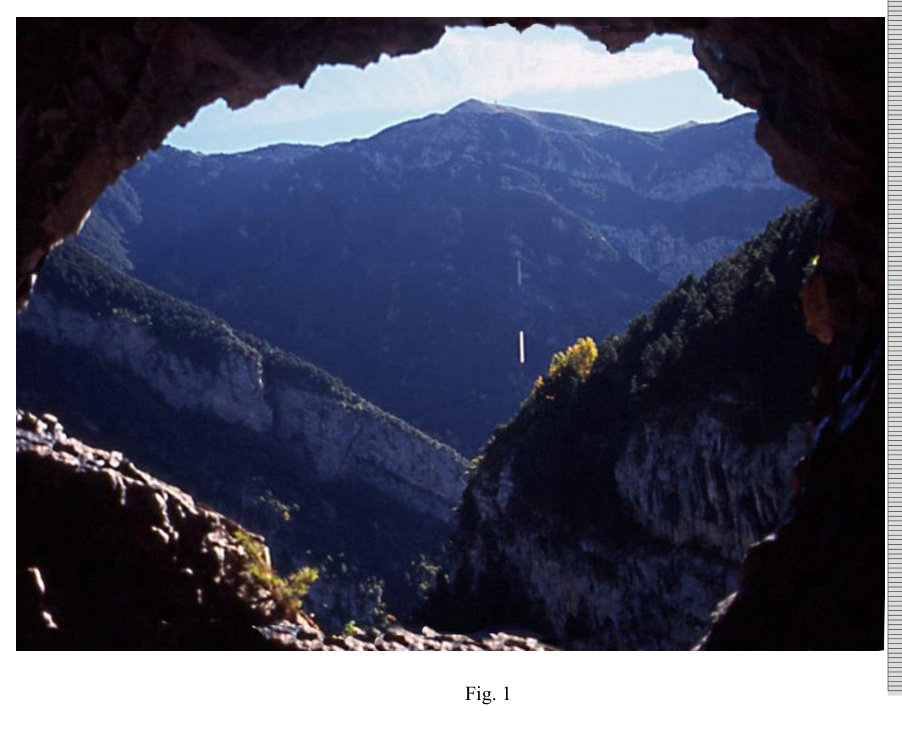 Foto gruta con goccia in caduta libera
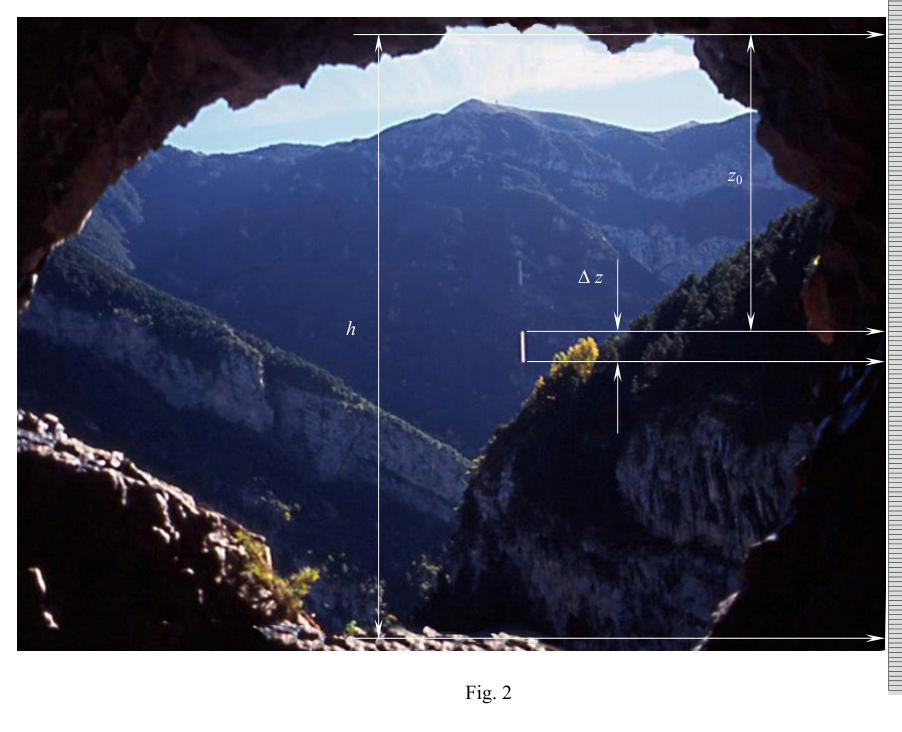 Foto annotata misure goccia A B H distanze
Topic: Newtonian Mechanics, Order-of-Magnitude Estimation Metodi: Kinematic Equations, Approximation & Series Expansion, Experimental Data Analysis Competenze: Estimation & Approximation, Experimental Data Analysis, Mathematical Modeling Objects: Droplet Fonte: Testo (PDF) — p.6
P2 Soluzione
In primo luogo, utilizzando la regola di figura 1, si possono determinare le distanze caratteristiche del processo di caduta della goccia: la lunghezza della traccia della goccia durante l’esposizione, , la distanza percorsa dalla goccia fino all’istante del colpo della camera, , e l’altezza della grotta, . Queste distanze sono indicate in figura 2 e le loro misure, espresse in unità arbitrarie (a.a.), saranno i dati del problema. I risultati delle misure sono:
Esprimite in metri, le lunghezze precedenti sono rispettivamente:
In cui è il fattore di conversione delle unità arbitrarie in metri, in principio sconosciuto.
a) Sfruttando la resistenza dell’aria, la goccia cade dal riposo con l’accelerazione . Se è il tempo che passa dal momento in cui la goccia viene scaricata fino al momento in cui la camera viene sparata (tempo di reazione del montatore), la velocità della goccia all’istante di sparare è
Lo spazio percorso dalla goccia in questo tempo è
Inoltre, poiché e il tempo di esposizione è molto breve, si può considerare che la goccia si muova a velocità costante circa durante l’esposizione, in modo che
Le relazioni (2) e (3) possono essere espresse in base ai dati e al fattore di conversione
Dividendo membro a membro (4) e (5) e tenendo conto di (1), si ottiene
Questa espressione è indipendente da . Con i dati numerici precedenti e si ottiene
b) Substituendo direttamente in (2) si calcola la distanza
c) Per calcolare l’altezza dell’ingresso della grotta, , è necessario il fattore di conversione . Il suo valore è
Per quanto l’altezza è
Nota: le misure sulla fotografia sono molto precise. In particolare, la misura di è molto imprecisa perché non è molto chiaro dove sia il suolo della grotta. Ha anche una precisione relativa molto bassa, la misura di , essendo una distanza solo un po’ maggiore della risoluzione della regola. Per questo i risultati numerici sono semplici stime dei valori reali.
Foto grotta con goccia in caduta libera
Foto annotata misure goccia A B H distanze
Topic: Newtonian Mechanics, Order-of-Magnitude Estimation Metodi: Kinematic Equations, Approximation & Series Expansion, Experimental Data Analysis Competenze: Estimation & Approximation, Experimental Data Analysis, Mathematical Modeling Objects: Droplet Fonte: Testo (PDF) — p.6
P2 Solution
First, the characteristic distances of the drop drop drop process can be determined using the rule in Figure 1: the length of the drop trace during exposure, , the distance travelled by the drop to the moment of the camera shooting, , and the height of the cave, . These distances are shown in Figure 2 and their measurements, expressed in arbitrary units (U.S.), will be the data of the problem. The results of the measures are:
The previous lengths, expressed in metres, are respectively:
Where is the conversion factor of arbitrary units to meters, in principle unknown.
a) Despite the resistance of the air, the drop falls from rest with acceleration . If is the time elapsed from the drop to the camera firing (mountaineer reaction time), the drop velocity at the time of shooting is
The space travelled by the drop at this time is
On the other hand, since and the exposure time is very short, we can consider that the droplet moves at approximately constant speed during exposure, so that the
The relationships (2) and (3) can be expressed in terms of data and conversion factor
By dividing member by member (4) and (5) and taking into account (1)
This expression is independent of . The above numerical data and are obtained
b) Substituting directly in (2) calculates the distance
c) The conversion factor is required to calculate the height of the cave entrance, . His value is
So the height is
Note: the measurements on the photograph are very low accuracy. In particular, the measurement of is very inaccurate because it is not very clear where the cave floor is. It also has a very low relative accuracy measured at , being only a little longer than the resolution of the rule. For all these reasons, the numerical results are merely estimates of the real values.
Photo of the cave with free droplet
The Commission has decided to extend the scope of the proposal to the Member States.
Topic: Newtonian Mechanics, Order-of-Magnitude Estimation Metodi: Kinematic Equations, Approximation & Series Expansion, Experimental Data Analysis Competenze: Estimation & Approximation, Experimental Data Analysis, Mathematical Modeling Objects: Droplet Fonte: Testo (PDF) — p.6
P3 Solución
a) Como se indica en el enunciado, la carga de la esfera conductora se distribuye en la superficie, pero el campo eléctrico en el exterior de la esfera es el mismo que si toda la carga estuviese concentrada en el centro de la esfera, es decir con dirección radial y módulo
La mayor intensidad de este campo se tiene junto a la superficie del conductor, es decir cuando . En el límite de que este campo sea igual al de ruptura dieléctrica
El potencial de la esfera es, en este caso
b) La carga de la esfera es
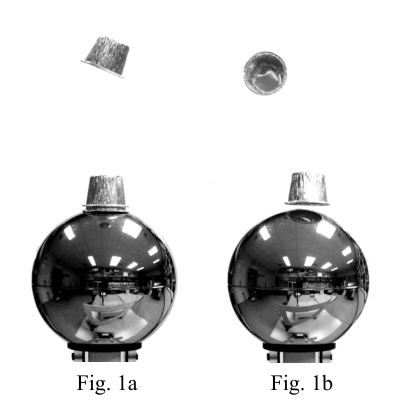
c) Dos cargas de igual signo se repelen. Sobre el molde situado en la parte superior de la esfera actúa una fuerza resultante hacia arriba , siendo la fuerza eléctrica de repulsión y la fuerza gravitatoria, es decir, el peso del molde. Para calcular la fuerza de interacción entre la esfera y un molde, supuesto puntual, podemos utilizar la ley de Coulomb, como si fuesen dos partículas cargadas.
d) En una primera fase del recorrido el molde parte del reposo y se acelera hacia arriba, ya que . En un punto determinado, C, las fuerzas se igualan y a partir de entonces , por lo que el molde reduce su velocidad hasta que, en el punto más alto, la velocidad vuelve a anularse.
Las fuerzas y son conservativas, por lo que la energía mecánica del molde se conserva. Tanto en el punto inicial, A, como en el más alto, B, la energía cinética es nula, luego
Operando, se obtiene la siguiente ecuación de segundo grado en
Sustituyendo los datos (en el SI), se obtiene
De las dos soluciones de la ecuación, una de ellas es la trivial, , que corresponde a la posición inicial. La otra, correspondiente al punto más alto B, resulta
e) La velocidad ascendente del molde aumenta hasta el punto C, en el que se igualan en módulo las fuerzas gravitatoria y electrostática. En este punto la aceleración del molde es nula y la velocidad es máxima, . Por tanto, en C se cumple
f) La conservación de la energía mecánica entre los puntos A y C permite escribir
g) Podría pensarse que, cuando hay varios moldes superpuestos, se cargan todos a la vez y el conjunto es repelido en bloque por la esfera. Esto no es correcto porque, como se indica en la “ayuda” del enunciado, la carga de un cuerpo conductor en equilibrio se distribuye en su superficie. En nuestro caso el cuerpo conductor total es la esfera más los moldes apilados en su vértice superior, de forma que únicamente el molde más exterior forma parte de la superficie del conjunto. Por tanto, el único que se carga inicialmente es el que está en el exterior, es decir el más alto. Cuando este molde salta y se aleja, el que era segundo molde pasa a formar parte de la superficie del conductor, se carga y es repelido por la esfera, y así sucesivamente.
 Schema Van de Graaff con molde sferico Fig 1a 1b
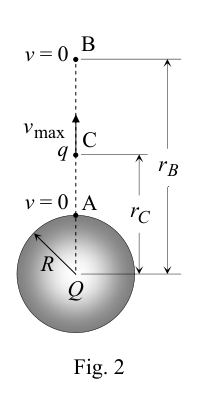 Sfera carica con posizioni A B C velocita
Topic: Electrostatics, Newtonian Mechanics Metodi: Gauss’s Law, Coulomb’s Law, Conservation of Energy, Free-Body Diagram Competenze: Mathematical Modeling, Physical Reasoning, Diagrammatic Reasoning Objects: Conducting Sphere Fonte: Testo (PDF) — p.10
P3 Soluzione
a) Come indicato nella frase, la carica della sfera conduttrice è distribuita sulla superficie, ma il campo elettrico all’esterno della sfera è lo stesso che se tutta la carica fosse concentrata nel centro della sfera, cioè con direzione radial e modulo
L’intensità più elevata di questo campo è raggiunta vicino alla superficie del conduttore, cioè quando . Al limite che questo campo sia uguale a quello di rottura dielettrica
Il potenziale della sfera è, in questo caso,
b) La carica della sfera è
c) Due carichi di identico segno si rivolgono. Sul mucchio situato nella parte superiore della sfera agisce una forza risultante verso l’alto , essendo la forza elettrica di respiro e la forza gravitazionale, cioè il peso del mucchio. Per calcolare la forza di interazione tra la sfera e un modello, supposto puntuale, possiamo usare la legge di Coulomb, come se fossero due particelle cariche.
d) In una prima fase del percorso il molde parte dal riposo e si accelera verso l’alto, poiché . A un determinato punto, C, le forze si igualitano e da allora , quindi il modello riduce la sua velocità fino a quando, al punto più alto, la velocità si annulla di nuovo.
Le forze e sono conservatrici, quindi l’energia meccanica del modello è conservata. Sia nel punto iniziale, A, sia nel più alto, B, l’energia cinetica è nulla, quindi
Operando, si ottiene la seguente equazione di secondo grado in
Rimpiazzando i dati (in SI), si ottiene
Tra le due soluzioni dell’equazione, una è la triviale, , che corrisponde alla posizione iniziale. L’altro, che si trova al punto più alto B, è
e) La velocità ascendente del modello aumenta fino al punto C, in cui le forze gravitazionali e elettrostatiche si eguagliano in modulo. A questo punto l’accelerazione del mucchio è zero e la velocità massima è . Quindi, in C si compie
f) La conservazione dell’energia meccanica tra i punti A e C consente di scrivere:
g) Si potrebbe pensare che, quando ci sono diversi modelli superposti, si caricano tutti contemporaneamente e l’insieme viene respinto in blocco dalla sfera. Questo non è corretto perché, come indicato nell’aiuto della frase, il carico di un corpo conduttore in equilibrio è distribuito sulla sua superficie. Nel nostro caso il corpo conduttore totale è la sfera più gli stampi accumulati nella sua vertica superiore, in modo che solo il stampo più esterno fa parte della superficie dell’insieme. Quindi, l’unico che si carica inizialmente è quello che è all’esterno, cioè il più alto. Quando questo modello salta e si allontana, quello che era un secondo modello diventa parte della superficie del conduttore, si carica e viene respinto dalla sfera, e così via.
Schema Van de Graaff con modello sferico Fig 1a 1b
Sfera carica con posizioni A B C veloce
Topic: Electrostatics, Newtonian Mechanics Metodi: Gauss’s Law, Coulomb’s Law, Conservation of Energy, Free-Body Diagram Competenze: Mathematical Modeling, Physical Reasoning, Diagrammatic Reasoning Objects: Conducting Sphere Fonte: Testo (PDF) — p.10
P3 Solution
a) As indicated in the statement, the charge of the conducting sphere is distributed on the surface, but the electric field on the outside of the sphere is the same as if all the charge were concentrated in the centre of the sphere, i.e. with radial direction and module
The highest intensity of this field is obtained next to the surface of the conductor, i.e. when . In the limit that this field is equal to that of dielectric breakdown
The potential of the sphere is, in this case,
b) The charge of the sphere is
c) Two charges of equal sign are repelled. The force on the top of the sphere is the upward force , the electric force of repulsion being and the gravitational force, i.e. the weight of the mold, being . To calculate the force of interaction between the sphere and a mold, assuming point, we can use Coulomb’s law, as if they were two charged particles.
d) In the first stage of the route the mould is part of the rest and accelerates upwards, since . At a given point, C, the forces are equalized and from then on , so the mold reduces its speed until, at the highest point, the speed is again cancelled.
The and forces are conservative, so the mechanical energy of the mold is conserved. So both at the starting point, A, and at the highest point, B, the kinetic energy is zero, then
Operating the following second-degree equation in
Substituting the data (in SI) is obtained
Of the two solutions to the equation, one of them is the trivial, , which corresponds to the starting position. The other, corresponding to the highest point B, is
e) The upward speed of the mold increases to the point C, where the gravitational and electrostatic forces are equated in the module. At this point the mold acceleration is zero and the maximum speed is . Therefore, in C it is fulfilled
f) The conservation of mechanical energy between points A and C allows for writing
g) You might think that when there are several overlapping molds, they all load at once and the whole is repelled in blocks by the sphere. This is incorrect because, as indicated in the “help” of the statement, the load of a conducting body in equilibrium is distributed on its surface. In our case the total conductive body is the sphere plus the moulds stacked at its top vertex, so that only the outermost mould is part of the surface of the set. So the only one that is initially charged is the one outside, that is, the highest. When this mold jumps and goes away, the second mold becomes part of the conductor surface, it is loaded and repelled by the sphere, and so on.
The following table shows the results of the calculation of the total value of the sampled Union producers:
The position of the loaded sphere at position A B C is rapidly *
Topic: Electrostatics, Newtonian Mechanics Metodi: Gauss’s Law, Coulomb’s Law, Conservation of Energy, Free-Body Diagram Competenze: Mathematical Modeling, Physical Reasoning, Diagrammatic Reasoning Objects: Conducting Sphere Fonte: Testo (PDF) — p.10