- A car turning to the right is traveling at constant speed in a circle. From the driver’s perspective, the angular momentum vector about the center of the circle points and the acceleration vector of the car points where
- A. is left, is left.
- B. is forward, is right.
- C. is down, is forward.
- D. is left, is right.
- E. is down, is right.
Topic: Newtonian Mechanics, Rotational Dynamics Metodi: Torque & Angular Momentum Analysis, Vector Decomposition Competenze: Physical Reasoning, Diagrammatic Reasoning Objects: - Fonte: Testo (PDF) - p.2
- Una macchina che gira a destra sta viaggiando a velocità costante in un cerchio. Dal punto di vista del conducente, il vettore angolare di impulso intorno al centro dei punti del cerchio e il vettore di accelerazione dei punti della vettura dove
- A. è sinistra, è sinistra.
- B. è in avanti, è corretto.
- C. è in discesa, è in avanti.
- D. è sinistra, è destra.
- E. è scesa, è corretta.
Topic: Newtonian Mechanics, Rotational Dynamics Metodi: Torque & Angular Momentum Analysis, Vector Decomposition Competenze: Physical Reasoning, Diagrammatic Reasoning Objects: - Fonte: Testo (PDF) - p.2
- A ball rolls without slipping down an inclined plane as shown in the diagram.
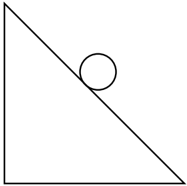
Which of the following vectors best represents the direction of the total force that the ball exerts on the plane?
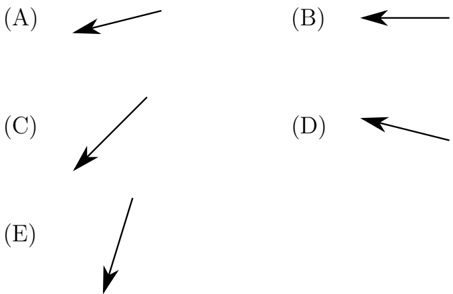
- A. A vector directed up and to the left.
- B. A vector directed horizontally to the left.
- C. A vector directed down and to the left.
- D. A vector directed up and to the left, at a shallower angle.
- E. A vector directed downward (down and slightly to the left).
Topic: Newtonian Mechanics Metodi: Free-Body Diagram, Vector Decomposition Competenze: Physical Reasoning, Diagrammatic Reasoning Objects: Ball, Inclined Plane Fonte: Testo (PDF) - p.2
- Una palla ruota senza scivolare in un piano inclinato come mostrato nel diagramma.
Quale dei seguenti vettori rappresenta meglio la direzione della forza totale che la palla esercita sul piano?
- A. Un vettore diretto verso l’alto e verso sinistra.
- B. Un vettore diretto orizzontalmente a sinistra.
- C. Un vettore diretto verso il basso e verso la sinistra.
- D. Un vettore diretto verso l’alto e verso la sinistra, ad un angolo più basso.
- E. Un vettore diretto verso il basso (a basso e leggermente a sinistra).
Topic: Newtonian Mechanics Metodi: Free-Body Diagram, Vector Decomposition Competenze: Physical Reasoning, Diagrammatic Reasoning Objects: Ball, Inclined Plane Fonte: Testo (PDF) - p.2
- An object of uniform density floats partially submerged so that 20% of the object is above the water. A 3 N force presses down on the top of the object so that the object becomes fully submerged. What is the volume of the object? The density of water is .
- A.
- B.
- C.
- D.
- E.
Topic: Fluid Mechanics Metodi: Hydrostatic Equilibrium, Free-Body Diagram Competenze: Physical Reasoning Objects: - Fonte: Testo (PDF) - p.2
- Un oggetto di densità uniforme galleggia in parte sommerso in modo che il 20% dell’oggetto sia sopra l’acqua. Una forza di 3 N si premesse sulla parte superiore dell’oggetto in modo che l’oggetto diventi completamente sommerso. Qual è il volume dell’oggetto? La densità dell’acqua è .
- A.
- B.
- C.
- D.
- E.
Topic: Fluid Mechanics Metodi: Hydrostatic Equilibrium, Free-Body Diagram Competenze: Physical Reasoning Objects: - Fonte: Testo (PDF) - p.2
- What are the correct values of the numbers in the following statements? Assume there are no external forces, and take to mean that the statement cannot be made for any meaningful number of particles.
-
If a particle at rest explodes into or fewer particles with known masses, and the total kinetic energy of the new particles is known, the kinetic energy of each of the new particles is completely determined.
-
If a particle at rest explodes into or fewer particles, the velocities of the new particles must lie in a line.
-
If a particle at rest explodes into or fewer particles, the velocities of the new particles must lie in a plane.
-
A. , ,
-
B. , ,
-
C. , ,
-
D. , ,
-
E. , ,
Topic: Conservation of Momentum Metodi: Conservation of Momentum, Symmetry Argument Competenze: Physical Reasoning Objects: - Fonte: Testo (PDF) - p.2
- Quali sono i valori corretti dei numeri nelle seguenti affermazioni? Supponiamo che non esistano forze esterne e prendiamo per significare che la dichiarazione non può essere fatta per un numero significativo di particelle.
-
Se una particella in riposo esplode in o meno particelle con masse note e si conosce l’energia cinetica totale delle nuove particelle, l’energia cinetica di ciascuna delle nuove particelle viene determinata completamente.
-
Se una particella in riposo esplode in o meno, le velocità delle nuove particelle devono essere in linea.
-
Se una particella in riposo esplode in o meno, le velocità delle nuove particelle devono essere in un piano.
-
A. , ,
-
B. , ,
-
C. , ,
-
D. , ,
-
E. , ,
Topic: Conservation of Momentum Metodi: Conservation of Momentum, Symmetry Argument Competenze: Physical Reasoning Objects: - Fonte: Testo (PDF) - p.2
- A unicyclist goes around a circular track of radius 30 m at a (amazingly fast!) constant speed of 10 m/s. At what angle to the left (or right) of vertical must the unicyclist lean to avoid falling? Assume that the height of the unicyclist is much smaller than the radius of the track.
- A.
- B.
- C.
- D.
- E.
Topic: Newtonian Mechanics Metodi: Free-Body Diagram, Vector Decomposition Competenze: Physical Reasoning Objects: - Fonte: Testo (PDF) - p.2
- Un monosciclista gira intorno a una pista circolare di 30 m di raggio a una velocità costante (incredibile!) di 10 m/s. A quale angolo verso sinistra (o destra) della verticale deve appoggiarsi il monovolante per evitare di cadere? Supponiamo che l’altezza del monosciclista sia molto inferiore al raggio della pista.
- A.
- B.
- C.
- D.
- E.
Topic: Newtonian Mechanics Metodi: Free-Body Diagram, Vector Decomposition Competenze: Physical Reasoning Objects: - Fonte: Testo (PDF) - p.2
- A cubical box of mass 10 kg with edge length 5 m is free to move on a frictionless horizontal surface. Inside is a small block of mass 2 kg, which moves without friction inside the box. At time , the block is moving with velocity 5 m/s directly towards one of the faces of the box, while the box is initially at rest. The coefficient of restitution for any collision between the block and box is 90%, meaning that the relative speed between the box and block immediately after a collision is 90% of the relative speed between the box and block immediately before the collision.
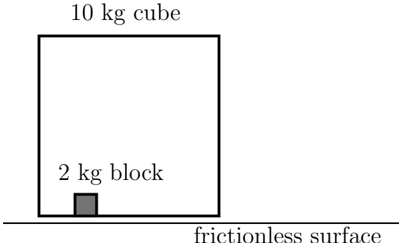
After 1 minute, the block is a displacement from the original position. Which of the following is closest to ?
- A. 0 m
- B. 50 m
- C. 100 m
- D. 200 m
- E. 300 m
Topic: Conservation of Momentum Metodi: Conservation of Momentum, Conservation of Energy Competenze: Physical Reasoning Objects: Block Fonte: Testo (PDF) - p.3
- Una scatola cubica di massa 10 kg con lunghezza di bordo di 5 m è libera di muoversi su una superficie orizzontale senza attrito. All’interno è un piccolo blocco di massa di 2 kg, che si muove senza attrito all’interno della scatola. Al tempo , il blocco si muove a velocità di 5 m/s direttamente verso una delle facce della scatola, mentre la scatola è inizialmente in riposo. Il coefficiente di restituzione per qualsiasi collisione tra il blocco e il blocco è del 90%, il che significa che la velocità relativa tra il blocco e il blocco immediatamente dopo una collisione è del 90% della velocità relativa tra il blocco e il blocco immediatamente prima della collisione.
Dopo 1 minuto, il blocco è spostato dalla posizione originale. Qual è il punto più vicino a ?
- A. 0 m
- B. 50 m
- C. 100 m
- D. 200 m
- E. 300 m
Topic: Conservation of Momentum Metodi: Conservation of Momentum, Conservation of Energy Competenze: Physical Reasoning Objects: Block Fonte: Testo (PDF) - p.3
- A 1.00 m long stick with uniform density is allowed to rotate about a point 30.0 cm from its end. The stick is perfectly balanced when a 50.0 g mass is placed on the stick 20.0 cm from the same end. What is the mass of the stick?
- A. 35.7 g
- B. 33.3 g
- C. 25.0 g
- D. 17.5 g
- E. 14.3 g
Topic: Rigid Body Statics Metodi: Torque & Angular Momentum Analysis, Free-Body Diagram Competenze: Physical Reasoning Objects: Rod Fonte: Testo (PDF) - p.3
- Un bastone lungo 1,00 m con densità uniforme può ruotare circa un punto di 30,0 cm dalla sua estremità. Il bastone è perfettamente equilibrato quando viene posto su un bastone una massa di 50,0 g a 20,0 cm dalla stessa estremità. Qual è la massa del bastone?
- A. 35.7 g
- B. 33.3 g
- C. 25.0 g
- D. 17.5 g
- E. 14.3 g
Topic: Rigid Body Statics Metodi: Torque & Angular Momentum Analysis, Free-Body Diagram Competenze: Physical Reasoning Objects: Rod Fonte: Testo (PDF) - p.3
- An object of mass is hung on a vertical spring of spring constant and is set into vertical oscillations. The period of this oscillation is . The spring is then cut in half and the same mass is attached and the system is set up to oscillate on a frictionless inclined plane making an angle to the horizontal. Determine the period of the oscillations on the inclined plane in terms of .
- A.
- B.
- C.
- D.
- E.
Topic: Oscillations & Waves Metodi: Simple Harmonic Motion Analysis, Hooke’s Law Competenze: Physical Reasoning Objects: Spring Fonte: Testo (PDF) - p.3
- Un oggetto di massa è appeso su una molla verticale della costante di molla e è impostato in oscillazioni verticali. Il periodo di questa oscillazione è . La molla viene poi tagliata a metà e la stessa massa viene attaccata e il sistema viene impostato per oscillare su un piano inclinato senza attrito, facendo un angolo verso l’orizzontale. Determinare il periodo delle oscillazioni sul piano inclinato in termini di .
- A.
- B.
- C.
- D.
- E.
Topic: Oscillations & Waves Metodi: Simple Harmonic Motion Analysis, Hooke’s Law Competenze: Physical Reasoning Objects: Spring Fonte: Testo (PDF) - p.3
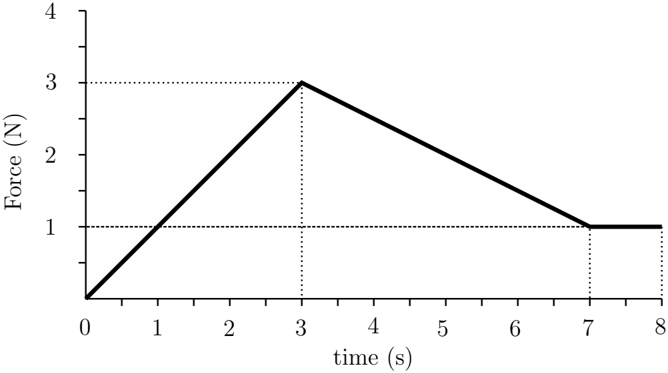
- A 5.0 kg object undergoes a time-varying force as shown in the graph below. If the velocity at s is m/s, what is the velocity of the object at s?
- A. 2.45 m/s
- B. 2.50 m/s
- C. 3.50 m/s
- D. 12.5 m/s
- E. 15.0 m/s
Topic: Newtonian Mechanics Metodi: Impulse-Momentum Theorem, Kinematic Equations Competenze: Physical Reasoning, Diagrammatic Reasoning Objects: - Fonte: Testo (PDF) - p.3
- Un oggetto di 5,0 kg subisce una forza variabile nel tempo come mostrato nel grafico di seguito. Se la velocità a s è m/s, qual è la velocità dell’oggetto a s?
- A. 2.45 m/s
- B. 2.50 m/s
- C. 3.50 m/s
- D. 12.5 m/s
- E. 15.0 m/s
Topic: Newtonian Mechanics Metodi: Impulse-Momentum Theorem, Kinematic Equations Competenze: Physical Reasoning, Diagrammatic Reasoning Objects: - Fonte: Testo (PDF) - p.3
- A radio controlled car is attached to a stake in the ground by a 3.00 m long piece of string, and is forced to move in a circular path. The car has an initial angular velocity of 1.00 rad/s and smoothly accelerates at a rate of 4.00 rad/s. The string will break if the centripetal acceleration exceeds m/s. How long can the car accelerate at this rate before the string breaks?
- A. 0.25 s
- B. 0.50 s
- C. 1.00 s
- D. 1.50 s
- E. 2.00 s
Topic: Newtonian Mechanics Metodi: Kinematic Equations, Vector Decomposition Competenze: Physical Reasoning Objects: String Fonte: Testo (PDF) - p.4
- Un’auto radiocontrollata è attaccata a un palo in terra da un pezzo di corda lungo 3,00 m e viene costretta a muoversi in un percorso circolare. L’auto ha una velocità angolare iniziale di 1,00 rad/s e accelera senza problemi a una velocità di 4,00 rad/s. La corda si rompe se l’accelerazione centripetale supera m/s. Quanto tempo la macchina può accelerare a questa velocità prima che la corda si spezzi?
- A. 0.25 s
- B. 0.50 s
- C. 1.00 s
- D. 1.50 s
- E. 2.00 s
Topic: Newtonian Mechanics Metodi: Kinematic Equations, Vector Decomposition Competenze: Physical Reasoning Objects: String Fonte: Testo (PDF) - p.4
- A point mass is connected to an ideal spring on a horizontal frictionless surface. The mass is pulled a short distance and then released.
Which of the following is the most correct plot of the kinetic energy as a function of potential energy?
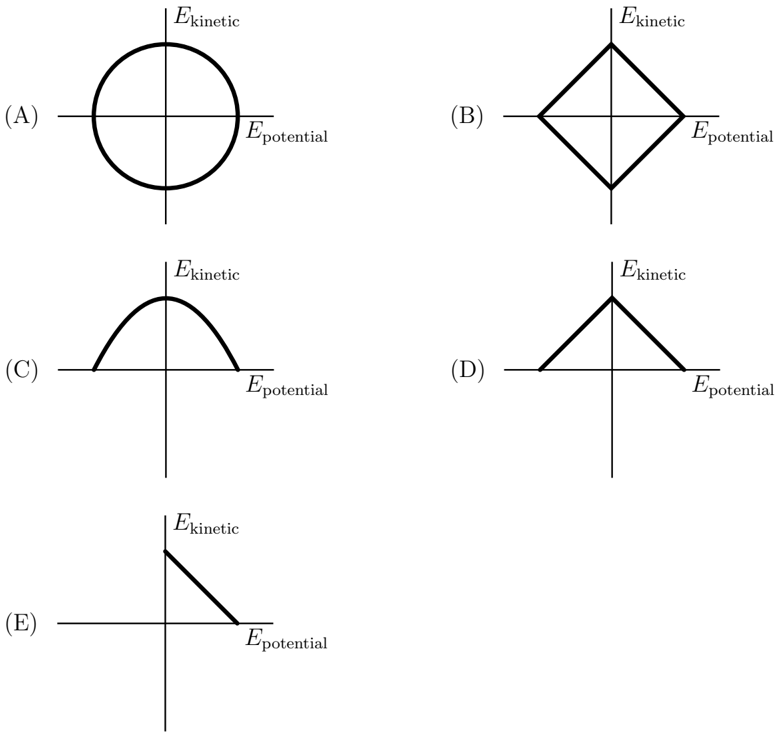
- A. A circle centered at the origin in the (, ) plane.
- B. A square (diamond) with vertices on the axes.
- C. A downward-opening arc (dome) above the positive axis.
- D. An inverted-V (triangular peak) above the positive axis.
- E. A straight line of negative slope from the axis down to the positive axis.
Topic: Conservation of Energy, Oscillations & Waves Metodi: Conservation of Energy, Simple Harmonic Motion Analysis Competenze: Physical Reasoning, Diagrammatic Reasoning Objects: Spring Fonte: Testo (PDF) - p.4
- Una massa puntologica è collegata ad una molla ideale su una superficie orizzontale senza attrito. La massa viene tirata a breve distanza e poi rilasciata.
Quale delle seguenti è la scheda più corretta dell’energia cinetica come funzione dell’energia potenziale?
- A. Un cerchio centrato all’origine nel piano (, ).
- B. Un quadrato (diamante) con vertici sugli assi.
- C. Un arco (copa) di apertura verso il basso sopra l’asse positivo .
- D. Un V inverso (pice triangolare) sopra l’asse positivo .
- E. Una linea retta di pendenza negativa dall’asse fino all’asse positivo.
Topic: Conservation of Energy, Oscillations & Waves Metodi: Conservation of Energy, Simple Harmonic Motion Analysis Competenze: Physical Reasoning, Diagrammatic Reasoning Objects: Spring Fonte: Testo (PDF) - p.4
The following information applies to questions 12 and 13.
A paper helicopter with rotor radius and weight is dropped from a height in air with a density of .
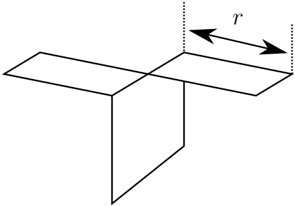
Assuming that the helicopter quickly reaches terminal velocity, a function for the time of flight can be found in the form
where is an unknown dimensionless constant (actually, 1.164). , , , and are constant exponents to be determined.
- Determine .
- A.
- B.
- C.
- D.
- E.
Topic: Fluid Mechanics Metodi: Dimensional Analysis, Physical Modeling Competenze: Physical Reasoning, Estimation & Approximation Objects: - Fonte: Testo (PDF) - p.4
Le seguenti informazioni si applicano alle domande 12 e 13.
Un elicottero di carta con raggio di rotore e peso viene abbassato da un’altezza in aria con una densità .
Supponendo che l’elicottero raggiunga rapidamente la velocità terminale, una funzione per il tempo di volo può essere trovata nella forma
dove è una costante senza dimensioni sconosciuta (in realtà 1,164). , , e sono esponenti costanti da determinare.
- Determina .
- A.
- B.
- C.
- D.
- E.
Topic: Fluid Mechanics Metodi: Dimensional Analysis, Physical Modeling Competenze: Physical Reasoning, Estimation & Approximation Objects: - Fonte: Testo (PDF) - p.4
The following information applies to questions 12 and 13.
A paper helicopter with rotor radius and weight is dropped from a height in air with a density of .
Assuming that the helicopter quickly reaches terminal velocity, a function for the time of flight can be found in the form
where is an unknown dimensionless constant (actually, 1.164). , , , and are constant exponents to be determined.
- Determine .
- A.
- B.
- C.
- D.
- E. can not be uniquely determined without more information.
Topic: Fluid Mechanics Metodi: Dimensional Analysis, Physical Modeling Competenze: Physical Reasoning, Estimation & Approximation Objects: - Fonte: Testo (PDF) - p.4
Le seguenti informazioni si applicano alle domande 12 e 13.
Un elicottero di carta con raggio di rotore e peso viene abbassato da un’altezza in aria con una densità .
Supponendo che l’elicottero raggiunga rapidamente la velocità terminale, una funzione per il tempo di volo può essere trovata nella forma
dove è una costante senza dimensioni sconosciuta (in realtà 1,164). , , e sono esponenti costanti da determinare.
- Determina .
- A.
- B.
- C.
- D.
- E. non può essere determinato in modo unico senza ulteriori informazioni.
Topic: Fluid Mechanics Metodi: Dimensional Analysis, Physical Modeling Competenze: Physical Reasoning, Estimation & Approximation Objects: - Fonte: Testo (PDF) - p.4
- A disk of moment of inertia , mass , and radius has a cord wrapped around it tightly as shown in the diagram. The disk is free to slide on its side as shown in the top down view. A constant force of is applied to the end of the cord and accelerates the disk along a frictionless surface.
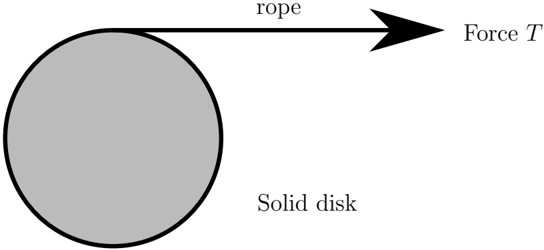
After the disk has accelerated some distance, determine the ratio of the translational KE to total KE of the disk, .
- A.
- B.
- C.
- D.
- E.
Topic: Rotational Dynamics Metodi: Torque & Angular Momentum Analysis, Conservation of Energy Competenze: Physical Reasoning Objects: Disk Fonte: Testo (PDF) - p.5
- Un disco di momento di inerzia , massa e raggio ha un cavo strettamente avvolto intorno a sé come mostrato nel diagramma. Il disco è libero di scivolare sul suo lato come mostrato nella vista in alto in basso. Una forza costante di viene applicata alla fine del cavo e accelera il disco lungo una superficie senza attrito.
Dopo che il disco ha accelerato una certa distanza, determinare il rapporto tra KE traslazionale e KE totale del disco, .
- A.
- B.
- C.
- D.
- E.
Topic: Rotational Dynamics Metodi: Torque & Angular Momentum Analysis, Conservation of Energy Competenze: Physical Reasoning Objects: Disk Fonte: Testo (PDF) - p.5
- The maximum torque output from the engine of a new experimental car of mass is . The maximum rotational speed of the engine is . The engine is designed to provide a constant power output . The engine is connected to the wheels via a perfect transmission that can smoothly trade torque for speed with no power loss. The wheels have a radius , and the coefficient of static friction between the wheels and the road is .
What is the maximum sustained speed the car can drive up a 30 degree incline? Assume no frictional losses and assume is large enough so that the tires do not slip.
- A.
- B.
- C.
- D.
- E.
Topic: Newtonian Mechanics Metodi: Conservation of Energy, Physical Modeling Competenze: Physical Reasoning Objects: Inclined Plane, Wheel Fonte: Testo (PDF) - p.5
- La coppia massima prodotta dal motore di una nuova vettura sperimentale di massa è . La velocità massima di rotazione del motore è . Il motore è progettato per fornire una potenza di uscita costante . Il motore è collegato alle ruote tramite una trasmissione perfetta che può scambiare senza problemi la coppia per la velocità senza perdita di potenza. Le ruote hanno un raggio e il coefficiente di attrito statico tra le ruote e la strada è .
Qual è la velocità massima sostenuta che l’auto può guidare verso un’inclinazione di 30 gradi? Supponiamo che non ci siano perdite di attrito e supponiamo che sia abbastanza grande da non far scivolare le gomme.
- A.
- B.
- C.
- D.
- E.
Topic: Newtonian Mechanics Metodi: Conservation of Energy, Physical Modeling Competenze: Physical Reasoning Objects: Inclined Plane, Wheel Fonte: Testo (PDF) - p.5
- An object of mass initially moving at speed collides with an object of mass , where , that is initially at rest. The collision could be completely elastic, completely inelastic, or partially inelastic. After the collision the two objects move at speeds and . Assume that the collision is one dimensional, and that object one cannot pass through object two.
After the collision, the speed ratio of object 1 is bounded by
- A.
- B.
- C.
- D.
- E.
Topic: Conservation of Momentum Metodi: Conservation of Momentum, Conservation of Energy Competenze: Physical Reasoning, Mathematical Modeling Objects: - Fonte: Testo (PDF) - p.5
- Un oggetto di massa inizialmente in movimento a velocità si schianta con un oggetto di massa , dove , che è inizialmente a riposo. La collisione potrebbe essere completamente elastica, completamente inelastica o parzialmente inelastica. Dopo la collisione i due oggetti si muovono a velocità e . Supponiamo che la collisione sia unidimensional, e che l’oggetto uno non possa passare attraverso l’oggetto due.
Dopo la collisione, il rapporto di velocità dell’oggetto 1 è limitato da:
- A.
- B.
- C.
- D.
- E.
Topic: Conservation of Momentum Metodi: Conservation of Momentum, Conservation of Energy Competenze: Physical Reasoning, Mathematical Modeling Objects: - Fonte: Testo (PDF) - p.5
- A spherical cloud of dust in space has a uniform density and a radius . The gravitational acceleration of free fall at the surface of the cloud due to the mass of the cloud is .
A process occurs (heat expansion) that causes the cloud to suddenly grow to a radius , while maintaining a uniform (but not constant) density. The gravitational acceleration of free fall at a point away from the center of the cloud due to the mass of the cloud is now
- A.
- B.
- C.
- D.
- E.
Topic: Gravitation Metodi: Newton’s Law of Gravitation, Gauss’s Law, Symmetry Argument Competenze: Physical Reasoning Objects: - Fonte: Testo (PDF) - p.6
- Una nuvola di polvere sferica nello spazio ha una densità uniforme e un raggio . L’accelerazione gravitazionale della caduta libera sulla superficie della nuvola a causa della massa della nuvola è .
Si verifica un processo (espansione termico) che provoca che la nube cresca improvvisamente a un raggio , mantenendo una densità uniforme (ma non costante). L’accelerazione gravitazionale della caduta libera in un punto lontano dal centro della nuvola a causa della massa della nuvola è ora
- A.
- B.
- C.
- D.
- E.
Topic: Gravitation Metodi: Newton’s Law of Gravitation, Gauss’s Law, Symmetry Argument Competenze: Physical Reasoning Objects: - Fonte: Testo (PDF) - p.6
- Consider the following diagram of a box and two weight scales. Scale A supports the box via a massless rope. A pulley is attached to the top of the box; a second massless rope passes over the pulley, one end is attached to the box and the other end to scale B. The two scales read indicate the tensions and in the ropes. Originally scale A reads 30 Newtons and scale B reads 20 Newtons.
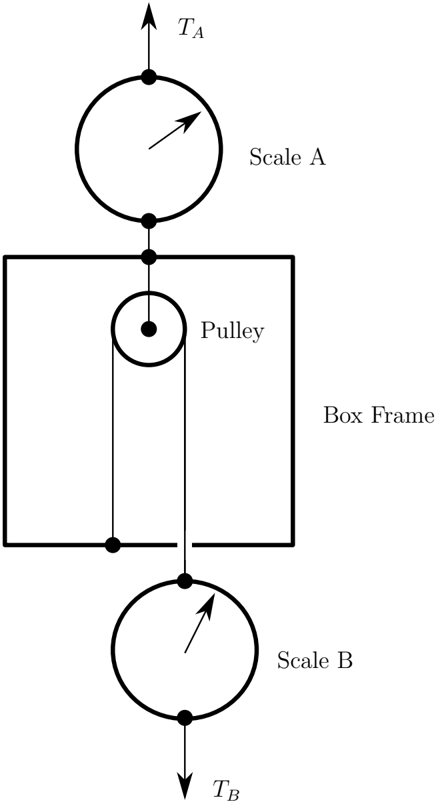
If an additional force pulls down on scale B so that the reading increases to 30 Newtons, what will be the new reading on scale A?
- A. 35 Newtons
- B. 40 Newtons
- C. 45 Newtons
- D. 50 Newtons
- E. 60 Newtons
Topic: Newtonian Mechanics Metodi: Free-Body Diagram, Conservation Laws Competenze: Physical Reasoning, Diagrammatic Reasoning Objects: Pulley, String Fonte: Testo (PDF) - p.6
- Considerate il seguente diagramma di una scatola e di due pesanti. La scala A sostiene la scatola attraverso una corda senza massa. Una pollice è attaccata alla parte superiore della scatola; una seconda corda senza massa passa sopra la pollice, una estremità è attaccata alla scatola e l’altra è di scala B. Le due scale letture indicano le tensioni e nelle corde. Originariamente la scala A contava 30 Newton e la scala B 20 Newton.
Se una forza aggiuntiva si abbassa sulla scala B in modo che la lettura aumenta a 30 Newtons, quale sarà la nuova lettura sulla scala A?
- A. 35 Newton
- B. 40 Newton
- C. 45 Newton
- D. 50 Newton
- E. 60 Newton
Topic: Newtonian Mechanics Metodi: Free-Body Diagram, Conservation Laws Competenze: Physical Reasoning, Diagrammatic Reasoning Objects: Pulley, String Fonte: Testo (PDF) - p.6
- A helicopter is flying horizontally at constant speed. A perfectly flexible uniform cable is suspended beneath the helicopter; air friction on the cable is not negligible.
Which of the following diagrams best shows the shape of the cable as the helicopter flies through the air to the right?
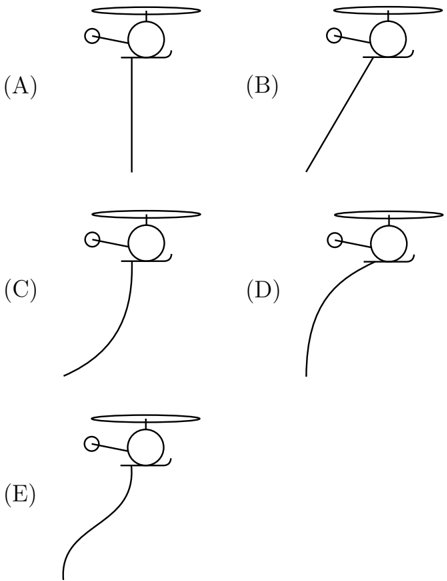
- A. The cable hangs straight down, vertical.
- B. The cable is straight but slanted backward (to the left).
- C. The cable trails backward with a smooth concave curve.
- D. The cable curves backward more sharply near the bottom.
- E. The cable has an S-shaped (reflex) curve trailing backward.
Topic: Newtonian Mechanics, Fluid Mechanics Metodi: Free-Body Diagram, Physical Modeling Competenze: Physical Reasoning, Diagrammatic Reasoning Objects: String Fonte: Testo (PDF) - p.6
- Un elicottero vola orizzontalmente a velocità costante. Sotto l’elicottero è sospeso un cavo uniforme perfettamente flessibile; la friczione dell’aria sul cavo non è trascurabile.
Quale dei seguenti diagrammi mostra meglio la forma del cavo mentre l’elicottero vola nell’aria verso destra?
- A. Il cavo è appeso dritto in basso, verticale.
- B. Il cavo è retto ma inclinato verso l’indietro (a sinistra).
- C. Il cavo si fa avanti con una curva concava liscia.
- D. Il cavo si tende più drasticamente verso l’indietro vicino alla parte inferiore.
- E. Il cavo ha una curva a forma di S (riflessivo) che si allontana in retrospetto.
Topic: Newtonian Mechanics, Fluid Mechanics Metodi: Free-Body Diagram, Physical Modeling Competenze: Physical Reasoning, Diagrammatic Reasoning Objects: String Fonte: Testo (PDF) - p.6
- A crew of scientists has built a new space station. The space station is shaped like a wheel of radius , with essentially all its mass at the rim. When the crew arrives, the station will be set rotating at a rate that causes an object at the rim to have radial acceleration , thereby simulating Earth’s surface gravity. This is accomplished by two small rockets, each with thrust newtons, mounted on the station’s rim. How long a time does one need to fire the rockets to achieve the desired condition?
- A.
- B.
- C.
- D.
- E.
Topic: Rotational Dynamics Metodi: Torque & Angular Momentum Analysis, Impulse-Momentum Theorem Competenze: Physical Reasoning Objects: - Fonte: Testo (PDF) - p.7
- Un equipaggio di scienziati ha costruito una nuova stazione spaziale. La stazione spaziale è a forma di una ruota di raggio , con essenzialmente tutta la sua massa al bordo. Quando l’equipaggio arriva, la stazione sarà impostata a rotazione a una velocità che provoca un oggetto al bordo ad avere un’accelerazione radial , simulando così la gravità superficiale della Terra. Questo è realizzato da due piccoli razzi, ognuno con spinta newtons, montati sul bordo della stazione. How long a time does one need to fire the rockets to achieve the desired condition?
- A.
- B.
- C.
- D.
- E.
Topic: Rotational Dynamics Metodi: Torque & Angular Momentum Analysis, Impulse-Momentum Theorem Competenze: Physical Reasoning Objects: - Fonte: Testo (PDF) - p.7
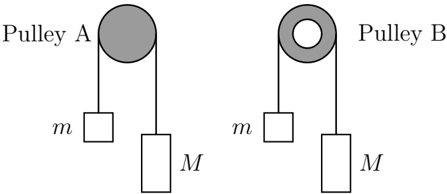
- Two pulleys (shown in figure) are made of the same metal with density . Pulley A is a uniform disk with radius . Pulley B is identical except a circle of is removed from the center. When two boxes () are connected over the pulleys through a massless rope and move without slipping, what is the ratio between the accelerations in system A and B? The mass of pulley A is .
- A.
- B.
- C.
- D.
- E.
Topic: Rotational Dynamics Metodi: Torque & Angular Momentum Analysis, Free-Body Diagram Competenze: Physical Reasoning, Mathematical Modeling Objects: Pulley, String Fonte: Testo (PDF) - p.7
- Due pollice (sostituite nella figura) sono realizzate dello stesso metallo con densità . La pollice A è un disco uniforme con raggio . La polla B è identica, tranne che dal centro viene rimosso un cerchio di . Quando due scatole () sono collegate sulle pollice attraverso una corda senza massa e si muovono senza scivolare, qual è il rapporto tra le accelerazioni del sistema A e B? La massa della pollice A è .
- A.
- B.
- C.
- D.
- E.
Topic: Rotational Dynamics Metodi: Torque & Angular Momentum Analysis, Free-Body Diagram Competenze: Physical Reasoning, Mathematical Modeling Objects: Pulley, String Fonte: Testo (PDF) - p.7
- A body of mass and a body of mass are in circular orbits about their center of mass under the influence of their mutual gravitational attraction to each other. The distance between the bodies is , which is much larger than the size of either body.
A small amount of matter is removed from the body of mass and transferred to the body of mass . The transfer is done in such a way so that the orbits of the two bodies remain circular, and remain separated by a distance . Which of the following statements is correct?
- A. The gravitational force between the two bodies increases.
- B. The gravitational force between the two bodies remains constant.
- C. The total angular momentum of the system increases.
- D. The total angular momentum of the system remains constant.
- E. The period of the orbit of two bodies remains constant.
Topic: Gravitation Metodi: Newton’s Law of Gravitation, Kepler’s Laws, Conservation Laws Competenze: Physical Reasoning Objects: - Fonte: Testo (PDF) - p.7
- Un corpo di massa e un corpo di massa sono in orbite circolari intorno al loro centro di massa sotto l’influenza della loro attrazione gravitazionale reciproca l’uno verso l’altro. La distanza tra i corpi è , che è molto più grande della dimensione di entrambi i corpi.
Una piccola quantità di materia viene rimossa dal corpo di massa e trasferita al corpo di massa . Il trasferimento è effettuato in modo tale che le orbite dei due corpi rimangano circolari e siano separate da una distanza . Quale delle seguenti affermazioni è corretta?
- A. La forza gravitazionale tra i due corpi aumenta.
- B. La forza gravitazionale tra i due corpi rimane costante.
- C. Il momento angolare totale del sistema aumenta.
- D. La dinamica angolare totale del sistema rimane costante.
- E. Il periodo di orbita di due corpi rimane costante.
Topic: Gravitation Metodi: Newton’s Law of Gravitation, Kepler’s Laws, Conservation Laws Competenze: Physical Reasoning Objects: - Fonte: Testo (PDF) - p.7
The following information applies to questions 23 and 24.
A 100 kg astronaut carries a launcher loaded with a 10 kg bowling ball; the launcher and the astronaut’s spacesuit have negligible mass. The astronaut discovers that firing the launcher results in the ball moving away from her at a relative speed of 50 m/s.
- What is the impulse delivered to the astronaut when firing the launcher?
- A. 455 N s
- B. 500 N s
- C. 550 N s
- D. 5000 N s
- E. 5500 N s
Topic: Conservation of Momentum Metodi: Conservation of Momentum, Impulse-Momentum Theorem Competenze: Physical Reasoning Objects: Ball Fonte: Testo (PDF) - p.8
Le seguenti informazioni si applicano alle domande 23 e 24.
Un astronauta da 100 kg porta un lanciatore carico di una palla da bowling da 10 kg; il lanciatore e la tuta spaziale dell’astronauta hanno una massa trascurabile. L’astronauta scopre che sparare il lanciatore provoca che la palla si allontana da lei a una velocità relativa di 50 m/s.
- Qual è l’impulso che viene fornito all’astronauta quando lancia il lanciatore?
- A. 455 N s
- B. 500 N s
- C. 550 N s
- D. 5000 N s
- E. 5500 N s
Topic: Conservation of Momentum Metodi: Conservation of Momentum, Impulse-Momentum Theorem Competenze: Physical Reasoning Objects: Ball Fonte: Testo (PDF) - p.8
The following information applies to questions 23 and 24.
A 100 kg astronaut carries a launcher loaded with a 10 kg bowling ball; the launcher and the astronaut’s spacesuit have negligible mass. The astronaut discovers that firing the launcher results in the ball moving away from her at a relative speed of 50 m/s.
- The astronaut in the previous situation is now moving at 10 m/s (as measured in a certain frame of reference). She wishes to fire the launcher so that her velocity turns through as large an angle as possible (in this frame of reference). What is this maximum angle? (Hint: a diagram may be useful.)
- A.
- B.
- C.
- D.
- E.
Topic: Conservation of Momentum Metodi: Conservation of Momentum, Vector Decomposition Competenze: Physical Reasoning, Diagrammatic Reasoning Objects: Ball Fonte: Testo (PDF) - p.8
Le seguenti informazioni si applicano alle domande 23 e 24.
Un astronauta da 100 kg porta un lanciatore carico di una palla da bowling da 10 kg; il lanciatore e la tuta spaziale dell’astronauta hanno una massa trascurabile. L’astronauta scopre che sparare il lanciatore provoca che la palla si allontana da lei a una velocità relativa di 50 m/s.
- L’astronauta nella situazione precedente si sta muovendo a 10 m/s (come misurato in un certo quadro di riferimento). Desidera sparare il lanciatore in modo che la sua velocità si sposta attraverso un angolo più grande possibile (in questo quadro di riferimento). Qual è l’angolo massimo? (Signore: un diagramma può essere utile.)
- A.
- B.
- C.
- D.
- E.
Topic: Conservation of Momentum Metodi: Conservation of Momentum, Vector Decomposition Competenze: Physical Reasoning, Diagrammatic Reasoning Objects: Ball Fonte: Testo (PDF) - p.8
- A block with mass is released from rest at the top of a frictionless ramp. The block starts at a height above the base of the ramp, slides down the ramp, and then up a second ramp. The coefficient of kinetic friction between the block and the second ramp is . If both ramps make an angle of with the horizontal, to what height above the base of the second ramp will the block rise?
- A.
- B.
- C.
- D.
- E.
Topic: Conservation of Energy Metodi: Conservation of Energy, Free-Body Diagram Competenze: Physical Reasoning Objects: Block, Inclined Plane Fonte: Testo (PDF) - p.8
- Un blocco di massa viene rilasciato dal riposo nella parte superiore di una rampa senza attrito. Il blocco inizia ad un’altezza sopra la base della rampa, scende verso il basso della rampa e poi sale su una seconda rampa. Il coefficiente di attrito cinetico tra il blocco e la seconda rampa è . Se entrambe le rampe fanno un angolo di con l’orizzontale, a quale altezza sopra la base della seconda rampa il blocco si alzerà?
- A.
- B.
- C.
- D.
- E.
Topic: Conservation of Energy Metodi: Conservation of Energy, Free-Body Diagram Competenze: Physical Reasoning Objects: Block, Inclined Plane Fonte: Testo (PDF) - p.8