Explain or comment on the following. More marks will be awarded for numerate or algebraic solutions where possible. Estimate quantities that you may need if these are not given.
i) Light hitting a single small hole will spread out.
ii) Why do you think that stars appear to twinkle to the naked eye when planets do not?
iii) Figures 1.1 and 1.2 show a comet with its tail. On the original photo the tail is so transparent that stars can be seen through the tail. Why does the comet’s tail always point away from the sun? Why are there two tails, as seen in Figure 1.2? Explain what orbit the comet might follow.
iv) It seems odd that the planets’ orbits round the Sun are nearly circular. Why do you think this is?
The Sun Figure 1.1 Figure 1.2 4
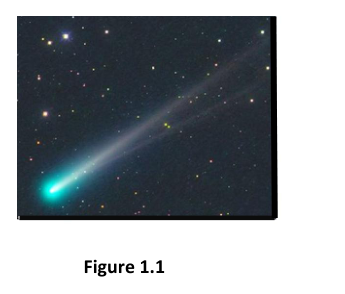 Figura 1.1: cometa con coda
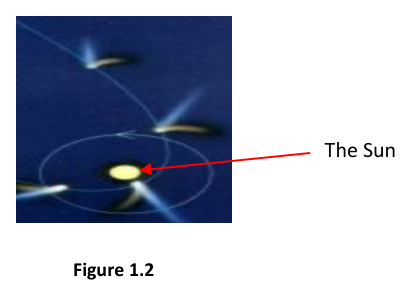 Figura 1.2: cometa coda e Sole
Topic: Wave Optics, Astrophysics, Gravitation Metodi: Physical Modeling, Newton’s Law of Gravitation, Kepler’s Laws Competenze: Physical Reasoning, Estimation & Approximation Objects: Slit, Star, Planet Fonte: Testo (PDF) — p.3
Spiega o commenta le seguenti osservazioni. Altri voti verranno assegnati per le soluzioni numerate o algebriche
- quando è possibile. Estima le quantità di cui potresti avere bisogno se non le hai date.
i) La luce che colpisce un piccolo buco si diffonderà.
ii) Perché pensi che le stelle sembrino luccicare a occhio nudo, quando i pianeti non lo fanno?
iii) Le figure 1.1 e 1.2 mostrano una cometa con la coda. Nella foto originale la coda è così trasparente che le stelle possono essere viste attraverso la coda. Perché la coda della cometa punta sempre lontano dalla Il sole? Perché ci sono due code, come si vede nella figura 1.2? Spiegate quale orbita potrebbe seguire la cometa.
iv) Sembra strano che i pianeti orbitino intorno al Sole quasi in circolo. Perché pensi che sia così?
Il sole Figura 1.1 Figura 1.2 4
Figura 1.1: cometa con coda
Figura 1.2: cometa coda e Sole
Topic: Wave Optics, Astrophysics, Gravitation Metodi: Physical Modeling, Newton’s Law of Gravitation, Kepler’s Laws Competenze: Physical Reasoning, Estimation & Approximation Objects: Slit, Star, Planet Fonte: Testo (PDF) — p.3
It can be shown that a square wave can be represented by a sum of sine waves as given by the formula below
v = + + + ..
Solar cells have an output that is dc. The pd across a cell depends on the incident radiation and the efficiency of the solar cells – Hubble telescope cells have an efficiency of about 30% in full sunlight. Solar cells for use on buildings etc. normally have an efficiency of about 15%. The dc power from the solar cells has to be transmitted to the mains which is 240V ac. At your disposal you have electronic black boxes. A possible solution is sketched out in Figure 2.1 below.
What is the black box for? Suggest components for the black box.
Some electrical energy may be lost as heat. How can you maximise the efficiency of the electrical energy transfer from the solar panels to the 240 V ac of the mains?
Explain why electrical energy is transferred by the grid using three or four wires.
It has been suggested that one way of storing electrical energy would be to store it in a rotating flywheel. A simple flywheel should store electrical energy from a 1MW power supply for 20 minutes. Suggest a design for this flywheel. Marks are awarded for the detail of the design.
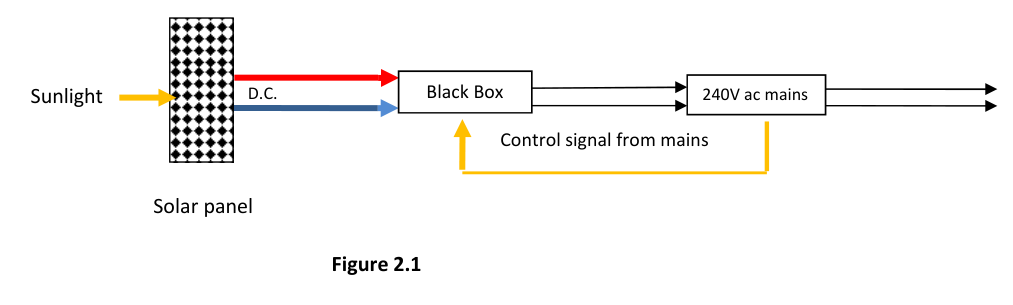 Figura 2.1: schema pannello solare inverter
Topic: Circuits, Oscillations & Waves, Rotational Dynamics Metodi: Superposition Principle, Energy Conservation Method, Physical Modeling Competenze: Physical Reasoning, Mathematical Modeling Objects: Wheel, Wire Fonte: Testo (PDF) — p.4
Si può dimostrare che un’onda quadrata può essere rappresentata da una somma di onde sinusoide come dato dalla formula di seguito
v = + + + ..
Le celle solari hanno una uscita di DC. Il pd attraverso una cellula dipende dalla radiazione incidente e dalla Le cellule del telescopio Hubble hanno un’efficienza di circa il 30% in piena luce solare. Il sistema solare cellule destinate all’uso in edifici ecc. di solito hanno un’efficienza di circa il 15%. Potenza di corrente continua delle celle solari deve essere trasmessa alla rete elettrica di 240 V ac. A vostra disposizione avete scatole nere elettroniche. A La soluzione possibile è descritta nella figura 2.1 di seguito.
Per cosa serve la scatola nera? Suggerisci componenti per la scatola nera.
Alcune energie elettriche possono essere perdute come calore. Come massimizzare l’efficienza dell’energia elettrica trasferimento dai pannelli solari al 240 V ac della rete?
Spiegate perché l’energia elettrica viene trasmessa dalla rete tramite tre o quattro fili.
È stato suggerito che un modo per conservare l’energia elettrica sarebbe quella di memorizzarla in un volante rotante. A un semplice volante deve conservare l’energia elettrica di un alimentatore da 1 MW per 20 minuti. Suggerire un progetto per questo volante. I marchi sono assegnati per i dettagli del disegno.
Figura 2.1: schema pannello inverter solare
Topic: Circuits, Oscillations & Waves, Rotational Dynamics Metodi: Superposition Principle, Energy Conservation Method, Physical Modeling Competenze: Physical Reasoning, Mathematical Modeling Objects: Wheel, Wire Fonte: Testo (PDF) — p.4
Calculate the approximate speed of Nitrogen molecules at a temperature of 20o C.
Calculate the height at which the density of the Nitrogen molecules becomes one per cent of the pressure at ground level. It has been suggested that if a plane achieved a suborbital flight to Australia then a great deal of fuel could be saved. Estimate the energy needed to reach a suitable height so that the resistance of the air would be very small.
The “Dreamliner” has a mass of 2.27 105 kg.
Control signal from mains Black Box Solar panel Sunlight D.C. 240V ac mains Figure 2.1 5
Topic: Kinetic Theory, Thermodynamics, Gravitation Metodi: Kinetic Theory of Gases, Ideal Gas Law, Energy Conservation Method Competenze: Estimation & Approximation, Mathematical Modeling Objects: Gas Fonte: Testo (PDF) — p.4
Calcolare la velocità approssimativa delle molecole di azoto a una temperatura di 20oC.
Calcolare l’altezza alla quale la densità delle molecole di azoto diventa l’1% della pressione livello del suolo. Si è suggerito che se un aereo raggiunge un volo suborbitale verso l’Australia allora una grande quantità di di combustibile potrebbe essere risparmiato. Calcolare l’energia necessaria per raggiungere un’altezza adeguata in modo che la resistenza della l’aria sarebbe molto piccola.
Il Dreamliner ha una massa di 2,27 105 kg.
Segnale di controllo della rete Scatola nera Pannello solare Luce solare D.C. 240V di corrente ac Figura 2.1 5
Topic: Kinetic Theory, Thermodynamics, Gravitation Metodi: Kinetic Theory of Gases, Ideal Gas Law, Energy Conservation Method Competenze: Estimation & Approximation, Mathematical Modeling Objects: Gas Fonte: Testo (PDF) — p.4
It has been reported that the wind speed reached 200 mph (90 ms-1) in the Philippines. This is capable of toppling walls.
Figure 4.1
A concrete wall is made from two sections A and B. Section A is 2 m high and section B is 1.3 m long. The thickness of the concrete is 0.7 m. The cross section is made of concrete. The orange lines within the concrete show the position of reinforcing steel bars with a twisted cross section of rather rusty steel. Why are these steel bars embedded in the wall? It may be assumed that there is a linear increase in wind speed with height.
i) How does the pressure of the wind vary with the height of the wall? Hence, or otherwise, find how the pressure on the ground varies with position. Hence estimate what wind speed is likely to topple the wall.
ii) How else could you help make the wall more stable?
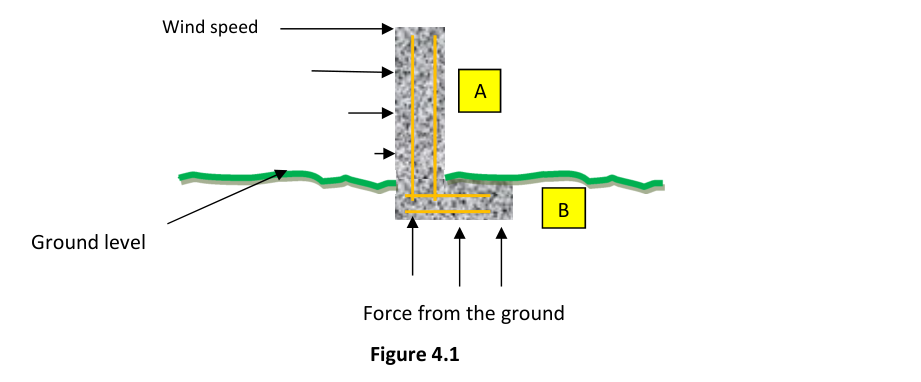 Figura 4.1: sezione muro calcestruzzo vento
Topic: Fluid Mechanics, Rigid Body Statics, Elasticity & Materials Metodi: Bernoulli’s Equation, Torque & Angular Momentum Analysis, Free-Body Diagram Competenze: Physical Reasoning, Mathematical Modeling Objects: — Fonte: Testo (PDF) — p.5
È stato riferito che la velocità del vento ha raggiunto le 200 mph (90 ms-1) nelle Filippine. Questo è capace di abbattere le pareti.
Figura 4.1
Un muro di cemento è realizzato da due sezioni A e B. La sezione A è alta 2 m e la sezione B è lunga 1,3 m. Il spessore del cemento è di 0,7 m. La sezione trasversale è fatta di cemento. Le linee arancione all’interno del il cemento mostra la posizione delle barre di acciaio rinforzante con un tramo incrociato di acciaio piuttosto arrugginito. Perché queste barre di acciaio sono incastrate nel muro? Si può presumere che vi sia un aumento lineare del vento velocità con altezza.
i) Come varia la pressione del vento a seconda dell’altezza del muro? Quindi, o altrimenti, trovare come la pressione sul terreno varia a seconda della posizione. Quindi stima la velocità del vento probabile
- Per abbattere il muro.
ii) In che altro modo potresti contribuire a rendere il muro più stabile?
Figura 4.1: sezione muro calcestruzzo vento
Topic: Fluid Mechanics, Rigid Body Statics, Elasticity & Materials Metodi: Bernoulli’s Equation, Torque & Angular Momentum Analysis, Free-Body Diagram Competenze: Physical Reasoning, Mathematical Modeling Objects: — Fonte: Testo (PDF) — p.5
Imagine that you are an observer on a planet of a nearby star such as Proximae Centauri (if it has one). You might notice that our Sun seems to wobble slightly with a somewhat complex wobble. This observed wobble has been used to detect planets round other stars.
i) What is the wobble due to?
ii) Using the data provided find the maximum speed of the wobble.
iii) What other method might be used to detect a planet orbiting a distant star?
Force from the ground A B Ground level Wind speed 6
Topic: Gravitation, Astrophysics Metodi: Newton’s Law of Gravitation, Kepler’s Laws, Conservation of Momentum Competenze: Mathematical Modeling, Estimation & Approximation Objects: Planet, Star Fonte: Testo (PDF) — p.5
Immaginate di essere un osservatore su un pianeta vicino a una stella come Proximae Centauri (se ne ha una). Tu… Potrebbe notare che il nostro Sole sembra oscillare leggermente con un oscillazione un po’ complessa. Questo ha osservato l’oscillazione è stata utilizzata per rilevare pianeti attorno ad altre stelle.
i) A cosa si deve l’oscillazione?
ii) Con i dati forniti, si trova la velocità massima dell’oscillazione.
iii) Quale altro metodo potrebbe essere utilizzato per rilevare un pianeta che orbita attorno a una stella lontana?
Forza dal suolo A B Livello del suolo Velocità del vento 6
Topic: Gravitation, Astrophysics Metodi: Newton’s Law of Gravitation, Kepler’s Laws, Conservation of Momentum Competenze: Mathematical Modeling, Estimation & Approximation Objects: Planet, Star Fonte: Testo (PDF) — p.5
Figure 6.2
Figure 6.1 shows a vertical cross section of a metal horn. A small red ball moves along a line that is horizontal and circular, C, D. However the ball could take the track E, F.
Discuss, using appropriate algebra where possible, the relative energies of the two tracks. How good a model is this of the solar system?
End of Questions Figure 6.1 Horn ball A B C D E F D E C B
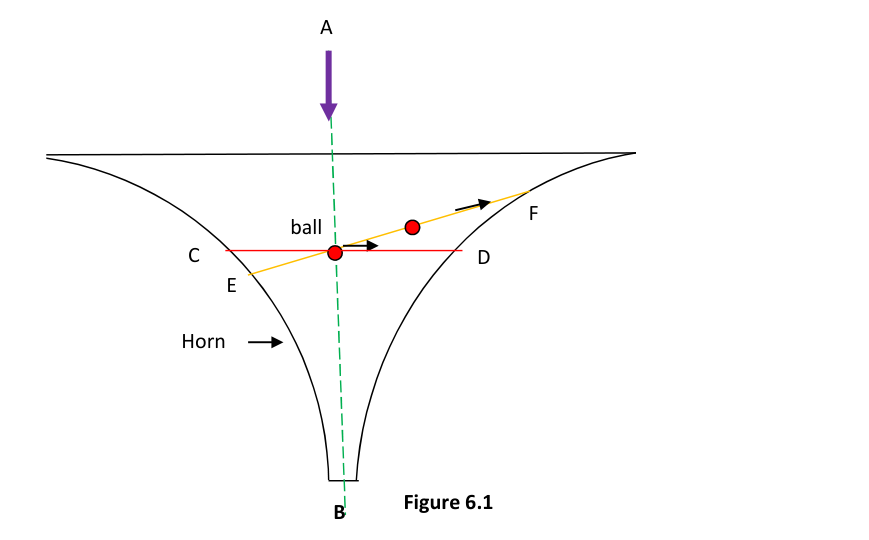 Figura 6.1: sezione verticale corno metallico
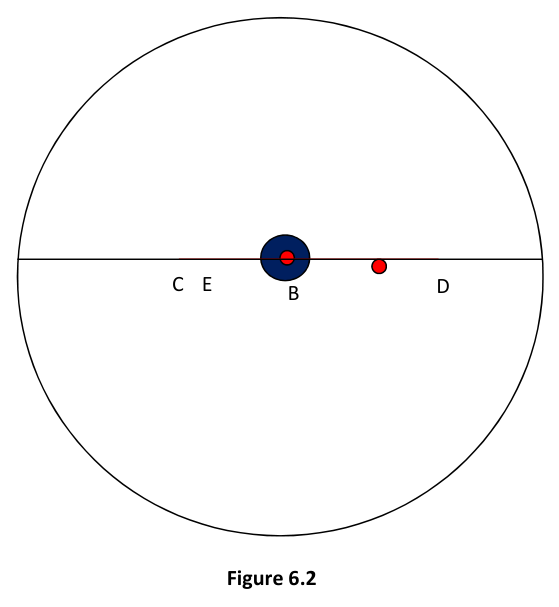 Figura 6.2: vista dall’alto corno orbite
Topic: Gravitation, Conservation of Energy, Newtonian Mechanics Metodi: Energy Conservation Method, Newton’s Law of Gravitation, Physical Modeling Competenze: Physical Reasoning, Mathematical Modeling Objects: Ball Fonte: Testo (PDF) — p.6
Figura 6.2
La figura 6.1 mostra una sezione trasversale verticale di un corno metallico. Una piccola palla rossa si muove lungo una linea che è orizzontale e circolare, C, D. Comunque la palla potrebbe prendere la pista E, F.
Discutere, utilizzando l’algebra appropriata ove possibile, le relative energie delle due tracce. Quanto è buono questo modello del sistema solare?
Fine delle domande Figura 6.1 Corno palla A B C D E F D E C B
Figura 6.1: sezione verticale corno metallico
Figura 6.2: vista dall’orbita alti corni
Topic: Gravitation, Conservation of Energy, Newtonian Mechanics Metodi: Energy Conservation Method, Newton’s Law of Gravitation, Physical Modeling Competenze: Physical Reasoning, Mathematical Modeling Objects: Ball Fonte: Testo (PDF) — p.6