The circuit in Figure 1.(a) contains a cell of emf , a known variable resistance , an unknown resistance and an ammeter. When X and Y are short circuited . When is inserted the current is , where is a constant.
(i) Express in terms of and , giving the range of validity of and .
(ii) In order to extend the range of , modify the circuit by putting in parallel with . Determine the ranges of and for the modified circuit.
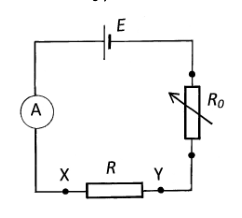 Circuit with emf, R0, R, ammeter
Topic: Circuits Metodi: Kirchhoff’s Laws, Equivalent Circuit Reduction Competenze: Physical Reasoning, Mathematical Modeling Objects: Battery, Resistor, Galvanometer Fonte: Testo (PDF) — p.3
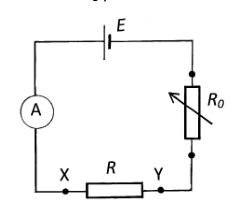
Il circuito di cui alla figura 1.(a) contiene una cella di emf , una resistenza variabile nota , una resistenza sconosciuta e un ammetro. Quando X e Y sono a circuito corto . Quando viene inserito la corrente è , dove è una costante.
(i) Esprimere in termini di e , dando l’intervallo di validità di e .
ii) Per estendere la gamma di , modificare il circuito mettendo in parallelo con . Determinare le fasce e per il circuito modificato.
Circuito con emf, R0, R, ammetro
Topic: Circuits Metodi: Kirchhoff’s Laws, Equivalent Circuit Reduction Competenze: Physical Reasoning, Mathematical Modeling Objects: Battery, Resistor, Galvanometer Fonte: Testo (PDF) — p.3
A man, on an open wagon of a train travelling along a straight horizontal track at a constant speed of , throws a ball into the air in line with the track, that he judges to be at to the horizontal. A woman standing on the ground observes the ball rise vertically.
How high does the ball rise relative to:
(i) the man; and
(ii) the woman?
Topic: Newtonian Mechanics Metodi: Kinematic Equations, Vector Decomposition Competenze: Physical Reasoning, Mathematical Modeling Objects: Ball Fonte: Testo (PDF) — p.3
Un uomo, su un vagone aperto di un treno che viaggia lungo una pista orizzontale dritta a velocità costante di , lancia un pallone in aria in linea con la pista, che giudica essere a orizzontale. Una donna che sta in piedi osserva la palla salire verticalmente.
Quanto alza la palla rispetto a:
- l’uomo;
(ii) la donna?
Topic: Newtonian Mechanics Metodi: Kinematic Equations, Vector Decomposition Competenze: Physical Reasoning, Mathematical Modeling Objects: Ball Fonte: Testo (PDF) — p.3
A glass block of refractive index has an ‘L’ cross-section (Figure 1.(c)), and is of constant width and thickness.
(i) A laser beam enters the block from the left, as indicated in Figure 1.(c), at an incident angle of . If the block was absent the beam would pass through the point P. Determine the angle at which the beam will emerge from the bottom face after refraction through the block.
(ii) If this beam enters the block below the horizontal through P, determine its possible subsequent path(s).
 L-shaped glass block, laser beam path
Topic: Geometric Optics Metodi: Snell’s Law, Ray Tracing Competenze: Diagrammatic Reasoning, Physical Reasoning Objects: — Fonte: Testo (PDF) — p.3
Un blocco di vetro di indice di rifrazione ha una sezione trasversale “L” (Figura 1.(c) e ha una larghezza e uno spessore costanti.
(i) Un raggio laser entra nel blocco da sinistra, come indicato alla figura 1.(c), ad un angolo di incidenza di . Se il blocco fosse assente il fascio passerebbe attraverso il punto P. Determinare l’angolo con cui il fascio emergerà dalla faccia inferiore dopo la rifrazione attraverso il blocco.
(ii) Se questo fascio entra nel blocco sotto l’orizzontale attraverso P, determinare i suoi possibili percorsi successivi.
Blocco di vetro a forma di L, percorso del fascio laser
Topic: Geometric Optics Metodi: Snell’s Law, Ray Tracing Competenze: Diagrammatic Reasoning, Physical Reasoning Objects: — Fonte: Testo (PDF) — p.3
The largest moon of Jupiter, Ganymede, revolves around the planet in a circular orbit of radius and period days. Determine the mass of Jupiter, , in terms of the mass of the Earth, .
The radius of the Earth .
Topic: Gravitation, Astrophysics Metodi: Kepler’s Laws, Newton’s Law of Gravitation Competenze: Mathematical Modeling, Physical Reasoning Objects: Satellite, Planet Fonte: Testo (PDF) — p.4
La luna più grande di Giove, Ganimede, ruota attorno al pianeta in un’orbita circolare di raggio e periodo giorni. Determinare la massa di Giove, , in termini di massa della Terra, .
Il raggio della Terra .
Topic: Gravitation, Astrophysics Metodi: Kepler’s Laws, Newton’s Law of Gravitation Competenze: Mathematical Modeling, Physical Reasoning Objects: Satellite, Planet Fonte: Testo (PDF) — p.4
Two lengths of wire, one copper and one tungsten, are joined vertically end to end. The copper wire has a diameter of . When a block is suspended from one end, the combined length of wire stretches by . What is the diameter, , of the tungsten wire if the Young’s modulus for copper is , and that for tungsten is ?
Topic: Elasticity & Materials Metodi: Stress-Strain Analysis, Hooke’s Law Competenze: Mathematical Modeling, Physical Reasoning Objects: Wire, Block Fonte: Testo (PDF) — p.4
Due fili di lunghezza , uno di rame e uno di tungsteno, sono uniti verticalmente da capo a capo. Il filo di rame ha un diametro di . Quando un blocco è sospeso da un’estremità, la lunghezza combinata del filo si estende per . Qual è il diametro, , del filo di tungsteno se il modulo del Young per il rame è e quello per il tungsteno è ?
Topic: Elasticity & Materials Metodi: Stress-Strain Analysis, Hooke’s Law Competenze: Mathematical Modeling, Physical Reasoning Objects: Wire, Block Fonte: Testo (PDF) — p.4
Wood from the coffin of an Egyptian mummy showed a specific activity of . Comparable living wood has a value of . The half life of carbon-14 is years. What is the time interval, , in years, since the burial?
Topic: Nuclear & Particle Physics Metodi: Radioactive Decay Law Competenze: Mathematical Modeling, Physical Reasoning Objects: Nucleus Fonte: Testo (PDF) — p.4
Il legno della bara di una mummia egiziana mostrava una specifica attività di . Legno vivente comparabile ha un valore di . La semivita’ del carbonio-14 è anni. Qual è l’intervallo di tempo, , in anni, dal funerale?
Topic: Nuclear & Particle Physics Metodi: Radioactive Decay Law Competenze: Mathematical Modeling, Physical Reasoning Objects: Nucleus Fonte: Testo (PDF) — p.4
Explain why the centre of gravity of a triangular plate lies along a median; the line joining a vertex to the midpoint of the opposite side. An equilateral triangular plate, sides of length , has a triangle, formed by two corners and the centre of gravity of the original plate, removed. Determine the centre of gravity of the remaining plate.
The centre of gravity of a triangular plate is at a point two thirds along the length of a median measured from the vertex.
Topic: Rigid Body Statics, Newtonian Mechanics Metodi: Symmetry Argument, Free-Body Diagram Competenze: Physical Reasoning, Mathematical Modeling Objects: — Fonte: Testo (PDF) — p.4
Spiegate perché il centro di gravità di una piastra triangolare si trova lungo una media; la linea che unisce un vertice al punto medio del lato opposto. Una piastra triangolare equilaterale, laterale di lunghezza , ha un triangolo, formato da due angoli e il centro di gravità della piastra originale rimosso. Determinare il centro di gravità della piastra rimanente.
Il centro di gravità di una piastra triangolare è a un punto due terzi lungo la lunghezza di una media misurata dal vertice.
Topic: Rigid Body Statics, Newtonian Mechanics Metodi: Symmetry Argument, Free-Body Diagram Competenze: Physical Reasoning, Mathematical Modeling Objects: — Fonte: Testo (PDF) — p.4
A vertical U-tube, partially filled with liquid, is accelerated vertically upwards in a lift, acceleration . What is the effective value of '', ? If the U-tube is mounted in a vehicle accelerating in a horizontal straight line, acceleration (Figure 1.(h)), what is the effective '', ? Express in terms of the distance between the arms of the U-tube, , and the difference in heights, , of the liquid in the arms.
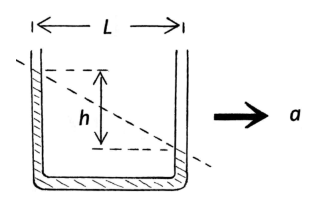 U-tube in horizontally accelerating vehicle
Topic: Fluid Mechanics, Newtonian Mechanics Metodi: Hydrostatic Equilibrium, Free-Body Diagram Competenze: Physical Reasoning, Mathematical Modeling Objects: Tube Fonte: Testo (PDF) — p.5
Un tubo U verticale, parzialmente riempito di liquido, viene accelerato verticalmente verso l’alto in un ascensore, con accelerazione . Qual è il valore effettivo di , ? Se il tubo U è montato in un veicolo che accelera in linea retta orizzontale, accelerazione (Figura 1.(h)), qual è l’effettiva "", ? Esprimere in termini di distanza tra le braccia del tubo U, , e la differenza di altezza, , del liquido nei braccia.
U-tube in veicolo ad acceleramento orizzontale
Topic: Fluid Mechanics, Newtonian Mechanics Metodi: Hydrostatic Equilibrium, Free-Body Diagram Competenze: Physical Reasoning, Mathematical Modeling Objects: Tube Fonte: Testo (PDF) — p.5
In Figure 1.(i) a fixed mirror, a light source and a light receiver are all from a rotating mirror, with angular frequency . The distance between the light source and the receiver is . What is the lowest value of required for detection of the reflected light?
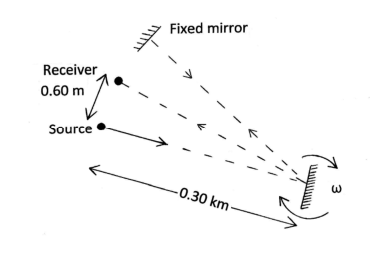 Rotating mirror, light source and receiver
Topic: Geometric Optics, Oscillations & Waves Metodi: Kinematic Equations, Ray Tracing Competenze: Physical Reasoning, Mathematical Modeling Objects: Mirror Fonte: Testo (PDF) — p.5
Nella figura 1.(i) uno specchio fisso, una fonte luminosa e un ricevitore luminoso sono tutti da uno specchio rotante, con frequenza angolare . La distanza tra la fonte luminosa e il ricevitore è . Qual è il valore minimo di richiesto per il rilevamento della luce riflessa?
*L’obiettivo è quello di ottenere una luce di cui al punto 1.
Topic: Geometric Optics, Oscillations & Waves Metodi: Kinematic Equations, Ray Tracing Competenze: Physical Reasoning, Mathematical Modeling Objects: Mirror Fonte: Testo (PDF) — p.5
A car travelling at in a straight line sounds its horn continuously, frequency , as it passes a stationary observer. At the closest point, A, to the observer the car is at a distance from the observer. Determine the frequency heard by the observer when the car is:
(i) at A;
(ii) at a distance from A, after passing A.
The velocity of sound is .
Topic: Oscillations & Waves Metodi: Wave Equation, Kinematic Equations Competenze: Physical Reasoning, Mathematical Modeling Objects: — Fonte: Testo (PDF) — p.5
Una macchina che viaggia a in linea retta suona continuamente il suo corno, frequenza , mentre passa davanti a un osservatore fermo. Al punto più vicino, A, all’osservatore, l’auto è a una distanza dall’osservatore. Determinare la frequenza ascoltata dall’osservatore quando l’auto è:
(i) at A;
- a distanza da A, dopo aver superato A.
La velocità del suono è .
Topic: Oscillations & Waves Metodi: Wave Equation, Kinematic Equations Competenze: Physical Reasoning, Mathematical Modeling Objects: — Fonte: Testo (PDF) — p.5
A ball of mass and velocity collides elastically with a larger ball of mass , initially at rest. The ball of mass rebounds along its original line of motion with speed and the ball of mass has velocity in the direction of .
(i) Write down the conservation equations for the system.
(ii) Deduce the result that .
Topic: Conservation of Momentum, Conservation of Energy Metodi: Conservation of Momentum, Conservation of Energy Competenze: Mathematical Modeling, Physical Reasoning Objects: Ball Fonte: Testo (PDF) — p.6
Una palla di massa e velocità colpisce elasticamente con una palla di massa più grande , inizialmente in riposo. La palla di massa rimbalza lungo la sua linea di movimento originale con velocità e la palla di massa ha velocità nella direzione .
(i) Scrivere le equazioni di conservazione del sistema.
- Riduzione del risultato che .
Topic: Conservation of Momentum, Conservation of Energy Metodi: Conservation of Momentum, Conservation of Energy Competenze: Mathematical Modeling, Physical Reasoning Objects: Ball Fonte: Testo (PDF) — p.6
A velocity selector (Figure 1.(l)) consists of two slotted discs mounted on a common axis a distance apart. The slots are displaced relative to each other by an angle . The axis is driven at an angular velocity . Particles in a horizontal beam, with all possible velocities, will get through the first slit, in the first disc, for a short time interval. To subsequently get through the second slit, particles must travel a distance in the time it takes the second slot to line up with the beam. This will occur, for rotations of the second slit of , etc.
If , and , what are the speeds of those particles that pass through the velocity selector?
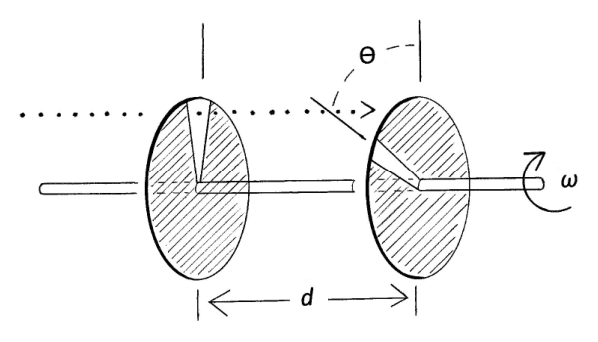 Velocity selector with two slotted discs
Topic: Newtonian Mechanics, Modern-Quantum Physics Metodi: Kinematic Equations, Physical Modeling Competenze: Physical Reasoning, Mathematical Modeling Objects: Disk, Slit, Particle Beam Fonte: Testo (PDF) — p.6
Un selettore di velocità (Figura 1.(l)) è costituito da due dischi a slot montati su un asse comune a distanza . Le slot sono spostate l’una rispetto all’altra da un angolo . L’asse è guidato a una velocità angolare . Le particelle in un raggio orizzontale, con tutte le velocità possibili, attraverseranno la prima fessura, nel primo disco, per un breve intervallo di tempo. Per superare successivamente la seconda fessura, le particelle devono percorrere una distanza nel tempo necessario per allinearsi con il fascio. Questo si verifica per le rotazioni della seconda fessura di , ecc.
Se , e , quali sono le velocità di quelle particelle che passano attraverso il selettore di velocità?
Selettore di velocità con due dischi a slot
Topic: Newtonian Mechanics, Modern-Quantum Physics Metodi: Kinematic Equations, Physical Modeling Competenze: Physical Reasoning, Mathematical Modeling Objects: Disk, Slit, Particle Beam Fonte: Testo (PDF) — p.6