Q2.
The circuits in this question have arms with resistance , and currents , , and in the arms indicated in the Figures. An external potential difference, , produces the current . The symbol for resistance has been omitted from the Figures.
Use the symmetry of the circuit and apply the result that reversing reverses the directions of all the currents; the magnitudes remaining unaltered.
Kirchhoff’s first rule may be required. It states that at any vertex, the sum of the currents entering is equal to the sum of the currents leaving.
(a)
(i) Obtain the current in EF, , in the circuit in Figure 2.(a).
(ii) Determine the resistance across AB, , in terms of . [5]
(b) Determine the resistance across AC, , in terms of in Figure 2.(b). [5]
(c) Determine the resistance across AD, , in terms of in Figure 2.(c).
This may require the application of Kirchhoff’s second rule. This states, for application here, that the clockwise sum of the currents in any closed loop is zero. [10]
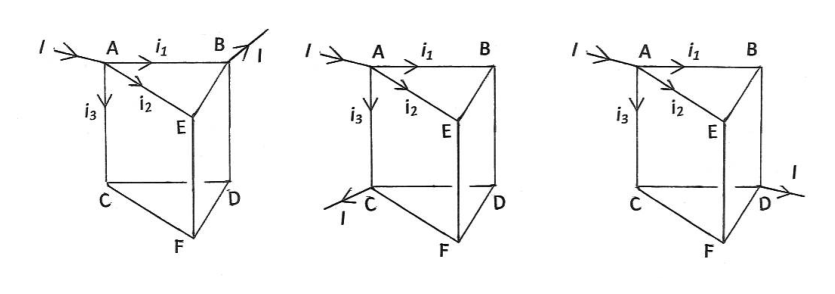 Figure 2.(a)(b)(c): three resistor networks
Topic: Circuits Metodi: Kirchhoff’s Laws, Equivalent Circuit Reduction, Symmetry Argument Competenze: Physical Reasoning, Mathematical Modeling Objects: Resistor Fonte: Testo (PDF) — p.3
Q2.
I circuiti di questa domanda hanno bracci con resistenza e correnti , , e nei bracci indicati nelle figure. Una differenza di potenziale esterna, , produce la corrente . Il simbolo di resistenza è stato omesso dalle figure.
Utilizzare la simmetria del circuito e applicare il risultato che invertendo invertono le direzioni di tutte le correnti; le magnitudini rimangono invariate.
Potrebbe essere necessaria la prima regola di Kirchhoff. Essa afferma che a qualsiasi vertice, la somma delle correnti che entrano è uguale alla somma delle correnti che usciranno.
(a)
(i) Ottenere la corrente in EF, , nel circuito della figura 2.
(ii) Determinare la resistenza di AB, , in termini di . [5]
**(b) ** Determina la resistenza attraverso l’AC, , in termini di nella figura 2.(b). [5]
**(c) ** Determina la resistenza attraverso AD, , in termini di nella figura 2.(c).
Ciò potrebbe richiedere l’applicazione della seconda regola di Kirchhoff. Questo afferma, per applicazione qui, che la somma nel senso orario delle correnti in qualsiasi circuito chiuso è zero. [10]
Figura 2.(a)(b)(c): tre reti di resistenza
Topic: Circuits Metodi: Kirchhoff’s Laws, Equivalent Circuit Reduction, Symmetry Argument Competenze: Physical Reasoning, Mathematical Modeling Objects: Resistor Fonte: Testo (PDF) — p.3
Q3.
Particles of mass and charge are projected with velocity , with much less than , into a uniform magnetic field of flux density , at an angle to the field.
(a) Show, by considering the motion parallel and perpendicular to the magnetic field, that the particles have a helical trajectory, with their axes along the direction of the magnetic field. [8]
(b) Determine the pitch of the helix . [3]
(c) Show that if is small, the trajectories for different but constant will all pass through a point P along the axis of the helix, after travelling a distance along the magnetic field. Determine and calculate its value if the particles are electrons and and . [7]
(d) How would the analysis be modified if was a relativistic velocity? [2]
Topic: Magnetism, Special Relativity Metodi: Lorentz Force Analysis, Simple Harmonic Motion Analysis, Small-Angle Approximation Competenze: Physical Reasoning, Mathematical Modeling Objects: Point Charge, Electron Fonte: Testo (PDF) — p.4
Q3.
Le particelle di massa e carica sono proiettate con velocità , con molto inferiore a , in un campo magnetico uniforme di densità di flusso , ad un angolo rispetto al campo.
**(a) ** Mostra, considerando il movimento parallelo e perpendicolare al campo magnetico, che le particelle hanno una traiettoria elica, con i loro assi lungo la direzione del campo magnetico. [8]
**(b) ** Determina il tono dell’elice . [3]
**(c) ** Mostra che se è piccolo, le traiettorie di diversi ma costanti passeranno tutti attraverso un punto P lungo l’asse dell’elice, dopo aver percorso una distanza lungo il campo magnetico. Determinare e calcolare il suo valore se le particelle sono elettroni e e . [7]
Come sarebbe modificata l’analisi se fosse una velocità relativistica? [2]
Topic: Magnetism, Special Relativity Metodi: Lorentz Force Analysis, Simple Harmonic Motion Analysis, Small-Angle Approximation Competenze: Physical Reasoning, Mathematical Modeling Objects: Point Charge, Electron Fonte: Testo (PDF) — p.4
Q4.
(a) A smooth rod is bent into a right angle and mounted in a vertical plane on a horizontal base, Figure 4.(a). Beads of mass and slide without friction on the rod, and are connected by a cord of negligible weight with tension . The angle between the horizontal base and the rod with the mass is . When the system is in static equilibrium, determine:
(i) the angle between the cord with tension and the slope, Figure 4.(a)
(ii) the tension [12]
(b) A smooth straw of length and mass is balanced on the edge of a smooth cylindrical container of diameter which rests on a horizontal table, Figure 4.(b), at an angle to the horizontal, as indicated in the Figure. Determine the angle . [8]
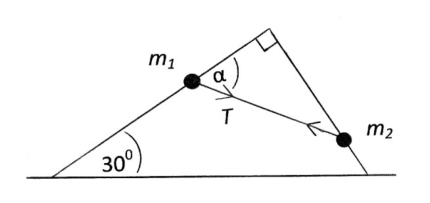 Figure 4.(a): beads on right-angle rod
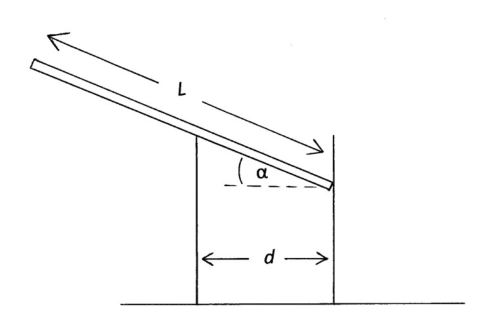 Figure 4.(b): straw on cylindrical container
Topic: Rigid Body Statics, Newtonian Mechanics Metodi: Free-Body Diagram, Torque & Angular Momentum Analysis, Vector Decomposition Competenze: Physical Reasoning, Diagrammatic Reasoning Objects: Rod, Cylinder, String Fonte: Testo (PDF) — p.5
Q4.
**(a) ** Una canna liscia è piegata in angolo retto e montata in piano verticale su una base orizzontale, figura 4.(a). Le perle di massa e scivolavano senza attrito sulla canna e sono collegate da un cavo di peso trascurabile con tensione . L’angolo tra la base orizzontale e la canna con massa è . Quando il sistema è in equilibrio statico, determinare:
(i) l’angolo tra il cavo con tensione e la pendenza , figura 4.(a)
(ii) la tensione [12]
**(b) ** Una paglia liscia di lunghezza e massa è bilanciata sul bordo di un contenitore cilindrico liscio di diametro che si posa su una tavola orizzontale, figura 4.(b), ad un angolo orizzontale, come indicato nella figura. Determinare l’angolo . [8]
Figura 4.(a): perle su una barra a angolo retto
Figura 4.(b): paglia su contenitore cilindrico
Topic: Rigid Body Statics, Newtonian Mechanics Metodi: Free-Body Diagram, Torque & Angular Momentum Analysis, Vector Decomposition Competenze: Physical Reasoning, Diagrammatic Reasoning Objects: Rod, Cylinder, String Fonte: Testo (PDF) — p.5
Q5.
A Newton’s rings interference experiment uses a plano-convex lens resting on a glass plate with light of wavelength incident normally on the lens, Figure 5.(1).
(a) Derive the conditions for constructive and destructive interference resulting from a region where the air gap has thickness . [5]
(b) A constructive interference ring, resulting from light passing through the air gap of thickness , has a radius . Show that the radius of curvature of the lens, , is given by the equation [3]
(c) By neglecting in the above formula, derive a formula for in terms of and the order of interference, , that is independent of for the case in which the th order destructive interference ring has radius . [2]
(d) If, using sodium light of wavelength , the diameter of the th order constructive interference ring is and that of the th has diameter , calculate the radius of curvature of the lens. [4]
(e) If, in , the air gap between the lens and the plate is filled with methyl alcohol of refractive index , what are the average speeds at which the radii of the constructive interference rings increase in (d) in this time interval? [6]
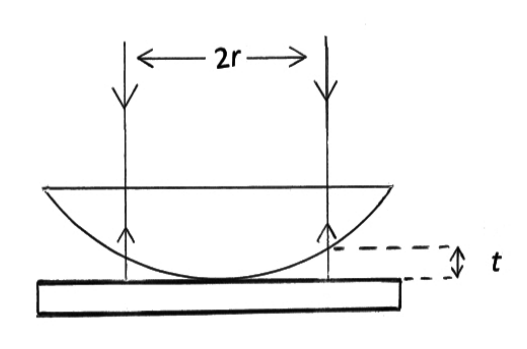 Figure 5.(1): Newton’s rings setup
Topic: Wave Optics, Geometric Optics Metodi: Interference & Diffraction Analysis, Thin Lens & Mirror Equation, Small-Angle Approximation Competenze: Physical Reasoning, Mathematical Modeling Objects: Lens Fonte: Testo (PDF) — p.6
Q5.
Un esperimento di interferenza con gli anelli di Newton utilizza una lente convexa piano che si basa su una piastra di vetro con luce di lunghezza d’onda che incide normalmente sulla lente, Figura 5.(1).
**(a) ** Derivare le condizioni per interferenze costruttive e distruttive derivanti da una regione in cui il divario atmosferico ha spessore . [5]
**(b) ** Un anello di interferenza costruttiva, risultante dalla luce che passa attraverso il divario di aria di spessore , ha un raggio . Mostra che il raggio di curvatura della lente, , è dato dall’equazione [3]
**(c) ** Trascurando nella formula di cui sopra, derivare una formula per in termini di e l’ordine di interferenza, , che è indipendente da nel caso in cui l’anello di interferenza distruttiva di di ordine ha raggio . [2]
Se, utilizzando la luce di sodio di lunghezza d’onda , il diametro dell’anello di interferenza costruttiva di th ordine è e quello del th ha diametro , calcolare il raggio di curvatura della lente. [4]
Se, in , l’intervallo di aria tra l’obiettivo e la piastra è riempito di alcol metile di indice di rifrazione , quali sono le velocità medie con cui i raggi degli anelli di interferenza costruttiva aumentano di (d) in questo intervallo di tempo? [6]
Figura 5.(1): configurazione degli anelli di Newton
Topic: Wave Optics, Geometric Optics Metodi: Interference & Diffraction Analysis, Thin Lens & Mirror Equation, Small-Angle Approximation Competenze: Physical Reasoning, Mathematical Modeling Objects: Lens Fonte: Testo (PDF) — p.6
Q6.
(a) The diode in the above circuit, Figure 6.(1), is used to rectify an ac voltage supply. The ac voltage supply at time has the form It has and . The capacitor has capacitance and the resistance can take the values , and .
Determine the time constants for the discharge of the capacitor, for all three values of the resistance. [2]
(b) Sketch a graph of the voltage forms across the resistance for the three values of , superimposing the original ac source on each sketch. [8]
(c) For the case , deduce a relation for determining the time the diode conducts, , in terms of and , where is the time the capacitor discharges per cycle. Show that it is the solution of the equation and verify that .
Determine the percentage of the time that the diode is conducting. [6]
(d) Calculate the variation in voltage, from maximum to minimum, for . [4]
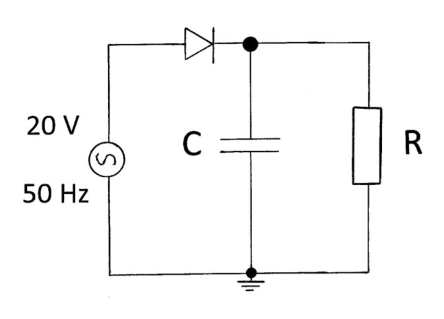 Figure 6.(1): diode rectifier circuit
Topic: Circuits, Electromagnetism Metodi: Kirchhoff’s Laws, Differential Equations, Experimental Data Analysis Competenze: Physical Reasoning, Mathematical Modeling Objects: Capacitor, Resistor Fonte: Testo (PDF) — p.7
Q6.
**(a) ** Il diodo del circuito di cui sopra, figura 6.(1), viene utilizzato per rettificare un’alimentazione di tensione ac. La corrente di tensione ac in tempo ha la forma Ha e . Il condensatore ha una capacità e la resistenza può assumere i valori , e .
Determinare le costanti temporali per la scarica del condensatore, per tutti e tre i valori della resistenza. [2]
**(b) ** Segnare un grafico delle forme di tensione attraverso la resistenza per i tre valori di , sovrappondendo la fonte ac originale su ogni schizzo. [8]
**(c) ** Per il caso , dedurre una relazione per determinare il tempo di conduzione del diodo, , in termini di e , dove è il tempo di scarico del condensatore per ciclo. Mostrare che è la soluzione dell’equazione e verificare che .
Determina la percentuale di tempo che il diodo sta conducendo. [6]
**(d) ** Calcolare la variazione della tensione, dal massimo al minimo, per . [4]
Figura 6.(1): circuito di rettificatore di diodo
Topic: Circuits, Electromagnetism Metodi: Kirchhoff’s Laws, Differential Equations, Experimental Data Analysis Competenze: Physical Reasoning, Mathematical Modeling Objects: Capacitor, Resistor Fonte: Testo (PDF) — p.7
Q7.
(a) Explain the difference between random errors and systematic errors. Give one example of each using either a clock to measure time or an ammeter to measure current.
Give a numerical example of:
(i) a correct measurement of with low precision
(ii) the root mean square of the two length measurements, and [6]
(b) If the maximum fractional error in the measurement of the period of a simple pendulum is and that in measuring the length is , what is the maximum percentage error in calculating the value of the gravitational acceleration due to free fall, ? [3]
(c) Use the measurements in Table 7.(c) to plot a suitable straight line graph to verify that the numerical values of pd, , and the current, , varies as where and are constants.
| 1 | 2 | 3 | 4 | 5 | 6 | |
|---|---|---|---|---|---|---|
| /V | 3.0 | 3.6 | 4.6 | 5.0 | 6.2 | 6.6 |
| /A | 3.2 | 9.9 | 20.4 | 31.6 | 97 | 193 |
Determine and , with an estimate of their accuracy. [7]
(d) Using the three sets of measurements, (1,4), (2,5) and (3,6) in Table 7.(c), determine the three associated values of , and their mean value , together with the magnitudes of their deviations from . Compare and comment on the accuracy of with that of determined in (c). [4]
Topic: Order-of-Magnitude Estimation Metodi: Error Propagation, Graph Linearization, Experimental Data Analysis Competenze: Error Propagation, Graph Linearization, Experimental Data Analysis Objects: Pendulum Fonte: Testo (PDF) — p.8
Q7.
**a) ** Spiegare la differenza tra errori casuali e errori sistematici. Cita un esempio di ciascuna di esse che usa un orologio per misurare il tempo o un ammetro per misurare la corrente.
Fornisci un esempio numerico di:
- una misura corretta di con bassa precisione
ii) la media quadrata radicale delle due misurazioni di lunghezza, e [6]
Se l’errore frazionario massimo nella misurazione del periodo di un pendolo semplice è e che nella misurazione della lunghezza è , quale è l’errore percentuale massimo nel calcolo del valore dell’accelerazione gravitazionale dovuta alla caduta libera, ? [3]
**(c) ** Utilizzare le misure di cui alla tabella 7.(c) per disegnare un grafico di linea retta appropriato per verificare che i valori numerici di pd, e della corrente, variano come dove e sono costanti.
| 1 | 2 | 3 | 4 | 5 | 6 | |
|---|---|---|---|---|---|---|
| /V | 3.0 | 3.6 | 4.6 | 5.0 | 6.2 | 6.6 |
| /A | 3.2 | 9.9 | 20.4 | 31.6 | 97 | 193 |
Determinare e , con una stima della loro accuratezza. [7]
**(d) ** Con le tre serie di misure, (1,4, (2,5) e (3,6) della tabella 7.(c), determinare i tre valori associati di e il loro valore medio , insieme alle magnitudini delle loro deviazioni da . Confronta e osserva l’accuratezza di con quella di determinata alla lettera c). [4]
Topic: Order-of-Magnitude Estimation Metodi: Error Propagation, Graph Linearization, Experimental Data Analysis Competenze: Error Propagation, Graph Linearization, Experimental Data Analysis Objects: Pendulum Fonte: Testo (PDF) — p.8
Q8.
A particle of mass is incident with velocity on a stationary particle of mass . The incident particle is scattered through an angle , with velocity , and the other particle is scattered in a direction that makes an angle with the direction of , with velocity , Figure 8.(1).
(a) Determine the velocity ratios and assuming momentum conservation only. [5]
(b) Compare the initial kinetic energy, , with the final kinetic energy, , for the following situations:
(i)
(ii)
(iii) ,
In each case determine if the energy is conserved. [12]
(c) If and are small, verify that energy is conserved if .
(For small , .) [3]
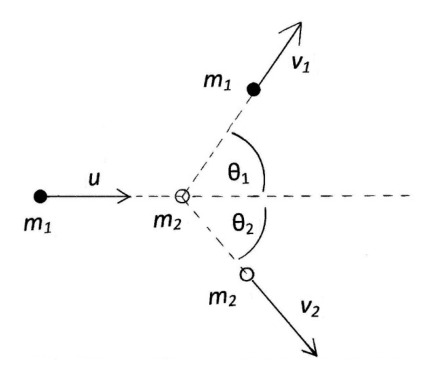 Figure 8.(1): particle scattering diagram
Topic: Conservation of Momentum, Conservation of Energy, Newtonian Mechanics Metodi: Conservation of Momentum, Conservation of Energy, Vector Decomposition Competenze: Physical Reasoning, Mathematical Modeling Objects: — Fonte: Testo (PDF) — p.9
Q8.
Una particella di massa incide con velocità su una particella fermata di massa . La particella incidente è dispersa attraverso un angolo , con velocità , e l’altra particella è dispersa in una direzione che rende un angolo con la direzione , con velocità , Figura 8.(1).
**(a) ** Determinare i rapporti di velocità e assumendo solo la conservazione del momento. [5]
**(b) ** Confronta l’energia cinetica iniziale, , con l’energia cinetica finale, , per le seguenti situazioni:
(i)
(ii)
- ,
In ogni caso, si determina se l’energia è conservata. [12]
Se e sono piccoli, verificare che l’energia sia conservata se .
(Per i piccoli , .) [3]
Figura 8.(1): diagramma di dispersione delle particelle
Topic: Conservation of Momentum, Conservation of Energy, Newtonian Mechanics Metodi: Conservation of Momentum, Conservation of Energy, Vector Decomposition Competenze: Physical Reasoning, Mathematical Modeling Objects: — Fonte: Testo (PDF) — p.9
Q9.
(a) The energy levels, , of the hydrogen atom are given by What is the wavelength of the photon that results from a transition from the second excited state to the ground state? [3]
(b) A laser, of wavelength producing a beam with a divergence angle of radians, is pointing at the Moon. What is the maximum number of photons arriving per second per square metre on the Moon? [5]
The Earth–Moon distance .
(c) A photon of frequency and wavelength , momentum , is scattered by a stationary electron. A photon of frequency and wavelength results. It travels in the opposite direction to the initial photon and the electron gains energy of , with velocity in the same direction as the incident photon. Determine numerically the value of . [8]
(d) Monochromatic light of wavelength is incident on a metal surface. A potential of is required to cut off the flow of photoelectrons. What is the work function of the metal? [4]
Topic: Modern-Quantum Physics, Nuclear & Particle Physics Metodi: Bohr Model & Quantization, Photon Energy Relation, Conservation of Energy Competenze: Physical Reasoning, Mathematical Modeling Objects: Photon, Electron, Atom Fonte: Testo (PDF) — p.10
Q9.
**(a) ** I livelli energetici, , dell’atomo di idrogeno sono dati da Qual è la lunghezza d’onda del fotone che deriva da una transizione dal secondo stato eccitato allo stato di base? [3]
**(b) ** Un laser , di lunghezza d’onda che produce un fascio con un angolo di divergenza di radiani, punta verso la Luna. Qual è il numero massimo di fotoni che arrivano sulla Luna al secondo per metro quadrato? [5]
La distanza TerraLuna .
**(c) ** Un fotone di frequenza e lunghezza d’onda , impulso , è disperso da un elettrone stazionario. Un fotone di frequenza e lunghezza d’onda si ottiene. Viaggia nella direzione opposta al fotone iniziale e l’elettrone guadagna energia di , con velocità nella stessa direzione del fotone incidente. Determinare numericamente il valore di . [8]
**(d) ** La luce monocromatica di lunghezza d’onda incide su una superficie metallica. Per interrompere il flusso di fotoelettroni è richiesto un potenziale di . Qual è la funzione di lavoro del metallo? [4]
Topic: Modern-Quantum Physics, Nuclear & Particle Physics Metodi: Bohr Model & Quantization, Photon Energy Relation, Conservation of Energy Competenze: Physical Reasoning, Mathematical Modeling Objects: Photon, Electron, Atom Fonte: Testo (PDF) — p.10