As shown in the picture, a ball is attached to a ceiling and a wall with massless ropes A and B. Rope A is at angle from the vertical direction, and rope B is horizontal. The system is static. If rope B is cut, what is the ratio of the tension in rope A immediately after it is cut to the tension in A before it is cut?
- A. 1
- B.
- C.
- D.
- E.
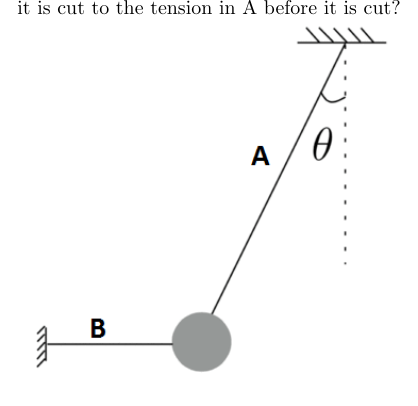 Ball on ceiling-wall ropes at angle theta
Topic: Newtonian Mechanics Metodi: Free-Body Diagram, Vector Decomposition Competenze: Physical Reasoning, Mathematical Modeling Objects: Ball, String Fonte: Testo (PDF) — p.2
Come si vede sulla foto, una palla è attaccata al soffitto e al muro con corde senza massa A e B. La corda A è all’angolo dalla direzione verticale e la corda B è orizzontale. Il sistema è statico. Se la corda B viene tagliata, qual è il rapporto tra la tensione della corda A immediatamente dopo la taglia e la tensione della corda A prima della taglia?
- A. 1
- B.
- C.
- D.
- E.
Palla su corde di parete del soffitto all’angolo theta
Topic: Newtonian Mechanics Metodi: Free-Body Diagram, Vector Decomposition Competenze: Physical Reasoning, Mathematical Modeling Objects: Ball, String Fonte: Testo (PDF) — p.2
Consider a circuit made of a wire with uniform resistance in a shape of a circle as shown in the picture. The circle is connected diagonally from point A to point B with the same type of wire. If the current passing through the circuit is , what is the current passing through the wire AB as a function of angle ?
- A. 0
- B.
- C.
- D.
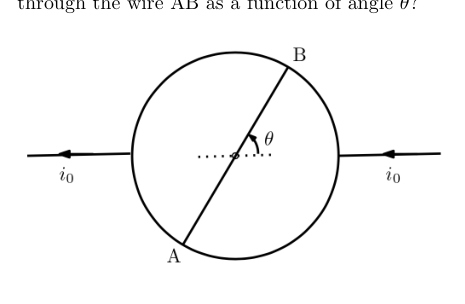 Circular wire circuit with diagonal AB
Topic: Circuits Metodi: Kirchhoff’s Laws, Equivalent Circuit Reduction Competenze: Mathematical Modeling, Physical Reasoning Objects: Wire Fonte: Testo (PDF) — p.2
Considerate un circuito fatto di un filo con resistenza uniforme a forma di cerchio come mostrato nella foto. Il cerchio è collegato diagonalmente dal punto A al punto B con lo stesso tipo di filo. Se la corrente che passa attraverso il circuito è , qual è la corrente che passa attraverso il filo AB come funzione dell’angolo ?
- A. 0
- B.
- C.
- D.
circuito di filo circolare con diagonale AB
Topic: Circuits Metodi: Kirchhoff’s Laws, Equivalent Circuit Reduction Competenze: Mathematical Modeling, Physical Reasoning Objects: Wire Fonte: Testo (PDF) — p.2
The following graph represents the speed of a car as a function of time. We know that as the car speeds up there is a friction force with air that can be approximately considered to be proportional to the speed of the car.
Which of the following graphs can be the force of the engine as a function of time?
- A. [graph a]
- B. [graph b]
- C. [graph c]
- D. [graph d]
- E. [graph e]
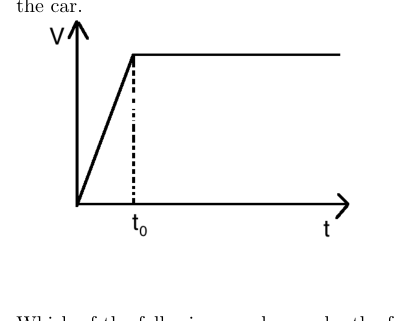 Speed vs time graph of accelerating car
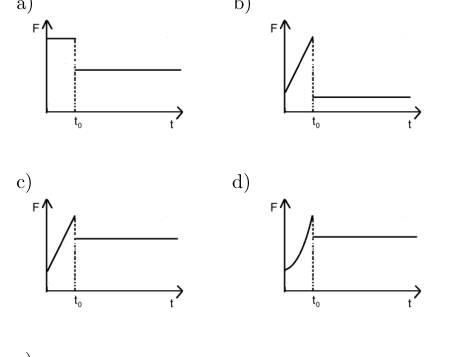 Engine force vs time answer options a-d
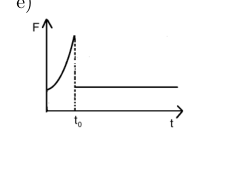 Engine force vs time answer option e
Topic: Newtonian Mechanics Metodi: Free-Body Diagram, Kinematic Equations Competenze: Physical Reasoning, Diagrammatic Reasoning Objects: — Fonte: Testo (PDF) — p.3
Il grafico seguente rappresenta la velocità di un’auto in funzione del tempo. Sappiamo che mentre l’auto accelera, c’è una forza di attrito con l’aria che può essere considerata approssimativamente proporzionale alla velocità dell’auto.
Quale dei seguenti grafici può essere la forza del motore in funzione del tempo?
- A. [grafico a]
- B. [grafico b]
- C. [grafico c]
- D. [grafico d]
- E. [grafico e]
Grafico velocità vs tempo della vettura ad accelerare
Forza motore vs tempo opzioni di risposta a-d
Forza motore vs tempo risposta opzione e
Topic: Newtonian Mechanics Metodi: Free-Body Diagram, Kinematic Equations Competenze: Physical Reasoning, Diagrammatic Reasoning Objects: — Fonte: Testo (PDF) — p.3
If electromagnetic radiation with intensity (power per unit area) is absorbed by a surface, it exerts a pressure on the surface that is given by , where is the speed of light and is the angle the light rays hit the surface relative to a direction perpendicular to the surface. The Sun has a radiation power of W. The absorption of sunlight by Earth causes a force on Earth that pushes it away from the Sun. Which of the following is closest to the magnitude of this force?
- A. N
- B. N
- C. N
- D. N
Topic: Electromagnetism, Order-of-Magnitude Estimation Metodi: Order-of-Magnitude Estimation, Physical Modeling Competenze: Estimation & Approximation, Physical Reasoning Objects: Planet, Star Fonte: Testo (PDF) — p.3
Se una superficie assorbe radiazioni elettromagnetiche di intensità (potenza per unità di superficie), essa esercita sulla superficie una pressione data da , dove è la velocità della luce e è l’angolo in cui i raggi luminosi colpiscono la superficie in relazione a una direzione perpendicolare alla superficie. Il Sole ha una potenza di radiazione di W. L’assorbimento della luce solare da parte della Terra provoca una forza sulla Terra che la spinge lontano dal Sole. Quale delle seguenti è più vicino alla grandezza di questa forza?
- A. N
- B. N
- C. N
- D. N
Topic: Electromagnetism, Order-of-Magnitude Estimation Metodi: Order-of-Magnitude Estimation, Physical Modeling Competenze: Estimation & Approximation, Physical Reasoning Objects: Planet, Star Fonte: Testo (PDF) — p.3
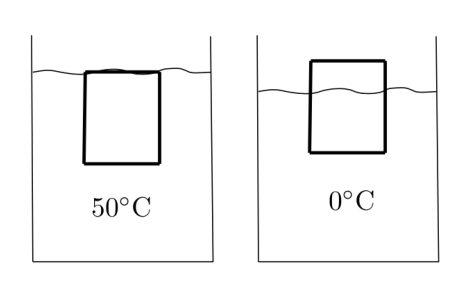
As shown in the picture a cylinder with volumetric thermal expansion coefficient of is completely submerged and floating in a fluid at the temperature . The fluid has volumetric thermal expansion coefficient of . If we cool down the cylinder and the fluid to what percentage of the cylinder’s height will be out of the fluid?
- A. 0.39%
- B. 0.42%
- C. 0.78%
- D. 0.84%
Topic: Fluid Mechanics, Thermodynamics Metodi: Hydrostatic Equilibrium, Approximation & Series Expansion Competenze: Mathematical Modeling, Physical Reasoning Objects: Cylinder Fonte: Testo (PDF) — p.3
Come mostrato nella figura, un cilindro con un coefficiente di espansione termico volumetrico di è completamente sommerso e galleggia in un fluido a temperatura . Il fluido ha un coefficiente di espansione termica volumetrica di . Se raffreddamo il cilindro e il fluido a , quale percentuale dell’altezza del cilindro sarà fuori dal fluido?
- A. 0.39%
- B. 0.42%
- C. 0.78%
- D. 0.84%
Topic: Fluid Mechanics, Thermodynamics Metodi: Hydrostatic Equilibrium, Approximation & Series Expansion Competenze: Mathematical Modeling, Physical Reasoning Objects: Cylinder Fonte: Testo (PDF) — p.3
The amount of sunlight absorbed by the Earth’s atmosphere is approximately proportional to the length of air through which it travels to reach to the Earth. Which of the following is closest to the ratio of the absorption of sunlight during sunset relative to the absorption when the Sun is exactly at the center of the sky? The effective height of the atmosphere is about 10 km.
- A. 22
- B. 36
- C. 45
- D. 64
Topic: Astrophysics, Order-of-Magnitude Estimation Metodi: Order-of-Magnitude Estimation, Approximation & Series Expansion Competenze: Estimation & Approximation, Physical Reasoning Objects: Star, Planet Fonte: Testo (PDF) — p.3
La quantità di luce solare assorbita dall’atmosfera terrestre è approssimativamente proporzionale alla lunghezza dell’aria attraverso la quale viaggia per raggiungere la Terra. Quale delle seguenti è più vicino al rapporto tra l’assorbimento della luce solare durante il tramonto e quello che si fa quando il Sole è esattamente al centro del cielo? L’altezza effettiva dell’atmosfera è di circa 10 km.
- A. 22
- B. 36
- C. 45
- D. 64
Topic: Astrophysics, Order-of-Magnitude Estimation Metodi: Order-of-Magnitude Estimation, Approximation & Series Expansion Competenze: Estimation & Approximation, Physical Reasoning Objects: Star, Planet Fonte: Testo (PDF) — p.3
A beam of red light is made up of a stream of photons. The size of dots represents the photon energy, and the spacing represents the spatial distribution between photons.
If we use photons of half the wavelength of red light, keeping the intensity constant, what should the stream look like?
- A. [stream a]
- B. [stream b]
- C. [stream c]
- D. [stream d]
- E. [stream e]
 Original red photon stream pattern
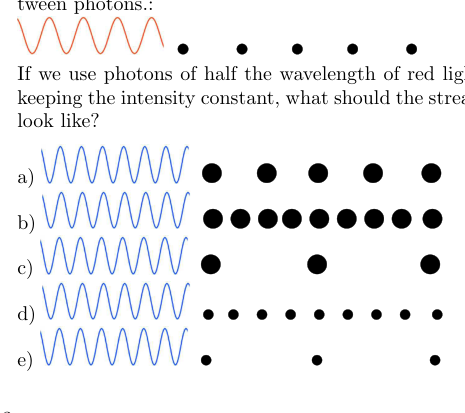 Answer options a-e for photon stream
Topic: Modern-Quantum Physics Metodi: Photon Energy Relation Competenze: Physical Reasoning, Diagrammatic Reasoning Objects: Photon Fonte: Testo (PDF) — p.3
Un raggio di luce rossa è composto da un flusso di fotoni. La dimensione dei punti rappresenta l’energia dei fotoni e lo spaziamento rappresenta la distribuzione spaziale tra i fotoni.
Se usiamo fotoni della metà della lunghezza d’onda della luce rossa, mantenendo costante l’intensità, come dovrebbe essere il flusso?
- A. [stream a]
- B. [stream b]
- C. [stream c]
- D. [stream d]
- E. [stream e]
Mostrone originale di flusso di fotoni rossi
Opzioni di risposta a-e per il flusso di fotoni
Topic: Modern-Quantum Physics Metodi: Photon Energy Relation Competenze: Physical Reasoning, Diagrammatic Reasoning Objects: Photon Fonte: Testo (PDF) — p.3
To paint the surface of a solid metal sculpture we need 100 buckets of paint. If we melt the sculpture and create 1000 smaller but otherwise identical sculptures, how many buckets of paint are needed to paint the surface of all 1000 small sculptures? Assume that the original and the smaller sculptures are all solid with no cavity inside.
- A. 10
- B. 100
- C. 1000
- D. 10000
Topic: Order-of-Magnitude Estimation, Newtonian Mechanics Metodi: Dimensional Analysis, Order-of-Magnitude Estimation Competenze: Estimation & Approximation, Physical Reasoning Objects: — Fonte: Testo (PDF) — p.4
Per dipingere la superficie di una scultura metallica massiccia ci servono 100 secchi di vernice. Se sciogliamo la scultura e creiamo 1000 sculture più piccole ma altrimenti identiche, quanti secchi di vernice ci vogliono per dipingere la superficie di tutte le 1000 piccole sculture? Supponiamo che l’originale e le sculture più piccole siano tutte solide senza cavità all’interno.
- A. 10
- B. 100
- C. 1000
- D. 10000
Topic: Order-of-Magnitude Estimation, Newtonian Mechanics Metodi: Dimensional Analysis, Order-of-Magnitude Estimation Competenze: Estimation & Approximation, Physical Reasoning Objects: — Fonte: Testo (PDF) — p.4
A person is standing on a platform that is sliding down the hill as shown in the picture. The slope of the hill is with respect to the horizontal. The person is standing on a scale positioned on the surface of the platform and the scale is reading only 150 lbs while his real weight is 160 lbs. Which of the following is the coefficient of kinetic friction between the platform and the slope?
- A.
- B.
- C.
- D.
- E. there is not enough information to calculate the friction coefficient.
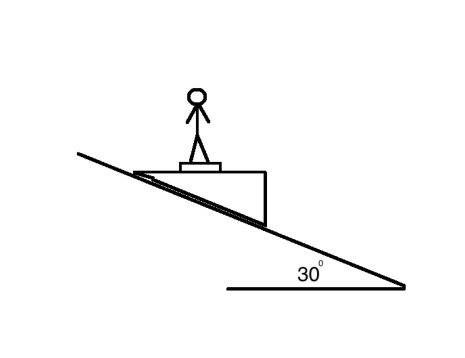 Person on scale on platform sliding down slope
Topic: Newtonian Mechanics Metodi: Free-Body Diagram, Vector Decomposition Competenze: Mathematical Modeling, Physical Reasoning Objects: Inclined Plane Fonte: Testo (PDF) — p.4
Una persona sta in piedi su una piattaforma che scende dalla collina come è mostrato nella foto. L’inclinazione della collina è rispetto all’orizzontale. La persona sta in piedi su una scala posizionata sulla superficie della piattaforma e la scala sta leggendo solo 150 libbre mentre il suo peso reale è 160 libbre. Qual è il coefficiente di attrito cinetico tra la piattaforma e la pendenza?
- A.
- B.
- C.
- D.
- E. non ci sono informazioni sufficienti per calcolare il coefficiente di attrito.
Persona sulla scala su piattaforma che scivola verso il basso
Topic: Newtonian Mechanics Metodi: Free-Body Diagram, Vector Decomposition Competenze: Mathematical Modeling, Physical Reasoning Objects: Inclined Plane Fonte: Testo (PDF) — p.4
A constant amount of ideal gas, at the temperature , undergoes a process that changes its pressure from to . Then its volume is increased from to at a constant pressure, as shown on PV diagram:
Which of the PT diagrams below correctly reflects these processes?
- A. [PT diagram a]
- B. [PT diagram b]
- C. [PT diagram c]
- D. [PT diagram d]
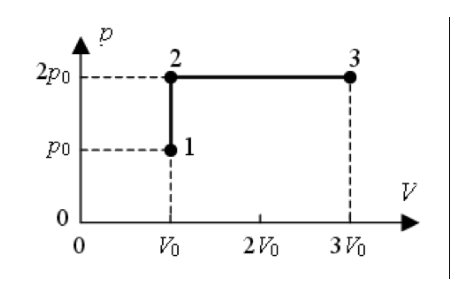 PV diagram of two-step ideal gas process
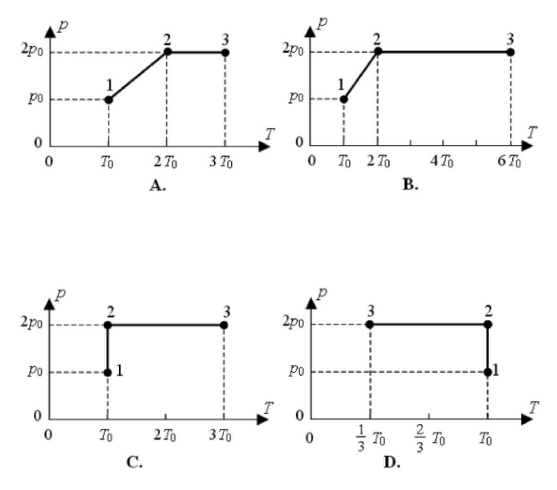 PT diagram answer options a, b, c, d
Topic: Thermodynamics Metodi: Ideal Gas Law, Thermodynamic Cycle Analysis Competenze: Diagrammatic Reasoning, Mathematical Modeling Objects: Gas Fonte: Testo (PDF) — p.4
Una quantità costante di gas ideale, a temperatura , subisce un processo che cambia la sua pressione da a . Poi il suo volume viene aumentato da a a pressione costante, come mostrato sul diagramma fotovoltaico:
Quale dei diagrammi PT di seguito riflette correttamente questi processi?
- A. [Diagramma PT a]
- B. [Diagramma PT b]
- C. [Diagramma PT c]
- D. [dialogo PT d]
Diagramma PV di processo a due fasi del gas ideale
Opzioni di risposta a, b, c, d
Topic: Thermodynamics Metodi: Ideal Gas Law, Thermodynamic Cycle Analysis Competenze: Diagrammatic Reasoning, Mathematical Modeling Objects: Gas Fonte: Testo (PDF) — p.4
A sentence from a book by a famous bestselling author Dan Brown:
The pilot nodded. “Altitude sickness. We were at sixty thousand feet. You’re thirty percent lighter up there. Lucky we only did a puddle jump. If we’d gone to Tokyo I’d have taken her all the way up a hundred miles. Now that’ll get your insides rolling.”
Is the statement correct?
- A. Yes
- B. No, the distance from the surface of the Earth have to be about 1000 km for a person to feel 30% lighter.
- C. No, the person will not feel lighter at higher altitude since the upward force of airplanes engine compensates for the lack of gravity
- D. No both arguments 2 and 3 are true
Topic: Gravitation, Newtonian Mechanics Metodi: Newton’s Law of Gravitation, Order-of-Magnitude Estimation Competenze: Physical Reasoning, Estimation & Approximation Objects: Planet Fonte: Testo (PDF) — p.4
Una frase di un libro del famoso bestseller autore Dan Brown:
Il pilota ha assaggiato. “Malezza d’altitudine. Siamo stati a 60.000 piedi. Sei il 30% piu’ leggero lassù. Fortunatamente abbiamo fatto solo un salto in pozzo. Se fossimo andati a Tokyo l’avrei portata fino a 100 miglia. Ora ti farà girare le tue vene.
La dichiarazione è corretta?
- A. Sì
- B. No, la distanza dalla superficie della Terra deve essere di circa 1000 km per una persona di sentirsi il 30% più leggero.
- C. No, la persona non si sentirà più leggera ad altitudine più alta poiché la forza ascendente del motore degli aerei compensa la mancanza di gravità
- D. Non sono valide entrambe le argomentazioni 2 e 3
Topic: Gravitation, Newtonian Mechanics Metodi: Newton’s Law of Gravitation, Order-of-Magnitude Estimation Competenze: Physical Reasoning, Estimation & Approximation Objects: Planet Fonte: Testo (PDF) — p.4
The figure above shows some light rays coming from point P and passing through a lens.
Which of the distances shown in the diagram below corresponds to the focal length of this lens?
- A. 1
- B. 2
- C. 3
- D. 4
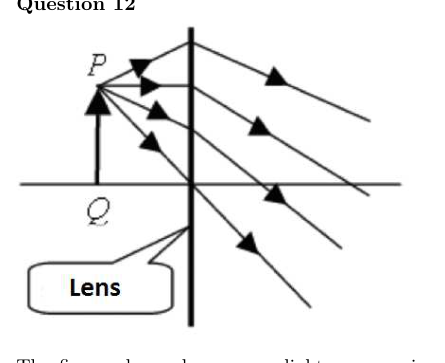 Rays from point P through a converging lens
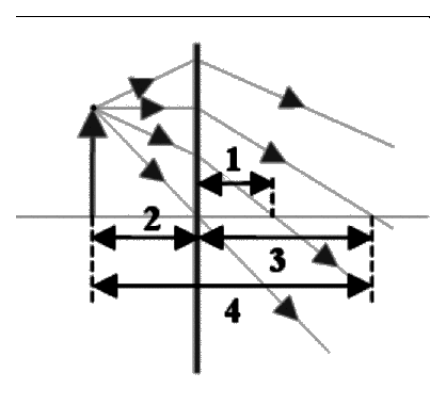 Distances 1-4 marked on lens diagram
Topic: Geometric Optics Metodi: Ray Tracing, Thin Lens & Mirror Equation Competenze: Diagrammatic Reasoning, Physical Reasoning Objects: Lens Fonte: Testo (PDF) — p.5
La figura sopra mostra alcuni raggi luminosi provenienti dal punto P e passando attraverso una lente.
Quale delle distanze mostrate nel diagramma di seguito corrisponde alla distanza focale di questa lente?
- A. 1
- B. 2
- C. 3
- D. 4
Raggi dal punto P attraverso un obiettivo convergente
Distanze 1-4 segnate sul diagramma dell’obiettivo
Topic: Geometric Optics Metodi: Ray Tracing, Thin Lens & Mirror Equation Competenze: Diagrammatic Reasoning, Physical Reasoning Objects: Lens Fonte: Testo (PDF) — p.5
A passenger of a train that is moving with the speed of 25 m/s sees from his seat far from a window that it takes 6 seconds for another train to pass the window completely. If the length of the second train is 300 m and it is going in the opposite direction, what is its velocity?
- A. 15 m/s
- B. 20 m/s
- C. 25 m/s
- D. 30 m/s
- E. 35 m/s
Topic: Newtonian Mechanics, Special Relativity Metodi: Kinematic Equations Competenze: Mathematical Modeling, Physical Reasoning Objects: — Fonte: Testo (PDF) — p.5
Un passeggero di un treno che si muove a velocità di 25 m/s vede dal suo sedile lontano da una finestra che ci vogliono 6 secondi per un altro treno per passare completamente la finestra. Se la lunghezza del secondo treno è di 300 m e va nella direzione opposta, qual è la sua velocità?
- A. 15 m/s
- B. 20 m/s
- C. 25 m/s
- D. 30 m/s
- E. 35 m/s
Topic: Newtonian Mechanics, Special Relativity Metodi: Kinematic Equations Competenze: Mathematical Modeling, Physical Reasoning Objects: — Fonte: Testo (PDF) — p.5
An observer is running toward a mirror with a speed of 15 km/h, and the mirror is moving toward the observer with a speed of 10 km/h. What is the relative speed with which the observer sees his image approaching him?
- A. 10 km/h
- B. 20 km/h
- C. 25 km/h
- D. 30 km/h
- E. 50 km/h
Topic: Geometric Optics, Newtonian Mechanics Metodi: Kinematic Equations, Ray Tracing Competenze: Physical Reasoning, Mathematical Modeling Objects: Mirror Fonte: Testo (PDF) — p.5
Un osservatore corre verso uno specchio a una velocità di 15 km/h, e lo specchio si muove verso l’osservatore a una velocità di 10 km/h. Qual è la velocità relativa con cui l’osservatore vede l’immagine avvicinarsi a lui?
- A. 10 km/h
- B. 20 km/h
- C. 25 km/h
- D. 30 km/h
- E. 50 km/h
Topic: Geometric Optics, Newtonian Mechanics Metodi: Kinematic Equations, Ray Tracing Competenze: Physical Reasoning, Mathematical Modeling Objects: Mirror Fonte: Testo (PDF) — p.5
Three identical closed containers are filled with gases at the same temperature. Container A is filled with 64 g of oxygen, container B is filled with 84 g of nitrogen, and container C is filled with 8 g of hydrogen. Which is the correct ranking of the pressures in the containers?
- A.
- B.
- C.
- D.
- E.
Topic: Thermodynamics, Kinetic Theory Metodi: Ideal Gas Law, Kinetic Theory of Gases Competenze: Mathematical Modeling, Physical Reasoning Objects: Gas, Container Fonte: Testo (PDF) — p.5
Tre contenitori chiusi identici sono riempiti di gas alla stessa temperatura. Il contenitore A è riempito di 64 g di ossigeno, il contenitore B di 84 g di azoto e il contenitore C di 8 g di idrogeno. Qual è la classificazione corretta delle pressioni nei contenitori?
- A.
- B.
- C.
- D.
- E.
Topic: Thermodynamics, Kinetic Theory Metodi: Ideal Gas Law, Kinetic Theory of Gases Competenze: Mathematical Modeling, Physical Reasoning Objects: Gas, Container Fonte: Testo (PDF) — p.5
A ball is placed on a massless spring that is held at an angle of with respect to the horizontal. The spring is then compressed a distance of and released. When the ball reaches the maximum height of its trajectory, it is traveling at a speed . Then a different ball, weighing four times as much as the first, is placed on the spring which is still at an angle . The spring is again compressed a distance and released. Compared to the first ball, the second ball reaches a maximum height that is
- A. times as high.
- B. times as high.
- C. times as high.
- D. 4 times higher.
Topic: Newtonian Mechanics, Conservation of Energy Metodi: Energy Conservation Method, Kinematic Equations Competenze: Mathematical Modeling, Physical Reasoning Objects: Ball, Spring Fonte: Testo (PDF) — p.5
Una palla è collocata su una molla senza massa che viene tenuta ad un angolo rispetto all’orizzontale. La molla viene quindi compressa a una distanza di e rilasciata. Quando la palla raggiunge l’altezza massima della sua traiettoria, si muove a una velocità . Poi viene posta su una molla diversa, di quattro volte il peso della prima, che è ancora all’angolo . La molla viene nuovamente compressa a una distanza e rilasciata. Rispetto alla prima palla, la seconda palla raggiunge un’altezza massima che è
- A. volte più elevato.
- B. volte più elevato.
- C. volte più elevato.
- D. 4 volte più elevato.
Topic: Newtonian Mechanics, Conservation of Energy Metodi: Energy Conservation Method, Kinematic Equations Competenze: Mathematical Modeling, Physical Reasoning Objects: Ball, Spring Fonte: Testo (PDF) — p.5
A laser beam propagating in glass (shown in white) hits the rectangular gap filled with air (shown in gray). Which line shown on the figure below represents correct path of the beam?
- A. 1
- B. 2
- C. 3
- D. 4
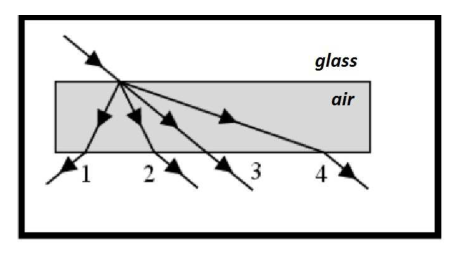 Laser beam in glass hitting air gap with 4 path options
Topic: Geometric Optics, Wave Optics Metodi: Snell’s Law, Ray Tracing Competenze: Diagrammatic Reasoning, Physical Reasoning Objects: — Fonte: Testo (PDF) — p.5
Un raggio laser che si propaga in vetro (visto in bianco) colpisce il vuoto rettangolare riempito di aria (visto in grigio). Quale linea nella figura seguente rappresenta il percorso corretto del fascio?
- A. 1
- B. 2
- C. 3
- D. 4
Raggione laser in vetro che colpisce l’aria con 4 percorsi
Topic: Geometric Optics, Wave Optics Metodi: Snell’s Law, Ray Tracing Competenze: Diagrammatic Reasoning, Physical Reasoning Objects: — Fonte: Testo (PDF) — p.5
A parallel beam of light of frequency Hz enters a glass plate with an index of refraction . The frequency of light in the glass is:
- A. Hz
- B. Hz
- C. Hz
- D. Hz
Topic: Geometric Optics, Wave Optics Metodi: Snell’s Law Competenze: Physical Reasoning, Unit Conversion Objects: — Fonte: Testo (PDF) — p.6
Un fascio parallelo di luce di frequenza Hz entra in una piastra di vetro con un indice di rifrazione . La frequenza della luce nel vetro è:
- A. Hz
- B. Hz
- C. Hz
- D. Hz
Topic: Geometric Optics, Wave Optics Metodi: Snell’s Law Competenze: Physical Reasoning, Unit Conversion Objects: — Fonte: Testo (PDF) — p.6
Students are watching a science fiction movie where the blood spilled during a battle on a spaceship with its engines turned off form spheres floating in air. The students think it is unphysical.
- A. The students are right, because the blood should not form spheres.
- B. The students are wrong, because in free fall the liquid should form into spheres due to atmospheric pressure.
- C. The students are wrong, because in free fall the liquid should form the spheres due to the surface tension.
- D. The students are right, because the gravitational forces should immediately pull the blood toward the walls or other objects on the ship.
Topic: Newtonian Mechanics, Fluid Mechanics Metodi: Physical Modeling Competenze: Physical Reasoning, Diagrammatic Reasoning Objects: Droplet Fonte: Testo (PDF) — p.6
Gli studenti stanno guardando un film di fantascienza in cui il sangue è stato versato durante una battaglia su una nave spaziale con i motori spenti formando sfere galleggianti nell’aria. Gli studenti pensano che non sia fisico.
Gli studenti hanno ragione, perché il sangue non dovrebbe formare sfere. Gli studenti si sbagliano, perché in caduta libera il liquido dovrebbe formarsi in sfere a causa della pressione atmosferica.
- C. Gli studenti si sbagliano, perché in caduta libera il liquido dovrebbe formare le sfere a causa della tensione superficiale. Gli studenti hanno ragione, perché le forze gravitazionali dovrebbero immediatamente tirare il sangue verso le pareti o altri oggetti sulla nave.
Topic: Newtonian Mechanics, Fluid Mechanics Metodi: Physical Modeling Competenze: Physical Reasoning, Diagrammatic Reasoning Objects: Droplet Fonte: Testo (PDF) — p.6
Unstable elementary particles are produced traveling at with respect to an observer in a laboratory. These particles have a typical intrinsic lifetime of 100 ns. In the frame of the observer, how long will the particles typically last before decaying?
- A. They won’t decay while moving
- B. 100 ns
- C. 125 ns
- D. 175 ns
- E. 80 ns
Topic: Special Relativity, Modern-Quantum Physics Metodi: Lorentz Transformation Competenze: Mathematical Modeling, Physical Reasoning Objects: Particle Beam Fonte: Testo (PDF) — p.6
Le particelle elementari instabili sono prodotte viaggiando a rispetto ad un osservatore in laboratorio. Queste particelle hanno una vita intrinseca tipica di 100 ns. Nel quadro dell’osservatore, quanto tempo dureranno le particelle prima di decadere?
- A. Non si decompongono mentre si muovono
- B. 100 ns
- C. 125 ns
- D. 175 ns
- E. 80 ns
Topic: Special Relativity, Modern-Quantum Physics Metodi: Lorentz Transformation Competenze: Mathematical Modeling, Physical Reasoning Objects: Particle Beam Fonte: Testo (PDF) — p.6
A charged moving object enters a volume where a uniform field is present. After some time the object moves in a circular orbit. Which field was present in this area?
- A. gravitational
- B. magnetic
- C. electrostatic
- D. both a or c are possible
- E. both b or c are possible
Topic: Magnetism, Electrostatics Metodi: Lorentz Force Analysis Competenze: Physical Reasoning, Diagrammatic Reasoning Objects: Point Charge Fonte: Testo (PDF) — p.6
Un oggetto in movimento carico entra in un volume in cui è presente un campo uniforme. Dopo un po’ di tempo l’oggetto si muove in orbita circolare. Quale campo era presente in questa zona?
- A. gravitazionale
- B. magnetica
- C. elettrostatico
- D. sono possibili entrambe le parti a o c
- E. sono possibili entrambe le parti b o c
Topic: Magnetism, Electrostatics Metodi: Lorentz Force Analysis Competenze: Physical Reasoning, Diagrammatic Reasoning Objects: Point Charge Fonte: Testo (PDF) — p.6
Students are watching a science fiction movie where the crew of one spaceship watches an explosion on the other spaceship. After a short time interval the crew hear the sound of the explosion. The students think it is unphysical.
- A. The students are right, because there should be no delay: the sound propagates in vacuum at the speed of light.
- B. The students are wrong. The science advisor of the movie made it according to the laws of physics.
- C. The students are right, because the steel body of the spaceship blocks the sound
- D. The students are right, because sound cannot propagate in the region between the spaceships
Topic: Oscillations & Waves Metodi: Physical Modeling Competenze: Physical Reasoning, Estimation & Approximation Objects: — Fonte: Testo (PDF) — p.6
Gli studenti stanno guardando un film di fantascienza in cui l’equipaggio di una nave spaziale guarda un’esplosione sull’altra. Dopo un breve intervallo di tempo l’equipaggio sente il suono dell’esplosione. Gli studenti pensano che non sia fisico.
- A. Gli studenti hanno ragione, perché non dovrebbe esserci alcun ritardo: il suono si propaga nel vuoto alla velocità della luce.
- B. Gli studenti si sbagliano. Il consulente scientifico del film lo ha fatto secondo le leggi della fisica. Gli studenti hanno ragione, perché il corpo in acciaio della nave spaziale blocca il suono. Gli studenti hanno ragione, perché il suono non può diffondersi nella regione tra le navi spaziali.
Topic: Oscillations & Waves Metodi: Physical Modeling Competenze: Physical Reasoning, Estimation & Approximation Objects: — Fonte: Testo (PDF) — p.6
A beam of electrons is sent through a small hole in a piece of foil. The places where the electrons hit on a distant screen are recorded. If we make the hole smaller, the region where the electrons are hitting the screen will be
- A. bigger
- B. the same
- C. smaller
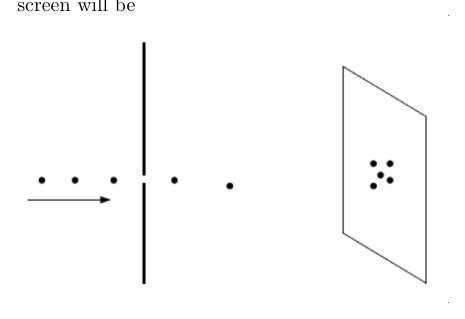 Electron beam through hole diffraction setup
Topic: Modern-Quantum Physics, Wave Optics Metodi: Interference & Diffraction Analysis, de Broglie Relation Competenze: Physical Reasoning, Diagrammatic Reasoning Objects: Electron, Particle Beam, Slit, Screen Fonte: Testo (PDF) — p.6
Un raggio di elettroni viene inviato attraverso un piccolo buco in un pezzo di foglio. I luoghi in cui gli elettroni colpiscono uno schermo lontano vengono registrati. Se facciamo il buco più piccolo, la regione in cui gli elettroni colpiscono lo schermo sarà
- A. più grande
- B. lo stesso
- C. più piccolo
Fragmento di elettroni attraverso la configurazione di diffrazione del buco
Topic: Modern-Quantum Physics, Wave Optics Metodi: Interference & Diffraction Analysis, de Broglie Relation Competenze: Physical Reasoning, Diagrammatic Reasoning Objects: Electron, Particle Beam, Slit, Screen Fonte: Testo (PDF) — p.6
An astronaut takes a pendulum up to the International Space Station (ISS). The ISS orbits 330 km above the surface of the Earth. The radius of the Earth is 6371 km. Compared to when it is at ground level, the pendulum on the ISS swings with a period that is:
- A. times as long.
- B. 0.95 times as long.
- C. 1.05 times longer.
- D. 20.3 times longer.
- E. The pendulum does not swing on the ISS.
Topic: Oscillations & Waves, Gravitation Metodi: Simple Harmonic Motion Analysis, Newton’s Law of Gravitation Competenze: Physical Reasoning, Mathematical Modeling Objects: Pendulum, Satellite, Planet Fonte: Testo (PDF) — p.6
Un astronauta prende un pendolo fino alla Stazione Spaziale Internazionale (ISS). L’ISS orbita 330 km sopra la superficie terrestre. Il raggio della Terra è di 6371 km. Rispetto al momento in cui si trova a livello del suolo, il pendolo della ISS oscilla con un periodo che è:
- A. volte più lungo.
- B. 0,95 volte più lungo.
- C. 1,05 volte più lungo.
- D. 20,3 volte più lungo.
- E. Il pendolo non oscilla sulla ISS.
Topic: Oscillations & Waves, Gravitation Metodi: Simple Harmonic Motion Analysis, Newton’s Law of Gravitation Competenze: Physical Reasoning, Mathematical Modeling Objects: Pendulum, Satellite, Planet Fonte: Testo (PDF) — p.6
Two objects, A and B, appear to be the same length in a reference frame when A is stationary and B is moving with speed along its length. In the frame of reference where B is stationary and A is moving, what is the ratio of their lengths?
- A.
- B.
- C.
- D.
- E.
Topic: Special Relativity Metodi: Lorentz Transformation, Relativistic Energy-Momentum Competenze: Mathematical Modeling, Physical Reasoning Objects: — Fonte: Testo (PDF) — p.6
Due oggetti, A e B, sembrano avere la stessa lunghezza in un quadro di riferimento quando A è stazionario e B si muove a velocità lungo la sua lunghezza. Nel quadro di riferimento in cui B è fermo e A si muove, qual è il rapporto tra le loro lunghezze?
- A.
- B.
- C.
- D.
- E.
Topic: Special Relativity Metodi: Lorentz Transformation, Relativistic Energy-Momentum Competenze: Mathematical Modeling, Physical Reasoning Objects: — Fonte: Testo (PDF) — p.6
Problem 1
The picture below shows a gravel shooter, a fast moving conveyor belt that shoots the gravel to the desired point on the construction site. Perform some measurements on the photograph and calculate the speed with which the gravel leaves the end of the conveyor belt.
(a) Estimate the uncertainty of your answer.
(b) Estimate how much the air drag (friction) affects the distance to which gravel is shot.
(c) What is the average drag force on the gravel?
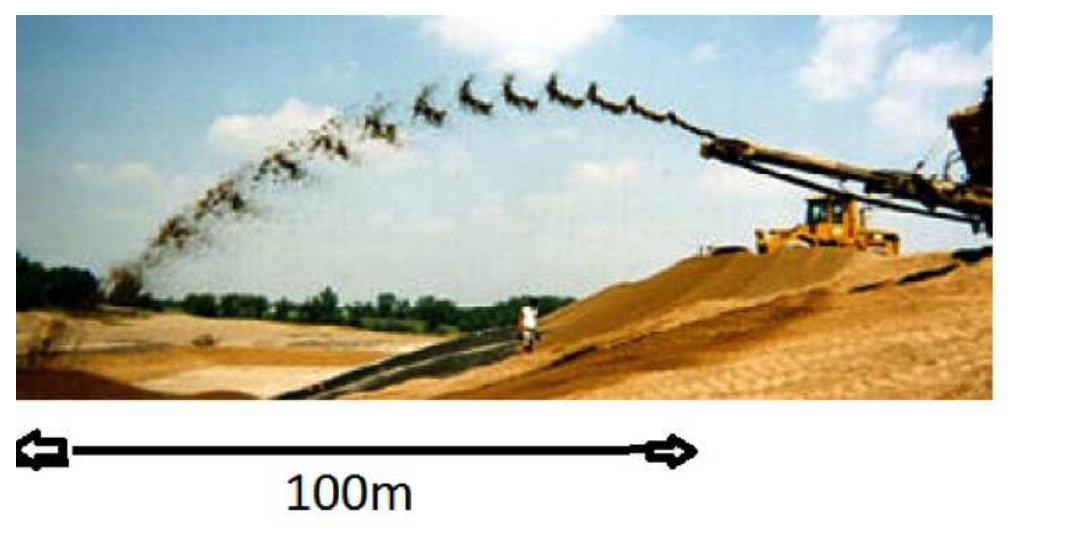 Photograph of gravel shooter conveyor belt
Topic: Newtonian Mechanics Metodi: Kinematic Equations, Experimental Data Analysis, Error Propagation Competenze: Experimental Data Analysis, Measurement & Instrumentation, Estimation & Approximation Objects: Projectile Fonte: Testo (PDF) — p.7
Il problema 1
La foto che segue mostra un tiratore di ghiaia, una cintura trasportatrice in movimento veloce che spara la ghiaia al punto desiderato sul cantiere. Eseguire alcune misurazioni sulla fotografia e calcolare la velocità con cui la ghiaia lascia l’estremità della fascia trasportatrice.
(a) Valutate l’incertezza della vostra risposta.
b) Calcolare quanto la resistenza all’aria (friczione) influisca sulla distanza fino alla quale viene sparato il ghiaia.
c) Qual è la forza di resistenza media della ghiaia?
Foto della cintura trasportatrice per il tiro a ghiaia
Topic: Newtonian Mechanics Metodi: Kinematic Equations, Experimental Data Analysis, Error Propagation Competenze: Experimental Data Analysis, Measurement & Instrumentation, Estimation & Approximation Objects: Projectile Fonte: Testo (PDF) — p.7
Problem 2
An astronaut on a spacewalk loses her grip on a circular garter spring (pictured below). Looking at the spring she notices that it is rotating around its axis of rotational symmetry at a rate of 300 rpm. The circumference of the rotating garter spring is 1% longer than that of the garter spring when at rest. Calculate the spring constant of the spring if the radius of the rotating garter spring is cm and its mass is 1 kg. (We are looking for the spring constant of the spring if it were cut open and stretched along a straight line.)
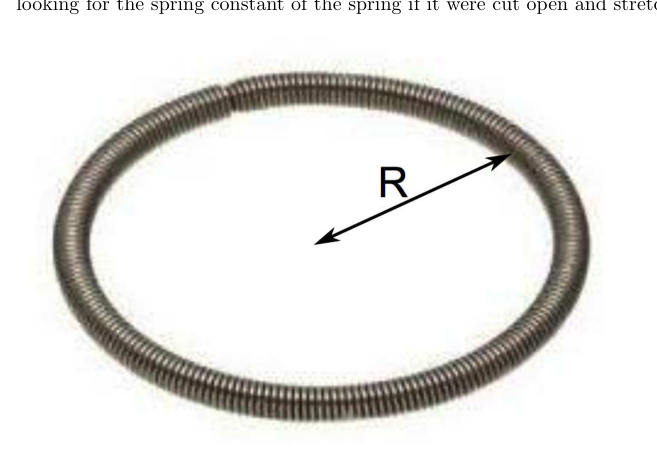 Circular garter spring rotating in space
Topic: Oscillations & Waves, Elasticity & Materials, Rotational Dynamics Metodi: Hooke’s Law, Free-Body Diagram, Torque & Angular Momentum Analysis Competenze: Mathematical Modeling, Physical Reasoning Objects: Spring Fonte: Testo (PDF) — p.7
Problema 2
Un astronauta in una passeggiata spaziale perde la presa su una sorgente a giunta circolare (foto qui sotto). Guardando la molla, si accorge che ruota attorno al suo asse di simmetria di rotazione a una velocità di 300 giri al minuto. La circonferenza della molla di giunta rotante è dell’1% più lunga di quella della molla di giunta in riposo. Calcolare la costante di molla della molla se il raggio di rotolamento della molla di giunta è cm e la sua massa è di 1 kg. (Stiamo cercando la costante di primavera della primavera se fosse stata tagliata aperta e allungata lungo una linea retta.)
Sorte di giunta circolare che ruotano nello spazio
Topic: Oscillations & Waves, Elasticity & Materials, Rotational Dynamics Metodi: Hooke’s Law, Free-Body Diagram, Torque & Angular Momentum Analysis Competenze: Mathematical Modeling, Physical Reasoning Objects: Spring Fonte: Testo (PDF) — p.7
Problem 3
The vapor pressure is the pressure at which a liquid can be in equilibrium with its own vapor. When the pressure in the liquid is lower than the vapor pressure, the liquid begins to boil. The vapor pressure increases with temperature. The following picture represents the vapor pressure of water, in Torr (760 Torr = 1 atm), as a function of temperature in Celsius.
Imagine a tall column of water on the Moon, maintained at a temperature of and left open to the vacuum at the top. Up to what depth will the water in this column boil? The Moon’s radius is 0.273 that of the Earth’s and its mass 1.23% that of the Earth’s.
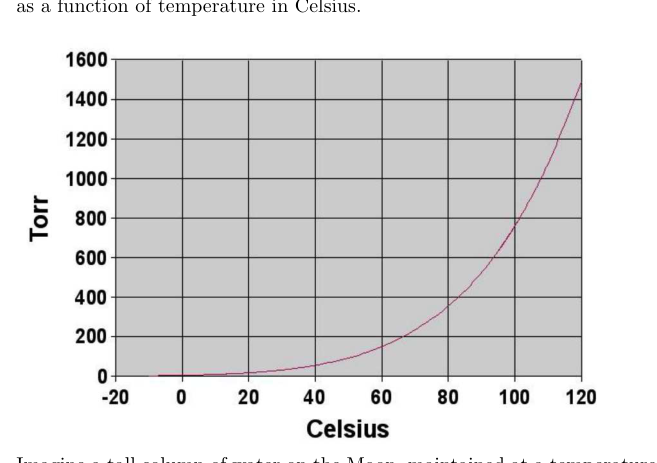 Vapor pressure of water vs temperature graph
Topic: Fluid Mechanics, Thermodynamics, Gravitation Metodi: Hydrostatic Equilibrium, Experimental Data Analysis, Newton’s Law of Gravitation Competenze: Experimental Data Analysis, Mathematical Modeling, Physical Reasoning Objects: Container Fonte: Testo (PDF) — p.8
**Problema 3 **
La pressione del vapore è la pressione alla quale un liquido può essere in equilibrio con il suo vapore. Quando la pressione del liquido è inferiore alla pressione del vapore, il liquido inizia a bollire. La pressione del vapore aumenta con la temperatura. La seguente immagine rappresenta la pressione del vapore dell’acqua, in Torr (760 Torr = 1 atm), come funzione della temperatura in Celsius.
Immaginate una lunga colonna d’acqua sulla Luna, mantenuta a una temperatura di e lasciata aperta al vuoto in cima. Fino a che profondità l’acqua in questa colonna ferverà? Il raggio della Luna è di 0,273 quello della Terra e la sua massa è di 1,23% di quello della Terra.
Grafico di pressione di vapore dell’acqua vs temperatura
Topic: Fluid Mechanics, Thermodynamics, Gravitation Metodi: Hydrostatic Equilibrium, Experimental Data Analysis, Newton’s Law of Gravitation Competenze: Experimental Data Analysis, Mathematical Modeling, Physical Reasoning Objects: Container Fonte: Testo (PDF) — p.8