An electron with kinetic energy 1 MeV travels along the -axis and collides with a positron at rest. The particles annihilate producing a pair of two photons and with equal energies.
i) (1.5 points) Find the speed of the electron in the lab frame.
ii) (0.5 points) Find the energy of photon in the lab frame.
iii) (1 point) Find the momentum of photon in the lab frame.
iv) (2 points) Find the angle between the -axis and the momentum of photon in the lab frame.
v) (1 point) Why is it not possible for a collision process to produce just one single photon?
The rest mass of electron . You can express your results in electron volts and related units.
Topic: Special Relativity, Nuclear & Particle Physics Metodi: Relativistic Energy-Momentum, Conservation of Momentum, Mass-Energy Equivalence Competenze: Mathematical Modeling, Physical Reasoning Objects: Electron, Photon Fonte: Testo (PDF)
Un elettrone con energia cinetica 1 MeV viaggia lungo l’asse e collide con un positrone a riposo. Le particelle annientano producendo una coppia di due fotoni e con uguali energie.
i) (1,5 punti) Trova la velocità dell’elettrone nel telaio di laboratorio.
ii) (0,5 punti) Trova l’energia del fotone nel telaio di laboratorio.
iii) (1 punto) Trova il momento del fotone nel telaio di laboratorio.
iv) (2 punti) Trova l’angolo tra l’asse e la dinamica del fotone nel telaio di laboratorio.
v) (1 punto) Perché non è possibile che un processo di collisione produca un solo fotone?
La massa residuale dell’elettrone . Puoi esprimere i risultati in elettroni volti e unità correlate.
Topic: Special Relativity, Nuclear & Particle Physics Metodi: Relativistic Energy-Momentum, Conservation of Momentum, Mass-Energy Equivalence Competenze: Mathematical Modeling, Physical Reasoning Objects: Electron, Photon Fonte: Testo (PDF)
Monochromatic light can be focused into a point using a holographic lens (better known as a Fresnel zone plate). This is a thin film which has a system of opaque and transparent concentric rings: the opaque rings obstruct those light waves which would arrive at the focus in the opposite phase (as compared with the light from the transparent rings). In what follows, let us assume that the diameter and focal length of such a lens cm; the wavelength of the monochromatic incident light radiation is m.
i) (1.5 points) Starting enumeration from the (opaque) centre of the lens, what is the radius of the -th transparent ring (more precisely, the circle at the middle of the ring)?
ii) (1.5 points) Let us consider also a glass lens of the same focal length and diameter , such that a parallel incident beam is collected perfectly into the focus (has aspheric surfaces). What is the minimal possible thickness of such a lens if the coefficient of refraction of the glass is ?
iii) (2 points) If a short light pulse falls onto a lens, the behaviour of the holographic lens is very different from that of the glass lens. Indeed, if we ignore the dispersion of the glass (the dependence of on the wavelength), the pulse duration at the focus of the glass lens is the same as that of the incident beam. Meanwhile, in the case of a short pulse ( s), the pulse duration at the focus of the holographic lens becomes significantly dilated. Sketch qualitatively the light intensity at the focus of the holographic lens as a function of time. A scale is required for time , but not for . The speed of light m/s.
iv) (1 point) Even if the light source is an ideal laser providing a perfectly monochromatic radiation, the short pulse is no longer strictly monochromatic. Estimate the width of the range of wavelengths in the pulse of duration .
v) (1 point) Estimate the duration of this light pulse in the focus of the glass lens. Assume that in the glass, the light wave group velocity depends on the wavelength at the rate , and that for the wavelength , group speed is equal to the phase speed.
Topic: Wave Optics Metodi: Interference & Diffraction Analysis, Approximation & Series Expansion Competenze: Mathematical Modeling, Diagrammatic Reasoning Objects: Lens Fonte: Testo (PDF)
La luce monocromatica può essere focalizzata in un punto utilizzando una lente olografica (più conosciuta come una piastra di zona Fresnel). Si tratta di un film sottile che dispone di un sistema di anelli concentrici opaci e trasparenti: gli anelli opaci ostacolano le onde di luce che arrivano al foco nella fase opposta (rispetto alla luce degli anelli trasparenti). In quanto segue, supponiamo che il diametro e la distanza focale di tale lente siano cm; la lunghezza d’onda della radiazione luminosa incidente monocromatica sia m.
i) (1,5 punti) A partire dal centro (opaco) della lente, quale è il raggio dell’anello trasparente - (più precisamente, il cerchio al centro dell’anello)?
ii) (1,5 punti) Consideriamo anche una lente di vetro della stessa lunghezza focale e diametro , in modo tale che un fascio incidente parallelo sia raccolto perfettamente nel fuoco (ha superfici asferiche). Qual è lo spessore minimo possibile di una tale lente se il coefficiente di rifrazione del vetro è ?
iii) (2 punti) Se un breve impulso luminoso cade su una lente, il comportamento della lente olografica è molto diverso da quello della lente in vetro. Infatti, se si ignora la dispersione del vetro (la dipendenza di dalla lunghezza d’onda), la durata del polso al foco del cristallo è la stessa di quella del fascio incidente. Nel frattempo, nel caso di un impulso breve ( s), la durata del pulso al centro della lente olografica si dilata significativamente. Segna qualitativamente l’intensità luminosa al centro della lente olografica in funzione del tempo. Per il tempo è richiesta una scala, ma non per . La velocità della luce m/s.
iv) (1 punto) Anche se la fonte luminosa è un laser ideale che fornisce una radiazione perfettamente monocromatica, l’impulso corto non è più strettamente monocromatico. Calcolare la larghezza della gamma di lunghezze d’onda nell’impulso di durata .
v) (1 punto) Calcolare la durata di questo impulso luminoso nel fuoco della lente in vetro. Supponiamo che nel vetro la velocità del gruppo d’onde dipenda dalla lunghezza d’onda al ritmo , e che per la lunghezza d’onda la velocità del gruppo sia uguale alla velocità di fase.
Topic: Wave Optics Metodi: Interference & Diffraction Analysis, Approximation & Series Expansion Competenze: Mathematical Modeling, Diagrammatic Reasoning Objects: Lens Fonte: Testo (PDF)
The maximum torque of a car’s engine depends on the engine’s rotation speed (see the following figure, a larger copy is on an extra sheet).
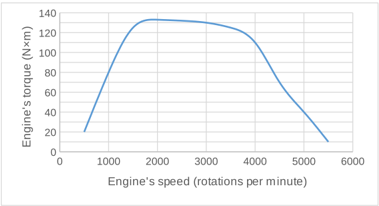
The rotations of the engine are transferred to the wheels through a transmission gearbox. When the car is in the first gear, then the gear ratio from the engine to the wheels is 14:1; in the second gear, the gear ratio is 7:1.
i) (2 points) At what speed of the car should the transmission be shifted from the first gear into the second, in order for the average acceleration of the car to be maximum?
ii) (1 point) What is the acceleration of the car immediately before and immediately after the gear change?
Neglect any drag force. The mass of the car kg, the diameter of a wheel is cm.
Topic: Newtonian Mechanics Metodi: Graph Linearization, Kinematic Equations, Torque & Angular Momentum Analysis Competenze: Graph Linearization, Mathematical Modeling Objects: Wheel, Gear Fonte: Testo (PDF)
La coppia massima del motore di un’auto dipende dalla velocità di rotazione del motore (vedi figura seguente, una copia più grande è su un foglio extra).
Le rotazioni del motore vengono trasferite sulle ruote attraverso una cassetta di trasmissione. Quando l’auto è nella prima marcia, allora il rapporto tra il motore e le ruote è di 14:1; nella seconda marcia, il rapporto tra le marcie è di 7:1.
i) (2 punti) A quale velocità della vettura si deve spostare la trasmissione dal primo cambio al secondo, per ottenere un’accelerazione media massima della vettura?
ii) (1 punto) Qual è l’accelerazione dell’auto immediatamente prima e immediatamente dopo il cambio di marcia?
Lascia perdere qualsiasi forza di trazione. La massa della vettura kg, il diametro di una ruota è cm.
Topic: Newtonian Mechanics Metodi: Graph Linearization, Kinematic Equations, Torque & Angular Momentum Analysis Competenze: Graph Linearization, Mathematical Modeling Objects: Wheel, Gear Fonte: Testo (PDF)
Here we’ll study in which region of space targets can be hit with an interplanetary ballistic missile. The launching point is motionless in the inertial frame of reference of a gravitationally attracting star centred at . The launching speed of the missile is fixed throughout this problem and equal to , the same applies to the distance to launching point . The mass of the star is , and the gravity constant is . Hint: the total energy of a missile of mass moving on an elliptical orbit is , where is the longer semiaxis of its orbit.
i) (2 points) The missile is launched as described above in an arbitrary direction. What is the period of the missile on its elliptic orbit?
ii) (2 points) According to Kepler’s I law, the missile’s orbit is an ellipse, with one of the foci being at . The position of the other focus depends on the launching angle. While the launching angle is changed, the focus moves along a certain curve; what curve is it? Also, determine the geometric dimensions of that curve.
iii) (1 point) Let us consider such a point on the missile’s trajectory, the distance of which from the star equals . Determine the distance .
iv) (1 point) The position of point (as defined above) depends on the launching angle of the missile, and so does the distance . Among all the possible positions of the point , what is the largest possible distance ?
v) (2 points) For questions iii and iv, we assumed that the distance had a fixed value. Now, if we consider as a free parameter, the position of the point is a function of both and of the launching angle. What is the boundary of that region of space to which the point can belong?
Topic: Gravitation Metodi: Kepler’s Laws, Conservation of Energy, Newton’s Law of Gravitation Competenze: Mathematical Modeling, Physical Reasoning Objects: Projectile, Star Fonte: Testo (PDF)
Qui studieremo in quale regione di obiettivi spaziali si possa colpire con un missile balistico interplanetario. Il punto di lancio è immobile nel quadro inerziale di riferimento di una stella gravitazionalmente attrattiva centrata a . La velocità di lancio del missile è fissa durante tutto questo problema ed è uguale a , lo stesso vale per la distanza al punto di lancio . La massa della stella è e la costante di gravità è . Suggerimento: l’energia totale di un missile di massa in movimento in un’orbita ellittica è , dove è il semiacci più lungo della sua orbita.
i) (2 punti) Il missile viene lanciato come descritto sopra in una direzione arbitraria. Qual è il periodo del missile sulla sua orbita ellittica?
ii) (2 punti) Secondo la legge I di Kepler, l’orbita del missile è un’ellisse, con uno dei foci a . La posizione dell’altro foco dipende dall’angolo di lancio. Mentre l’angolo di lancio è cambiato, il focus si muove lungo una certa curva; quale curva è? Determina anche le dimensioni geometriche di quella curva.
iii) (1 punto) Consideriamo un punto del tipo sulla traiettoria del missile, la cui distanza dalla stella è uguale a . Determinare la distanza .
iv) (1 punto) La posizione del punto (come definito sopra) dipende dall’angolo di lancio del missile, e lo stesso vale per la distanza . Tra tutte le posizioni possibili del punto , quale è la distanza più grande possibile ?
V) (2 punti) Per le domande iii e iv, abbiamo presunto che la distanza avesse un valore fisso. Ora, se consideriamo come parametro libero, la posizione del punto è una funzione sia di che dell’angolo di lancio. Qual è il limite di quella regione dello spazio al quale può appartenere il punto ?
Topic: Gravitation Metodi: Kepler’s Laws, Conservation of Energy, Newton’s Law of Gravitation Competenze: Mathematical Modeling, Physical Reasoning Objects: Projectile, Star Fonte: Testo (PDF)
Measure the heat transfer coefficient between the environment and an aluminium profile. , where is the heat flux from the aluminium profile to air per unit of length; and are the temperatures of aluminium and the environment, respectively. For measurements, keep the aluminium profile flat on your table surface, to limit nonlinear effects from turbulence. Thermal conductivity of aluminium is and the cross-section of the profile is .
Hint: to describe the stationary temperature distribution along the profile we can derive a one-dimensional Helmholtz equation , the general solution of which is
where and are integration constants.
Equipment: Aluminium profile, wire (for heating), DC power source, infrared thermometer, ruler.
Keep the temperature of the wire below C as both the wire insulation and the table surface will start to emit smoke after that point!
Topic: Thermodynamics Metodi: Differential Equations, Experimental Data Analysis Competenze: Experimental Data Analysis, Measurement & Instrumentation Objects: - Fonte: Testo (PDF)
Misurare il coefficiente di trasferimento di calore tra l’ambiente e un profilo di alluminio. , dove è il flusso di calore dal profilo di alluminio all’aria per unità di lunghezza; e sono rispettivamente le temperature dell’alluminio e dell’ambiente. Per le misure, mantenere il profilo di alluminio piatto sulla superficie del tavolo, per limitare gli effetti non lineari derivanti dalla turbolenza. La conducibilità termica dell’alluminio è e la sezione trasversale del profilo è .
Suggerimento: per descrivere la distribuzione della temperatura stazionaria lungo il profilo possiamo derivare un’equazione di Helmholtz unidimensionale , la cui soluzione generale è
dove e sono costanti di integrazione.
**Equipaggiamento: ** Profil di alluminio, filo (per il riscaldamento), fonte di alimentazione a corrente continua, termometro a infrarossi, regolare.
Tenere la temperatura del filo al di sotto di C, poiché sia l’isolamento del filo che la superficie del tavolo inizieranno a emettere fumo dopo quel punto!
Topic: Thermodynamics Metodi: Differential Equations, Experimental Data Analysis Competenze: Experimental Data Analysis, Measurement & Instrumentation Objects: - Fonte: Testo (PDF)
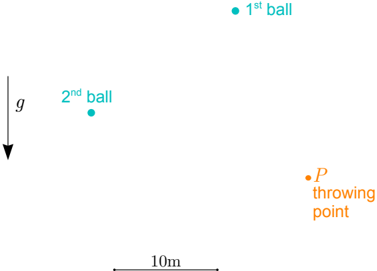
The following snapshot (a larger version is on an extra sheet) depicts two balls that were thrown simultaneously and with the same initial speed, but in different directions from point . What was the initial speed? Use .
Topic: Newtonian Mechanics Metodi: Kinematic Equations, Vector Decomposition Competenze: Diagrammatic Reasoning, Mathematical Modeling Objects: Ball, Projectile Fonte: Testo (PDF)
Il seguente istantaneo (una versione più grande è su un foglio extra) raffigura due palle lanciate contemporaneamente e con la stessa velocità iniziale, ma in direzioni diverse dal punto . Qual era la velocità iniziale? Utilizzare .
Topic: Newtonian Mechanics Metodi: Kinematic Equations, Vector Decomposition Competenze: Diagrammatic Reasoning, Mathematical Modeling Objects: Ball, Projectile Fonte: Testo (PDF)
A homogeneous elastic ball with radius bounces from a vertical wall in such a way that it rebounds back exactly in the same direction it came from. The ball’s speed before the bounce is at an angle to the vertical; the ball also has an angular speed . There was no slipping at the contact point, but do not assume that . The bounce was completely elastic, i.e. no kinetic energy was lost; also, the horizontal components of incident and rebound velocities have the same magnitude. The moment of inertia for a homogeneous ball is .
i) (1 point) Find the angular speed of the ball after the bounce.
ii) (2 points) Find the initial angular speed in terms of , and .
iii) (2 points) What is the minimum value for coefficient of friction that such a bounce could happen?
Topic: Rotational Dynamics Metodi: Conservation of Energy, Impulse-Momentum Theorem, Torque & Angular Momentum Analysis Competenze: Mathematical Modeling, Physical Reasoning Objects: Ball Fonte: Testo (PDF)
Una palla elastica omogenea con raggio rimbalza da una parete verticale in modo tale che rimbalza esattamente nella stessa direzione da cui è venuta. La velocità della palla prima del rimbalzo è ad un angolo verso la verticale; la palla ha anche una velocità angolare . Non c’è stato alcun scivolamento al punto di contatto, ma non supponiamo che . Il rimbalzo era completamente elastico, cioè Non è stata persa alcuna energia cinetica; inoltre, le componenti orizzontali delle velocità di incidente e di rimbalzo hanno la stessa magnitudine. Il momento di inerzia per una palla omogenea è .
i) (1 punto) Trova la velocità angolare della palla dopo il rimbalzo.
ii) (2 punti) Trova la velocità angolare iniziale in termini di , e .
iii) (2 punti) Qual è il valore minimo per il coefficiente di attrito che potrebbe verificarsi un tale rimbalzo?
Topic: Rotational Dynamics Metodi: Conservation of Energy, Impulse-Momentum Theorem, Torque & Angular Momentum Analysis Competenze: Mathematical Modeling, Physical Reasoning Objects: Ball Fonte: Testo (PDF)
A conducting ring with radius carries a large current . The ring lies stationary in the -plane with its centerpoint at . An observer approaches the ring parallel to the -axis with velocity and measures the electric field at distance from the axis. Assume that and .
i) (2 points) Find the direction and magnitude of the magnetic field on the -axis in the stationary reference frame.
ii) (4 points) Estimate the magnitude and direction of the electric field measured by the observer when he is at a distance from the ring’s plane.
Topic: Electromagnetism, Special Relativity Metodi: Biot-Savart Law, Lorentz Transformation Competenze: Mathematical Modeling, Physical Reasoning Objects: Coil, Wire Fonte: Testo (PDF)
Un anello di conduttore con raggio porta una grande corrente . L’anello si trova fisso nel piano con il suo punto centrale a . Un osservatore si avvicina all’anello parallelo all’asse con velocità e misura il campo elettrico a distanza dall’asse. Supponiamo che e .
i) (2 punti) Trova la direzione e la magnitudine del campo magnetico sull’asse nel quadro di riferimento stazionario.
ii) (4 punti) Estimare la magnitudine e la direzione del campo elettrico misurati dall’osservatore quando si trova a una distanza dal piano dell’anello.
Topic: Electromagnetism, Special Relativity Metodi: Biot-Savart Law, Lorentz Transformation Competenze: Mathematical Modeling, Physical Reasoning Objects: Coil, Wire Fonte: Testo (PDF)
A tightly-wound rigid solenoid coil has been partly inserted into another. They are connected to a constant current source so that the same current flows through them; both generate a magnetic field in the same direction. The solenoids have turns both, their length is , their cross-sectional areas are and . It may be assumed that . You may find it useful to know that the magnetic field at the centre of one solenoid taken separately is , where is the permeability of vacuum.
i) (2 points) The centres of the coils are at a distance along their common axis []. Find the total energy of the magnetic field in the system.
ii) (4 points) Find the electromotive forces and generated on the coils when one is pulled out with a speed .
iii) (2 points) Find the force needed to pull one coil outwards.
Topic: Electromagnetic Induction Metodi: Faraday’s Law of Induction, Energy Conservation Method Competenze: Mathematical Modeling, Physical Reasoning Objects: Solenoid, Coil Fonte: Testo (PDF)
Una bobina rigida solido strettamente rotta è stata in parte inserita in un’altra. Sono collegate a una fonte di corrente costante in modo che la stessa corrente fluisca attraverso di loro; entrambe generano un campo magnetico nella stessa direzione. I solenoidi hanno entrambi i giri, la loro lunghezza è , le loro aree di sezione trasversale sono e . Si può supporre che . Potrebbe essere utile sapere che il campo magnetico al centro di un solenoide preso separatamente è , dove è la permeabilità del vuoto.
i) (2 punti) I centri delle bobine sono a una distanza lungo il loro asse comune [. Trova l’energia totale del campo magnetico nel sistema.
ii) (4 punti) Trova le forze elettro-motive e generate sulle bobine quando una viene tirata fuori a velocità .
iii) (2 punti) Trova la forza necessaria per tirare fuori una bobina.
Topic: Electromagnetic Induction Metodi: Faraday’s Law of Induction, Energy Conservation Method Competenze: Mathematical Modeling, Physical Reasoning Objects: Solenoid, Coil Fonte: Testo (PDF)
Measure the room temperature saturated vapour pressure of the unknown fluid in the syringe. The volume of the bottle is L, the inner diameter of the pipe is mm. Current air pressure and room temperature are written on the blackboard. There is no need to repeat the measurement after a successful attempt as getting the bottle free from vapours is time consuming. Estimate the uncertainty of the result.
Equipment: syringe with an unknown fluid, syringe with water, bottle, flexible pipe, ruler, plug, stand, tape.
Topic: Thermodynamics Metodi: Ideal Gas Law, Experimental Data Analysis Competenze: Experimental Data Analysis, Measurement & Instrumentation Objects: Container, Tube Fonte: Testo (PDF)
Misurare la pressione di vapore saturo a temperatura ambiente del liquido sconosciuto nella siringa. Il volume della bottiglia è L, il diametro interno della tubazione è mm. La pressione dell’aria corrente e la temperatura ambiente sono scritte sulla lavagna. Non è necessario ripetere la misura dopo un tentativo di successo, poiché liberare la bottiglia dai vapori richiede tempo. Estimare l’incertezza del risultato.
**Apparecchiature: ** siringa con un liquido sconosciuto, siringa con acqua, bottiglia, tubo flessibile, regolare, tappo, supporto, nastro.
Topic: Thermodynamics Metodi: Ideal Gas Law, Experimental Data Analysis Competenze: Experimental Data Analysis, Measurement & Instrumentation Objects: Container, Tube Fonte: Testo (PDF)