Problema Teórico 1
Sea el circuito que se muestra en la figura. La fuente entrega , la resistencia en serie es , y las resistencias en paralelo son y (con un amperímetro en serie con ).
Sabiendo que el amperímetro indica una corriente de ,
a) Escriba una expresión para la resistencia equivalente () del paralelo formado por las resistencias y .
b) Escriba una expresión que vincule las corrientes e que circulan por las resistencias y , respectivamente, con las resistencias y .
c) Escriba la expresión que vincula la corriente que circula por la fuente con las corrientes e .
d) Escriba una relación entre las caídas de tensión a los bornes de y de y el voltaje entregado por la fuente ().
e) A partir de los puntos anteriores, determine el valor de la resistencia .
f) Determine el valor de la corriente que circula por la fuente.
g) Determine el valor de la resistencia que disipa la misma energía por unidad de tiempo que las tres resistencias del circuito.
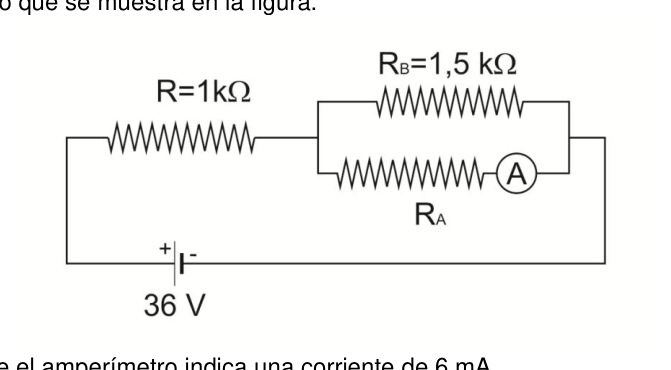 Circuit: R=1kΩ series, RB=1.5kΩ and RA parallel, 36V
Topic: Circuits Metodi: Kirchhoff’s Laws, Equivalent Circuit Reduction Competenze: Physical Reasoning, Mathematical Modeling Objects: Resistor, Battery, Galvanometer Fonte: Testo (PDF) — p.2
Problema teorico 1
Che sia il circuito che viene mostrato nella figura. La fonte fornisce , la resistenza in serie è , e le resistenze in parallelo sono e (con un amperimetro in serie con ).
Sapendo che l’ampielitore indica un corrente di ,
a) Scrivere un’espressione per la resistenza equivalente () del parallelo formato dalle resistenze e .
b) Scrivere un’espressione che collega le correnti e che circolano nelle resistenze e , rispettivamente, alle resistenze e .
c) Scrivere l’espressione che collega il corrente che circola attraverso la fonte con i correnti e .
d) Scrivere un rapporto tra le cadute di tensione dei bordi di e di e la voltazione fornita dalla fonte ().
e) A partire dai punti precedenti, determinare il valore della resistenza .
f) Determina il valore del corrente che circola attraverso la fonte.
g) Determina il valore della resistenza che dissipa la stessa energia per unità di tempo delle tre resistenze del circuito.
Circuito: R=1kΩ serie, RB=1.5kΩ e RA parallel, 36V
Topic: Circuits Metodi: Kirchhoff’s Laws, Equivalent Circuit Reduction Competenze: Physical Reasoning, Mathematical Modeling Objects: Resistor, Battery, Galvanometer Fonte: Testo (PDF) — p.2
Theoretical problem 1 is theoretical problem 1 is theoretical problem 1 is theoretical problem 1 is theoretical problem 1 is theoretical problem 1 is theoretical problem 1 is theoretical problem 1 is theoretical problem 1 is theoretical problem 1 is theoretical problem 1 is theoretical problem 1 is theoretical problem 1 is theoretical problem 1 is theoretical problem 1 is theoretical problem 1 is theoretical problem 1 is theoretical problem 1 is theoretical problem 1 is theoretical problem 1 is theoretical problem 1 is theoretical problem 1 is theoretical problem 1 is theoretical problem 1 is theoretical problem 1 is theoretical problem 1 is theoretical problem 1 is theoretical problem 1 is theoretical problem 1 is theoretical problem 1 is theoretical problem 1 is theoretical problem 1 is theoretical problem
Be the circuit shown in the figure. The source delivers , the serial resistance is , and the parallel resistance is and (with a serial ampere with ).
Knowing that the ampere indicates a current of ,
(a) Write an expression for the equivalent resistance () of the parallel formed by the resistances and .
(b) Write an expression linking the currents and circulating through the resistances and , respectively, to the resistances and .
(c) Write the expression linking the source current to the current and .
(d) Write a ratio between the voltage drop to the and terminals and the voltage delivered by the source ().
(e) From the above points, determine the value of the resistance .
(f) Determine the value of the current flowing through the source.
(g) Determine the value of the resistance dissipating the same energy per unit time as the three resistors of the circuit.
The following is the list of the main components of the engine:
Topic: Circuits Metodi: Kirchhoff’s Laws, Equivalent Circuit Reduction Competenze: Physical Reasoning, Mathematical Modeling Objects: Resistor, Battery, Galvanometer Fonte: Testo (PDF) — p.2
Problema Teórico 2
En un termo de vidrio (rígido y adiabático), con un volumen total de , se colocan de agua a y se completa con hielo a .
Datos:
- Densidad del agua:
- Densidad del hielo:
- Calor específico del agua:
- Calor específico del hielo:
- Calor latente de fusión:
a) Determine la masa de hielo utilizada.
b) Determine el estado final del sistema agua-hielo.
c) Determine si el termo se rompe.
Topic: Thermodynamics Metodi: First Law of Thermodynamics, Conservation of Energy Competenze: Physical Reasoning, Mathematical Modeling Objects: Container Fonte: Testo (PDF) — p.3
Il problema teorico 2
In un termo vetro (rigido e adiabatico) con un volume totale di , si inserisce di acqua a e si completa con ghiaccio a .
Dati:
- Densità dell’acqua:
- Densità del ghiaccio:
- Calore specifico dell’acqua:
- Calore specifico del ghiaccio:
- Calore latente di fusione:
a) Determina la massa di ghiaccio utilizzata.
b) Determina lo stato finale del sistema acqua-ghiaccio.
c) Determina se il termostato si rompe.
Topic: Thermodynamics Metodi: First Law of Thermodynamics, Conservation of Energy Competenze: Physical Reasoning, Mathematical Modeling Objects: Container Fonte: Testo (PDF) — p.3
Theoretical problem 2 is that the data is not available to the user.
In a glass thermos (rigid and adiabatic) with a total volume of , of water at is placed and completed with ice at .
The data:
- Density of water:
- Ice density:
- Specific water heat:
- Specific heat of the ice:
- Latent heat of fusion:
(a) Determine the mass of ice used.
(b) Determine the final state of the water-ice system.
(c) Determine whether the thermos is broken.
Topic: Thermodynamics Metodi: First Law of Thermodynamics, Conservation of Energy Competenze: Physical Reasoning, Mathematical Modeling Objects: Container Fonte: Testo (PDF) — p.3
Problema Teórico 3
En la figura se representan dos hilos paralelos conductores muy largos. Los hilos y están separados entre sí; el punto se encuentra a a la izquierda del hilo , y el punto se encuentra a a la derecha del hilo . La distancia entre y es de (los hilos equidistan de ambos puntos). Por circula una corriente eléctrica de en el sentido indicado en la figura.
Dato: permeabilidad magnética del vacío .
a) Calcular el valor y sentido de la corriente eléctrica que circula por , teniendo en cuenta que el campo magnético en el punto es nulo.
b) ¿Cuál es el valor, dirección y sentido del campo magnético en el punto ?
c) ¿Qué fuerza por unidad de longitud se ejercen los hilos entre sí? ¿Se atraen o se repelen?
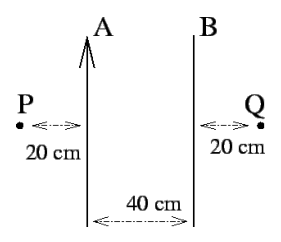 Two parallel wires A, B with points P, Q
Topic: Magnetism Metodi: Biot-Savart Law, Superposition Principle Competenze: Physical Reasoning, Mathematical Modeling Objects: Wire Fonte: Testo (PDF) — p.4
Problema teorico 3
La figura mostra due fili paralleli conduttori molto lunghi. I fili e sono separati tra loro; il punto si trova a a sinistra del filo , e il punto si trova a a destra del filo . La distanza tra e è di (le fili equidistanti di entrambi i punti). Per circola un corrente elettrica di nella direzione indicata nella figura.
Data: permeabilità magnetica del vuoto .
a) Calcolare il valore e il senso del corrente elettrica che circola per , tenendo conto che il campo magnetico al punto è zero.
b) Qual è il valore, la direzione e il senso del campo magnetico al punto ?
c) Quale forza per unità di lunghezza si esercitano tra le fili? Si attraggono o si respingono?
Two parallel wires A, B with points P, Q
Topic: Magnetism Metodi: Biot-Savart Law, Superposition Principle Competenze: Physical Reasoning, Mathematical Modeling Objects: Wire Fonte: Testo (PDF) — p.4
Theoretical problem 3
The figure shows two parallel very long conductive threads. The and threads are separated from each other; the point is located at to the left of the thread, and the point is located at to the right of the thread. The distance between and is (the threads equidistant from both points). For an electric current of circulates in the direction indicated in the figure.
Date: magnetic permeability of the vacuum .
(a) Calculate the value and direction of the electric current circulating at , taking into account that the magnetic field at the point is zero.
(b) What is the value, direction and direction of the magnetic field at the point?
(c) What force per unit length do the threads exert on each other? Are they attracted or repelled?
Two parallel wires A, B with points P, Q
Topic: Magnetism Metodi: Biot-Savart Law, Superposition Principle Competenze: Physical Reasoning, Mathematical Modeling Objects: Wire Fonte: Testo (PDF) — p.4
Problema Experimental: Determinación del calor latente de fusión del agua
Objetivo: Determinar el calor latente de fusión del agua.
Elementos:
- Recipiente aislante (vaso de café)
- Jeringa descartable de
- Agua a temperatura ambiente
- Cubos de hielo a (se obtiene poniendo el hielo en agua y esperando unos minutos para que el sistema agua + hielo llegue al equilibrio)
- Termómetro (provisto por el Profesor)
Teoría: Cuando dos cuerpos a distintas temperaturas se ponen en contacto térmico en un recinto adiabático, calor fluye del cuerpo de mayor temperatura al de menor temperatura hasta que ambos cuerpos alcanzan una misma temperatura (temperatura de equilibrio). En caso que uno de los cuerpos alcance la temperatura de cambio de fase, el calor entregado o recibido no modifica su temperatura sino que es utilizado para cambiar de una fase a la otra. La cantidad de calor necesaria para que un gramo de la sustancia cambie de fase se denomina calor latente.
a) Escriba las ecuaciones calorimétricas correspondientes a la situación planteada. Suponga que el recipiente es adiabático y que la temperatura de equilibrio de una mezcla de agua y hielo es . Desprecie efectos debidos al cambio de la densidad de agua con la temperatura.
b) Coloque una cantidad de hielo a en el recipiente y agregue un volumen de agua conocido () a temperatura ambiente. Agite la mezcla por al menos 15 segundos, teniendo cuidado de que siempre haya una mezcla de agua y hielo. Utilizando la jeringa, determine el nuevo volumen de agua (). Repita la medición al menos 10 veces.
c) A partir del análisis teórico realizado y de las mediciones, determine el valor del calor latente de fusión con su incerteza.
Topic: Thermodynamics Metodi: First Law of Thermodynamics, Experimental Data Analysis Competenze: Experimental Data Analysis, Error Propagation Objects: Calorimeter Fonte: Testo (PDF) — p.9
Problema sperimentale: determinazione del calore latente della fusione dell’acqua
Obiettivo: Determinare il calore latente della fusione dell’acqua.
**Elementi: **
- recipiente isolante (copo di caffè)
- Seringa scaricabile di
- Acqua a temperatura ambiente
- Cubi di ghiaccio a (si ottiene mettendo il ghiaccio in acqua e aspettando alcuni minuti per il sistema acqua + ghiaccio per raggiungere l’equilibrio)
- Termometro (forniti dal Professore)
Teoria: Quando due corpi a temperature diverse si mettono in contatto termico in un recinto adiabatico, il calore scorre dal corpo a temperatura più alta al corpo a temperatura più bassa fino a che entrambi i corpi raggiungono la stessa temperatura (temperatura di equilibrio). Se uno dei corpi raggiunge la temperatura di cambiamento di fase, il calore dato o ricevuto non modifica la sua temperatura ma viene utilizzato per passare da una fase all’altra. La quantità di calore necessaria per un grammo di sostanza a cambiare fase è chiamata calore latente.
a) Scrivi le equazioni calorimetriche corrispondenti alla situazione in questione. Supponiamo che il recipiente sia adiabatico e che la temperatura di equilibrio di una miscela di acqua e ghiaccio sia . Scommette gli effetti derivanti dal cambiamento della densità dell’acqua con la temperatura.
b) Mettete una quantità di ghiaccio nel recipiente e aggiungete un volume di acqua conosciuto () a temperatura ambiente. Agitare il miscela per almeno 15 secondi, facendo attenzione che vi sia sempre un miscela di acqua e ghiaccio. Usando la siringa, determinare il nuovo volume di acqua (). Ripetere la misurazione almeno 10 volte.
c) Sulla base dell’analisi teorica effettuata e delle misure, determinare il valore del calore latente di fusione con la sua incertezza.
Topic: Thermodynamics Metodi: First Law of Thermodynamics, Experimental Data Analysis Competenze: Experimental Data Analysis, Error Propagation Objects: Calorimeter Fonte: Testo (PDF) — p.9
The test results of the test are given in the following table:
The objective is to determine the latent heat of water melt.
The following elements are included:
- Insulating vessel (coffee glass)
- Disposable syringe of
- Water at room temperature
- Ice cubes to (obtained by putting the ice in water and waiting a few minutes for the water + ice system to reach equilibrium)
- Thermometer (provided by Professor)
Theory: When two bodies at different temperatures come into thermal contact in an adiabatic enclosure, heat flows from the higher-temperature body to the lower-temperature body until both bodies reach the same temperature (balance temperature). If one of the bodies reaches the phase change temperature, the heat delivered or received does not change its temperature but is used to change from one phase to another. The amount of heat required for a gram of the substance to change phase is called latent heat.
(a) Write the calorimetric equations corresponding to the situation in question. Suppose the container is adiabatic and the equilibrium temperature of a mixture of water and ice is . It’s a disregard for the effects of changing water density with temperature.
(b) Place an amount of ice in the container and add a known volume of water () to room temperature. Shake the mixture for at least 15 seconds, always making sure there is a mixture of water and ice. Using the syringe, determine the new water volume (). Repeat the measurement at least 10 times.
(c) From the theoretical analysis and measurements, determine the latent heat of fusion with its uncertainty.
Topic: Thermodynamics Metodi: First Law of Thermodynamics, Experimental Data Analysis Competenze: Experimental Data Analysis, Error Propagation Objects: Calorimeter Fonte: Testo (PDF) — p.9