Use N/kg throughout this contest.
A 600 meter wide river flows directly south at 4.0 m/s. A small motor boat travels at 5.0 m/s in still water and points in such a direction so that it will travel directly east relative to the land.
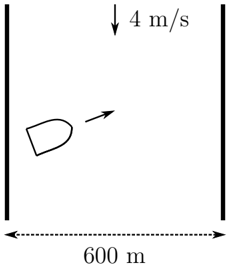
The time it takes to cross the river is closest to
- A. 67 s
- B. 120 s
- C. 150 s
- D. 200 s
- E. 600 s
Topic: Newtonian Mechanics Metodi: Vector Decomposition, Kinematic Equations Competenze: Physical Reasoning, Mathematical Modeling Objects: - Fonte: Testo (PDF) - p.2
Utilizzare N/kg durante tutto il concorso.
Un fiume di 600 metri di larghezza scorre direttamente a sud a 4,0 m/s. Una piccola barca a motore si muove a 5,0 m/s in acqua ferma e punta in una direzione tale da poter viaggiare direttamente ad est rispetto alla terra.
Il tempo necessario per attraversare il fiume è il più vicino
- A. 67 s
- B. 120 s
- C. 150 s
- D. 200 s
- E. 600 s
Topic: Newtonian Mechanics Metodi: Vector Decomposition, Kinematic Equations Competenze: Physical Reasoning, Mathematical Modeling Objects: - Fonte: Testo (PDF) - p.2
Use N/kg throughout this contest.
A car travels directly north on a straight highway at a constant speed of 80 km/hr for a distance of 25 km. The car then continues directly north at a constant speed of 50 km/hr for a distance of 75 more kilometers. The average speed of the car for the entire journey is closest to
- A. 55.2 km/hr
- B. 57.5 km/hr
- C. 65 km/hr
- D. 69.6 km/hr
- E. 72.5 km/hr
Topic: Newtonian Mechanics Metodi: Kinematic Equations Competenze: Physical Reasoning Objects: - Fonte: Testo (PDF) - p.2
Utilizzare N/kg durante tutto il concorso.
Un’auto si muove direttamente a nord su una autostrada retta a una velocità costante di 80 km/h per una distanza di 25 km. La macchina continua quindi direttamente a nord a una velocità costante di 50 km/h per una distanza di 75 chilometri in più. La velocità media dell’auto per l’intero viaggio è la più vicina a
- A. 55.2 km/hr
- B. 57.5 km/hr
- C. 65 km/hr
- D. 69.6 km/hr
- E. 72.5 km/hr
Topic: Newtonian Mechanics Metodi: Kinematic Equations Competenze: Physical Reasoning Objects: - Fonte: Testo (PDF) - p.2
Use N/kg throughout this contest.
The force of friction on an airplane in level flight is given by , where is some constant, and is the speed of the airplane. When the power output from the engines is , the plane is able to fly at a speed . If the power output of the engines is increased by 100% to , the airplane will be able to fly at a new speed given by
- A.
- B.
- C.
- D.
- E.
Topic: Newtonian Mechanics Metodi: Physical Modeling, Dimensional Analysis Competenze: Physical Reasoning Objects: - Fonte: Testo (PDF) - p.2
Utilizzare N/kg durante tutto il concorso.
La forza di attrito in un aereo in volo a livello è data da , dove è una certa costante e è la velocità dell’aereo. Quando la potenza uscita dei motori è , l’aereo è in grado di volare a una velocità . Se la potenza di uscita dei motori è aumentata del 100% a , l’aereo potrà volare a una nuova velocità data da
- A.
- B.
- C.
- D.
- E.
Topic: Newtonian Mechanics Metodi: Physical Modeling, Dimensional Analysis Competenze: Physical Reasoning Objects: - Fonte: Testo (PDF) - p.2
Use N/kg throughout this contest.
A 2.0 kg box is originally at rest on a horizontal surface where the coefficient of static friction between the box and the surface is and the coefficient of the kinetic friction between the box and the surface is . An external horizontal force of magnitude is then applied to the box. Which of the following is a graph of the acceleration of the box versus the external force ?
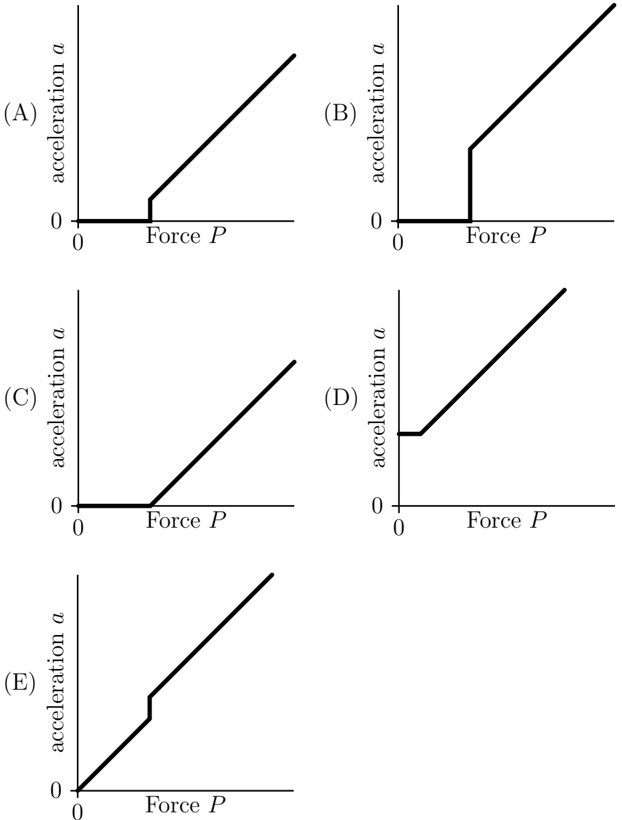
Topic: Newtonian Mechanics Metodi: Free-Body Diagram Competenze: Physical Reasoning, Diagrammatic Reasoning Objects: Block Fonte: Testo (PDF) - p.3
Utilizzare N/kg durante tutto il concorso.
Una scatola da 2,0 kg è originariamente in riposo su una superficie orizzontale in cui il coefficiente di attrito statico tra la scatola e la superficie è e il coefficiente di attrito cinetico tra la scatola e la superficie è . Si applica quindi alla scatola una forza orizzontale esterna di magnitudo . Qual è il grafico dell’accelerazione della casella rispetto alla forza esterna ?
Topic: Newtonian Mechanics Metodi: Free-Body Diagram Competenze: Physical Reasoning, Diagrammatic Reasoning Objects: Block Fonte: Testo (PDF) - p.3
Use N/kg throughout this contest.
A 470 gram lead ball is launched at a 60 degree angle above the horizontal with an initial speed of 100 m/s directly toward a target on a vertical cliff wall that is 150 meters away as shown in the figure.
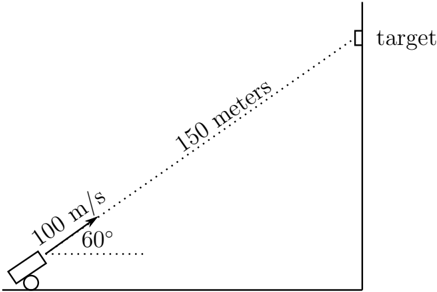
Ignoring air friction, by what distance does the lead ball miss the target when it hits the cliff wall?
- A. 1.3 m
- B. 2.2 m
- C. 5.0 m
- D. 7.1 m
- E. 11 m
Topic: Newtonian Mechanics Metodi: Kinematic Equations, Vector Decomposition Competenze: Physical Reasoning Objects: Projectile Fonte: Testo (PDF) - p.3
Utilizzare N/kg durante tutto il concorso.
Una palla di piombo di 470 grammi viene lanciata ad un angolo di 60 gradi sopra l’orizzontale con una velocità iniziale di 100 m/s direttamente verso un bersaglio su una parete di scogliera verticale che si trova a 150 metri di distanza come mostrato nella figura.
Ignorando l’attrito dell’aria, a che distanza la palla di piombo perde l’obiettivo quando colpisce la parete del falco?
- A. 1.3 m
- B. 2.2 m
- C. 5.0 m
- D. 7.1 m
- E. 11 m
Topic: Newtonian Mechanics Metodi: Kinematic Equations, Vector Decomposition Competenze: Physical Reasoning Objects: Projectile Fonte: Testo (PDF) - p.3
Use N/kg throughout this contest.
Three trolley carts are free to move on a one dimensional frictionless horizontal track. Cart A has a mass of 1.9 kg and an initial speed of 1.7 m/s to the right; Cart B has a mass of 1.1 kg and an initial speed of 2.5 m/s to the left; cart C has a mass of 1.3 kg and is originally at rest. Collisions between carts A and B are perfectly elastic; collisions between carts B and C are perfectly inelastic.
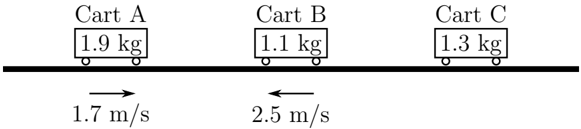
What is the velocity of the center of mass of the system of the three carts after the last collision?
- A. 0.11 m/s
- B. 0.16 m/s
- C. 1.4 m/s
- D. 2.0 m/s
- E. 3.23 m/s
Topic: Conservation of Momentum Metodi: Conservation of Momentum Competenze: Physical Reasoning Objects: Cart Fonte: Testo (PDF) - p.3
Utilizzare N/kg durante tutto il concorso.
Tre carri sono liberi di muoversi su una pista orizzontale senza attrito di dimensione. Il carrello A ha una massa di 1,9 kg e una velocità iniziale di 1,7 m/s a destra; il carrello B ha una massa di 1,1 kg e una velocità iniziale di 2,5 m/s a sinistra; il carrello C ha una massa di 1,3 kg ed è originariamente in riposo. Le collisioni tra i carri A e B sono perfettamente elastiche; le collisioni tra i carri B e C sono perfettamente inelasche.
Qual è la velocità del centro di massa del sistema dei tre carri dopo l’ultima collisione?
- A. 0.11 m/s
- B. 0.16 m/s
- C. 1.4 m/s
- D. 2.0 m/s
- E. 3.23 m/s
Topic: Conservation of Momentum Metodi: Conservation of Momentum Competenze: Physical Reasoning Objects: Cart Fonte: Testo (PDF) - p.3
Use N/kg throughout this contest.
The following information applies to questions 7 and 8.

Carts A, B, and C are on a long horizontal frictionless track. The masses of the carts are , , and . Originally cart B is at rest at the 1.0 meter mark and cart C is at rest on the 2.0 meter mark. Cart A is originally at the zero meter mark moving toward the cart B at a speed of .
Assuming that all collisions are completely inelastic, what is the final speed of cart C?
- A.
- B.
- C.
- D.
- E.
Topic: Conservation of Momentum Metodi: Conservation of Momentum Competenze: Physical Reasoning Objects: Cart Fonte: Testo (PDF) - p.4
Utilizzare N/kg durante tutto il concorso.
Le seguenti informazioni si applicano alle domande 7 e 8.
I carri A, B e C sono su una lunga pista orizzontale senza attrito. Le masse dei carri sono , e . In origine il carrello B è a riposo al marchio di 1,0 metri e il carrello C è a riposo al marchio di 2,0 metri. Il carrello A è originariamente al punto di zero che si muove verso il carrello B a una velocità .
Supponendo che tutte le collisioni siano completamente inelasche, qual è la velocità finale del carrello C?
- A.
- B.
- C.
- D.
- E.
Topic: Conservation of Momentum Metodi: Conservation of Momentum Competenze: Physical Reasoning Objects: Cart Fonte: Testo (PDF) - p.4
Use N/kg throughout this contest.
The following information applies to questions 7 and 8.
Carts A, B, and C are on a long horizontal frictionless track. The masses of the carts are , , and . Originally cart B is at rest at the 1.0 meter mark and cart C is at rest on the 2.0 meter mark. Cart A is originally at the zero meter mark moving toward the cart B at a speed of .
Assuming that all collisions are completely elastic, what is the final speed of cart C?
- A.
- B.
- C.
- D.
- E.
Topic: Conservation of Momentum Metodi: Conservation of Momentum, Conservation of Energy Competenze: Physical Reasoning Objects: Cart Fonte: Testo (PDF) - p.4
Utilizzare N/kg durante tutto il concorso.
Le seguenti informazioni si applicano alle domande 7 e 8.
I carri A, B e C sono su una lunga pista orizzontale senza attrito. Le masse dei carri sono , e . In origine il carrello B è a riposo al marchio di 1,0 metri e il carrello C è a riposo al marchio di 2,0 metri. Il carrello A è originariamente al punto di zero che si muove verso il carrello B a una velocità .
Supponendo che tutte le collisioni siano completamente elastiche, qual è la velocità finale del carrello C?
- A.
- B.
- C.
- D.
- E.
Topic: Conservation of Momentum Metodi: Conservation of Momentum, Conservation of Energy Competenze: Physical Reasoning Objects: Cart Fonte: Testo (PDF) - p.4
Use N/kg throughout this contest.
The following information applies to questions 9 and 10.
A 0.650 kg ball moving at 5.00 m/s collides with a 0.750 kg ball that is originally at rest. After the collision, the 0.750 kg ball moves off with a speed of 4.00 m/s, and the 0.650 kg ball moves off at a right angle to the final direction of motion of the 0.750 kg ball.
What is the final speed of the 0.650 kg ball?
- A. 1.92 m/s
- B. 2.32 m/s
- C. 3.00 m/s
- D. 4.64 m/s
- E. 5.77 m/s
Topic: Conservation of Momentum Metodi: Conservation of Momentum, Vector Decomposition Competenze: Physical Reasoning Objects: Ball Fonte: Testo (PDF) - p.4
Utilizzare N/kg durante tutto il concorso.
Le seguenti informazioni si applicano alle domande 9 e 10.
Una palla di 0,650 kg in movimento a 5,00 m/s si schianta con una palla di 0,750 kg che è originariamente in riposo. Dopo la collisione, la palla da 0,750 kg si allontana a una velocità di 4,00 m/s, e la palla da 0,650 kg si allontana in angolo retto verso la direzione finale del movimento della palla da 0,750 kg.
Qual è la velocità finale della palla da 0,650 kg?
- A. 1.92 m/s
- B. 2.32 m/s
- C. 3.00 m/s
- D. 4.64 m/s
- E. 5.77 m/s
Topic: Conservation of Momentum Metodi: Conservation of Momentum, Vector Decomposition Competenze: Physical Reasoning Objects: Ball Fonte: Testo (PDF) - p.4
Use N/kg throughout this contest.
The following information applies to questions 9 and 10.
A 0.650 kg ball moving at 5.00 m/s collides with a 0.750 kg ball that is originally at rest. After the collision, the 0.750 kg ball moves off with a speed of 4.00 m/s, and the 0.650 kg ball moves off at a right angle to the final direction of motion of the 0.750 kg ball.
Let the change in total kinetic energy in this collision be defined by , where is the total final kinetic energy, and is the total initial kinetic energy. Which of the following is true?
- A.
- B.
- C.
- D.
- E.
Topic: Conservation of Energy Metodi: Conservation of Energy, Conservation of Momentum Competenze: Physical Reasoning Objects: Ball Fonte: Testo (PDF) - p.4
Utilizzare N/kg durante tutto il concorso.
Le seguenti informazioni si applicano alle domande 9 e 10.
Una palla di 0,650 kg in movimento a 5,00 m/s si schianta con una palla di 0,750 kg che è originariamente in riposo. Dopo la collisione, la palla da 0,750 kg si allontana a una velocità di 4,00 m/s, e la palla da 0,650 kg si allontana in angolo retto verso la direzione finale del movimento della palla da 0,750 kg.
La variazione dell’energia cinetica totale in questa collisione deve essere definita da , dove è l’energia cinetica finale totale e è l’energia cinetica iniziale totale. Quale di queste parole è vero?
- A.
- B.
- C.
- D.
- E.
Topic: Conservation of Energy Metodi: Conservation of Energy, Conservation of Momentum Competenze: Physical Reasoning Objects: Ball Fonte: Testo (PDF) - p.4
Use N/kg throughout this contest.
A sphere floats in water with 2/3 of the volume of the sphere submerged. The sphere is removed and placed in oil that has 3/4 the density of water. If it floats in the oil, what fraction of the sphere would be submerged in the oil?
- A. 1/12
- B. 1/2
- C. 8/9
- D. 17/12
- E. The sphere will not float, it will sink in the oil.
Topic: Fluid Mechanics Metodi: Hydrostatic Equilibrium, Conservation Laws Competenze: Physical Reasoning Objects: Sphere Fonte: Testo (PDF) - p.5
Utilizzare N/kg durante tutto il concorso.
Una sfera galleggia in acqua con 2/3 del volume della sfera sommersa. La sfera viene rimossa e collocata in olio che ha 3/4 della densità dell’acqua. Se galleggia nell’olio, quale frazione della sfera sarebbe sommersa nell’olio?
- A. 1/12
- B. 1/2
- C. 8/9
- D. 17/12 La sfera non fluttuerà, affonderà nell’olio.
Topic: Fluid Mechanics Metodi: Hydrostatic Equilibrium, Conservation Laws Competenze: Physical Reasoning Objects: Sphere Fonte: Testo (PDF) - p.5
Use N/kg throughout this contest.
The following information applies to questions 12 and 13.
A pendulum consists of a small bob of mass attached to a fixed point by a string of length . The pendulum bob swings down from rest from an initial angle degrees.
Which of the following statements about the pendulum bob’s acceleration is true?
- A. The magnitude of the acceleration is constant for the motion.
- B. The magnitude of the acceleration at the lowest point is , the acceleration of free fall.
- C. The magnitude of the acceleration is zero at some point of the pendulum’s swing.
- D. The acceleration is always directed toward the center of the circle.
- E. The acceleration at the bottom of the swing is pointing vertically upward.
Topic: Newtonian Mechanics Metodi: Free-Body Diagram, Vector Decomposition Competenze: Physical Reasoning Objects: Pendulum Fonte: Testo (PDF) - p.5
Utilizzare N/kg durante tutto il concorso.
Le seguenti informazioni si applicano alle domande 12 e 13.
Un pendolo è costituito da una piccola bobina di massa attaccata a un punto fisso da una catena di lunghezza . La bobina del pendolo s’innalza dal riposo da un angolo iniziale gradi.
Quale delle seguenti affermazioni sull’accelerazione del pendolo è vera?
- A. L’ampiezza dell’accelerazione è costante per il movimento.
- B. L’ampiezza dell’accelerazione al punto più basso è , l’accelerazione della caduta libera.
- C. La magnitudine dell’accelerazione è zero in un certo punto dello swing del pendolo.
- D. L’accelerazione è sempre diretta verso il centro del cerchio.
- E. L’accelerazione in fondo allo swing punta verticalmente verso l’alto.
Topic: Newtonian Mechanics Metodi: Free-Body Diagram, Vector Decomposition Competenze: Physical Reasoning Objects: Pendulum Fonte: Testo (PDF) - p.5
Use N/kg throughout this contest.
The following information applies to questions 12 and 13.
A pendulum consists of a small bob of mass attached to a fixed point by a string of length . The pendulum bob swings down from rest from an initial angle degrees.
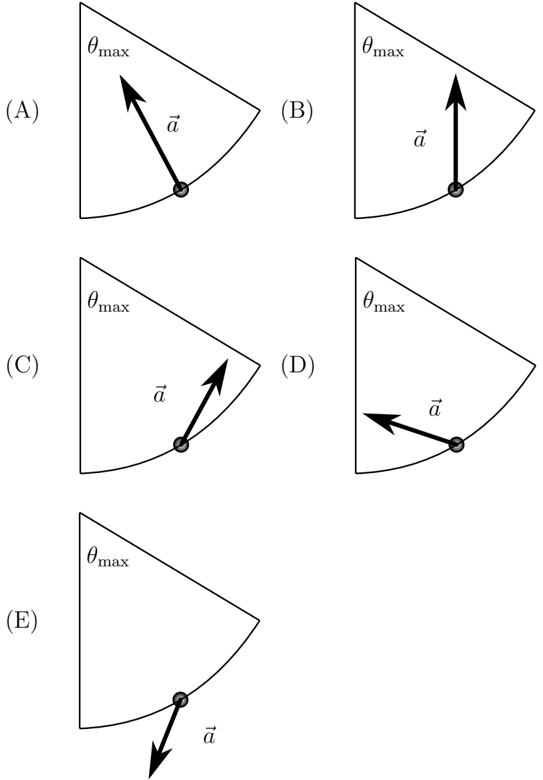
Consider the pendulum bob when it is at an angle on the way up (moving toward ). What is the direction of the acceleration vector? Choose among the options (A) through (E) shown below.
Topic: Newtonian Mechanics Metodi: Free-Body Diagram, Vector Decomposition Competenze: Physical Reasoning, Diagrammatic Reasoning Objects: Pendulum Fonte: Testo (PDF) - p.5
Utilizzare N/kg durante tutto il concorso.
Le seguenti informazioni si applicano alle domande 12 e 13.
Un pendolo è costituito da una piccola bobina di massa attaccata a un punto fisso da una catena di lunghezza . La bobina del pendolo s’innalza dal riposo da un angolo iniziale gradi.
Considerare il bobino del pendolo quando è in un angolo sulla via di salita (movendo verso ). Qual è la direzione del vettore di accelerazione? Scegli tra le opzioni (A) a (E) mostrate di seguito.
Topic: Newtonian Mechanics Metodi: Free-Body Diagram, Vector Decomposition Competenze: Physical Reasoning, Diagrammatic Reasoning Objects: Pendulum Fonte: Testo (PDF) - p.5
Use N/kg throughout this contest.
The following information applies to questions 14 and 15.
A 3.0 meter long massless rod is free to rotate horizontally about its center. Two 5.0 kg point objects are originally located at the ends of the rod; they are free to slide on the frictionless rod and are kept from flying off the rod by an inflexible massless rope that connects the two objects. Originally the system is rotating at 4.0 radians per second; assume the system is completely frictionless; and ignore any concerns about instability of the system.
Calculate the original tension in the rope.
- A. 60 N
- B. 106 N
- C. 120 N
- D. 240 N
- E. 480 N
Topic: Rotational Dynamics Metodi: Free-Body Diagram, Vector Decomposition Competenze: Physical Reasoning Objects: Rod, String Fonte: Testo (PDF) - p.5
Utilizzare N/kg durante tutto il concorso.
Le seguenti informazioni si applicano alle domande 14 e 15.
Una canna senza massa di 3,0 metri di lunghezza può girare in orizzontale intorno al suo centro. Due oggetti puntati da 5,0 kg sono originariamente situati alle estremità della canna; sono liberi di scivolare sulla canna senza attrito e vengono impediti di volare dalla canna da una corda massless inflessibile che collega i due oggetti. In origine il sistema ruota a 4,0 radianti al secondo; supponiamo che il sistema sia completamente senza attrito; e ignoriamo qualsiasi preoccupazione per l’instabilità del sistema.
Calcola la tensione originale della corda.
- A. 60 N
- B. 106 N
- C. 120 N
- D. 240 N
- E. 480 N
Topic: Rotational Dynamics Metodi: Free-Body Diagram, Vector Decomposition Competenze: Physical Reasoning Objects: Rod, String Fonte: Testo (PDF) - p.5
Use N/kg throughout this contest.
The following information applies to questions 14 and 15.
A 3.0 meter long massless rod is free to rotate horizontally about its center. Two 5.0 kg point objects are originally located at the ends of the rod; they are free to slide on the frictionless rod and are kept from flying off the rod by an inflexible massless rope that connects the two objects. Originally the system is rotating at 4.0 radians per second; assume the system is completely frictionless; and ignore any concerns about instability of the system.
The rope is slowly tightened by a small massless motor attached to one of the objects. It is done in such a way as to pull the two objects closer to the center of the rotating rod. How much work is done by the motor in pulling the two objects from the ends of the rod until they are each 0.5 meters from the center of rotation?
- A. 120 J
- B. 180 J
- C. 240 J
- D. 1440 J
- E. 1620 J
Topic: Rotational Dynamics Metodi: Torque & Angular Momentum Analysis, Conservation of Energy Competenze: Physical Reasoning Objects: Rod, String Fonte: Testo (PDF) - p.6
Utilizzare N/kg durante tutto il concorso.
Le seguenti informazioni si applicano alle domande 14 e 15.
Una canna senza massa di 3,0 metri di lunghezza può girare in orizzontale intorno al suo centro. Due oggetti puntati da 5,0 kg sono originariamente situati alle estremità della canna; sono liberi di scivolare sulla canna senza attrito e vengono impediti di volare dalla canna da una corda massless inflessibile che collega i due oggetti. In origine il sistema ruota a 4,0 radianti al secondo; supponiamo che il sistema sia completamente senza attrito; e ignoriamo qualsiasi preoccupazione per l’instabilità del sistema.
La corda viene lentamente stretta da un piccolo motore senza massa attaccato a uno degli oggetti. Si fa in modo tale da tirare i due oggetti più vicino al centro della canna rotante. Quanto lavoro fa il motore per tirare i due oggetti dalle estremità della canna fino a quando ciascuno è a 0,5 metri dal centro di rotazione?
- A. 120 J
- B. 180 J
- C. 240 J
- D. 1440 J
- E. 1620 J
Topic: Rotational Dynamics Metodi: Torque & Angular Momentum Analysis, Conservation of Energy Competenze: Physical Reasoning Objects: Rod, String Fonte: Testo (PDF) - p.6
Use N/kg throughout this contest.
Shown below is a graph of potential energy as a function of position for a 0.50 kg object.
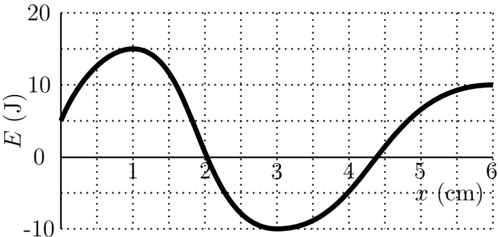
Which of the following statements is NOT true in the range ?
- A. The object could be at equilibrium at either cm or cm.
- B. The minimum possible total energy for this object in the range is J.
- C. The magnitude of the force on the object at 4 cm is approximately 1000 N.
- D. If the total energy of the particle is 0 J then the object will have a maximum kinetic energy of 10 J.
- E. The magnitude of the acceleration of the object at cm is approximately 4 cm/s.
Topic: Conservation of Energy Metodi: Conservation of Energy, Free-Body Diagram Competenze: Physical Reasoning, Diagrammatic Reasoning Objects: - Fonte: Testo (PDF) - p.6
Utilizzare N/kg durante tutto il concorso.
In seguito è mostrato un grafico di energia potenziale a funzione della posizione di un oggetto di 0,50 kg.
Qual è la seguente affermazione NON vera nell’intervallo ?
- A. L’oggetto potrebbe essere in equilibrio a cm o cm.
- B. L’energia totale minima possibile per questo oggetto nell’intervallo è J.
- C. La grandezza della forza sull’oggetto a 4 cm è di circa 1000 N.
- D. Se l’energia totale della particella è di 0 J, l’oggetto avrà un’energia cinetica massima di 10 J.
- E. La magnitudine dell’accelerazione dell’oggetto a cm è di circa 4 cm/s.
Topic: Conservation of Energy Metodi: Conservation of Energy, Free-Body Diagram Competenze: Physical Reasoning, Diagrammatic Reasoning Objects: - Fonte: Testo (PDF) - p.6
Use N/kg throughout this contest.
A flywheel can rotate in order to store kinetic energy. The flywheel is a uniform disk made of a material with a density and tensile strength (measured in Pascals), a radius , and a thickness . The flywheel is rotating at the maximum possible angular velocity so that it does not break. Which of the following expression correctly gives the maximum kinetic energy per kilogram that can be stored in the flywheel? Assume that is a dimensionless constant.
- A.
- B.
- C.
- D.
- E.
Topic: Rotational Dynamics, Elasticity & Materials Metodi: Dimensional Analysis Competenze: Physical Reasoning, Estimation & Approximation Objects: Disk Fonte: Testo (PDF) - p.6
Utilizzare N/kg durante tutto il concorso.
Un volante può ruotare per conservare energia cinetica. Il volante è un disco uniforme costituito da un materiale con densità e resistenza alla trazione (misurata in Pascals), raggio e spessore . Il volante ruota alla velocità angolare massima possibile in modo da non rompersi. Quale espressione di cui sopra dà correttamente l’energia cinetica massima per chilogrammo che può essere immagazzinata nel volante? Supponiamo che sia una costante senza dimensioni.
- A.
- B.
- C.
- D.
- E.
Topic: Rotational Dynamics, Elasticity & Materials Metodi: Dimensional Analysis Competenze: Physical Reasoning, Estimation & Approximation Objects: Disk Fonte: Testo (PDF) - p.6
Use N/kg throughout this contest.
Shown below are three graphs of the same data.
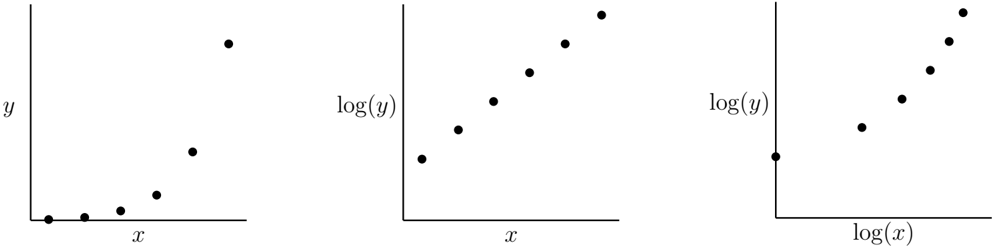
Which is the correct functional relationship between the data points? Assume and are constants.
- A.
- B.
- C.
- D.
- E.
Topic: Mathematics Metodi: Graph Linearization, Curve Fitting Competenze: Graph Linearization, Curve Fitting Objects: - Fonte: Testo (PDF) - p.6
Utilizzare N/kg durante tutto il concorso.
Sotto sono mostrati tre grafici degli stessi dati.
Qual è la corretta relazione funzionale tra i punti dati? Supponiamo che e siano costanti.
- A.
- B.
- C.
- D.
- E.
Topic: Mathematics Metodi: Graph Linearization, Curve Fitting Competenze: Graph Linearization, Curve Fitting Objects: - Fonte: Testo (PDF) - p.6
Use N/kg throughout this contest.
The following information applies to questions 19 and 20.
A U-tube manometer consists of a uniform diameter cylindrical tube that is bent into a U shape. It is originally filled with water that has a density . The total length of the column of water is . Ignore surface tension and viscosity.
The water is displaced slightly so that one side moves up a distance and the other side lowers a distance . Find the frequency of oscillation.
- A.
- B.
- C.
- D.
- E.
Topic: Oscillations & Waves, Fluid Mechanics Metodi: Simple Harmonic Motion Analysis, Hydrostatic Equilibrium Competenze: Physical Reasoning, Mathematical Modeling Objects: Manometer, Tube Fonte: Testo (PDF) - p.7
Utilizzare N/kg durante tutto il concorso.
Le seguenti informazioni si applicano alle domande 19 e 20.
Un manometro a tubo U è costituito da un tubo cilindrico di diametro uniforme che è piegato in forma di U. È originariamente riempito di acqua con una densità . La lunghezza totale della colonna d’acqua è . Ignora la tensione superficiale e la viscosità.
L’acqua viene spostata leggermente in modo che un lato si muova in salita a una distanza e l’altro lato abbassa una distanza . Trova la frequenza di oscillazione.
- A.
- B.
- C.
- D.
- E.
Topic: Oscillations & Waves, Fluid Mechanics Metodi: Simple Harmonic Motion Analysis, Hydrostatic Equilibrium Competenze: Physical Reasoning, Mathematical Modeling Objects: Manometer, Tube Fonte: Testo (PDF) - p.7
Use N/kg throughout this contest.
The following information applies to questions 19 and 20.
A U-tube manometer consists of a uniform diameter cylindrical tube that is bent into a U shape. It is originally filled with water that has a density . The total length of the column of water is . Ignore surface tension and viscosity.
Oil with a density half that of water is added to one side of the tube until the total length of oil is equal to the total length of water. Determine the equilibrium height difference between the two sides.
- A.
- B.
- C.
- D.
- E.
Topic: Fluid Mechanics Metodi: Hydrostatic Equilibrium Competenze: Physical Reasoning Objects: Manometer, Tube Fonte: Testo (PDF) - p.7
Utilizzare N/kg durante tutto il concorso.
Le seguenti informazioni si applicano alle domande 19 e 20.
Un manometro a tubo U è costituito da un tubo cilindrico di diametro uniforme che è piegato in forma di U. È originariamente riempito di acqua con una densità . La lunghezza totale della colonna d’acqua è . Ignora la tensione superficiale e la viscosità.
L’olio con una densità della metà dell’acqua viene aggiunto su un lato del tubo fino a quando la lunghezza totale dell’olio è pari alla lunghezza totale dell’acqua. Determinare la differenza di altezza di equilibrio tra i due lati.
- A.
- B.
- C.
- D.
- E.
Topic: Fluid Mechanics Metodi: Hydrostatic Equilibrium Competenze: Physical Reasoning Objects: Manometer, Tube Fonte: Testo (PDF) - p.7
Use N/kg throughout this contest.
An object launched vertically upward from the ground with a speed of 50 m/s bounces off of the ground on the return trip with a coefficient of restitution given by , meaning that immediately after a bounce the upward speed is 90% of the previous downward speed. The ball continues to bounce like this; what is the total amount of time between when the ball is launched and when it finally comes to a rest? Assume the collision time is zero; the bounce is instantaneous. Treat the problem as ideally classical and ignore any quantum effects that might happen for very small bounces.
- A. 71 s
- B. 100 s
- C. 141 s
- D. 1000 s
- E. (the ball never comes to a rest)
Topic: Newtonian Mechanics Metodi: Kinematic Equations, Approximation & Series Expansion Competenze: Physical Reasoning, Mathematical Modeling Objects: Ball Fonte: Testo (PDF) - p.7
Utilizzare N/kg durante tutto il concorso.
Un oggetto lanciato verticalmente verso l’alto dal suolo con una velocità di 50 m/s rimbalza dal suolo durante il viaggio di ritorno con un coefficiente di restituzione di , il che significa che immediatamente dopo un rimbalzo la velocità verso l’alto è del 90% della velocità precedente in discesa. La palla continua a saltare così; qual è il tempo totale tra il lancio della palla e il momento in cui finalmente si riposa? Supponiamo che il tempo di collisione sia zero; il rimbalzo è istantaneo. Tratta il problema come idealmente classico e ignora gli effetti quantistici che potrebbero accadere per piccole rebote.
- A. 71 s
- B. 100 s
- C. 141 s
- D. 1000 s
- E. (la palla non si ferma mai)
Topic: Newtonian Mechanics Metodi: Kinematic Equations, Approximation & Series Expansion Competenze: Physical Reasoning, Mathematical Modeling Objects: Ball Fonte: Testo (PDF) - p.7
Use N/kg throughout this contest.
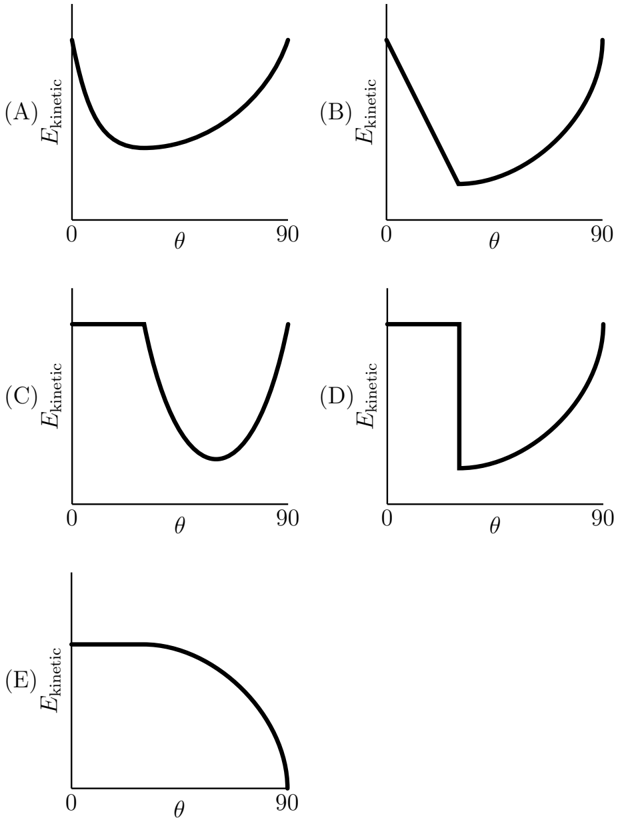
A solid ball is released from rest down inclines of various inclination angles but through a fixed vertical height . The coefficient of static and kinetic friction are both equal to . Which of the following graphs best represents the total kinetic energy of the ball at the bottom of the incline as a function of the angle of the incline?
Topic: Rotational Dynamics, Conservation of Energy Metodi: Conservation of Energy, Torque & Angular Momentum Analysis, Free-Body Diagram Competenze: Physical Reasoning, Diagrammatic Reasoning Objects: Ball, Sphere, Inclined Plane Fonte: Testo (PDF) - p.7
Utilizzare N/kg durante tutto il concorso.
Una palla solida viene rilasciata da inclinamenti a riposo di varie angolazioni di inclinazione , ma attraverso un’altezza verticale fissa . Il coefficiente di attrito statico e cinetico è uguale a . Quale dei grafici seguenti rappresenta meglio l’energia cinetica totale della palla in fondo all’inclinazione in funzione dell’angolo di inclinazione?
Topic: Rotational Dynamics, Conservation of Energy Metodi: Conservation of Energy, Torque & Angular Momentum Analysis, Free-Body Diagram Competenze: Physical Reasoning, Diagrammatic Reasoning Objects: Ball, Sphere, Inclined Plane Fonte: Testo (PDF) - p.7
Use N/kg throughout this contest.
A 2.0 kg object falls from rest a distance of 5.0 meters onto a 6.0 kg object that is supported by a vertical massless spring with spring constant N/m. The two objects stick together after the collision, which results in the mass/spring system oscillating. What is the maximum magnitude of the displacement of the 6.0 kg object from its original location before it is struck by the falling object?
- A. 0.27 m
- B. 1.1 m
- C. 2.5 m
- D. 2.8 m
- E. 3.1 m
Topic: Oscillations & Waves, Conservation of Momentum Metodi: Simple Harmonic Motion Analysis, Conservation of Momentum, Conservation of Energy Competenze: Physical Reasoning, Mathematical Modeling Objects: Spring, Block Fonte: Testo (PDF) - p.8
Utilizzare N/kg durante tutto il concorso.
Un oggetto di 2,0 kg cade da un riposo a una distanza di 5,0 metri su un oggetto di 6,0 kg sostenuto da una sorgente verticale senza massa con costante sorgente N/m. I due oggetti si fissano dopo la collisione, il che provoca oscillazioni del sistema di massa/primavera. Qual è la magnitudine massima del spostamento dell’oggetto di 6,0 kg dalla sua posizione originale prima di essere colpito dall’oggetto cadente?
- A. 0.27 m
- B. 1.1 m
- C. 2.5 m
- D. 2.8 m
- E. 3.1 m
Topic: Oscillations & Waves, Conservation of Momentum Metodi: Simple Harmonic Motion Analysis, Conservation of Momentum, Conservation of Energy Competenze: Physical Reasoning, Mathematical Modeling Objects: Spring, Block Fonte: Testo (PDF) - p.8
Use N/kg throughout this contest.
The speed of a transverse wave on a long cylindrical steel string is given by
where is the tension in the string, is the mass, and is the length of the string. Ignore any string stiffness, and assume that it does not stretch when tightened.
Consider two steel strings of the same length, the first with radius and a second thicker string with radius . Each string is tightened to the maximum possible tension without breaking.
What is the ratio of the fundamental frequencies of vibration on the two strings?
- A. 1
- B.
- C. 2
- D.
- E. 4
Topic: Oscillations & Waves Metodi: Wave Equation, Dimensional Analysis, Stress-Strain Analysis Competenze: Physical Reasoning Objects: String Fonte: Testo (PDF) - p.8
Utilizzare N/kg durante tutto il concorso.
La velocità di un’onda trasversale su una lunga corda di acciaio cilindrica è data da
in cui è la tensione della corda, è la massa e è la lunghezza della corda. Ignora ogni rigidità della corda e supponi che non si estenda quando è stretta.
Considerate due stringhe di acciaio della stessa lunghezza, la prima con raggio e una seconda più spessa con raggio . Ogni corda è stretta alla massima tensione possibile senza rottura.
Qual è il rapporto delle frequenze fondamentali di vibrazione sulle due corde?
- A. 1
- B.
- C. 2
- D.
- E. 4
Topic: Oscillations & Waves Metodi: Wave Equation, Dimensional Analysis, Stress-Strain Analysis Competenze: Physical Reasoning Objects: String Fonte: Testo (PDF) - p.8
Use N/kg throughout this contest.
Two identical carts A and B each with mass are connected via a spring with spring constant . Two additional springs, identical to the first, connect the carts to two fixed points. The carts are free to oscillate under the effect of the springs in one dimensional frictionless motion.

Under suitable initial conditions, the two carts will oscillate in phase according to
where and are the locations of carts A and B relative to their respective equilibrium positions. Under other suitable initial conditions, the two carts will oscillate exactly out of phase according to
Determine the ratio .
- A.
- B. 2
- C.
- D. 3
- E. 5
Topic: Oscillations & Waves Metodi: Simple Harmonic Motion Analysis, Superposition Principle, Differential Equations Competenze: Physical Reasoning, Mathematical Modeling Objects: Spring, Cart Fonte: Testo (PDF) - p.8
Utilizzare N/kg durante tutto il concorso.
Due carrelli identici A e B, ognuno di massa , sono collegati tramite una molla con costante molla . Due sorgenti aggiuntive, identiche alla prima, collegano i carri a due punti fissi. I carri sono liberi di oscillare sotto l’effetto delle molle in un movimento senza attrito di dimensione.
In condizioni iniziali adeguate, i due carri oscilleranno in fase secondo le seguenti condizioni:
dove e sono le posizioni dei carri A e B rispetto alle rispettive posizioni di equilibrio. In altre condizioni iniziali adatte, i due carri oscilleranno esattamente fuori fase secondo le seguenti condizioni:
Determinare il rapporto .
- A.
- B. 2
- C.
- D. 3
- E. 5
Topic: Oscillations & Waves Metodi: Simple Harmonic Motion Analysis, Superposition Principle, Differential Equations Competenze: Physical Reasoning, Mathematical Modeling Objects: Spring, Cart Fonte: Testo (PDF) - p.8