Consider a particle of mass that elastically bounces off of an infinitely hard horizontal surface under the influence of gravity. The total mechanical energy of the particle is and the acceleration of free fall is . Treat the particle as a point mass and assume the motion is non-relativistic.
a. An estimate for the regime where quantum effects become important can be found by simply considering when the deBroglie wavelength of the particle is on the same order as the height of a bounce. Assuming that the deBroglie wavelength is defined by the maximum momentum of the bouncing particle, determine the value of the energy where quantum effects become important. Write your answer in terms of some or all of , , and Planck’s constant .
b. A second approach allows us to develop an estimate for the actual allowed energy levels of a bouncing particle. Assuming that the particle rises to a height , we can write
where is the momentum as a function of height above the ground, is a non-negative integer, and is Planck’s constant.
- i. Determine the allowed energies as a function of the integer , and some or all of , , and Planck’s constant .
- ii. Numerically determine the minimum energy of a bouncing neutron. The mass of a neutron is kg MeV; you may express your answer in either Joules or eV.
- iii. Determine the bounce height of one of these minimum energy neutrons.
c. Let be the minimum energy of the bouncing neutron and be the frequency of the bounce. Determine an order of magnitude estimate for the ratio . It only needs to be accurate to within an order of magnitude or so, but you do need to show work!
Topic: Modern-Quantum Physics Topic: Order-of-Magnitude Estimation Metodi: de Broglie Relation Metodi: Bohr Model & Quantization Metodi: Order-of-Magnitude Estimation Competenze: Physical Reasoning Competenze: Estimation & Approximation Objects: - Fonte: Testo (PDF) - p.3
Considera una particella di massa che rimbalza elasticamente da una superficie orizzontale infinitamente dura sotto l’influenza della gravità. L’energia meccanica totale della particella è e l’accelerazione della caduta libera è . Trattare la particella come una massa puntaria e assumere che il movimento non sia relativistico.
a. Una stima del regime in cui gli effetti quantistici diventano importanti può essere trovata semplicemente considerando quando la lunghezza d’onda deBroglie della particella è dello stesso ordine dell’altezza di un rimbalzo. Supponendo che la lunghezza d’onda deBroglie sia definita dalla massima dinamica della particella rimbalzante, determinare il valore dell’energia in cui gli effetti quantistici diventano importanti. Scrivi la tua risposta in termini di parte o di tutti , e costante di Planck .
b. Un secondo approccio ci permette di sviluppare una stima dei livelli di energia effettivi consentiti di una particella in rimbalzo. Supponendo che la particella si alzi ad un’altezza , possiamo scrivere
se è la velocità in funzione dell’altezza sopra il terreno, è un intero non negativo e è la costante di Planck.
- i. Determinare le energie ammesse come funzione del numero intero , e parte o tutte di , , e costante di Planck .
- ii. Determina numericamente l’energia minima di un neutrone rimbalzante. La massa di un neutrone è kg MeV; si può esprimere la risposta in Joules o eV.
- III. Determina l’altezza di rimbalzo di uno di questi neutroni di energia minima.
c. Che sia l’energia minima del neutrone rimbalzante e sia la frequenza del rimbalzo. Determinare una stima di ordine di magnitudine del rapporto . Deve essere accurata fino ad un certo numero di metri, ma deve essere efficace!
Topic: Modern-Quantum Physics Topic: Order-of-Magnitude Estimation Metodi: de Broglie Relation Metodi: Bohr Model & Quantization Metodi: Order-of-Magnitude Estimation Competenze: Physical Reasoning Competenze: Estimation & Approximation Objects: - Fonte: Testo (PDF) - p.3
Consider the circuit shown below. is a constant current source, meaning that no matter what device is connected between points A and B, the current provided by the constant current source is the same.
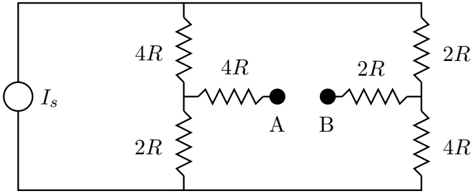
a. Connect an ideal voltmeter between and . Determine the voltage reading in terms of any or all of and .
b. Connect instead an ideal ammeter between and . Determine the current in terms of any or all of and .
c. It turns out that it is possible to replace the above circuit with a new circuit as follows:
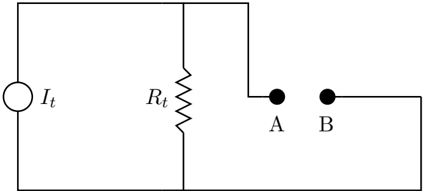
From the point of view of any passive resistance that is connected between A and B the circuits are identical. You don’t need to prove this statement, but you do need to find and in terms of any or all of and .
Topic: Circuits Metodi: Kirchhoff’s Laws Metodi: Equivalent Circuit Reduction Competenze: Physical Reasoning Competenze: Mathematical Modeling Objects: Resistor Fonte: Testo (PDF) - p.4
Considerate il circuito che viene mostrato qui sotto. è una fonte di corrente costante, il che significa che, indipendentemente dal dispositivo collegato tra i punti A e B, la corrente fornita dalla fonte di corrente costante è la stessa.
a. Collegare un voltometro ideale tra e . Determinare la lettura della tensione in termini di una parte o di tutte le e .
b. Invece, collegare un ammetro ideale tra e . Determina la corrente in termini di una o tutte le e .
c. Si scopre che è possibile sostituire il circuito di cui sopra con un nuovo circuito come segue:
Dal punto di vista di qualsiasi resistenza passiva che sia collegata tra A e B i circuiti sono identici. Non è necessario dimostrare questa affermazione, ma è necessario trovare e in termini di alcuni o tutti e .
Topic: Circuits Metodi: Kirchhoff’s Laws Metodi: Equivalent Circuit Reduction Competenze: Physical Reasoning Competenze: Mathematical Modeling Objects: Resistor Fonte: Testo (PDF) - p.4
A large block of mass is located on a horizontal frictionless surface. A second block of mass is located on top of the first block; the coefficient of friction (both static and kinetic) between the two blocks is given by . All surfaces are horizontal; all motion is effectively one dimensional. A spring with spring constant is connected to the top block only; the spring obeys Hooke’s Law equally in both extension and compression. Assume that the top block never falls off of the bottom block; you may assume that the bottom block is very, very long. The top block is moved a distance away from the equilibrium position and then released from rest.

a. Depending on the value of , the motion can be divided into two types: motion that experiences no frictional energy losses and motion that does. Find the value that divides the two motion types. Write your answer in terms of any or all of , the acceleration of gravity , the masses and , and the spring constant .
b. Consider now the scenario . In this scenario the amplitude of the oscillation of the top block as measured against the original equilibrium position will change with time. Determine the magnitude of the change in amplitude, , after one complete oscillation, as a function of any or all of , , , and the angular frequency of oscillation of the top block .
c. Assume still that . What is the maximum speed of the bottom block during the first complete oscillation cycle of the upper block?
Topic: Oscillations & Waves Topic: Newtonian Mechanics Metodi: Simple Harmonic Motion Analysis Metodi: Conservation of Energy Metodi: Free-Body Diagram Competenze: Physical Reasoning Competenze: Mathematical Modeling Objects: Spring Objects: Block Fonte: Testo (PDF) - p.5
Un grande blocco di massa si trova su una superficie orizzontale senza attrito. Un secondo blocco di massa si trova sopra il primo blocco; il coefficiente di attrito (sia statico che cinetico) tra i due blocchi è dato da . Tutte le superfici sono orizzontali; tutto il movimento è effettivamente unidimensionale. Una molla con costante molla è collegata al blocco superiore solo; la molla obbedisce alla legge di Hooke in modo uguale sia nell’estensione che nella compressione. Supponiamo che il blocco superiore non cadga mai dal blocco inferiore; possiamo supporre che il blocco inferiore sia molto, molto lungo. Il blocco superiore viene spostato a una distanza dalla posizione di equilibrio e quindi rilasciato dal riposo.
a. A seconda del valore di , il movimento può essere diviso in due tipi: movimento che non subisce perdite di energia da attrito e movimento che non subisce perdite di energia da attrito. Trova il valore che divide i due tipi di movimento. Scrivi la tua risposta in termini di una o tutte le , l’accelerazione della gravità , le masse e e la costante di primavera .
b. Considerate ora lo scenario . In questo scenario l’ampiezza dell’oscillazione del blocco superiore misurata rispetto alla posizione di equilibrio originale cambierà con il tempo. Determinare la magnitudine del cambiamento di amplitudine, , dopo una oscillazione completa, in funzione di una o tutte le , , e della frequenza angolare di oscillazione del blocco superiore .
c. Supponiamo ancora che . Qual è la velocità massima del blocco inferiore durante il primo ciclo di oscillazione completo del blocco superiore?
Topic: Oscillations & Waves Topic: Newtonian Mechanics Metodi: Simple Harmonic Motion Analysis Metodi: Conservation of Energy Metodi: Free-Body Diagram Competenze: Physical Reasoning Competenze: Mathematical Modeling Objects: Spring Objects: Block Fonte: Testo (PDF) - p.5
A heat engine consists of a moveable piston in a vertical cylinder. The piston is held in place by a removable weight placed on top of the piston, but piston stops prevent the piston from sinking below a certain point. The mass of the piston is kg, the cross sectional area of the piston is cm, and the weight placed on the piston has a mass of kg.
Assume that the region around the cylinder and piston is a vacuum, so you don’t need to worry about external atmospheric pressure.
- At point A the cylinder volume is completely filled with liquid water at a temperature K and a pressure that would be just sufficient to lift the piston alone, except the piston has the additional weight placed on top.
- Heat energy is added to the water by placing the entire cylinder in a hot bath.
- At point B the piston and weight begins to rise.
- At point C the volume of the cylinder reaches and the temperature reaches . The heat source is removed; the piston stops rising and is locked in place.
- Heat energy is now removed from the water by placing the entire cylinder in a cold bath.
- At point D the pressure in the cylinder returns to . The added weight is removed; the piston is unlocked and begins to move down.
- The cylinder volume returns to . The cylinder is removed from the cold bath, the weight is placed back on top of the piston, and the cycle repeats.
Because the liquid water can change to gas, there are several important events that take place
- At point W the liquid begins changing to gas.
- At point X all of the liquid has changed to gas. This occurs at the same point as point C described above.
- At point Y the gas begins to change back into liquid.
- At point Z all of the gas has changed back into liquid.
When in the liquid state you need to know that for water kept at constant volume, a change in temperature is related to a change in pressure according to
When in the gas state you should assume that water behaves like an ideal gas.
Of relevance to this question is the pressure/temperature phase plot for water, showing the regions where water exists in liquid form or gaseous form. The curve shows the coexistence condition, where water can exist simultaneously as gas or liquid.
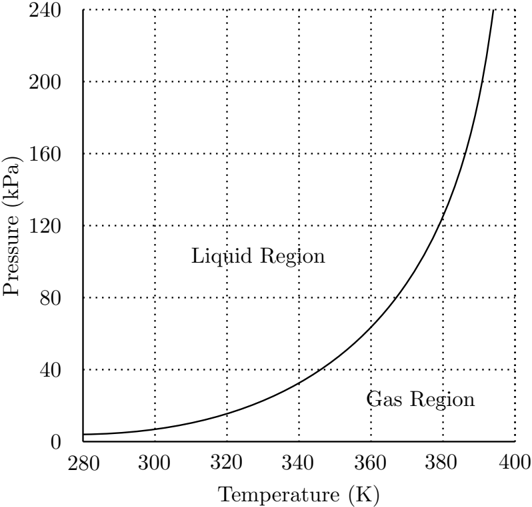
The following graphs should be drawn on the answer sheet provided.
a. Sketch a PT diagram for this cycle on the answer sheet. The coexistence curve for the liquid/gas state is shown. Clearly and accurately label the locations of points B through D and W through Z on this cycle.
b. Sketch a PV diagram for this cycle on the answer sheet. You should estimate a reasonable value for , note the scale is logarithmic. Clearly and accurately label the locations of points B through D on this cycle. Provide reasonable approximate locations for points W through Z on this cycle.
Topic: Thermodynamics Metodi: Thermodynamic Cycle Analysis Metodi: Ideal Gas Law Metodi: First Law of Thermodynamics Competenze: Physical Reasoning Competenze: Diagrammatic Reasoning Objects: Piston Objects: Heat Engine Objects: Gas Fonte: Testo (PDF) - p.6
Un motore termico è costituito da un pistone mobile in cilindro verticale. Il pistone è tenuto in posizione da un peso rimovibile posto sopra il pistone, ma gli arresti del pistone impediscono al pistone di affondare al di sotto di un certo punto. La massa del pistone è kg, la superficie trasversale del pistone è cm e il peso posto sul pistone ha una massa di kg.
Supponiamo che la regione intorno al cilindro e al pistone sia un vuoto, quindi non devi preoccuparti della pressione atmosferica esterna.
- Al punto A il volume del cilindro è completamente riempito di acqua liquida a temperatura K e di una pressione sufficiente a sollevare il pistone, salvo che il pistone abbia il peso aggiuntivo posto in cima.
- L’acqua viene alimentata da energia termico inserendo l’intero cilindro in un bagno caldo.
- Al punto B il pistone e il peso iniziano ad aumentare.
- Al punto C il volume del cilindro raggiunge e la temperatura . La fonte di calore viene rimossa; il pistone si ferma e si blocca.
- L’energia termico viene ora rimossa dall’acqua mettendo l’intero cilindro in un bagno freddo.
- Al punto D la pressione del cilindro torna a . Il peso aggiunto viene rimosso; il pistone viene sbloccato e inizia a muoversi verso il basso.
- Il volume del cilindro ritorna a . Il cilindro viene rimosso dal bagno freddo, il peso viene riposto sulla cima del pistone e il ciclo si ripete.
Poiché l’acqua liquida può trasformarsi in gas, ci sono diversi eventi importanti che si verificano
- Al punto W il liquido inizia a trasformarsi in gas.
- Al punto X tutto il liquido è diventato gas. Questo avviene nello stesso punto del punto C sopra descritto.
- Al punto Y il gas inizia a tornare a diventare liquido.
- Al punto Z tutto il gas è tornato a essere liquido.
Quando si trova in stato liquido è necessario sapere che per l’acqua tenuta a volume costante, un cambiamento di temperatura è correlato a un cambiamento di pressione secondo
Quando si trova nello stato di gas si dovrebbe presumere che l’acqua si comporti come un gas ideale.
In questo caso, è importante il grafico di fase pressione/temperatura dell’acqua, che mostra le regioni in cui l’acqua esiste in forma liquida o gasosa. La curva mostra la condizione di coesistenza, in cui l’acqua può esistere simultaneamente come gas o liquido.
Le seguenti figure devono essere disegnate sulla scheda di risposta fornita.
a. Segnare un diagramma del ciclo di lavoro sul foglio delle risposte. Si mostra la curva di coesistenza dello stato liquido/gas. Segnalare chiaramente e con precisione le posizioni dei punti B a D e W a Z su questo ciclo.
b. Segnare un diagramma fotovoltaico per questo ciclo sulla scheda delle risposte. Dovresti stimare un valore ragionevole per , nota che la scala è logaritmica. Indicare chiaramente e accuratamente le posizioni dei punti B-D di questo ciclo. Fornire posizioni approssimative ragionevoli per i punti da W a Z di questo ciclo.
Topic: Thermodynamics Metodi: Thermodynamic Cycle Analysis Metodi: Ideal Gas Law Metodi: First Law of Thermodynamics Competenze: Physical Reasoning Competenze: Diagrammatic Reasoning Objects: Piston Objects: Heat Engine Objects: Gas Fonte: Testo (PDF) - p.6
This problem is divided into three parts. It is possible to solve these three parts independently, but they are not equally weighted.
a. An ideal rocket when empty of fuel has a mass and will carry a mass of fuel . The fuel burns and is ejected with an exhaust speed of relative to the rocket. The fuel burns at a constant mass rate for a total time . Ignore gravity; assume the rocket is far from any other body.
- i. Determine an equation for the acceleration of the rocket as a function of time in terms of any or all of , , , , , and any relevant fundamental constants.
- ii. Assuming that the rocket starts from rest, determine the final speed of the rocket in terms of any or all of , , , , and any relevant fundamental constants.
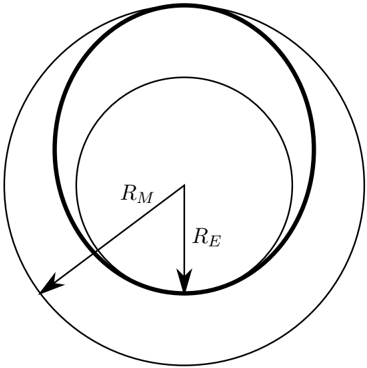
b. The ship starts out in a circular orbit around the sun very near the Earth and has a goal of moving to a circular orbit around the Sun that is very close to Mars. It will make this transfer in an elliptical orbit as shown in bold in the diagram below. This is accomplished with an initial velocity boost near the Earth and then a second velocity boost near Mars . Assume that both of these boosts are from instantaneous impulses, and ignore mass changes in the rocket as well as gravitational attraction to either Earth or Mars. Don’t ignore the Sun! Assume that the Earth and Mars are both in circular orbits around the Sun of radii and respectively. The orbital speeds are and respectively.
- i. Derive an expression for the velocity boost to change the orbit from circular to elliptical. Express your answer in terms of and .
- ii. Derive an expression for the velocity boost to change the orbit from elliptical to circular. Express your answer in terms of and .
- iii. What is the angular separation between Earth and Mars, as measured from the Sun, at the time of launch so that the rocket will start from Earth and arrive at Mars when it reaches the orbit of Mars? Express your answer in terms of .
Topic: Gravitation Topic: Newtonian Mechanics Metodi: Kepler’s Laws Metodi: Conservation of Momentum Metodi: Newton’s Law of Gravitation Competenze: Physical Reasoning Competenze: Mathematical Modeling Objects: Planet Objects: Satellite Fonte: Testo (PDF) - p.9
Questo problema è diviso in tre parti. È possibile risolvere queste tre parti in modo indipendente, ma non sono uguali.
a. Un razzo ideale quando è vuoto di carburante ha una massa e porterà una massa di carburante . Il combustibile brucia e viene espulso a una velocità di scarico di rispetto al razzo. Il combustibile brucia a velocità di massa costante per un tempo totale . Ignora la gravità; supponi che il razzo sia lontano da qualsiasi altro corpo.
- i. Determinare un’equazione per l’accelerazione del razzo in funzione del tempo in termini di una o tutte le costanti fondamentali , , , , e di qualsiasi costante fondamentale pertinente.
- ii. Se il razzo parte dal riposo, determinare la velocità finale del razzo in termini di una o tutte le costanti fondamentali pertinenti: , , , .
b. La nave parte in orbita circolare intorno al Sole molto vicino alla Terra e ha l’obiettivo di spostarsi in un’orbita circolare intorno al Sole che è molto vicina a Marte. Questo trasferimento sarà effettuato in un’orbita ellittica come mostrato in grasso nel diagramma di seguito. Questo viene realizzato con un primo aumento della velocità vicino alla Terra e poi un secondo aumento della velocità vicino a Marte . Supponiamo che entrambi questi impulsi siano da impulsi istantanei, e ignoriamo i cambiamenti di massa nel razzo così come l’attrazione gravitazionale verso la Terra o Marte. Non ignorare il sole! Supponiamo che la Terra e Marte siano entrambe in orbite circolari intorno al Sole di radii e rispettivamente. Le velocità orbitali sono rispettivamente e .
- i. Derivare un’espressione per l’aumento di velocità per cambiare l’orbita da circolare ad ellittica. Esprimere la risposta in termini di e .
- ii. Derivare un’espressione per l’aumento di velocità per cambiare l’orbita da ellittica a circolare. Esprimere la risposta in termini di e .
- III. Qual è la separazione angolare tra la Terra e Marte, misurata dal Sole, al momento del lancio in modo che il razzo partisca dalla Terra e arrivi su Marte quando raggiungerà l’orbita di Marte? Esprimere la risposta in termini di .
Topic: Gravitation Topic: Newtonian Mechanics Metodi: Kepler’s Laws Metodi: Conservation of Momentum Metodi: Newton’s Law of Gravitation Competenze: Physical Reasoning Competenze: Mathematical Modeling Objects: Planet Objects: Satellite Fonte: Testo (PDF) - p.9
The nature of magnetic dipoles.
a. A ‘Gilbert’ dipole consists of a pair of magnetic monopoles each with a magnitude but opposite magnetic charges separated by a distance , where is small. In this case, assume that is located at and is located at .

Assume that magnetic monopoles behave like electric monopoles according to a coulomb-like force
and the magnetic field obeys
- i. What are the dimensions of the quantity ?
- ii. Write an exact expression for the magnetic field strength along the axis as a function of for . Write your answer in terms of , , , and any necessary fundamental constants.
- iii. Evaluate this expression in the limit as , assuming that the product is kept constant, keeping only the lowest non-zero term. Write your answer in terms of , , and any necessary fundamental constants.
b. An ‘Ampere’ dipole is a magnetic dipole produced by a current loop around a circle of radius , where is small. Assume that the axis is the axis of rotational symmetry for the circular loop, and the loop lies in the plane at .
- i. Write an exact expression for the magnetic field strength along the axis as a function of for . Write your answer in terms of , , , and any necessary fundamental constants.
- ii. Let have dimensions equal to that of the quantity defined above in Part aiii, where and are dimensionless constants. Determine the value of .
- iii. Evaluate the expression in Part bi in the limit as , assuming that the product is kept constant, keeping only the lowest non-zero term. Write your answer in terms of , , , and any necessary fundamental constants.
- iv. Assuming that the two approaches are equivalent, . Determine the constant in Part bii.
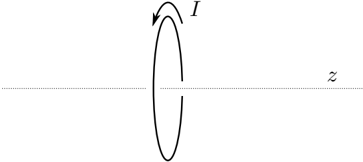
c. Now we try to compare the two approaches if we model a physical magnet as being composed of densely packed microscopic dipoles.
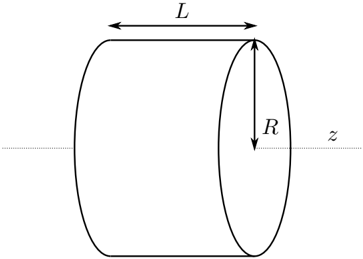
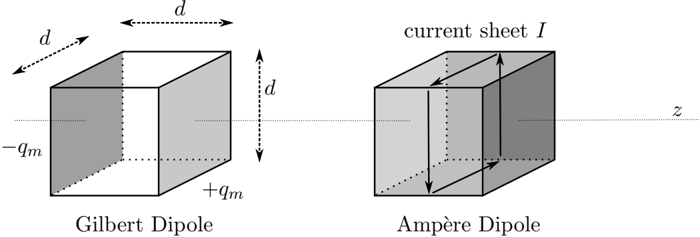
A cylinder of this uniform magnetic material has a radius and a length . It is composed of magnetic dipoles that could be either all Ampere type or all Gilbert type. is a very large number. The axis of rotation of the cylinder and all of the dipoles are all aligned with the axis and all point in the same direction as defined above so that the magnetic field outside the cylinder is the same in either dipole case as you previously determined. Below is a picture of the two dipole models; they are cubes of side and with volume .
- i. Assume that and only Gilbert type dipoles, determine the magnitude and direction of at the center of the cylinder in terms of any or all of , , , , and any necessary fundamental constants.
- ii. Assume that and only Ampere type dipoles, determine the magnitude and direction of at the center of the cylinder in terms of any or all of , , , , and any necessary fundamental constants.
Topic: Magnetism Topic: Electromagnetism Metodi: Biot-Savart Law Metodi: Dimensional Analysis Metodi: Superposition Principle Competenze: Physical Reasoning Competenze: Mathematical Modeling Objects: Magnet Objects: Coil Fonte: Testo (PDF) - p.10
La natura dei dipoli magnetici.
a. Un dipolo “Gilbert” è costituito da una coppia di monopoli magnetici ognuno di cui una magnitudine ma cariche magnetiche opposte separate da una distanza , dove è piccola. In questo caso, supponiamo che sia situato a e sia situato a .
Supponiamo che i monopoli magnetici si comportino come i monopoli elettrici secondo una forza simile a un coulomb
e il campo magnetico obbedisce
- i. Quali sono le dimensioni della quantità ?
- ii. Scrivere un’espressione esatta della forza del campo magnetico lungo l’asse come funzione di per . Scrivi la tua risposta in termini di , , e di eventuali costanti fondamentali necessarie.
- III. Valutare questa espressione nel limite come , supponendo che il prodotto sia mantenuto costante, mantenendo solo il termine non zero più basso. Scrivi la tua risposta in termini di , e di eventuali costanti fondamentali necessarie.
b. Un dipolo “Ampere” è un dipolo magnetico prodotto da un ciclo di corrente intorno a un cerchio di raggio , dove è piccolo. Supponiamo che l’asse sia l’asse di simmetria di rotazione per il ciclo circolare e che il ciclo si trovi nel piano a .
- i. Scrivere un’espressione esatta della forza del campo magnetico lungo l’asse come funzione di per . Scrivi la tua risposta in termini di , , e di eventuali costanti fondamentali necessarie.
- ii. Le dimensioni di siano uguali a quelle della quantità definita sopra nella parte aiii, dove e sono costanti senza dimensioni. Determinare il valore di .
- III. Valutare l’espressione della parte bi del limite come , supponendo che il prodotto sia mantenuto costante, mantenendo solo il termine non zero più basso. Scrivi la tua risposta in termini di , , e di eventuali costanti fondamentali necessarie.
- iv. Supponendo che i due approcci siano equivalenti, . Determinare la costante nella parte bii.
c. Ora cerchiamo di confrontare i due approcci se modelliamo un magnete fisico come composto da dipoli microscopici densamente imbattuti.
Un cilindro di questo materiale magnetico uniforme ha un raggio e una lunghezza . È composto da dipoli magnetici che potrebbero essere di tipo Ampere o di tipo Gilbert. è un numero molto grande. L’asse di rotazione del cilindro e tutti i dipoli sono tutti allineati con l’asse e tutti puntano nella stessa direzione come definito sopra, in modo che il campo magnetico al di fuori del cilindro sia lo stesso in entrambi i casi di dipolo come si è determinato in precedenza. Qui di seguito è riportato un quadro dei due modelli di dipole: i cubetti laterali e con volume .
- i. Supponiamo che e solo i dipoli di tipo Gilbert determinino la magnitudo e la direzione di al centro del cilindro in termini di una o tutte le costanti fondamentali , , , e di qualsiasi costante fondamentale necessaria.
- ii. Supponiamo che e solo i dipoli di tipo Ampere determinino la magnitudine e la direzione di al centro del cilindro in termini di una o tutte le costanti fondamentali , , , e di qualsiasi costante fondamentale necessaria.
Topic: Magnetism Topic: Electromagnetism Metodi: Biot-Savart Law Metodi: Dimensional Analysis Metodi: Superposition Principle Competenze: Physical Reasoning Competenze: Mathematical Modeling Objects: Magnet Objects: Coil Fonte: Testo (PDF) - p.10