Qu 1.
In this question you are asked to make reasoned estimates, assumptions and explanations. These assumptions and estimations must be clearly stated.
(a)
(i) The planet Venus orbits the Sun. Viewed through weak binoculars it appears to be crescent shaped. Its size and shape appear to change a few days later. Why is this?
(ii) The planet does not appear to change in size and shape to the naked eye. However, its brightness does vary through its orbit. Why?
(iii) It was realised in the 18th century that if two telescopes on different parts of the Earth measured the position of Venus at the same time, the distance from Earth to Venus could be measured and hence the scale of the Solar system (at that time, the radius of the Earth was well known). Why did they need to do this when Venus was in transit across the Sun?
(b) If a long hose is connected to a tap and the end of the hose is partially covered by a thumb, the water squirts out faster. Explain why.
(c) Alpha radiation from a source is observed in a cloud chamber and the tracks are photographed with a digital camera. The density of the track (number of dark pixels per unit length, ) is plotted against the distance from the source, . Explain the graph in Figure 1a.
(d) A beam of electrons is accelerated from rest by a pd of 1 kV. The electric field is uniform. The beam current is 1 μA and the diameter of the cross section of the circular beam is 5 mm.
Calculate:
(i) the maximum velocity of the electrons.
(ii) the velocity of the electrons after they had traversed half the distance in the field.
(iii) the magnetic field a distance of 5 mm from the centre of the beam.
(iv) how does the magnetic field vary across the beam?
(v) how does this field affect the electrons?
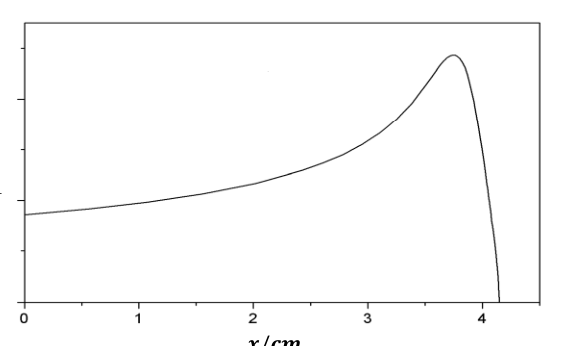 Alpha particle track density vs distance (Figure 1a)
Topic: Astrophysics, Newtonian Mechanics, Electromagnetism Metodi: Physical Modeling, Kinematic Equations, Ampère’s Law Competenze: Physical Reasoning, Mathematical Modeling Objects: Planet, Star, Tube, Electron, Particle Beam Fonte: Testo (PDF) — p.3
Qu 1.
In questa domanda vi viene chiesto di fare stime, ipotesi e spiegazioni motivate. Tali ipotesi e stime devono essere chiaramente indicate.
(a)
(i) Il pianeta Venere orbita intorno al Sole. Guardato attraverso un binoscolo debole sembra essere a forma di mezzaluna. La sua dimensione e forma sembrano cambiare pochi giorni dopo. Perché è così?
(ii) Il pianeta non sembra cambiare dimensione e forma a occhio nudo. Tuttavia, la sua luminosità varia in orbita. - Perché? - Perché?
(iii) Nel XVIII secolo si realizzò che se due telescopi in diverse parti della Terra misurassero la posizione di Venere allo stesso tempo, la distanza dalla Terra a Venere poteva essere misurata e quindi la scala del sistema solare (all’epoca, il raggio della Terra era ben noto). Perché hanno dovuto farlo quando Venere era in transito attraverso il Sole?
Se un tubo lungo è collegato a un rubinetto e la fine del tubo è parzialmente coperta da un pollice, l’acqua si scorre più velocemente. Spiegate il motivo.
**(c) ** Le radiazioni alfa provenienti da una fonte sono osservate in una camera di nuvole e le tracce sono fotografate con una fotocamera digitale. La densità della traccia (numero di pixel scuri per lunghezza unità, ) è tracciata in base alla distanza dalla fonte, . Spiega il grafico nella figura 1a.
**(d) ** Un fascio di elettroni viene accelerato dal riposo da un pd di 1 kV. Il campo elettrico è uniforme. La corrente del fascio è di 1 μA e il diametro della sezione trasversale del fascio circolare è di 5 mm.
Calcola:
-
la velocità massima degli elettroni.
-
la velocità degli elettroni dopo aver percorso metà della distanza nel campo.
-
il campo magnetico a una distanza di 5 mm dal centro del fascio.
(iv) come varia il campo magnetico nel raggio?
(v) come questo campo influenza gli elettroni?
*Densità della pista di particelle alfa vs distanza (Figura 1a) *
Topic: Astrophysics, Newtonian Mechanics, Electromagnetism Metodi: Physical Modeling, Kinematic Equations, Ampère’s Law Competenze: Physical Reasoning, Mathematical Modeling Objects: Planet, Star, Tube, Electron, Particle Beam Fonte: Testo (PDF) — p.3
Qu 2.
Figure 2a shows the cross section of a gully that a cross country skier is skiing into. Figure 2b shows an aerial view. She wishes to turn left at the gully bottom and continue down the mountain. There is very little wind and air resistance is negligible. However, if she is going at a speed greater than 5 m s she will not make the turn and will hit the rubbly snow. (Cross country skis are only attached to the boot at the toe and it is very difficult to execute a small radius turn at speed). If she continues to go up the other side of the gully, shown in Figure 2a, she can then turn very slowly (or stop) in order to turn through 180° and go back. By repeating this procedure up and down the slopes on each side, she will be skiing backwards and forwards until she loses enough speed to turn safely left (or right) down the centre of the gully, as shown in Figure 2b.
The slopes shown are not to scale. Take the maximum slope as 5°. You may assume that the mass of the skier plus equipment is 65 kg. The effective coefficient of friction of the snow is 0.08.
What is the maximum height, , (Figure 2a) that she can start from in her final descent so that she is able to make the turn without going up the slope on the other side?
(The radius of curvature at the base of the gully is 5 m.)
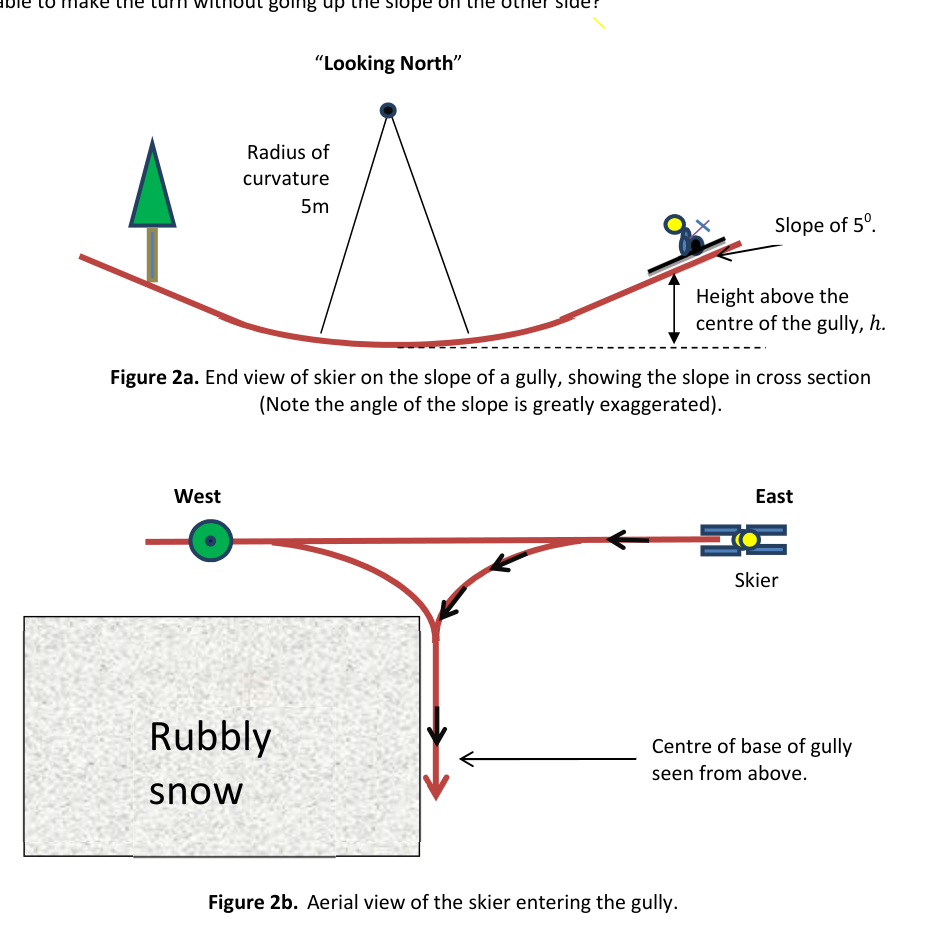 Gully cross section and aerial view (Figures 2a, 2b)
Topic: Newtonian Mechanics, Conservation of Energy Metodi: Energy Conservation Method, Free-Body Diagram, Kinematic Equations Competenze: Physical Reasoning, Mathematical Modeling Objects: — Fonte: Testo (PDF) — p.4
Qu 2.
La figura 2a mostra la sezione trasversale di un fossato in cui un sciatore di cross country sta sciando. La figura 2b mostra una vista aerea. Desidera girare a sinistra al fondo del gola e continuare giù per la montagna. C’è molto poco vento e la resistenza dell’aria è trascurabile. Tuttavia, se si sta andando a una velocità superiore a 5 m s non farà la svolta e colpirà la neve rotondata. (Gli sci di cross country sono fissati solo al bagagliaio al dito e è molto difficile eseguire una piccola rotazione a velocità di raggio). Se continua a salire dall’altra parte del guano, come mostrato nella figura 2a, può poi girare molto lentamente (o fermarsi) per girare 180° e tornare indietro. Ripetendo questa procedura su e giù per le piste su ciascun lato, si scierà avanti e indietro fino a quando non perde la velocità sufficiente a girare in modo sicuro a sinistra (o a destra) nel centro del golaio, come mostrato alla figura 2b.
Le piste mostrate non sono scalabili. Prendete la pendenza massima come 5°. Si può supporre che la massa dello sciatore più l’attrezzatura sia di 65 kg. Il coefficiente di attrito effettivo della neve è di 0,08.
Qual è l’altezza massima, , (Figura 2a) da cui può partire nella sua discesa finale in modo da poter fare la curva senza salire la pendenza dall’altra parte?
(Il raggio di curvatura alla base del canali è di 5 m.)
*Sezione trasversale di Gully e vista aerea (Figure 2a, 2b) *
Topic: Newtonian Mechanics, Conservation of Energy Metodi: Energy Conservation Method, Free-Body Diagram, Kinematic Equations Competenze: Physical Reasoning, Mathematical Modeling Objects: — Fonte: Testo (PDF) — p.4
Qu 3.
Whilst travelling in one of the Stans after the end of the 2014 Physics Olympiad in Kazakhstan, the author noticed what appeared to be pools of water on the road and that the headlamps of the approaching vehicle seemed to be reflected in the road. However, this was surprising since the air temperature was about 36 °C and it had not rained for some time. The refractive index of air at this temperature is about 1.0003.
Briefly account for this phenomenon by means of a description and a diagram. Then consider numerical values to explain the magnitude of the effect.
Marks will be given for the derivation of a formula that gives the geometric path of the light.
The refractive index of the air, , is linearly related to the absolute temperature of the air, which varies linearly with height, . You may assume that the refractive index has the form
with
( is not measured from the road level)
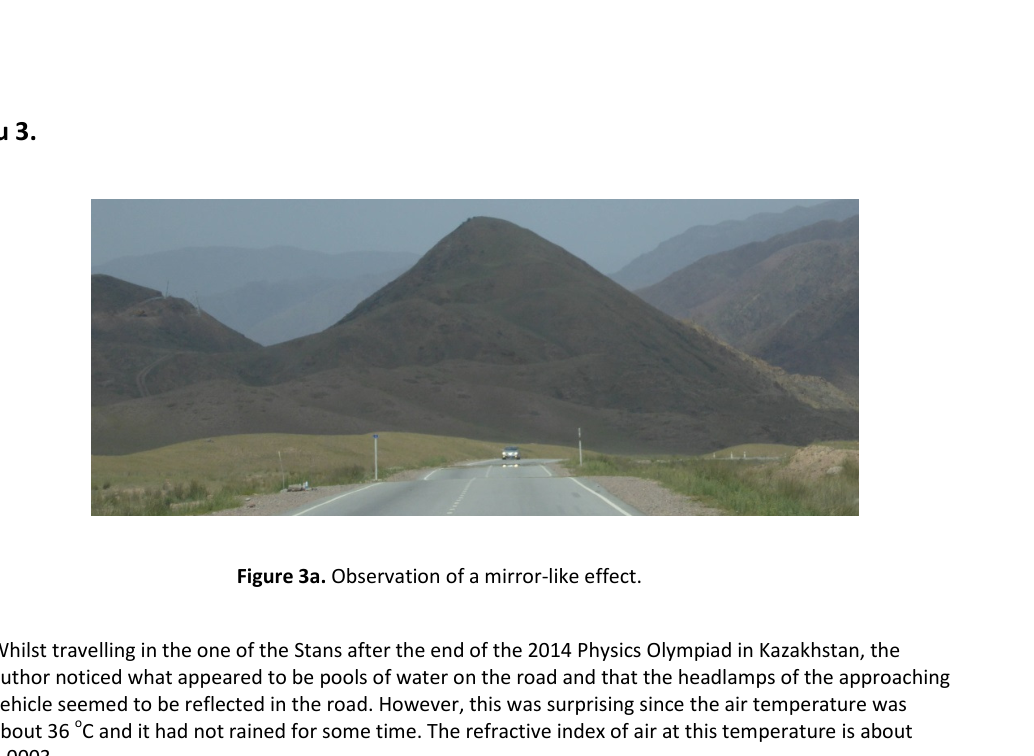 Mirage observation diagram (Figure 3a)
Topic: Geometric Optics, Oscillations & Waves Metodi: Snell’s Law, Ray Tracing, Approximation & Series Expansion Competenze: Physical Reasoning, Mathematical Modeling Objects: — Fonte: Testo (PDF) — p.5
Qu 3.
Mentre viaggiava in uno degli Stans dopo la fine della Olimpiada di Fisica del 2014 in Kazakistan, l’autore notò che sembravano essere laghi d’acqua sulla strada e che i fari del veicolo che si avvicinava sembravano riflessi sulla strada. Tuttavia, questo risultato fu sorprendente, poiché la temperatura dell’aria era di circa 36 °C e non pioveva da tempo. L’indice di rifrazione dell’aria a questa temperatura è di circa 1.0003.
In breve spiegazione di questo fenomeno mediante una descrizione e un diagramma. Poi considerate i valori numerici per spiegare la grandezza dell’effetto.
Verranno dati segni per la derivazione di una formula che fornisca il percorso geometrico della luce.
L’indice di rifrazione dell’aria, , è linearmente correlato alla temperatura assoluta dell’aria, che varia linearmente con l’altezza, . Si può presumere che l’indice di rifrazione abbia la forma
con
( non viene misurato dal livello della strada)
*Diagramma di osservazione mirage (Figura 3a) *
Topic: Geometric Optics, Oscillations & Waves Metodi: Snell’s Law, Ray Tracing, Approximation & Series Expansion Competenze: Physical Reasoning, Mathematical Modeling Objects: — Fonte: Testo (PDF) — p.5
Qu 4.
Figure 4a shows a simplified design working of a magnetic rifle. The bullet is made of a magnetic material such as iron. The idea is that the trigger switches on the current, this draws the bullet into the solenoid and the bullet proceeds on its way. However trials showed that it did not work. Why do you think this was so? Suggest modifications and explain as numerically as you can how your modifications would work.
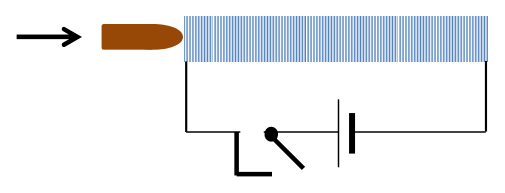 Magnetic rifle schematic (Figure 4a)
Topic: Electromagnetism, Electromagnetic Induction Metodi: Faraday’s Law of Induction, Physical Modeling, Lenz’s Law Competenze: Physical Reasoning, Mathematical Modeling Objects: Solenoid Fonte: Testo (PDF) — p.5
Qu 4.
La figura 4a mostra un disegno semplificato che opera con un fucile magnetico. Il proiettile è fatto di un materiale magnetico come il ferro. L’idea è che il grilletto accende la corrente, questo attira il proiettile nel solenoide e il proiettile procede sulla sua strada. Tuttavia, le prove hanno dimostrato che non ha funzionato. - Perche’ credi sia stato cosi’? Suggerire modifiche e spiegare numericamente come funzionerebbero le modifiche.
*Schematic magnetic rifle (Figura 4a) *
Topic: Electromagnetism, Electromagnetic Induction Metodi: Faraday’s Law of Induction, Physical Modeling, Lenz’s Law Competenze: Physical Reasoning, Mathematical Modeling Objects: Solenoid Fonte: Testo (PDF) — p.5
Qu 5.
A lunar eclipse from the year 2000 is shown in Figure 5a below. The composite image is a set of nine separate images taken as a sequence over a period of three to four hours, and has been processed in Adobe Photoshop so that the moon’s image is shown relative to the Earth’s shadow. It shows various stages of the total lunar eclipse of Jan 20–21 2000, observed from Maryland in the United States. The three images of the moon at the centre of the composite are some 10000 times fainter than the surrounding images of the moon, and have been enhanced in this composite image. The reddening of the image is due to the scattering effect of light in the Earth’s atmosphere.
The angular diameter of the moon subtended at the Earth is about 0.52°, whilst the angle subtended by the Sun at the Earth is on average about 0.53°.
The diameter of the Earth is 6370 km and the Sun is much larger, but at a very great distance away compared to the Earth–Moon distance. Using the information provided, estimate the distance from the Earth to the Moon.
Use sketch diagrams to show your method.
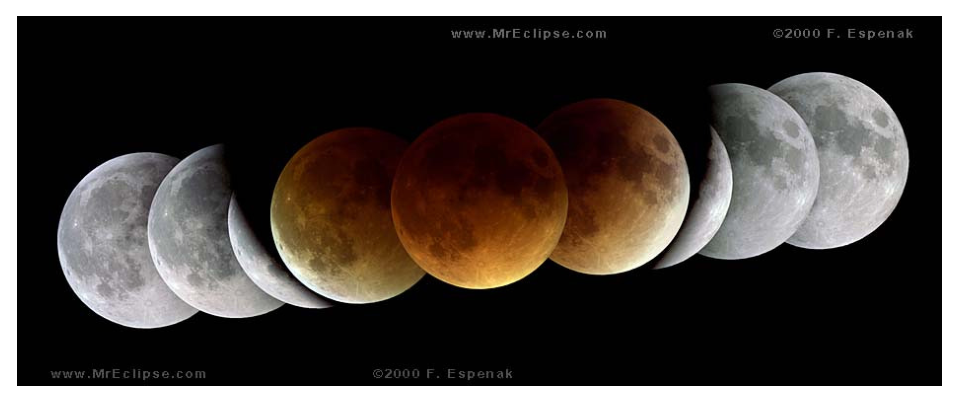 Composite image of total lunar eclipse Jan 2000
Topic: Astrophysics, Gravitation, Order-of-Magnitude Estimation Metodi: Physical Modeling, Small-Angle Approximation, Order-of-Magnitude Estimation Competenze: Physical Reasoning, Estimation & Approximation Objects: Planet, Star Fonte: Testo (PDF) — p.6
Qu 5.
Un’eclissi lunare dell’anno 2000 è mostrata nella figura 5a qui sotto. L’immagine composta è un insieme di nove immagini separate scattate in sequenza in un periodo di tre o quattro ore, ed è stata elaborata in Adobe Photoshop in modo che l’immagine della luna sia mostrata rispetto all’ombra della Terra. Mostra varie fasi dell’eclissi lunare totale del 20-21 gennaio 2000, osservato dal Maryland negli Stati Uniti. Le tre immagini della luna al centro del composto sono circa 10.000 volte più sottili delle immagini circostanti della luna, e sono state migliorate in questa immagine composta. L’arrossamento dell’immagine è dovuto all’effetto di diffusione della luce nell’atmosfera terrestre.
Il diametro angolare della luna sottosentita alla Terra è di circa 0.52°, mentre l’angolo sottosentito dal Sole alla Terra è in media di circa 0.53°.
Il diametro della Terra è di 6370 km e il Sole è molto più grande, ma a una distanza molto grande rispetto alla distanza della TerraLuna. Usando le informazioni fornite, calcolare la distanza dalla Terra alla Luna.
Utilizzare schizzi per mostrare il metodo.
Immagine composta dell’eclissi lunare totale gennaio 2000
Topic: Astrophysics, Gravitation, Order-of-Magnitude Estimation Metodi: Physical Modeling, Small-Angle Approximation, Order-of-Magnitude Estimation Competenze: Physical Reasoning, Estimation & Approximation Objects: Planet, Star Fonte: Testo (PDF) — p.6