A measurement is carried out to check the speed of a camera shutter of 1/15 s. The camera is focused symmetrically on a rotating turntable which revolves at revolutions per minute and has a spot at its centre and at its circumference. A photograph shows the arc produced by the spot on the circumference subtends an angle of at the centre of rotation. What is the correct exposure time?
Topic: Newtonian Mechanics, Order-of-Magnitude Estimation Metodi: Error Propagation, Kinematic Equations Competenze: Error Propagation, Physical Reasoning Objects: Disk Fonte: Testo (PDF) — p.3
Si effettua una misura per verificare la velocità di un otturatore della fotocamera di 1/15 s. La fotocamera è focalizzata simmetricamente su una scheda giratoria che ruota a rotazioni al minuto e ha un punto al centro e alla sua circonferenza. Una fotografia mostra che l’arco prodotto dal punto sulla circonferenza sottende un angolo di al centro di rotazione. Qual è il tempo corretto di esposizione?
Topic: Newtonian Mechanics, Order-of-Magnitude Estimation Metodi: Error Propagation, Kinematic Equations Competenze: Error Propagation, Physical Reasoning Objects: Disk Fonte: Testo (PDF) — p.3
The temperature coefficients of resistance, , of certain alloys are positive and others are negative. They have resistance per unit length of . This makes it possible to produce a resistor, using the two wires in series, which does not vary with temperature. The values of , at 0 °C, and are given in Table 1.b for constantan and manganin. These wires have lengths and respectively at 0 °C. What values of and are required to produce a resistor?
| Wire | / | / °C |
|---|---|---|
| Constantan | 6.3 | |
| Manganin | 5.3 |
Table 1.b
Topic: Circuits Metodi: Kirchhoff’s Laws, Physical Modeling Competenze: Mathematical Modeling, Physical Reasoning Objects: Wire, Resistor Fonte: Testo (PDF) — p.3
I coefficienti di resistenza a temperatura di alcune leghe sono positivi e altri negativi. Hanno una resistenza per unità di lunghezza . Ciò consente di produrre una resistenza, utilizzando i due fili in serie, che non varia con la temperatura. I valori di , a 0 °C, e sono indicati nella tabella 1.b per constantan e manganina. I fili sono di lunghezza e rispettivamente a 0 °C. Quali valori di e sono necessari per produrre una resistenza ?
| Wire | / | / °C |
|---|---|---|
| Constantan | 6.3 | |
| Manganin | 5.3 |
Tabella 1.b
Topic: Circuits Metodi: Kirchhoff’s Laws, Physical Modeling Competenze: Mathematical Modeling, Physical Reasoning Objects: Wire, Resistor Fonte: Testo (PDF) — p.3
A monochromatic sodium lamp, wavelength m, radiates 100 W of radiation uniformly in all directions. At what distance from the lamp will the photons have an average density of m?
Topic: Modern-Quantum Physics, Electromagnetism Metodi: Photon Energy Relation, Physical Modeling Competenze: Mathematical Modeling, Physical Reasoning Objects: Photon Fonte: Testo (PDF) — p.3
Una lampada monocromatica a sodio, con lunghezza d’onda m, irradia 100 W di radiazioni uniformemente in tutte le direzioni. A che distanza dalla lampada i fotoni avranno una densità media di m?
Topic: Modern-Quantum Physics, Electromagnetism Metodi: Photon Energy Relation, Physical Modeling Competenze: Mathematical Modeling, Physical Reasoning Objects: Photon Fonte: Testo (PDF) — p.3
Protons are accelerated from rest through a p.d. of V and fired at a gold () foil. What is the distance of closest approach of a proton to the gold nucleus?
Topic: Nuclear & Particle Physics, Electrostatics Metodi: Conservation of Energy, Coulomb’s Law Competenze: Mathematical Modeling, Physical Reasoning Objects: Nucleus Fonte: Testo (PDF) — p.3
I protoni vengono accelerati dal riposo attraverso un P.D. di V e scagliato su un foglio d’oro (). Qual è la distanza di avvicinamento più vicino di un protone al nucleo dell’oro?
Topic: Nuclear & Particle Physics, Electrostatics Metodi: Conservation of Energy, Coulomb’s Law Competenze: Mathematical Modeling, Physical Reasoning Objects: Nucleus Fonte: Testo (PDF) — p.3
Figure 1.e is a section through a smooth parabolic metal bowl, which can be rotated about its vertical axis of symmetry, the -axis. Its equation, in Cartesian coordinates, is . The gradient at the point is .
There is one angular speed of rotation, , of the bowl about the -axis for which a small metal sphere remains at rest relative to the rotating bowl, wherever it is placed on the inner surface. Determine in terms of and .
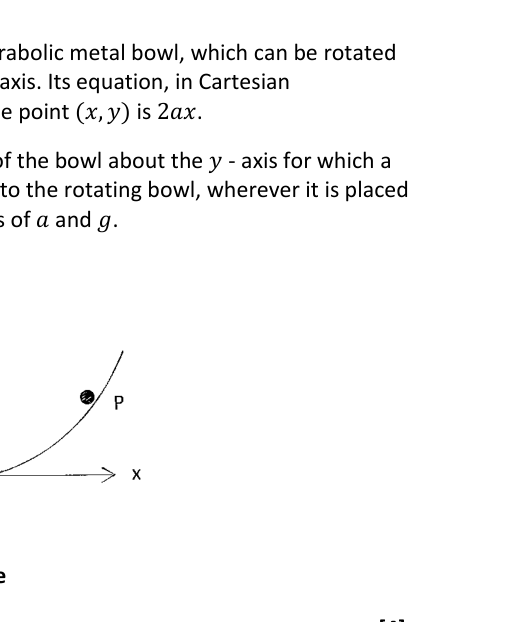 Parabolic bowl rotating about vertical axis
Topic: Newtonian Mechanics, Rotational Dynamics Metodi: Free-Body Diagram, Kinematic Equations Competenze: Mathematical Modeling, Physical Reasoning Objects: Sphere Fonte: Testo (PDF) — p.4
La figura 1.e è una sezione attraverso una tazza metallica parabolica liscia, che può essere rotata intorno al suo asse verticale di simmetria, l’asse . La sua equazione, nelle coordinate cartesiane, è . Il gradiente al punto è .
C’è una velocità angolare di rotazione, , della ciotola intorno all’asse per la quale una piccola sfera metallica rimane in riposo rispetto alla ciotola in rotazione, ovunque sia posizionata sulla superficie interna. Determinare in termini di e .
Bota parabolica che ruota attorno all’asse verticale
Topic: Newtonian Mechanics, Rotational Dynamics Metodi: Free-Body Diagram, Kinematic Equations Competenze: Mathematical Modeling, Physical Reasoning Objects: Sphere Fonte: Testo (PDF) — p.4
A ray of light is incident on a glass prism of refractive index 1.500 at an angle of incidence of . Determine:
(i) the angle of emergence, , from the prism; i.e. the angle between the emergent ray and the normal to the prism face.
(ii) the angle of deviation of the ray, .
Topic: Geometric Optics Metodi: Snell’s Law, Ray Tracing Competenze: Mathematical Modeling, Physical Reasoning Objects: Prism Fonte: Testo (PDF) — p.4
Un raggio di luce è inciso su un prisma di vetro di indice di rifrazione 1.500 ad un angolo di incidenza di . Determinazione:
-
l’angolo di emergenza, , dal prisma; l’angolo tra il raggio emergente e il normale verso la faccia del prisma.
-
l’angolo di deviazione del raggio, .
Topic: Geometric Optics Metodi: Snell’s Law, Ray Tracing Competenze: Mathematical Modeling, Physical Reasoning Objects: Prism Fonte: Testo (PDF) — p.4
A man blowing a whistle of frequency moves away from a stationary observer at speed . Derive the formula for the frequency heard by the observer. The velocity of sound is .
If a man blowing a whistle of frequency 500 Hz moves away from a stationary observer towards a fixed wall, in a direction perpendicular to the wall at 2.00 m s, determine the beat frequency heard by the observer if m s.
Topic: Oscillations & Waves Metodi: Wave Equation, Physical Modeling Competenze: Mathematical Modeling, Physical Reasoning Objects: — Fonte: Testo (PDF) — p.4
Un uomo che suona un fischio di frequenza si allontana da un osservatore stazionario a velocità . Derivare la formula per la frequenza udita dall’osservatore. La velocità del suono è .
Se un uomo che suona un fischio di frequenza 500 Hz si allontana da un osservatore stazionario verso una parete fissa, in direzione perpendicolare alla parete a 2,00 m s, determinare la frequenza dei battiti udita dall’osservatore se m s.
Topic: Oscillations & Waves Metodi: Wave Equation, Physical Modeling Competenze: Mathematical Modeling, Physical Reasoning Objects: — Fonte: Testo (PDF) — p.4
Determine, in Figure 1.h, the total resistances, across BC, across BD and across AB.
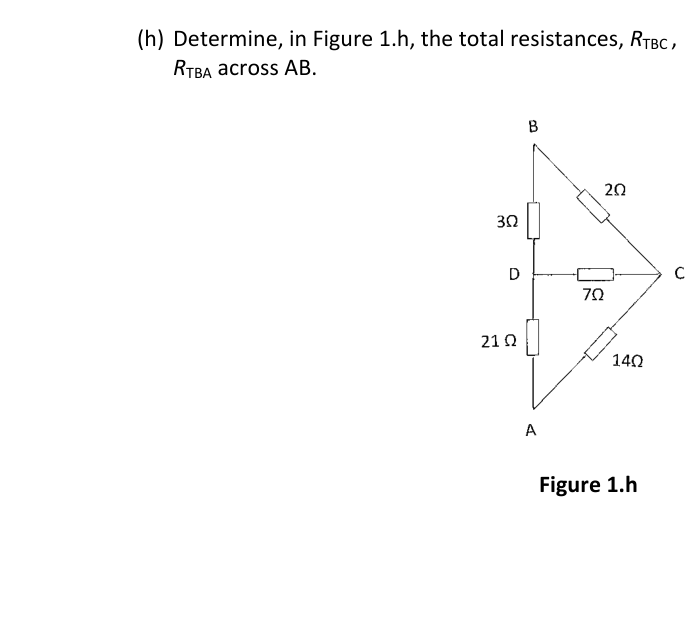 Resistor network with nodes A, B, C, D
Topic: Circuits Metodi: Kirchhoff’s Laws, Equivalent Circuit Reduction Competenze: Mathematical Modeling, Diagrammatic Reasoning Objects: Resistor, Wire Fonte: Testo (PDF) — p.5
Determinare, nella figura 1.h, le resistenze totali, su BC, su BD e su AB.
Rete di resistore con nodi A, B, C, D
Topic: Circuits Metodi: Kirchhoff’s Laws, Equivalent Circuit Reduction Competenze: Mathematical Modeling, Diagrammatic Reasoning Objects: Resistor, Wire Fonte: Testo (PDF) — p.5
What mass of radium, mass number 226, half-life of 1620 years, and an emitter, is required to produce an average of 10 particles per second?
Topic: Nuclear & Particle Physics Metodi: Radioactive Decay Law, Physical Modeling Competenze: Mathematical Modeling, Unit Conversion Objects: Nucleus Fonte: Testo (PDF) — p.5
Quale massa di radio, numero di massa 226, emivita di 1620 anni e emittente è necessaria per produrre una media di 10 particelle al secondo?
Topic: Nuclear & Particle Physics Metodi: Radioactive Decay Law, Physical Modeling Competenze: Mathematical Modeling, Unit Conversion Objects: Nucleus Fonte: Testo (PDF) — p.5
An a.c. voltmeter displays the rms value of the voltage, , for a.c. signals and also for periodic signals that are not sinusoidal. What reading will it display if connected to a periodic voltage, period , that changes instantaneously from V to V to V repeatedly, the voltages lasting, respectively, for , and ?
Determine the following:
(i) the mean voltage, i.e. .
(ii) the rms voltage, i.e. .
(iii) the rms value of deviation from the mean, , which is .
Topic: Circuits, Oscillations & Waves Metodi: Physical Modeling, Calculus-Integration Competenze: Mathematical Modeling, Physical Reasoning Objects: — Fonte: Testo (PDF) — p.5
An a.c. Il voltmeter mostra il valore rms della tensione, , per a.c. I segnali sono stati utilizzati per la produzione di un’unità di segnale di cui al punto 1. Qual è la lettura che verrà visualizzata se collegata a una tensione periodica, periodo , che cambia istantaneamente da V a V a V ripetutamente, con le tensioni di durata rispettivamente per , e ?
Determinare quanto segue:
(i) la tensione media, cioè .
-
la tensione rms, cioè .
-
il valore rms della deviazione dalla media, , che è .
Topic: Circuits, Oscillations & Waves Metodi: Physical Modeling, Calculus-Integration Competenze: Mathematical Modeling, Physical Reasoning Objects: — Fonte: Testo (PDF) — p.5
Assuming the Earth is a homogeneous sphere, calculate the fractional difference between the acceleration due to free fall at the Earth’s equator and at the poles, indicating which is the greater. You may not use a value of given in the constants table as that is an average value, neither correct at the poles nor at the equator.
Mass of the Earth kg, Radius of the Earth m.
Topic: Newtonian Mechanics, Gravitation Metodi: Newton’s Law of Gravitation, Kinematic Equations Competenze: Mathematical Modeling, Physical Reasoning Objects: Planet Fonte: Testo (PDF) — p.5
Supponendo che la Terra sia una sfera omogenea, calcola la differenza frazionaria tra l’accelerazione dovuta alla caduta libera all’equatore della Terra e ai poli, indicando quale è il più grande. Non è consentito utilizzare un valore di indicato nella tabella delle costanti, in quanto è un valore medio, né corretto nei poli né all’equatore.
Massa della Terra kg, raggio della Terra m.
Topic: Newtonian Mechanics, Gravitation Metodi: Newton’s Law of Gravitation, Kinematic Equations Competenze: Mathematical Modeling, Physical Reasoning Objects: Planet Fonte: Testo (PDF) — p.5
A horizontal square wire loop of side 4.00 cm has a resistance, , of . The loop is situated in a vertical downward magnetic field of 0.700 T. When the field is switched off, it decreases to zero, at a uniform rate, in 0.800 s.
Determine:
(i) the induced current, , and its direction in the loop.
(ii) the energy dissipated in the loop.
Topic: Electromagnetic Induction Metodi: Faraday’s Law of Induction, Lenz’s Law Competenze: Mathematical Modeling, Physical Reasoning Objects: Wire Fonte: Testo (PDF) — p.6
Un circuito di filo quadrato orizzontale di lato di 4,00 cm ha una resistenza, , di . Il circuito è situato in un campo magnetico verticale verso il basso di 0,700 T. Quando il campo viene spento, diminuisce a zero, a un ritmo uniforme, in 0,800 s.
Determinazione:
-
la corrente indotta, , e la sua direzione nel ciclo.
-
l’energia dissipata nel circuito.
Topic: Electromagnetic Induction Metodi: Faraday’s Law of Induction, Lenz’s Law Competenze: Mathematical Modeling, Physical Reasoning Objects: Wire Fonte: Testo (PDF) — p.6
Two well separated identical conducting spheres of radius 10.0 cm are charged to V and V. If they are joined by a long wire, how much heat is generated?
Topic: Electrostatics Metodi: Conservation of Energy, Electric Potential Method Competenze: Mathematical Modeling, Physical Reasoning Objects: Conducting Sphere, Wire Fonte: Testo (PDF) — p.6
Due sfere di conduttore identiche ben separate, di raggio di 10,0 cm, sono caricate a V e V. Se sono collegati da un lungo filo, quanto calore viene generato?
Topic: Electrostatics Metodi: Conservation of Energy, Electric Potential Method Competenze: Mathematical Modeling, Physical Reasoning Objects: Conducting Sphere, Wire Fonte: Testo (PDF) — p.6