Electrons are accelerated through a potential , producing a horizontal beam along the -axis. The beam enters a perfectly uniform electric field parallel to the -axis, produced by a parallel plate capacitor with potential difference between the plates, which have separation and are of length , as shown in Figure 2.1.
(a) Determine an expression for:
(i) the initial velocity of the electrons entering the electric field.
(ii) the deflection angle of the beam emerging from the electric field in terms of and .
(iii) the displacement at P, , of the emerging beam from the -axis in terms of .
[8]
(b) Calculate the transition time of an electron through the electric field, given that V, V, cm and cm.
[2]
(c) On emerging from the parallel plates, the beam enters an identical electrostatic field that is at right angles to the initial field, perpendicular to the -axis and the -axis, along the -axis. Determine an algebraic expression for the final speed of an electron exiting the second field and the angles it makes with the Cartesian coordinate axes.
[10]
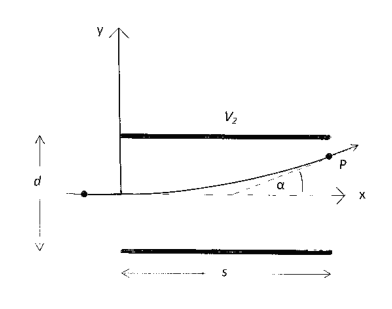 Electron beam entering parallel plate capacitor
Topic: Electrostatics, Newtonian Mechanics Metodi: Electric Potential Method, Kinematic Equations, Vector Decomposition Competenze: Mathematical Modeling, Physical Reasoning Objects: Electron, Capacitor, Particle Beam Fonte: Testo (PDF) — p.3
Gli elettroni vengono accelerati attraverso un potenziale , producendo un fascio orizzontale lungo l’asse . Il fascio entra in un campo elettrico perfettamente uniforme parallelo all’asse , prodotto da un condensatore di piastra parallela con una differenza potenziale tra le piastre, che hanno separazione e sono di lunghezza , come mostrato alla figura 2.1.
a) Determinare un’espressione per:
(i) la velocità iniziale degli elettroni che entrano nel campo elettrico.
-
l’angolo di deviazione del fascio che emerge dal campo elettrico in termini di e .
-
il spostamento al P, , del fascio emergente dall’asse in termini di .
[8]
b) Calcolare il tempo di transizione di un elettrone attraverso il campo elettrico, dato che V, V, cm e cm.
[2]
c) Sorgendo dalle piastre parallele, il fascio entra in un campo elettrostatico identico che si trova ad angoli rettangolari del campo iniziale, perpendicolare all’asse e all’asse , lungo l’asse . Determinare un’espressione algebrica per la velocità finale di un elettrone che esce dal secondo campo e gli angoli che esso fa con gli assi di coordinate cartesiane.
[10]
Fonte di elettroni che entrano nel condensatore di piastre parallele
Topic: Electrostatics, Newtonian Mechanics Metodi: Electric Potential Method, Kinematic Equations, Vector Decomposition Competenze: Mathematical Modeling, Physical Reasoning Objects: Electron, Capacitor, Particle Beam Fonte: Testo (PDF) — p.3
A force resisting the motion of a cyclist travelling along a straight level road at speed , in the absence of a wind, is given by
where and are constants.
Table 3 lists data on the power developed by the cyclist as a function of .
| / m s | 1.40 | 3.20 | 4.70 | 6.50 | 8.50 | 9.80 | 11.2 | 12.1 |
|---|---|---|---|---|---|---|---|---|
| / W | 6.00 | 19.0 | 37.0 | 82.0 | 149 | 224 | 298 | 373 |
Table 3
(a) Draw a graph of against . Determine the constants and with an estimate of their accuracy.
[8]
(b) Suggest the physical significance of the terms and .
[2]
(c) The cyclist can sustain a power of 60 W over long periods. Deduce the equation for the maximum speed he can maintain for long periods on a level road.
[5]
- D. By superimposing a graph on the sheet used in
- A. determine .
[5]
 Table of power vs speed data
Topic: Newtonian Mechanics, Fluid Mechanics Metodi: Graph Linearization, Physical Modeling, Experimental Data Analysis Competenze: Graph Linearization, Mathematical Modeling Objects: — Fonte: Testo (PDF) — p.4
Una forza che resiste al movimento di un ciclista che si muove lungo una strada retta a velocità , in assenza di vento, è data da:
dove e sono costanti.
La tabella 3 elenca i dati sulla potenza sviluppati dal ciclista come funzione di .
| / m s | 1.40 | 3.20 | 4.70 | 6.50 | 8.50 | 9.80 | 11.2 | 12.1 |
|---|---|---|---|---|---|---|---|---|
| / W | 6.00 | 19.0 | 37.0 | 82.0 | 149 | 224 | 298 | 373 |
Tabella 3
a) Disegnare un grafico di contro . Determinare le costanti e con una stima della loro accuratezza.
[8]
b) Suggerire il significato fisico dei termini e .
[2]
c) Il ciclista può mantenere una potenza di 60 W per lunghi periodi. Riduzione dell’equazione per la velocità massima che può mantenere per lunghi periodi su una strada a piattaforma.
[5]
- D. Superponiendo un grafico sulla scheda utilizzata in
- A. determina .
[5]
Tabella di potenza vs dati di velocità
Topic: Newtonian Mechanics, Fluid Mechanics Metodi: Graph Linearization, Physical Modeling, Experimental Data Analysis Competenze: Graph Linearization, Mathematical Modeling Objects: — Fonte: Testo (PDF) — p.4
(a) A square wave, positive voltage pulse with peak value 5.0 V and duration 0.020 s is applied across a series combination of a 2.0 k resistor and a 5.0 F capacitor. Sketch, on the same graph, the voltages across the resistor , using a full curve, and across the capacitor , using a dashed curve. Add the two voltages using a dotted curve. No numerical calculation is required.
[6]
(b) The current through a rod is related to the voltage across it by
The rod is connected in series with a resistor, resistance , and a 6.0 V battery. What is the value of if:
(i) the current in the circuit is 0.40 A?
(ii) the power dissipated in the rod is twice that dissipated in the resistor?
[7]
(c) In the circuit in Figure 4.c(i), show that the circuit can be reduced to that in Figure 4.c(ii). Determine the values of , , and . Each time a simplification is made to the circuit elements, draw the modified circuit.
[7]
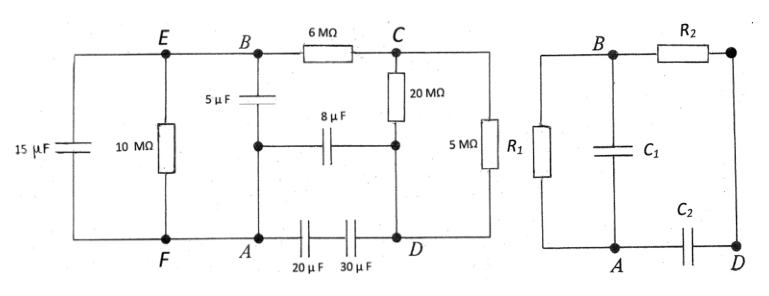 Two equivalent circuit diagrams Figure 4.c(i) and 4.c(ii)
Topic: Circuits Metodi: Kirchhoff’s Laws, Equivalent Circuit Reduction, Physical Modeling Competenze: Diagrammatic Reasoning, Mathematical Modeling Objects: Resistor, Capacitor, Rod, Battery Fonte: Testo (PDF) — p.5
a) Si applica un’onda quadrata, impulso di tensione positiva con valore massimo di 5,0 V e durata di 0,020 s su una combinazione di serie di resistore di 2,0 k e condensatore di 5,0 F. Sketta, sullo stesso grafico, le tensioni attraverso la resistenza , utilizzando una curva completa, e attraverso il condensatore , utilizzando una curva a punti. Aggiungi le due tensioni usando una curva puntata. Non è necessario calcolare numericamente.
[6]
b) La corrente attraverso una canna è correlata alla tensione che la attraversa
La canna è collegata in serie con una resistenza, resistenza e una batteria da 6,0 V. Qual è il valore di se:
(i) la corrente nel circuito è di 0,40 A?
(ii) la potenza dissipata nella canna è doppia rispetto alla potenza dissipata nella resistenza?
[7]
(c) Nel circuito della figura 4.c (i), dimostrare che il circuito può essere ridotto a quello della figura 4.c (ii). Determinare i valori di , , e . Ogni volta che si semplifica l’elemento del circuito, disegna il circuito modificato.
[7]
*Due diagrammi di circuiti equivalenti Figura 4.c(i) e 4.c(ii) *
Topic: Circuits Metodi: Kirchhoff’s Laws, Equivalent Circuit Reduction, Physical Modeling Competenze: Diagrammatic Reasoning, Mathematical Modeling Objects: Resistor, Capacitor, Rod, Battery Fonte: Testo (PDF) — p.5
A vertical glass tube, of height , is sealed at its lower end and open at the top end to the atmosphere. It contains moles of air in the lower half (i.e. length ) of volume , and mercury of density in the top half. As the air expands the mercury is expelled. Atmospheric pressure corresponds to length of mercury in a barometer.
(a) Air expands, occupying an additional length of the tube, but with total volume and pressure . Using the reduced volume and the reduced pressure of the air, express these quantities in terms of the reduced value of , . Deduce:
(i) the relation between and that is independent of temperature.
(ii) the general ideal gas law, for the air in the tube at temperature , in terms of the reduced variables , and only, where and .
[4]
(b) Sketch on a graph for the system:
(i) the behaviour of the air in the physically admissible region.
(ii) the isotherms for the air, indicating which are at the higher temperatures by labelling using etc.
Comment on the symmetry of the curves in (i) and (ii). Deduce the highest temperature reached by the air in the tube.
[8]
(c) When a small change in the reduced temperature and reduced volume takes place
where is the specific heat per mole of the air in the tube. Deduce that
[4]
(d) Sketch a graph of against in the physically admissible region.
[4]
Topic: Thermodynamics, Fluid Mechanics Metodi: Ideal Gas Law, First Law of Thermodynamics, Hydrostatic Equilibrium Competenze: Mathematical Modeling, Physical Reasoning Objects: Tube, Gas Fonte: Testo (PDF) — p.6
Un tubo di vetro verticale, di altezza , è sigillato alla sua estremità inferiore e aperto alla sua estremità superiore all’atmosfera. Contiene molli di aria nella metà inferiore (cioè lunghezza ) di volume e densità di mercurio nella metà superiore. Mentre l’aria si espandono il mercurio viene espulso. La pressione atmosferica corrisponde alla lunghezza del mercurio in un barometro.
a) L’aria si espandono, occupando una lunghezza aggiuntiva del tubo, ma con volume totale e pressione . Usando il volume ridotto e la pressione ridotta dell’aria, esprimere queste quantità in termini di valore ridotto di , . Riduzione:
-
la relazione tra e indipendente dalla temperatura.
-
la legge generale del gas ideale, per l’aria nel tubo a temperatura , in termini di variabili ridotte , e soltanto, dove e .
[4]
b) Sketch su un grafico per il sistema:
-
il comportamento dell’aria nella regione fisicamente ammissibile.
-
l’isoterma dell’aria, indicando quali sono le temperature più elevate mediante l’etichettatura con ecc.
Commento sulla simmetria delle curve di cui alle lettere i) e ii). Riduci la temperatura più alta raggiunta dall’aria nel tubo.
[8]
c) Quando si verifica un piccolo cambiamento della temperatura e del volume ridotti
dove è il calore specifico per mol dell’aria nel tubo. - Deduci questo.
[4]
d) Segnare un grafico di rispetto a nella regione fisicamente ammissibile.
[4]
Topic: Thermodynamics, Fluid Mechanics Metodi: Ideal Gas Law, First Law of Thermodynamics, Hydrostatic Equilibrium Competenze: Mathematical Modeling, Physical Reasoning Objects: Tube, Gas Fonte: Testo (PDF) — p.6
Two identical spherical homogeneous stars A and B, each of mass and radius , have their centres apart. The motion of the stars is to be ignored.
(a) Explain:
(i) Why the surface of B is, or is not, a gravitational equipotential surface.
(ii) With the aid of a diagram where, external to the surface of the stars, the gravitational potential is smallest and largest.
(iii) Where on the surface of the stars is the potential a maximum?
(iv) What is the potential mid-way between the stars?
[9]
(b) Sketch, on the same diagram, the equipotentials that have the values:
(i)
(ii)
(iii)
[4]
(c) If a body of mass is ejected from B, determine, with appropriate explanation, the minimum velocity of launch required to enable it to reach A.
[7]
Topic: Gravitation Metodi: Newton’s Law of Gravitation, Conservation of Energy, Symmetry Argument Competenze: Mathematical Modeling, Physical Reasoning Objects: Star Fonte: Testo (PDF) — p.7
Due stelle omogenee a sfera identiche A e B, ognuna di massa e raggio , hanno i loro centri separati. Il movimento delle stelle deve essere ignorato.
(a) Spiega:
(i) Perché la superficie di B è o non è una superficie equipotenziale gravitazionale.
- con l’aiuto di un diagramma in cui, all’esterno della superficie delle stelle, il potenziale gravitazionale è più piccolo e più grande.
(iii) In quale parte della superficie delle stelle è il potenziale massimo?
(iv) Qual è la potenziale distanza tra le stelle?
[9]
b) Sketch, sullo stesso diagramma, gli equipotenziali che hanno i valori:
(i)
(ii)
(iii)
[4]
c) Se un corpo di massa viene espulso da B, determinare, con una spiegazione appropriata, la velocità minima di lancio necessaria per consentirgli di raggiungere A.
[7]
Topic: Gravitation Metodi: Newton’s Law of Gravitation, Conservation of Energy, Symmetry Argument Competenze: Mathematical Modeling, Physical Reasoning Objects: Star Fonte: Testo (PDF) — p.7