Question 1 Why does a raindrop fall with near-constant speed during the later stages of its descent?
- A. The gravitational force is constant.
- B. Air resistance just balances the force of gravity.
- C. The height from which the raindrop started falling is fixed in space.
- D. The force of gravity is negligible for objects as small as a raindrop.
- E. Gravity cannot increase the speed of a falling object to more than .
Topic: Newtonian Mechanics, Fluid Mechanics Metodi: Free-Body Diagram, Physical Modeling Competenze: Physical Reasoning Objects: Droplet Fonte: Testo (PDF) — p.2
Domanda 1 Perché una goccia di pioggia cade con velocità quasi costante durante le fasi successive della sua discesa?
- A. La forza gravitazionale è costante. La resistenza all’aria bilancia la forza di gravità.
- C. L’altezza da cui è iniziata la caduta della pioggia è fissata nello spazio.
- D. La forza di gravità è trascurabile per oggetti piccoli come una goccia di pioggia.
- E. La gravità non può aumentare la velocità di un oggetto cadente a più di .
Topic: Newtonian Mechanics, Fluid Mechanics Metodi: Free-Body Diagram, Physical Modeling Competenze: Physical Reasoning Objects: Droplet Fonte: Testo (PDF) — p.2
Question 2 The Moon orbits the Earth. What is the Newton’s Third Law reaction force to the gravitational force of the Earth on the Moon?
- A. The gravitational force of the Earth on the Moon
- B. The normal force of the Earth on the Moon
- C. The normal force of the Moon on the Earth
- D. The gravitational force of the Moon on the Earth
- E. The friction force acting on the Moon
Topic: Newtonian Mechanics, Gravitation Metodi: Newton’s Law of Gravitation, Free-Body Diagram Competenze: Physical Reasoning Objects: Planet, Satellite Fonte: Testo (PDF) — p.2
Domanda 2 La Luna orbita la Terra. Qual è la forza di reazione della terza legge di Newton alla forza gravitazionale di la Terra sulla Luna?
- A. La forza gravitazionale della Terra sulla Luna
- B. La forza normale della Terra sulla Luna
- C. La forza normale della Luna sulla Terra
- D. La forza gravitazionale della Luna sulla Terra
- E. La forza di attrito che agisce sulla Luna
Topic: Newtonian Mechanics, Gravitation Metodi: Newton’s Law of Gravitation, Free-Body Diagram Competenze: Physical Reasoning Objects: Planet, Satellite Fonte: Testo (PDF) — p.2
Question 3 “Slice” is the name given to the angular deviation from the straight-through direction that a golfer produces when they hit a golf ball off the tee. David derives the following formula for his slice: In this formula, David’s slice, , depends on three positive values (P, H and L) that are all less than one, with H > L, and an angle (measured in degrees) that can range between and . Which of the following options will minimise David’s slice?
- A. Make P as small as possible, keeping the other variables constant.
- B. Make H as small as possible, keeping the other variables constant.
- C. Make L as small as possible, keeping the other variables constant.
- D. Make as small as possible, keeping the other variables constant.
- E. None of the above will help David minimise his slice.
Topic: Newtonian Mechanics Metodi: Approximation & Series Expansion, Physical Modeling Competenze: Mathematical Modeling, Physical Reasoning Objects: Ball Fonte: Testo (PDF) — p.2
Domanda 3 Slice è il nome dato alla deviazione angolare dalla direzione dritta che un golfista produce quando colpiscono una palla da golf fuori dalla tee. David deriva la seguente formula per la sua fetta: In questa formula, la fetta di David, , dipende da tre valori positivi (P, H e L) che sono tutti inferiori a uno, con H > L e un angolo (misurato in gradi) che può variare tra e . Quale delle seguenti opzioni ridurrà al minimo la fetta di David?
- A. Rendere P il più piccolo possibile, mantenendo le altre variabili costanti.
- B. Rendere il H il più piccolo possibile, mantenendo le altre variabili costanti.
- C. Rendere L il più piccolo possibile, mantenendo le altre variabili costanti.
- D. Rendere il più piccolo possibile, mantenendo le altre variabili costanti. Nessuna delle cose sopra ha aiutato David a ridurre al minimo la sua fetta.
Topic: Newtonian Mechanics Metodi: Approximation & Series Expansion, Physical Modeling Competenze: Mathematical Modeling, Physical Reasoning Objects: Ball Fonte: Testo (PDF) — p.2
Question 4 A glass-walled elevator is moving upwards with constant acceleration. At some point in the elevator’s motion, a bolt breaks loose and drops from the ceiling. What is the motion of the bolt as seen by an external observer (i.e. one located outside the elevator)?
- A. The bolt moves upwards at a constant speed.
- B. The bold initially moves upwards, then slows, reverses direction and moves downwards.
- C. The bolt appears to remain stationary.
- D. The bolt immediately moves downwards, accelerating as it goes.
- E. The bolt immediately moves downwards, at constant speed.
Topic: Newtonian Mechanics Metodi: Kinematic Equations, Free-Body Diagram Competenze: Physical Reasoning Objects: — Fonte: Testo (PDF) — p.3
Domanda 4 Un ascensore a pareti di vetro si sta muovendo verso l’alto con costante accelerazione. In qualche punto dell’ascensore movimento, un bullone si scatta e cade dal soffitto. Qual è il movimento del bullone visto da un osservatore esterno (ad esempio: uno situato fuori dall’ascensore)?
- A. Il bullone si muove verso l’alto a velocità costante.
- B. Il carattere grasso inizia a salire, poi rallenta, inverte la direzione e si muove verso il basso.
- C. Il bullone sembra rimanere fermo.
- D. Il bullone si muove immediatamente verso il basso, accelerando con la sua avanzata.
- E. Il bullone si muove immediatamente verso il basso, a velocità costante.
Topic: Newtonian Mechanics Metodi: Kinematic Equations, Free-Body Diagram Competenze: Physical Reasoning Objects: — Fonte: Testo (PDF) — p.3
Question 5 The Earth and the Moon both exert gravitational forces on objects in their vicinity. Imagine a line joining the Earth to the Moon, and extending to either side, as shown below (not to scale). Consider placing an object along this line. Where along this line is the net gravitational force on the object due to the Earth and the Moon equal to zero?
- A. On the far side of the Earth from the Moon.
- B. Between the Earth and the Moon, but closer to the Earth than to the Moon.
- C. Halfway between the Earth and the Moon.
- D. Between the Earth and the Moon, but closer to the Moon than to the Earth.
- E. Nowhere along the line.
Topic: Gravitation Metodi: Newton’s Law of Gravitation, Symmetry Argument Competenze: Physical Reasoning, Mathematical Modeling Objects: Planet, Satellite Fonte: Testo (PDF) — p.3
Domanda 5 La Terra e la Luna esercitano entrambi forze gravitazionali sugli oggetti nelle loro vicinanze. Immaginate una linea che si unisce la Terra alla Luna, e si estende da entrambi i lati, come mostrato di seguito (non a scala). Considera di inserire un l’oggetto lungo questa linea. Dove lungo questa linea è la forza gravitazionale netta sull’oggetto dovuto alla Terra e la Luna è uguale a zero?
- MSK1/>A. Sul lato più lontano della Terra dalla Luna.
- B. Tra la Terra e la Luna, ma più vicino alla Terra che alla Luna.
- C. A metà strada tra la Terra e la Luna.
- D. Tra la Terra e la Luna, ma più vicino alla Luna che alla Terra.
- E. In nessun luogo lungo la linea.
Topic: Gravitation Metodi: Newton’s Law of Gravitation, Symmetry Argument Competenze: Physical Reasoning, Mathematical Modeling Objects: Planet, Satellite Fonte: Testo (PDF) — p.3
Question 6 The electrostatic force that an object of charge Q exerts on another object of charge q is given by Coulomb’s law: where the charges of the two objects, Q and q, are measured in units of coulombs (C), and r is the distance separating the two objects. What are the units of the constant ?
- A.
- B.
- C.
- D.
- E.
Topic: Electrostatics Metodi: Coulomb’s Law, Dimensional Analysis Competenze: Unit Conversion, Mathematical Modeling Objects: Point Charge Fonte: Testo (PDF) — p.3
Domanda 6 La forza elettrostatica che un oggetto di carica Q esercita su un altro oggetto di carica q è data da Legge di Coulomb: dove le cariche dei due oggetti, Q e q, sono misurate in unità di coulomb (C), e r è la Distanza che separa i due oggetti. Quali sono le unità della costante ?
- A.
- B.
- C.
- D.
- E.
Topic: Electrostatics Metodi: Coulomb’s Law, Dimensional Analysis Competenze: Unit Conversion, Mathematical Modeling Objects: Point Charge Fonte: Testo (PDF) — p.3
Question 7 A ball is held at a height H above a floor, as sketched in the diagram on the right. It is then released and falls to the floor. If air resistance can be ignored, which of the five graphs below (labelled a. to e. beneath each graph) correctly gives the mechanical energy of the Earth-ball system as a function of the altitude y of the ball?
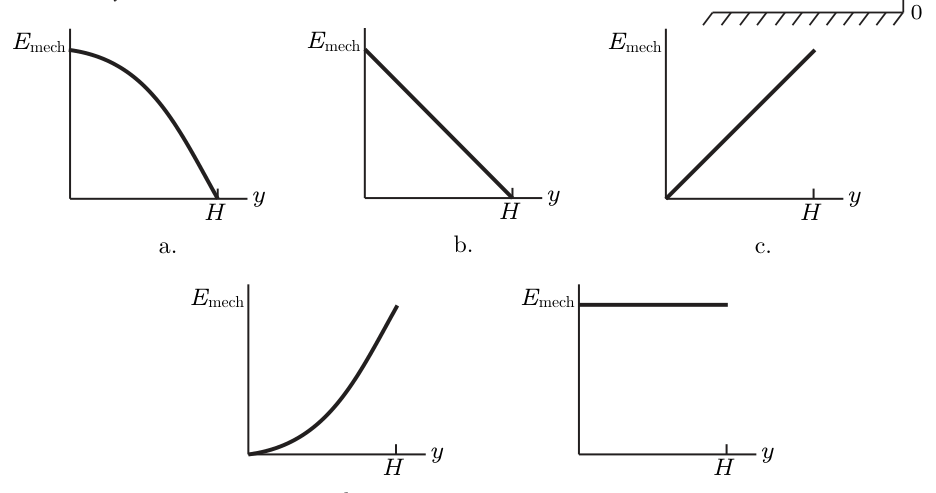 cinque grafici energia-altitudine per palla
Topic: Conservation of Energy, Newtonian Mechanics Metodi: Energy Conservation Method, Conservation Laws Competenze: Physical Reasoning, Diagrammatic Reasoning Objects: Ball Fonte: Testo (PDF) — p.4
Domanda 7 Una palla è tenuta ad un’altezza H sopra un pavimento, come disegnato nel diagramma sul
- Sì, certo. Poi viene rilasciato e cade a terra. Se la resistenza dell’aria può essere ignorata, quale dei cinque grafici di seguito (indicato a. to e. sotto ogni grafico) correttamente dà l’energia meccanica del sistema di sfere terrestri come funzione di l’altitudine y della palla?
cinque grafici energia-altitudine per palla
Topic: Conservation of Energy, Newtonian Mechanics Metodi: Energy Conservation Method, Conservation Laws Competenze: Physical Reasoning, Diagrammatic Reasoning Objects: Ball Fonte: Testo (PDF) — p.4
Question 8 Some students are doing an experiment to calculate the spring constant of a particular spring. As part of this experiment, they suspend an object from the spring, pull it downwards, and let it go. The object then oscillates up and down, with a period of about 2 seconds. The students use a stopwatch to measure the period of oscillation. The best way to get an accurate and precise measurement of the period would be to:
- A. measure the time taken for a single oscillation 10 times, and average the results.
- B. measure the time taken for 10 oscillations, and divide by 10.
- C. measure the time taken for a single oscillation 10 times, and average the results. Repeat this measurement three times, and average the results. d. measure the time taken for 10 oscillations, and divide by 10. Repeat this measurement three times, and average the results. e. All of the methods above are equivalent, and will result in the same precision in the measurement of the period of oscillation.
Topic: Oscillations & Waves Metodi: Simple Harmonic Motion Analysis, Experimental Data Analysis Competenze: Experimental Data Analysis, Measurement & Instrumentation Objects: Spring Fonte: Testo (PDF) — p.4
Domanda 8 Alcuni studenti stanno facendo un esperimento per calcolare la costante di primavera di una particolare primavera. Come parte di In questo esperimento, sospendono un oggetto dalla sorgente, lo tirano verso il basso e lo lasciano andare. L’oggetto allora oscilla su e giù, con un periodo di circa 2 secondi. Gli studenti utilizzano un orologio per misurare il periodo di oscillazione. Il modo migliore per ottenere una misurazione accurata e precisa del periodo sarebbe:
- A. misurare il tempo impiegato per una singola oscillazione 10 volte e media i risultati.
- B. misurare il tempo impiegato per 10 oscillazioni e dividere per 10.
- C. misura il tempo impiegato per una singola oscillazione 10 volte e media i risultati. Ripeti questo . La misurazione è triplice e la media dei risultati. d. misura il tempo impiegato per 10 oscillazioni e divide per 10. Ripetere questa misurazione tre volte, e la media dei risultati. e. Tutti i metodi di misura sono equivalenti e si tradurranno nella stessa precisione di un periodo di oscillazione.
Topic: Oscillations & Waves Metodi: Simple Harmonic Motion Analysis, Experimental Data Analysis Competenze: Experimental Data Analysis, Measurement & Instrumentation Objects: Spring Fonte: Testo (PDF) — p.4
Question 9 A roller-coaster car is full of water, and is moving at constant velocity along a frictionless horizontal track. Someone removes a plug in the bottom of the floor, allowing the water to drain out. Ignoring air resistance, as the water drains out the car will:
- A. slow down.
- B. continue to move at constant velocity.
- C. speed up.
- D. initially slow down, then speed up.
- E. initially speed up, then slow down.
Topic: Conservation of Momentum, Newtonian Mechanics Metodi: Conservation of Momentum, Conservation Laws Competenze: Physical Reasoning Objects: Cart, Container Fonte: Testo (PDF) — p.5
Domanda 9 Una montagna russa è piena di acqua e si muove a velocità costante lungo un orizzontale senza attrito
- La pista. Qualcuno toglie un tappo nel fondo del pavimento, permettendo all’acqua di scorrere. Ignorare l’aria resistenza, come l’acqua drena fuori la macchina:
- A. rallenta.
- ** B.** continua a muoversi a velocità costante.
- C. accelerazione.
- D. inizialmente rallenta, poi accelera.
- E. iniziale accelerare, poi rallentare.
Topic: Conservation of Momentum, Newtonian Mechanics Metodi: Conservation of Momentum, Conservation Laws Competenze: Physical Reasoning Objects: Cart, Container Fonte: Testo (PDF) — p.5
Question 10 The velocity of a particle moving along the x-axis changes from to . For which of these values of and does the particle’s kinetic energy increase the most?
- A. ,
- B. ,
- C. ,
- D. ,
- E. ,
SECTION B: WRITTEN ANSWER QUESTIONS USE THE ANSWER BOOKLET PROVIDED Note: Suggested times are given for Section B as a general guide only. You may take more or less time on any question – everyone is different.
Topic: Conservation of Energy, Newtonian Mechanics Metodi: Energy Conservation Method, Kinematic Equations Competenze: Mathematical Modeling, Physical Reasoning Objects: Particle Beam Fonte: Testo (PDF) — p.5
Domanda 10 La velocità di una particella che si muove lungo l’asse x cambia da a . Per quale di questi valori e aumenta la massima energia cinetica della particella?
- A. ,
- B. ,
- C. ,
- D. ,
- E. ,
PARTE B: Risposte scritte Utilizzate il volantino di risposta fornito Nota: I tempi suggeriti sono forniti per la sezione B solo come guida generale. Potrebbe richiedere più o meno tempo per Qualsiasi domanda… tutti sono diversi.
Topic: Conservation of Energy, Newtonian Mechanics Metodi: Energy Conservation Method, Kinematic Equations Competenze: Mathematical Modeling, Physical Reasoning Objects: Particle Beam Fonte: Testo (PDF) — p.5
Question 11 Suggested Time: 25 min The following parts of this question are unrelated and so may be completed in any order. Note that the data provided on the next page may be used for any part, as required. You must explain your reasoning for each part.
- A. Calculate the amount of energy per gram of fat.
- B. The typical office computer is only used one third of the time during business hours. Today a typical office computer consumes around 130 W of power. Estimate the cost savings and reduction in greenhouse gas emissions over one year if everyone in an office of 60 people turns off their computers when they are not using them instead of leaving them on at all times, even over the weekend. c) Estimate the energy efficiency of the conversion of sunlight into sugarcane. d) “Kilogram per kilogram humans produce more heat than the Sun.” Is this claim true?
Typical Australian Adult: Typical adult mass Typical adult height Dietary Guidelines: Recommended energy intake Recommended daily intake of fat 30% of energy (70 g/day) Recommended daily intake of carbohydrates (sugars, flour, etc.) 45–65% of energy (230–310 g/day) Electricity Data: Typical price 15 c/kWh Typical greenhouse emissions Note: 1 kWh = 1 kilowatt hour Australian Sugar Cane Data: Average yield of sugar cane Typical sugar content 15% Typical bagasse content 30% Typical water content 55% Typical energy content of bagasse Note: bagasse is the by-product of crushing sugar cane to extract sugar and is often used as a fuel. Solar System Data Earth-Sun distance Radius of Sun Mass of Sun Radius of Earth Mass of Earth Typical intensity of sunlight at Earth
Topic: Thermodynamics, Order-of-Magnitude Estimation Metodi: Order-of-Magnitude Estimation, First Law of Thermodynamics, Physical Modeling Competenze: Estimation & Approximation, Mathematical Modeling Objects: Star, Planet Fonte: Testo (PDF) — p.6
Domanda 11 Tempo di programmazione: 25 minuti Le seguenti parti della domanda non sono correlate e possono essere completate in qualsiasi ordine. Si noti che il i dati forniti nella pagina successiva possono essere utilizzati per qualsiasi parte, se necessario. Devi spiegare il tuo ragionamento per ogni parte.
- A. Calcolare la quantità di energia per grammo di grasso.
- B. Il tipico computer di ufficio viene utilizzato solo un terzo del tempo durante l’orario di lavoro. Oggi un un computer di ufficio tipico consuma circa 130 W di potenza. La Commissione ha inoltre adottato una decisione che prevede che i costi di produzione di gas serra siano ridotti in base a un’esame di un ufficio di 60 persone spegne i loro computer quando non li usano invece di andar via li metti sempre, anche durante il fine settimana. c) Estimare l’efficienza energetica della conversione della luce solare in canna da zucchero. d) Il chilo per chilo umano produce più calore del Sole. È vero questo asserimento?
Adulto australiano tipico: Massa tipica per adulti Altezza tipica per adulti Linee guida alimentari: Assunzione energetica raccomandata Assunzione giornaliera raccomandata di grassi 30% di energia (70 g/giorno) Assunzione giornaliera raccomandata di carboidrati (zucchieri, farina, ecc.) 4565% di energia (230310 g/giorno) Dati sull’elettricità: Prezzi tipici 15 c/kWh Tipico di emissioni di serra Nota: 1 kWh = 1 kilowattora Dati sulla canna da zucchero australiana: Rendimento medio della canna da zucchero Contenuto tipico di zucchero 15% Contenuto tipico di bagasse 30% Contenuto di acqua tipico 55% Contenuto energetico tipico del bagasse Nota: il bagasse è il sottoprodotto della triturazione della canna da zucchero per estrarre lo zucchero ed è spesso utilizzato come combustibile. Dati del Sistema Solare Distanza Terra-Sol Radius del Sole Massa del sole Radius della Terra Massa della Terra Typical intensità della luce solare sulla Terra
Topic: Thermodynamics, Order-of-Magnitude Estimation Metodi: Order-of-Magnitude Estimation, First Law of Thermodynamics, Physical Modeling Competenze: Estimation & Approximation, Mathematical Modeling Objects: Star, Planet Fonte: Testo (PDF) — p.6
Question 12 Suggested Time: 25 min Angus the accountant decides to change careers and starts a bicycle building business. To make his bicycles stand out he builds them with square wheels, making sure that both wheels can sit with a side flat on the ground at the same time. Angus rides his first bicycle proudly out of his shed turning his pedals at a constant rate. a) (i) Sketch the trajectory of the centre of the front wheel in the space on p. 4 of the answer booklet. (ii) On the same diagram sketch the trajectory of the centre of mass of the bicycle. In the space below the diagram explain how the trajectory of the centre of mass is related to the trajectory of the centre of the front wheel and why this is so. (iii) For each wheel label the point about which it is rotating. (iv) Label the points on the trajectory where the centre of mass of the bicycle is moving forward fastest. Explain your reasoning in the space provided below the diagram. b) Calculate the ratio of the length of the path followed by the centre of mass to the distance travelled along the road. Angus generously gives Sam one of his square wheeled bicycles for her birthday. Sam is very lazy and teaches herself to ride the bicycle so that she is only just pedalling hard enough to replace energy lost from the bike. The bike then has constant energy. c) Describe the differences and similarities between the motion of the bicycle when Sam rides compared to when Angus rides. After watching Sam ride the bicycle Angus realises the error of his ways, and decides to construct a racetrack specifically for his square bicycles. d) Draw a side view of the racetrack’s surface shape to ensure the smoothest ride on one of the square wheeled bicycles.
Topic: Newtonian Mechanics, Rotational Dynamics, Conservation of Energy Metodi: Torque & Angular Momentum Analysis, Energy Conservation Method, Physical Modeling Competenze: Diagrammatic Reasoning, Mathematical Modeling, Physical Reasoning Objects: Wheel Fonte: Testo (PDF) — p.8
Domanda 12 Tempo di programmazione: 25 minuti Angus, il contabile, decide di cambiare carriera e inizia un’attività di costruzione di biciclette. Per fargli le biciclette si distinguono costruisce con le ruote quadrate, assicurandosi che entrambe le ruote possano sedersi con un lato
- Piatto a terra allo stesso tempo. Angus cavalca orgogliosamente la sua prima bicicletta fuori dal suo capanno girando i suoi pedali a ritmo costante. a) (i) Segnare la traiettoria del centro della ruota anteriore nello spazio a p. 4 della risposta
- Il libretto.
- sullo stesso diagramma disegnare la traiettoria del centro di massa della bicicletta. Nel mondo In seguito al diagramma spiegate come la traiettoria del centro di massa sia correlata al la traiettoria del centro della ruota anteriore e il motivo per cui si tratta di tale.
- per ciascuna ruota, etichettare il punto di rotazione.
- etichettare i punti della traiettoria in cui il centro di massa della bicicletta si sta muovendo in avanti
- E’ il piu’ veloce. Spiegate il vostro ragionamento nel quadro di seguito. b) Calcolare il rapporto tra la lunghezza del percorso seguito dal centro di massa e la distanza percorsa lungo la strada. Angus dona generosamente a Sam una delle sue biciclette a ruote quadrate per il suo compleanno. Sam è molto pigro e… si impara a guidare la bicicletta in modo che stia solo pedalando abbastanza duramente per sostituire l’energia persa dalla bici. La moto ha quindi un’energia costante. c) Descrivere le differenze e le somiglianze tra il movimento della bicicletta quando Sam guida
- rispetto a quando Angus cavalca. Dopo aver visto Sam guidare la bicicletta Angus si rende conto dell’errore dei suoi modi, e decide di costruire un pista di corsa, specificamente per le sue biciclette quadrate. d) Disegnare una vista laterale della forma della superficie della pista per garantire la guida più fluida su una delle piste biciclette a ruote quadrate.
Topic: Newtonian Mechanics, Rotational Dynamics, Conservation of Energy Metodi: Torque & Angular Momentum Analysis, Energy Conservation Method, Physical Modeling Competenze: Diagrammatic Reasoning, Mathematical Modeling, Physical Reasoning Objects: Wheel Fonte: Testo (PDF) — p.8
Question 13 Suggested Time: 25 min Having missed the boat for Rio 2016, Emily and Joshua are determined to qualify instead for the Winter Olympics in 2018, to be held in PyeongChang, South Korea. Emily, being a novice skier, is sliding down a slope and desperately trying to slow down using a ‘snowplough’ stop. The ski slope makes an angle with the horizontal. By digging the inside edges of her skis into the snow while keeping them in a V-shape, Emily can stop completely. The forces due to this ploughing motion act on each ski perpendicular to the ski and along the slope. Each of these forces has magnitude . Emily has a mass m. a) (i) Which direction will the total force due to the ploughing motion be in? (ii) Explain why the magnitude of the total force due to the ploughing motion is when the angle between Emily’s skis is . b) Draw all the forces as vectors acting on Emily as she ploughs downhill on the diagram on p. 6 of the answer booklet. Include the combined effect of the ploughing forces as a single vector. c) At what angle between the skis will Emily continue down the hill at a constant speed? Joshua thinks he might have a go at the slalom event so has been practising sharp turns. d) Joshua is skiing down the slope with his skis pointing downhill and suddenly turns his skis so that they are pointing across the slope. (i) Sketch a diagram showing Joshua’s path once he has turned his skis on the diagram on p. 7 of the answer booklet. (ii) Briefly explain your reasoning. Note: another diagram might help your explanation. e) Joshua decides to practice a different turn. He skis down the same hill and then suddenly turns his skis by and then keeps them pointing in the same direction. Draw a diagram of his path on p. 7 of the answer booklet. Please point out any important features of the path.
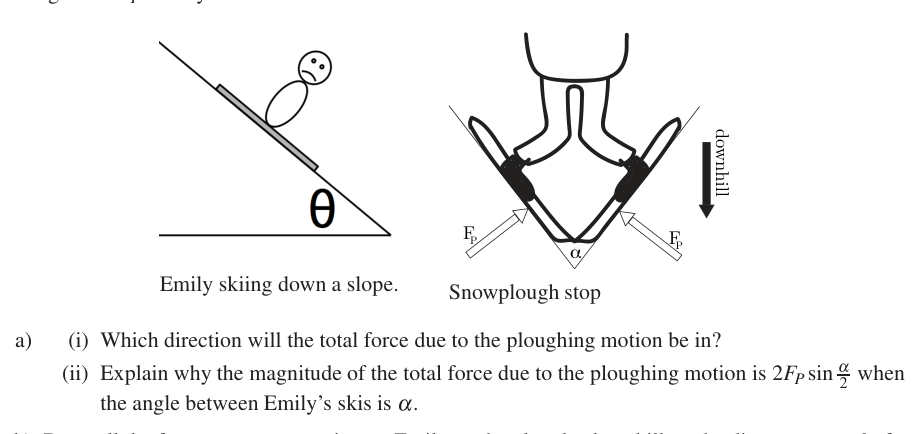 Emily scende pendio con schema snowplow
Topic: Newtonian Mechanics, Rigid Body Statics Metodi: Free-Body Diagram, Vector Decomposition, Kinematic Equations Competenze: Diagrammatic Reasoning, Physical Reasoning, Mathematical Modeling Objects: — Fonte: Testo (PDF) — p.9
Domanda 13 Tempo di programmazione: 25 minuti Dopo aver perso la barca per Rio 2016, Emily e Joshua sono determinate a qualificarsi per l’inverno Le Olimpiadi del 2018 si terranno a PyeongChang, in Corea del Sud. Emily, essendo una sciatrice novata, si scivola su una pendice e cerca disperatamente di rallentare usando un
- Fermo il foglio. La pendenza sciistica fa un angolo con l’orizzontale. Scavando i bordi interni di con gli sci nella neve, mantenendoli in forma di V, Emily può fermarsi completamente. Le forze dovute a Questo movimento di aratura agisce su ogni sci perpendicolare allo sci e lungo la pendizione. Ciascuna di queste forze ha una magnitudo . Emily ha un mass m. a) (i) In quale direzione sarà la forza totale dovuta al movimento di aratura? (ii) Spiegare perché la grandezza della forza totale dovuta al movimento di aratura è quando l’angolo tra gli sci di Emily è . b) Disegnare tutte le forze come vettori che agiscono su Emily mentre aregge verso il basso sul diagramma a p. 6 of il libretto di risposte. Include l’effetto combinato delle forze di aratura come singolo vettore. c) At what angle between the skis will Emily continue down the hill at a constant speed? Joshua pensa di poter partecipare al slalom, quindi ha praticato le curve. d) Joshua sciga per la pendiente con gli sci puntati verso il basso e improvvisamente gira gli sci in modo che
- Sottolineano la pendice. (i) Segnare un diagramma che mostri il percorso di Giosuè una volta che ha girato gli sci sul diagramma a p. 7 della brochure delle risposte. (ii) Spiegate brevemente il vostro ragionamento. Nota: un altro diagramma potrebbe aiutare la tua spiegazione. e) Giosuè decide di praticare un altro giro. Scende sulla stessa collina e poi improvvisamente si gira gli sci di e poi li tiene puntati nella stessa direzione. Disegna un diagramma del suo percorso su p. 7 del foglio di risposta. Per favore, indicate le caratteristiche importanti del percorso.
Emily scende pendio con schema snowplow
Topic: Newtonian Mechanics, Rigid Body Statics Metodi: Free-Body Diagram, Vector Decomposition, Kinematic Equations Competenze: Diagrammatic Reasoning, Physical Reasoning, Mathematical Modeling Objects: — Fonte: Testo (PDF) — p.9
Question 14 Suggested Time: 25 min Metronomes are tools sometimes used by musicians to help make their tempo more consistent when playing a piece of music. The tempo is the number of beats per minute. The metronome pictured below is set to 138 beats per minute. When the vertical arm swings back and forth it produces clicks at either end of the swing. The tempo is changed by sliding the weight up or down the metal arm until the top of the weight aligns with the marking for the desired tempo. a) Explain how you could use the image above to determine y, which is the distance from the top of the vertical arm to the top of the sliding weight, for any given tempo setting of the metronome.
- B. Use this method to complete the table of tempos and distances y on p. 8 of the answer booklet.
- C. A graph of y versus tempo has been plotted on p. 9 of the answer booklet. However, one or two of the points are not plotted correctly. (i) Complete the graph by adding any necessary labels and markings. (ii) Correct any points which have not been correctly plotted. (iii) Draw a line of best fit to the data. d) Calculate the slope of the graph and explain what information this gives about the metronome. e) What is the lowest tempo to which the metronome could be set? Explain your reasoning. f) The graphed data points do not lie exactly on the line of best fit. Suggest the most likely reason(s) why this may be so and give a detailed but concise explanation of the reasons for your suggestions in the allocated space on p. 9 of the answer booklet.
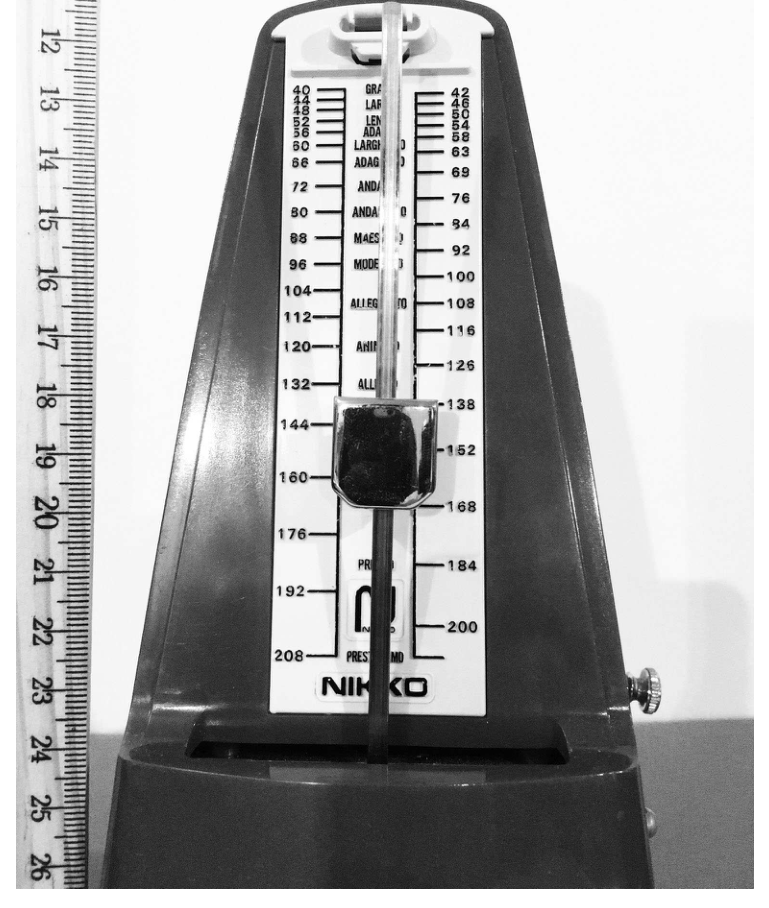 fotografia metronomo con scala tempi
Topic: Oscillations & Waves Metodi: Simple Harmonic Motion Analysis, Graph Linearization, Experimental Data Analysis Competenze: Graph Linearization, Experimental Data Analysis, Curve Fitting Objects: Pendulum Fonte: Testo (PDF) — p.10
Domanda 14 Tempo di programmazione: 25 minuti I metroni sono strumenti che a volte i musicisti usano per rendere il loro tempo più coerente quando suonare un pezzo di musica. Il tempo è il numero di battiti al minuto. Il metronomo riportato di seguito è impostato a 138 battiti al minuto. Quando il braccio verticale va avanti e indietro produce clic su entrambi i punti fine del swing. Il tempo viene modificato spostando il peso verso l’alto o verso il basso del braccio di metallo fino alla cima del il peso si allinea con il marchio per il tempo desiderato. a) Spiegate come si potrebbe usare l’immagine di cui sopra per determinare y, che è la distanza dalla parte superiore di il braccio verticale verso l’alto del peso scorrevole, per qualsiasi impostazione del tempo del metronomo.
- B. Utilizzare questo metodo per completare la tabella dei tempi e delle distanze y su p. 8 del libro di risposte.
- C. Un grafico di y contro il tempo è stato tracciato su p. 9 del foglio di risposta. Tuttavia, uno o due di i punti non sono stati tracciati correttamente.
- Completa il grafico aggiungendo le etichette e le marcature necessarie.
- correggere i punti non corretamente tracciati.
- disegnare una linea che si adatti al meglio ai dati. d) Calcolare la pendenza del grafico e spiegare quali informazioni questo fornisce sul metronomo. e) Qual è il ritmo più basso a cui si può impostare il metronomo? Spiegate il vostro ragionamento. f) I punti di dati illustrati non si trovano esattamente sulla linea di migliore adempimento. Suggerire la ragione più probabile Perché questo può essere così e dare una spiegazione dettagliata ma concisa dei motivi dei vostri suggerimenti nello spazio assegnato a p. 9 del foglio di risposta.
fotografia metronomo con tempi scala
Topic: Oscillations & Waves Metodi: Simple Harmonic Motion Analysis, Graph Linearization, Experimental Data Analysis Competenze: Graph Linearization, Experimental Data Analysis, Curve Fitting Objects: Pendulum Fonte: Testo (PDF) — p.10