A grandfather clock measures time by counting the number of oscillations of a small-angle pendulum. You take a grandfather clock that gives the correct time at sea level (where m/s²) up a mountain and notice that after two days it is running five minutes behind. What is the value of the gravitational acceleration up that mountain?
- A. m/s²
- B. m/s²
- C. m/s²
- D. m/s²
- E. There is not enough information to answer the question
Topic: Oscillations & Waves, Gravitation Metodi: Simple Harmonic Motion Analysis, Kinematic Equations Competenze: Physical Reasoning, Mathematical Modeling Objects: Pendulum Fonte: Testo (PDF) — p.2
Un orologio di nonno misura il tempo contando il numero di oscillazioni di un pendolo a piccolo angolo. Prendi un orologio di nonno che dà l’ora corretta al livello del mare (dove m/s2) su una montagna e noti che dopo due giorni è in ritardo di cinque minuti. Qual è il valore dell’accelerazione gravitazionale su quella montagna?
- A. m/s²
- B. m/s²
- C. m/s²
- D. m/s²
- E. Non ci sono informazioni sufficienti per rispondere alla domanda
Topic: Oscillations & Waves, Gravitation Metodi: Simple Harmonic Motion Analysis, Kinematic Equations Competenze: Physical Reasoning, Mathematical Modeling Objects: Pendulum Fonte: Testo (PDF) — p.2
The Hubble space telescope, having a mass of kg, is in low-Earth orbit with a semi-major axis of km. What is its orbital period?
- A. minutes
- B. minutes
- C. minutes
- D. minutes
- E. minutes
Topic: Gravitation, Newtonian Mechanics Metodi: Kepler’s Laws, Newton’s Law of Gravitation Competenze: Mathematical Modeling, Physical Reasoning Objects: Satellite, Planet Fonte: Testo (PDF) — p.2
Il telescopio spaziale Hubble, con una massa di kg, è in orbita terrestre bassa con un asse semimejor di km. Qual è il suo periodo orbitale?
- A. minuti
- B. minuti
- C. minuti
- D. minuti
- E. minuti
Topic: Gravitation, Newtonian Mechanics Metodi: Kepler’s Laws, Newton’s Law of Gravitation Competenze: Mathematical Modeling, Physical Reasoning Objects: Satellite, Planet Fonte: Testo (PDF) — p.2
A 75 kg person gets in an elevator. How much more power must the elevator’s motor supply if the elevator is to go up at the same constant speed of 0.5 m/s as it goes up when empty?
- A. W
- B. W
- C. W
- D. W
- E. W
Topic: Newtonian Mechanics, Conservation of Energy Metodi: Energy Conservation Method, Free-Body Diagram Competenze: Physical Reasoning, Mathematical Modeling Objects: — Fonte: Testo (PDF) — p.2
Una persona di 75 kg entra in ascensore. Quanto più potenza deve avere l’alimentazione motoria dell’ascensore se vuole salire alla stessa velocità costante di 0,5 m/s che quando sale vuoto?
- A. W
- B. W
- C. W
- D. W
- E. W
Topic: Newtonian Mechanics, Conservation of Energy Metodi: Energy Conservation Method, Free-Body Diagram Competenze: Physical Reasoning, Mathematical Modeling Objects: — Fonte: Testo (PDF) — p.2
A 2 kg ball is initially stationary on a flat, frictionless surface. It is then hit by a 0.25 kg piece of putty traveling at 25 m/s. After the collision, the putty sticks to the ball. At what speed will the putty-covered ball travel?
- A. m/s
- B. m/s
- C. m/s
- D. m/s
- E. m/s
Topic: Newtonian Mechanics, Conservation of Momentum Metodi: Conservation of Momentum, Impulse-Momentum Theorem Competenze: Physical Reasoning, Mathematical Modeling Objects: Ball Fonte: Testo (PDF) — p.2
Una palla da 2 kg è inizialmente stazionaria su una superficie piatta e senza attrito. È quindi colpito da un pezzo di putty di 0,25 kg che viaggia a 25 m/s. Dopo la collisione, il putty si attacca alla palla. A che velocità la palla ricoperta di putty si muoverà?
- A. m/s
- B. m/s
- C. m/s
- D. m/s
- E. m/s
Topic: Newtonian Mechanics, Conservation of Momentum Metodi: Conservation of Momentum, Impulse-Momentum Theorem Competenze: Physical Reasoning, Mathematical Modeling Objects: Ball Fonte: Testo (PDF) — p.2
You are holding a bottle of pop in your hands on a bus. The bubbles in the pop are going straight up. Suddenly, the bus brakes hard to avoid a road hazard. How is the motion of the bubbles in the pop affected?
- A. The bubbles will gain some motion towards the front of the bus.
- B. The answer depends on the initial speed of the bus.
- C. The motion of the bubbles will not change.
- D. The bubbles will gain some motion towards the back of the bus.
Topic: Fluid Mechanics, Newtonian Mechanics Metodi: Free-Body Diagram, Physical Modeling Competenze: Physical Reasoning, Diagrammatic Reasoning Objects: Bubble Fonte: Testo (PDF) — p.3
Stai tenendo una bottiglia di pop in mano su un autobus. Le bolle in aria stanno andando dritto in su. All’improvviso, l’autobus frena fortemente per evitare un pericolo stradale. Come si influisce il movimento delle bolle nella pop?
Le bolle guadagneranno un certo movimento verso la parte anteriore dell’autobus.
- B. La risposta dipende dalla velocità iniziale dell’autobus.
- C. Il movimento delle bolle non cambierà. Le bolle guadagneranno un certo movimento verso la parte posteriore dell’autobus.
Topic: Fluid Mechanics, Newtonian Mechanics Metodi: Free-Body Diagram, Physical Modeling Competenze: Physical Reasoning, Diagrammatic Reasoning Objects: Bubble Fonte: Testo (PDF) — p.3
Consider an open circuit consisting of a battery with voltage , a resistor of resistance and a capacitor of capacitance , all in series. Before closing the circuit, the capacitor carries no charge. After how long does the current running through the circuit drop by half compared to the moment it is closed?
- A.
- B.
- C.
- D.
- E.
Topic: Circuits Metodi: Kirchhoff’s Laws, Differential Equations Competenze: Mathematical Modeling, Physical Reasoning Objects: Battery, Resistor, Capacitor Fonte: Testo (PDF) — p.3
Considerare un circuito aperto costituito da una batteria a tensione , da una resistenza e da un condensatore a capacità , tutti in serie. Prima di chiudere il circuito, il condensatore non porta carica. Dopo quanto tempo la corrente che attraversa il circuito scende di metà rispetto al momento in cui viene chiusa?
- A.
- B.
- C.
- D.
- E.
Topic: Circuits Metodi: Kirchhoff’s Laws, Differential Equations Competenze: Mathematical Modeling, Physical Reasoning Objects: Battery, Resistor, Capacitor Fonte: Testo (PDF) — p.3
Which value is closest to the average net speed of electrons (“drift speed”) in a copper wire of radius 1 mm for a current of 3 Amperes? The density of copper at room temperature is about 9 g/cm³ and its molar mass is 63.5 g/mol.
- A. m/s
- B. m/s
- C. m/s
- D. m/s
- E. m/s
Topic: Electromagnetism, Circuits Metodi: Order-of-Magnitude Estimation, Physical Modeling Competenze: Estimation & Approximation, Physical Reasoning Objects: Wire, Electron Fonte: Testo (PDF) — p.3
Qual è il valore più vicino alla velocità netta media degli elettroni (“velocità di deriva”) in un filo di rame di 1 mm di raggio per una corrente di 3 Ampere? La densità del rame a temperatura ambiente è di circa 9 g/cm3 e la sua massa molare è di 63,5 g/mol.
- A. m/s
- B. m/s
- C. m/s
- D. m/s
- E. m/s
Topic: Electromagnetism, Circuits Metodi: Order-of-Magnitude Estimation, Physical Modeling Competenze: Estimation & Approximation, Physical Reasoning Objects: Wire, Electron Fonte: Testo (PDF) — p.3
Consider three charges located at the three vertices of an equilateral triangle of edge length . Two of the charges have a value of and the third one has a value of . What is the magnitude of the net electric field at the centre of the triangle?
- A.
- B.
- C.
- D.
- E.
Topic: Electrostatics Metodi: Coulomb’s Law, Superposition Principle, Vector Decomposition Competenze: Mathematical Modeling, Physical Reasoning Objects: Point Charge Fonte: Testo (PDF) — p.3
Considerate tre cariche posizionate alle tre vertici di un triangolo equilaterale di lunghezza di bordo . Due dei diritti hanno un valore di e il terzo ha un valore di . Qual è la magnitudine del campo elettrico netto al centro del triangolo?
- A.
- B.
- C.
- D.
- E.
Topic: Electrostatics Metodi: Coulomb’s Law, Superposition Principle, Vector Decomposition Competenze: Mathematical Modeling, Physical Reasoning Objects: Point Charge Fonte: Testo (PDF) — p.3
An FM radio station broadcasts signals at a frequency of about 100 MHz. What is approximately the wavelength of such a signal?
- A. m
- B. m
- C. m
- D. m
- E. More information is needed to answer this question
Topic: Oscillations & Waves Metodi: Wave Equation, Order-of-Magnitude Estimation Competenze: Physical Reasoning, Estimation & Approximation Objects: — Fonte: Testo (PDF) — p.3
Una stazione radio FM trasmette segnali a una frequenza di circa 100 MHz. Qual è la lunghezza d’onda di un tale segnale?
- A. m
- B. m
- C. m
- D. m
- E. Per rispondere a questa domanda occorrono ulteriori informazioni
Topic: Oscillations & Waves Metodi: Wave Equation, Order-of-Magnitude Estimation Competenze: Physical Reasoning, Estimation & Approximation Objects: — Fonte: Testo (PDF) — p.3
A bright flash of light has a measured intensity of 800 W/m² at a distance of 1 m from the source. What will be the measured intensity 10 m away from the source, treating the source as point-like?
- A. W/m²
- B. W/m²
- C. W/m²
- D. W/m²
- E. W/m²
Topic: Oscillations & Waves, Geometric Optics Metodi: Physical Modeling, Superposition Principle Competenze: Physical Reasoning, Mathematical Modeling Objects: — Fonte: Testo (PDF) — p.3
Un lampo luminoso ha un’intensità misurata di 800 W/m2 a una distanza di 1 m dalla sorgente. Qual sarà l’intensità misurata a 10 m dalla sorgente, trattandola come punto?
- A. W/m²
- B. W/m²
- C. W/m²
- D. W/m²
- E. W/m²
Topic: Oscillations & Waves, Geometric Optics Metodi: Physical Modeling, Superposition Principle Competenze: Physical Reasoning, Mathematical Modeling Objects: — Fonte: Testo (PDF) — p.3
Unstable elementary particles are produced traveling at with respect to an observer in a laboratory. These particles have a typical intrinsic lifetime of 100 ns. In the frame of the observer, how long will the particles typically last before decaying?
- A. ns
- B. ns
- C. ns
- D. They won’t decay while moving.
- E. ns
Topic: Special Relativity Metodi: Lorentz Transformation, Physical Modeling Competenze: Physical Reasoning, Mathematical Modeling Objects: Particle Beam Fonte: Testo (PDF) — p.3
Le particelle elementari instabili sono prodotte viaggiando a rispetto ad un osservatore in laboratorio. Queste particelle hanno una vita intrinseca tipica di 100 ns. Nel quadro dell’osservatore, quanto tempo dureranno le particelle prima di decadere?
- A. ns
- B. ns
- C. ns
- Non si decompongono mentre si muovono.
- E. ns
Topic: Special Relativity Metodi: Lorentz Transformation, Physical Modeling Competenze: Physical Reasoning, Mathematical Modeling Objects: Particle Beam Fonte: Testo (PDF) — p.3
A red beam of light is made up of a stream of photons. If we double the frequency of the beam, keeping the intensity constant, what will happen to the stream?
- A. The number of photons will stay the same and the energy of each photon will stay the same.
- B. The number of photons will stay the same and the energy of each photon will increase.
- C. The number of photons will decrease and the energy of each photon will increase.
- D. The number of photons will increase and the energy of each photon will stay the same.
- E. The number of photons will increase and the energy of each photon will increase.
Topic: Modern-Quantum Physics Metodi: Photon Energy Relation, Physical Modeling Competenze: Physical Reasoning, Mathematical Modeling Objects: Photon Fonte: Testo (PDF) — p.3
Un raggio rosso di luce è composto da un flusso di fotoni. Se raddoppiamo la frequenza del raggio, mantenendo costante l’intensità, cosa accadrà al flusso?
- A. Il numero di fotoni rimarrà lo stesso e l’energia di ogni fotone rimarrà lo stesso.
- B. Il numero di fotoni rimarrà lo stesso e l’energia di ogni fotone aumenterà.
- C. Il numero dei fotoni diminuirà e l’energia di ogni fotone aumenterà.
- D. Il numero dei fotoni aumenterà e l’energia di ogni fotone rimarrà la stessa.
- E. Il numero di fotoni aumenterà e l’energia di ogni fotone aumenterà.
Topic: Modern-Quantum Physics Metodi: Photon Energy Relation, Physical Modeling Competenze: Physical Reasoning, Mathematical Modeling Objects: Photon Fonte: Testo (PDF) — p.3
A beam of electrons is sent through a small hole in a piece of foil. The places where the electrons hit a distant screen are recorded. If we make the hole smaller, the region where the electrons are hitting the screen will be:
- A. bigger
- B. the same size
- C. smaller
- D. there is not enough information to answer.
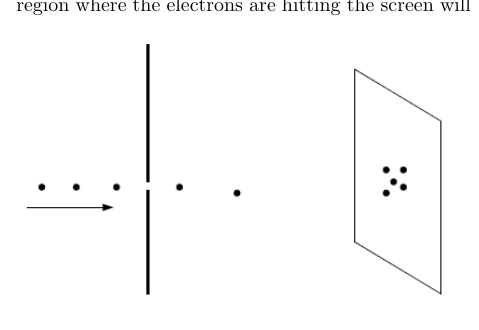 Electron beam through small hole diagram
Topic: Modern-Quantum Physics, Wave Optics Metodi: de Broglie Relation, Interference & Diffraction Analysis Competenze: Physical Reasoning, Diagrammatic Reasoning Objects: Electron, Slit, Screen Fonte: Testo (PDF) — p.4
Un raggio di elettroni viene inviato attraverso un piccolo buco in un pezzo di foglio. I luoghi in cui gli elettroni colpiscono uno schermo lontano vengono registrati. Se facciamo il buco più piccolo, la regione in cui gli elettroni colpiscono lo schermo sarà:
- A. più grande
- B. della stessa taglia
- C. più piccolo
- D. non ci sono informazioni sufficienti per rispondere.
Raggio elettronico attraverso il diagramma di buchi piccoli
Topic: Modern-Quantum Physics, Wave Optics Metodi: de Broglie Relation, Interference & Diffraction Analysis Competenze: Physical Reasoning, Diagrammatic Reasoning Objects: Electron, Slit, Screen Fonte: Testo (PDF) — p.4
The magnitude of the gravitational force with which a ping pong ball attracts the Earth is:
- A. equal to the magnitude of the gravitational force with which the Earth attracts that ping pong ball.
- B. greater than the magnitude of the gravitational force with which the Earth attracts that ping pong ball.
- C. less than the magnitude of the gravitational force with which the Earth attracts that ping pong ball.
- D. zero.
- E. unknowable.
Topic: Newtonian Mechanics, Gravitation Metodi: Newton’s Law of Gravitation, Physical Modeling Competenze: Physical Reasoning, Diagrammatic Reasoning Objects: Ball, Planet Fonte: Testo (PDF) — p.4
La grandezza della forza gravitazionale con cui una palla di ping pong attira la Terra è:
- A. uguale alla grandezza della forza gravitazionale con cui la Terra attira quella palla di ping pong.
- B. maggiore della grandezza della forza gravitazionale con cui la Terra attira quella palla di ping pong.
- C. inferiore alla grandezza della forza gravitazionale con cui la Terra attira quella palla di ping pong.
- D. zero.
- E. inconoscibile.
Topic: Newtonian Mechanics, Gravitation Metodi: Newton’s Law of Gravitation, Physical Modeling Competenze: Physical Reasoning, Diagrammatic Reasoning Objects: Ball, Planet Fonte: Testo (PDF) — p.4
An object is released from rest at a height . For the object to go around the loop (of radius ) what is the smallest possible value of ?
- A.
- B.
- C.
- D.
- E.
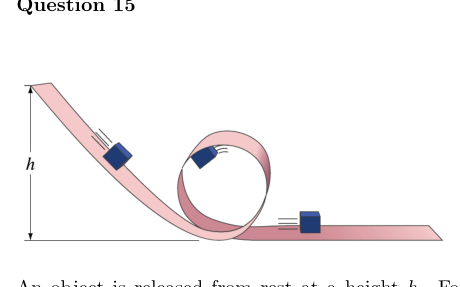 Object on ramp with loop diagram
Topic: Newtonian Mechanics, Conservation of Energy Metodi: Energy Conservation Method, Free-Body Diagram Competenze: Physical Reasoning, Mathematical Modeling Objects: — Fonte: Testo (PDF) — p.4
Un oggetto viene rilasciato dal riposo ad un’altezza . Per che l’oggetto faccia la cerchia (di raggio ) qual è il valore più piccolo possibile di ?
- A.
- B.
- C.
- D.
- E.
Oggetto in rampa con diagramma a circuito
Topic: Newtonian Mechanics, Conservation of Energy Metodi: Energy Conservation Method, Free-Body Diagram Competenze: Physical Reasoning, Mathematical Modeling Objects: — Fonte: Testo (PDF) — p.4
Two projectiles, K and Z, are launched from the top of a building with the same initial speed. Their launch angles (relative to the horizontal ground) are and . Which projectile will hit the ground with greater speed (neglecting air resistance)?
- A. K
- B. Z
- C. Both will have the same speed
- D. K will never hit the ground
- E. There is not enough information to tell
Topic: Newtonian Mechanics, Conservation of Energy Metodi: Kinematic Equations, Conservation of Energy Competenze: Physical Reasoning, Mathematical Modeling Objects: Projectile Fonte: Testo (PDF) — p.4
Due proiettili, K e Z, vengono lanciati dalla cima di un edificio con la stessa velocità iniziale. Gli angoli di lancio (rispetto al terreno orizzontale) sono e . Quale proiettile colpirà il terreno con maggiore velocità (negliendosi la resistenza dell’aria)?
- A. K
- B. Z
- C. Entrambi avranno la stessa velocità
- D. K non colpirà mai il terreno
- E. Non ci sono informazioni sufficienti per dire
Topic: Newtonian Mechanics, Conservation of Energy Metodi: Kinematic Equations, Conservation of Energy Competenze: Physical Reasoning, Mathematical Modeling Objects: Projectile Fonte: Testo (PDF) — p.4
A ray of light passes through three media as shown in the figure. How are the speeds of light in these media related?
- A.
- B.
- C.
- D.
- E.
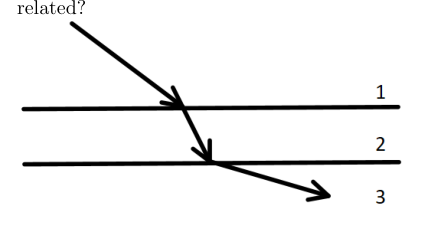 Ray of light through three media
Topic: Geometric Optics, Wave Optics Metodi: Snell’s Law, Ray Tracing Competenze: Diagrammatic Reasoning, Physical Reasoning Objects: — Fonte: Testo (PDF) — p.4
Un raggio di luce passa attraverso tre mezzi, come mostrato nella figura. Come sono correlate le velocità della luce in questi mezzi?
- A.
- B.
- C.
- D.
- E.
Raggio luminoso attraverso tre mezzi
Topic: Geometric Optics, Wave Optics Metodi: Snell’s Law, Ray Tracing Competenze: Diagrammatic Reasoning, Physical Reasoning Objects: — Fonte: Testo (PDF) — p.4
Two space heaters are made to output their nominal power of 1000 W and 500 W respectively when they are supplied with 120 V. If they are connected in series to a normal (120 V) wall outlet, compared to only the 1000 W heater how much heat will be produced?
- A. More
- B. Less
- C. The same amount
Topic: Circuits Metodi: Kirchhoff’s Laws, Equivalent Circuit Reduction Competenze: Physical Reasoning, Mathematical Modeling Objects: Resistor Fonte: Testo (PDF) — p.4
Due riscaldatori di spazio sono realizzati per produrre rispettivamente una potenza nominale di 1000 W e 500 W quando sono alimentati da 120 V. Se sono collegate in serie ad una normale uscita di parete (120 V), rispetto al solo riscaldatore da 1000 W, quanto calore produrrà?
- A. Più
- B. Meno
- C. La stessa quantità
Topic: Circuits Metodi: Kirchhoff’s Laws, Equivalent Circuit Reduction Competenze: Physical Reasoning, Mathematical Modeling Objects: Resistor Fonte: Testo (PDF) — p.4
A magnet is held between two conductive rings that are attached to a frictionless rail by two insulators (they can move freely to the left and right). If we move the magnet to the left what will happen to the rings?
- A. A will move right and B will move left
- B. A will move left and B will move right
- C. They will both move left
- D. They will both move right
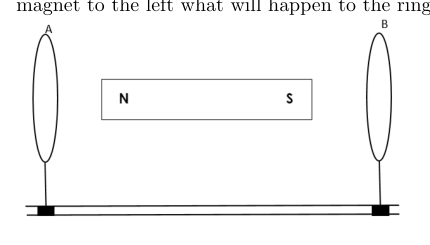 Magnet between two conductive rings on rail
Topic: Electromagnetic Induction, Magnetism Metodi: Faraday’s Law of Induction, Lenz’s Law Competenze: Diagrammatic Reasoning, Physical Reasoning Objects: Magnet Fonte: Testo (PDF) — p.5
Un magnete è tenuto tra due anelli conduttori che sono attaccati a una rotaia senza attrito da due isolanti (possono muoversi liberamente a sinistra e a destra). Se spostamo il magnete a sinistra cosa accadrà agli anelli?
- A. A si muoverà a destra e B a sinistra
- B. A si muoverà a sinistra e B si muoverà a destra
- C. Entrambi si muoveranno a sinistra
- D. Entrambi si muoveranno a destra
Magnete tra due anelli conduttori su rotaia
Topic: Electromagnetic Induction, Magnetism Metodi: Faraday’s Law of Induction, Lenz’s Law Competenze: Diagrammatic Reasoning, Physical Reasoning Objects: Magnet Fonte: Testo (PDF) — p.5
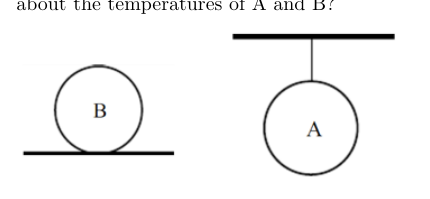
Consider two identical homogeneous balls, A and B, with the same initial temperatures. One of them is at rest on a horizontal plane, while the second one hangs on a thread. The same quantity of heat has been supplied to both balls. Which of the following statements is true about the temperatures of A and B?
- A.
- B.
- C.
Topic: Thermodynamics Metodi: First Law of Thermodynamics, Physical Modeling Competenze: Physical Reasoning, Diagrammatic Reasoning Objects: Ball Fonte: Testo (PDF) — p.5
Considerate due palle omogenee identiche, A e B, con le stesse temperature iniziali. Uno di essi è a riposo su un piano orizzontale, mentre il secondo è appeso a un filo. La stessa quantità di calore è stata fornita a entrambe le palle. Quale delle seguenti affermazioni è vera riguardo alle temperature di A e B?
- A.
- B.
- C.
Topic: Thermodynamics Metodi: First Law of Thermodynamics, Physical Modeling Competenze: Physical Reasoning, Diagrammatic Reasoning Objects: Ball Fonte: Testo (PDF) — p.5
A square hole is cut out from a rectangular sheet of metal. What would the shape of the hole be after heating the piece up? (The pictures are focused on the hole and do not show the whole sheet.)
- A. [see figure a]
- B. [see figure b]
- C. [see figure c]
- D. [see figure d]
 Metal sheet with square hole (original)
 Option (a) shape of hole after heating
 Option (b) shape of hole after heating
 Option (c) shape of hole after heating
 Option (d) shape of hole after heating
Topic: Thermodynamics, Elasticity & Materials Metodi: Physical Modeling, Approximation & Series Expansion Competenze: Physical Reasoning, Diagrammatic Reasoning Objects: — Fonte: Testo (PDF) — p.5
Un buco quadrato viene tagliato da un foglio di metallo rettangolare. Come sarebbe la forma del buco dopo aver riscaldato il pezzo? (Le immagini sono focalizzate sul buco e non mostrano l’intero foglio.)
- A. [vedere figura a]
- B. [vedi figura b]
- C. [vedere figura c]
- D. [vedi figura d]
*Liccia di metallo con buco quadrato (originale) *
Opzione (a) forma di buco dopo il riscaldamento
Opzione (b) forma del buco dopo il riscaldamento
*Forma di buco dopo riscaldamento *
Forma d’opzione del foro dopo il riscaldamento
Topic: Thermodynamics, Elasticity & Materials Metodi: Physical Modeling, Approximation & Series Expansion Competenze: Physical Reasoning, Diagrammatic Reasoning Objects: — Fonte: Testo (PDF) — p.5
The lens shown below constructs a real image (B) of the arrow (A) on the screen (S). What will happen to the image if we paint the upper half of the lens black?
- A. The image will get inverted.
- B. The upper half of the image will disappear.
- C. The lower half of the image will disappear.
- D. The shape of the image will remain the same and will only get dimmer.
 Lens forming real image of arrow on screen
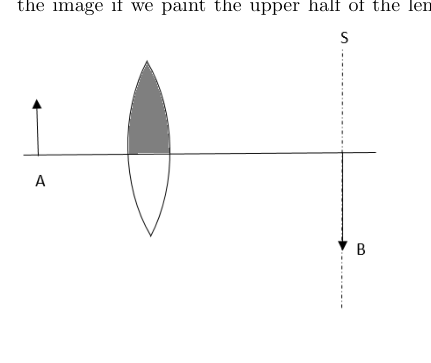 Lens diagram with object, image and screen
Topic: Geometric Optics Metodi: Ray Tracing, Thin Lens & Mirror Equation Competenze: Diagrammatic Reasoning, Physical Reasoning Objects: Lens, Screen Fonte: Testo (PDF) — p.5
L’obiettivo mostrato di seguito costruisce una vera immagine (B) della freccia (A) sullo schermo (S). Cosa accadrà all’immagine se dipingiamo la metà superiore della lente in nero?
- A. L’immagine verrà invertita.
- B. La metà superiore dell’immagine scomparirà.
- C. La metà inferiore dell’immagine scomparirà.
- D. La forma dell’immagine rimarrà la stessa e diventerà solo più sottile.
Lens che forma una vera immagine di freccia sullo schermo
Diagramma dell’obiettivo con oggetto, immagine e schermo
Topic: Geometric Optics Metodi: Ray Tracing, Thin Lens & Mirror Equation Competenze: Diagrammatic Reasoning, Physical Reasoning Objects: Lens, Screen Fonte: Testo (PDF) — p.5
A ring is placed at a distance on the left side of a lens of focal distance , along the optical axis. Which of these pictures best shows the shape of the image?
- A. [see figure a]
- B. [see figure b]
- C. [see figure c]
- D. [see figure d]
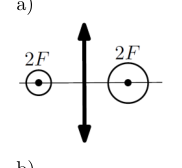 Option (a) image of ring through lens
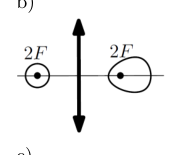 Option (b) image of ring through lens
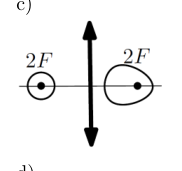 Option (c) image of ring through lens
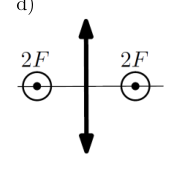 Option (d) image of ring through lens
Topic: Geometric Optics Metodi: Thin Lens & Mirror Equation, Ray Tracing Competenze: Diagrammatic Reasoning, Physical Reasoning Objects: Lens Fonte: Testo (PDF) — p.6
Un anello è posizionato a distanza sul lato sinistro di un obiettivo di distanza focale , lungo l’asse ottico. Quale di queste immagini mostra meglio la forma dell’immagine?
- A. [vedere figura a]
- B. [vedi figura b]
- C. [vedere figura c]
- D. [vedi figura d]
Opzione (a) immagine di anello attraverso l’obiettivo
Opzione (b) immagine di anello attraverso l’obiettivo
Immagine opzionale (c) di anello attraverso l’obiettivo
Immagine d) opzionale di anello attraverso l’obiettivo
Topic: Geometric Optics Metodi: Thin Lens & Mirror Equation, Ray Tracing Competenze: Diagrammatic Reasoning, Physical Reasoning Objects: Lens Fonte: Testo (PDF) — p.6
While on a long plane ride over the equator (where the Earth’s radius is 6 378 km), the captain announces that the local gravitational acceleration is 9.75 m/s². At approximately what altitude is the plane flying?
- A. m
- B. m
- C. m
- D. m
- E. m
Topic: Gravitation, Newtonian Mechanics Metodi: Newton’s Law of Gravitation, Approximation & Series Expansion Competenze: Mathematical Modeling, Physical Reasoning Objects: Planet Fonte: Testo (PDF) — p.6
Mentre si fa un lungo viaggio aereo sull’equatore (dove il raggio della Terra è di 6 378 km), il capitano annuncia che l’accelerazione gravitazionale locale è di 9,75 m/s2. A quanta quota circa vola l’aereo?
- A. m
- B. m
- C. m
- D. m
- E. m
Topic: Gravitation, Newtonian Mechanics Metodi: Newton’s Law of Gravitation, Approximation & Series Expansion Competenze: Mathematical Modeling, Physical Reasoning Objects: Planet Fonte: Testo (PDF) — p.6
Problem 1 (Part B)
A railway car wheel is made by getting a solid steel wheel of diameter cm and covering the rim of the wheel with a thin (0.5 cm) ring of hard steel. To do so, the ring is heated to 400°C. At that temperature it has an inner diameter identical to that of the cold wheel (75 cm). After putting the ring on the wheel, it was cooled back down to room temperature. The coefficient of linear expansion of the steel is K and the elastic constant of a strip of steel with the same cross section and length as the ring is N/m. What force would one need to slide the ring off the wheel (in the direction parallel to the axis)? The coefficient of friction of steel on steel is .
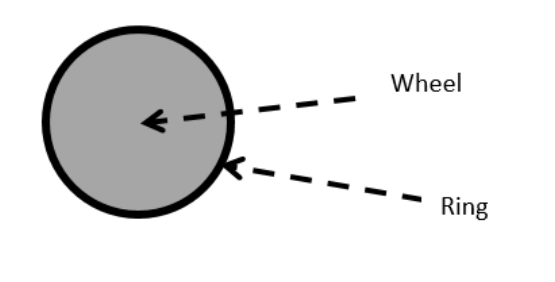 Railway wheel with steel ring cross-section
Topic: Elasticity & Materials, Thermodynamics Metodi: Hooke’s Law, Stress-Strain Analysis, Physical Modeling Competenze: Mathematical Modeling, Physical Reasoning Objects: Wheel Fonte: Testo (PDF) — p.7
**Il problema 1 (parte B) **
Una ruota di auto ferroviaria è realizzata ottenendo una ruota in acciaio solida di diametro cm e coprendo il bordo della ruota con un anello sottile (0,5 cm) di acciaio duro. Per questo, l’anello viene riscaldato a 400°C. A tale temperatura ha un diametro interno identico a quello della ruota fredda (75 cm). Dopo aver messo l’anello sul volante, è stato raffreddato a temperatura ambiente. Il coefficiente di espansione lineare dell’acciaio è K e la costante elastica di una striscia di acciaio con la stessa sezione e lunghezza del anello è N/m. Che forza è necessaria per scivolare l’anello dal ruota (in direzione parallela all’asse)? Il coefficiente di attrito dell’acciaio sullo acciaio è .
Rota ferroviaria con sezione trasversale di anello in acciaio
Topic: Elasticity & Materials, Thermodynamics Metodi: Hooke’s Law, Stress-Strain Analysis, Physical Modeling Competenze: Mathematical Modeling, Physical Reasoning Objects: Wheel Fonte: Testo (PDF) — p.7
Problem 2 (Part B)
Some people are not satisfied with just driving snowmobiles on snow and try high jumps on them. In flight, the angle which the snowmobile makes with the horizontal can be changed by using the brakes or accelerator. Shortly explain how this is done, quoting the appropriate physics laws. Assuming that the mass of the snowmobile with the rider is about 250 kg and the mass of the rotating parts is about 20 kg, calculate what he has to do to tilt the snowmobile by down (to lower the front) and then maintain the snowmobile at that angle. State any approximations and size estimates that you make.
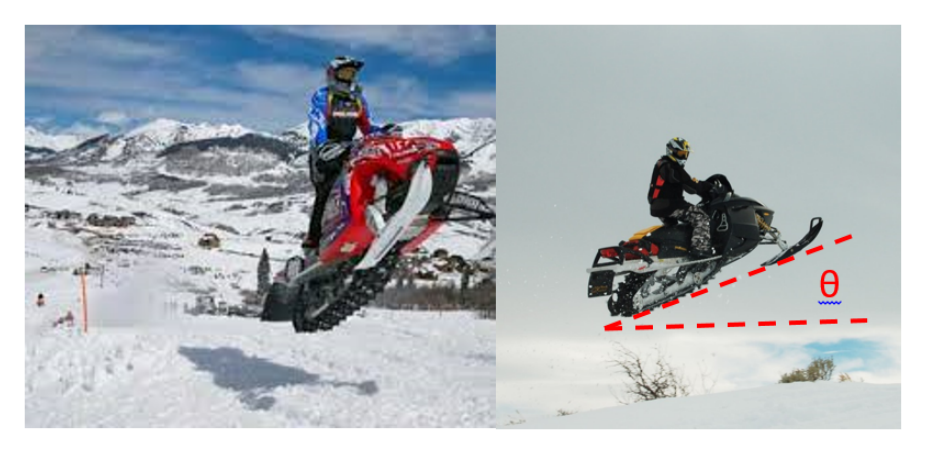 Snowmobile in flight during high jump
Topic: Rotational Dynamics, Newtonian Mechanics Metodi: Torque & Angular Momentum Analysis, Conservation of Momentum, Physical Modeling Competenze: Mathematical Modeling, Estimation & Approximation Objects: — Fonte: Testo (PDF) — p.8
**Il problema 2 (parte B) **
Alcune persone non sono soddisfatte solo di guidare motosinn sulla neve e provare a saltare in altezza su di loro. Durante il volo, l’angolo che la motoscafo fa con l’orizzontale può essere modificato utilizzando i freni o l’acceleratore. Spiegate brevemente come si fa questo, citando le leggi fisiche appropriate. Supponendo che la massa della motoscafo con il pilota sia di circa 250 kg e la massa delle parti rotanti di circa 20 kg, calcolare cosa deve fare per inclinare la motoscafo di in basso (per abbassare la parte anteriore) e quindi mantenere la motoscafo di neve in quell’angolo. Indicare le approssimative e le stime di dimensioni che si fanno.
Snowmobile in volo durante il salto di altezza
Topic: Rotational Dynamics, Newtonian Mechanics Metodi: Torque & Angular Momentum Analysis, Conservation of Momentum, Physical Modeling Competenze: Mathematical Modeling, Estimation & Approximation Objects: — Fonte: Testo (PDF) — p.8
Problem 3 (Part B)
A Reuleaux triangle is a two-dimensional figure defined as the intersection of three identical disks placed so that the center of each disk lies on the boundary of the other two (see diagram).
The moment of inertia of a Reuleaux triangle rotating about its centre of mass is given by
where is its mass, the radius of the circles and is a numerical constant.
(a) Consider a “wheel” in the shape of a Reuleaux triangle with uniform density, resting on a flat surface. What is the frequency of small oscillations of this wheel? Neglect any slipping.
(b) Consider two logs with Reuleaux triangle cross-sections placed on a flat horizontal surface and supporting a long flat plank of wood, as shown. Assume no slipping and consider only the time period before one of the logs reaches the end of the plank. Sketch the height of the center of mass of the plank as a function of horizontal displacement.
- C. Is there a configuration in part
- B. for which the center of mass of the whole system (logs + plank) remains at constant height as the plank moves? Justify your answer.
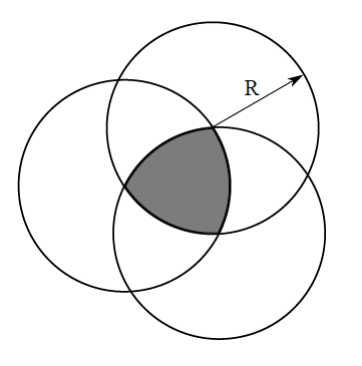 Reuleaux triangle geometry definition
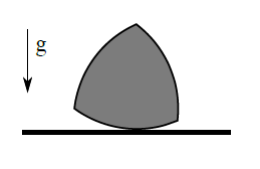 Reuleaux triangle wheel on flat surface
 Two Reuleaux logs supporting a plank
Topic: Oscillations & Waves, Rotational Dynamics, Newtonian Mechanics Metodi: Simple Harmonic Motion Analysis, Torque & Angular Momentum Analysis, Conservation of Energy Competenze: Mathematical Modeling, Physical Reasoning Objects: Disk, Wheel Fonte: Testo (PDF) — p.9
**Il problema 3 (parte B) **
Un triangolo di Reuleaux è una figura bidimensionale definita come l’intersezione di tre dischi identici posizionati in modo che il centro di ciascun disco si trovi sul confine degli altri due (vedi diagramma).
Il momento di inerzia di un triangolo di Reuleaux che ruota intorno al suo centro di massa è dato da
dove è la sua massa, il raggio dei cerchi e è una costante numerica.
(a) Considerate una “ruota” a forma di triangolo di Reuleaux di densità uniforme, appoggiata su una superficie piatta. Qual è la frequenza delle piccole oscillazioni di questa ruota? - Non fare scivolare.
b) Considerate due tronchi con sezioni trasversali del triangolo Reuleaux posizionati su una superficie piatta orizzontale e sostenendo una lunga tavola piatta di legno, come mostrato. Non scorre e considera solo il periodo di tempo prima che uno dei tronchi raggiunga la fine della tavola. Segnare l’altezza del centro di massa della tavola in funzione del spostamento orizzontale.
- C. C’è una configurazione in parte
- B. per il quale il centro di massa di tutto il sistema (log + tavola) rimane ad un’altezza costante mentre la tavola si muove? giustifica la tua risposta.
Definizione della geometria del triangolo di Reuleaux
Rei di triangolo Reuleaux su superficie piana
Due registri Reuleaux che supportano una lavagna
Topic: Oscillations & Waves, Rotational Dynamics, Newtonian Mechanics Metodi: Simple Harmonic Motion Analysis, Torque & Angular Momentum Analysis, Conservation of Energy Competenze: Mathematical Modeling, Physical Reasoning Objects: Disk, Wheel Fonte: Testo (PDF) — p.9