- FUEL CONSUMPTION (5 points) — Jaan Kalda. The given graph (a larger copy is on an extra sheet) shows a car’s fuel consumption as a function of time. It is known that the car started moving from a horizontal road segment with initial acceleration . At time s, the road was horizontal and the driver switched on the cruise control for constant speed km/h. Shortly afterwards, the car started moving up a hill. How high was the highest point on the road over that hill, relative to the height at ? Assume that the efficiency of the car was constant at all times. Remark: between seconds 2 and 10, there might have been ascents and/or descents on the road. fuel consumption (L/100 km) t (s) 25 20 15 10 5 0 10 20 30
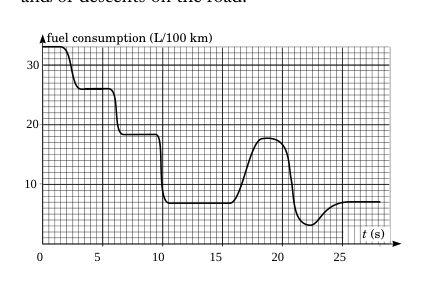 consumo carburante in funzione del tempo
Topic: Conservation of Energy, Newtonian Mechanics Metodi: Energy Conservation Method, Experimental Data Analysis, Graph Linearization Competenze: Experimental Data Analysis, Graph Linearization, Physical Reasoning Objects: — Fonte: Testo (PDF) — p.1
- Consumo di carburante (5 punti) Jaan Calda, non è così. Il grafico dato (una copia più grande è su un foglio extra) mostra il consumo di carburante di un’auto come funzione del tempo. È noto che l’auto ha iniziato a spostarsi da un segmento stradale orizzontale con accelerazione iniziale . A tempo debito s, la strada era orizzontale e il conducente con controllo di crociera a velocità costante km/h. Poco dopo, l’auto cominciò a salire su una collina. Quanto alto era il più alto punto sulla strada sopra quella collina, rispetto al altezza a ? Supponiamo che l’efficienza della La macchina era costante in ogni momento. Nota: tra secondi 2 e 10, ci sono state ascese. e/o discese sulla strada. consumo di carburante (L/100 km) t (s) 25 20 15 10 5 0 10 20 30
consumo carburante in funzione del tempo
Topic: Conservation of Energy, Newtonian Mechanics Metodi: Energy Conservation Method, Experimental Data Analysis, Graph Linearization Competenze: Experimental Data Analysis, Graph Linearization, Physical Reasoning Objects: — Fonte: Testo (PDF) — p.1
- GLASS PLATE (10 points) — Rasmus Kisel and Mihkel Heidelberg. Light from a laser with a wavelength of and power of falls perpendicularly on to a thin glass plate of thickness where is the index of refraction of glass. The reflection coefficient of the glass surfaces is , which can be interpreted as the probability for a photon to be reflected from a single glass surface. i) (2 points)Calculate the force applied to the glass by the laser light when the incident side of the glass is painted totally black. ii) (3 points)Calculate the force applied to the glass by the laser light when the opposite side of the glass is painted totally black. iii) (5 points)Calculate the force applied to the glass by the laser light when neither of the sides is painted.
Topic: Wave Optics, Modern-Quantum Physics Metodi: Photon Energy Relation, Superposition Principle, Interference & Diffraction Analysis Competenze: Mathematical Modeling, Physical Reasoning Objects: Photon Fonte: Testo (PDF) — p.1
- PLOTA DI VISO (10 punti) Rasmus Kisel e Mihkel Heidelberg. Luce da un laser con una lunghezza d’onda di e una potenza di si affacciano perpendicularmente su una sottile piastra di vetro di spessore in cui è l’indice di rifrazione del vetro. Il coefficiente di riflessione del le superfici di vetro sono , che può essere interpretata come la probabilità che un fotone si rifletta da una singola superficie di vetro. i) (2 punti) Calcolare la forza applicata alla il vetro con la luce laser quando il lato incidentale di Il vetro è dipinto completamente nero. ii) (3 punti) Calcolare la forza applicata alla il vetro con la luce laser quando il lato opposto di Il vetro è dipinto completamente nero. iii) (5 punti) Calcolare la forza applicata alla vetro con la luce laser quando nessuno dei lati
- E’ dipinto.
Topic: Wave Optics, Modern-Quantum Physics Metodi: Photon Energy Relation, Superposition Principle, Interference & Diffraction Analysis Competenze: Mathematical Modeling, Physical Reasoning Objects: Photon Fonte: Testo (PDF) — p.1
- MUSIC (8 points) — Lasse Frantti. A band consisting of three physicists is on tour. The band plays progressive world music and is equipped with an electric guitar, pipe organ and tubular bells made of steel. Their first gig is at Tavastiaclub in Helsinki, where they tune their instruments before the show. The air is comfortably dry and the temperature is 25 degrees Celsius. i) (6.5 points)Their second gig is in Libya, where the temperature is 45 degrees Celsius. Their instruments are out of tune because of the scorching heat but all the tuning equipment has been left home. How badly out of tune are they? Estimate the audible change in the original 330 Hz tuning in all of the three instruments. ii) (1.5 points)The tour ends with a private gig at a pulmonary clinic. The temperature in the treatment room is 25 degrees, but instead of air the room is filled with a mixture of helium and air (heliox). How does this affect the audible sound produced by the three instruments? Speed of sound in air Speed of sound in heliox Heat capacity of steel 450 J/kg K Density of steel Melting point of steel Heat conductivity of steel 50 W/mK Young modulus of steel 200 GPa Coefficient of thermal expansion (steel) Power of the guitar amplifier 500 W Diameter of the guitar E string 0.30 mm Free length of the E string 65 cm Frequency of the E string 330 Hz You can neglect the effects of temperature on the guitar body. The guitar string pitch is determined by the transverse standing wave frequency on the guitar string. The pipe organ pitch is determined by the longitudinal standing wave frequency of air in the pipe. The tubular bell pitch is determined by the transverse standing wave of the (steel) tube. You may use dimensional analysis where possible. Assume that the Young modulus of steel is constant in temperature.
Topic: Oscillations & Waves, Thermodynamics Metodi: Wave Equation, Dimensional Analysis, Approximation & Series Expansion Competenze: Estimation & Approximation, Physical Reasoning, Mathematical Modeling Objects: String, Tube Fonte: Testo (PDF) — p.1
- MUSICA (8 punti) Lasse Frantti. Una band
- E’ in tournée. La band suona musica mondiale progressista ed è dotata di con una chitarra elettrica, un organo a tubo e un tubo campane in acciaio. Il loro primo concerto è al Tavastiaclub di Helsinki, dove mettono in sintonia i loro strumenti prima dello spettacolo. L’aria è comoda . secco e la temperatura è di 25 gradi Celsius. i) (6,5 punti) Il loro secondo concerto è in Libia, dove La temperatura è di 45 gradi Celsius. I loro strumenti sono fuori sintonia a causa del calore bruciante ma tutte le attrezzature di sintonia sono state
- E’ andata via da casa. Quanto sono fuori sintonia? Estimare il cambiamento udibile nel 330 Hz originale
- La sintonia di tutti e tre gli strumenti. ii) (1,5 punti) Il tour si conclude con un concerto privato al una clinica polmonare. La temperatura nella sala di trattamento è di 25 gradi, ma invece di aria la stanza è riempita di una miscela di elio e aria
- Non lo so. Come questo influisce sul suono udibile La Commissione ha adottato una proposta di risoluzione. Velocità del suono nell’aria Velocità del suono in eliox Capacità termica di acciaio 450 J/kg K Densità di acciaio Punto di fusione di acciaio Conducibilità termico dell’acciaio 50 W/mK Modulo giovane di acciaio 200 GPa Coefficiente of termico espansione
- Non lo so . Potenza dell’amplificatore per chitarra 500 W Diametro della chitarra E 0,30 mm Lunghezza libera della corda E 65 cm Frequenza della corda E 330 Hz Si possono trascurare gli effetti della temperatura su il corpo della chitarra. Il tono delle stringhe della chitarra è determinato dalla frequenza di onde in piedi trasversale sulla corda della chitarra. Il tono dell’organo del tubo è determinato dalla frequenza longitudinale di onde di posizione dell’aria nel tubo. Il tono della campana tubulare è determinato dall’onda di posizione trasversale di il tubo (d’acciaio). Potete usare l’analisi dimensionale quando possibile. Supponiamo che i giovani il modulo dell’acciaio è costante a temperatura.
Topic: Oscillations & Waves, Thermodynamics Metodi: Wave Equation, Dimensional Analysis, Approximation & Series Expansion Competenze: Estimation & Approximation, Physical Reasoning, Mathematical Modeling Objects: String, Tube Fonte: Testo (PDF) — p.1
- DIMMER (9 points) — Siim Ainsaar. A dimmer for controlling the brightness of lighting consists of a rheostat, a capacitor, a diac and a triac, connected as in the schematics. R C I U : A diac is a component whose behaviour is determined by the voltage-current diagram shown above. A triac , on the other hand, can be thought of as a switch controlled by current — look at the following equivalent schematics. gate anode 1 anode 2 gate anode 1 anode 2 The switch is open as long as the current through the triac’s gate stays under the threshold current ; closes when the threshold current is applied (in either direction) and stays closed while a current is flowing through the switch (the gate current is irrelevant until the switch opens again). i) (3 points) Assume that the resistance is large enough that the charge moving through the diac can be neglected. Let the sinusoidal supply voltage have a maximum value of and a frequency of ; the rheostat be set to the resistance and the capacitor’s capacitance be . Find the maximum value of the voltage on the capacitor, and its phase shift with respect to the supply voltage. ii) (2 points) What inequality should be satisfied by the diac’s characteristic voltages and , triac’s threshold current and gate resistance to ensure that when the diac starts to conduct (while the voltage on the capacitor rises), then the triac would also immediately start to conduct? You may assume that and that the diac’s voltage at current is . t iii) (2 points)The voltage on the lamp follows the plot above. Let’s assume that the assumption of part i) and the inequality of part ii) hold. Find the time during which the voltage on the lamp is zero. iv) (2 points)Express through and , how many times the average power of the lamp is lower than the one of a lamp without a dimmer, assuming that the resistance of the lamp is unchanged.
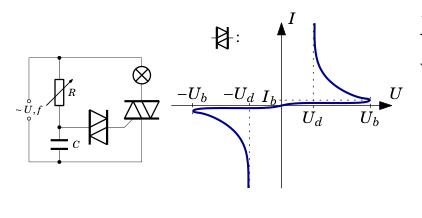 circuito dimmer con diac e curva I-V
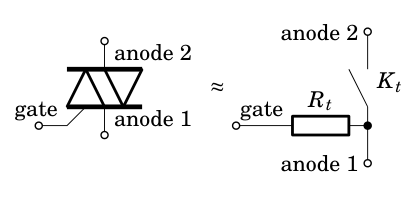 schemi equivalenti triac con gate e anodi
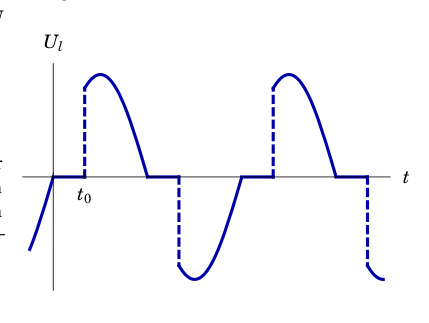 tensione U_l sulla lampada nel tempo
Topic: Circuits, Electromagnetism Metodi: Kirchhoff’s Laws, Differential Equations, Conservation of Energy Competenze: Mathematical Modeling, Diagrammatic Reasoning, Physical Reasoning Objects: Resistor, Capacitor, Switch Fonte: Testo (PDF) — p.1
- DIMMER (9 punti) Siim Ainsaar. A dimmer per il controllo della luminosità dell’illuminazione è costituito da un reostato, un condensatore, un diacastro e un Triac, collegato come nei schemi. R C I U : Un diacetta è un componente il cui comportamento è determinato dal diagramma di tensione-corente
- come mostrato sopra. Un triacco , d’altra parte, può essere considerato come un interruttore controllato da corrente si esaminano i seguenti schemi equivalenti. porta anodo 1 anodo 2 porta anodo 1 anodo 2 Il interruttore è aperto finché la corrente attraverso il cancello del triacco rimane sotto la soglia corrente ; si chiude quando la corrente soglia viene applicata (in entrambe le direzioni) e rimane chiusa mentre un corrente fluisce attraverso il interruttore (la corrente di portata è irrilevante fino al passaggio si apre di nuovo). i) (3 punti) Supponiamo che la resistenza sia grande abbastanza da permettere alla carica di attraversare Il diaco può essere trascurato. Lascia che l’ approvvigionamento sinusoidale tensione ha un valore massimo di e una frequenza di ; il reostato deve essere impostato sulla resistenza e la capacità del condensatore è . Trova il il valore massimo della tensione sul condensatore e il suo spostamento di fase rispetto al tensione di alimentazione. (ii) (2 punti) Quali disuguaglianze devono essere soddisfatte per le tensioni caratteristiche dei diacs e , la corrente soglia e la resistenza alla porta per garantire che quando il diacco comincia a condurre (mentre la tensione del condensatore aumenta), Il triacco inizierebbe immediatamente a dirigere? Si può presumere che e che i diacs la tensione a corrente è . t iii) (2 punti) La tensione della lampada è la seguente: la trama sopra. Supponiamo che l’ipotesi di parte i) e l’ineguaglianza della parte ii). Trova il tempo durante il quale la tensione della lampada è
- E’ zero. iv) (2 punti) Esprimere attraverso e , quante volte la potenza media della lampada è inferiore a di lampada senza lampadine, supponendo che la resistenza della lampada non sia cambiata.
*condizione di circuito di attenuazione della curva I-V *
- schemi equivalenti con e anodi *
- tensione sul lampada nel tempo *
Topic: Circuits, Electromagnetism Metodi: Kirchhoff’s Laws, Differential Equations, Conservation of Energy Competenze: Mathematical Modeling, Diagrammatic Reasoning, Physical Reasoning Objects: Resistor, Capacitor, Switch Fonte: Testo (PDF) — p.1
CANDY WRAPPER (6 points) — Eero Uustalu. Measure the thickness of the candy wrapper, estimate the uncertainty. Equipment: Candy, two hexagonal pencils, rubber bands, green = 532 nm laser, measuring tape, screen, stand. Warning: do not look into the laser beam and do not direct it to the eyes of others!
Topic: Wave Optics Metodi: Interference & Diffraction Analysis, Physical Modeling Competenze: Measurement & Instrumentation, Error Propagation, Experimental Data Analysis Objects: Screen Fonte: Testo (PDF) — p.1
CANDY WRAPPER (6 punti) Eero Uustalu. Misurare lo spessore del caramello
- Involucro, stima l’incertezza. Equipaggiamento: Candy, due matite esagonali, bande di gomma, verde = laser da 532 nm, nastro di misura, schermo,
- Si’, fermati. Avvertimento: non guardare il raggio laser e non dirigerla agli occhi degli altri!
Topic: Wave Optics Metodi: Interference & Diffraction Analysis, Physical Modeling Competenze: Measurement & Instrumentation, Error Propagation, Experimental Data Analysis Objects: Screen Fonte: Testo (PDF) — p.1
- CHARGE ON A RING (7 points) — Andreas Isacsson. A pointlike particle with mass and charge is free to slide without friction along a fixed horizontal circular ring with radius . In the plane of the ring, another charge is placed in a fixed position, at a distance from the center of the ring, with (see figure). i) (3 points) The particle on the ring is given an initial velocity . Calculate its velocity as a function of the angle , . ii) (2 points)How large is the force from the ring on the particle, as a function of the angle ? iii) (2 points) Viscous friction can be modelled with a force directed against the velocity, with a magnitude proportional to the speed, i.e. , where is a positive constant. Assume that this kind of frictional force acts on the particle on the ring. Given an initial , determine the position where the particle comes to rest.
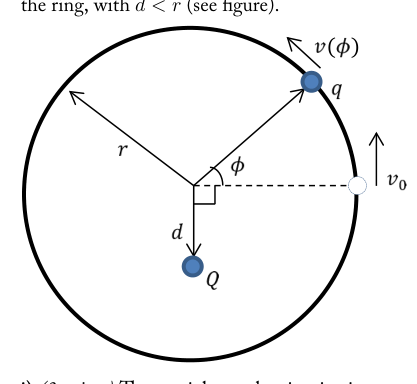 anello circolare con cariche q e Q
Topic: Electrostatics, Newtonian Mechanics Metodi: Conservation of Energy, Electric Potential Method, Free-Body Diagram Competenze: Mathematical Modeling, Physical Reasoning, Diagrammatic Reasoning Objects: Point Charge Fonte: Testo (PDF) — p.2
- L’AUTOR: Andrea (Sette punti) Isacsson. Particella puntalistica di massa e carica è libera di scivolare senza attrito lungo un un anello circolare orizzontale fisso con raggio . Nel piano dell’anello, un’altra carica viene inserita in un posizione fissa, a una distanza dal centro di l’anello, con (vedere figura). I) (3 punti) La particella sull’anello riceve un velocità iniziale . Calcolare la sua velocità come funzione dell’angolo , . ii) (2 punti) Quanta è la forza dell’anello sulla particella, come funzione dell’angolo ? iii) (2 punti) La frizione viscosa può essere modellata con una forza diretta contro la velocità, con un grandezza proporzionale alla velocità, ovvero , dove è una costante positiva. Supponiamo che questo tipo di forza di attrito agisce sulla particella su
- L’anello. Date le prime , determinare la posizione in cui la particella si posa a riposo.
- annello circolare con cariche q e Q *
Topic: Electrostatics, Newtonian Mechanics Metodi: Conservation of Energy, Electric Potential Method, Free-Body Diagram Competenze: Mathematical Modeling, Physical Reasoning, Diagrammatic Reasoning Objects: Point Charge Fonte: Testo (PDF) — p.2
- HELIUM (6 points)— Jaan Toots. Liquid helium is cooled under low pressure by vaporizing it and pumping the gas away. The heat of vaporization of helium is kJ , which you can take to be constant. The specific heat of the liquid is shown on the graph (a larger copy is on an extra sheet). What fraction of the liquid helium has to vaporize to cool the remaining liquid from K to K? 0 1 2 3 4 5 6 7 8 2.2 2.4 2.6 2.8 3 3.2 3.4 3.6 3.8 4 4.2 4.4 4.6 T/K
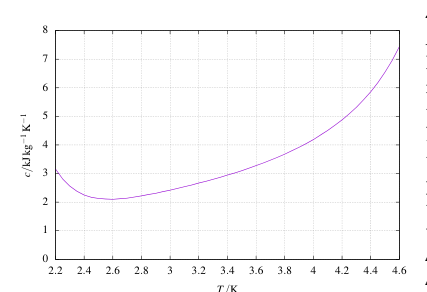 calore specifico elio liquido c(T)
Topic: Thermodynamics Metodi: First Law of Thermodynamics, Calculus-Integration, Experimental Data Analysis Competenze: Graph Linearization, Mathematical Modeling, Physical Reasoning Objects: Gas Fonte: Testo (PDF) — p.2
- HELIUM (6 punti) Jaan Toots. L’elio liquido viene raffreddato a bassa pressione vaporizzando e pompare il gas. Il calore di vaporizzazione dell’elio è kJ , che si
- Non è un’idea. Il calore specifico della Il grafico mostra il liquido (una copia più grande) è su un foglio extra). Che frazione del liquido L’elio deve vaporizzare per raffreddare il liquido rimanente da K a K? 0 1 2 3 4 5 6 7 8 2.2 2.4 2.6 2.8 3 3.2 3.4 3.6 3.8 4 4.2 4.4 4.6 T/K
- calori specifici elio liquido c) T) *
Topic: Thermodynamics Metodi: First Law of Thermodynamics, Calculus-Integration, Experimental Data Analysis Competenze: Graph Linearization, Mathematical Modeling, Physical Reasoning Objects: Gas Fonte: Testo (PDF) — p.2
- OSCILLATIONS (7 points)— Lasse Frantti. i) (2 points) A steel ball (mass kg) is attached to an ideal vertical spring. This causes the spring to lengthen by cm. The ball is then pulled down by cm from its equilibrium point and released, which leads to an oscillation. What should be the length of a point mass pendulum in order to have the same small oscillations period as this system? ii) (2 points) A hole is drilled diametrically through a spherical asteroid. An astronaut drops a stone into the hole to see what happens. Show that the stone starts to oscillate harmonically back and forth in the hole. iii) (2 points) You want to send a parcel to your friend at the other end of the drilled hole. You can either throw the parcel horizontally (around the asteroid) or drop it into the hole. Which way is faster? iv) (1 point) A perfectly elastic ball is dropped onto a horizontal table from height cm. Estimate the period of bounces. Is this motion a simple harmonic oscillation? Why/why not?
Topic: Oscillations & Waves, Gravitation, Newtonian Mechanics Metodi: Simple Harmonic Motion Analysis, Newton’s Law of Gravitation, Kinematic Equations Competenze: Mathematical Modeling, Physical Reasoning, Estimation & Approximation Objects: Spring, Ball, Pendulum Fonte: Testo (PDF) — p.2
- Oscillazioni (7 punti) Lasse Frantti. i) (2 punti) Una palla di acciaio (massa kg) è attaccata ad una molla verticale ideale. Questo causa la la primavera per allungarsi di cm. La palla è allora pulled down by cm from its equilibrium puntare e rilasciare, che porta ad una oscillazione. Qual è la lunghezza di un pendolo di massa puntaria per avere le stesse piccole oscillazioni
- Come questo sistema? ii) (2 punti) Un buco è perforato diametralmente attraverso un asteroide sferico. Un astronauta cade Una pietra nel buco per vedere cosa succede. - Spettacolo che la pietra inizia ad oscillare in modo armonico
- E’ un po’ più tardi. iii) (2 punti) Volete inviare un pacco al vostro amico all’altra estremità del buco perforato. Tu… può lanciare il pacco orizzontalmente (circond l’asteroide) o gettarlo nel buco. Da dove? E’ piu’ veloce? iv) (1 punto) viene lanciata una palla perfettamente elastica su una tavola orizzontale a partire da un’altezza cm. Calcola il periodo di rimbalzo. La mozione a una semplice oscillazione armonica? Perché?
Topic: Oscillations & Waves, Gravitation, Newtonian Mechanics Metodi: Simple Harmonic Motion Analysis, Newton’s Law of Gravitation, Kinematic Equations Competenze: Mathematical Modeling, Physical Reasoning, Estimation & Approximation Objects: Spring, Ball, Pendulum Fonte: Testo (PDF) — p.2
- DEFLECTION ON FALLING (8 points) — Mihkel Kree. Imagine a vertical mine shaft of height m at the equator. Consider a free falling steel ball, released from the top of the shaft, and let us neglect the air drag (friction). Not surprisingly, due to the rotation of the Earth, the ball will reach the bottom of the shaft at a point which is slightly different from the point of the vertical projection of the release location. Let us denote the distance between these points by . (Historical note: the correct expression for was first calculated independently by Laplace and Gauss in 1803.) i) (1 point)Calculate the velocity difference of the top of the shaft and the bottom of the shaft as seen in an absolute, non-rotating frame of reference. ii) (1 point)Neglecting the rotation of the Earth, but assuming that the steel ball is released with an initial horizontal velocity as seen from the bottom of the shaft, calculate the horizontal displacement of the steel ball by the time it reaches the bottom. Obviously, the answer found in ii) is not physically correct, because we neglected the rotation of the Earth and, correspondingly, the Coriolis force. Luckily, the correct expression can still be found without integrating the Coriolis force (although Laplace and Gauss did it). iii) (6 points)Considering the falling steel ball being on a Keplerian orbit and taking into account the curvature of the Earth, find the true value of the horizontal displacement . Hint: use appropriate approximations for small values and note that the small segment of ellipse corresponding to the fall of the steel ball can still be approximated as a parabola.
Topic: Newtonian Mechanics, Gravitation Metodi: Kinematic Equations, Newton’s Law of Gravitation, Approximation & Series Expansion, Kepler’s Laws Competenze: Mathematical Modeling, Physical Reasoning, Estimation & Approximation Objects: Ball, Planet Fonte: Testo (PDF) — p.2
- DEFECTIONE SULLA CAUSA (8 punti) Mihkel Kree. Immaginate un pozzo di mina verticale di altezza m all’equatore. Considerate un palla di acciaio in caduta libera, rilasciata dalla parte superiore del il filo, e trascurare la resistenza dell’aria (friczione). Non sorprende, a causa della rotazione della Terra, la palla raggiungerà il fondo dell’albero a punto che è leggermente diverso dal punto di la proiezione verticale del luogo di rilascio. Lascia che noi indichiamo la distanza tra questi punti da . (Nota storica: la corretta espressione per è stato calcolato per la prima volta da Laplace in modo indipendente e Gauss nel 1803.) i) (1 punto) Calcolare la differenza di velocità di il capo del fusto e il fondo del fusto come osservato in un quadro di riferimento assoluto e non rotante. ii) (1 punto) Ignorando la rotazione della Terra, ma presumendo che la palla di acciaio sia rilasciata con una velocità orizzontale iniziale vista dal il fondo dell’albero, calcola il spostamento orizzontale della palla d’acciaio al momento in cui essa raggiunge il fondo. Ovviamente la risposta trovata in ii) non è fisicamente corretta, perché abbiamo trascurato la rotazione di terra e, di conseguenza, dei Coriolis
- La forza. Fortunatamente, l’espressione corretta può ancora essere La forza di Coriolis non è stata integrata (anche se Laplace e Gauss lo hanno fatto). iii) (6 punti) Considerando che la palla di acciaio cadente è in orbita kepleriana e tenendo conto della sua la curvatura della Terra, trovare il vero valore di il spostamento orizzontale . Suggerimento: utilizzare approssimative appropriate per valori piccoli e notare che il segmento piccolo dell’ellisse corrispondente alla caduta di la palla d’acciaio può ancora essere approssimata come parabola.
Topic: Newtonian Mechanics, Gravitation Metodi: Kinematic Equations, Newton’s Law of Gravitation, Approximation & Series Expansion, Kepler’s Laws Competenze: Mathematical Modeling, Physical Reasoning, Estimation & Approximation Objects: Ball, Planet Fonte: Testo (PDF) — p.2
- BLACK BOX (10 points)— Mihkel Heidelberg and Jaan Kalda. The black box has three terminal wires: “blue”, “black” and “white”, and contains two resistors with resistances k and a single Zener diode in some arrangement. In the voltage ranges we are using, the Zener diode behaves as a regular diode — conducts current well when voltage is applied in the forward direction, and conducts little when voltage is applied in the reverse direction. We are using a Zener diode, because it has a higher leakage current of up to 1 mA when voltage is applied in reverse direction. You may neglect the internal resistance of the voltmeter in all ranges and of the ammeter in the 40 mA and 400 mA ranges. The internal resistance of the ammeter in the 400 and 4000 ranges is . i) (2 points) Draw the electrical circuit that is inside the black box. Motivate your solution with measurements. ii) (4 points) Measure the resistances and , estimate the uncertainties. iii) (4 points) Measure and draw the currentvoltage curve of the Zener diode in the black box, use as many different datapoints as possible. Equipment: Black box, DC voltage source, multimeter. Do not anger Eero by shorting the voltage source with the ammeter, you will blow the fuse.
Topic: Circuits Metodi: Kirchhoff’s Laws, Equivalent Circuit Reduction, Experimental Data Analysis Competenze: Experimental Data Analysis, Measurement & Instrumentation, Diagrammatic Reasoning Objects: Resistor, Wire Fonte: Testo (PDF) — p.2
- Cassa nera (10 punti) Mihkel Heidelberg e Jaan Kalda. La scatola nera ha tre terminali. fili: blu, nero e bianco e contiene due resistenti con resistenze k e una sola dioda Zener in qualche disposizione. Nei intervalli di tensione che stiamo utilizzando, il diodo Zener si comporta come un diodo regolare conduce corrente bene quando la tensione viene applicata nel direzione, e conduce poco quando la tensione viene applicata nella direzione inversa. - Si tratta di un’unica soluzione. Diodo Zener, perché ha una corrente di perdita superiore fino a 1 mA quando la tensione viene applicata in direzione inversa. Si può trascurare la resistenza interna del voltometro in tutti i ranghi e della Ammetro nei ranghi di 40 mA e 400 mA. Il resistenza interna dell’ampilometro nel 400 e le gamme 4000 sono . i) (2 punti) Disegnare il circuito elettrico che è all’interno della scatola nera. Motivare la soluzione con misurazioni. ii) (4 punti) Misurare le resistenze e ,
- valutare le incertezze. iii) (4 punti) Misurare e disegnare la curva di tensione di corrente della dioda Zener nella scatola nera, utilizzare il maggior numero possibile di punti dati diversi. Attrezzature: scatola nera, fonte di tensione a corrente continua,
- Multimetro. Non irritare Eero abbattersi la tensione
- Con l’ampilometro, farete saltare il fusibile.
Topic: Circuits Metodi: Kirchhoff’s Laws, Equivalent Circuit Reduction, Experimental Data Analysis Competenze: Experimental Data Analysis, Measurement & Instrumentation, Diagrammatic Reasoning Objects: Resistor, Wire Fonte: Testo (PDF) — p.2