Question A1
The Doppler effect for a source moving relative to a stationary observer is described by
where is the frequency measured by the observer, is the frequency emitted by the source, is the speed of the source, is the wave speed, and is the angle between the source velocity and the line between the source and observer. (Thus when the source is moving directly towards the observer and when moving directly away.)
A sound source of constant frequency travels at a constant velocity past an observer, and the observed frequency is plotted as a function of time (see figure). The experiment happens in room temperature air, so the speed of sound is 340 m/s.
a. What is the speed of the source?
b. What is the smallest distance between the source and the observer?
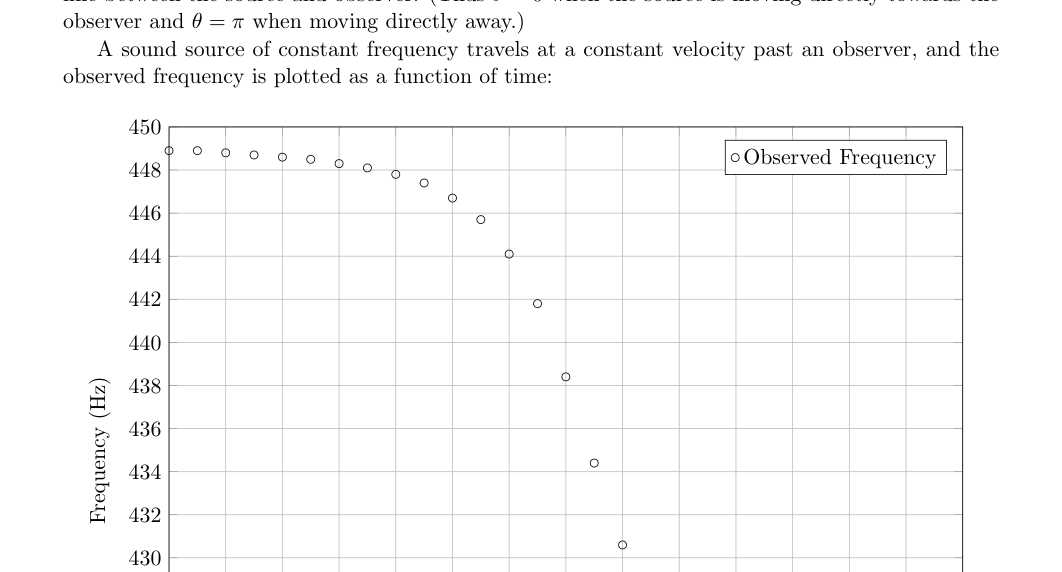 Observed frequency vs time, 420–450 Hz range
Topic: Oscillations & Waves, Newtonian Mechanics Metodi: Wave Equation, Kinematic Equations, Physical Modeling Competenze: Graph Linearization, Physical Reasoning Objects: — Fonte: Testo (PDF) — p.3
La domanda A1
L’effetto Doppler per una fonte in movimento rispetto ad un osservatore stazionario è descritto da
se è la frequenza misurata dall’osservatore, è la frequenza emessa dalla fonte, è la velocità della fonte, è la velocità delle onde e è l’angolo tra la velocità della fonte e la linea tra la fonte e l’osservatore. (In questo modo quando la fonte si sta spostando direttamente verso l’osservatore e quando si sta spostando direttamente lontano.)
Una fonte sonora di frequenza costante viaggia a velocità costante oltre un osservatore e la frequenza osservata è tracciata come funzione del tempo (vedi figura). L’esperimento avviene all’aria a temperatura ambiente, quindi la velocità del suono è di 340 m/s.
a. Qual è la velocità della fonte?
b. Qual è la distanza più piccola tra la fonte e l’osservatore?
Frequenza osservata vs tempo, gamma 420450 Hz
Topic: Oscillations & Waves, Newtonian Mechanics Metodi: Wave Equation, Kinematic Equations, Physical Modeling Competenze: Graph Linearization, Physical Reasoning Objects: — Fonte: Testo (PDF) — p.3
Question A2
A student designs a simple integrated circuit device that has two inputs, and , and two outputs, and . The inputs are effectively connected internally to a single resistor with effectively infinite resistance. The outputs are effectively connected internally to a perfect source of emf . The integrated circuit is configured so that , where is a very large number somewhere between and . The circuits below are chosen so that the precise value of is unimportant.
a. Consider the following circuit. and are two resistors. Terminal and the negative side of are connected to ground, so both are at a potential of 0 volts. Determine the ratio .
b. Consider the following circuit. All four resistors have identical resistance . Determine in terms of any or all of , , and .
c. Consider the following circuit. The circuit has a capacitor and a resistor with time constant . The source on the left provides variable, but bounded voltage. Assume is a function of time. Determine as a function of , and any or all of time and .
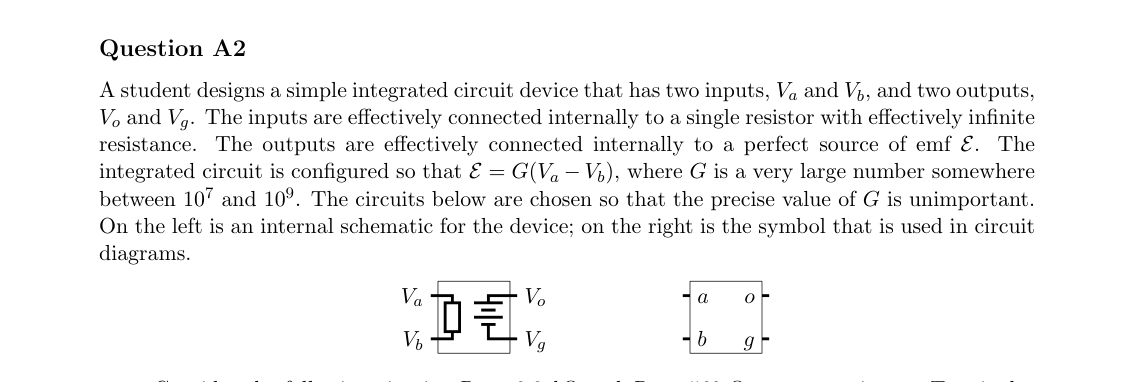 Op-amp internal schematic and symbol
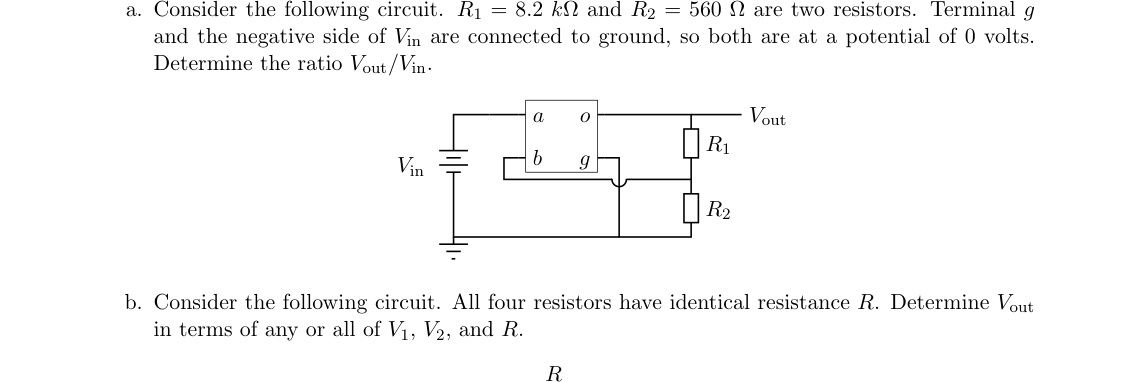 Inverting amplifier circuit with R1, R2
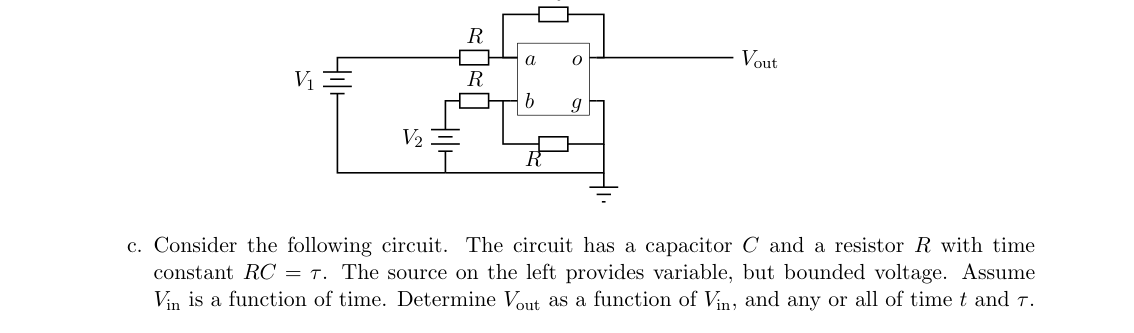 Differential amplifier circuit with four equal R
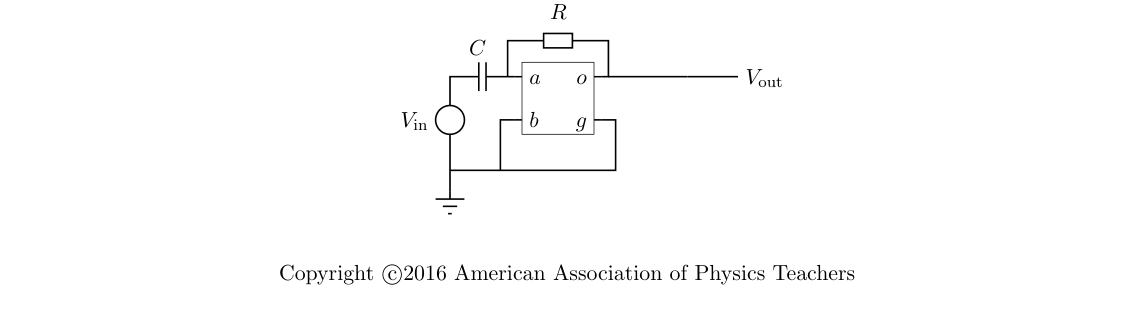 Integrator circuit with R and C
Topic: Circuits, Electrostatics Metodi: Kirchhoff’s Laws, Equivalent Circuit Reduction, Differential Equations Competenze: Mathematical Modeling, Physical Reasoning Objects: Resistor, Capacitor Fonte: Testo (PDF) — p.4
La domanda A2
Uno studente progetta un semplice dispositivo di circuito integrato che ha due input, e , e due output, e . Le entrate sono effettivamente collegate internamente a un singolo resistore con resistenza effettivamente infinita. Le uscite sono effettivamente collegate internamente ad una fonte perfetta di emf . Il circuito integrato è configurato in modo tale che , dove è un numero molto grande da qualche parte tra e . I circuiti di seguito sono scelti in modo tale che il valore preciso di non sia importante.
a. Considerate il circuito seguente. e sono due resistenti. Il terminale e il lato negativo di sono collegati al terreno, quindi entrambi sono a un potenziale di 0 volt. Determinare il rapporto .
b. Considerate il circuito seguente. Tutte le quattro resistenze hanno la stessa resistenza . Determinare in termini di una o tutte le , e .
c. Considerate il circuito seguente. Il circuito ha un condensatore e una resistenza con costante temporale . La fonte a sinistra fornisce tensione variabile, ma limitata. Supponiamo che sia una funzione del tempo. Determinare come funzione di , e di qualsiasi o di tutto il tempo e .
Schematic e simbolo interno di amplificazione op
Inversione del circuito dell’amplificatore con R1, R2
Circuito di amplificatore differenziale con quattro R uguali
Circuito integratore con R e C
Topic: Circuits, Electrostatics Metodi: Kirchhoff’s Laws, Equivalent Circuit Reduction, Differential Equations Competenze: Mathematical Modeling, Physical Reasoning Objects: Resistor, Capacitor Fonte: Testo (PDF) — p.4
Question A3
Throughout this problem the inertial rest frame of the rod will be referred to as the rod’s frame, while the inertial frame of the cylinder will be referred to as the cylinder’s frame.
A rod is traveling at a constant speed of to the right relative to a hollow cylinder. The rod passes through the cylinder, and then out the other side. The left end of the rod aligns with the left end of the cylinder at time and in the cylinder’s frame and time and in the rod’s frame.
The left end of the rod aligns with the left end of the cylinder at the same time as the right end of the rod aligns with the right end of the cylinder in the cylinder’s frame; in this reference frame the length of the cylinder is 15 m.
For the following, sketch accurate, scale diagrams of the motions of the ends of the rod and the cylinder on the graphs provided. The horizontal axis corresponds to , the vertical axis corresponds to , where is the speed of light. Both the vertical and horizontal gridlines have 5.0 meter spacing.
a. Sketch the world lines of the left end of the rod (RL), left end of the cylinder (CL), right end of the rod (RR), and right end of the cylinder (CR) in the cylinder’s frame.
b. Do the same in the rod’s frame.
c. On both diagrams clearly indicate the following four events by the letters A, B, C, and D.
- A: The left end of the rod is at the same point as the left end of the cylinder
- B: The right end of the rod is at the same point as the right end of the cylinder
- C: The left end of the rod is at the same point as the right end of the cylinder
- D: The right end of the rod is at the same point as the left end of the cylinder
d. At event B a small particle P is emitted that travels to the left at a constant speed in the cylinder’s frame.
i. Sketch the world line of P in the cylinder’s frame.
ii. Sketch the world line of P in the rod’s frame.
e. Now consider the following in the cylinder’s frame. The right end of the rod stops instantaneously at event B and emits a flash of light, and the left end of the rod stops instantaneously when the light reaches it. Determine the final length of the rod after it has stopped. You can assume the rod compresses uniformly with no other deformation.
Any computation that you do must be shown on a separate sheet of paper, and not on the graphs. Graphical work that does not have supporting computation might not receive full credit.
Topic: Special Relativity, Newtonian Mechanics Metodi: Lorentz Transformation, Kinematic Equations, Symmetry Argument Competenze: Diagrammatic Reasoning, Mathematical Modeling Objects: Rod, Cylinder, Particle Beam Fonte: Testo (PDF) — p.5
La domanda A3
In tutto questo problema il sistema di riposo inerziale della canna sarà chiamato sistema di riposo della canna, mentre il sistema di inerzia del cilindro sarà chiamato sistema di cilindro.
Una canna si muove a velocità costante di verso destra rispetto a un cilindro vuoto. La canna passa attraverso il cilindro, e poi fuori dall’altro lato. L’estremità sinistra del bastone si allinea con l’estremità sinistra del cilindro nel tempo e nel quadro del cilindro e nel tempo e nel quadro del bastone.
L’estremità sinistra del bastone si allinea con l’estremità sinistra del cilindro allo stesso tempo che l’estremità destra del bastone si allinea con l’estremità destra del cilindro nel quadro del cilindro; in questo quadro di riferimento la lunghezza del cilindro è di 15 m.
Per quanto segue, esegire diagrammi precisi e a scala dei movimenti delle estremità della canna e del cilindro sui grafici forniti. L’asse orizzontale corrisponde a , l’asse verticale corrisponde a , dove è la velocità della luce. Sia le griglie verticali che le griglie orizzontali hanno un spazio di 5,0 metri.
a. Scrittura delle linee mondiali della parte sinistra della canna (RL), della parte sinistra del cilindro (CL), della parte destra della canna (RR) e della parte destra del cilindro (CR) nella cornice del cilindro.
b. Fai lo stesso nel telaio della canna.
c. Su entrambi i diagrammi indicare chiaramente i seguenti quattro eventi con le lettere A, B, C e D.
- A: L’estremità sinistra della canna è nello stesso punto dell’estremità sinistra del cilindro
- B: L’estremità destra della canna è nello stesso punto dell’estremità destra del cilindro
- C: L’estremità sinistra della canna è nello stesso punto dell’estremità destra del cilindro
- D: L’estremità destra della canna è nello stesso punto dell’estremità sinistra del cilindro
d. In caso B viene emessa una piccola particella P che si sposta verso sinistra a una velocità costante nel telaio del cilindro.
-
Il numero di persone che hanno il diritto di soggiornare Segna la linea mondiale di P nel telaio del cilindro.
-
il numero di persone che hanno partecipato Segna la linea mondiale di P nel quadro della canna.
e. Ora consideriamo il seguente nel quadro del cilindro. L’estremità destra della canna si ferma istantaneamente all’evento B ed emette un lampo di luce, e l’estremità sinistra della canna si ferma istantaneamente quando la luce la raggiunge. Determinare la lunghezza finale della canna dopo che è fermata. Si può supporre che la canna si comprima uniformemente senza altre deformazioni.
Qualsiasi calcolo che si fa deve essere mostrato su un foglio di carta separato, e non sui grafici. Il lavoro grafico che non supporta il calcolo potrebbe non ricevere il pieno merito.
Topic: Special Relativity, Newtonian Mechanics Metodi: Lorentz Transformation, Kinematic Equations, Symmetry Argument Competenze: Diagrammatic Reasoning, Mathematical Modeling Objects: Rod, Cylinder, Particle Beam Fonte: Testo (PDF) — p.5
Question A4
The flow of heat through a material can be described via the thermal conductivity . If the two faces of a slab of material with thermal conductivity , area , and thickness are held at temperatures differing by , the thermal power transferred through the slab is
A large, flat lake in the upper Midwest has a uniform depth of 5.0 meters of water that is covered by a uniform layer of 1.0 cm of ice. Cold air has moved into the region so that the upper surface of the ice is now maintained at a constant temperature of C by the cold air (an infinitely large constant temperature heat sink). The bottom of the lake remains at a fixed C because of contact with the earth (an infinitely large constant temperature heat source). It is reasonable to assume that heat flow is only in the vertical direction and that there is no convective motion in the water.
a. Determine the initial rate of change in ice thickness.
b. Assuming the air stays at the same temperature for a long time, find the equilibrium thickness of the ice.
c. Explain why convective motion can be ignored in the water.
Some important quantities for this problem:
| Quantity | Value |
|---|---|
| Specific heat capacity of water | 4200 J/(kg·C°) |
| Specific heat capacity of ice | 2100 J/(kg·C°) |
| Thermal conductivity of water | 0.57 W/(m·C°) |
| Thermal conductivity of ice | 2.2 W/(m·C°) |
| Latent heat of fusion for water | 330,000 J/kg |
| Density of water | 999 kg/m³ |
| Density of ice | 920 kg/m³ |
Topic: Thermodynamics, Fluid Mechanics Metodi: First Law of Thermodynamics, Differential Equations, Physical Modeling Competenze: Mathematical Modeling, Physical Reasoning Objects: — Fonte: Testo (PDF) — p.6
Question A4
Il flusso di calore attraverso un materiale può essere descritto mediante la conducibilità termica . Se le due facce di una lastra di materiale con conducibilità termico , superficie e spessore sono tenute a temperature diverse di , la potenza termico trasferita attraverso la lastra è
Un grande lago piatto nell’alto Midwest ha una profondità uniforme di 5,0 metri d’acqua che è coperto da uno strato uniforme di 1,0 cm di ghiaccio. L’aria fredda si è spostata nella regione in modo che la superficie superiore del ghiaccio sia ora mantenuta a una temperatura costante di C dall’aria fredda (un infinitamente grande dissipatore di calore a temperatura costante). Il fondo del lago rimane a un livello fisso C a causa del contatto con la terra (una fonte di calore a temperatura costante infinitamente grande). È ragionevole supporre che il flusso di calore sia solo nella direzione verticale e che non vi sia alcun movimento conveettivo nell’acqua.
a. Determinare il tasso iniziale di variazione dello spessore del ghiaccio.
b. Supponendo che l’aria rimanga a la stessa temperatura per un lungo periodo, trovi lo spessore di equilibrio del ghiaccio.
c. Spiegate perché il movimento convezionale può essere ignorato nell’acqua.
Alcune quantità importanti per questo problema:
Quantità # Valore
|---|---| | Specific heat capacity of water | 4200 J/(kg·C°) | | Specific heat capacity of ice | 2100 J/(kg·C°) | | Thermal conductivity of water | 0.57 W/(m·C°) | | Thermal conductivity of ice | 2.2 W/(m·C°) | | Latent heat of fusion for water | 330,000 J/kg | | Density of water | 999 kg/m³ | | Density of ice | 920 kg/m³ |
Topic: Thermodynamics, Fluid Mechanics Metodi: First Law of Thermodynamics, Differential Equations, Physical Modeling Competenze: Mathematical Modeling, Physical Reasoning Objects: — Fonte: Testo (PDF) — p.6
Question B1
A uniform solid spherical ball starts from rest on a loop-the-loop track. It rolls without slipping along the track. However, it does not have enough speed to make it to the top of the loop. From what height would the ball need to start in order to land at point P directly underneath the top of the loop? Express your answer in terms of , the radius of the loop. Assume that the radius of the ball is very small compared to the radius of the loop, and that there are no energy losses due to friction.
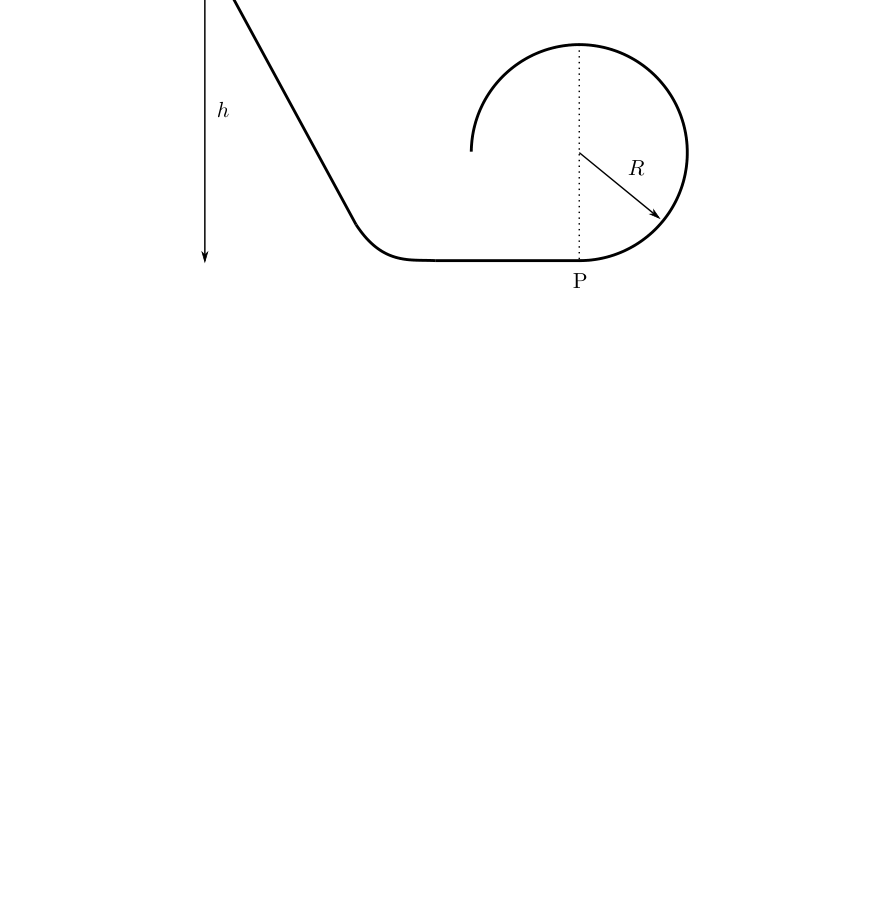 Loop-the-loop track with height h and point P below top
Topic: Rotational Dynamics, Conservation of Energy, Newtonian Mechanics Metodi: Conservation of Energy, Kinematic Equations, Torque & Angular Momentum Analysis Competenze: Mathematical Modeling, Physical Reasoning Objects: Ball, Sphere Fonte: Testo (PDF) — p.8
La domanda B1
Una palla solida e uniforme inizia a riposo su una pista di loop-the-loop. Rolla senza scivolare lungo la pista. Tuttavia, non ha abbastanza velocità per raggiungere la cima del circuito. Da quale altezza dovrebbe partire la palla per atterrare al punto P direttamente sotto la parte superiore del cerchio? Esprimere la risposta in termini di , il raggio del loop. Supponiamo che il raggio della palla sia molto piccolo rispetto al raggio del circuito e che non ci siano perdite energetiche dovute all’attrito.
Scorso di circuito con altezza h e punto P sotto la parte superiore
Topic: Rotational Dynamics, Conservation of Energy, Newtonian Mechanics Metodi: Conservation of Energy, Kinematic Equations, Torque & Angular Momentum Analysis Competenze: Mathematical Modeling, Physical Reasoning Objects: Ball, Sphere Fonte: Testo (PDF) — p.8
Question B2
a. A spherical region of space of radius has a uniform charge density and total charge . An electron of charge is free to move inside or outside the sphere, under the influence of the charge density alone. For this first part ignore radiation effects.
i. Consider a circular orbit for the electron where . Determine the period of the orbit in terms of any or all of , , , , and any necessary fundamental constants.
ii. Consider a circular orbit for the electron where . Determine the period of the orbit in terms of any or all of , , , , and any necessary fundamental constants.
iii. Assume the electron starts at rest at . Determine the speed of the electron when it passes through the center in terms of any or all of , , , and any necessary fundamental constants.
b. Accelerating charges radiate. The total power radiated by charge with acceleration is given by
where is a dimensionless numerical constant (which is equal to ), is a physical constant that is a function only of the charge , the speed of light , and the permittivity of free space , and is a dimensionless constant. Determine and .
c. Consider the electron in the first part, except now take into account radiation. Assume that the orbit remains circular and the orbital radius changes by an amount .
i. Consider a circular orbit for the electron where . Determine the change in the orbital radius during one orbit in terms of any or all of , , , , and any necessary fundamental constants. Be very specific about the sign of .
ii. Consider a circular orbit for the electron where . Determine the change in the orbital radius during one orbit in terms of any or all of , , , , and any necessary fundamental constants. Be very specific about the sign of .
Topic: Electrostatics, Modern-Quantum Physics Metodi: Gauss’s Law, Coulomb’s Law, Dimensional Analysis Competenze: Mathematical Modeling, Physical Reasoning Objects: Electron, Sphere Fonte: Testo (PDF) — p.9
La domanda B2
a. Una regione sferica di spazio di raggio ha una densità di carica uniforme e una carica totale . Un elettrone di carica può muoversi liberamente all’interno o all’esterno della sfera, solo sotto l’influenza della densità di carica. Per questa prima parte ignori gli effetti delle radiazioni.
-
Il numero di persone che hanno il diritto di soggiornare Considera un’orbita circolare per l’elettrone dove . Determinare il periodo di orbita in termini di una o tutte le costanti fondamentali , , , e di qualsiasi costante fondamentale necessaria.
-
il numero di persone che hanno partecipato Considera un’orbita circolare per l’elettrone dove . Determinare il periodo di orbita in termini di una o tutte le costanti fondamentali , , , e di qualsiasi costante fondamentale necessaria.
-
il numero di persone che hanno diritto a un’assistenza sociale Supponiamo che l’elettrone inizia a riposo a . Determinare la velocità dell’elettrone quando passa attraverso il centro in termini di una o tutte le , , e di eventuali costanti fondamentali necessarie.
b. Le cariche acceleranti si irradiano. La potenza totale irradiata dalla carica con accelerazione è data da:
se è una costante numerica senza dimensioni (equivalente a ), è una costante fisica che è una funzione solo della carica , la velocità della luce e la permissività dello spazio libero , e è una costante senza dimensioni. Determina e .
c. Considerate l’elettrone nella prima parte, eccetto ora tenete conto della radiazione. Supponiamo che l’orbita rimanga circolare e che il raggio orbitale cambie di un importo .
-
Il numero di persone che hanno il diritto di soggiornare Considera un’orbita circolare per l’elettrone dove . Determinare il cambiamento del raggio orbitale durante un’orbita in termini di una o tutte le costanti fondamentali , , , e di qualsiasi costante fondamentale necessaria. Essere molto specifici sul segno di .
-
il numero di persone che hanno partecipato Considera un’orbita circolare per l’elettrone dove . Determinare il cambiamento del raggio orbitale durante un’orbita in termini di una o tutte le costanti fondamentali , , , e di qualsiasi costante fondamentale necessaria. Essere molto specifici sul segno di .
Topic: Electrostatics, Modern-Quantum Physics Metodi: Gauss’s Law, Coulomb’s Law, Dimensional Analysis Competenze: Mathematical Modeling, Physical Reasoning Objects: Electron, Sphere Fonte: Testo (PDF) — p.9