P1 Solución a1) Si se desprecian la fricción con el alambre y la resistencia del aire, tanto 0 v como A v pueden obtenerse directamente a partir de la conservación de la energía mecánica
gh v 2 0
h g vA
2
4 3h h
2 3gh vA
a2) Tal y como se indica en el enunciado, el coeficiente de restitución es 0 / v v e A
. Por tanto
h h e
87 ,0 2 3
e
(1) b1) La bola B, igual que la A, ha descendido una altura h en caída libre, luego su velocidad es
gh v vB 2 0
(2) b2) En la figura 3a se indica que, justo antes del choque entre las bolas, A se mueve hacia arriba y B hacia abajo, de forma que el módulo de la velocidad relativa entre las bolas es A B i r v v v
, . Después del choque (figura 3b), las dos bolas se mueven hacia arriba con A B v v
, luego el módulo de la velocidad relativa es A B f r v v v
, . En total A B A B v v v v e
(3) b3) Tomando sentido positivo hacia arriba, la conservación del momento lineal se escribe B B A A B B A A v m v m v m v m
(4) Teniendo en cuenta que 0 v vB y que 0 ev vA , las ecuaciones (3) y (4) forman un sistema de dos ecuaciones con dos incógnitas, A B v v
y . Resolviendo el sistema se obtiene
0 2 v m m m m e e v B A B A B
Para B A m m 10
, y teniendo en cuenta el valor de e dado en (1), se obtiene
0 17 ,2 v vB
(5) b4) Aplicando de nuevo la conservación de la energía mecánica, y teniendo en cuenta (5) gH vB 2
gh v vB 2 17 ,2 17 ,2 0
Operando, se obtiene por fin h H 7 , 4
Nota: La altura H calculada no es hasta el suelo, como por error se indica en la figura 2b, sino hasta el vértice superior de la bola A en el instante del choque (figura b 2 ). La altura hasta el suelo sería H más el diámetro (desconocido) de la bola A. b 2 Fig.
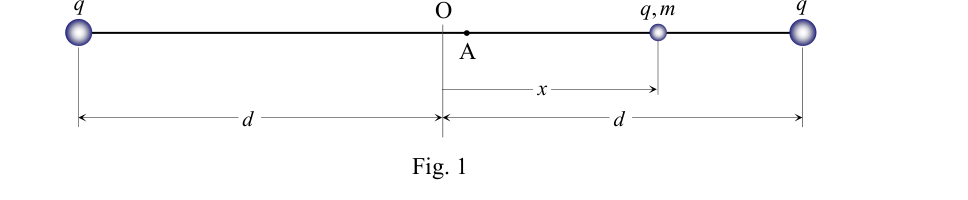
H A B XXXVII OLIMPIADA ESPAÑOLA DE FÍSICA FASE DE ARAGÓN P2.- Oscilaciones de una esfera cargada. Dos pequeñas esferas están sujetas en los extremos de una varilla fija no conductora de longitud 2d. Una tercera esfera, de masa m, está ensartada en la varilla y puede deslizar sin rozamiento por ella. Las tres esferas son no conductoras y cada una tiene una carga eléctrica q uniformemente distribuida sobre su superficie. a) Determina la expresión de la fuerza electrostática, ) (x F , que actúa sobre la esfera central cuando está a una distancia x del centro de la varilla, O, como se indica en la figura 1. b) Obtén una expresión aproximada de F(x) para x << d. c) La esfera se libera con velocidad inicial nula desde un punto A, situado a una distancia 20 / d xA a la derecha de O. ¿Cuál será su velocidad, 0 v , cuando pase por O? d) La esfera seguirá moviéndose hacia la izquierda, después de pasar por O. ¿Cuál es la coordenada, B x , del punto B más alejado de O hasta el que llegará? e) Teniendo en cuenta la expresión aproximada de F(x) que has obtenido en el apartado b), calcula el tiempo que tardará la esfera en realizar el trayecto AB.
d d x q q m q, O Fig. 1 A XXXVII OLIMPIADA ESPAÑOLA DE FÍSICA FASE DE ARAGÓN
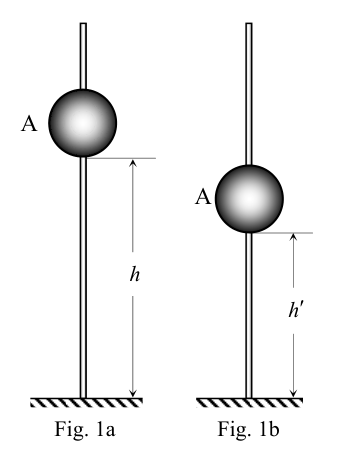 Balle su filo: Fig.1a e Fig.1b
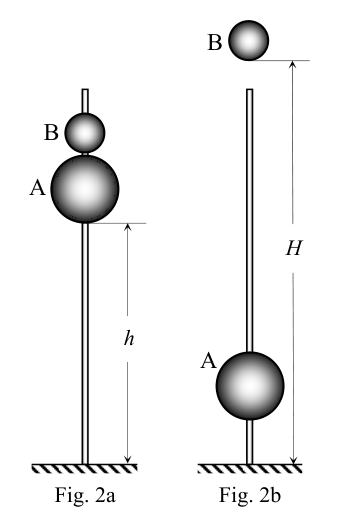 Balle su filo: Fig.2a e Fig.2b
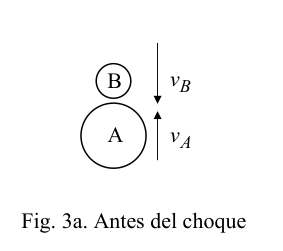 Fig.3a: balle prima dell urto
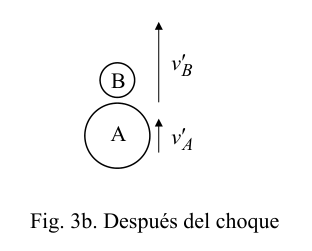 Fig.3b: balle dopo l urto
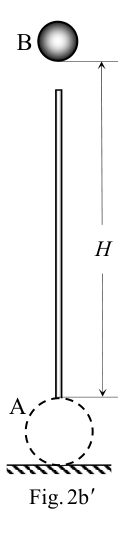 Fig.2b: altezza palla su filo
Topic: Newtonian Mechanics, Conservation of Momentum, Conservation of Energy Metodi: Kinematic Equations, Conservation of Energy, Conservation of Momentum, Impulse-Momentum Theorem Competenze: Physical Reasoning, Mathematical Modeling, Diagrammatic Reasoning Objects: Ball, Rod Fonte: Testo (PDF) — p.4
P1 Soluzione a1) Se si disprezza la friczione con il filo e la resistenza dell’aria, v come A v possono essere ottenute direttamente a partire dalla conservazione dell’energia meccanica
gh v 2 0
h g vA
2
4 3h h
2 3gh vA
a2) Come indicato nella sentenza, il coefficiente di restituzione è 0 / v v e A
. Quindi
h h e
87 ,0 2 3
e
(1) b1) La palla B, come la A, è scesa a una quota h in caduta libera, quindi la sua velocità è
gh v vB 2 0
(2) b2) La figura 3a indica che, appena prima dell’impatto tra le palle, A si muove verso l’alto e B verso il Sotto, in modo che il modulo di velocità relativa tra le palle è A B i r v v v
, . Dopo il colpo (Figura 3b), le due palle si muovono verso l’alto con A B v v
, poi il modulo di velocità relativa è A B f r v v v
, . Complessivamente A B A B v v v v e
(3) b3) Prendendo un senso positivo verso l’alto, la conservazione del momento lineare viene scritta B B A A B B A A v m v m v m v m
(4) Considerando che 0 v vB e che 0 ev vA , le equazioni (3) e (4) formano un sistema di due equazioni con due incognite, A B v v
y . Risolvendo il sistema si ottiene
0 2 v m m m m e e v B A B A B
Per B A m m 10
, e considerando il valore di e dato in (1), si ottiene
0 17 ,2 v vB
(5) b4) Riprese in atto la conservazione dell’energia meccanica, tenendo conto (5) gH vB 2
gh v vB 2 17 ,2 17 ,2 0
Operando, si ottiene finalmente h H 7 , 4
Nota: l’altezza H calcolata non è fino al suolo, come indicato erroneamente nella figura 2b, ma fino alla vertica superiore della palla A all’istante dello scatto (figura b) 2 ). Altezza fino al suolo sarebbe H più il diametro (non noto) della palla A. b 2 Fig.
H A B XXXVII Olimpiadi di fisica spagnola Fase di ARAGON P2.- Oscillazioni di una sfera carica. Due piccole sfere sono attaccate alle estremità di un’asta fissa non conduttrice di lunghezza 2d. Una la terza sfera, di massa m, è fissata sul bastone e può scivolare senza rottura. Le tre sfere Le parti di questo sistema sono non conduttrici e ognuna ha un carico elettrico uniformemente distribuito sulla sua superficie. a) Determina l’espressione della forza elettrostatica, ) (x F , che agisce sulla sfera centrale quando è a una distanza x dal centro della canna, O, come indicato nella figura 1. b) Ottieni un’espressione approssimativa di F(x) per x << d. c) La sfera si libera a velocità iniziale zero da un punto A, situato a una distanza 20 / d xA a la a destra di O. Qual è la velocità, 0? V, quando passa per O? d) La sfera continuerà a muoversi a sinistra dopo aver attraversato O. Qual è la coordinata, B di x , del punto B più lontano da O fino a che punto arriverà? e) Considerando l’espressione approssimativa di F(x) che hai ottenuto al punto (b), calcola il tempo che la sfera ci vorrà tempo per effettuare il percorso AB.
d d x q q m q, O Fig. 1 A XXXVII Olimpiadi di fisica spagnola Fase di ARAGON
Balle il suo filo: Fig.1a e Fig.1b
Balle il suo filo: Fig.2a e Fig.2b
Fig.3a: balle prima dell’urto
Fig.3b: balle dopo l’urto
Fig.2b: altezza palla il filo
Topic: Newtonian Mechanics, Conservation of Momentum, Conservation of Energy Metodi: Kinematic Equations, Conservation of Energy, Conservation of Momentum, Impulse-Momentum Theorem Competenze: Physical Reasoning, Mathematical Modeling, Diagrammatic Reasoning Objects: Ball, Rod Fonte: Testo (PDF) — p.4
P1 Solution a1) If the friction with the wire and the air resistance are neglected, both 0 v as A v can be obtained directly from the conservation of mechanical energy
gh v 2 0
h g vA
2
4 3h h
2 3gh vA
a2) As stated in the statement, the rate of refund is 0 / v v e A
. So, what?
h h e
87 ,0 2 3
e
(1) b1) Ball B, like ball A, has descended a height h in free fall, then its speed is
gh v vB 2 0
(2) b2) Figure 3a shows that just before the balls hit, A moves up and B moves up. Below, so that the modulo of the relative velocity between the balls is A B i r v v v
, . After the impact (Figure 3b), the two balls move upwards with A B v v
, then the speed module relative is A B f r v v v
, . Total of the A B A B v v v v e
(3) b3) Taking positive upward direction, the conservation of linear momentum is written B B A A B B A A v m v m v m v m
(4) Given that 0 v vB and that 0 ev vA , the equations (3) and (4) form a system of two Equations with two unknowns, A B v v
y . Solving the system gets
0 2 v m m m m e e v B A B A B
Stop B A m m 10
, and taking into account the value of e given in (1), it is obtained
0 17 ,2 v vB
(5) b4) Re-applying the conservation of mechanical energy, and taking into account (5) gH vB 2
gh v vB 2 17 ,2 17 ,2 0
Operating, you finally get h H 7 , 4
Note: The calculated height H is not up to the ground as shown in the figure by mistake 2b, but up to the top of the ball A at the instant of impact (Figure b) 2 ). Height down to the ground would be H plus the diameter (unknown) of the ball A. b 2 Fig.
H A B XXXVII Spanish Olympics in Physics The following is the list of the categories of products: P2.- Oscillations of a charged sphere. Two small spheres are attached at the ends of a fixed non-conductive rod of 2d length. One of them. The third sphere, m-mass, is fixed to the rod and can slide through it without any bruising. The three spheres They are non-conductive and each has an electrical charge which is evenly distributed over its surface. a) Determines the expression of electrostatic force, ) (x F , which acts on the central sphere when it is at a distance x from the centre of the rod, O, as shown in Figure 1. b) Get an approximate expression of F(x) for x << d. c) The sphere is released at zero initial velocity from a point A, located at a distance 20 / d xA a la Right of O. What is your speed, 0? v, when you pass O? d) The sphere will continue to move to the left after passing through O. What’s the coordinate, B x , of Point B further from O to which point will it reach? e) Taking into account the approximate expression of F(x) you have obtained in paragraph (b), calculate the time It will take the sphere to make the AB path.
d d x q q m q, O Fig. 1 A XXXVII Spanish Olympics in Physics The following is the list of the categories of products:
The following table shows the results of the tests:
The following table shows the results of the calculations:
The following table shows the results of the evaluation:
The following table shows the results of the evaluation:
Fig.2b: Altitude of the ball at the edge
Topic: Newtonian Mechanics, Conservation of Momentum, Conservation of Energy Metodi: Kinematic Equations, Conservation of Energy, Conservation of Momentum, Impulse-Momentum Theorem Competenze: Physical Reasoning, Mathematical Modeling, Diagrammatic Reasoning Objects: Ball, Rod Fonte: Testo (PDF) — p.4
P2 Solución a) La fuerza neta es la suma (vectorial) de las repulsiones electrostáticas de las dos cargas situadas en los extremos de la varilla. Tomando sentido positivo hacia la derecha 2 2 2 2 ) ( ) ( x d q k x d q k F
2 2 2 ) ( ) ( 4 x d x d x d kq F
b) Si x << d, despreciando x frente a d en el denominador de la expresión anterior, la fuerza se reduce a 3 2 4 d x kq F
Se obtiene una fuerza que, aproximadamente, es directamente proporcional al desplazamiento x y en sentido opuesto (fuerza tipo “muelle”), por lo que si la carga se aparta ligeramente de O y se libera realizará oscilaciones aproximadamente armónicas, con frecuencia angular 3 3 2 2 4 md k q md kq
(1) c) La fuerza eléctrica que actúa sobre la carga q es conservativa. Planteando la conservación de la energía mecánica entre A y O se tiene 2 0 2 2 2 2 1 2 20 / 19 20 / 21 mv d q k d q k d q k
Operando se obtiene
md k q md q k v 10 399 4 2 0
A este último resultado aproximado también puede llegarse teniendo en cuenta las conclusiones del apartado b). En una oscilación armónica, la velocidad al pasar por O (velocidad máxima) es A , donde A es la amplitud de la oscilación, es decir
md k q md k q d d v 10 2 20 20 3
d) Evidentemente, la carga se moverá hasta la posición simétrica de la inicial, donde la energía cinética es nula y la potencial coincide con la inicial, es decir 20 d x x A B
e) Como ya se ha comentado, si x << d la ecuación de movimiento es la correspondiente a un oscilador armónico ma d x kq F
3 2 4 x x md kq a 2 3 2 4
La frecuencia angular de oscilación será la dada en (1), y el tiempo que tardará la partícula en ir de A hasta B será medio periodo
2 , T t B A k md q t B A 3 , 2 XXXVII OLIMPIADA ESPAÑOLA DE FÍSICA FASE DE ARAGÓN P3.- El efecto invernadero. Algunos gases presentes en la atmósfera como el vapor de agua, CO2, CH4 y NOx se denominan “gases de efecto invernadero”. Estos gases absorben y reemiten hacia la corteza terrestre gran parte de la radiación infrarroja emitida por la Tierra, logrando un equilibrio que hace posible que la superficie de este planeta se mantenga a una temperatura media compatible con la vida. Pero un aumento antropogénico de la concentración de dichos gases puede producir un aumento en la temperatura de la Tierra de funestas consecuencias. El objetivo de una serie de reuniones internacionales sobre cambio climático la última en París a finales de 2015 es precisamente reducir la emisión de gases de efecto invernadero. En este ejercicio se plantean algunos aspectos relacionados con la radiación solar, y en el último apartado se presenta un tratamiento básico del efecto invernadero. La capa alta de la atmósfera terrestre recibe una radiación solar cuya intensidad (potencia por unidad de superficie) es 2 3 m W/ 10 37 ,1
T S . La distancia entre el Sol y la Tierra es m 10 5,1 11
ST R
Determina y calcula la potencia total con que emite el Sol, S W . La velocidad de la luz en el vacío es s/ m 10 0 ,3 8
c . 2) Calcula la masa que pierde el Sol por unidad de tiempo, t m
/ , para generar tal cantidad de energía. El radio del Sol es m 10 0 , 7 8
S R . 3) Determina y calcula la potencia por unidad de superficie, S S , que emite el Sol en su superficie. La ley de Stefan-Boltzmann relaciona la potencia por unidad de superficie emitida por un cuerpo negro con su temperatura absoluta, T. Su expresión es: 4 T S
, en la que 4 2 8 K m W 10 7 ,5
(Constante de Stefan-Boltzmann). Considera que la radiación solar cumple esta ley, es decir que el Sol se comporta como un cuerpo negro. 4) ¿Cuál es la temperatura en la superficie del Sol, S T ? Desde el Sol, la Tierra se ve como un disco de área 2 T R A
, donde m 10 37 , 6 6
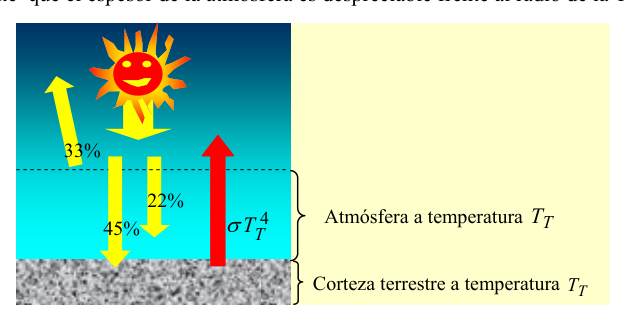
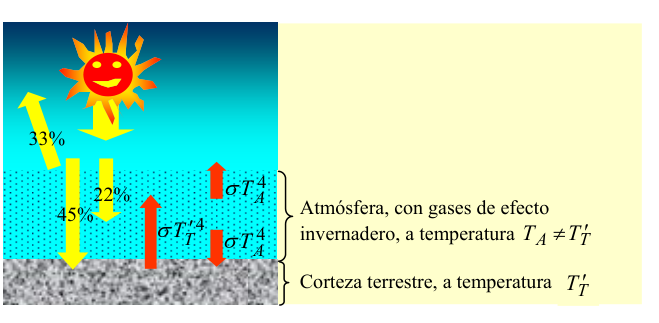
T R es el radio de la Tierra. Esta área es la sección eficaz de la Tierra para la radiación solar. 5) Determina y calcula la potencia solar que recibe la Tierra, T W . Como se esquematiza en la figura 1, un 33% de la energía solar que llega a la Tierra se refleja, un 22% se absorbe en la atmósfera y el 45% restante se absorbe en la corteza terrestre. Vamos a considerar en principio que, una vez alcanzado un estado estacionario en el que se equilibran ganancias y pérdidas energéticas, la corteza terrestre y la atmósfera están a la misma temperatura media (promedio entre día y noche), T T . Admite en adelante que el espesor de la atmósfera es despreciable frente al radio de la Tierra. Atmósfera a temperatura T T Fig. 1 Corteza terrestre a temperatura T T 33% 22% 45% 4 T T XXXVII OLIMPIADA ESPAÑOLA DE FÍSICA FASE DE ARAGÓN 6) Determina y calcula la temperatura de equilibrio del sistema corteza-atmósfera, T T , considerando al conjunto como un único cuerpo negro. En el planteamiento del apartado anterior no se ha tenido en cuenta el efecto invernadero, y por eso la temperatura T T que se obtiene es apreciablemente inferior a la temperatura media real de la Tierra, T T . La radiación que emite la Tierra está en el rango del infrarrojo, y precisamente la atmósfera absorbe esta radiación con gran eficacia debido a los gases de efecto invernadero que contiene (CO2, NOx, etc.). Como modelo más elaborado, consideremos ahora una situación de equilibrio en la que toda la radiación infrarroja que emite la corteza terrestre, a una temperatura T T , es completamente absorbida por la atmósfera, a una temperatura A T . Por otra parte, la atmósfera emite por igual en todas las direcciones, de manera que emite la misma radiación hacia el espacio exterior que hacia la corteza, como se esquematiza en la figura 2. 7) Determina y calcula la temperatura de equilibrio en la corteza terrestre, T T , suponiendo que tanto la corteza como la atmósfera se comportan como cuerpos negros.
Fig. 2 Atmósfera, con gases de efecto invernadero, a temperatura T A T T
4 T T
4 A T
4 A T
Corteza terrestre, a temperatura 45% 22% T T 33% XXXVII OLIMPIADA ESPAÑOLA DE FÍSICA FASE DE ARAGÓN
 Varilla con sfere cariche agli estremi
Topic: Electrostatics, Oscillations & Waves Metodi: Coulomb’s Law, Approximation & Series Expansion, Energy Conservation Method, Simple Harmonic Motion Analysis Competenze: Physical Reasoning, Mathematical Modeling, Estimation & Approximation Objects: Sphere, Rod Fonte: Testo (PDF) — p.6
P2 Soluzione a) La forza netta è la somma (vectoriale) delle repulsioni elettrostatiche delle due cariche situate nei le estremità del bastone. Prendendo un senso positivo verso destra 2 2 2 2 ) ( ) ( x d q k x d q k F
2 2 2 ) ( ) ( 4 x d x d x d kq F
b) Se x << d, disprezzando x rispetto a d nel denominatore dell’espressione precedente, la forza viene ridotta a 3 2 4 d x kq F
Si ottiene una forza che, approssimativamente, è direttamente proporzionale al spostamento x e in Il modello di forza di un’altra parte è il modello di forza di un’altra parte. oscillazioni approssimativamente armoniche, con frequenza angolare 3 3 2 2 4 md k q md kq
(1) c) La forza elettrica che agisce sulla carica q è conservatrice. Sviluppare la conservazione dell’energia Meccanica tra A e O si ha 2 0 2 2 2 2 1 2 20 / 19 20 / 21 mv d q k d q k d q k
Operando si ottiene
md k q md q k v 10 399 4 2 0
Questo ultimo risultato approssimativo può essere raggiunto anche tenendo conto delle conclusioni del il paragrafo b). In un’oscillazione armonica, la velocità passando per O (velocità massima) è A, dove A è l’ampiezza dell’oscillazione, cioè
md k q md k q d d v 10 2 20 20 3
d) Ovviamente, la carica si muoverà fino alla posizione simmetrica dell’iniziale, dove l’energia cinetica è zero e il potenziale coincide con l’iniziale, cioè 20 d x x A B
e) Come già detto, se x << d l’equazione di movimento è quella corrispondente ad un oscillatore Armonica ma d x kq F
3 2 4 x x md kq a 2 3 2 4
La frequenza angolare di oscillazione sarà data in (1), e il tempo che la particella impiega per andare da A a B sarà medio periodo
2 , T t B A k md q t B A 3 , 2 XXXVII Olimpiadi di fisica spagnola Fase di ARAGON P3.- L’effetto serra. Alcuni gas presenti nell’atmosfera come il vapore acqueo, CO2, CH4 e NOx sono denominati gas di effetto serra. Questi gas assorbono e reemettono verso la corteccia terrestre gran parte della radiazione l’infrarosso emesso dalla Terra, raggiungendo un equilibrio che rende possibile che la superficie di questo pianeta sia mantenere una temperatura media compatibile con la vita. Ma un aumento antropogeno della concentrazione di tali gas può produrre un aumento della temperatura terrestre con conseguenze disastrose. L’obiettivo di una serie di riunioni internazionali sul cambiamento climatico l’ultima a Parigi alla fine del 2015 è Infine, la Commissione ha deciso di ridurre le emissioni di gas serra. Questo esercizio pone alcuni aspetti relativi alla radiazione solare, e l’ultimo paragrafo si presenta un trattamento di base dell’effetto serra. L’alto strato dell’atmosfera terrestre riceve una radiazione solare la cui intensità (potenza per unità di superficie) è 2 3 m W/ 10 37 ,1
T S . La distanza tra il Sole e la Terra è m 10 5,1 11
ST R
Determina e calcola la potenza totale con cui emette il Sole, S W . La velocità della luce nel vuoto è s/ m 10 0 ,3 8
c . 2) Calcola la massa che il Sole perde per unità di tempo, t m
/ , per generare tale quantità di energia. Il raggio del sole è m 10 0 , 7 8
S R . 3) Determina e calcola la potenza per unità di superficie, S S , che emette il sole sulla sua superficie. La legge di Stefan-Boltzmann relaziona la potenza per unità di superficie emessa da un corpo nero Con la sua temperatura assoluta, T. La sua espressione è: 4 T S
, in cui 4 2 8 K m W 10 7 ,5
(Constante di Stefan-Boltzmann). Considera che la radiazione solare soddisfa questa legge, cioè che il sole si comporta come un corpo nero. 4) Qual è la temperatura sulla superficie del Sole, S T ? Dal sole la Terra appare come un disco di area 2 T R A
, dove m 10 37 , 6 6
T R è il radio della Terra. Questa zona è la sezione efficace della Terra per la radiazione solare. 5) Determina e calcola la potenza solare che riceve la Terra, T W . Come illustrato in figura 1, il 33% dell’energia solare che arriva sulla Terra si riflette, il 22% si riflette. Il 45% è assorbito nell’atmosfera e il 45% del resto nella corteccia terrestre. Considereremo in principio che, una volta raggiunto uno stato di stazionarietà in cui si bilanciano guadagni e perdite energetiche, la La corteccia terrestre e l’atmosfera sono alla stessa temperatura media (media di giorno e di notte), T T . Ammette che lo spessore dell’atmosfera è sconsiderato rispetto al raggio terrestre. Atmosfera a temperatura T T Fig. 1 Corte terrestre a temperatura T T 33% 22% 45% 4 T T XXXVII Olimpiadi di fisica spagnola Fase di ARAGON 6) Determina e calcola la temperatura di equilibrio del sistema corteccio-atmosfera, T T , considerando il insieme come un unico corpo nero. La proposta di direttiva del Consiglio che istituisce un sistema di protezione dei consumatori è stata adottata nel corso del suo corso. T temperatura La temperatura media della Terra è notevolmente inferiore alla temperatura media reale della Terra, T . La radiazione che emette la Terra è nel raggio dell’infrarosso, e proprio l’atmosfera assorbe questa radiazione. la radioterapia con grande efficacia a causa dei gas serra contenuti (CO2, NOx, ecc.). Come modello più elaborato, consideriamo ora una situazione di equilibrio in cui tutta la radiazione infrarossi che emettono la corteccia terrestre a una temperatura T T, è completamente assorbita dall’atmosfera, a una temperatura A T . L’atmosfera emette uguali emissioni in tutte le direzioni, quindi emette la stessa radiazione verso lo spazio esterno che verso la corteccia, come illustrato in figura 2. 7) Determina e calcola la temperatura di equilibrio nella corteccia terrestre, T T, supponendo che sia tanto la La corteccia come l’atmosfera si comporta come corpi neri.
Fig. 2 Atmosfera, con gas di effetto serra, a temperatura T A T T
4 T T
4 A T
4 A T
Corte terrestre, a temperatura 45% 22% T T 33% XXXVII Olimpiadi di fisica spagnola Fase di ARAGON
Stocca con sfera carica agli estremi
Topic: Electrostatics, Oscillations & Waves Metodi: Coulomb’s Law, Approximation & Series Expansion, Energy Conservation Method, Simple Harmonic Motion Analysis Competenze: Physical Reasoning, Mathematical Modeling, Estimation & Approximation Objects: Sphere, Rod Fonte: Testo (PDF) — p.6
P2 Solution a) The net force is the (vectoral) sum of the electrostatic repulsions of the two charges in the ends of the rod. Taking a positive direction to the right 2 2 2 2 ) ( ) ( x d q k x d q k F
2 2 2 ) ( ) ( 4 x d x d x d kq F
(b) If x << d, neglecting x versus d in the denominator of the above expression, the force is reduced to 3 2 4 d x kq F
The force is obtained which is approximately directly proportional to the displacement x and in The force is the opposite direction (force type muelle), so if the load is slightly separated from O and released it will be approximately harmonic oscillations, with angular frequency 3 3 2 2 4 md k q md kq
(1) c) The electrical force acting on the charge q is conservative. The Commission is also considering the need to develop a new approach to energy conservation. The mechanics between A and O is 2 0 2 2 2 2 1 2 20 / 19 20 / 21 mv d q k d q k d q k
Operating is obtained
md k q md q k v 10 399 4 2 0
This last approximate result can also be reached by taking into account the conclusions of the the following points are added: In a harmonic oscillation, the speed passing through O (maximum velocity) is A, where A is the amplitude of the oscillation, i.e.
md k q md k q d d v 10 2 20 20 3
d) Obviously, the charge will move to the symmetrical position of the initial, where the kinetic energy is The potential is zero and the potential is equal to the initial, i.e. 20 d x x A B
e) As already mentioned, if x << d the equation of motion is the corresponding one to an oscillator of a kind used for the manufacture of ma d x kq F
3 2 4 x x md kq a 2 3 2 4
The angular frequency of oscillation shall be given in (1), and the time it will take the particle to go from A to B is half-term
2 , T t B A k md q t B A 3 , 2 XXXVII Spanish Olympics in Physics The following is the list of the categories of products: P3.- The greenhouse effect. Some gases in the atmosphere such as water vapor, CO2, CH4 and NOx are called gases greenhouse effect. These gases absorb and re-emitted much of the radiation to the Earth’s crust. Infrared emission from the Earth, achieving a balance that makes it possible for the surface of this planet to be Keep it at a life-compatible average temperature. But an anthropogenic increase in concentration The effects of these gases can cause an increase in the Earth’s temperature with dire consequences. The objective of a series of international climate change meetings the latest in Paris at the end of 2015 is The Commission has already decided to reduce the greenhouse gas emissions. This exercise discusses some aspects of solar radiation, and the last paragraph a basic treatment of the greenhouse effect is provided. The upper layer of the Earth’s atmosphere receives solar radiation whose intensity (power per unit of surface area) is 2 3 m W/ 10 37 ,1
T S . The distance between the sun and the earth is m 10 5,1 11
ST R
Determine and calculate the total power the Sun emits, S W . The speed of light in a vacuum is s/ m 10 0 ,3 8
c . 2) Calculate the mass the Sun loses per unit of time, t m
/ , to generate such a large amount of energy. The radius of the sun is m 10 0 , 7 8
S R . 3) Determine and calculate the power per unit area, S S , which emits the sun on its surface. Stefan-Boltzmann’s law relates the power per unit area emitted by a black body with its absolute temperature, T. His expression is: 4 T S
, in which 4 2 8 K m W 10 7 ,5
(Constant of The Commission has already adopted a number of proposals. He considers that solar radiation complies with this law, that is, the Sun behaves like a black body. 4) What is the temperature on the surface of the Sun, S T ? From the Sun, the Earth looks like a disk of area 2 T R A
, where m 10 37 , 6 6
T R It’s the radio of the Earth. This area is the effective section of the Earth for solar radiation. 5) It determines and calculates the solar power that the Earth receives, T W . As shown in Figure 1, 33% of solar energy reaching the Earth is reflected, 22% is It absorbs in the atmosphere and the remaining 45% is absorbed in the Earth’s crust. We’ll consider in principle The energy efficiency of the energy sector is also a major factor in the reduction of energy consumption. Earth’s crust and atmosphere are at the same average temperature (average between day and night), T T . He goes on to admit that the thickness of the atmosphere is despicable in the face of the Earth’s radius. Atmosphere at T temperature T Fig. 1 Earth’s crust at T temperature T 33% 22% 45% 4 T T XXXVII Spanish Olympics in Physics The following is the list of the categories of products: 6) Determines and calculates the equilibrium temperature of the cortex-atmosphere system, T T , having regard to the together as a single black body. The Greenhouse effect has not been taken into account in the above paragraph and the Commission has therefore T temperature The resulting T is appreciably lower than the actual average temperature of the Earth, T T . The radiation that the Earth emits is in the infrared range, and precisely the atmosphere absorbs this radiation. radiation with high efficiency due to the greenhouse gases it contains (CO2, NOx, etc.). As a more elaborate model, let’s now consider a situation of equilibrium in which all radiation is Infrared emission from the Earth’s crust at a temperature of T T, is completely absorbed by the atmosphere, a a temperature A T . On the other hand, the atmosphere emits the same in all directions, so it emits The same radiation to the outer space as to the crust, as outlined in Figure 2. 7) Determines and calculates the equilibrium temperature in the Earth’s crust, T T, assuming that both the Cortex like the atmosphere behaves like black bodies.
Fig. 2 Atmosphere, with effect gases Greenhouse, at temperature T A T T
4 T T
4 A T
4 A T
Earth’s crust at temperature 45% 22% T T 33% XXXVII Spanish Olympics in Physics The following is the list of the categories of products:
Stick with sphere loaded to the ends
Topic: Electrostatics, Oscillations & Waves Metodi: Coulomb’s Law, Approximation & Series Expansion, Energy Conservation Method, Simple Harmonic Motion Analysis Competenze: Physical Reasoning, Mathematical Modeling, Estimation & Approximation Objects: Sphere, Rod Fonte: Testo (PDF) — p.6
P3 Solución 1) Si la distancia entre el Sol y la Tierra es ST R y la potencia que recibe la Tierra por unidad de superficie es T S , la energía total que emite el Sol es
W 10 9 ,3 4 26 2
T ST S S R W
De acuerdo con la muy conocida expresión de Einstein, una masa m
de Sol equivale a una energía E
dada por
2 c m E
Por tanto, la energía por unidad de tiempo (potencia) que genera el Sol, t E WS
/ , supone una pérdida de masa por unidad de tiempo
t E c t m
2 1
s/ kg 10 3 , 4 9 2
c W t m S
Si S R es el radio del Sol, la potencia por unidad de superficie que emite en su superficie es
2 7 2 m / W 10 3 , 6 4
S S S R W S
Si el Sol se considera como un cuerpo negro a temperatura S T , en virtud de la ley de Stefan-Boltzmann, se tiene
K 10 8,5 3 4 /1
S S S T
La energía que transporta la radiación solar incide en la Tierra a través de su sección eficaz, 2 T R A
, por lo que la potencia que llega a la tierra es
T T T S R W 2
(1)
W 10 7 ,1 17
T W
De la energía solar que llega a la Tierra, el 33% se refleja. El 67% restante se absorbe en la atmósfera o en la corteza terrestre. Si ambas, Tierra y atmosfera, están en equilibrio térmico a una temperatura T T , y suponiendo que el conjunto se comporta como un único cuerpo negro, la energía que emite por unidad de tiempo tiene que ser igual a la que recibe, T W 67 ,0 . Es decir,
T T T T S R T R 2 4 2 67 ,0 4
De donde
4 / 1 4 67 , 0
T T S T
(2)
K 252
T T XXXVII OLIMPIADA ESPAÑOLA DE FÍSICA FASE DE ARAGÓN 7) La temperatura obtenida en el apartado anterior ( 21 oC) es, sin duda, demasiado fresquita. Para obtener un resultado más realista es preciso mejorar el modelo, teniendo en cuenta los gases de efecto invernadero contenidos en la atmósfera, que supondremos a una temperatura A T . La atmósfera, considerada como un cuerpo negro, emite la energía que recibe del Sol y de la corteza de forma isótropa, y por tanto una parte se escapará al espacio y otra igual irá a parar a la corteza terrestre. Suponiendo también que la corteza es un cuerpo negro a temperatura T T , se pueden hacer los siguientes balances:
La corteza terrestre:
4 2 4 2 4 : Emite 4 45 , 0 Recibe T T A T T T R T R W
En estado de equilibrio
4 2 4 2 4 4 45 , 0 T T A T T T R T R W
Teniendo en cuenta (1) y simplificando
4 4 4 4 45 , 0 T A T T T S
(3)
En cuanto a la atmósfera, el balance energético es
La atmosfera:
4 2 4 2 4 2 : Emite 4 22 , 0 Recibe A T T T T T R T R W
Por lo que
4 2 4 2 2 4 2 4 22 , 0 A T T T T T T R T R S R
2 8 22 , 0 4 4 T T A T S T
(4)
Sustituyendo (4) en (3) y simplificando se obtiene
T T S T 28 , 0 4
Teniendo en cuenta (2), queda finalmente
4 4 67 ,1 T T T T
K 286 14 ,1
T T T T
Esta nueva temperatura es más y acorde con la realidad.
 Schema effetto serra atmosferico
 Schema temperatura cortezza-atmosfera
Topic: Thermodynamics, Astrophysics, Modern-Quantum Physics Metodi: Physical Modeling, Mass-Energy Equivalence, Dimensional Analysis, Conservation Laws Competenze: Physical Reasoning, Mathematical Modeling, Estimation & Approximation Objects: Star, Planet Fonte: Testo (PDF) — p.9
P3 Soluzione 1) Se la distanza tra il Sole e la Terra è ST R e la potenza che la Terra riceve per unità di superficie è T S , l’ energia totale emessa dal Sole è
W 10 9 ,3 4 26 2
T ST S S R W
Secondo la famosa espressione di Einstein, una massa m
di Sole equivale a un’energia E
data da
2 c m E
Quindi, l’energia per unità di tempo che il Sole genera, t E WS
/ , suppone una perdita di massa per unità di tempo
t E c t m
2 1
s/ kg 10 3 , 4 9 2
c W t m S
Si S R è il raggio del Sole, la potenza per unità di superficie che emette sulla sua superficie è
2 7 2 m / W 10 3 , 6 4
S S S R W S
Se il Sole è considerato un corpo nero a temperatura S T, in virtù della legge di Stefan-Boltzmann,
- Si ’ , si ’
K 10 8,5 3 4 /1
S S S T
L’energia che trasporta il raggi solare incide sulla Terra attraverso la sua sezione efficace, 2 T R A
, Quindi la potenza che arriva sulla terra è
T T T S R W 2
(1)
W 10 7 ,1 17
T W
Il 33% dell’energia solare che arriva sulla Terra si riflette. Il restante 67% viene assorbito nell’atmosfera o nella corteccia terrestre. Se entrambi, la Terra e l’atmosfera, sono in equilibrio termico a una temperatura T T , y Supponendo che l’insieme si comporti come un unico corpo nero, l’energia emessa per unità di Il tempo deve essere uguale a quello che riceve, T W 67 ,0 . Cioè,
T T T T S R T R 2 4 2 67 ,0 4
Da dove
4 / 1 4 67 , 0
T T S T
(2)
K 252
T T XXXVII Olimpiadi di fisica spagnola Fase di ARAGON 7) La temperatura ottenuta nel precedente punto (21 oC) è certamente troppo fresca. Per ottenere Un risultato più realistico è che il modello deve essere migliorato, tenendo conto dei gas a effetto serra. contenuti nell’atmosfera, che supponiamo sia a una temperatura A T . L’atmosfera, considerata come un Il corpo nero emette l’energia che riceve dal Sole e dalla corteccia in forma isotropico, e quindi una parte E’ un’altra specie che si sposta nello spazio e che si sposta nella corteccia terrestre. Supponiamo anche che la corteccia sia un corpo nero a temperatura T T , si possono fare i seguenti bilanci:
La corteccia terrestre:
4 2 4 2 4 : Emettete 4 45 , 0 Ricevi T T A T T T R T R W
In stato di equilibrio
4 2 4 2 4 4 45 , 0 T T A T T T R T R W
Considerando (1) e semplificando
4 4 4 4 45 , 0 T A T T T S
(3)
Per quanto riguarda l’atmosfera, il bilanciamento energetico è
L’atmosfera:
4 2 4 2 4 2 : Emettete 4 22 , 0 Ricevi A T T T T T R T R W
Per cui
4 2 4 2 2 4 2 4 22 , 0 A T T T T T T R T R S R
2 8 22 , 0 4 4 T T A T S T
(4)
Substituendo (4) per (3) e semplificando si ottiene
T T S T 28 , 0 4
Considerando che (2), è
4 4 67 ,1 T T T T
K 286 14 ,1
T T T T
Questa nuova temperatura è più e si adatta alla realtà.
Schema serra atmosferica
Schema temperatura cortezza-atmosfera
Topic: Thermodynamics, Astrophysics, Modern-Quantum Physics Metodi: Physical Modeling, Mass-Energy Equivalence, Dimensional Analysis, Conservation Laws Competenze: Physical Reasoning, Mathematical Modeling, Estimation & Approximation Objects: Star, Planet Fonte: Testo (PDF) — p.9
P3 Solution 1) If the distance between the Sun and the Earth is ST R And the power that the Earth receives per unit area is T S , the total energy emitted by the Sun is
W 10 9 ,3 4 26 2
T ST S S R W
According to Einstein’s well-known expression, a mass m
The energy of the Sun is equal to one E
given by
2 c m E
So the energy per unit of time (power) that the Sun generates, t E WS
/ , assuming one Loss of mass per unit of time
t E c t m
2 1
s/ kg 10 3 , 4 9 2
c W t m S
Si S R is the radius of the Sun, the power per unit area it emits on its surface is
2 7 2 m / W 10 3 , 6 4
S S S R W S
If the Sun is considered a black body at temperature S T, under the Stefan-Boltzmann law, You got it.
K 10 8,5 3 4 /1
S S S T
The energy that carries the solar radiation affects the Earth through its effective section, 2 T R A
, So the power that reaches the earth is
T T T S R W 2
(1)
W 10 7 ,1 17
T W
Of the solar energy that reaches Earth, 33 percent is reflected. The remaining 67% is absorbed into the atmosphere or in the Earth’s crust. If both Earth and atmosphere are in thermal equilibrium at a temperature T T , y Supposing that the whole behaves as a single black body, the energy it emits per unit of Time has to be equal to what it gets, T W 67 ,0 . I mean,
T T T T S R T R 2 4 2 67 ,0 4
Where did you come from?
4 / 1 4 67 , 0
T T S T
(2)
K 252
T T XXXVII Spanish Olympics in Physics The following is the list of the categories of products: 7) The temperature obtained in the previous paragraph (21 oC) is certainly too cool. To obtain The Commission has already adopted a proposal for a directive on the protection of the environment. contained in the atmosphere, which we will assume at a temperature A T . The atmosphere, considered as a It emits the energy it receives from the sun and the cortex in isotropic form, and therefore a part of the solar system. It will escape into space and another like it will reach the Earth’s crust. Assuming also that the crust is a black body at T temperature T , the following balances can be made:
The Earth’s crust:
4 2 4 2 4 : It broadcasts 4 45 , 0 Receive T T A T T T R T R W
In a state of equilibrium
4 2 4 2 4 4 45 , 0 T T A T T T R T R W
Taking into account (1) and simplifying
4 4 4 4 45 , 0 T A T T T S
(3)
As for the atmosphere, the energy balance is
The atmosphere:
4 2 4 2 4 2 : It broadcasts 4 22 , 0 Receive A T T T T T R T R W
So what?
4 2 4 2 2 4 2 4 22 , 0 A T T T T T T R T R S R
2 8 22 , 0 4 4 T T A T S T
(4)
Substitution of (4) by (3) and simplification is obtained
T T S T 28 , 0 4
Having regard to the second paragraph of Article 2 of the Treaty,
4 4 67 ,1 T T T T
K 286 14 ,1
T T T T
This new temperature is more and it’s in line with reality.
The Commission shall adopt delegated acts in accordance with Article 21 of this Regulation.
The following table shows the results of the calculation of the temperature of the product:
Topic: Thermodynamics, Astrophysics, Modern-Quantum Physics Metodi: Physical Modeling, Mass-Energy Equivalence, Dimensional Analysis, Conservation Laws Competenze: Physical Reasoning, Mathematical Modeling, Estimation & Approximation Objects: Star, Planet Fonte: Testo (PDF) — p.9