A car drives anticlockwise (counterclockwise) around a flat, circular curve at constant speed, so that the left, front wheel traces out a circular path of radius m. If the width of the car is m, what is the ratio of the angular velocity about its axle of the left, front wheel to that of the right, front wheel, of the car as it moves through the curve? Assume the wheels roll without slipping.
- A.
- B.
- C.
- D.
- E.
Topic: Rotational Dynamics Metodi: Kinematic Equations, Physical Modeling Competenze: Physical Reasoning Objects: Wheel Fonte: Testo (PDF)
Una macchina si muove in senso antiorologico (in senso antiorologico) attorno a una curva piatta e circolare a velocità costante, in modo che la ruota anteriore sinistra traccia un percorso circolare di raggio m. Se la larghezza della vettura è m, qual è il rapporto tra la velocità angolare dell’asse sinistra, della ruota anteriore e quella della ruota anteriore destra della vettura mentre si muove attraverso la curva? Supponiamo che le ruote ruotino senza scivolare.
- A.
- B.
- C.
- D.
- E.
Topic: Rotational Dynamics Metodi: Kinematic Equations, Physical Modeling Competenze: Physical Reasoning Objects: Wheel Fonte: Testo (PDF)
A 3.0 cm thick layer of oil with density kg/m is floating above water that has density kg/m. A solid cylinder is floating so that 1/3 is in the water, 1/3 is in the oil, and 1/3 is in the air. Additional oil is added until the cylinder is floating only in oil. What fraction of the cylinder is in the oil?
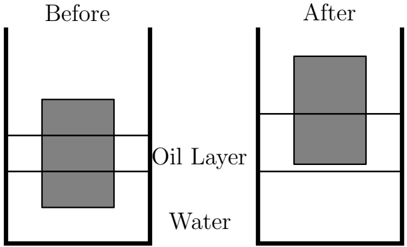
- A.
- B.
- C.
- D.
- E.
Topic: Fluid Mechanics Metodi: Hydrostatic Equilibrium, Physical Modeling Competenze: Physical Reasoning Objects: Cylinder Fonte: Testo (PDF)
Un strato di olio di 3,0 cm di spessore con densità kg/m galleggia sopra l’acqua con densità kg/m. Un cilindro solido galleggia in modo che 1/3 sia nell’acqua, 1/3 nell’olio e 1/3 nell’aria. Si aggiunge olio aggiuntivo fino a quando il cilindro galleggia solo in olio. Quanta frazione del cilindro c’è nell’olio?
- A.
- B.
- C.
- D.
- E.
Topic: Fluid Mechanics Metodi: Hydrostatic Equilibrium, Physical Modeling Competenze: Physical Reasoning Objects: Cylinder Fonte: Testo (PDF)
An introductory physics student, elated by a first semester grade, celebrates by dropping a textbook from a balcony into a deep layer of soft snow which is 3.00 m below. Upon hitting the snow the book sinks a further 1.00 m into it before coming to a stop. The mass of the book is 5.0 kg. Assuming a constant retarding force, what is the force from the snow on the book?
- A. N
- B. N
- C. N
- D. N
- E. N
Topic: Conservation of Energy Metodi: Energy Conservation Method, Kinematic Equations Competenze: Physical Reasoning Objects: Block Fonte: Testo (PDF)
Uno studente di fisica introduttiva, eccitato da una prima classe del semestre, celebra cadendo un libro di testo da un balcone in un profondo strato di neve morbida che è di 3,00 m di sotto. Quando colpisce la neve, il libro affonda un altro metro in fondo prima di fermarsi. La massa del libro è di 5,0 kg. Supponendo una forza di ritardo costante, quale è la forza della neve sul libro?
- A. N
- B. N
- C. N
- D. N
- E. N
Topic: Conservation of Energy Metodi: Energy Conservation Method, Kinematic Equations Competenze: Physical Reasoning Objects: Block Fonte: Testo (PDF)
A small bead slides from rest along a wire that is shaped like a vertical uniform helix (spring). Which graph below shows the magnitude of the acceleration as a function of time?
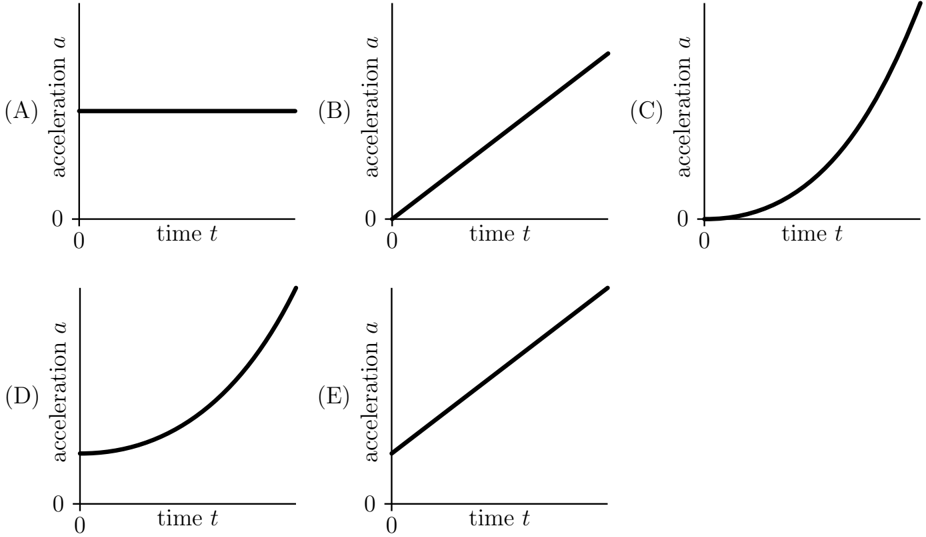
Topic: Newtonian Mechanics Metodi: Kinematic Equations, Free-Body Diagram Competenze: Physical Reasoning, Diagrammatic Reasoning Objects: Ball Fonte: Testo (PDF)
Una piccola perla scivola dal riposo lungo un filo che ha la forma di un’elice uniforme verticale (sorgente). Quale grafico di seguito mostra la grandezza dell’accelerazione in funzione del tempo?
Topic: Newtonian Mechanics Metodi: Kinematic Equations, Free-Body Diagram Competenze: Physical Reasoning, Diagrammatic Reasoning Objects: Ball Fonte: Testo (PDF)
Le informazioni seguenti si applicano ai quesiti 5 e 6.
Consider a particle in a box where the force of gravity is down as shown in the figure.
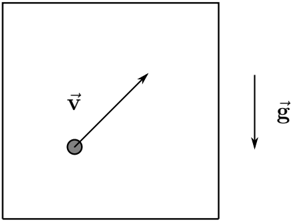
The particle has an initial velocity as shown, and the box has a constant acceleration to the right.
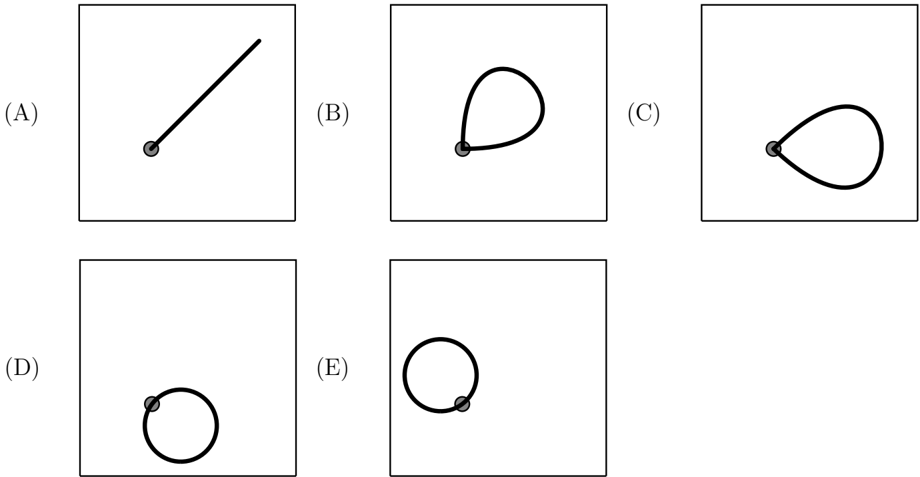
In the frame of the box, which of the following is a possible path followed by the particle?
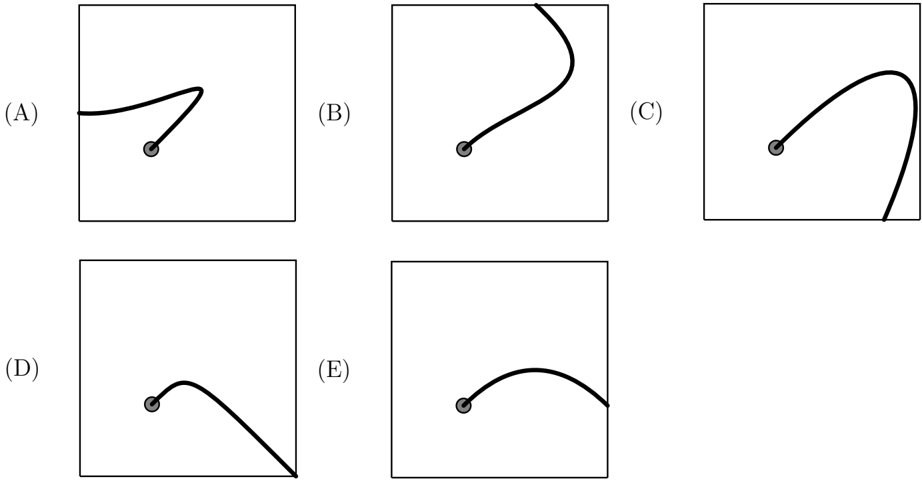
Topic: Newtonian Mechanics Metodi: Kinematic Equations, Vector Decomposition Competenze: Physical Reasoning, Diagrammatic Reasoning Objects: Projectile Fonte: Testo (PDF)
Le informazioni seguenti si applicano alle domande 5 e 6.
Considerate una particella in una scatola dove la forza di gravità è ridotta come mostrato nella figura.
La particella ha una velocità iniziale come mostrato, e la scatola ha un’accelerazione costante a destra.
Nella cornice della scatola, quale delle seguenti è un percorso possibile seguito dalla particella?
Topic: Newtonian Mechanics Metodi: Kinematic Equations, Vector Decomposition Competenze: Physical Reasoning, Diagrammatic Reasoning Objects: Projectile Fonte: Testo (PDF)
Le informazioni seguenti si applicano ai quesiti 5 e 6.
Consider a particle in a box where the force of gravity is down as shown in the figure. The particle has an initial velocity as shown, and the box has a constant acceleration to the right.
If the magnitude of the acceleration of the box is chosen correctly, the launched particle will follow a path that returns to the point that it was launched. In the frame of the box, which path is followed by the particle?
Topic: Newtonian Mechanics Metodi: Kinematic Equations, Vector Decomposition Competenze: Physical Reasoning, Diagrammatic Reasoning Objects: Projectile Fonte: Testo (PDF)
Le informazioni seguenti si applicano alle domande 5 e 6.
Considerate una particella in una scatola dove la forza di gravità è ridotta come mostrato nella figura. La particella ha una velocità iniziale come mostrato, e la scatola ha un’accelerazione costante a destra.
Se la grandezza dell’accelerazione della scatola viene scelta correttamente, la particella lanciata seguirà un percorso che ritorna al punto in cui è stata lanciata. Nel quadro della scatola, quale percorso segue la particella?
Topic: Newtonian Mechanics Metodi: Kinematic Equations, Vector Decomposition Competenze: Physical Reasoning, Diagrammatic Reasoning Objects: Projectile Fonte: Testo (PDF)
A mass on a frictionless table is attached to the midpoint of an originally unstretched spring fixed at the ends. If the mass is displaced a distance parallel to the table surface but perpendicular to the spring, it exhibits oscillations. The period of the oscillations
- A. does not depend on .
- B. increases as increases, approaching a fixed value.
- C. decreases as increases, approaching a fixed value.
- D. is approximately constant for small values of , then increases without bound.
- E. is approximately constant for small values of , then decreases without bound.
Topic: Oscillations & Waves Metodi: Simple Harmonic Motion Analysis, Approximation & Series Expansion Competenze: Physical Reasoning Objects: Spring, Block Fonte: Testo (PDF)
Una massa su un tavolo senza attrito è attaccata al punto medio di una molla originariamente non allungata fissata alle estremità. Se la massa è spostata a una distanza parallela alla superficie della tavola ma perpendicolare alla molla, essa presenta oscillazioni. Il periodo delle oscillazioni
- A. non dipende da .
- B. aumenta con l’aumento di , avvicinandosi a un valore fisso.
- C. diminuisce con l’aumento di , avvicinandosi a un valore fisso.
- D. è approssimativamente costante per piccoli valori di , quindi aumenta senza limite.
- E. è approssimativamente costante per piccoli valori di , quindi diminuisce senza limite.
Topic: Oscillations & Waves Metodi: Simple Harmonic Motion Analysis, Approximation & Series Expansion Competenze: Physical Reasoning Objects: Spring, Block Fonte: Testo (PDF)
Kepler’s Laws state that
- I. the orbits of planets are elliptical with one focus at the sun,
- II. a line connecting the sun and a planet sweeps out equal areas in equal times, and
- III. the square the period of a planet’s orbit is proportional to the cube of its semimajor axis.
Which of these laws would remain true if the force of gravity were proportional to rather than ?
- A. Only I.
- B. Only II.
- C. Only III.
- D. Both II and III.
- E. None of the above.
Topic: Gravitation Metodi: Kepler’s Laws, Newton’s Law of Gravitation Competenze: Physical Reasoning Objects: Planet Fonte: Testo (PDF)
Le leggi di Kepler affermano che
- I. le orbite dei pianeti sono ellittiche con un unico foco sul Sole,
- II. una linea che collega il sole e un pianeta che spazza fuori aree uguali in tempi uguali, e
- III. il quadrato il periodo di orbita di un pianeta è proporzionale al cubo del suo asse semimajor.
Quale di queste leggi sarebbe ancora vero se la forza di gravità fosse proporzionale a piuttosto che ?
- A. Solo I.
- B. Solo II.
- C. Solo III.
- D. Sia II che III.
- E. Nessuna delle seguenti.
Topic: Gravitation Metodi: Kepler’s Laws, Newton’s Law of Gravitation Competenze: Physical Reasoning Objects: Planet Fonte: Testo (PDF)
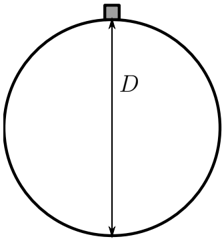
A small bead is placed on the top of a frictionless glass sphere of diameter as shown. The bead is given a slight push and starts sliding down along the sphere. Find the speed of the bead at the point at which the bead leaves the sphere.
- A.
- B.
- C.
- D.
- E.
Topic: Conservation of Energy Metodi: Energy Conservation Method, Free-Body Diagram Competenze: Physical Reasoning Objects: Sphere, Ball Fonte: Testo (PDF)
Una piccola perla viene collocata sulla parte superiore di una sfera di vetro senza attrito di diametro come mostrato. La perla riceve una leggera spinta e inizia a scivolare lungo la sfera. Trova la velocità della perla al punto in cui la perla lascia la sfera.
- A.
- B.
- C.
- D.
- E.
Topic: Conservation of Energy Metodi: Energy Conservation Method, Free-Body Diagram Competenze: Physical Reasoning Objects: Sphere, Ball Fonte: Testo (PDF)
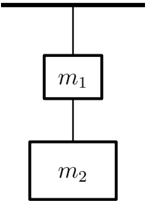
Two blocks are suspended by two massless elastic strings to the ceiling as shown in the figure. The masses of the upper and lower block are kg and kg respectively. If the upper string is suddenly cut just above the top block what are the accelerations of the two blocks at the moment when the top block begins to fall?
- A. upper: m/s; lower:
- B. upper: m/s; lower: m/s
- C. upper: m/s; lower: m/s
- D. upper: m/s; lower:
- E. upper: m/s; lower: m/s
Topic: Newtonian Mechanics Metodi: Free-Body Diagram, Hooke’s Law Competenze: Physical Reasoning Objects: Block, Spring Fonte: Testo (PDF)
Due blocchi sono sospesi con due stringhe elastiche senza massa al soffitto come mostrato nella figura. Le masse del blocco superiore e inferiore sono rispettivamente kg e kg. Se la stringa superiore viene improvvisamente tagliata appena sopra il blocco superiore, quali sono le accelerazioni dei due blocchi al momento in cui il blocco superiore inizia a cadere?
- A. superiore: m/s; inferiore:
- B. superiore: m/s; inferiore: m/s
- C. superiore: m/s; inferiore: m/s
- D. superiore: m/s; inferiore:
- E. superiore: m/s; inferiore: m/s
Topic: Newtonian Mechanics Metodi: Free-Body Diagram, Hooke’s Law Competenze: Physical Reasoning Objects: Block, Spring Fonte: Testo (PDF)
The power output from a certain experimental car design to be shaped like a cube is proportional to the mass of the car. The force of air friction on the car is proportional to , where is the speed of the car and the cross sectional area. On a level surface the car has a maximum speed . Assuming that all versions of this design have the same density, then which of the following is true?
- A.
- B.
- C.
- D.
- E.
Topic: Newtonian Mechanics, Order-of-Magnitude Estimation Metodi: Dimensional Analysis, Approximation & Series Expansion Competenze: Physical Reasoning, Estimation & Approximation Objects: - Fonte: Testo (PDF)
La potenza prodotta da un determinato progetto di auto sperimentale a forma di cubo è proporzionale alla massa dell’auto. La forza di attrito dell’aria sull’auto è proporzionale a , dove è la velocità dell’auto e l’area di sezione trasversale. Su superficie piana, l’auto ha una velocità massima . Supponendo che tutte le versioni di questo disegno abbiano la stessa densità, quale delle seguenti è vero?
- A.
- B.
- C.
- D.
- E.
Topic: Newtonian Mechanics, Order-of-Magnitude Estimation Metodi: Dimensional Analysis, Approximation & Series Expansion Competenze: Physical Reasoning, Estimation & Approximation Objects: - Fonte: Testo (PDF)
A block floats partially submerged in a container of liquid. When the entire container is accelerated upward, which of the following happens? Assume that both the liquid and the block are incompressible.
- A. The block descends down lower into the liquid.
- B. The block ascends up higher in the liquid.
- C. The block does not ascend nor descend in the liquid.
- D. The answer depends on the direction of motion of the container.
- E. The answer depends on the rate of change of the acceleration.
Topic: Fluid Mechanics Metodi: Hydrostatic Equilibrium, Physical Modeling Competenze: Physical Reasoning Objects: Block, Container Fonte: Testo (PDF)
Un blocco galleggia in un contenitore di liquido. Quando l’intero contenitore viene accelerato verso l’alto, quale di questi accade? Supponiamo che sia il liquido che il blocco siano incompressibili.
- A. Il blocco scende più in basso nel liquido.
- B. Il blocco sale più in alto nel liquido.
- C. Il blocco non sale né scende nel liquido.
- D. La risposta dipende dalla direzione di movimento del contenitore.
- E. La risposta dipende dal tasso di variazione dell’accelerazione.
Topic: Fluid Mechanics Metodi: Hydrostatic Equilibrium, Physical Modeling Competenze: Physical Reasoning Objects: Block, Container Fonte: Testo (PDF)
An object of mass initially moving at speed collides with an originally stationary object of mass , where . The collision could be completely elastic, completely inelastic, or partially inelastic. After the collision the two objects move at speeds and . Assume that the collision is one dimensional, and that object one cannot pass through object two.
After the collision, the speed ratio of object 2 is bounded by
- A.
- B.
- C.
- D.
- E.
Topic: Conservation of Momentum Metodi: Conservation of Momentum, Conservation of Energy Competenze: Physical Reasoning Objects: - Fonte: Testo (PDF)
Un oggetto di massa inizialmente in movimento a velocità si schianta con un oggetto di massa originariamente fermo , dove . La collisione potrebbe essere completamente elastica, completamente inelastica o parzialmente inelastica. Dopo la collisione i due oggetti si muovono a velocità e . Supponiamo che la collisione sia unidimensional, e che l’oggetto uno non possa passare attraverso l’oggetto due.
Dopo la collisione, il rapporto di velocità dell’oggetto 2 è limitato da:
- A.
- B.
- C.
- D.
- E.
Topic: Conservation of Momentum Metodi: Conservation of Momentum, Conservation of Energy Competenze: Physical Reasoning Objects: - Fonte: Testo (PDF)
Le informazioni seguenti si applicano ai quesiti 14 e 15.
A uniform rod of length lies on a frictionless horizontal surface. One end of the rod is attached to a pivot. An un-stretched spring of length lies on the surface perpendicular to the rod; one end of the spring is attached to the movable end of the rod, and the other end is attached to a fixed post. When the rod is rotated slightly about the pivot, it oscillates at frequency .
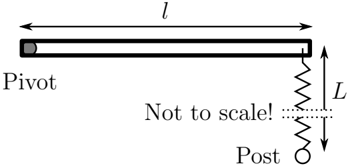
The spring attachment is moved to the midpoint of the rod, and the post is moved so the spring remains unstretched and perpendicular to the rod. The system is again set into small oscillations. What is the new frequency of oscillation?
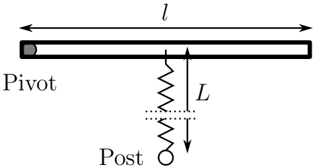
- A.
- B.
- C.
- D.
- E.
Topic: Oscillations & Waves Metodi: Simple Harmonic Motion Analysis, Torque & Angular Momentum Analysis, Hooke’s Law Competenze: Physical Reasoning Objects: Rod, Spring Fonte: Testo (PDF)
Le informazioni seguenti si applicano alle domande 14 e 15.
Una barra uniforme di lunghezza si trova su una superficie orizzontale senza attrito. Una estremità della canna è attaccata a un pivot. Una molla non allungata di lunghezza si trova sulla superficie perpendicolare alla canna; una estremità della molla è attaccata alla estremità mobile della canna e l’altra è attaccata a un post fisso. Quando la canna è rotata leggermente intorno al pivot, oscilla alla frequenza .
Il supporto di molla viene spostato al punto medio della canna e il palo viene spostato in modo che la molla rimanga non allungata e perpendicolare alla canna. Il sistema è di nuovo impostato in piccole oscillazioni. Qual è la nuova frequenza di oscillazione?
- A.
- B.
- C.
- D.
- E.
Topic: Oscillations & Waves Metodi: Simple Harmonic Motion Analysis, Torque & Angular Momentum Analysis, Hooke’s Law Competenze: Physical Reasoning Objects: Rod, Spring Fonte: Testo (PDF)
Le informazioni seguenti si applicano ai quesiti 14 e 15.
A uniform rod of length lies on a frictionless horizontal surface. One end of the rod is attached to a pivot. An un-stretched spring of length lies on the surface perpendicular to the rod; one end of the spring is attached to the movable end of the rod, and the other end is attached to a fixed post. When the rod is rotated slightly about the pivot, it oscillates at frequency .
The spring attachment is moved back to the end of the rod; the post is moved so that it is in line with the rod and the pivot and the spring is unstretched. The post is then moved away from the pivot by an additional amount . What is the new frequency of oscillation?
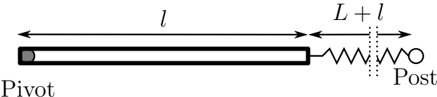
- A.
- B.
- C.
- D.
- E.
Topic: Oscillations & Waves Metodi: Simple Harmonic Motion Analysis, Torque & Angular Momentum Analysis, Hooke’s Law Competenze: Physical Reasoning Objects: Rod, Spring Fonte: Testo (PDF)
Le informazioni seguenti si applicano alle domande 14 e 15.
Una barra uniforme di lunghezza si trova su una superficie orizzontale senza attrito. Una estremità della canna è attaccata a un pivot. Una molla non allungata di lunghezza si trova sulla superficie perpendicolare alla canna; una estremità della molla è attaccata alla estremità mobile della canna e l’altra è attaccata a un post fisso. Quando la canna è rotata leggermente intorno al pivot, oscilla alla frequenza .
Il supporto di molla viene spostato indietro alla fine della canna; il palo viene spostato in modo che sia in linea con la canna e il rotolo e la molla non è allungata. Il posto viene poi spostato dal pivot di un importo aggiuntivo . Qual è la nuova frequenza di oscillazione?
- A.
- B.
- C.
- D.
- E.
Topic: Oscillations & Waves Metodi: Simple Harmonic Motion Analysis, Torque & Angular Momentum Analysis, Hooke’s Law Competenze: Physical Reasoning Objects: Rod, Spring Fonte: Testo (PDF)
A ball rolls from the back of a large truck traveling 10.0 m/s to the right. The ball is traveling horizontally at 8.0 m/s to the left relative to an observer in the truck. The ball lands on the roadway 1.25 m below its starting level. How far behind the truck does it land?
- A. m
- B. m
- C. m
- D. m
- E. m
Topic: Newtonian Mechanics Metodi: Kinematic Equations, Vector Decomposition Competenze: Physical Reasoning Objects: Ball Fonte: Testo (PDF)
Una palla ruota da dietro un grande camion che si muove a destra a 10,0 m/s. La palla si muove orizzontalmente a 8,0 m/s a sinistra rispetto ad un osservatore nel camion. La palla atterrà sulla strada a 1,25 m sotto il suo livello di partenza. Quanto lontano dietro il camion atterrà?
- A. m
- B. m
- C. m
- D. m
- E. m
Topic: Newtonian Mechanics Metodi: Kinematic Equations, Vector Decomposition Competenze: Physical Reasoning Objects: Ball Fonte: Testo (PDF)
As shown in the figure, a ping-pong ball with mass with initial horizontal velocity and angular velocity comes into contact with the ground. Friction is not negligible, so both the velocity and angular velocity of the ping-pong ball changes. What is the critical velocity such that the ping-pong ball will stop and remain stopped? Treat the ping-pong ball as a hollow sphere.
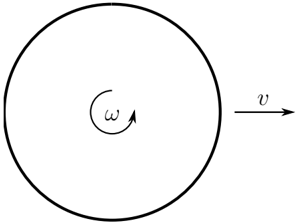
- A.
- B.
- C.
- D.
- E.
Topic: Rotational Dynamics Metodi: Torque & Angular Momentum Analysis, Impulse-Momentum Theorem Competenze: Physical Reasoning Objects: Ball Fonte: Testo (PDF)
Come mostrato nella figura, una palla di ping-pong di massa con velocità orizzontale iniziale e velocità angolare entra in contatto con il terreno. La frizione non è trascurabile, quindi sia la velocità che la velocità angolare della palla di ping-pong cambiano. Qual è la velocità critica tale che la palla di ping-pong si ferma e rimanga ferma? Tratta la palla di ping-pong come una sfera vuota.
- A.
- B.
- C.
- D.
- E.
Topic: Rotational Dynamics Metodi: Torque & Angular Momentum Analysis, Impulse-Momentum Theorem Competenze: Physical Reasoning Objects: Ball Fonte: Testo (PDF)
A spinning object begins from rest and accelerates to an angular velocity of rad/s with an angular acceleration of rad/s. It remains spinning at that constant angular velocity and then stops with an angular acceleration of the same magnitude as it previously accelerated. The object made a total of 3 complete rotations during the entire motion. How much time did the motion take?
- A. s
- B. s
- C. s
- D. s
- E. s
Topic: Rotational Dynamics Metodi: Kinematic Equations Competenze: Physical Reasoning Objects: - Fonte: Testo (PDF)
Un oggetto in rotazione inizia dal riposo e si accelera a una velocità angolare di rad/s con un’accelerazione angolare di rad/s. Rimane a girare a quella velocità angolare costante e poi si ferma con un’accelerazione angolare della stessa magnitudo in cui si era precedentemente accelerata. L’oggetto ha fatto un totale di 3 rotazioni complete durante tutto il movimento. Quanto tempo ci è voluto per la mozione?
- A. s
- B. s
- C. s
- D. s
- E. s
Topic: Rotational Dynamics Metodi: Kinematic Equations Competenze: Physical Reasoning Objects: - Fonte: Testo (PDF)
A semicircular wire of radius is oriented vertically. A small bead is released from rest at the top of the wire, it slides without friction under the influence of gravity to the bottom, where it then leaves the wire horizontally and falls a distance to the ground. The bead lands a horizontal distance away from where it was launched.
Which of the following is a correct graph of against ?
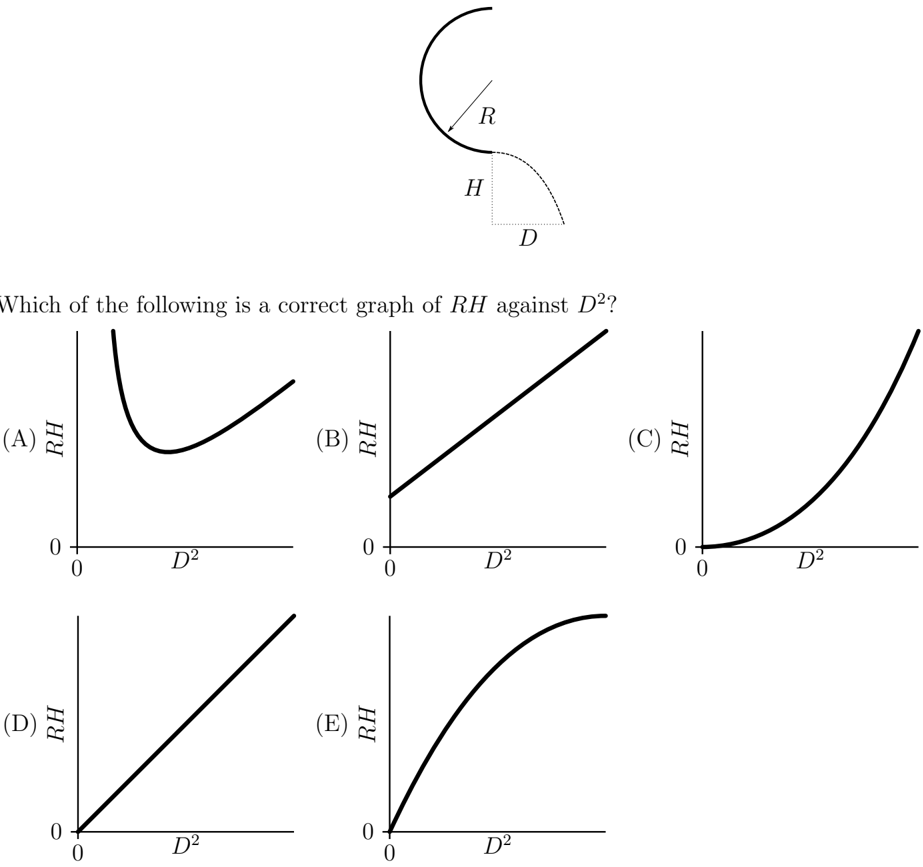
Topic: Conservation of Energy Metodi: Energy Conservation Method, Kinematic Equations Competenze: Physical Reasoning Objects: Ball, Wire Fonte: Testo (PDF)
Un filo semicircolare di raggio è orientato verticalmente. Una piccola manciata viene rilasciata dal riposo nella parte superiore del filo, si scivola senza attrito sotto l’influenza della gravità verso il basso, dove lascia il filo orizzontalmente e cade a una distanza dal terreno. La manciata atterrà a una distanza orizzontale dal luogo di lancio.
Qual è il grafico corretto di rispetto a ?
Topic: Conservation of Energy Metodi: Energy Conservation Method, Kinematic Equations Competenze: Physical Reasoning Objects: Ball, Wire Fonte: Testo (PDF)
A uniform solid right prism whose cross section is an isosceles right triangle with height and width is placed on an incline that has a variable angle with the horizontal . What is the minimum coefficient of static friction so that the prism topples before it begins sliding as is slowly increased from zero?
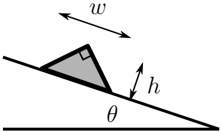
- A.
- B.
- C.
- D.
- E.
Topic: Rigid Body Statics Metodi: Torque & Angular Momentum Analysis, Free-Body Diagram Competenze: Physical Reasoning Objects: Inclined Plane Fonte: Testo (PDF)
Un prisma retto solido uniforme la cui sezione trasversale è un triangolo retto a pari stelle con altezza e larghezza è posizionato su un’inclinazione che ha un angolo variabile con l’orizzontale . Qual è il coefficiente minimo di attrito statico in modo che il prisma si abbatta prima di iniziare a scivolare mentre aumenta lentamente da zero?
- A.
- B.
- C.
- D.
- E.
Topic: Rigid Body Statics Metodi: Torque & Angular Momentum Analysis, Free-Body Diagram Competenze: Physical Reasoning Objects: Inclined Plane Fonte: Testo (PDF)
Le informazioni seguenti si applicano ai quesiti 21 e 22.
A small ball of mass is at rest on the ground. A second small ball of mass is positioned above the ground by a vertical massless rod of length that is also attached to the ball on the ground. The original orientation of the rod is directly vertical, and the top ball is given a small horizontal nudge. There is no friction; assume that everything happens in a single plane.
Determine the horizontal displacement of the second ball just before it hits the ground.
- A.
- B.
- C.
- D.
- E.
Topic: Conservation of Momentum Metodi: Conservation of Momentum, Physical Modeling Competenze: Physical Reasoning Objects: Rod, Ball Fonte: Testo (PDF)
Le informazioni seguenti si applicano alle domande 21 e 22.
Una piccola palla di massa è in riposo sul terreno. Una seconda piccola palla di massa è posizionata sopra il terreno da una barra verticale senza massa di lunghezza che è anch’essa attaccata alla palla sul terreno. L’orientamento originale della canna è direttamente verticale e alla palla superiore viene dato un piccolo spinto orizzontale. Non c’è attrito; supponiamo che tutto accada in un unico piano.
Determinare il spostamento orizzontale della seconda palla poco prima che colpisca il terreno.
- A.
- B.
- C.
- D.
- E.
Topic: Conservation of Momentum Metodi: Conservation of Momentum, Physical Modeling Competenze: Physical Reasoning Objects: Rod, Ball Fonte: Testo (PDF)
Le informazioni seguenti si applicano ai quesiti 21 e 22.
A small ball of mass is at rest on the ground. A second small ball of mass is positioned above the ground by a vertical massless rod of length that is also attached to the ball on the ground. The original orientation of the rod is directly vertical, and the top ball is given a small horizontal nudge. There is no friction; assume that everything happens in a single plane.
Determine the speed of the second (originally top) ball just before it hits the ground.
- A.
- B.
- C.
- D.
- E.
Topic: Conservation of Energy Metodi: Energy Conservation Method, Conservation of Momentum Competenze: Physical Reasoning Objects: Rod, Ball Fonte: Testo (PDF)
Le informazioni seguenti si applicano alle domande 21 e 22.
Una piccola palla di massa è in riposo sul terreno. Una seconda piccola palla di massa è posizionata sopra il terreno da una barra verticale senza massa di lunghezza che è anch’essa attaccata alla palla sul terreno. L’orientamento originale della canna è direttamente verticale e alla palla superiore viene dato un piccolo spinto orizzontale. Non c’è attrito; supponiamo che tutto accada in un unico piano.
Determinare la velocità della seconda palla (in origine superiore) poco prima che colpisca il terreno.
- A.
- B.
- C.
- D.
- E.
Topic: Conservation of Energy Metodi: Energy Conservation Method, Conservation of Momentum Competenze: Physical Reasoning Objects: Rod, Ball Fonte: Testo (PDF)
A uniform thin circular rubber band of mass and spring constant has an original radius . Now it is tossed into the air. Assume it remains circular when stabilized in air and rotates at angular speed about its center uniformly. Which of the following gives the new radius of the rubber band?
- A.
- B.
- C.
- D.
- E.
Topic: Elasticity & Materials Metodi: Hooke’s Law, Physical Modeling Competenze: Physical Reasoning Objects: String Fonte: Testo (PDF)
Una fascia di gomma circolare sottile uniforme di massa e costante di molla ha un raggio originale . Ora viene lanciato in aria. Supponiamo che rimanga circolare quando si stabilizza nell’aria e ruota uniformemente a velocità angolare intorno al suo centro. Quale delle seguenti indica il nuovo raggio della fascia gommata?
- A.
- B.
- C.
- D.
- E.
Topic: Elasticity & Materials Metodi: Hooke’s Law, Physical Modeling Competenze: Physical Reasoning Objects: String Fonte: Testo (PDF)
The moment of inertia of a uniform equilateral triangle with mass and side length about an axis through one of its sides and parallel to that side is . What is the moment of inertia of a uniform regular hexagon of mass and side length about an axis through two opposite vertices?
- A.
- B.
- C.
- D.
- E.
Topic: Rotational Dynamics Metodi: Superposition Principle, Physical Modeling Competenze: Physical Reasoning, Mathematical Modeling Objects: - Fonte: Testo (PDF)
Il momento di inerzia di un triangolo equilaterale uniforme con massa e lunghezza laterale intorno ad un asse attraverso uno dei suoi lati e parallelo a tale lato è . Qual è il momento di inerzia di un esagono regolare uniforme di massa e lunghezza laterale intorno ad un asse attraverso due vertici opposti?
- A.
- B.
- C.
- D.
- E.
Topic: Rotational Dynamics Metodi: Superposition Principle, Physical Modeling Competenze: Physical Reasoning, Mathematical Modeling Objects: - Fonte: Testo (PDF)
Three students make measurements of the length of a 1.50 meter rod. Each student reports an uncertainty estimate representing an independent random error applicable to the measurement.
Alice: A single measurement using a 2.0 meter long tape measure, to within mm.
Bob: Two measurements using a wooden meter stick, each to within mm, which he adds together.
Christina: Two measurements using a machinist’s meter ruler, each to within mm, which she adds together.
The students’ teacher prefers measurements that are likely to have less error. Which is the correct order of preference?
- A. Christina’s is preferable to Alice’s, which is preferable to Bob’s
- B. Alice’s is preferable to Christina’s, which is preferable to Bob’s
- C. Alice’s and Christina’s are equally preferable; both are preferable to Bob’s
- D. Christina’s is preferable to both Alice’s and to Bob’s, which are equally preferable
- E. Alice’s is preferable to Bob’s and Christina’s, which are equally preferable
Topic: Mathematics Metodi: Error Propagation, Experimental Data Analysis Competenze: Error Propagation, Significant Figures Objects: - Fonte: Testo (PDF)
Tre studenti misurano la lunghezza di un bastone di 1,50 metri. Ogni studente riferisce una stima di incertezza che rappresenta un errore casuale indipendente applicabile alla misura.
Alice: misurazione singola con nastro di misura lungo 2,0 metri, entro mm.
Bob: Due misure con un bastone di legno, ciascuna entro mm, che si aggiungono.
Christina: Due misure con la regola del contatore di un macchinista, ciascuna entro mm, che aggiunge insieme.
Il maestro degli studenti preferisce misure che hanno meno probabilità di errori. Qual è l’ordine corretto di preferenza?
- La Christina è preferita a Alice, che è preferita a Bob.
- B. Alice è preferita a Christina, che è preferita a Bob
- C. Le di Alice e Christina sono ugualmente preferibili; entrambi sono preferibili alla di Bob
- D. Christina è preferita sia a Alice che a Bob, che sono ugualmente preferiti
- E. Alice’s è preferibile a Bob’s e Christina’s, che sono ugualmente preferibili
Topic: Mathematics Metodi: Error Propagation, Experimental Data Analysis Competenze: Error Propagation, Significant Figures Objects: - Fonte: Testo (PDF)