(a) Sketch the electric field lines due to two point charges, of magnitudes and , at A and B, separated by a distance .
(i) Determine the location of the neutral point, P, where the electric field is zero.
(ii) Why does the magnitude of the electric field vary along a field line?
Topic: Electrostatics Metodi: Coulomb’s Law, Superposition Principle Competenze: Physical Reasoning, Diagrammatic Reasoning Objects: Point Charge Fonte: Testo (PDF) — p.4
**(a) ** Segnare le linee di campo elettrico a causa di due cariche a punti, di magnitudini e , a A e B, separate da una distanza .
(i) Determinare la posizione del punto neutro, P, dove il campo elettrico è zero.
(ii) Perché la magnitudine del campo elettrico varia lungo una linea di campo?
Topic: Electrostatics Metodi: Coulomb’s Law, Superposition Principle Competenze: Physical Reasoning, Diagrammatic Reasoning Objects: Point Charge Fonte: Testo (PDF) — p.4
(b) A charge of C passes through a 12 V battery when the battery discharges. Assuming that the p.d. across the terminals remains constant, calculate the time for which it can supply 0.45 kW.
Topic: Circuits Metodi: Equivalent Circuit Reduction Competenze: Physical Reasoning, Unit Conversion Objects: Battery Fonte: Testo (PDF) — p.4
**(b) ** Una carica di C passa attraverso una batteria da 12 V quando la batteria si scarica. Supponendo che la polizia per i terminali rimane costante, calcola il tempo per il quale può fornire 0,45 kW.
Topic: Circuits Metodi: Equivalent Circuit Reduction Competenze: Physical Reasoning, Unit Conversion Objects: Battery Fonte: Testo (PDF) — p.4
(c) Draw a general resistive network diagram with:
(i) two resistors in series which are, in turn, in series with three resistors in parallel.
(ii) five resistors that are not in series or parallel, or in a combination of series and parallel arrangements.
Calculate the resistance in (i) and (ii) if all the resistors have resistance .
Topic: Circuits Metodi: Equivalent Circuit Reduction, Kirchhoff’s Laws Competenze: Diagrammatic Reasoning, Mathematical Modeling Objects: Resistor Fonte: Testo (PDF) — p.4
**(c) ** Disegnare un diagramma generale di rete resistiva con:
-
due resistori in serie che, a loro volta, sono in serie con tre resistori in parallelo.
-
cinque resistori non in serie o parallele, o in combinazione di serie e di arrangiamenti paralleli.
Calcolare la resistenza nelle lettere i) e ii) se tutte le resistenze hanno resistenza .
Topic: Circuits Metodi: Equivalent Circuit Reduction, Kirchhoff’s Laws Competenze: Diagrammatic Reasoning, Mathematical Modeling Objects: Resistor Fonte: Testo (PDF) — p.4
(d) Two spheres, of uniform density, one of mass and radius and the other of mass and radius , attract each other gravitationally. What is their relative speed at the instant of collision if they are released from rest when a great distance apart?
Topic: Gravitation, Conservation of Energy Metodi: Conservation of Energy, Newton’s Law of Gravitation Competenze: Mathematical Modeling, Physical Reasoning Objects: Sphere Fonte: Testo (PDF) — p.4
Due sfere, di densità uniforme, una di massa e di raggio e l’altra di massa e raggio , si attraggono gravitazionalmente. Qual è la velocità relativa di ** al momento della collisione se vengono rilasciate dal riposo a grande distanza?
Topic: Gravitation, Conservation of Energy Metodi: Conservation of Energy, Newton’s Law of Gravitation Competenze: Mathematical Modeling, Physical Reasoning Objects: Sphere Fonte: Testo (PDF) — p.4
(e) A bicycle tyre has a volume of m³ when fully inflated. A bicycle pump has a working volume of m³. How many strokes, , of the pump are needed to inflate the completely flat tyre, containing no air, to a pressure of Pa? The atmospheric pressure is Pa. Assume the air is pumped in slowly so that there is no change in temperature.
Topic: Thermodynamics Metodi: Ideal Gas Law Competenze: Physical Reasoning, Mathematical Modeling Objects: Gas, Container Fonte: Testo (PDF) — p.5
**(e) ** Un pneumatico di bicicletta ha un volume di m3 quando è completamente gonfiato. Una pompa per biciclette ha un volume di lavoro di m3. Quanti colpi, , della pompa sono necessari per gonfiare il pneumatico completamente piatto, senza aria, a una pressione di Pa? La pressione atmosferica è Pa. Supponiamo che l’aria venga pompata lentamente in modo che non ci sia alcun cambiamento di temperatura.
Topic: Thermodynamics Metodi: Ideal Gas Law Competenze: Physical Reasoning, Mathematical Modeling Objects: Gas, Container Fonte: Testo (PDF) — p.5
(f) A van, travelling at constant speed of 80 km hr⁻¹, passes a car. The car immediately begins to accelerate at a constant rate of 1.2 m s⁻² and passes the van 0.50 km further down the road. What is the speed, , of the car when it passes the van?
Topic: Newtonian Mechanics Metodi: Kinematic Equations Competenze: Mathematical Modeling, Physical Reasoning Objects: — Fonte: Testo (PDF) — p.5
**(f) ** Un furgone, che viaggia a velocità costante di 80 km/h-1, passa davanti ad un’auto. L’auto inizia immediatamente ad accelerare a una velocità costante di 1,2 m/s-2 e passa la furgone 0,50 km più in basso sulla strada. Qual è la velocità, , dell’auto quando passa il furgone?
Topic: Newtonian Mechanics Metodi: Kinematic Equations Competenze: Mathematical Modeling, Physical Reasoning Objects: — Fonte: Testo (PDF) — p.5
(g) A calorimeter contains 0.800 kg of water at a temperature of 15.0 °C. The heat capacity of the calorimeter is 42.8 J °C⁻¹. 0.400 kg of molten lead is poured into the calorimeter. The final equilibrium temperature is 25.0 °C. What was the initial temperature of the lead?
The specific heat of molten lead is 158 J kg⁻¹ °C⁻¹, the specific heat of solid lead is 137 J kg⁻¹ °C⁻¹ and the specific latent heat is J kg⁻¹. Lead freezes at 327 °C. The specific heat of water is 4200 J kg⁻¹ °C⁻¹.
Topic: Thermodynamics Metodi: First Law of Thermodynamics Competenze: Physical Reasoning, Mathematical Modeling Objects: Calorimeter Fonte: Testo (PDF) — p.5
**(g) ** Un calorimetro contiene 0,800 kg di acqua a una temperatura di 15.0 °C. La capacità termico del calorimetro è di 42,8 J °C−1. 0,400 kg di piombo fuso vengono versati nel calorimetro. La temperatura di equilibrio finale è 25.0 °C. Qual era la temperatura iniziale del piombo?
Il calore specifico del piombo fuso è di 158 J kg−1 °C−1, il calore specifico del piombo solido è di 137 J kg−1 °C−1 e il calore specifico latente è di J kg−1. Congelamento del piombo a 327 °C. Il calore specifico dell’acqua è di 4200 J kg−1 °C−1.
Topic: Thermodynamics Metodi: First Law of Thermodynamics Competenze: Physical Reasoning, Mathematical Modeling Objects: Calorimeter Fonte: Testo (PDF) — p.5
(h) A small object of mass rests on a scale-pan which is supported by a spring. The period of vertical oscillations is 0.50 s. When the amplitude of the oscillations exceeds the value, , the mass leaves the scale-pan. Determine .
Topic: Oscillations & Waves Metodi: Simple Harmonic Motion Analysis, Free-Body Diagram Competenze: Physical Reasoning, Mathematical Modeling Objects: Spring, Block Fonte: Testo (PDF) — p.5
**(h) ** Un piccolo oggetto di massa si posa su una scala a salsa sostenuta da una molla. Il periodo di oscillazioni verticali è di 0,50 s. Quando l’ampiezza delle oscillazioni supera il valore , la massa lascia la scala. Determina .
Topic: Oscillations & Waves Metodi: Simple Harmonic Motion Analysis, Free-Body Diagram Competenze: Physical Reasoning, Mathematical Modeling Objects: Spring, Block Fonte: Testo (PDF) — p.5
(i) Uncharged metallic spheres of radii , and are mounted on insulated stands. The spheres of radii and are charged to a potential above earth potential. All three spheres are then briefly joined by a copper wire. What, in terms of , is the subsequent potential of the sphere of radius ?
What fraction of the original total charge is held by the sphere of radius ?
Topic: Electrostatics Metodi: Electric Potential Method Competenze: Physical Reasoning, Mathematical Modeling Objects: Conducting Sphere, Wire Fonte: Testo (PDF) — p.6
Le sfere metalliche non cariche di raggio , e sono montate su supporti isolati. Le sfere di raggio e sono caricate ad un potenziale superiore al potenziale terrestre. Le tre sfere sono quindi unite brevemente da un filo di rame. Qual è, in termini di , il potenziale successivo della sfera di raggio ?
Qual è la frazione della carica totale originale detenuta dalla sfera di raggio ?
Topic: Electrostatics Metodi: Electric Potential Method Competenze: Physical Reasoning, Mathematical Modeling Objects: Conducting Sphere, Wire Fonte: Testo (PDF) — p.6
(j) The maximum kinetic energy of photoelectrons ejected from a tungsten surface by monochromatic light of wavelength 248 nm is J.
What is the value of the work function, , of tungsten?
Topic: Modern-Quantum Physics Metodi: Photon Energy Relation Competenze: Physical Reasoning, Unit Conversion Objects: Photon, Electron Fonte: Testo (PDF) — p.6
**(j) ** L’energia cinetica massima dei fotoelettroni espulsi da una superficie di tungsteno da una luce monocromatica di lunghezza d’onda 248 nm è J.
Qual è il valore della funzione di lavoro, , del tungsteno?
Topic: Modern-Quantum Physics Metodi: Photon Energy Relation Competenze: Physical Reasoning, Unit Conversion Objects: Photon, Electron Fonte: Testo (PDF) — p.6
(k) A ladder of length and mass , with a uniform density, rests against a frictionless vertical wall at an angle of 60° to the wall. The lower end rests on a flat surface with a coefficient of static friction of . A student with a mass attempts to climb the ladder. What fraction of the distance up the ladder will the student have reached when the ladder begins to slip?
Topic: Rigid Body Statics Metodi: Torque & Angular Momentum Analysis, Free-Body Diagram Competenze: Diagrammatic Reasoning, Mathematical Modeling Objects: Rod Fonte: Testo (PDF) — p.6
**(k) ** Una scala di lunghezza e massa , con una densità uniforme, si posa su una parete verticale senza attrito ad un angolo di 60° alla parete. L’estremità inferiore si posa su una superficie piana con un coefficiente di attrito statico . Uno studente con una massa tenta di salire la scala. Quanto sarà la distanza che lo studente raggiungerà quando la scala inizierà a scivolare?
Topic: Rigid Body Statics Metodi: Torque & Angular Momentum Analysis, Free-Body Diagram Competenze: Diagrammatic Reasoning, Mathematical Modeling Objects: Rod Fonte: Testo (PDF) — p.6
(l) A smooth ball of radius 10.0 cm, mass 0.600 kg, hangs by a weightless string from a support. What is the speed of a horizontal wind necessary to keep the string inclined at 39° to the vertical? Make the assumption that the wind speed drops to zero on collision with the ball. The density of the air is 1.293 kg m⁻³.
Topic: Newtonian Mechanics, Fluid Mechanics Metodi: Free-Body Diagram, Conservation of Momentum Competenze: Physical Reasoning, Mathematical Modeling Objects: Ball, String Fonte: Testo (PDF) — p.6
Una palla liscia di radio di 10,0 cm, di massa di 0,600 kg, appesa da una corda senza peso da un supporto. Qual è la velocità di un vento orizzontale necessaria per mantenere la corda inclinata a 39° verso la verticale? Supponiamo che la velocità del vento scenda a zero quando si colpisce con la palla. La densità dell’aria è di 1.293 kg m−3.
Topic: Newtonian Mechanics, Fluid Mechanics Metodi: Free-Body Diagram, Conservation of Momentum Competenze: Physical Reasoning, Mathematical Modeling Objects: Ball, String Fonte: Testo (PDF) — p.6
(m) The activity of polonium, Po, fell to one eighth of its initial value in 420 days. Calculate the half-life, , of polonium.
Give the numerical values of , , , , , and in the nuclear equation
Topic: Nuclear & Particle Physics Metodi: Radioactive Decay Law Competenze: Physical Reasoning, Mathematical Modeling Objects: Nucleus Fonte: Testo (PDF) — p.6
L’attività del polonio, Po, è scesa a un ottavo del suo valore iniziale in 420 giorni. Calcolare la semivita’ del polonio.
Indicare i valori numerici di , , , , e nell’equazione nucleare
Topic: Nuclear & Particle Physics Metodi: Radioactive Decay Law Competenze: Physical Reasoning, Mathematical Modeling Objects: Nucleus Fonte: Testo (PDF) — p.6
(n) Four masses of 1 kg, 4 kg, 3 kg, and 4 kg are arranged cyclically at the corners of a square of side and centre O. A thin circular metal ring has radius , mass 8 kg, and with the same centre O lies in the same plane as the square. Determine the position of the centre of mass of the system from O.
Topic: Newtonian Mechanics Metodi: Vector Decomposition, Symmetry Argument Competenze: Mathematical Modeling, Physical Reasoning Objects: Disk Fonte: Testo (PDF) — p.7
**(n) ** Quattro masse di 1 kg, 4 kg, 3 kg e 4 kg sono disposte ciclicamente agli angoli di un quadrato laterale e centro O. Un anello di metallo circolare sottile ha un raggio , una massa di 8 kg e con lo stesso centro O si trova nello stesso piano del quadrato. Determinare la posizione del centro di massa del sistema da O.
Topic: Newtonian Mechanics Metodi: Vector Decomposition, Symmetry Argument Competenze: Mathematical Modeling, Physical Reasoning Objects: Disk Fonte: Testo (PDF) — p.7
(o) A trumpeter travelling in an open car sounds a note at 440 Hz. A stationary pedestrian directly in the path of the car hears a note at frequency 466 Hz. What is the speed of the car? The velocity of sound is 331 m s⁻¹.
Topic: Oscillations & Waves Metodi: Wave Equation Competenze: Physical Reasoning, Mathematical Modeling Objects: — Fonte: Testo (PDF) — p.7
Un trombettista che viaggia in una macchina aperta suona una nota a 440 Hz. Un pedone fermo direttamente nel sentiero della macchina sente una nota a frequenza 466 Hz. Qual è la velocità dell’auto? La velocità del suono è di 331 m s−1.
Topic: Oscillations & Waves Metodi: Wave Equation Competenze: Physical Reasoning, Mathematical Modeling Objects: — Fonte: Testo (PDF) — p.7
(p) A beam of protons is accelerated from rest through a potential difference of 2000 V and enters a uniform magnetic field which is perpendicular to the direction of the proton beam. If the flux density is 0.2000 T, calculate the radius of the path of the beam.
How is the result modified for deuterons?
Topic: Magnetism, Electrostatics Metodi: Lorentz Force Analysis, Energy Conservation Method Competenze: Physical Reasoning, Mathematical Modeling Objects: Particle Beam Fonte: Testo (PDF) — p.7
Un fascio di protoni è accelerato dal riposo attraverso una differenza di potenziale di 2000 V e entra in un campo magnetico uniforme perpendicolare alla direzione del fascio di protoni. Se la densità di flusso è di 0,2000 T, calcolare il raggio del percorso del fascio.
Come viene modificato il risultato per i deuteroni?
Topic: Magnetism, Electrostatics Metodi: Lorentz Force Analysis, Energy Conservation Method Competenze: Physical Reasoning, Mathematical Modeling Objects: Particle Beam Fonte: Testo (PDF) — p.7
(q) A particle, mass , slides down the smooth track, Figure 1(q), from a height under gravity. It is to complete a circular trajectory of radius when reaching its lowest point. Determine the smallest value of .
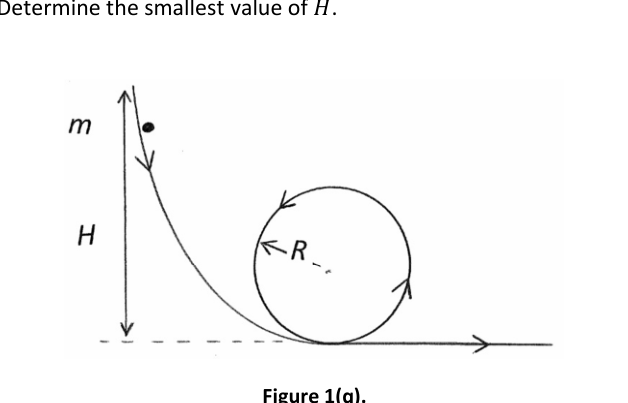 Particle on curved track with loop radius R
Topic: Newtonian Mechanics, Conservation of Energy Metodi: Energy Conservation Method, Free-Body Diagram Competenze: Physical Reasoning, Diagrammatic Reasoning Objects: — Fonte: Testo (PDF) — p.7
**(q) ** Una particella, di massa , scorre lungo la pista liscia, figura 1(q), da un’altezza sotto la gravità. L’obiettivo è completare una traiettoria circolare di raggio quando raggiunge il suo punto più basso. Determinare il valore più piccolo di .
Particella su pista curva con raggio di circuito R
Topic: Newtonian Mechanics, Conservation of Energy Metodi: Energy Conservation Method, Free-Body Diagram Competenze: Physical Reasoning, Diagrammatic Reasoning Objects: — Fonte: Testo (PDF) — p.7