Question 2.
(a) Ideal cells of EMF , , are connected to a wire of resistance and of length between ends A and B as shown in Figure 2(a).
(i) With switches K and K initially open, write down the potential at length from A in terms of , and .
(ii) The cells and are chosen such that . When K and K are closed, the galvanometer G (a very sensitive ammeter) is connected between A and B at a distance from A so that no current flows through it. Write down equations relating
a. , , and
b. , , and
[2]
(b) The circuit in Figure 2(b) enables the measurement of the EMF, , of a thermocouple T (a temperature dependent source of a small EMF). AB is a uniform wire of length 1.00 m and resistance 2.00 . K and K are switches.
No current flows through G when:
(i) K is closed and K is open and AC = 90.0 cm.
(ii) K is closed and K is open and AC = 45.0 cm.
Determine the EMF, , and the resistance .
[8]
(c) The potential difference across a filament lamp, , is related to the current through it by
The lamp is connected to a measurement arm of a Wheatstone bridge, the circuit shown in Figure 2(c). The other arms are each of resistance 4 . Determine the value of the voltage across the bridge, , necessary for the bridge to be balanced i.e. when no current flows through G.
[5]
(d) In the circuit, Figure 2(d), determine the value of resistance required to minimise the heat generated in the 5 resistor.
[5]
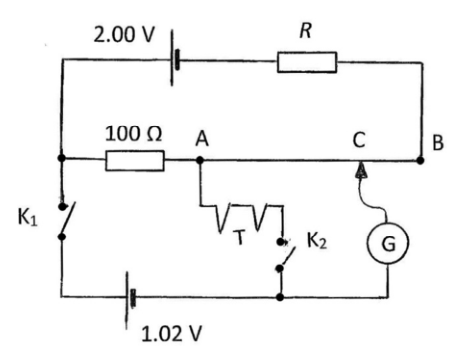 Figure 2(b): thermocouple potentiometer circuit
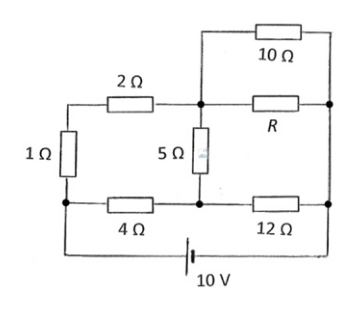 Figures 2(c) and 2(d): bridge circuits
Topic: Circuits Metodi: Kirchhoff’s Laws, Equivalent Circuit Reduction, Electric Potential Method Competenze: Mathematical Modeling, Physical Reasoning Objects: Battery, Wire, Resistor, Galvanometer, Switch Fonte: Testo (PDF) — p.2
Domanda 2.
**(a) ** Le celle ideali di EMF , , sono collegate a un filo di resistenza e di lunghezza tra le estremità A e B come mostrato alla figura 2(a).
**(i) ** Con i commutatori K e K inizialmente aperti, annotare il potenziale a lungo da A in termini di , e .
Le celle e sono scelte in modo tale che . Quando K e K sono chiusi, il galvanometro G (un ammetro molto sensibile) è collegato tra A e B a una distanza da A in modo che non fluisca alcuna corrente. Scrittura delle equazioni relative
a. , , e
b. , , e
[2]
**(b) ** Il circuito di cui alla figura 2(b) consente la misurazione del FEM, , di un termopare T (una fonte di temperatura dipendente di un piccolo FEM). AB è un filo uniforme di lunghezza di 1,00 m e resistenza di 2,00 . K e K sono interruttori.
Nessuna corrente passa attraverso G quando:
(i) K è chiuso e K è aperto e AC = 90,0 cm.
(ii) K è chiuso e K è aperto e AC = 45,0 cm.
Determinare la FEM, , e la resistenza .
[8]
**(c) ** La differenza di potenziale di una lampada a filamento, , è correlata alla corrente che la attraversa per
La lampada è collegata a un braccio di misura di un ponte Wheatstone, il circuito mostrato alla figura 2 ((c). Gli altri bracci sono di resistenza 4 . Determinare il valore della tensione attraverso il ponte, , necessaria per l’equilibrio del ponte, ovvero quando non c’ è corrente che attraversa G.
[5]
**(d) ** Nel circuito, figura 2(d), determinare il valore di resistenza necessaria per ridurre al minimo il calore generato nella resistenza 5 .
[5]
Figura 2 ((b): circuito di potenziometro termopare
Figure 2 ((c) e 2 ((d): circuiti di ponte
Topic: Circuits Metodi: Kirchhoff’s Laws, Equivalent Circuit Reduction, Electric Potential Method Competenze: Mathematical Modeling, Physical Reasoning Objects: Battery, Wire, Resistor, Galvanometer, Switch Fonte: Testo (PDF) — p.2
Question 3.
(a) In a Young’s slit experiment the slits, S and S, are a distance apart and the screen is at a distance from the line joining the slits, Figure 3(a). P is a point on the screen a distance from the line of symmetry of the system.
(i) Derive an expression for the spacing between adjacent fringes, , for light of wavelength , in terms of , and in the approximation .
[10]
(ii) If white light was passed through the slits, sketch or describe what would be seen near the centre of the screen.
(iii) A laser is often used to illuminate the two slits. Before the invention of the laser, a light bulb with a small filament and with a colour filter was used to illuminate a single slit in front of the double slit in Figure 3(b). Explain the purpose of the single slit. Your answer should consider the effect of coherence.
[4]
(b) Two whistles, both of frequency kHz, are situated 3.00 m apart and blown simultaneously. An observer travelling along a line parallel to the line joining the whistles, and at a distance approximately 20.0 m opposite the whistles, detects minima in sound intensity at a series of points spaced 1.14 m apart. Calculate the speed of sound in air.
[6]
(For small , )
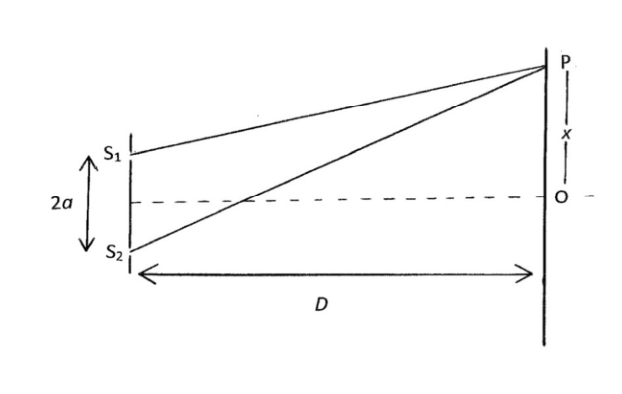 Figure 3(a): Young’s double slit geometry
Topic: Wave Optics, Oscillations & Waves Metodi: Interference & Diffraction Analysis, Wave Equation, Small-Angle Approximation Competenze: Physical Reasoning, Mathematical Modeling Objects: Slit, Screen Fonte: Testo (PDF) — p.4
Domanda 3.
**(a) ** Nell’esperimento di slit di Young le slitte, S e S, sono distanti da e lo schermo è a distanza dalla linea che unisce le slitte, figura 3(a). P è un punto sullo schermo a una distanza dalla linea di simmetria del sistema.
**(i) ** Derivare un’espressione per l’intervallo tra i bordi adiacenti, , per la luce di lunghezza d’onda , in termini di , e nell’approssimazione .
[10]
**(ii) ** Se la luce bianca è stata trasmessa attraverso le fessure, disegnare o descrivere ciò che si vedrebbe vicino al centro dello schermo.
**iii) ** Un laser è spesso usato per illuminare le due fessure. Prima dell’invenzione del laser, una lampadina con un piccolo filamento e un filtro a colori è stata utilizzata per illuminare una singola fessura davanti alla fessura doppia nella figura 3 ((b). Spiegare lo scopo della singola fessura. La tua risposta dovrebbe considerare l’effetto della coerenza.
[4]
**(b) ** Due fischi, entrambi di frequenza kHz, sono situati a 3,00 m di distanza e soffiati contemporaneamente. Un osservatore che viaggia lungo una linea parallela alla linea che unisce i fischi e a una distanza di circa 20,0 m di fronte ai fischi, rileva minimi di intensità sonora in una serie di punti spaziati a 1,14 m di distanza. Calcolare la velocità del suono nell’aria.
[6]
(Per i piccoli , )
Figura 3 ((a): geometria a doppia fessura di Young
Topic: Wave Optics, Oscillations & Waves Metodi: Interference & Diffraction Analysis, Wave Equation, Small-Angle Approximation Competenze: Physical Reasoning, Mathematical Modeling Objects: Slit, Screen Fonte: Testo (PDF) — p.4
Question 4.
(a) Fixed charges of are situated at the corners of
(i) a square of side and
(ii) a cube of side .
The square and cube each have a charge of at their centre.
Determine the total potential energy of each system. Sketch diagrams of the charge arrangements for each example.
[9]
(b)
(i) Obtain the force, , on the charge when it is displaced a distance from the centre of the square along a line through its centre, and perpendicular to the plane of the square.
Sketch a graph of against .
[5]
(ii) If the charge , mass , in (b)(i), performs simple harmonic motion about the centre of the square, determine the period, , of the motion.
If the motion is simple harmonic, obtain the necessary condition for the amplitude of the motion, .
[6]
(For small , )
Topic: Electrostatics, Oscillations & Waves Metodi: Coulomb’s Law, Simple Harmonic Motion Analysis, Electric Potential Method Competenze: Mathematical Modeling, Physical Reasoning Objects: Point Charge Fonte: Testo (PDF) — p.5
Domanda 4.
Le cariche fisse di sono situate alle estremità di
(i) un quadrato di lato e
- un cubo laterale .
Il quadrato e il cubo hanno ciascuna una carica di al centro.
Determinare l’energia potenziale totale di ciascun sistema. Schizzi di schemi delle modalità di carica per ciascun esempio.
[9]
(b)
**(i) ** Ottieni la forza, , sulla carica quando viene spostata a una distanza dal centro del quadrato lungo una linea attraverso il suo centro, e perpendicolare al piano del quadrato.
Segnare un grafico di contro .
[5]
Se la carica , massa , in (b) ((i), esegue un semplice movimento armonico intorno al centro del quadrato, determinare il periodo, , del movimento.
Se il movimento è semplice armonico, ottenere la condizione necessaria per l’ampiezza del movimento, .
[6]
(Per i piccoli , )
Topic: Electrostatics, Oscillations & Waves Metodi: Coulomb’s Law, Simple Harmonic Motion Analysis, Electric Potential Method Competenze: Mathematical Modeling, Physical Reasoning Objects: Point Charge Fonte: Testo (PDF) — p.5
Question 5. (You may answer EITHER Qu 5 OR Qu 6 but not both)
Galaxies are a large collection of stars and gas that are held together by their own gravity. One class of galaxies, spiral galaxies, are characterised by a spherical bulge and a flattened disk in which the stars form a spiral pattern. The stars and gas in a spiral galaxy trace out circular orbits around the centre of the galaxy. A schematic of a spiral galaxy, the Milky Way, can be seen below in Figure 5.
(a) Using the gravitational force acting on a star moving in a circular orbit and assuming spherical symmetry, determine the rotational velocity of a star as a function of the mass enclosed within a radius . Only the mass of material contained within the orbital radius of the star contributes to the gravitational force of attraction.
[2]
(b) Assuming that most of the mass of the galaxy is contained within the spherical bulge of radius , with uniform density , determine the shape of the rotation curve (the graph of against ) inside and outside . Sketch the expected rotation curve of the galaxy.
[7]
(c) Astronomers have observed the rotation curves of galaxies and found a significant discrepancy between what is measured and the theoretical prediction. They found that the rotation velocity curve was flat at , which cannot be explained by a centrally dominating mass. Another component was suggested to make up for the missing, invisible mass, called “dark matter”. Assuming a more realistic density profile for the spherically distributed dark matter:
Determine the exponent, , needed such that the rotation curve is flat at , as seen from measurements.
[4]
(d) At light years distant from the centre of the Milky Way, our Sun has a measured velocity of km s and an expected velocity of km s. Calculate the visible as well as the true mass of the Milky Way. What is the percentage of dark matter in the galaxy? Express your answer in units of solar masses, .
kg. 1 light year is the distance light travels in a year.
[3]
(e) Although dark matter is now the widely accepted explanation for the rotation curve problem, an alternative has been suggested: modifying the laws of gravity. Modified Newtonian Dynamics (MOND) postulates that Newton’s third law can be re-written as where is a function with the property that for and for , is the acceleration and is a constant that marks the transition between Newtonian gravity and MOND. In the limits of small acceleration (), show that this formulation also leads to a flat rotation curve at large radii.
[4]
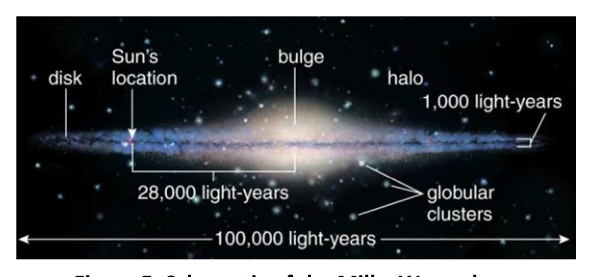 Figure 5: schematic of the Milky Way galaxy
Topic: Astrophysics, Gravitation Metodi: Newton’s Law of Gravitation, Kepler’s Laws, Physical Modeling Competenze: Mathematical Modeling, Physical Reasoning Objects: Star, Disk Fonte: Testo (PDF) — p.6
Domanda 5. (Si può rispondere a QUALDRE domande 5 o 6 ma non a entrambe)
Le galassie sono una grande collezione di stelle e gas che sono tenute insieme dalla loro gravità. Una classe di galassie, le galassie a spirale, è caratterizzata da un gonfiore sferico e da un disco appiattito in cui le stelle formano un modello a spirale. Le stelle e il gas di una galassia a spirale tracciano orbite circolari intorno al centro della galassia. Un schema di una galassia a spirale, la Via Lattea, può essere visto in basso nella Figura 5.
**(a) ** Usando la forza gravitazionale che agisce su una stella in orbita circolare e assumendo una simmetria sferica, determinare la velocità di rotazione di una stella come funzione della massa chiusa all’interno di un raggio . Solo la massa di materiale contenuta all’interno del raggio orbitale della stella contribuisce alla forza gravitazionale di attrazione.
[2]
**(b) ** Supponendo che la maggior parte della massa della galassia sia contenuta all’interno del bulbo sferica del raggio , con densità uniforme , determinare la forma della curva di rotazione (il grafico di contro ) all’interno e all’esterno . Segna la curva di rotazione prevista della galassia.
[7]
**(c) ** Gli astronomi hanno osservato le curve di rotazione delle galassie e hanno trovato una significativa discrepanza tra ciò che viene misurato e la previsione teorica. Hanno scoperto che la curva di velocità di rotazione era piatta a , che non può essere spiegata da una massa centralizzata dominante. Un altro componente fu suggerito per compensare la massa mancante, invisibile, chiamata “materia oscura”. Supponendo un profilo di densità più realistico per la materia oscura distribuita sfericamente:
Determinare l’esponente necessario affinché la curva di rotazione sia piatta a , come osservato dalle misurazioni.
[4]
**(d) ** A anni luce dal centro della Via Lattea, il nostro Sole ha una velocità misurata di km s e una velocità prevista di km s. Calcola la massa visibile e la vera della Via Lattea. Qual è la percentuale di materia oscura nella galassia? Esprimere la risposta in unità di massa solare, .
kg. 1 anno luce è la distanza percorsa dalla luce in un anno.
[3]
Anche se la materia oscura è ora l’esposizione ampiamente accettata per il problema della curva di rotazione, è stata suggerita un’alternativa: modificare le leggi della gravità. La Dinamica Newtonica Modificata (MOND) postula che la terza legge di Newton può essere riscritta come dove è una funzione con la proprietà che per e per , è l’accelerazione e è una costante che segna la transizione tra la gravità di Newton e MOND. Nei limiti di piccole accelerazioni (), dimostrare che questa formulazione porta anche a una curva di rotazione piatta a grandi raggi.
[4]
*Figura 5: schema della Via Lattea *
Topic: Astrophysics, Gravitation Metodi: Newton’s Law of Gravitation, Kepler’s Laws, Physical Modeling Competenze: Mathematical Modeling, Physical Reasoning Objects: Star, Disk Fonte: Testo (PDF) — p.6
Question 6. (You may answer EITHER Qu 5 OR Qu 6 but not both)
(a) Kepler’s 3rd Law requires that planets in orbit around the Sun, with radius and period , have the same value of , where and are constants. Assuming the orbits of the Earth and Jupiter are circular:
(i) Calculate the ratio by using the data provided below.
The radii of the orbits of the Earth and Jupiter are respectively m and m. Orbital period of Jupiter is 11.8 years.
(ii) Using the data above, show that the mass of the Sun is about kg.
[8]
(b) A satellite is launched into a synchronous orbit of the Earth. Determine its radius of orbit, , and speed, .
[4]
(c) Satellites launched from Earth speed up slowly as they take off from the launch pad, which uses up a lot of fuel (energy) in the process. This is inefficient but it is the only method at present. Physicists use the idea of escape velocity instead.
(i) What is meant by escape velocity?
(ii) Determine a value for the escape velocity, , from the Earth.
(iii) In what way does the location of the launch site on the Earth’s surface affect the escape velocity, ?
(iv) Determine the minimum initial launch speed from the Earth.
[6]
(d) Ignoring any effect of the launch site location on the Earth in c(i), what is the minimum escape velocity when launching from the Earth to escape the gravitational field of the Sun?
[2]
Radius of the Earth m, mass of the Earth kg.
Topic: Gravitation, Astrophysics Metodi: Kepler’s Laws, Newton’s Law of Gravitation, Conservation of Energy Competenze: Mathematical Modeling, Physical Reasoning Objects: Planet, Star, Satellite Fonte: Testo (PDF) — p.7
**Questione 6. ** (Si può rispondere a QUALQUI 5 O QUALQUI 6, ma non a entrambi)
La terza legge di Kepler impone che i pianeti in orbita attorno al Sole, con raggio e periodo , abbiano lo stesso valore di , dove e sono costanti. Supponendo che le orbite della Terra e di Giove siano circolari:
**(i) ** Calcolare il rapporto utilizzando i dati riportati di seguito.
I raggi delle orbite della Terra e di Giove sono rispettivamente m e m. Il periodo orbitale di Giove è di 11,8 anni.
**(ii) ** Usando i dati di cui sopra, mostrare che la massa del Sole è di circa kg.
[8]
Un satellite viene lanciato in orbita sincrona della Terra. Determinare il suo raggio di orbita, , e la sua velocità, .
[4]
I satelliti lanciati dalla Terra si accelerano lentamente mentre decolano dalla pista di lancio, che consuma molto combustibile (energia) nel processo. Questo è inefficiente, ma è l’unico metodo attualmente. I fisici usano invece l’idea della velocità di fuga.
**i) ** Che cosa si intende per velocità di fuga?
**(ii) ** Determina un valore per la velocità di fuga, , dalla Terra.
In che modo la posizione del sito di lancio sulla superficie terrestre influisce sulla velocità di fuga, ?
**(iv) ** Determina la velocità minima iniziale di lancio dalla Terra.
[6]
Ignorando qualsiasi effetto della posizione del sito di lancio sulla Terra in c(i), qual è la velocità minima di fuga quando si lancia dalla Terra per sfuggire al campo gravitazionale del Sole?
[2]
Radius della Terra m, massa della Terra kg.
Topic: Gravitation, Astrophysics Metodi: Kepler’s Laws, Newton’s Law of Gravitation, Conservation of Energy Competenze: Mathematical Modeling, Physical Reasoning Objects: Planet, Star, Satellite Fonte: Testo (PDF) — p.7
Question 7.
Millikan’s oil drop experiment, illustrated in Figure 7, was the first experiment to determine the size of the elementary charge, . Charged oil droplets are sprayed into an air-filled chamber and observed through a microscope inserted in the side of the chamber. The droplets fall under gravity with a terminal velocity. A uniform electric field between the top and bottom plates could be used to hold the charged oil drops in a fixed vertical position in the electric field. The potential between the plates was measured. The polarity could be changed in order to pull them back up against gravity. The drag force on them due to air resistance is known as viscous drag. The charge on an oil drop may spontaneously change due to random ionisation.
(a) The viscous drag force on a small spherical droplet is given by where is the radius of the drop, is the terminal velocity of the drop, is the viscosity of the air. kg m s.
In two successive measurements of an oil droplet, the rise times were 42 s and 78 s. The distance travelled upwards at constant velocity was 1.00 cm, the potential difference across the plates was 5000 V, and the plate separation was 1.50 cm. The radius of the drop was m.
Calculate the change in the number of electrons in the drop between the two observations.
[8]
(b) Two drops of the same density, with radii and , both with identical charges and terminal velocities and respectively, coalesce. How is the final terminal velocity of the drop related to the initial velocities?
[5]
(c) A separate experiment to measure for an electron could be used to enable the electron mass, , to be determined.
A potential difference of 3000 V is maintained between deflector plates, with separation 2.0 cm, in an evacuated tube. A magnetic field of T at right angles to the electric field gives no deflection to an electron beam entering the fields. The electron beam received an initial kinetic energy by being accelerated through a potential difference of 10 000 V. Calculate the ratio .
[7]
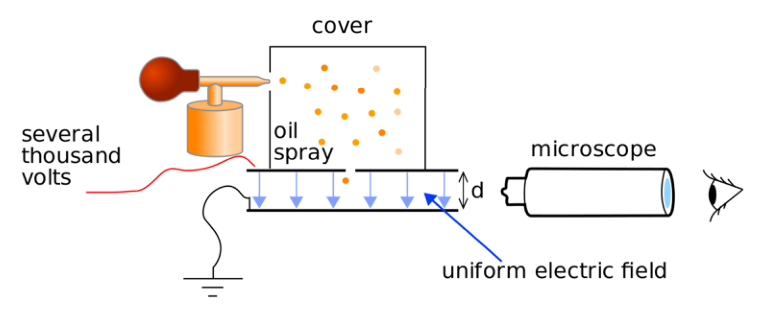 Figure 7: Millikan oil drop experiment apparatus
Topic: Electrostatics, Newtonian Mechanics, Magnetism Metodi: Free-Body Diagram, Lorentz Force Analysis, Experimental Data Analysis Competenze: Physical Reasoning, Mathematical Modeling Objects: Droplet, Electron, Particle Beam Fonte: Testo (PDF) — p.8
**Domanda 7. **
L’esperimento di Millikan sulla caduta di olio, illustrato nella figura 7, è stato il primo esperimento per determinare la dimensione della carica elementare, . Le goccioline di olio cariche vengono spruzzate in una camera piena di aria e osservate attraverso un microscopio inserito nel lato della camera. Le goccioline cadono sotto la gravità con una velocità terminale. Un campo elettrico uniforme tra le piastre superiori e inferiori potrebbe essere utilizzato per tenere le gocce di olio cariche in una posizione verticale fissa nel campo elettrico. Il potenziale tra le placche è stato misurato. La polarità potrebbe essere cambiata per tirarli indietro contro la gravità. La forza di trazione su di loro a causa della resistenza all’aria è conosciuta come trazione viscosa. La carica di una goccia di olio può cambiare spontaneamente a causa di ionizzazione casuale.
**(a) ** La forza di trazione viscosa su una piccola goccia sferica è data da dove è il raggio della goccia, è la velocità terminale della goccia, è la viscosità dell’aria. kg m s.
In due misurazioni successive di un gocciole di olio, i tempi di salita sono stati di 42 s e 78 s. La distanza percorsa verso l’alto a velocità costante era di 1,00 cm, la differenza potenziale tra le piastre era di 5000 V e la separazione tra le piastre era di 1,50 cm. Il raggio di caduta è stato m.
Calcolare il cambiamento nel numero di elettroni nella caduta tra le due osservazioni.
[8]
**(b) ** Due gocce della stessa densità, con radii e , entrambe con cariche identiche e velocità terminali e , rispettivamente, si fusiono. Come si relaziona la velocità terminale finale della caduta alle velocità iniziali?
[5]
**(c) ** Per determinare la massa di un elettrone, , potrebbe essere utilizzato un esperimento separato per misurare per un elettrone.
Si mantiene una differenza potenziale di 3000 V tra le piastre deflettrici, con una separazione di 2,0 cm, in un tubo evacuato. Un campo magnetico di T ad angolo retto rispetto al campo elettrico non dà alcuna deviazione al fascio di elettroni che entra nei campi. Il fascio di elettroni ha ricevuto un’energia cinetica iniziale accelerandolo attraverso una differenza potenziale di 10 000 V. Calcolare il rapporto .
[7]
Figura 7: Apparecchi per l’esperimento di gocce di olio Millikan
Topic: Electrostatics, Newtonian Mechanics, Magnetism Metodi: Free-Body Diagram, Lorentz Force Analysis, Experimental Data Analysis Competenze: Physical Reasoning, Mathematical Modeling Objects: Droplet, Electron, Particle Beam Fonte: Testo (PDF) — p.8
Question 8.
A circular copper ring, of radius m and resistance , rotates about a vertical diameter with constant angular velocity, , radians per second. A small magnetic compass needle, which can rotate about a vertical axis, is situated in the middle of the ring, Figure 8. When the ring is stationary, the needle points in the direction of the horizontal component of the Earth’s magnetic field, . However, when it rotates at the rate of 10 revolutions per second, the compass needle deviates by an average angle of from this orientation. At time the ring is in a plane perpendicular to .
Determine, algebraically:
(a) the magnetic flux, , through the ring at time . [2]
(b) the current, , in the ring. [3]
(c) the magnetic field components of the ring, parallel and perpendicular to . [3]
(d) the average values, over time, of these components. [7]
(e) Hence determine, numerically, . [5]
Field at the centre of a circular loop
END OF SECTION 2
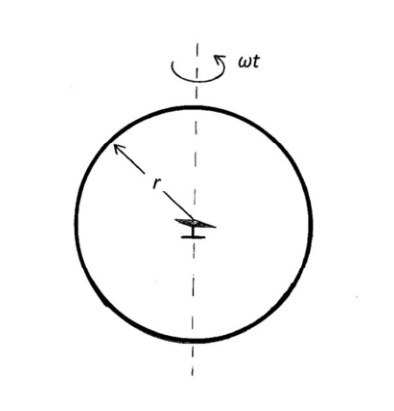 Figure 8: rotating copper ring in Earth’s field
Topic: Electromagnetic Induction, Magnetism Metodi: Faraday’s Law of Induction, Lenz’s Law, Calculus-Integration Competenze: Mathematical Modeling, Physical Reasoning Objects: Disk, Magnet Fonte: Testo (PDF) — p.10
**Domanda 8. **
Un anello di rame circolare, di raggio m e resistenza , ruota attorno a un diametro verticale con velocità angolare costante, , radianti al secondo. Un piccolo ago di bussola magnetica, che può ruotare attorno ad un asse verticale, è situato al centro dell’anello, figura 8. Quando l’anello è fermo, l’ago punta nella direzione della componente orizzontale del campo magnetico terrestre, . Tuttavia, quando ruota a velocità di 10 giri al secondo, l’ago della bussola si allontana da questo orientamento con un angolo medio di . Al tempo l’anello è in un piano perpendicolare a .
Determina, in modo algebrico:
**(a) ** il flusso magnetico, , attraverso l’anello in tempo . [2]
**(b) ** la corrente, , nell’anello. [3]
**(c) ** i componenti del campo magnetico dell’anello, paralleli e perpendicolari a . [3]
**(d) ** i valori medi, nel tempo, di questi componenti. [7]
**(e) ** Determina quindi numericamente . [5]
Campo al centro di un ciclo circolare
FINNO DELLA SECZIONE 2
Figura 8: anello di rame rotante nel campo terrestre
Topic: Electromagnetic Induction, Magnetism Metodi: Faraday’s Law of Induction, Lenz’s Law, Calculus-Integration Competenze: Mathematical Modeling, Physical Reasoning Objects: Disk, Magnet Fonte: Testo (PDF) — p.10