A motorcycle rides on the vertical walls around the perimeter of a large circular room. The friction coefficient between the motorcycle tires and the walls is . How does the minimum needed to prevent the motorcycle from slipping downwards change with the motorcycle’s speed ?
- A.
- B.
- C.
- D.
- E. none of these
Topic: Newtonian Mechanics, Rotational Dynamics Metodi: Free-Body Diagram, Kinematic Equations Competenze: Physical Reasoning, Mathematical Modeling Objects: — Fonte: Testo (PDF) — p.2
Una motociclista si sposta sulle pareti verticali intorno al perimetro di una grande stanza circolare. Il coefficiente di attrito tra le gomme della moto e le pareti è . Come cambia il minimo necessario per evitare che la moto scivoli verso il basso con la velocità della moto ?
- A.
- B.
- C.
- D.
- E. nessuna di queste
Topic: Newtonian Mechanics, Rotational Dynamics Metodi: Free-Body Diagram, Kinematic Equations Competenze: Physical Reasoning, Mathematical Modeling Objects: — Fonte: Testo (PDF) — p.2
A mass hangs from a massless spring connected to the roof of a box of mass . When the box is held stationary, the mass-spring system oscillates vertically with angular frequency . If the box is dropped and falls freely under gravity, how will the angular frequency change?
- A. will be unchanged
- B. will increase
- C. will decrease
- D. Oscillations are impossible under these conditions
- E. will increase or decrease depending on the values of and
Topic: Oscillations & Waves, Newtonian Mechanics Metodi: Simple Harmonic Motion Analysis, Free-Body Diagram Competenze: Physical Reasoning, Mathematical Modeling Objects: Spring, Block Fonte: Testo (PDF) — p.2
Una massa è appesa a una sorgente senza massa collegata al tetto di una scatola di massa . Quando la scatola è tenuta ferma, il sistema di molla di massa oscilla verticalmente con frequenza angolare . Se la scatola viene abbassata e cade liberamente sotto la gravità, come cambierà la frequenza angolare?
- A. resterà invariato
- B. aumenterà
- C. diminuirà
- D. Le oscillazioni sono impossibili in queste condizioni
- E. aumenterà o diminuirà a seconda dei valori di e
Topic: Oscillations & Waves, Newtonian Mechanics Metodi: Simple Harmonic Motion Analysis, Free-Body Diagram Competenze: Physical Reasoning, Mathematical Modeling Objects: Spring, Block Fonte: Testo (PDF) — p.2
A ball of radius and mass is magically put inside a thin shell of the same mass and radius . The system is at rest on a horizontal frictionless surface initially. When the ball is, again magically, released inside the shell, it sloshes around in the shell and eventually stops at the bottom of the shell. How far does the shell move from its initial contact point with the surface?
- A. .
- B. .
- C. .
- D. .
- E.
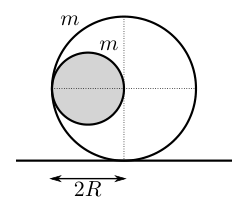 Ball inside shell, both mass m
Topic: Newtonian Mechanics, Conservation of Momentum Metodi: Conservation of Momentum, Conservation Laws Competenze: Physical Reasoning, Mathematical Modeling Objects: Ball, Sphere Fonte: Testo (PDF) — p.2
Una palla di raggio e massa viene magicamente inserita all’interno di una scia fina della stessa massa e raggio . Il sistema è a riposo su una superficie orizzontale senza attrito inizialmente. Quando la palla viene, di nuovo magicamente, rilasciata all’interno della conchiglia, si sposta intorno alla conchiglia e alla fine si ferma in fondo alla conchiglia. Quanto si muove la conchiglia dal suo punto di contatto iniziale con la superficie?
- A. .
- B. .
- C. .
- D. .
- E.
Massa di massa di entrata di palla m
Topic: Newtonian Mechanics, Conservation of Momentum Metodi: Conservation of Momentum, Conservation Laws Competenze: Physical Reasoning, Mathematical Modeling Objects: Ball, Sphere Fonte: Testo (PDF) — p.2
Several identical cars are standing at a red light on a one-lane road, one behind the other, with negligible (and equal) distance between adjacent cars. When the green light comes up, the first car takes off to the right with constant acceleration. The driver in the second car reacts and does the same 0.2 s later. The third driver starts moving 0.2 s after the second one and so on. All cars accelerate until they reach the speed limit of 45 km/hr, after which they move to the right at a constant speed. Consider the following patterns of cars labeled I, II, III, IV. Just before the first car starts accelerating to the right, the car pattern will qualitatively look like pattern I. After that, the pattern will qualitatively evolve according to
- A. First I, then II, and then III.
- B. First I, then II, and then IV.
- C. First I, and then IV, with neither II nor III as intermediate stage.
- D. First I, and then II.
- E. First I, and then III.
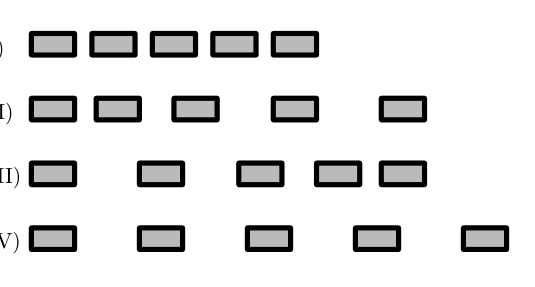 Four car-spacing patterns I through IV
Topic: Newtonian Mechanics Metodi: Kinematic Equations, Physical Modeling Competenze: Physical Reasoning, Diagrammatic Reasoning Objects: Cart Fonte: Testo (PDF) — p.3
Diverse auto identiche sono in piedi a un semaforo rosso su una strada a una corsia, una dietro l’altra, con una distanza trascurabile (e uguale) tra le auto adiacenti. Quando la luce verde viene accesa, la prima auto decolla a destra con costante accelerazione. Il conducente della seconda auto reagisce e fa lo stesso 0,2 secondi dopo. Il terzo pilota inizia a muoversi 0,2 secondi dopo il secondo e così via. Tutte le auto accelereranno fino a raggiungere il limite di velocità di 45 km/h, dopo di che si muoveranno a destra a velocità costante. Considerate i seguenti modelli di auto con le etichette I, II, III e IV. Poco prima che la prima auto inizi a accelerare a destra, il modello della macchina sembrerà qualitativamente modello I. Dopo di che, il modello si evolverà qualitativamente in base a
- A. Prima I, poi II e poi III.
- B. Prima I, poi II e poi IV.
- C. Prima I e poi IV, senza che sia II né III come fase intermedia.
- D. Prima I, poi II.
- E. Prima I, poi III.
Quattro modelli di spaziamento tra le auto I e IV
Topic: Newtonian Mechanics Metodi: Kinematic Equations, Physical Modeling Competenze: Physical Reasoning, Diagrammatic Reasoning Objects: Cart Fonte: Testo (PDF) — p.3
A projectile is launched with speed off the edge of a cliff of height , at an angle from the horizontal. Air friction is negligible. To maximize the horizontal range of the projectile, should satisfy
- A.
- B.
- C.
- D.
- E. or , depending on the values of and .
Topic: Newtonian Mechanics Metodi: Kinematic Equations, Calculus-Integration Competenze: Mathematical Modeling, Physical Reasoning Objects: Projectile Fonte: Testo (PDF) — p.3
Un proiettile viene lanciato a velocità dal bordo di una scogliera di altezza , ad un angolo dall’orizzontale. L’attrito dell’aria è trascurabile. Per massimizzare l’intervallo orizzontale del proiettile, deve soddisfare
- A.
- B.
- C.
- D.
- E. o , a seconda dei valori di e .
Topic: Newtonian Mechanics Metodi: Kinematic Equations, Calculus-Integration Competenze: Mathematical Modeling, Physical Reasoning Objects: Projectile Fonte: Testo (PDF) — p.3
In the mobile below, the two cross beams and the seven supporting strings are all massless. The hanging objects are g, g, and g. What is the value of for the system to be in static equilibrium?
- A. 300 g
- B. 400 g
- C. 500 g
- D. 600 g
- E. 700 g
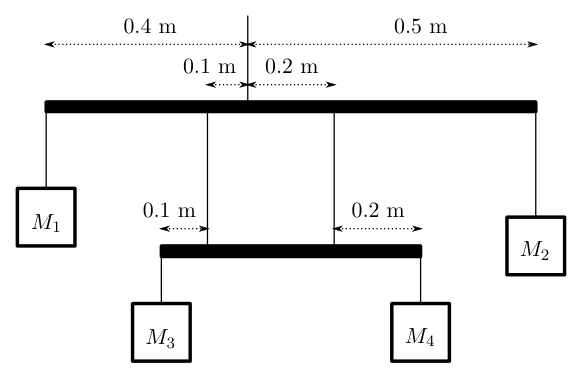 Mobile with masses M1, M2, M3, M4
Topic: Rigid Body Statics, Newtonian Mechanics Metodi: Torque & Angular Momentum Analysis, Free-Body Diagram Competenze: Physical Reasoning, Mathematical Modeling Objects: Beam, String Fonte: Testo (PDF) — p.4
Nel mobile di sotto, i due fasci e le sette corde di supporto sono tutti senza massa. Gli oggetti appesi sono g, g e g. Qual è il valore di per il sistema in equilibrio statico?
- A. 300 g
- B. 400 g
- C. 500 g
- D. 600 g
- E. 700 g
Movili con massa M1, M2, M3, M4
Topic: Rigid Body Statics, Newtonian Mechanics Metodi: Torque & Angular Momentum Analysis, Free-Body Diagram Competenze: Physical Reasoning, Mathematical Modeling Objects: Beam, String Fonte: Testo (PDF) — p.4
A train, originally of mass , is traveling on a frictionless straight horizontal track with constant speed . Snow starts to fall vertically and sticks to the train at a rate of , where has units of kilograms per second. The train’s engine keeps the train moving at constant speed as snow accumulates on the train.
The rate at which the kinetic energy of the train and snow increases is
- A. 0
- B.
- C.
- D.
- E.
Topic: Newtonian Mechanics, Conservation of Energy Metodi: Conservation of Momentum, Energy Conservation Method Competenze: Physical Reasoning, Mathematical Modeling Objects: — Fonte: Testo (PDF) — p.4
Un treno, originariamente di massa , si sposta su una pista orizzontale retta senza attrito con velocità costante . La neve inizia a cadere verticalmente e si attacca al treno a un ritmo di , dove ha unità di chilogrammi al secondo. Il motore del treno mantiene il treno in movimento a velocità costante mentre la neve si accumula sul treno.
La velocità con cui l’energia cinetica del treno e della neve aumenta è
- A. 0
- B.
- C.
- D.
- E.
Topic: Newtonian Mechanics, Conservation of Energy Metodi: Conservation of Momentum, Energy Conservation Method Competenze: Physical Reasoning, Mathematical Modeling Objects: — Fonte: Testo (PDF) — p.4
A train, originally of mass , is traveling on a frictionless straight horizontal track with constant speed . Snow starts to fall vertically and sticks to the train at a rate of , where has units of kilograms per second. The train’s engine keeps the train moving at constant speed as snow accumulates on the train.
The minimum power required from the engine to keep the train traveling at a constant speed is
- A. 0
- B.
- C.
- D.
- E.
Topic: Newtonian Mechanics, Conservation of Energy Metodi: Conservation of Momentum, Energy Conservation Method Competenze: Physical Reasoning, Mathematical Modeling Objects: — Fonte: Testo (PDF) — p.4
Un treno, originariamente di massa , si sposta su una pista orizzontale retta senza attrito con velocità costante . La neve inizia a cadere verticalmente e si attacca al treno a un ritmo di , dove ha unità di chilogrammi al secondo. Il motore del treno mantiene il treno in movimento a velocità costante mentre la neve si accumula sul treno.
La potenza minima richiesta dal motore per mantenere il treno a velocità costante è
- A. 0
- B.
- C.
- D.
- E.
Topic: Newtonian Mechanics, Conservation of Energy Metodi: Conservation of Momentum, Energy Conservation Method Competenze: Physical Reasoning, Mathematical Modeling Objects: — Fonte: Testo (PDF) — p.4
Flasks A, B, and C each have a circular base with a radius of 2 cm. An equal volume of water is poured into each flask, and none overflow. Rank the force of water on the base of the flask from greatest to least.
- A.
- B.
- C.
- D.
- E.
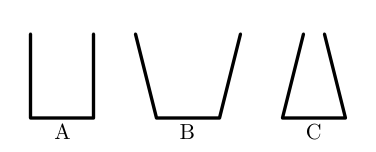 Three flasks A, B, C with equal base radius
Topic: Fluid Mechanics Metodi: Hydrostatic Equilibrium, Physical Modeling Competenze: Physical Reasoning, Diagrammatic Reasoning Objects: Container Fonte: Testo (PDF) — p.5
Le bottiglie A, B e C hanno ciascuna una base circolare con un raggio di 2 cm. In ogni bottiglia viene versata un’acqua uguale e nessuna si esborda. Rendi la forza dell’acqua sulla base del flacone dal massimo al minimo.
- A.
- B.
- C.
- D.
- E.
Tre bottiglie A, B e C con uguale raggio di base
Topic: Fluid Mechanics Metodi: Hydrostatic Equilibrium, Physical Modeling Competenze: Physical Reasoning, Diagrammatic Reasoning Objects: Container Fonte: Testo (PDF) — p.5
The handle of a gallon of milk is plugged by a manufacturing defect. After removing the cap and pouring out some milk, the level of milk in the main part of the jug is lower than in the handle, as shown in the figure. Which statement is true of the gauge pressure of the milk at the bottom of the jug? is the density of the milk.
- A.
- B.
- C.
- D.
- E.
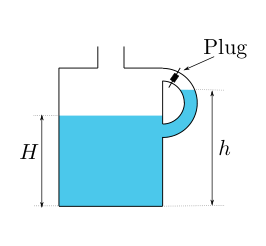 Jug with plugged handle, heights H and h
Topic: Fluid Mechanics Metodi: Hydrostatic Equilibrium, Physical Modeling Competenze: Physical Reasoning, Diagrammatic Reasoning Objects: Container Fonte: Testo (PDF) — p.5
Il maniglia di un litro di latte è collegato da un difetto di fabbricazione. Dopo aver tolto la copertura e versato del latte, il livello di latte nella parte principale della bottiglia è inferiore a quello della maniglia, come mostra la figura. Quale affermazione è vera riguardo alla pressione del latte al fondo della bottiglia? è la densità del latte.
- A.
- B.
- C.
- D.
- E.
Jug con maniglia contigliata, altezza H e h
Topic: Fluid Mechanics Metodi: Hydrostatic Equilibrium, Physical Modeling Competenze: Physical Reasoning, Diagrammatic Reasoning Objects: Container Fonte: Testo (PDF) — p.5
A small hard solid sphere of mass and negligible radius is connected to a thin rod of length and mass . A second small hard solid sphere, of mass and negligible radius, is fired perpendicularly at the rod at a distance above the sphere attached to the rod, and sticks to it.
In order for the rod not to rotate after the collision, the second sphere should hit the thin rod at
- A.
- B.
- C.
- D.
- E. Any location will work
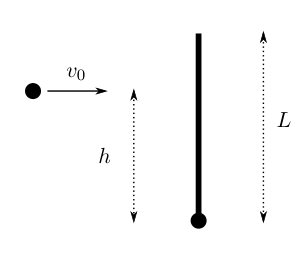 Sphere on rod, incoming projectile at height h
Topic: Rotational Dynamics, Newtonian Mechanics Metodi: Torque & Angular Momentum Analysis, Conservation of Momentum Competenze: Physical Reasoning, Mathematical Modeling Objects: Sphere, Rod, Projectile Fonte: Testo (PDF) — p.6
Una piccola sfera solida dura di massa e di raggio trascurabile è collegata a una sottile canna di lunghezza e massa . Una seconda piccola sfera solida dura, di massa e raggio trascurabile, viene sparata perpendicolare alla canna a una distanza sopra la sfera attaccata alla canna e si attacca a essa.
Per evitare che la canna ruota dopo la collisione, la seconda sfera deve colpire la canna sottile al punto
- A.
- B.
- C.
- D.
- E. Ogni posizione funzionerà
Sfera su bastone, proiettile in arrivo ad altezza h
Topic: Rotational Dynamics, Newtonian Mechanics Metodi: Torque & Angular Momentum Analysis, Conservation of Momentum Competenze: Physical Reasoning, Mathematical Modeling Objects: Sphere, Rod, Projectile Fonte: Testo (PDF) — p.6
A small hard solid sphere of mass and negligible radius is connected to a thin rod of length and mass . A second small hard solid sphere, of mass and negligible radius, is fired perpendicularly at the rod at a distance above the sphere attached to the rod, and sticks to it.
In order for the rod not to rotate after the collision, the second sphere should have a mass given by
- A.
- B.
- C.
- D.
- E. Any mass will work.
Topic: Rotational Dynamics, Newtonian Mechanics Metodi: Torque & Angular Momentum Analysis, Conservation of Momentum Competenze: Physical Reasoning, Mathematical Modeling Objects: Sphere, Rod, Projectile Fonte: Testo (PDF) — p.6
Una piccola sfera solida dura di massa e di raggio trascurabile è collegata a una sottile canna di lunghezza e massa . Una seconda piccola sfera solida dura, di massa e raggio trascurabile, viene sparata perpendicolare alla canna a una distanza sopra la sfera attaccata alla canna e si attacca a essa.
Per evitare che la canna ruota dopo la collisione, la seconda sfera deve avere una massa data da
- A.
- B.
- C.
- D.
- E. Funzionerà qualsiasi massa .
Topic: Rotational Dynamics, Newtonian Mechanics Metodi: Torque & Angular Momentum Analysis, Conservation of Momentum Competenze: Physical Reasoning, Mathematical Modeling Objects: Sphere, Rod, Projectile Fonte: Testo (PDF) — p.6
A massless rope passes over a frictionless pulley. Particles of mass and are suspended from the two different ends of the rope. If , the tension in the pulley rope is . If instead the value increases to infinity, the value of the tension
- A. stays constant
- B. decreases, approaching a nonzero constant
- C. decreases, approaching zero
- D. increases, approaching a finite constant
- E. increases to infinity
Topic: Newtonian Mechanics Metodi: Free-Body Diagram, Kinematic Equations Competenze: Physical Reasoning, Mathematical Modeling Objects: String, Pulley, Block Fonte: Testo (PDF) — p.6
Una corda senza massa passa sopra una polla senza attrito. Le particelle di massa e sono sospese dalle due estremità diverse della corda. Se , la tensione nella corda di pollice è . Se invece il valore aumenta all’infinito, il valore della tensione
- A. rimane costante
- B. diminuisce, avvicinandosi a una costante non zero
- C. diminuisce, avvicinandosi a zero
- D. aumenta, avvicinandosi a una costante finita
- E. aumenta fino all’infinito
Topic: Newtonian Mechanics Metodi: Free-Body Diagram, Kinematic Equations Competenze: Physical Reasoning, Mathematical Modeling Objects: String, Pulley, Block Fonte: Testo (PDF) — p.6
An object starting from rest can roll without slipping down an incline.
Which of the following four objects, each with mass and radius , would have the largest acceleration down the incline?
- A. A uniform solid sphere
- B. A uniform solid disk
- C. A hollow spherical shell
- D. A hoop
- E. All objects would have the same acceleration.
Topic: Rotational Dynamics, Newtonian Mechanics Metodi: Torque & Angular Momentum Analysis, Free-Body Diagram Competenze: Physical Reasoning, Mathematical Modeling Objects: Sphere, Disk, Inclined Plane Fonte: Testo (PDF) — p.7
Un oggetto che parte dal riposo può rotolare senza scivolare in pensione.
Quale dei quattro seguenti oggetti, ognuno con massa e raggio , avrebbe la maggiore accelerazione verso l’inclinazione?
- A. Una sfera solida uniforme
- B. Disco solido uniforme
- C. Un guscio sferico vuoto
- D. Un cerchio
- E. Tutti gli oggetti avrebbero la stessa accelerazione.
Topic: Rotational Dynamics, Newtonian Mechanics Metodi: Torque & Angular Momentum Analysis, Free-Body Diagram Competenze: Physical Reasoning, Mathematical Modeling Objects: Sphere, Disk, Inclined Plane Fonte: Testo (PDF) — p.7
An object starting from rest can roll without slipping down an incline.
Which of the following four objects, each a uniform solid sphere released from rest, would have the largest speed after the center of mass has moved through a vertical distance ?
- A. A sphere of mass and radius .
- B. A sphere of mass and radius .
- C. A sphere of mass and radius .
- D. A sphere of mass and radius .
- E. All objects would have the same speed.
Topic: Rotational Dynamics, Conservation of Energy Metodi: Energy Conservation Method, Torque & Angular Momentum Analysis Competenze: Physical Reasoning, Mathematical Modeling Objects: Sphere, Inclined Plane Fonte: Testo (PDF) — p.7
Un oggetto che parte dal riposo può rotolare senza scivolare in pensione.
Quale dei quattro seguenti oggetti, ognuno di cui una sfera solida uniforme rilasciata dal riposo, avrebbe la velocità più elevata dopo che il centro di massa si è spostato attraverso una distanza verticale ?
- A. Una sfera di massa e di raggio .
- B. Una sfera di massa e di raggio .
- C. Una sfera di massa e raggio .
- D. Una sfera di massa e di raggio .
- E. Tutti gli oggetti avrebbero la stessa velocità.
Topic: Rotational Dynamics, Conservation of Energy Metodi: Energy Conservation Method, Torque & Angular Momentum Analysis Competenze: Physical Reasoning, Mathematical Modeling Objects: Sphere, Inclined Plane Fonte: Testo (PDF) — p.7
A rod moves freely between the horizontal floor and the slanted wall. When the end in contact with the floor is moving at , what is the speed of the end in contact with the wall?
- A.
- B.
- C.
- D.
- E.
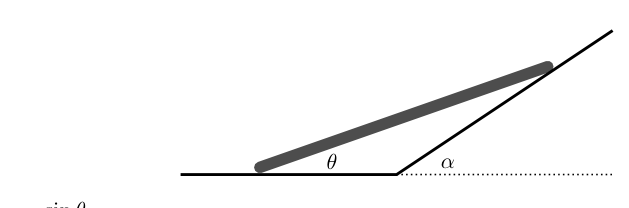 Rod between floor and slanted wall, angles θ and α
Topic: Newtonian Mechanics, Rigid Body Statics Metodi: Kinematic Equations, Vector Decomposition Competenze: Mathematical Modeling, Physical Reasoning Objects: Rod Fonte: Testo (PDF) — p.7
Una canna si muove liberamente tra il pavimento orizzontale e la parete inclinata. Quando la punta in contatto con il pavimento si muove a , qual è la velocità della punta in contatto con il muro?
- A.
- B.
- C.
- D.
- E.
Roda tra pavimento e parete inclinate, angoli θ e α
Topic: Newtonian Mechanics, Rigid Body Statics Metodi: Kinematic Equations, Vector Decomposition Competenze: Mathematical Modeling, Physical Reasoning Objects: Rod Fonte: Testo (PDF) — p.7
An object is thrown directly downward from the top of a 180 meter tall building. It takes 1.0 seconds for the object to fall the last 60 meters. With what initial downward speed was the object thrown from the roof?
- A. 15 m/s
- B. 25 m/s
- C. 35 m/s
- D. 55 m/s
- E. insufficient information.
Topic: Newtonian Mechanics Metodi: Kinematic Equations Competenze: Mathematical Modeling, Physical Reasoning Objects: — Fonte: Testo (PDF) — p.8
Un oggetto viene gettato direttamente in basso dalla cima di un edificio alto 180 metri. Ci vogliono 1,0 secondi per cadere gli ultimi 60 metri. Con quale velocità iniziale l’oggetto fu gettato dal tetto?
- A. 15 m/s
- B. 25 m/s
- C. 35 m/s
- D. 55 m/s
- E. informazioni insufficienti.
Topic: Newtonian Mechanics Metodi: Kinematic Equations Competenze: Mathematical Modeling, Physical Reasoning Objects: — Fonte: Testo (PDF) — p.8
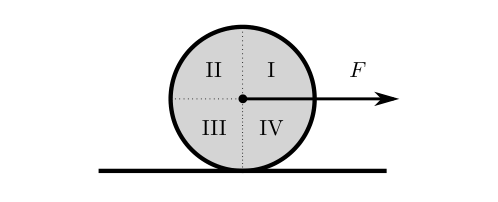
A uniform disk is being pulled by a force through a string attached to its center of mass. Assume that the disk is rolling smoothly without slipping. At a certain instant of time, in which region of the disk (if any) is there a point moving with zero total acceleration?
- A. Region I
- B. Region II
- C. Region III
- D. Region IV
- E. All points on the disk have non-zero acceleration.
 Disk with regions I–IV, pulled by force F
Topic: Rotational Dynamics, Newtonian Mechanics Metodi: Kinematic Equations, Torque & Angular Momentum Analysis Competenze: Physical Reasoning, Diagrammatic Reasoning Objects: Disk, String Fonte: Testo (PDF) — p.8
Un disco uniforme viene tirato con una forza attraverso una corda attaccata al suo centro di massa. Supponiamo che il disco ruoli senza scorciatezza. In un certo istante di tempo, in quale regione del disco (se esistono) c’è un punto in movimento con zero accelerazione totale?
- A. Regione I
- B. Regione II
- C. Regione III
- D. Regione IV
- E. Tutti i punti del disco hanno un’accelerazione non zero.
Disco con regioni IIV, tirato con forza F
Topic: Rotational Dynamics, Newtonian Mechanics Metodi: Kinematic Equations, Torque & Angular Momentum Analysis Competenze: Physical Reasoning, Diagrammatic Reasoning Objects: Disk, String Fonte: Testo (PDF) — p.8
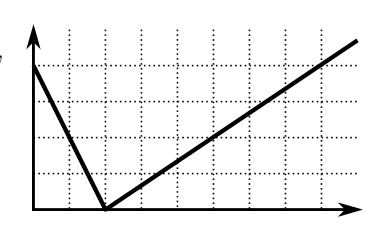
A puck is kicked up a ramp, which makes an angle of with the horizontal. The graph below depicts the speed of the puck versus time. What is the coefficient of friction between the puck and the ramp?
- A. 0.07
- B. 0.15
- C. 0.22
- D. 0.29
- E. 0.37
 Speed vs time graph for puck on ramp
Topic: Newtonian Mechanics Metodi: Free-Body Diagram, Kinematic Equations, Experimental Data Analysis Competenze: Graph Linearization, Physical Reasoning Objects: Inclined Plane Fonte: Testo (PDF) — p.8
Una piazza viene lanciata su una rampa, che fa un angolo di con l’orizzontale. Il grafico di seguito mostra la velocità del puck rispetto al tempo. Qual è il coefficiente di attrito tra la pucca e la rampa?
- A. 0.07
- B. 0.15
- C. 0.22
- D. 0.29
- E. 0.37
Grafico velocità vs tempo per la chiavetta sulla rampa
Topic: Newtonian Mechanics Metodi: Free-Body Diagram, Kinematic Equations, Experimental Data Analysis Competenze: Graph Linearization, Physical Reasoning Objects: Inclined Plane Fonte: Testo (PDF) — p.8
A particle of mass moving at speed collides with a particle of mass which is originally at rest. The fractional momentum transfer is the absolute value of the final momentum of divided by the initial momentum of .
If the collision is completely inelastic, under what condition will the fractional momentum transfer between the two objects be a maximum?
- A.
- B.
- C.
- D.
- E.
Topic: Conservation of Momentum, Newtonian Mechanics Metodi: Conservation of Momentum, Conservation Laws Competenze: Mathematical Modeling, Physical Reasoning Objects: — Fonte: Testo (PDF) — p.9
Una particella di massa in movimento a velocità si schianta con una particella di massa che è originariamente in riposo. Il trasferimento frazionario di impulso è il valore assoluto del impulso finale di diviso per il impulso iniziale di .
Se la collisione è completamente inelastica, in che condizione il trasferimento di momentum frazionario tra i due oggetti sarà massimo?
- A.
- B.
- C.
- D.
- E.
Topic: Conservation of Momentum, Newtonian Mechanics Metodi: Conservation of Momentum, Conservation Laws Competenze: Mathematical Modeling, Physical Reasoning Objects: — Fonte: Testo (PDF) — p.9
A particle of mass moving at speed collides with a particle of mass which is originally at rest. The fractional momentum transfer is the absolute value of the final momentum of divided by the initial momentum of .
If the collision is perfectly elastic, what is the maximum possible fractional momentum transfer, ?
- A.
- B.
- C.
- D.
- E.
Topic: Conservation of Momentum, Conservation of Energy Metodi: Conservation of Momentum, Energy Conservation Method Competenze: Mathematical Modeling, Physical Reasoning Objects: — Fonte: Testo (PDF) — p.9
Una particella di massa in movimento a velocità si schianta con una particella di massa che è originariamente in riposo. Il trasferimento frazionario di impulso è il valore assoluto del impulso finale di diviso per il impulso iniziale di .
Se la collisione è perfettamente elastica, qual è il massimo trasferimento di momentum frazionario possibile, ?
- A.
- B.
- C.
- D.
- E.
Topic: Conservation of Momentum, Conservation of Energy Metodi: Conservation of Momentum, Energy Conservation Method Competenze: Mathematical Modeling, Physical Reasoning Objects: — Fonte: Testo (PDF) — p.9
A particle of mass moving at speed collides with a particle of mass which is originally at rest. The fractional energy transfer is the absolute value of the final kinetic energy of divided by the initial kinetic energy of .
If the collision is perfectly elastic, under what condition will the fractional energy transfer between the two objects be a maximum?
- A.
- B.
- C.
- D.
- E.
Topic: Conservation of Energy, Conservation of Momentum Metodi: Energy Conservation Method, Conservation of Momentum Competenze: Mathematical Modeling, Physical Reasoning Objects: — Fonte: Testo (PDF) — p.9
Una particella di massa in movimento a velocità si schianta con una particella di massa che è originariamente in riposo. Il trasferimento frazionario di energia è il valore assoluto dell’energia cinetica finale di diviso per l’energia cinetica iniziale di .
Se la collisione è perfettamente elastica, in che condizione il trasferimento frazionario di energia tra i due oggetti sarà il massimo?
- A.
- B.
- C.
- D.
- E.
Topic: Conservation of Energy, Conservation of Momentum Metodi: Energy Conservation Method, Conservation of Momentum Competenze: Mathematical Modeling, Physical Reasoning Objects: — Fonte: Testo (PDF) — p.9
A spring has a length of 1.0 meter when there is no tension on it. The spring is then stretched between two points 10 meters apart. A wave pulse travels between the two end points in the spring in a time of 1.0 seconds. The spring is now stretched between two points that are 20 meters apart. The new time it takes for a wave pulse to travel between the ends of the spring is closest to
- A. 0.5 seconds
- B. 0.7 seconds
- C. 1 second
- D. 1.4 seconds
- E. 2 seconds
Topic: Oscillations & Waves Metodi: Wave Equation, Hooke’s Law Competenze: Mathematical Modeling, Physical Reasoning Objects: Spring Fonte: Testo (PDF) — p.9
Una sorgente ha una lunghezza di 1,0 metro quando non c’è tensione su di essa. La sorgente viene quindi allungata tra due punti a 10 metri di distanza. Un impulso d’onda viaggia tra i due punti finali in primavera in un tempo di 1,0 secondi. La sorgente è ora estesa tra due punti che si trovano a 20 metri di distanza. Il nuovo tempo necessario per un impulso d’onda per viaggiare tra le estremità della primavera è il più vicino a
- A. 0,5 secondi
- B. 0,7 secondi
- C. 1 secondo
- D. 1,4 secondi
- E. 2 secondi
Topic: Oscillations & Waves Metodi: Wave Equation, Hooke’s Law Competenze: Mathematical Modeling, Physical Reasoning Objects: Spring Fonte: Testo (PDF) — p.9
A ball of mass moving at speed collides with a massless spring of spring constant mounted on a stationary box of mass in free space. No mechanical energy is lost in the collision. If the system does not rotate, what is the maximum compression of the spring?
- A.
- B.
- C.
- D.
- E.
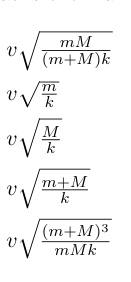 Ball colliding with spring on box
Topic: Conservation of Energy, Oscillations & Waves Metodi: Energy Conservation Method, Conservation of Momentum Competenze: Mathematical Modeling, Physical Reasoning Objects: Ball, Spring, Block Fonte: Testo (PDF) — p.10
Una palla di massa in movimento a velocità colpisce una molla senza massa di costante molla montata su una scatola stazionaria di massa nello spazio libero. Non si perde alcuna energia meccanica nella collisione. Se il sistema non ruota, qual è la compressione massima della molla?
- A.
- B.
- C.
- D.
- E.
Molle che si schianta con la molla sulla scatola
Topic: Conservation of Energy, Oscillations & Waves Metodi: Energy Conservation Method, Conservation of Momentum Competenze: Mathematical Modeling, Physical Reasoning Objects: Ball, Spring, Block Fonte: Testo (PDF) — p.10
A planet orbits around a star , as shown in the figure. The semi-major axis of the orbit is . The perigee, namely the shortest distance between the planet and the star is . When the planet passes point (on the line through the star and perpendicular to the major axis), its speed is . What is its speed when it passes the perigee?
- A.
- B.
- C.
- D.
- E.
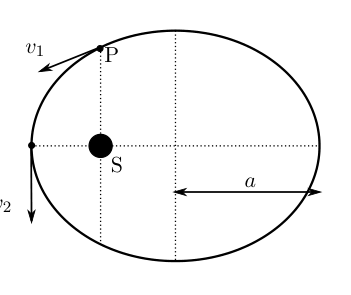 Elliptical orbit with star S, point P, perigee
Topic: Gravitation, Astrophysics Metodi: Kepler’s Laws, Conservation Laws, Energy Conservation Method Competenze: Mathematical Modeling, Physical Reasoning Objects: Planet, Star Fonte: Testo (PDF) — p.10
Un pianeta orbita attorno a una stella , come mostrato nella figura. L’asse semimejor dell’orbita è . Il perigeo, cioè la distanza più breve tra il pianeta e la stella, è . Quando il pianeta passa il punto (sulla linea attraverso la stella e perpendicolare all’asse principale), la sua velocità è . Qual è la sua velocità quando passa il perigeo?
- A.
- B.
- C.
- D.
- E.
Orbita ellittica con stella S, punto P, perigeo
Topic: Gravitation, Astrophysics Metodi: Kepler’s Laws, Conservation Laws, Energy Conservation Method Competenze: Mathematical Modeling, Physical Reasoning Objects: Planet, Star Fonte: Testo (PDF) — p.10