- DRAGON (5 points) — Aigar Vaigu. Here is a photo of a dragon under water (there is a larger photo on a separate sheet). The length of the dragon is and its height is . The diameter of the bottom of the bowl is and the angle between the table and the side of the bowl is . The refractive index of water is . The photo has been taken so that the camera was pointing directly along the water surface. In the following questions the angle between the horizon when looking at some point on the image of the dragon is defined as the angle between the horizontal water surface (or any other horizontal surface) and the straight line from the eye to that point on the image. i) (2 points)What is the largest angle below the horizon from which the reflection of the dragon from the water surface can be seen? ii) (3 points)What is the highest angle above the horizon from which this reflection can be seen?
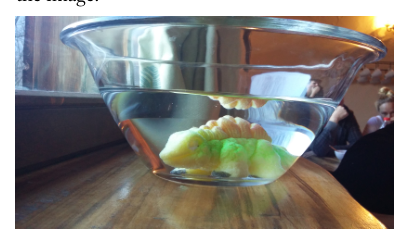 Foto drago sott’acqua in ciotola
Topic: Geometric Optics Metodi: Snell’s Law, Ray Tracing, Small-Angle Approximation Competenze: Physical Reasoning, Mathematical Modeling Objects: — Fonte: Testo (PDF) — p.1
- DRAGON (5 punti) Aigar Vaigu. Ecco qua. è una foto di un drago sotto l’acqua (ci è un foto più grandi su un foglio separato). La lunghezza di il drago è e la sua altezza è . Il diametro della parte inferiore della ciotola è e l’angolo tra la tavola e la tavola lato della ciotola è . L’indice di rifrazione dell’acqua è . La foto è stata presa in modo che la fotocamera puntasse direttamente lungo la superficie dell’acqua. Nelle seguenti domande l’angolo tra l’orizzonte quando si guarda a un punto dell’immagine del drago è definito come angolo tra la superficie orizzontale dell’acqua (o qualsiasi altra superficie orizzontale) e la linea retta dall’occhio a quel punto su l’immagine. i) (2 punti) Qual è l’angolo più grande sotto il orizzonte da cui il riflesso del drago dalla superficie dell’acqua si può vedere? (ii) (3 punti) Qual è l’angolo più alto sopra il l’orizzonte da cui si può vedere questo riflesso?
Foto drago sott’acqua a Ciotola
Topic: Geometric Optics Metodi: Snell’s Law, Ray Tracing, Small-Angle Approximation Competenze: Physical Reasoning, Mathematical Modeling Objects: — Fonte: Testo (PDF) — p.1
- COMET (8 points) — Jaan Kalda. A comet’s orbit intersects the Earth’s orbit (which can be assumed to be circular of radius km) at an angle . The comet’s and the Earth’s orbits lie on the same plane. i) (3 points)Find the distance of the comet’s perihelion from the Sun (i.e. its shortest distance). The distance of the comet’s aphelion from the Sun (i.e. its longest distance) can be assumed to be much larger than . ii) (5 points) For how many days will the comet’s distance to the Sun be less that ?
Topic: Gravitation Metodi: Kepler’s Laws, Newton’s Law of Gravitation, Conservation of Energy Competenze: Mathematical Modeling Objects: Planet, Star Fonte: Testo (PDF) — p.1
- COMET (8 punti) Jaan Kalda. A L’orbita della cometa interseca l’orbita della Terra (che può essere presumita essere circolare di raggio km) ad un angolo . Le comete e le orbite della Terra si trovano sullo stesso piano. i) (3 punti) Trova la distanza delle comete perielio dal Sole (cioè il suo più breve Distanza). Distanza delle comete Afilione dal Sole (cioè La distanza più lunga) può essere presumita essere molto più grande di . ii) (5 punti) Per quanti giorni La distanza della cometa al Sole è inferiore a ?
Topic: Gravitation Metodi: Kepler’s Laws, Newton’s Law of Gravitation, Conservation of Energy Competenze: Mathematical Modeling Objects: Planet, Star Fonte: Testo (PDF) — p.1
- RESISTORS AND CAPACITORS (5 points) — Mihkel Heidelberg. A circuit is made out of a battery, a switch, resistors and capacitors as shown in the image. The resistors all have a resistance of , the capacitors all have a capacitance of and the battery has a voltage of . The point A is connected to the ground and so it has a potential of . In the beginning the switch is open and all the capacitors have no charge. i) (2 points)What is the potential at points B and C after we have closed the switch and waited for all the potentials to stabilize? ii) (3 points) What is the potential at point D after we have closed the switch and waited for all the potentials to stabilize?
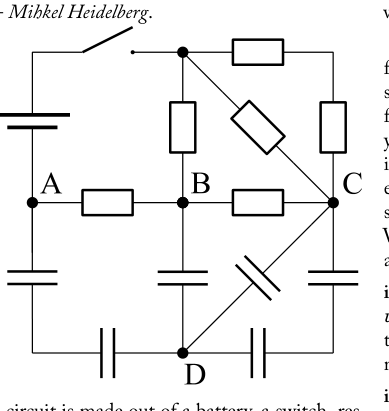 Circuito RC con batteria e switch
Topic: Circuits, Electrostatics Metodi: Kirchhoff’s Laws, Electric Potential Method, Equivalent Circuit Reduction Competenze: Diagrammatic Reasoning, Mathematical Modeling Objects: Battery, Switch, Resistor, Capacitor Fonte: Testo (PDF) — p.1
- Resistori e capacitori (5 punti) Mihkel Heidelberg. Un circuito è costituito da una batteria, un interruttore, resistori e condensatori come mostrato nell’immagine. Il le resistenze sono tutte di , i condensatori tutte hanno una capacità di e la batteria ha una tensione di . Il punto A è collegato alla il potenziale di . All’inizio il interruttore è aperto e tutti i condensatori Non sono accusati. i) (2 punti) Qual è il potenziale dei punti B e C dopo aver chiuso il interruttore e aspettato
- Tutti i potenziali per stabilizzarsi? ii) (3 punti) Qual è il potenziale al punto D Dopo aver chiuso il interruttore e aspettato
- Tutti i potenziali per stabilizzarsi?
Circuito RC con batterie e interruttore
Topic: Circuits, Electrostatics Metodi: Kirchhoff’s Laws, Electric Potential Method, Equivalent Circuit Reduction Competenze: Diagrammatic Reasoning, Mathematical Modeling Objects: Battery, Switch, Resistor, Capacitor Fonte: Testo (PDF) — p.1
- GRAVITATIONAL WAVES (7 points) — Artūrs Bērziņš. The power radiated in gravitational waves by an orbiting binary system is given by , where is the distance between the centers of the two orbiting masses and . It is known that the most compact object is a black hole. The size of a black hole is defined by its Schwarzschild radius , where is the mass of the black hole. i) (2 points) Estimate the upper limit of the power that can ever be emitted in gravitational waves by an orbiting binary system. The gravitational wave detectors on Earth function by measuring the so called gravity wave strain over time, which characterizes the deformation of spacetime. Data processing then yields the maximum strain and its corresponding wave frequency . With the help of a theoretical spacetime model, the energy density associated with the wave can then be determined. We will use the analogy of linear elasticity to examine this model. ii) (1.5 points) Derive the energy density in a uniformly stretched elastic band in terms of the strain and the Elastic (Young’s) modulus . iii) (1.5 points) Use dimensional analysis to estimate the frequency-dependent elastic modulus of spacetime in terms of the universal gravitational constant , speed of light and gravitational wave frequency . iv) (2 points) Estimate the maximum distance from the Earth to the gravitational wave source as a function of the strain and frequency . Use the models derived previously in this problem.
Topic: Gravitation, Oscillations & Waves, Order-of-Magnitude Estimation Metodi: Dimensional Analysis, Order-of-Magnitude Estimation, Stress-Strain Analysis Competenze: Physical Reasoning, Mathematical Modeling, Estimation & Approximation Objects: Black Hole, Planet Fonte: Testo (PDF) — p.1
- L’AUTOMETICA è stata rilevata in un’inchiesta di cui alla lettera a) del regolamento (CE) n. Artūrs Bērziņš. La potenza irradiata in onde gravitazionali da un sistema binario in orbita è data da , dove è la distanza tra i centri di le due masse in orbita e . E’ noto che l’oggetto più compatto è un buco nero. Il dimensioni di un buco nero è definito dal suo raggio Schwarzschild , dove è la massa di Il buco nero. I) (2 punti) Estimare il limite superiore del Potenza che può mai essere emessa in gravità onde da un sistema binario in orbita. I rilevatori di onde gravitazionali sulla Terra funzione misurando la cosiddetta onda gravitazionale la tensione nel tempo, che caratterizza la deformazione dello spazio-tempo. Trattamento dei dati produce la tensione massima e la sua frequenza d’onda corrispondente . Con l’aiuto di un modello spaziotempo teorico, è quindi possibile determinare la densità energetica associata all’onda. Useremo l’analogia dell’elasticità lineare per esaminare questo modello. (ii) (1,5 punti) Derivare la densità energetica in una banda elastica uniformemente estesa in termini della cepa e dell’Elastic (Youngs) modulo . iii) (1,5 punti) Utilizzare analisi dimensionale per stimare il modulo elastico di frequenza dipendente dello spazio-tempo in termini di costante gravitazionale , velocità di luce e frequenza delle onde gravitazionali . iv) (2 punti) Estimare la distanza massima dalla Terra alla gravità fonte d’onda in funzione del tensione e della frequenza . Utilizzi i modelli derivati precedentemente in
- Questo problema.
Topic: Gravitation, Oscillations & Waves, Order-of-Magnitude Estimation Metodi: Dimensional Analysis, Order-of-Magnitude Estimation, Stress-Strain Analysis Competenze: Physical Reasoning, Mathematical Modeling, Estimation & Approximation Objects: Black Hole, Planet Fonte: Testo (PDF) — p.1
- VIRTUAL MASS (10 points) — Jaan Kalda. When a body moves in a fluid, the effective inertial mass appears to be larger than the mass of the body itself, because to accelerate the body some of the fluid needs to be accelerated as well. This increase is called added mass or virtual mass. Measure the amount of virtual mass that is added to the ball as it moves through water. The diameter of the ball is . You don’t have to calculate the uncertainty of your results, however the accuracy of your methods and results is important and will be graded. Equipment: Ball fixed to a spring, stand, stopwatch, ruler, container with water.
Topic: Fluid Mechanics, Oscillations & Waves Metodi: Simple Harmonic Motion Analysis, Physical Modeling Competenze: Experimental Data Analysis, Measurement & Instrumentation, Physical Reasoning Objects: Ball, Spring, Container Fonte: Testo (PDF) — p.1
- L’AUTOR: L’AUTOR: L’AUTOR: L’AUTOR: L’AUTOR: L’AUTOR: L’AUTOR: L’AUTOR: L’AUTOR: L’AUTOR: L’AUTOR: L’AUTOR: L’AUTOR: L’AUTOR: L’AUTOR: L’AUTOR: L’AUTOR: L’AUTOR: L’AUTOR: L’AUTOR: L’AUTOR: L’AUTOR: L’AUTOR: L’AUTOR: L’AUTOR: L’AUTOR: L’AUTOR: L’AUTOR: L’AUTOR: L’AUTOR: L’AUTOR: L’AUTOR: L’AUTOR: L’AUTOR: L’AUTOR: L’AUTOR: L’AUTOR: L’AUTOR: L’AUTOR: L’AUTOR: L’AUTOR: L’AUTOR: L’AUTOR: L’AUTOR Quando un corpo si muove in un fluido, la massa inertiale effettiva sembra essere maggiore della massa di il corpo stesso, perché per accelerare il corpo
- Anche parte del fluido deve essere accelerata. Questo aumento è chiamato massa aggiunta o massa virtuale. Misurare la quantità di massa virtuale che è aggiunta alla palla mentre si muove attraverso l’acqua. Il il diametro della palla è . Non lo sai.
- dovete calcolare l’incertezza dei vostri risultati. Tuttavia, l’accuratezza dei metodi e dei risultati è importante e sarà valutata. Apparecchiature: palla fissata a una molla, supporto, orologio fermo, reggente, contenitore con acqua.
Topic: Fluid Mechanics, Oscillations & Waves Metodi: Simple Harmonic Motion Analysis, Physical Modeling Competenze: Experimental Data Analysis, Measurement & Instrumentation, Physical Reasoning Objects: Ball, Spring, Container Fonte: Testo (PDF) — p.1
- LOOP (6 points) — Lasse Franti. A wire loop is hovering in outer space (weightless vacuum) with its plane parallel to the -plane. In there is a homogeneous magnetic field parallel to the -axis. The rigid rectangular loop is wide and long. The loop is made of copper wire with a circular cross section (radius ). At the external magnetic field starts to decrease at a rate of . i) (3 points) Find the acceleration of the loop right after . The magnetic flux density is initially and the loop is immersed into the external field with its shorter side parallel to the -axis. ii) (3 points) We can try to increase the acceleration in many ways. How does the result in i) change if a) the loop is made with twice thicker copper wire ()? b) the original wire is wound three times instead of one (giving a short-circuited coil with three windings, the dimensions of the rectangle stay the same)? c) the mass of the coil is kept constant by using a wire with half the cross section which is then wound two times (the dimensions of the rectangle stay the same)? d) the loop is made of a different metal? Which of the metals given in the table gives the best result?
| Metal | Resistivity | Density |
|---|---|---|
| Iron | 9.71 | 7.87 |
| Copper | 1.67 | 8.96 |
| Aluminum | 2.65 | 2.70 |
| Lithium | 8.55 | 0.53 |
e) What if we use the thicker copper wire to make a twice bigger loop (, , ) and immerse it into the external field?
Topic: Electromagnetic Induction, Circuits, Electromagnetism Metodi: Faraday’s Law of Induction, Lenz’s Law, Free-Body Diagram Competenze: Diagrammatic Reasoning, Mathematical Modeling Objects: Wire, Coil Fonte: Testo (PDF) — p.1
- LOOP (6 punti) Lasse Franti. Un filo il ciclo galleggia nello spazio esterno (vacuo senza peso) con il suo piano parallelo al piano . In esiste un campo magnetico omogeneo parallelo all’asse . Il ciclo rigido rettangolare è larghezza e lunghezza. Il circuito è made of copper wire with a circular cross section (radius ). A il campo magnetico esterno inizia a diminuire a un ritmo of . i) (3 punti) Trova l’accelerazione del ciclo immediatamente dopo . La densità del flusso magnetico è inizialmente e il ciclo è immerso nel campo esterno con il suo più breve lato parallelo all’asse . ii) (3 punti) Possiamo cercare di aumentare l’accelerazione in molti modi. Come si ottiene il risultato di i) modificare se a) il circuito è realizzato con rame doppio di spessore il filo ()? b) il filo originale è rotto tre volte invece di una (con una bobina a corto circuito con tre avvolgimenti, le dimensioni del rettangolo restare lo stesso)? c) la massa della bobina è mantenuta costante mediante un filo con metà della sezione trasversale che è Poi ferito due volte (le dimensioni della il rettangolo rimane lo stesso)? d) il circuito è costituito da un metallo diverso? Qual è il metallo indicato nella tabella che dà miglior risultato?
| Metal | Resistivity | Density |
|---|---|---|
| ♬ Ferro 9,71 ♬ 7,87 ♬ |
Copper # 1.67 # 8.96
L’alluminio # 2,65 # 2,70
Il litio # 8.55 # 0.53
e) E se usassimo il filo di rame più spessore ? per creare un ciclo doppio di grandezza (, , ) e immergerlo in Il campo esterno?
Topic: Electromagnetic Induction, Circuits, Electromagnetism Metodi: Faraday’s Law of Induction, Lenz’s Law, Free-Body Diagram Competenze: Diagrammatic Reasoning, Mathematical Modeling Objects: Wire, Coil Fonte: Testo (PDF) — p.1
- ZENER (7 points) — Jaan Kalda. A Zener diode is connected to a source of alternating current as shown in the figure. The current is sinusoidal with a constant amplitude. The inductance of the inductor is such that , where and are the breakdown voltages (). The current-voltage characteristic of the Zener diode is shown in the figure. In the following assume that a very long time has passed since the current source was first turned on. i) (5 points)Find the average current through the inductor. ii) (2 points)Find the peak-to-peak amplitude of the current changes in the inductor.
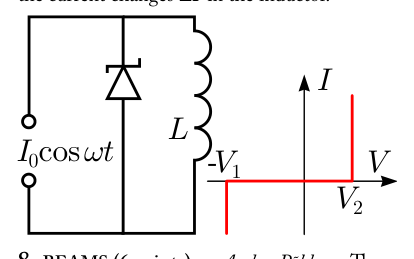 Circuito Zener con caratteristica I-V
Topic: Circuits, Electromagnetism Metodi: Kirchhoff’s Laws, Calculus-Integration, Physical Modeling Competenze: Physical Reasoning, Mathematical Modeling Objects: Inductor Fonte: Testo (PDF) — p.2
- ZENER (7 punti) Jaan Kalda. Un Zener la diodo è collegata a una fonte di corrente alternata come mostrato nella figura. La corrente è sinusoidale con un’ampiezza costante. L’induttanza dell’induttore è tale che , dove e sono le tensioni di rottura (). La corrente-voltaggio La caratteristica della dioda Zener è indicata nella tabella
- Sì, certo. In quanto tali, si presume che un periodo molto lungo Il tempo è passato da quando la fonte corrente è stata prima
- Si è accesa. i) (5 punti) Trova la corrente media attraverso l’induttore. ii) (2 punti) Trova l’ampiezza da picco a picco di le variazioni di corrente nell’induttore.
Circuito Zener con caratteristica I-V
Topic: Circuits, Electromagnetism Metodi: Kirchhoff’s Laws, Calculus-Integration, Physical Modeling Competenze: Physical Reasoning, Mathematical Modeling Objects: Inductor Fonte: Testo (PDF) — p.2
- BEAMS (6 points) — Andres Põldaru. There are three beams between two absolutely rigid plates. The weight of the plates and the beams can be neglected. The coefficient of thermal expansion of the beams is . The maximum strain (relative length change compared to the no load case) before permanent inelastic deformations of the material of the beam is . The beams can support a maximum amount of weight on the top plate, at which point permanent deformations start taking place in some of the beams. i) (2 points)Initially all the beams are at the same temperature. Then the temperature of the beam in the middle is increased by . Compared to the case when the beams were at equal temperatures, what fraction of the original maximal weight can the beams now support on the top plate? Assume that the properties of the materials (specifically the maximum strain and the elastic modulus) don’t change during the heating. ii) (4 points) All of the beams are originally at temperature . A load of 20% of the maximal load is placed on the top plate. Keeping the same load on, to what temperature can the beam in the middle be heated such that no permanent deformations occur? This time the elastic modulus of the material changes depending on the temperature as shown in the figure below (a larger figure is given on an extra sheet). Hint (added during the competition): the elastic modulus or Young modulus is defined by the formula , where is the force, is the area and is the relative lengthening.
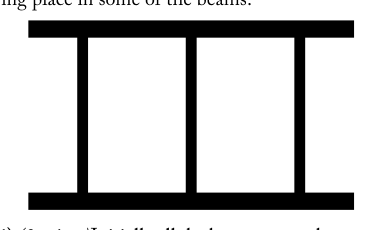 Tre travi tra piastre rigide
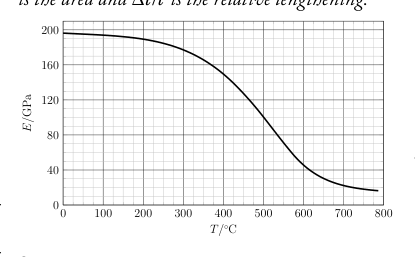 Grafico modulo elastico E vs temperatura T
Topic: Elasticity & Materials, Thermodynamics Metodi: Stress-Strain Analysis, Hooke’s Law, Approximation & Series Expansion Competenze: Mathematical Modeling, Diagrammatic Reasoning Objects: Beam Fonte: Testo (PDF) — p.2
- BEAMS (6 punti) Andres Põldaru. Ecco qua. sono tre travi tra due assolutamente rigide
- Le piastre. Peso delle lastre e dei travi
- Non si può dimenticare. Il coefficiente di espansione termica dei fasci è . Il tensione massima (cambiamento di lunghezza relativa rispetto alla cassa senza carico) prima di deformazioni inelastiche permanenti del materiale del fascio is . I travi possono sostenere un peso massimo sulla piastra superiore, a a che punto iniziano a verificarsi deformazioni permanenti in alcuni fasci. i) (2 punti) Inizialmente tutti i fasci sono uguali temperatura. Poi la temperatura del raggio in mezzo è aumentato di . Rispetto al caso in cui i fasci erano uguali Le temperature, quale frazione del peso massimo originale i fasci possono ora supportare sul
- Il top plate? Supponiamo che le proprietà dei materiali (in particolare la tensione massima e la modulo elastico) non cambiano durante il riscaldamento. (ii) (4 punti) Tutti i fascicoli sono originariamente temperatura . Un carico del 20% del il carico massimo è posto sulla piastra superiore. Tenendo lo stesso carico, a quale temperatura può il fascio al centro deve essere riscaldato in modo tale che non si verificano deformazioni permanenti? Questa volta il modulo elastico del materiale varia a seconda della temperatura, come mostrato nella figura di seguito (un numero più ampio è indicato su un foglio extra). Suggerimento (aggiunto durante il concorso): il modulo elastico o modulo giovane è definito da: la formula , dove è la forza, è l’area e è l’allungamento relativo.
Tre travi tra piastre rigide
*Grafico modulo elastico E vs temperatura T *
Topic: Elasticity & Materials, Thermodynamics Metodi: Stress-Strain Analysis, Hooke’s Law, Approximation & Series Expansion Competenze: Mathematical Modeling, Diagrammatic Reasoning Objects: Beam Fonte: Testo (PDF) — p.2
- SPACECRAFT PRESSURE (6 points) — Johan Runeson. Consider a spacecraft shaped as a homogeneous pipe, which is closed at both ends. The spacecraft is rotating around its center of mass with angular velocity , around an axis perpendicular to the pipe, in order to simulate gravity. The spacecraft is filled with air of molar mass , which has pressure at the rotation axis. The diameter of the spacecraft is much smaller than its length. Added during the competition: the temperature is . i) (4 points) Calculate the pressure as a function of the distance from the rotation axis. ii) (2 points) As a comparison, consider a (nonrotating) tower in a constant gravitational field of strength , filled with the same gas. If the ground level pressure is , what is the pressure as a function of height above the ground in such a tower?
Topic: Fluid Mechanics, Rotational Dynamics, Thermodynamics Metodi: Ideal Gas Law, Hydrostatic Equilibrium, Differential Equations Competenze: Mathematical Modeling, Physical Reasoning Objects: Tube, Gas Fonte: Testo (PDF) — p.2
- SPACECRAFT PRESSURE (6 punti) Johan Runeson. Considerate una nave spaziale a forma di un tubo omogeneo, chiuso in entrambe le parti finisce. La sonda ruota intorno al suo centro di massa con velocità angolare , intorno a un asse perpendicolare al tubo, per simulare la gravità. La sonda spaziale è piena di aria di massa molare , che ha una pressione all’asse di rotazione. Il diametro della sonda spaziale è molto inferiore alla sua lunghezza. Aggiunto durante la gara: la temperatura è . i) (4 punti) Calcolare la pressione in funzione della distanza dall’asse di rotazione. ii) (2 punti) Per un confronto, considerate una torre (non rotante) in un campo gravitazionale costante di resistenza , riempita dello stesso gas. Se il la pressione del livello del terreno è , qual è la pressione in funzione dell’altezza sopra il suolo in una torre del genere?
Topic: Fluid Mechanics, Rotational Dynamics, Thermodynamics Metodi: Ideal Gas Law, Hydrostatic Equilibrium, Differential Equations Competenze: Mathematical Modeling, Physical Reasoning Objects: Tube, Gas Fonte: Testo (PDF) — p.2
- BLACK BOX (10 points) — Jaan Kalda, Siim Ainsaar. In a black box with three terminals (A, B and C) there is a resistor (resistance ), a capacitor (capacitance ), and a series connection of a battery (electromotive force ) with another resistor (). i) (3 points)Determine the circuit diagram of the black box. ii) (7 points)Measure the electromotive force of the battery, the resistances of the resistors, and the capacitance of the capacitor. Estimate the uncertainties. Always indicate the circuit diagram and the multimeter settings you used for the measurements! Equipment: black box, multimeter, stopwatch, wires, graph paper.
Topic: Circuits, Electrostatics Metodi: Kirchhoff’s Laws, Electric Potential Method, Equivalent Circuit Reduction Competenze: Experimental Data Analysis, Measurement & Instrumentation, Diagrammatic Reasoning Objects: Resistor, Capacitor, Battery, Wire Fonte: Testo (PDF) — p.2
- BOSSA NERA (10 punti) Jaan Kalda, Siim Ainsaar. In una scatola nera con tre terminali (A, B e C) c’è una resistenza (resistenza) ), un condensatore (capacità ) e una serie connessione di una batteria (forza elettromotrice ) con un’altra resistenza (). i) (3 punti) Determinare il diagramma del circuito del
- Cassa nera. (ii) (7 punti) Misurare la forza elettromotrice di la batteria, le resistenze delle resistenze, e la capacità del condensatore. Valutare il
- Le incertezze. Indicare sempre il diagramma del circuito e le impostazioni del multimetro utilizzate per Le misure! Equipaggiamento: scatola nera, multimetro, orologio fermo, fili, carta grafica.
Topic: Circuits, Electrostatics Metodi: Kirchhoff’s Laws, Electric Potential Method, Equivalent Circuit Reduction Competenze: Experimental Data Analysis, Measurement & Instrumentation, Diagrammatic Reasoning Objects: Resistor, Capacitor, Battery, Wire Fonte: Testo (PDF) — p.2