Problema 1: Tarzán saltando con una liana (3,5 puntos) Tarzán quiere saltar sobre un río salvando una distancia entre las dos orillas. Para ello utiliza una liana de longitud que cuelga verticalmente de un árbol en el extremo de la orilla izquierda. Tarzán alcanza una velocidad de en el momento de coger la liana y se suelta cuando ésta forma un ángulo con la vertical. Suponemos que la masa de la liana es despreciable y que el centro de gravedad de Tarzán coincide con el extremo inferior de la liana. Calcula la distancia horizontal que consigue con el salto medida desde la posición inicial de la liana. ¿Consigue llegar a la orilla derecha?
Tarzán XXVIII Olimpiada Española de Física 24 de febrero de 2017 Fase Local, Universidad de Salamanca Nombre y apellidos:
Centro: Curso:
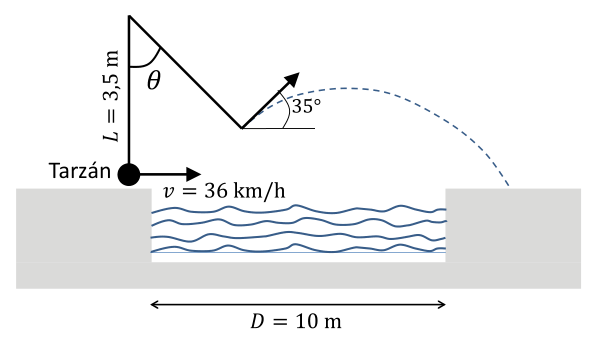 Tarzán su liana sopra il fiume
Topic: Newtonian Mechanics, Oscillations & Waves Metodi: Free-Body Diagram, Kinematic Equations, Vector Decomposition Competenze: Diagrammatic Reasoning, Mathematical Modeling, Physical Reasoning Objects: String, Pendulum Fonte: Testo (PDF) — p.1
Problema 1: Tarzan saltando con una liana (3,5 punti) Tarzán quiere saltar sobre un río salvando una distancia entre las dos orillas. Per questo si utilizza una lamina di di lunghezza che si appende verticalmente da un albero in l’estremità della riva sinistra. Tarzan raggiunge una velocità di nel momento di prendere la liana e di rilasciarla quando essa forma un angolo con la Verticale. Supponiamo che la massa della liana sia scarsa e che il centro di gravità di Tarzán coincide con l’estremità inferiore della liana. Calcola la distanza orizzontale che Si ottiene con il salto misurato dalla posizione iniziale della liana. Riesce a raggiungere la
- Il bordo destro?
Tarzan XXVIII Olimpiada spagnola di fisica 24 febbraio 2017 Fase Locale, Università di Salamanca Nome e cognome:
Centro: Curso:
Tarzan sua liana sopra il fiume
Topic: Newtonian Mechanics, Oscillations & Waves Metodi: Free-Body Diagram, Kinematic Equations, Vector Decomposition Competenze: Diagrammatic Reasoning, Mathematical Modeling, Physical Reasoning Objects: String, Pendulum Fonte: Testo (PDF) — p.1
Problem 1: Tarzan jumping with a liana (3.5 points) Tarzán quiere saltar sobre un río salvando una distancia entre las dos orillas. For this purpose, a length of is used, which hangs vertically from a tree in the the end of the left bank. Tarzan reaches a speed of in the The time to take the line and release it when it forms an angle with the vertical. Suppose the mass of the liana is despicable and that the center of gravity Tarzan’s corresponds to the lower end of the liana. Calculate the horizontal distance that It gets by the jump measured from the initial position of the liana. Can you get to the Right bank?
Tarzan XXVIII Spanish Olympics in Physics The Commission shall adopt implementing acts in accordance with Article 21 of this Regulation. Local phase, University of Salamanca Name and surname:
The Centre: Course:
Tarzán su liana sopra il fiume
Topic: Newtonian Mechanics, Oscillations & Waves Metodi: Free-Body Diagram, Kinematic Equations, Vector Decomposition Competenze: Diagrammatic Reasoning, Mathematical Modeling, Physical Reasoning Objects: String, Pendulum Fonte: Testo (PDF) — p.1
Problema 2: Cruzando un río en barca (3,5 puntos) Partiendo de una orilla, un barquero quiere cruzar un río con una barca manteniendo una velocidad constante de medida respecto del agua. (a) Si la corriente de agua circula a una velocidad de , ¿en qué dirección debe remar de forma que la distancia recorrida sea mínima? ¿A qué velocidad se mueve la barca con respecto a la tierra? (b) ¿Y si la velocidad del río fuera de ? Nota: Especifica la dirección en la que ha de remar el barquero mediante el ángulo que forma con respecto a la línea perpendicular al río que une ambas orillas. XXVIII Olimpiada Española de Física 24 de febrero de 2017 Fase Local, Universidad de Salamanca Nombre y apellidos:
Centro: Curso:
Topic: Newtonian Mechanics Metodi: Vector Decomposition, Physical Modeling, Kinematic Equations Competenze: Physical Reasoning, Mathematical Modeling Objects: — Fonte: Testo (PDF) — p.2
Problema 2: Attraversare un fiume in barca (3,5 punti) Partendo da una riva, un barchista vuole attraversare un fiume con una barca mantenendo una velocità costante di misurata rispetto all’acqua. (a) Se il flusso d’acqua circola a una velocità , in che direzione deve Rammaricare in modo da ridurre la distanza percorsa al minimo? A che velocità si muove? la barca rispetto alla terra? b) E se la velocità del fiume fosse ? Nota: Indica l’indirizzo in cui il navigatore deve rammare dall’angolo che forma rispetto alla linea perpendicolare al fiume che unisce le due rive. XXVIII Olimpiada spagnola di fisica 24 febbraio 2017 Fase Locale, Università di Salamanca Nome e cognome:
Centro: Curso:
Topic: Newtonian Mechanics Metodi: Vector Decomposition, Physical Modeling, Kinematic Equations Competenze: Physical Reasoning, Mathematical Modeling Objects: — Fonte: Testo (PDF) — p.2
Problem 2: Crossing a river by boat (3.5 points) Starting from a shore, a boatman wants to cross a river with a boat keeping a constant speed of measured with respect to water. (a) If the current of water is flowing at , in which direction should it be rowing so that the distance travelled is minimal? How fast does it move? The boat with respect to the land? (b) What if the river speed was ? Note: Specify the direction in which the sailor is to row at the angle that: shape with respect to the line perpendicular to the river connecting both banks. XXVIII Spanish Olympics in Physics The Commission shall adopt implementing acts in accordance with Article 21 of this Regulation. Local phase, University of Salamanca Name and surname:
The Centre: Course:
Topic: Newtonian Mechanics Metodi: Vector Decomposition, Physical Modeling, Kinematic Equations Competenze: Physical Reasoning, Mathematical Modeling Objects: — Fonte: Testo (PDF) — p.2
Problema 3: Bola cargada en el campo eléctrico terrestre (3 puntos) Todo el mundo sabe que existe un campo magnético terrestre, pero poca gente sabe que también existe un campo eléctrico terrestre. Este campo eléctrico se debe al predominio de los iones positivos sobre los negativos en la ionosfera, mientras que la carga neta de la Tierra es negativa. El campo está dirigido, por tanto, desde la ionosfera hacia la Tierra y su valor promedio es .
En este problema vamos a explorar la posibilidad de utilizar este campo eléctrico para hacer que un objeto cargado eléctricamente levite venciendo la fuerza gravitatoria. Para ello consideraremos una esfera de radio de espuma de poliuretano, un material muy ligero (). (a) ¿Cuánto pesa dicha esfera? Para poder cargar la esfera, ésta se cubre con una capa de pintura metálica, dado que el poliuretano es un material aislante. (b) Suponiendo que el peso de la capa de pintura es despreciable y que el campo eléctrico terrestre es uniforme y tiene un valor de , ¿cuánta carga tendríamos que colocar en la esfera para compensar la fuerza gravitatoria? ¿De qué signo debe ser la carga? ¿Crees que es posible colocar toda esta carga en la esfera? Debes tener en cuenta que, a medida que colocamos carga en un material conductor, ésta se coloca en la superficie externa y el campo eléctrico a su alrededor crece. Si este campo es suficientemente intenso, es capaz de ionizar las moléculas que hay en el aire y, por tanto, el conductor se descarga a través del aire en el que está inmerso. Este fenómeno se denomina ruptura dieléctrica y ocurre cuando el campo eléctrico supera el valor . Teniendo en cuenta que el campo en la superficie de un conductor es , donde es la constante de Coulomb y es la carga por unidad de superficie, (c) ¿cuál es la carga máxima que podemos colocar en la esfera? (d) Suponiendo que colocamos dicha carga máxima, ¿cuál es la razón entre la fuerza que experimenta la esfera debida al campo eléctrico terrestre y la fuerza gravitatoria? (e) ¿Aumentaría esta razón si tuviéramos una esfera más grande? Razona tu respuesta.
Ionosfera
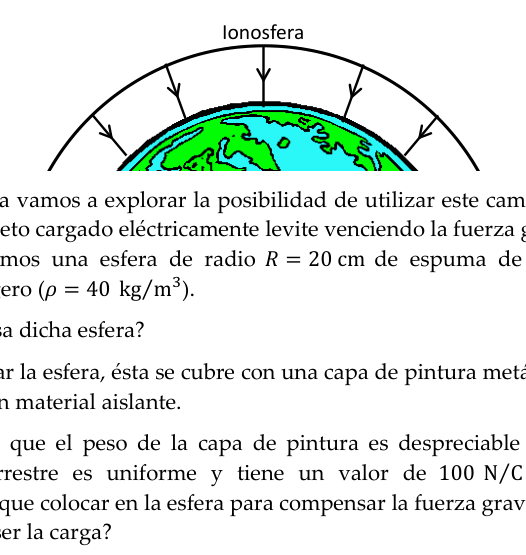 Terra con ionosfera e campo elettrico
Topic: Electrostatics, Newtonian Mechanics Metodi: Gauss’s Law, Coulomb’s Law, Free-Body Diagram Competenze: Mathematical Modeling, Physical Reasoning, Estimation & Approximation Objects: Conducting Sphere, Planet Fonte: Testo (PDF) — p.3
Problema 3: pallone carico nel campo elettrico terrestre (3 punti) Tutti sanno che esiste un campo magnetico terrestre, ma pochissime persone sanno che C’è anche un campo elettrico terrestre. Questo campo elettrico è dovuto al predominio La carica netta di ioni positivi è superiore a quella negativa nell’ionisfera, mentre la carica netta di ioni negativi è superiore a quella di ioni positivi nell’ionisfera. la Terra è negativa. Il campo è quindi diretto dall’ionosfera verso la Terra e il suo valore medio è .
In questo problema, esploreremo la possibilità di utilizzare questo campo elettrico per far levare un oggetto elettricamente carico superando la forza gravitazionale. Per In questo caso, considereremo una sfera radio di focolaio di poliuretano, un materiale molto leggero (). (a) Quanto pesa la sfera? Per poter caricare la sfera, essa viene coperta da un strato di vernice metallica, dato che la sfera è Il poliuretano è un materiale isolante. b) Supponendo che il peso del rivestimento di pittura sia scarsa e che il campo sia la corrente elettrica terrestre è uniforme e ha un valore di , Dovremmo metterci sulla sfera per compensare la forza gravitazionale? Di cosa? Il segno deve essere il carico? Pensi che sia possibile mettere tutta questa carica sulla sfera? Dovete tenere presente che, a Quando mettiamo carico su un materiale conduttore, questo si trova sulla superficie. La luce è esterna e il campo elettrico intorno a essa cresce. Se questo campo è sufficiente L’energia è molto intensa, è in grado di ionizzare le molecole presenti nell’aria e quindi il conduttore si scarica attraverso l’aria in cui è immerso. Questo fenomeno è chiamato rottura dielettrico e si verifica quando il campo elettrico supera il valore . Avendo in si considera che il campo sulla superficie di un conduttore è , dove è la costante di Coulomb e è il carico per unità di superficie, (c) Qual è il carico massimo che possiamo mettere sulla sfera? (d) Supponiamo di mettere tale carico massimo, qual è il rapporto tra la forza che sperimenta la sfera a causa del campo elettrico terrestre e la forza gravità? (e) Si potrebbe aumentare questa ragione se avessimo una sfera più grande? Raziona la tua risposta.
Ionosfera
Terra con ionosfera e campo elettrico
Topic: Electrostatics, Newtonian Mechanics Metodi: Gauss’s Law, Coulomb’s Law, Free-Body Diagram Competenze: Mathematical Modeling, Physical Reasoning, Estimation & Approximation Objects: Conducting Sphere, Planet Fonte: Testo (PDF) — p.3
Problem 3: Ball charged in the terrestrial electric field (3 points) Everyone knows there’s a magnetic field on Earth, but few people know that There’s also a terrestrial electric field. This electric field is due to the predominance of The net charge of the positive ions over the negative ions in the ionosphere, while the net charge of the Earth is negative. The field is directed, therefore, from the ionosphere towards Earth. and its mean value is .
In this problem we’re going to explore the possibility of using this electric field to To make an electrically charged object levitate by overcoming gravity. Stop ello consideraremos una esfera de radio de espuma de poliuretano, un Very lightweight material (). (a) How much does the sphere weigh? In order to carry the sphere, it is covered with a layer of metallic paint, since the sphere is covered with a layer of metallic paint. Polyurethane is an insulating material. (b) Assuming that the weight of the painting layer is negligible and that the field is the ground electricity is uniform and has a value of , how much charge We’d have to place it on the sphere to compensate for gravitational force? What? Sign must be the load? Do you think it’s possible to place all this charge on the sphere? You must take into account that, As we place charge on a conductive material, it is placed on the surface. The external and electric field around it grows. If this field is enough The energy content of the gas is very high, it is able to ionize the molecules in the air and therefore the conductor is It discharges through the air in which it is immersed. This phenomenon is called rupture. dieléctrica y ocurre cuando el campo eléctrico supera el valor . Having in takes into account that the field on the surface of a conductor is , where is the Coulomb constant and is the charge per unit area, (c) What is the maximum load we can place on the sphere? (d) Assuming we place this maximum load, what is the ratio between the force which experiences the sphere due to the earth’s electric field and force What about gravity? (e) Would this reason increase if we had a larger sphere? You’re right about your answer.
The ionosphere
Land with ionosphere and electric field
Topic: Electrostatics, Newtonian Mechanics Metodi: Gauss’s Law, Coulomb’s Law, Free-Body Diagram Competenze: Mathematical Modeling, Physical Reasoning, Estimation & Approximation Objects: Conducting Sphere, Planet Fonte: Testo (PDF) — p.3