Question A1
A pair of wedges are located on a horizontal surface. The coefficient of friction (both sliding and static) between the wedges is , the coefficient of friction between the bottom wedge B and the horizontal surface is , and the angle of the wedge is . The mass of the top wedge A is , and the mass of the bottom wedge B is . A horizontal force directed to the left is applied to the bottom wedge as shown in the figure.
Determine the range of values for so that the top wedge does not slip on the bottom wedge. Express your answer(s) in terms of any or all of , , , and .
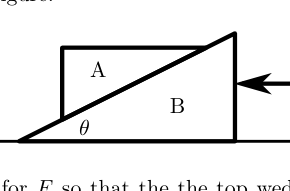 Wedge A on wedge B, force F applied
Topic: Newtonian Mechanics, Rigid Body Statics Metodi: Free-Body Diagram, Vector Decomposition Competenze: Physical Reasoning, Mathematical Modeling Objects: Wedge Fonte: Testo (PDF) — p.3
La domanda A1
Un paio di cucine si trovano su una superficie orizzontale. Il coefficiente di attrito (sliding e static) tra le cucine è , il coefficiente di attrito tra la cucina B inferiore e la superficie orizzontale è e l’angolo della cucina è . La massa della cucina superiore A è e la massa della cucina inferiore B è . Una forza orizzontale rivolta a sinistra viene applicata alla cuccia inferiore come mostrato nella figura.
Determinare l’intervallo di valori per in modo che la cucina superiore non scivoli sulla cucina inferiore. Esprimi la tua risposta (s) in termini di una o tutte le , , e .
Cinco A su cinica B, forza F applicata
Topic: Newtonian Mechanics, Rigid Body Statics Metodi: Free-Body Diagram, Vector Decomposition Competenze: Physical Reasoning, Mathematical Modeling Objects: Wedge Fonte: Testo (PDF) — p.3
Question A2
Consider two objects with equal heat capacities and initial temperatures and . A Carnot engine is run using these objects as its hot and cold reservoirs until they are at equal temperatures. Assume that the temperature changes of both the hot and cold reservoirs is very small compared to the temperature during any one cycle of the Carnot engine.
a. Find the final temperature of the two objects, and the total work done by the engine.
Now consider three objects with equal and constant heat capacity at initial temperatures , , and . Suppose we wish to raise the temperature of the third object.
To do this, we could run a Carnot engine between the first and second objects, extracting work . This work can then be dissipated as heat to raise the temperature of the third object. Even better, it can be stored and used to run a Carnot engine between the first and third object in reverse, which pumps heat into the third object.
Assume that all work produced by running engines can be stored and used without dissipation.
b. Find the minimum temperature to which the first object can be lowered.
c. Find the maximum temperature to which the third object can be raised.
Topic: Thermodynamics Metodi: Thermodynamic Cycle Analysis, Conservation of Energy Competenze: Mathematical Modeling, Physical Reasoning Objects: Heat Engine Fonte: Testo (PDF) — p.3
La domanda A2
Considerate due oggetti con capacità termiche uguali e temperature iniziali e . Un motore Carnot è eseguito utilizzando questi oggetti come serbatoi caldi e freddi fino a quando non sono a temperature uguali. Supponiamo che i cambiamenti di temperatura sia dei serbatoi caldi che di quelli freddi siano molto piccoli rispetto alla temperatura durante un ciclo del motore Carnot.
a. Trova la temperatura finale dei due oggetti e il lavoro totale svolto dal motore.
Ora consideriamo tre oggetti con capacità di calore uguale e costante alle temperature iniziali , e . Supponiamo di voler aumentare la temperatura del terzo oggetto.
Per fare questo, potremmo eseguire un motore Carnot tra il primo e il secondo oggetto, estradendo il lavoro . Questo lavoro può quindi essere dissipato come calore per aumentare la temperatura del terzo oggetto. Meglio ancora, può essere memorizzato e utilizzato per eseguire un motore Carnot tra il primo e il terzo oggetto in rovescia, che pompa il calore nel terzo oggetto.
Supponiamo che tutto il lavoro prodotto dai motori in funzione possa essere conservato e utilizzato senza dissipazione.
b. Trova la temperatura minima a cui il primo oggetto può essere abbassato.
c. Trova la temperatura massima a cui il terzo oggetto può essere sollevato.
Topic: Thermodynamics Metodi: Thermodynamic Cycle Analysis, Conservation of Energy Competenze: Mathematical Modeling, Physical Reasoning Objects: Heat Engine Fonte: Testo (PDF) — p.3
Question A3
A ship can be thought of as a symmetric arrangement of soft iron. In the presence of an external magnetic field, the soft iron will become magnetized, creating a second, weaker magnetic field. We want to examine the effect of the ship’s field on the ship’s compass, which will be located in the middle of the ship.
Let the strength of the Earth’s magnetic field near the ship be , and the orientation of the field be horizontal, pointing directly toward true north.
The Earth’s magnetic field will magnetize the ship, which will then create a second magnetic field in the vicinity of the ship’s compass given by
where and are positive constants, is the angle between the heading of the ship and magnetic north, measured clockwise, and are unit vectors pointing in the forward direction of the ship (bow) and directly right of the forward direction (starboard), respectively.
Because of the ship’s magnetic field, the ship’s compass will no longer necessarily point North.
a. Derive an expression for the deviation of the compass, , from north as a function of , , and .
b. Assuming that and are both much smaller than one, at what heading(s) will the deviation be largest?
A pair of iron balls placed in the same horizontal plane as the compass but a distance away can be used to help correct for the error caused by the induced magnetism of the ship.
Just like the ship, the iron balls will become magnetic because of the Earth’s field . As spheres, the balls will individually act like dipoles. A dipole can be thought of as the field produced by two magnetic monopoles of strength at two different points.
The magnetic field of a single pole is
where the positive sign is for a north pole and the negative for a south pole. The dipole magnetic field is the sum of the two fields: a north pole at and a south pole at , where the axis is horizontal and pointing north. is a small distance much smaller than the radius of the iron balls; in general where is a constant that depends on the size of the iron sphere.
c. Derive an expression for the magnetic field from the iron a distance from the center of the ball. Note that there will be a component directed radially away from the ball and a component directed tangent to a circle of radius around the ball, so using polar coordinates is recommended.
d. If placed directly to the right and left of the ship compass, the iron balls can be located at a distance to cancel out the error in the magnetic heading for any angle(s) where is largest. Assuming that this is done, find the resulting expression for the combined deviation due to the ship and the balls for the magnetic heading for all angles .
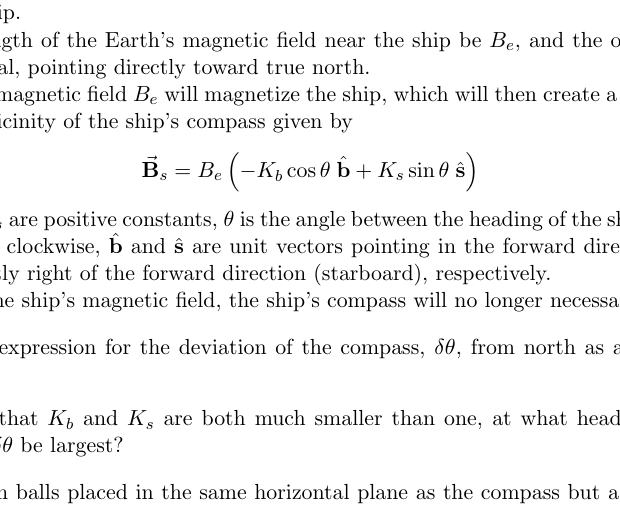 Binnacle with iron spheres correcting compass
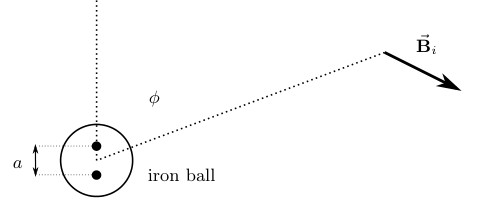 Dipole field diagram with iron ball and angle phi
Topic: Magnetism, Electromagnetism Metodi: Superposition Principle, Biot-Savart Law, Small-Angle Approximation Competenze: Mathematical Modeling, Physical Reasoning Objects: Magnetic Dipole, Sphere Fonte: Testo (PDF) — p.4
Question A3
Una nave può essere considerata come un’arrangamento simmetrico di ferro morbido. In presenza di un campo magnetico esterno, il ferro morbido si magnetizzerà, creando un secondo campo magnetico più debole. Vogliamo esaminare l’effetto del campo della nave sulla bussola della nave, che si trova al centro della nave.
La forza del campo magnetico terrestre vicino alla nave sia , e l’orientamento del campo sia orizzontale, puntando direttamente verso il vero nord.
Il campo magnetico terrestre magnetizzerà la nave, che creerà quindi un secondo campo magnetico nelle vicinanze della bussola della nave data da
se e sono costanti positive, è l’angolo tra la direzione della nave e il nord magnetico, misurato in senso orario, e sono vettori unitari che puntano rispettivamente nella direzione in avanti della nave (arco) e direttamente a destra della direzione in avanti (stamboard).
A causa del campo magnetico della nave, la bussola della nave non punterà più necessariamente a nord.
a. Derivare un’espressione per la deviazione della bussola, , da nord come funzione di , e .
b. Se e sono entrambi molto più piccoli di uno, in quale voce (s) sarà la deviazione più grande?
Per correggere l’errore causato dal magnetismo indotto della nave può essere utilizzata una coppia di sfere di ferro posizionate nello stesso piano orizzontale della bussola ma a una distanza .
Just like the ship, the iron balls will become magnetic because of the Earth’s field . Come sfere, le palle agiranno singolarmente come dipoli. Un dipolo può essere pensato come il campo prodotto da due monopoli magnetici di forza a due punti diversi.
Il campo magnetico di un solo polo è
dove il segno positivo è per un polo nord e il segno negativo per un polo sud. Il campo magnetico dipolo è la somma dei due campi: un polo nord a e un polo sud a , dove l’asse è orizzontale e punta verso nord. è una piccola distanza molto più piccola del raggio delle sfere di ferro; in generale dove è una costante che dipende dalla dimensione della sfera di ferro.
c. Derivare un’espressione per il campo magnetico dal ferro a una distanza dal centro della palla. Si noti che vi sarà una componente diretta radialmente lontano dalla palla e una componente diretta tangente ad un cerchio di raggio intorno alla palla, quindi si consiglia l’uso di coordinate polari.
d. Se posizionate direttamente a destra e a sinistra della bussola della nave, le palline di ferro possono essere posizionate a una distanza per cancellare l’errore nella direzione magnetica per qualsiasi angolo ((s) dove è più grande. Se si è fatto questo, si trova l’espressione risultante per la deviazione combinata dovuta alla nave e alle sfere per la direzione magnetica per tutti gli angoli .
Binnacle con sfere di ferro che correggono la bussola
Diagramma di campo di dipole con sfera di ferro e angolo phi
Topic: Magnetism, Electromagnetism Metodi: Superposition Principle, Biot-Savart Law, Small-Angle Approximation Competenze: Mathematical Modeling, Physical Reasoning Objects: Magnetic Dipole, Sphere Fonte: Testo (PDF) — p.4
Question A4
Relativistic particles obey the mass energy relation
where is the relativistic energy of the particle, is the relativistic momentum, is the mass, and is the speed of light.
A proton with mass and energy collides head on with a photon which is massless and has energy . The two combine and form a new particle with mass called , or “delta”. It is a one dimensional collision that conserves both relativistic energy and relativistic momentum.
a. Determine in terms of , , and . You may assume that is small.
b. In this case, the photon energy is that of the cosmic background radiation, which is an EM wave with wavelength . Determine the energy of the photons, writing your answer in electron volts.
c. Assuming this value for , what is the energy of the proton, in electron volts, that will allow the above reaction? This sets an upper limit on the energy of cosmic rays. The mass of the proton is given by and the mass of the is given by .
The following relationships may be useful in solving this problem:
- velocity parameter
- Lorentz factor
- relativistic momentum
- relativistic energy
- relativistic Doppler shift
Topic: Special Relativity, Modern-Quantum Physics Metodi: Relativistic Energy-Momentum, Conservation Laws, Photon Energy Relation Competenze: Mathematical Modeling, Physical Reasoning Objects: Photon, Nucleus Fonte: Testo (PDF) — p.6
La domanda A4
Le particelle relativistiche obbediscono alla relazione di massa energetica
dove è l’energia relativistica della particella, è il momento relativistico, è la massa e è la velocità della luce.
Un protone con massa ed energia collide di testa con un fotone che non ha massa e ha energia . Le due si combinano e formano una nuova particella con massa chiamata , o “delta”. Si tratta di una collisione unidimensional che conserva sia l’energia relativistica che l’impulso relativistico.
a. Determinare in termini di , e . Si può presumere che sia piccolo.
b. In questo caso, l’energia dei fotoni è quella della radiazione di fondo cosmica, che è un’onda EM con lunghezza d’onda . Determina l’energia dei fotoni, scrivendo la tua risposta in elettroni volti.
c. Supponendo questo valore per , qual è l’energia del protone, in elettroni volti, che consentirà la reazione di cui sopra? Questo impone un limite superiore all’energia dei raggi cosmici. La massa del protone è data da e la massa del è data da .
Le seguenti relazioni possono essere utili per risolvere questo problema:
- parametro di velocità
- fattore di Lorentz
- impulso relativistico
- energia relativistica
- spostamento Doppler relativistico
Topic: Special Relativity, Modern-Quantum Physics Metodi: Relativistic Energy-Momentum, Conservation Laws, Photon Energy Relation Competenze: Mathematical Modeling, Physical Reasoning Objects: Photon, Nucleus Fonte: Testo (PDF) — p.6
Question B1
Suppose a domino stands upright on a table. It has height , thickness , width (as shown below), and mass . The domino is free to rotate about its edges, but will not slide across the table.
a. Suppose we give the domino a sharp, horizontal impulsive push with total momentum .
i. At what height above the table is the impulse required to topple the domino smallest?
ii. What is the minimum value of to topple the domino?
b. Next, imagine a long row of dominoes with equal spacing between the nearest sides of any pair of adjacent dominos, as shown above. When a domino topples, it collides with the next domino in the row. Imagine this collision to be completely inelastic. What fraction of the total kinetic energy is lost in the collision of the first domino with the second domino?
c. After the collision, the dominoes rotate in such a way so that they always remain in contact. Assume that there is no friction between the dominoes and the first domino was given the smallest possible push such that it toppled. What is the minimum such that the second domino will topple?
You may work to lowest nontrivial order in the angles through which the dominoes have rotated. Equivalently, you may approximate .
d. A row of toppling dominoes can be considered to have a propagation speed of the length divided by the time between successive collisions. When the first domino is given a minimal push just large enough to topple and start a chain reaction of toppling dominoes, the speed increases with each domino, but approaches an asymptotic speed .
Suppose there is a row of dominoes on another planet. These dominoes have the same density as the dominoes previously considered, but are twice as tall, wide, and thick, and placed with a spacing of between them. If this row of dominoes topples with the same asymptotic speed previously found, what is the local gravitational acceleration on this planet?
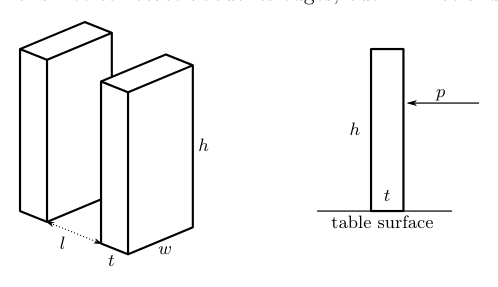 Domino geometry with height h, thickness t, spacing l
Topic: Rotational Dynamics, Newtonian Mechanics Metodi: Torque & Angular Momentum Analysis, Conservation of Energy, Impulse-Momentum Theorem Competenze: Mathematical Modeling, Physical Reasoning Objects: Block Fonte: Testo (PDF) — p.8
Question B1
Supponiamo che un domino si trovi eretto su un tavolo. Ha altezza , spessore , larghezza (come mostrato di seguito) e massa . Il domino può girare liberamente intorno ai bordi, ma non scivola attraverso il tavolo.
a. Supponiamo di dare al domino una spinta impulsiva orizzontale e netta con impulso totale .
i. A quale altezza sopra il tavolo è necessario l’impulso per abbattere il più piccolo domino?
ii. Qual è il valore minimo di per rovesciare il domino?
b. In seguito, immaginate una lunga fila di domino con spaziamento uguale tra i lati più vicini di qualsiasi coppia di domino adiacenti, come mostrato sopra. Quando un domino cade, colpisce il prossimo domino in fila. Immaginate che questa collisione sia completamente inelastica. Quale frazione dell’energia cinetica totale viene persa nella collisione del primo domino con il secondo domino?
c. Dopo la collisione, i dominò ruotano in modo tale che restino sempre in contatto. Supponiamo che non ci sia attrito tra i domino e il primo domino ha ricevuto la minima spinta possibile in modo che sia rovesciato. Qual è il minimo tale che il secondo domino si rovesci?
Potresti lavorare al più basso ordine non triviale negli angoli attraverso i quali i domino sono girati. Allo stesso modo, si può approssimare .
d. Una fila di dominosi che si rovescia può essere considerata avere una velocità di propagazione della lunghezza divisa per il tempo tra collisioni successive. Quando il primo domino riceve una spinta minima abbastanza grande da rovesciare e avviare una reazione in catena di rovesciamento, la velocità aumenta con ogni domino, ma si avvicina a una velocità asimptotica .
Supponiamo che ci sia una fila di domino su un altro pianeta. Questi dominosi hanno la stessa densità dei dominosi precedentemente considerati, ma sono due volte più alti, larghi e spessi e collocati con un spazio di tra di loro. If this row of dominoes topples with the same asymptotic speed previously found, what is the local gravitational acceleration on this planet?
Geometria di dominio con altezza h, spessore t, spaziamento l
Topic: Rotational Dynamics, Newtonian Mechanics Metodi: Torque & Angular Momentum Analysis, Conservation of Energy, Impulse-Momentum Theorem Competenze: Mathematical Modeling, Physical Reasoning Objects: Block Fonte: Testo (PDF) — p.8
Question B2
Beloit College has a “homemade” 500 kV Van De Graff proton accelerator, designed and constructed by the students and faculty.
The accelerator dome, an aluminum sphere of radius meters, is charged by a rubber belt with width that moves with speed . The accelerating column consists of 20 metal rings separated by glass rings; the rings are connected in series with resistors. The proton beam has a current of and is accelerated through and then passes through a tuning electromagnet. The electromagnet consists of wound copper pipe as a conductor. The electromagnet effectively creates a uniform field inside a circular region of radius and zero outside that region.
a. Assuming the dome is charged to , determine the strength of the electric field at the surface of the dome.
b. Assuming the proton beam is off, determine the time constant for the accelerating dome (the time it takes for the charge on the dome to decrease to of the initial value).
c. Assuming the proton beam is on, determine the surface charge density that must be sprayed onto the charging belt in order to maintain a steady charge of on the dome.
d. The proton beam enters the electromagnet and is deflected by an angle . Determine the magnetic field strength.
e. The electromagnet is composed of layers of spiral wound copper pipe; the pipe has inner diameter and outer diameter . The copper pipe is wound into this flat spiral that has an inner diameter and outer diameter . Assuming the pipe almost touches in the spiral winding, determine the length in one spiral.
f. Hollow pipe is used instead of solid conductors in order to allow for cooling of the magnet. If the resistivity of copper is , determine the electrical resistance of one spiral.
g. There are coils stacked on top of each other. Tap water with an initial temperature of enters the spiral through the copper pipe to keep it from overheating; the water exits at a temperature of . The copper pipe carries a direct 45 Amp current in order to generate the necessary magnetic field. At what rate must the cooling water flow be provided to the electromagnet? Express your answer in liters per second with only one significant digit. The specific heat capacity of water is ; the density of water is .
h. The protons are fired at a target consisting of Fluorine atoms (). What is the distance of closest approach to the center of the Fluorine nuclei for the protons? You can assume that the Fluorine does not move.
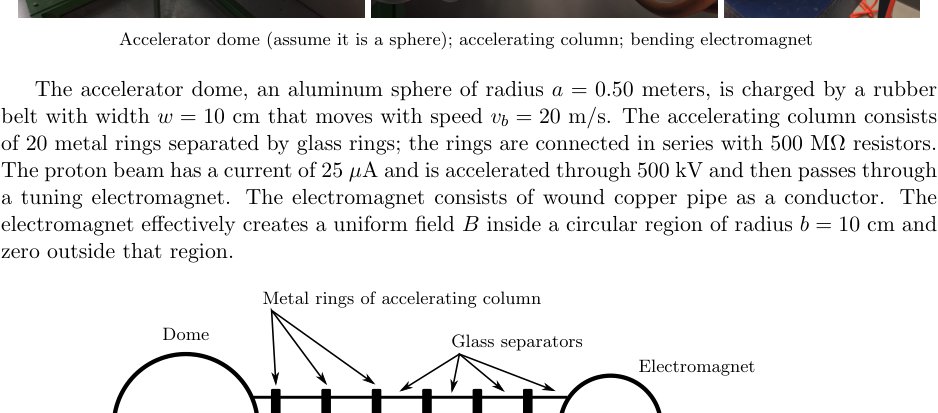 Van de Graaff accelerator dome, column, electromagnet
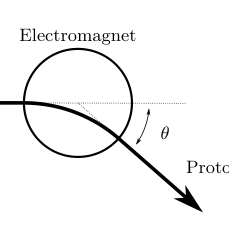 Electromagnet deflecting proton beam by angle theta
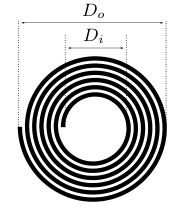 Spiral wound copper pipe cross section Di Do
Topic: Electrostatics, Circuits, Magnetism Metodi: Gauss’s Law, Equivalent Circuit Reduction, Lorentz Force Analysis, Coulomb’s Law Competenze: Mathematical Modeling, Physical Reasoning Objects: Conducting Sphere, Particle Beam, Resistor, Coil, Nucleus Fonte: Testo (PDF) — p.9
La domanda B2
Beloit College ha un acceleratore di protoni Van De Graff “fatto in casa” di 500 kV, progettato e costruito dagli studenti e dal personale docente.
La cupola dell’acceleratore, una sfera di alluminio di raggio metri, è caricata da una cintura di gomma di larghezza che si muove a velocità . La colonna di accelerazione è composta da 20 anelli metallici separati da anelli di vetro; gli anelli sono collegati in serie con resistori . Il fascio di protoni ha una corrente di e viene accelerato attraverso e poi passa attraverso un elettromagneto di sintonia. L’elettromagnetico è costituito da tubi di rame feriti come conduttore. L’elettromagnetico crea efficacemente un campo uniforme all’interno di una regione circolare di raggio e zero al di fuori di tale regione.
a. Supponendo che la cupola sia carica a , determinare la forza del campo elettrico alla superficie della cupola.
b. Supponendo che il fascio di protoni sia spento, determinare la costante temporale della cupola accelerante (il tempo necessario per ridurre la carica sulla cupola a del valore iniziale).
c. Supponendo che il fascio di protoni sia acceso, si determina la densità di carica superficiale che deve essere spruzzata sulla cintura di carica per mantenere una carica costante di sulla cupola.
d. Il fascio di protoni entra nell’elettromagneto ed è deviato da un angolo . Determina la forza del campo magnetico.
e. L’elettromagnetico è composto da strati di tubi di rame a ferita a spirale; il tubo ha un diametro interno e un diametro esterno . Il tubo di rame è avvolto in questa spirale piatta che ha un diametro interno e un diametro esterno . Supponendo che il tubo si tocchi quasi nella spirale, determinare la lunghezza in una spirale.
f. Il tubo vuoto viene utilizzato al posto dei conduttori solidi per permettere il raffreddamento del magnete. Se la resistività del rame è , determinare la resistenza elettrica di una spirale.
g. Ci sono bobine impilate una su l’altra. L’acqua del rubinetto con una temperatura iniziale di entra nella spirale attraverso il tubo di rame per evitare il surriscaldamento; l’acqua esce a una temperatura di . Il tubo di rame porta una corrente diretta di 45 Amp per generare il necessario campo magnetico. A che velocità deve essere fornito al elettromagneto il flusso di acqua di raffreddamento? Esprimi la tua risposta in litri al secondo con una sola cifra significativa. La capacità termico specifica dell’acqua è ; la densità dell’acqua è .
h. I protoni vengono sparati su un bersaglio composto da atomi di fluoruro (). Qual è la distanza di avvicinamento più vicino al centro dei nuclei di fluoruro per i protoni? Si può presumere che il Fluoro non si muova.
Copa, colonna, elettromagnetico dell’acceleratore Van de Graaff
Elettro-magnete che devia il fascio di protoni per angolo theta
Sezione trasversale di tubo di rame a ferita a spirale Di Do
Topic: Electrostatics, Circuits, Magnetism Metodi: Gauss’s Law, Equivalent Circuit Reduction, Lorentz Force Analysis, Coulomb’s Law Competenze: Mathematical Modeling, Physical Reasoning Objects: Conducting Sphere, Particle Beam, Resistor, Coil, Nucleus Fonte: Testo (PDF) — p.9