Qu 1. Estimations and Ideas
Answer the following questions briefly, but including physics ideas and explanations.
(a) A container of water in which a rat is swimming is in equilibrium on a balance (as in a ruler balanced on a centre pivot). A string is lowered from a rod attached to the other side of the balance so that it just touches the water. The rat begins to climb up the string. What happens to the balance?
(b) It is possible to observe a bright star (not the Sun) in the sky in the daytime using an ordinary telescope. Explain why the magnification of the eyepiece is crucial to being able to observe such a star, rather more than the objective lens or mirror of the telescope.
(c) The human eye is used to observe a distant point source of light. If the intensity of the light is at the eye’s pupil, by what factor is the intensity increased on the retina of the eye?
(d) There are six push-button switches. When none of them is pressed, a light bulb remains unlit. When buttons 1, 2 and 5 are simultaneously pressed, the bulb lights. No other combination of buttons can be pressed so as to light the bulb. Draw a diagram of the simplest electric circuit having this behaviour.
(e) The image of the living plant in Figure 1 has ice wings. Suggest how these might have formed.
(f) Neutrons pass readily through a lead block, but are stopped in the same distance in paraffin, water or other compound containing hydrogen atoms. Why might this be?
(g) An ordinary car is driven along a straight road, but it has been fitted with square wheels instead of the usual round ones. What is an estimate of the extra power converted by the engine in order to drive the car at 30 mph (miles per hour)?
(h) A washer, shown in Figure 2, is made of a conducting material of resistivity . It has a square cross-section of width and thickness , and its outer radius is . There is a small slit cut in the washer, and wires of negligible resistance are connected to the exposed faces at the slit. What is the resistance of the washer measured between the pair of connecting wires?
(i) A child stores his crayons in a plastic water bottle which has a narrow neck. When he shakes the bottle to get the crayons out, they jam in the neck. However, when several of the crayons have come out, the rest can be shaken out much more easily. Comment on this effect from a physics viewpoint.
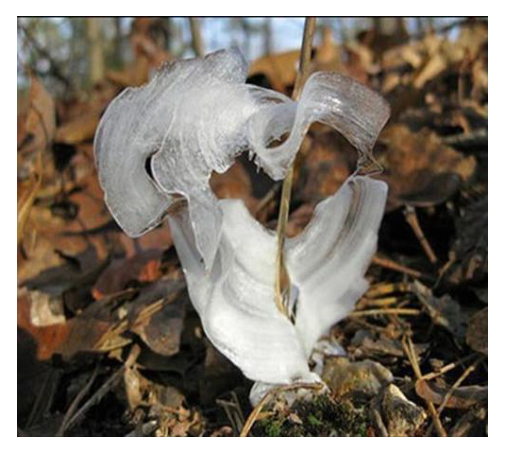 Plant growing in frozen environment
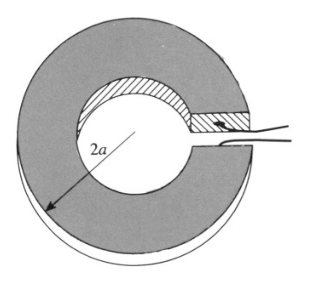 Washer shaped resistor with slit
Topic: Newtonian Mechanics, Geometric Optics, Circuits Metodi: Order-of-Magnitude Estimation, Physical Modeling, Dimensional Analysis Competenze: Estimation & Approximation, Physical Reasoning Objects: Container, String, Lens, Switch, Star Fonte: Testo (PDF) — p.4
Qu 1. Estimati e idee
Rispondete brevemente alle seguenti domande, ma includete le idee e le spiegazioni della fisica.
(a) Un contenitore d’acqua in cui un topo sta nuotando è in equilibrio su un equilibrio (come in una regola equilibrata su un pivot centrale). Una corda viene abbassata da una canna attaccata all’altro lato della bilancia in modo che tocchi solo l’acqua. Il topo inizia a salire la corda. Che succede all’equilibrio?
b) È possibile osservare nel cielo di giorno una stella brillante (non il Sole) utilizzando un normale telescopio. Spiegate perché l’ingrandimento dell’occhio è fondamentale per poter osservare una stella come questa, piuttosto che l’obiettivo o lo specchio del telescopio.
(c) L’occhio umano è utilizzato per osservare una fonte di luce a distanza. Se l’intensità della luce è nella pupilla dell’ occhio, per quale fattore l’intensità è aumentata sulla retina dell’ occhio?
d) Sono disponibili sei interruttori a pulsante. Quando nessuna di esse viene premuta, una lampadina rimane incinerata. Quando si premono contemporaneamente i pulsanti 1, 2 e 5, si accendono le lampadine. Nessuna altra combinazione di pulsanti può essere premuta per accendere la lampadina. Disegnare un diagramma del circuito elettrico più semplice che abbia questo comportamento.
e) L’immagine della pianta vivente nella figura 1 ha ali di ghiaccio. Suggerisci come si siano formate.
f) I neutroni passano facilmente attraverso un blocco di piombo, ma si fermano nella stessa distanza in paraffina, acqua o altro composto contenente atomi di idrogeno. Perché potrebbe essere così?
g) Una macchina ordinaria è guidata su una strada retta, ma è stata dotata di ruote quadrate invece che di ruote rotonde. Qual è la stima della potenza extra convertita dal motore per guidare l’auto a 30 miglia all’ora?
h) Una lavastoviglie, mostrata alla figura 2, è costituita da un materiale conduttore di resistività . Ha una sezione quadrata di larghezza e spessore , e il suo raggio esterno è . Nella lavatrice c’è una piccola fessura tagliata e i fili di resistenza trascurabile sono collegati alle facce esposte alla fessura. Qual è la resistenza della lavatrice misurata tra i due fili di connessione?
(i) Un bambino conserva i suoi matite in una bottiglia di acqua di plastica con un collo stretto. Quando agita la bottiglia per tirare fuori i matite, si inghiottono al collo. Tuttavia, quando alcuni dei matite sono usciti, il resto può essere scosso molto più facilmente. Commenta questo effetto dal punto di vista della fisica.
Piante che crescono in ambiente congelatto
Resistenza a forma di lavastore con fessura
Topic: Newtonian Mechanics, Geometric Optics, Circuits Metodi: Order-of-Magnitude Estimation, Physical Modeling, Dimensional Analysis Competenze: Estimation & Approximation, Physical Reasoning Objects: Container, String, Lens, Switch, Star Fonte: Testo (PDF) — p.4
Qu 2. Magnetoresistance
Magnetic properties of electrons are intrinsically related to their spin. In ferromagnetic materials, unpaired electron spins line up with each other within regions called domains. Within domains the magnetic field is therefore intense, though domains will generally be randomly orientated with respect to one another so that a bulk sample will usually be unmagnetised. However, an externally applied magnetic field can cause the magnetic domains to line up with each other; the material is said to be magnetised.
Electrons, although point particles, behave as if they were spinning and act like tiny magnets. Electrons in a ferromagnet whose spins are oriented in the direction of (parallel), or opposite to (antiparallel), the internal magnetisation carry independent currents, leading to the material behaving as if it has different resistivities and for each of the two current components.
Two ferromagnetic layers with identical dimensions (length , cross-sectional area ) but opposite magnetisation are placed next to each other in parallel with a cell of e.m.f. and internal resistance . The resistance of the rest of the external circuit is modelled by a resistance in series with the ferromagnetic layers.
(a) Draw a diagram of the circuit described above.
(b) Find the total resistance of the circuit.
(c) An external magnetic field is now applied to the ferromagnetic layers causing their magnetisation to line up. Draw a new circuit diagram and find the total resistance in this case.
(d) The current component parallel flows much more easily than that antiparallel, meaning that .
(i) Find an expression for the change in current between the two situations before and after the external field is applied.
(ii) For fixed resistances (and fixed resistivities ), under what conditions is the change in current maximised?
(e) The effect described above is known as magnetoresistance, and can be employed in the construction of hard disk read/write heads. Suggest how one of these might work and how the result of (d)(ii) is relevant. What other considerations are there?
Topic: Magnetism, Circuits, Electromagnetism Metodi: Equivalent Circuit Reduction, Kirchhoff’s Laws, Physical Modeling Competenze: Physical Reasoning, Mathematical Modeling Objects: Resistor, Battery Fonte: Testo (PDF) — p.5
Qu 2. Resistenza magnetica
Le proprietà magnetiche degli elettroni sono intrinsecamente correlate al loro spin. Nei materiali ferromagnetici, spin elettronici non accoppiati si allineano tra loro all’interno di regioni chiamate domini. All’interno dei domini il campo magnetico è quindi intenso, anche se i domini saranno generalmente orientati in modo casuale rispetto l’uno all’altro in modo che un campione di massa di solito non sarà magnetizzato. Tuttavia, un campo magnetico applicato esternamente può causare che i domini magnetici si allineino tra loro; si dice che il materiale sia magnetizzato.
Gli elettroni, sebbene siano particelle puntate, si comportano come se girassero e agiscono come piccoli magneti. Gli elettroni di un ferromagnete i cui giri sono orientati in direzione (parallel) o opposta (antiparallel), la magnetizzazione interna porta correnti indipendenti, che portano al materiale come se avesse resistenze diverse e per ciascuno dei due componenti correnti.
Due strati ferromagnetici di dimensioni identiche (lenghezza , area di sezione trasversale ) ma magnetizzazione opposta sono posizionati vicini a vicenda in parallelo con una cella di e.m.f. e resistenza interna . La resistenza del resto del circuito esterno è modellata da una resistenza in serie con gli strati ferromagnetici.
a) Disegnare un diagramma del circuito sopra descritto.
b) Trova la resistenza totale del circuito.
(c) Si applica ora un campo magnetico esterno ai strati ferromagnetici che li fa allineare. Disegnare un nuovo diagramma di circuito e trovare la resistenza totale in questo caso.
(d) Il componente parallelo corrente scorre molto più facilmente rispetto a quello antiparallelo, cioè .
-
Trovare un’espressione per il cambiamento di corrente tra le due situazioni prima e dopo l’applicazione del campo esterno.
-
Per le resistenze fisse (e le resistenze fisse ), in quali condizioni è massimizzata la variazione della corrente?
(e) L’effetto sopra descritto è noto come magnetoresistenza e può essere utilizzato nella costruzione di teste di lettura/scrittura del disco rigido. Suggerire come una di queste potrebbe funzionare e come il risultato di (d) (ii) sia rilevante. Quali altre considerazioni ci sono?
Topic: Magnetism, Circuits, Electromagnetism Metodi: Equivalent Circuit Reduction, Kirchhoff’s Laws, Physical Modeling Competenze: Physical Reasoning, Mathematical Modeling Objects: Resistor, Battery Fonte: Testo (PDF) — p.5
Qu 3. Radioactive Decay
An ionization chamber is designed to measure the ion current from a radioactive gas. Initially the gas in the chamber is nitrogen. A small amount of Gas A is introduced into the chamber. It contains radioactive atoms which emit alpha particles with energy 6.5 MeV. It takes 15.6 eV to ionize a molecule of nitrogen.
(a) How many alpha particles per second does a current of A correspond to?
(b) Make an estimate of the expected variation in this current due to random variations in radioactive decay. Why do the current readings not show these variations?
(c) For accurate half-life measurements, a balanced ionization chamber apparatus has been used. This is shown schematically in Figure 3. The liquid sample of radium, whose half life is known accurately, and an unknown sample B are inserted in adjacent chambers. The voltage across a resistor is measured when it is attached to each chamber to measure the difference in current between them. The measurements go to a recorder. What advantages could there be in this experimental method and setup?
(d) After evacuation of the original ionization chamber, Gas B is introduced and the current measured. Gas B contains two radioactive isotopes, both emitting radiation of the same energy as Gas A.
| Time /min | Current /nA |
|---|---|
| 0 | 17.000 |
| 1 | 14.930 |
| 2 | 13.261 |
| 3 | 11.912 |
| 4 | 10.820 |
| 5 | 9.934 |
| 6 | 9.212 |
| 7 | 8.622 |
| 8 | 8.137 |
| 9 | 7.737 |
| 10 | 7.404 |
| 11 | 7.126 |
| 12 | 6.892 |
| 13 | 6.692 |
| 14 | 6.521 |
| 15 | 6.372 |
| 16 | 6.242 |
| 17 | 6.126 |
| 18 | 6.022 |
| 19 | 5.927 |
| 20 | 5.841 |
| 21 | 5.760 |
| 22 | 5.685 |
Plot a graph of against time (where is current) and explain its shape in as much detail as you can.
(e) Use your graph to determine the half-life of the longer lived isotope.
(f) Now use the results of these calculations to find the half-life of the shorter lived isotope.
(g) Gas B is removed before Gas C is introduced and the current measured. Gas C is identical to Gas B except that the decay product of the shorter lived isotope is itself unstable, emitting alpha particles of identical energy to Gases A and B. If is the short-lived component of C, is the long-lived component and is the decay product of , sketch graphs of against time for the following cases. Indicate rough values on your graphs.
(i) The half-life of is less than the half-life of .
(ii) The half-life of is greater than the half-life of .
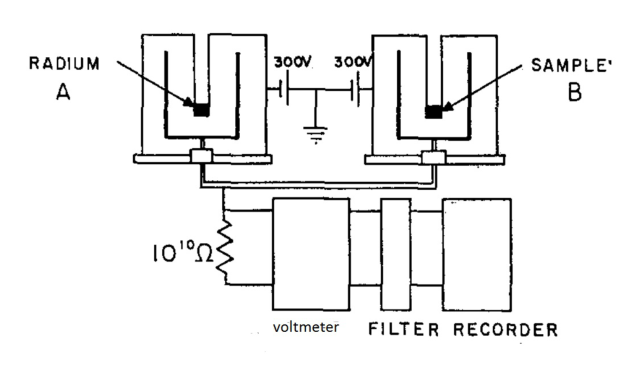 Balanced ionization chamber apparatus schematic
Topic: Nuclear & Particle Physics, Modern-Quantum Physics Metodi: Radioactive Decay Law, Experimental Data Analysis, Graph Linearization Competenze: Experimental Data Analysis, Graph Linearization Objects: Resistor, Nucleus Fonte: Testo (PDF) — p.6
Qu 3. Decadenza radioattiva
Una camera di ionizzazione è progettata per misurare la corrente ionica di un gas radioattivo. Inizialmente il gas nella camera è azoto. Una piccola quantità di gas A viene introdotta nella camera. Contiene atomi radioattivi che emettono particelle alfa con un’energia di 6,5 MeV. Ci vuole 15,6 eV per ionizzare una molecola di azoto.
a) A quante particelle alfa al secondo corrisponde una corrente di A?
b) Estimare la variazione attesa di questa corrente dovuta a variazioni casuali di decadimento radioattivo. Perché le letture attuali non mostrano queste variazioni?
c) Per le misure precise della durata dell’emivitazione è stato utilizzato un apparecchio di camera di ionizzazione equilibrata. Questo è illustrato schematicamente nella figura 3. Il campione liquido di radio, la cui mezza vita è conosciuta con precisione, e un campione sconosciuto B sono inseriti nelle camere adiacenti. La tensione di una resistenza viene misurata quando è collegata a ciascuna camera per misurare la differenza di corrente tra loro. Le misure vanno su un registratore. Quali vantaggi potrebbe avere questo metodo sperimentale?
d) Dopo l’evacuazione della camera di ionizzazione originale, viene introdotto il gas B e viene misurata la corrente. Il gas B contiene due isotopi radioattivi, entrambi emettendo radiazioni della stessa energia del gas A.
♬ Tempo / Minuto ♬ Attuale ♬ |-----------|-------------| | 0 | 17.000 | | 1 | 14.930 | | 2 | 13.261 | | 3 | 11.912 | | 4 | 10.820 | | 5 | 9.934 | | 6 | 9.212 | | 7 | 8.622 | | 8 | 8.137 | | 9 | 7.737 | | 10 | 7.404 | | 11 | 7.126 | | 12 | 6.892 | | 13 | 6.692 | | 14 | 6.521 | | 15 | 6.372 | | 16 | 6.242 | | 17 | 6.126 | | 18 | 6.022 | | 19 | 5.927 | | 20 | 5.841 | | 21 | 5.760 | | 22 | 5.685 |
Tracciare un grafico di contro il tempo (dove è corrente) e spiegare la sua forma nel più dettaglio possibile.
(e) Utilizzare il grafico per determinare la semivita dell’isotopo più lungo vissuto.
f) Ora utilizzare i risultati di questi calcoli per trovare la semivita dell’isotopo più breve vissuto.
g) Il gas B viene rimosso prima dell’introduzione del gas C e la corrente viene misurata. Il gas C è identico al gas B, tranne che il prodotto di decomposizione dell’isotopo più breve è lui stesso instabile, emettendo particelle alfa di energia identica ai gas A e B. Se è la componente di breve durata di C, è la componente di lunga durata e è il prodotto di decadimento di , grafici di bozza di contro il tempo per i seguenti casi. Indicare i valori approssimativi sui grafici.
(i) La durata dell’emivita di è inferiore alla durata dell’emivita di .
(ii) La durata di emivita di è superiore alla durata di emivita di .
Schema di apparecchiature di camera di ionizzazione equilibrata
Topic: Nuclear & Particle Physics, Modern-Quantum Physics Metodi: Radioactive Decay Law, Experimental Data Analysis, Graph Linearization Competenze: Experimental Data Analysis, Graph Linearization Objects: Resistor, Nucleus Fonte: Testo (PDF) — p.6
Qu 4. Elliptical Orbits
This question concerns elliptical orbits.
(a) The equation of an ellipse of eccentricity and centre in Cartesian co-ordinates is
where is the semi-major axis (i.e. along its longest diameter) and is the semi-minor axis (i.e. along its shortest diameter).
Show that the polar equation
describes an ellipse in the - plane with the following features:
Sketch the ellipse, noting the aforementioned features as well as the locations of the foci which are at a distance either side of the centre along the semi-major axis. What constraints are there on the eccentricity? You may find it useful to consider the relationship between Cartesian coordinates and polar coordinates: , , noting that .
(b) A Sun-planet system has total energy and angular momentum . is the mass of the Sun and the mass of the planet.
(i) Angular momentum is like a ‘moment’ of momentum. So, for an object undergoing rotational motion, its angular momentum at a distance from an axis of rotation with a linear speed (the component perpendicular to ) at that point, will have angular momentum equal to . Furthermore, Newton’s second law applies to angular momentum just as it does to momentum if you replace ‘resultant force’ with ‘resultant moment/torque’ and ‘momentum’ with ‘angular momentum’.
Why must be a constant? Show that the rate at which an imaginary line drawn between the orbital axis and the planet sweeps out area is given by
What relevance does this have for Kepler’s second law?
(ii) Show that
where and is a constant to be determined.
If time, , is re-parametrised in terms of angle , the solution to this differential equation is with and .
(iii) Find a formula for the time period of the planet in terms of the semi-major axis of its orbit. The total area of an ellipse is .
(c) A satellite in low earth orbit at an altitude of 320 km is to be transferred to a geosynchronous orbit using an elliptical orbit which is tangential to both the initial and final orbits at its periapsis and apoapsis (the smallest and largest distances from a focus) respectively. How elliptical is the transfer orbit, what is the total velocity change, , required to achieve the transfer and how long will it take? State any assumptions you make.
(d) A significant part of a manned mission to Mars involves transfer from a low earth orbit of altitude about 300 km to a low orbit around Mars of altitude about 250 km. What is the budget needed to make the trip using a similar transfer to that in (c), and what is the shortest length of time for a return trip using this method? What are your assumptions and how good are they in this context? To three significant figures, the eccentricities of Earth and Mars are 0.0167 and 0.0934 respectively, while Mars takes 1.88 Earth years to orbit the Sun.
Topic: Gravitation, Newtonian Mechanics, Special Relativity Metodi: Kepler’s Laws, Conservation of Energy, Conservation of Momentum Competenze: Mathematical Modeling, Physical Reasoning Objects: Satellite, Planet Fonte: Testo (PDF) — p.8
Qu 4. Orbitte ellittiche
Questa domanda riguarda le orbite ellitte.
(a) L’equazione di un’ellisse di eccentricità e centro nelle coordinate cartesiane è
in cui è l’asse semimejorante (cioè lungo il suo diametro più lungo) e è l’asse semimminore (cioè lungo il suo diametro più breve).
Mostrare che l’equazione polare
descrive un’ellisse nel piano - con le seguenti caratteristiche:
Segna l’ellisse, con l’indicazione delle caratteristiche di cui sopra e delle posizioni dei foci che si trovano a una distanza da entrambi i lati del centro lungo l’asse semimejor. Quali sono i vincoli che si pongono sull’escentricità? Potrebbe essere utile considerare la relazione tra le coordinate cartesiane e le coordinate polari: , , notando che .
b) Un sistema solare-planetario ha energia totale e impulso angolare . è la massa del Sole e la massa del pianeta.
(i) L’impulso angolare è come un “momento” di impulso. Quindi, per un oggetto in movimento rotazionale, il suo momento angolare a una distanza da un asse di rotazione con una velocità lineare (la componente perpendicolare a ) a quel punto, avrà un momento angolare uguale a . Inoltre, la seconda legge di Newton si applica al momento angolare proprio come si applica al momento se si sostituisce la “forza risultante” con il “momento/torque risultante” e il “momento” con il “momento angolare”.
Perché deve essere una costante? Mostra che la velocità con cui una linea immaginaria tra l’asse orbitale e il pianeta spazza fuori l’area è data da
Che rilevanza ha questo per la seconda legge di Kepler?
(ii) dimostrare che
dove e è una costante da determinare.
Se il tempo, , è rimetratto in termini di angolo , la soluzione di questa equazione differenziale è con e .
(iii) Trovare una formula per il periodo temporale del pianeta in termini di asse semimejor della sua orbita. L’area totale di un’ellisse è .
c) Un satellite in orbita terrestre bassa ad un’altitudine di 320 km deve essere trasferito in un’orbita geosincrona utilizzando un’orbita ellittica che sia tangenziale sia alle orbite iniziali che alle orbite finali al suo periapsis che all’apopsis (le più piccole e le più grandi distanze da un foco), rispettivamente. Quanto è ellittica l’orbita di trasferimento, qual è il cambiamento totale di velocità, , necessario per ottenere il trasferimento e quanto tempo ci vorrà? - Di’ le tue ipotesi.
d) Una parte significativa di una missione a Marte con equipaggio comporta il trasferimento da un’orbita terrestre bassa di circa 300 km di altitudine ad un’orbita bassa intorno a Marte di circa 250 km di altitudine. Qual è il budget necessario per effettuare il viaggio utilizzando un trasferimento simile a quello di cui alla lettera c), e quale è la durata più breve per un viaggio di ritorno utilizzando questo metodo? Quali sono le vostre ipotesi e quanto sono buone in questo contesto? Per tre numeri significativi, le eccentricità della Terra e di Marte sono rispettivamente di 0.0167 e 0.0934, mentre Marte richiede 1,88 anni terrestri per orbitare intorno al Sole.
Topic: Gravitation, Newtonian Mechanics, Special Relativity Metodi: Kepler’s Laws, Conservation of Energy, Conservation of Momentum Competenze: Mathematical Modeling, Physical Reasoning Objects: Satellite, Planet Fonte: Testo (PDF) — p.8
Qu 5. Thermal Properties of Ideal Gases
The first law of thermodynamics can be written as
where is the change in internal energy of a given system, is the heat supplied to the system and is the work done on the system.
(a) Show that for a monatomic ideal gas, the heat capacity at constant volume is given by , and also that the heat capacity at constant pressure is given by . is the number of moles of gas.
(b) When a monatomic ideal gas undergoes an adiabatic change, no heat is supplied to the gas leading to , where . Determine the corresponding relationships between and , and between and .
(c) Two thermally isolated (i.e. insulated) cylinders, L and R, of equal volume, both equipped with pistons, are connected by a valve. Initially L has its piston fully withdrawn and contains an ideal monatomic gas at temperature , while R has its piston fully inserted and the valve is closed as shown in the diagram below (Figure 4).
Calculate the final temperature of the gas in each cylinder after the following operations are performed, each with the same initial configuration as already described. Assume that the thermal capacity of the cylinders is negligible.
(i) The valve is fully opened and the gas is slowly drawn into R by pulling out piston R; piston L remains stationary.
(ii) Piston R is fully withdrawn and the valve opened slightly. The gas is then driven as far as it will go by pushing in piston L at such a rate that the pressure in L remains constant. The cylinders are in thermal contact.
(iii) Piston R is fully withdrawn and the valve opened slightly. The gas is then driven as far as it will go by pushing in piston L at such a rate that the pressure in L remains constant. The cylinders are thermally isolated from each other.
(iv) Piston R is fully withdrawn and the valve is then opened. The cylinders are in thermal contact.
(v) Piston R is fully withdrawn and the valve is then opened. The cylinders are thermally isolated from each other.
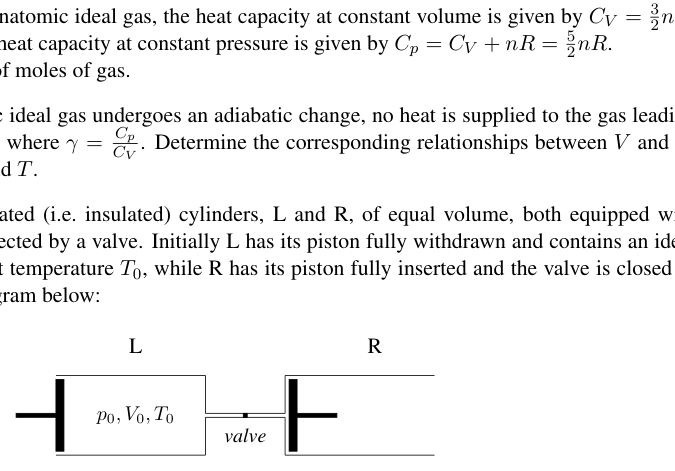 Thermally isolated cylinders L and R with valve
Topic: Thermodynamics, Kinetic Theory Metodi: First Law of Thermodynamics, Ideal Gas Law, Thermodynamic Cycle Analysis Competenze: Physical Reasoning, Mathematical Modeling Objects: Gas, Cylinder, Piston Fonte: Testo (PDF) — p.10
Qu 5. Proprietà termiche dei gas ideali
La prima legge della termodinamica può essere scritta come
se è il cambiamento di energia interna di un sistema dato, è il calore fornito al sistema e è il lavoro svolto sul sistema.
a) dimostrare che per un gas ideale monatomo la capacità termico a volume costante è data da e che la capacità termico a pressione costante è data da . è il numero di mole di gas.
b) Quando un gas ideale monatomo subisce un cambiamento adiabatico, non viene fornito calore al gas che conduce a , dove . Determinare le corrispondenti relazioni tra e e tra e .
c) Due isolati termicamente (cioè: I cilindri, L e R, di volume uguale, entrambi dotati di pistoni, sono collegati da una valvola. Inizialmente L ha il pistone completamente ritirato e contiene un gas monatomo ideale a temperatura , mentre R ha il pistone completamente inserito e la valvola è chiusa come mostrato nel diagramma di seguito (Figura 4).
Calcolare la temperatura finale del gas in ciascun cilindro dopo aver eseguito le seguenti operazioni, ciascuna con la stessa configurazione iniziale come già descritta. Supponiamo che la capacità termica dei cilindri sia trascurabile.
(i) La valvola è aperta completamente e il gas viene lentamente trascinato in R tirando fuori il pistone R; il pistone L rimane fermo.
(ii) Il pistone R è completamente ritirato e la valvola si apre leggermente. Il gas viene quindi spinto fino a dove può andare spingendo il pistone L a tale velocità che la pressione in L rimanga costante. I cilindri sono in contatto termico.
(iii) Il pistone R è completamente ritirato e la valvola si apre leggermente. Il gas viene quindi spinto fino a dove può andare spingendo il pistone L a tale velocità che la pressione in L rimanga costante. I cilindri sono isolati termicamente gli uni dagli altri.
(iv) Il pistone R viene completamente ritirato e la valvola viene quindi aperta. I cilindri sono in contatto termico.
(v) Il pistone R viene completamente ritirato e la valvola viene poi aperta. I cilindri sono isolati termicamente gli uni dagli altri.
Cilindri termicamente isolati L e R con valvola
Topic: Thermodynamics, Kinetic Theory Metodi: First Law of Thermodynamics, Ideal Gas Law, Thermodynamic Cycle Analysis Competenze: Physical Reasoning, Mathematical Modeling Objects: Gas, Cylinder, Piston Fonte: Testo (PDF) — p.10