Question 2
a) A 50 Hz alternating current of 10 A (rms) passes along a copper wire whose diameter is 1.0 mm. If copper contains free electrons per cm³, estimate
(i) the maximum speed of the electrons, and
(ii) the maximum displacement of the electrons associated with the current.
(6)
b) A wire of length and resistance is extended by an amount such that . If the volume of the wire and its resistivity remain unchanged,
(i) Give an expression for the fractional change in , i.e. .
(ii) Calculate the new resistance of the wire if and .
(6)
c) A non-linear electrical component is connected in a circuit in series with a supply of emf V and negligible internal resistance, and a resistor of 4.0 k. The relation between the current through the non-linear component, and the potential difference across it, , is given by where mA V, mA V.
(i) Obtain an algebraic expression for .
(ii) Determine the current through the non-linear component.
(6)
d) A metal hemisphere of radius 0.10 m is immersed near the centre of a large conducting tank containing a liquid of resistivity 60 m. The plane surface of the hemisphere is level with the surface of the liquid.
(i) Find an expression for the resistance between two hemispherical shells within the liquid, concentric with the centre of the metal hemisphere, having radii and respectively.
(ii) Calculate the resistance between the hemisphere and the tank.
(7)
[25 marks]
Topic: Circuits, Electrostatics, Newtonian Mechanics Metodi: Kirchhoff’s Laws, Dimensional Analysis, Physical Modeling Competenze: Mathematical Modeling, Physical Reasoning Objects: Wire, Electron, Resistor, Battery, Container Fonte: Testo (PDF) — p.3
La domanda 2
a) Una corrente alternata di 50 Hz di 10 A (rms) passa lungo un filo di rame del diametro di 1,0 mm. Se il rame contiene elettroni liberi per cm3, stima
-
la velocità massima degli elettroni;
-
il spostamento massimo degli elettroni associati alla corrente.
(6)
b) Un filo di lunghezza e resistenza è esteso di una quantità tale da . Se il volume del filo e la sua resistività restano invariati,
(i) Indicare l’espressione per la variazione frazionaria in , ovvero .
(ii) Calcolare la nuova resistenza del filo se e .
(6)
c) Un componente elettrico non lineare è collegato in circuito in serie con un’alimentazione di emf V e una resistenza interna trascurabile e una resistenza di 4,0 k . Il rapporto tra la corrente attraverso la componente non lineare e la differenza potenziale attraverso essa, , è dato da dove mA V, mA V.
(i) Ottenere un’espressione algebrica per .
(ii) Determina la corrente attraverso la componente non lineare.
(6)
d) Un emisfero metallico di raggio di 0,10 m è immerso vicino al centro di un grande serbatoio conduttore contenente un liquido di resistività 60 m. La superficie piana dell’emisfero è a livello della superficie del liquido.
(i) Trovare un’espressione della resistenza tra due conchiglie emisferiche all’interno del liquido, concentrici con il centro dell’emisfero metallico, con radii e rispettivamente.
- Calcolare la resistenza tra l’emisfero e il serbatoio.
(7)
[25 punti]
Topic: Circuits, Electrostatics, Newtonian Mechanics Metodi: Kirchhoff’s Laws, Dimensional Analysis, Physical Modeling Competenze: Mathematical Modeling, Physical Reasoning Objects: Wire, Electron, Resistor, Battery, Container Fonte: Testo (PDF) — p.3
Question 3
A tug boat winch is fitted with friction brakes that slip when the tension in the winch cable reaches 50 kN. The winch is mounted on a 450 tonne tug which is to tow a floating barge of mass 6300 tonne. The barge is initially at rest while the tug moves away from it. The speed of the tug at the moment that the cable becomes taut is 2.5 m s. At that moment the winch friction brakes start slipping in order to prevent the cable from breaking. The thrust exerted on the tug by its propeller is 35 kN. The winch and arrangement might look something like Figure 1a and Figure 1b:
a) Calculate
(i) The time during which the brakes are slipping,
(ii) The common velocity of the tug and the barge when the brakes stop slipping.
(iii) What length of cable runs out of the drum of the winch during the time the brakes are slipping?
(9)
b) In a different geometry the winch is used to haul sand up from the bottom of a dry dock using a crane constructed from a very light framework of girders. The crane is fixed to the horizontal dock side at points A and B. The dimensions of the sides CB, CD and BD are as shown (see Figure 2), the girder CB is vertical, and the winch is hauling a load of weight .
(i) Find the magnitude of the force exerted on D by the member BD,
(ii) The tension in the member CD.
(iii) If the force on the crane at A by the ground acts vertically downwards and has a magnitude , find the distance AB in terms of .
(8)
c) The bucket of mass is drawn up by the winch cable which exerts a steady force upwards (Figure 3). The bucket starts from rest and initially contains a mass of sand. The sand leaks out at a constant rate so that the bucket is empty after time , which occurs before it reaches the top of the dry dock wall.
In terms of , , , and (the gravitational field strength), what is the velocity of the bucket when it is just empty? The friction brakes do not slip.
You may use
(8)
[25 marks]
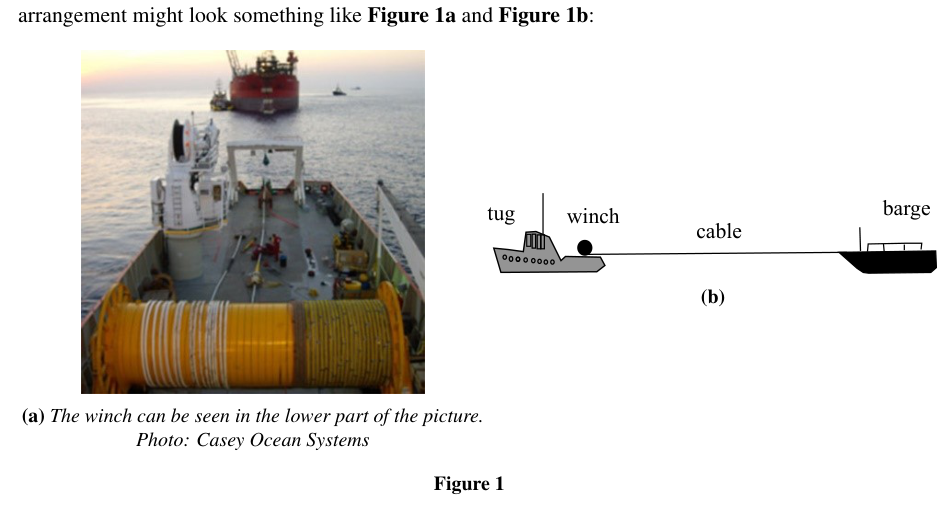 Figure 1: tug, barge, winch and cable
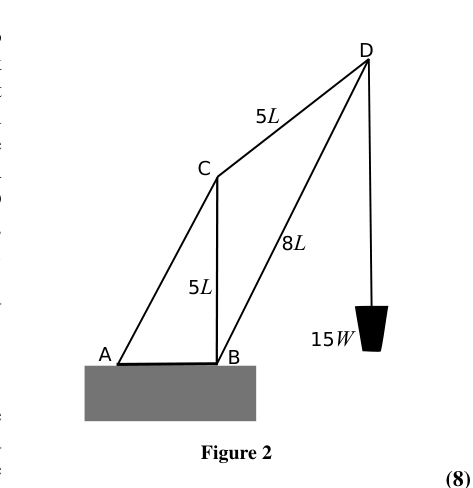 Figure 2: crane geometry with labels A,B,C,D
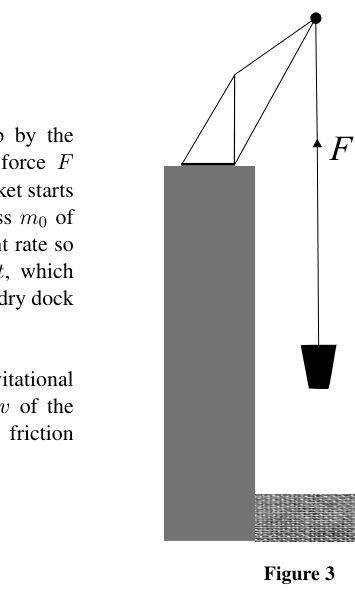 Figure 3: bucket with upward force F
Topic: Newtonian Mechanics, Rigid Body Statics, Conservation of Momentum Metodi: Impulse-Momentum Theorem, Free-Body Diagram, Torque & Angular Momentum Analysis Competenze: Mathematical Modeling, Physical Reasoning Objects: String Fonte: Testo (PDF) — p.4
La domanda 3
Un vincino di remuccia è dotato di freni di attrito che scivolavano quando la tensione del cavo di vincolo raggiunge 50 kN. Il vincino è montato su un rimorchio da 450 tonnellate che deve rimorchiare una barca galleggiante di 6300 tonnellate. La barca è inizialmente in riposo mentre il rimorchio si allontana da essa. La velocità del remorchio nel momento in cui il cavo si stringe è di 2,5 m s. In quel momento i freni di attrito del vincino iniziano a scivolare per evitare che il cavo si spezzi. La spinta esercitata sul reggiseno dalla sua elicotteria è di 35 kN. Il guinzaglio e l’impostazione potrebbero assomigliare a quanto riportato nella figura 1a e 1b:
a) Calcolare
(i) Il tempo in cui i freni scivolano,
(ii) La velocità comune del rimorchio e della barca quando i freni cessano di scivolare.
(iii) Quale lunghezza di cavo si esce dal tamburo del vincino durante il periodo di freno?
(9)
b) In una geometria diversa, il vincino è utilizzato per trascinare la sabbia dal fondo di un molo secco utilizzando una gru costruita da un telaio di cinghie molto leggero. La gru è fissata sul lato orizzontale del molo ai punti A e B. Le dimensioni dei lati CB, CD e BD sono come illustrato (vedi figura 2), la cintura CB è verticale e il guinzaglio porta un peso .
(i) Indicare la grandezza della forza esercitata su D dal membro BD,
- la tensione del CD membro.
(iii) Se la forza sulla gru a A vicino al suolo agisce verticalmente verso il basso e ha una magnitudine , trovare la distanza AB in termini di .
(8)
c) Il secchio di massa è tratto dal cavo di guinzaglio che esercita una forza costante verso l’alto (Figura 3). Il secchio parte dal riposo e contiene inizialmente una massa di sabbia. La sabbia scorre a velocità costante, in modo che il secchio sia vuoto dopo il tempo , che si verifica prima di raggiungere la parte superiore della parete del molo secco.
In termini di , , , e (forza del campo gravitazionale), qual è la velocità del secchio quando è semplicemente vuoto? I freni di attrito non scivolavano.
È possibile utilizzare
(8)
[25 punti]
Figura 1: trascinatore, barca, vinciolo e cavo
Figura 2: geometria della gru con le etichette A, B, C, D
Figura 3: secchio con forza ascendente F
Topic: Newtonian Mechanics, Rigid Body Statics, Conservation of Momentum Metodi: Impulse-Momentum Theorem, Free-Body Diagram, Torque & Angular Momentum Analysis Competenze: Mathematical Modeling, Physical Reasoning Objects: String Fonte: Testo (PDF) — p.4
Question 4
a) Calculate the smallest angle of incidence for light incident on the face of a 60° prism of refractive index 1.5, such that all of the light on the second face is totally reflected.
Draw a large diagram to show the path of the light and the angles.
(5)
b) Consider the step index optical fibre shown in Figure 4. The core, cladding and external medium have refractive indices , , and , respectively. The acceptance angle for light entering the core of the fibre will allow transmission without loss providing the angle between the incident ray and the axis is smaller than the maximum acceptance angle .
(i) Obtain an expression for in terms of , , and .
Hint:
(ii) Light enters the fibre optic at angles between and . Given a step index fibre with a core refractive index of 1.48585, and a cladding refractive index of 1.45641, determine the time broadening of the leading edge of a square pulse over a distance of 100 km.
(iii) If multiple, very brief, square pulses of light are sent down the cable at frequency , calculate the maximum possible pulse frequency over this 100 km distance, such that the pulses do not overlap.
(iv) Show that in general the time spread of a pulse , in a fibre of length , is given by with the difference in refractive indices between core and cladding, and the speed of light in the optical fibre.
(12)
c) A ray of light from a point source O on the principal axis of a thin converging lens, passing through the lens, is brought to a focus at the image point P also on the principal axis (Figure 5). One form of an equation for a thin lens, relating object and image distances, , to the focal length is By taking the limit , explain what the length represents for a lens.
(2)
d) Rays of light from a point source on the principal axis, passing through a converging lens by different paths and reaching a focus point on the principal axis, can be considered to do so by following paths which all have an equal time of travel.
A flat, thin, circular disc of transparent material is made so that its refractive index varies with the distance from the principal axis normal to the centre of the disc, according to the equation , where and are constant.
(i) By considering the times taken by light travelling by different paths (take a path not on the principal axis), show for rays travelling very close to the principal axis that the thin disc can behave as a lens, i.e. obtain an expression for , if the thickness of the disc is , with .
(ii) Derive an expression for its focal length in terms of , and .
(6)
[25 marks]
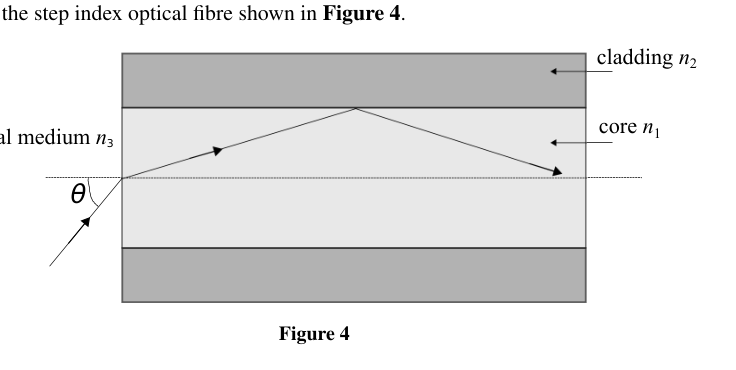 Figure 4: step-index optical fibre cross-section
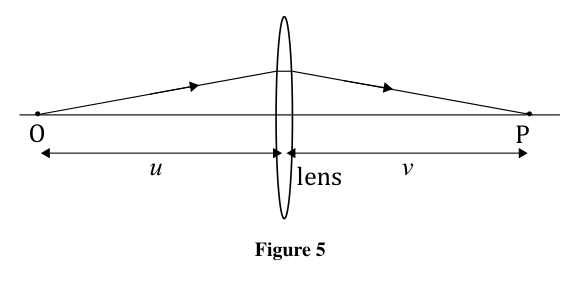 Figure 5: converging lens with object O and image P
Topic: Geometric Optics, Wave Optics, Oscillations & Waves Metodi: Snell’s Law, Ray Tracing, Thin Lens & Mirror Equation Competenze: Mathematical Modeling, Physical Reasoning Objects: Prism, Tube, Lens, Disk Fonte: Testo (PDF) — p.6
La domanda 4
a) Calcolare l’angolo di incidenza più piccolo per l’incidente della luce sulla faccia di un prisma 60° di indice di rifrazione 1.5, in modo che tutta la luce sulla seconda faccia sia totalmente riflessa.
Disegna un grande diagramma per mostrare il percorso della luce e gli angoli.
(5)
b) Considerare la fibra ottica a indice di passo mostrata nella figura 4. Il nucleo, il rivestimento e il supporto esterno hanno rispettivamente gli indici di rifrazione , e . L’angolo di accettazione per la luce che entra nel nucleo della fibra consentirà la trasmissione senza perdite, purché l’angolo tra il raggio incidente e l’asse sia inferiore all’angolo di accettazione massimo .
(i) Ottenere un’espressione per in termini di , e .
Indice:
(ii) La luce entra nella fibra ottica ad angoli tra e . Se si considera una fibra a indice di passo con un indice di rifrazione del nucleo di 1.48585 e un indice di rifrazione del rivestimento di 1.45641, si determina il tempo di allargamento del bordo anteriore di un impulso quadrato su una distanza di 100 km.
(iii) Se vengono trasmessi più, molto brevi, impulsi quadrati di luce lungo il cavo a frequenza , calcolare la frequenza massima possibile di impulsi su questa distanza di 100 km, in modo che gli impulsi non si sovrappongano.
(iv) Indicare che in generale la diffusione temporale di un impulso , in una fibra di lunghezza , è data da con la differenza di indici di rifrazione tra il nucleo e il rivestimento e la velocità della luce nella fibra ottica.
(12)
c) Un raggio di luce proveniente da una fonte di punto O sull’asse principale di una lente sottile convergente, che passa attraverso la lente, viene portato ad un focolamento al punto immagine P anche sull’asse principale (Figura 5). Una forma di equazione per una lente sottile, che relaziona le distanze di oggetto e immagine, , alla distanza focale è Prendendo il limite , spiegare quale sia la lunghezza per un obiettivo.
(2)
d) I raggi di luce provenienti da una fonte di punto sull’asse principale, che attraversano una lente convergente per percorsi diversi e raggiungono un punto di focolamento sull’asse principale, possono essere considerati come tali seguendo percorsi che hanno tutti un tempo di percorrenza uguale.
Si realizza un disco piatto, sottile e circolare di materiale trasparente in modo che il suo indice di rifrazione varia con la distanza dall’asse principale normale al centro del disco, secondo l’equazione , dove e sono costanti.
- Considerando i tempi impiegati dalla luce che viaggia per percorsi diversi (se si viaggia non sull’asse principale), dimostrare ai raggi che viaggiano molto vicino all’asse principale che il disco sottile può comportarsi come una lente, cioè ottenere un’espressione per , se lo spessore del disco è , con .
(ii) Derivare un’espressione per la sua distanza focale in termini di , e .
(6)
[25 punti]
Figura 4: sezione trasversale di fibra ottica a indice di passo
Figura 5: obiettivo di convergenza con oggetto O e immagine P
Topic: Geometric Optics, Wave Optics, Oscillations & Waves Metodi: Snell’s Law, Ray Tracing, Thin Lens & Mirror Equation Competenze: Mathematical Modeling, Physical Reasoning Objects: Prism, Tube, Lens, Disk Fonte: Testo (PDF) — p.6
Question 5
a) A simple pendulum of string length , with a bob of mass , containing charge , is in a horizontal electric field of magnitude .
(i) Determine the angle of the string with respect to the vertical when the bob is in equilibrium.
(ii) If the electric field now points vertically downwards and there is a small negative charge on the bob, , such that the string remains taut, what would be the period of oscillation of the bob once perturbed?
(iii) Give the condition relating , , and , such that oscillations will occur when the bob is perturbed.
(6)
b) Equal and opposite charges and are a distance of apart. Taking the midpoint between them as the origin O, find the electric potential and the magnitude of the field strength, at a point P which is distance from O, when
(i) P is on the line passing through the charges;
(ii) When P is on a perpendicular bisector of the line joining the charges.
(10)
c) Equal and opposite charges separated by a small distance constitute a dipole. A hydrogen chloride molecule may be treated as a dipole in which an electron is separated from a positive charge of equal magnitude by a distance of m. Calculate the work done needed to turn the molecule, which is lying parallel to a field of V m, through an angle of 180°.
(2)
d) In a simple model of a thundercloud, an upper cylindrical shaped region (axis vertical) contains a net positive charge and the lower cylindrical shaped region of the cloud a net negative charge (Figure 6). The upper region, from 9 km to 12 km height, with a radius of 5 km has a charge density of nC m, whilst the lower region from 2 km to 9 km high, also with a radius of 5 km, has a charge density of nC m.
(i) Calculate the magnitudes of the positive and negative charges in each region.
In order to determine the field strength at the ground due to these charges, we can approximate these two volumes of charge as two point charges at the centres of each of the two regions (at heights 10.5 km and 5.5 km respectively). The ground is a good conducting plane surface and so charges will be induced in the surface. The effect of this induced charge can be simulated by considering a charge of equal magnitude but opposite sign at the same distance below the surface as the real charge at height above the surface. The field at the surface is then calculated from the field of the real charge at the surface added to the field due to the image charge at the surface.
(ii) For the two charges calculated, with their two image charges of opposite signs, calculate the strength of the electric field at the surface of the Earth directly below the thundercloud.
(iii) If a two metre tall person stands with his feet on the ground in this region, what is the magnitude and polarity of the potential at his head? Take the potential of the ground to be 0 V.
(7)
[25 marks]
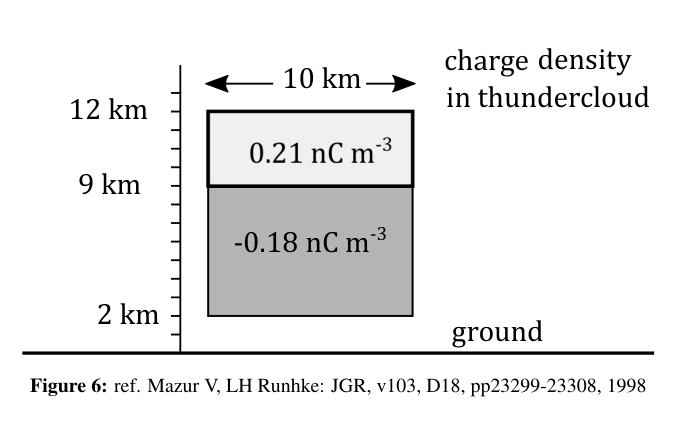 Figure 6: thundercloud charge model with ground
Topic: Electrostatics, Oscillations & Waves, Electromagnetism Metodi: Coulomb’s Law, Electric Potential Method, Simple Harmonic Motion Analysis Competenze: Mathematical Modeling, Physical Reasoning Objects: Pendulum, Point Charge Fonte: Testo (PDF) — p.8
La domanda 5
a) Un semplice pendolo di lunghezza di corda , con una bobina di massa , contenente carica , si trova in un campo elettrico orizzontale di magnitudo .
(i) Determinare l’angolo della corda rispetto alla verticale quando il bobino è in equilibrio.
(ii) Se il campo elettrico punta ora verticalmente verso il basso e c’è una piccola carica negativa sul bob, , in modo tale che la corda rimanga tensa, quale sarebbe il periodo di oscillazione del bob una volta perturbata?
(iii) Indicare la condizione relativa a , , e , in modo tale che si verifichino oscillazioni quando il bobino è disturbato.
(6)
b) Le cariche uguali e opposte e sono distanti di . Prendendo il punto medio tra loro come origine O, trovare il potenziale elettrico e la magnitudine della resistenza del campo, in un punto P che è la distanza da O, quando
- P è sulla linea che attraversa le cariche;
(ii) Quando P è su un bisettore perpendicolare della linea che unisce le cariche.
(10)
c) Le cariche uguali e opposte, separate da una piccola distanza, costituiscono un dipolo. Una molecola di cloruro di idrogeno può essere trattata come un dipolo in cui un elettrone è separato da una carica positiva di uguale magnitudine da una distanza di m. Calcolare il lavoro necessario per girare la molecola, che si trova parallela a un campo di V m, attraverso un angolo di 180°.
(2)
d) In un modello semplice di nuvole temporali, una regione a forma di cilindro superiore (assista verticale) contiene una carica positiva netta e la regione a forma di cilindro inferiore della nuvola una carica negativa netta (Figura 6). La regione superiore, dall’altezza da 9 km a 12 km, con un raggio di 5 km ha una densità di carica di nC m, mentre la regione inferiore, da 2 km a 9 km di altezza, anche con un raggio di 5 km, ha una densità di carica di nC m.
- Calcolare le magnitudini delle cariche positive e negative in ciascuna regione.
Per determinare la resistenza del campo a terra dovuta a queste cariche, possiamo approssimare questi due volumi di carica come cariche a due punti nei centri di ciascuna delle due regioni (ad altezza di 10,5 km e 5,5 km rispettivamente). Il terreno è una buona superficie di piano di conduttore e quindi le cariche saranno indotte nella superficie. L’effetto di questa carica indotta può essere simulato considerando una carica di uguale magnitudo ma segno opposto alla stessa distanza sotto la superficie come la carica reale ad altezza sopra la superficie. Il campo della superficie viene quindi calcolato a partire dal campo della carica reale della superficie aggiunta al campo a causa della carica dell’immagine sulla superficie.
ii) Per le due cariche calcolate, con le loro due cariche immagine di segni opposti, calcolare la forza del campo elettrico alla superficie della Terra direttamente sotto il nuvole di fulmine.
(iii) Se una persona alta due metri si trova a terra in questa regione, quale è l’entità e la polarità del potenziale che ha alla testa? Prendete il potenziale del terreno a 0 V.
(7)
[25 punti]
Figura 6: modello di carica di nuvole temporali con terra
Topic: Electrostatics, Oscillations & Waves, Electromagnetism Metodi: Coulomb’s Law, Electric Potential Method, Simple Harmonic Motion Analysis Competenze: Mathematical Modeling, Physical Reasoning Objects: Pendulum, Point Charge Fonte: Testo (PDF) — p.8
Question 6
a) Sea waves of frequency are moving North with velocity . A small boat moves South with a velocity , both velocities being measured with respect to the land. By counting the number of waves moving past the boat in a time or otherwise, show that the boat will be moving up and down with a frequency given by (4)
b) (i) A source of sound, emitting a single note of frequency is moving towards a stationary observer with speed . Show that if the air is stationary, the frequency detected by the observer is given by where is the speed of sound in air. You may wish to consider a time , and how many waves are emitted by the source, how far the waves and the source each move in this time, the wavelength the observer then detects, or any other approach.
(ii) What would be the value of if the source is moving away from the observer at a speed ?
(iii) If , show that .
(6)
c) The above formula can be applied to electromagnetic waves.
(i) Show that the observed frequency of an absorption line of emitted frequency in the spectrum of the Sun should vary between and where in which is the radius of the Sun, and the period of rotation.
(ii) Given that the density of the Sun is kg m, the mass is kg and the equatorial rotation period is 24.5 days, estimate the fractional frequency shift, , for the peak in the visible spectrum at 550 nm.
(5)
d) Two stars labelled A and B separated by a distance AU form a binary pair, gravitationally bound, orbiting a common centre of mass with a period y. Star A, with mass is at radius from the centre of mass, and star B, a very faint white dwarf, of mass orbits at radius . The stars have circular orbits with the plane of the orbit lying along the line of sight from the Earth. Only the brightest of the two stars can be observed through a telescope, and it is found that a spectral line of 656.3 nm in the lab varies by nm when observed in the bright star.
(i) Show that where is the total mass of the binary pair.
(ii) From the figures given, calculate a value for the total mass of the system.
(iii) Show that where is the orbital velocity of star A.
(iv) From the spectral line shift, calculate mass and hence the mass of star A, .
(v) Hence calculate the ratio of the orbital radii, .
m
(10)
[25 marks]
Topic: Oscillations & Waves, Astrophysics, Gravitation Metodi: Kepler’s Laws, Newton’s Law of Gravitation, Wave Equation Competenze: Mathematical Modeling, Physical Reasoning Objects: Star Fonte: Testo (PDF) — p.10
La domanda 6
a) Le onde marini di frequenza si muovono a nord con velocità . Una piccola barca si muove a sud con una velocità , entrambi i velocità sono misurate rispetto alla terra. Conteggiando il numero di onde che si muovono oltre la barca in un tempo o altrimenti, dimostra che la barca si muoverà su e giù con una frequenza data da (4)
b) (i) Una fonte sonora, che emette una singola nota di frequenza , si sta muovendo verso un osservatore stazionario con velocità . Indicare che, se l’aria è stazionaria, la frequenza rilevata dall’osservatore è data da dove è la velocità del suono nell’aria. Potresti voler considerare un tempo , e quante onde vengono emesse dalla fonte, quanto lontano le onde e la fonte si muovono in questo tempo, la lunghezza d’onda che l’osservatore rileva, o qualsiasi altro approccio.
(ii) Qual è il valore di se la fonte si allontana dall’osservatore a una velocità ?
(iii) Se , indicare che .
(6)
c) La formula di cui sopra può essere applicata alle onde elettromagnetiche.
(i) dimostrare che la frequenza osservata di una linea di assorbimento di frequenza emessa nello spettro solare dovrebbe variare tra e , quando in cui è il raggio del Sole e il periodo di rotazione.
(ii) Considerando che la densità del Sole è kg m, la massa è kg e il periodo di rotazione equatoriale è di 24,5 giorni, calcolare il cambiamento di frequenza frazionaria, , per il picco dello spettro visibile a 550 nm.
(5)
d) Due stelle con la marcatura A e B separate da una distanza AU formano una coppia binaria, gravitatoriamente legata, che orbita intorno a un centro di massa comune con un periodo y. La stella A, con massa , si trova al raggio dal centro di massa, e la stella B, una nana bianca molto debole, di massa , orbita al raggio . Le stelle hanno orbite circolari con il piano dell’orbita lungo la linea di visione dalla Terra. Solo la più brillante delle due stelle può essere osservata attraverso un telescopio, e si scopre che una linea spettrale di 656,3 nm in laboratorio varia di nm quando osservata nella stella brillante.
(i) Indicare che dove è la massa totale della coppia binaria.
- Calcolare, a partire dai dati forniti, un valore per la massa totale del sistema.
(iii) Indicare che dove è la velocità orbitale della stella A.
(iv) Dal spostamento della linea spettrale, calcolare la massa e quindi la massa della stella A, .
(v) Calcolare quindi il rapporto dei raggi orbitali, .
m
(10)
[25 punti]
Topic: Oscillations & Waves, Astrophysics, Gravitation Metodi: Kepler’s Laws, Newton’s Law of Gravitation, Wave Equation Competenze: Mathematical Modeling, Physical Reasoning Objects: Star Fonte: Testo (PDF) — p.10