A ball is attached to a cylinder by a string and is given an initial speed at time . The ball moves along a frictionless surface and the cylinder is fixed and cannot rotate. What is the speed of the ball at a later time ?
(A)
(B)
(C)
(D)
(E)
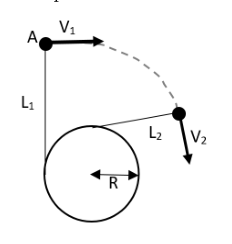 Ball on string winding around cylinder
Topic: Newtonian Mechanics, Rotational Dynamics Metodi: Conservation of Energy, Torque & Angular Momentum Analysis Competenze: Physical Reasoning, Mathematical Modeling Objects: Ball, String, Cylinder Fonte: Testo (PDF) — p.2
Una palla è attaccata a un cilindro con una corda e riceve una velocità iniziale al tempo . La palla si muove lungo una superficie senza attrito e il cilindro è fisso e non può ruotare. Qual è la velocità della palla in un momento successivo ?
(A)
(B)
(C)
(D)
(E)
Palla su una corda che si avvolge intorno al cilindro
Topic: Newtonian Mechanics, Rotational Dynamics Metodi: Conservation of Energy, Torque & Angular Momentum Analysis Competenze: Physical Reasoning, Mathematical Modeling Objects: Ball, String, Cylinder Fonte: Testo (PDF) — p.2
In the previous question, at , at what rate does the string wind around the cylinder (i.e. at what speed does get shorter)?
(A)
(B)
(C)
(D)
(E)
Topic: Newtonian Mechanics, Rotational Dynamics Metodi: Kinematic Equations, Torque & Angular Momentum Analysis Competenze: Physical Reasoning, Mathematical Modeling Objects: String, Cylinder Fonte: Testo (PDF) — p.2
Nella domanda precedente, a , a che velocità il filo si gira intorno al cilindro (cioè a che velocità si riduce)?
(A)
(B)
(C)
(D)
(E)
Topic: Newtonian Mechanics, Rotational Dynamics Metodi: Kinematic Equations, Torque & Angular Momentum Analysis Competenze: Physical Reasoning, Mathematical Modeling Objects: String, Cylinder Fonte: Testo (PDF) — p.2
Three planets, each with same mass, orbit in different orbits around the same star. Which statement is true about the total energy of the three orbits? Assume that .
(A)
(B)
(C)
(D)
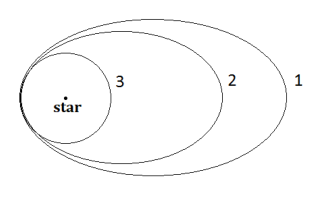 Three planetary orbits around star
Topic: Gravitation, Newtonian Mechanics Metodi: Conservation of Energy, Kepler’s Laws, Newton’s Law of Gravitation Competenze: Physical Reasoning, Mathematical Modeling Objects: Planet, Star Fonte: Testo (PDF) — p.2
Tre pianeti, ognuno della stessa massa, orbitano in orbite diverse attorno alla stessa stella. Quale affermazione è vera sull’energia totale delle tre orbite? Supponiamo che .
(A)
(B)
(C)
(D)
Tre orbite planetarie attorno alla stella
Topic: Gravitation, Newtonian Mechanics Metodi: Conservation of Energy, Kepler’s Laws, Newton’s Law of Gravitation Competenze: Physical Reasoning, Mathematical Modeling Objects: Planet, Star Fonte: Testo (PDF) — p.2
Charged particles with mass and charge are injected with speed into a region with a constant magnetic field. The particles are injected in a direction perpendicular to the magnetic field lines and are found to move in circular orbits with period . If the experiment is repeated for particles with mass , charge , while the magnetic field strength is tripled, what is the orbital period of the particles in the new experiment?
(A)
(B)
(C)
(D)
(E)
Topic: Magnetism, Electromagnetism Metodi: Lorentz Force Analysis, Kinematic Equations Competenze: Physical Reasoning, Mathematical Modeling Objects: Point Charge Fonte: Testo (PDF) — p.3
Le particelle cariche di massa e di carica vengono iniettate a velocità in una regione con un campo magnetico costante. Le particelle sono iniettate in una direzione perpendicolare alle linee del campo magnetico e si ritrovano a muoversi in orbite circolari con periodo . Se l’esperimento è ripetuto per le particelle con massa , carica , mentre la forza del campo magnetico è triplicata, qual è il periodo orbitale delle particelle nel nuovo esperimento?
(A)
(B)
(C)
(D)
(E)
Topic: Magnetism, Electromagnetism Metodi: Lorentz Force Analysis, Kinematic Equations Competenze: Physical Reasoning, Mathematical Modeling Objects: Point Charge Fonte: Testo (PDF) — p.3
In the cube shown below, each edge is a wire with resistance . What is the equivalent resistance between points and ?
(A)
(B)
(C)
(D)
(E)
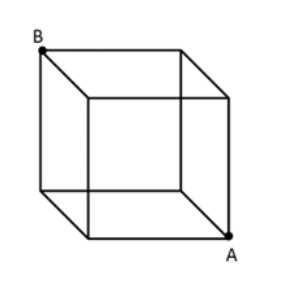 Cube with resistive edges, points A and B
Topic: Circuits Metodi: Equivalent Circuit Reduction, Kirchhoff’s Laws, Symmetry Argument Competenze: Physical Reasoning, Diagrammatic Reasoning Objects: Wire, Resistor Fonte: Testo (PDF) — p.3
Nel cubo mostrato di seguito, ogni bordo è un filo con resistenza . Qual è la resistenza equivalente tra i punti e ?
(A)
(B)
(C)
(D)
(E)
Cubino con bordi resistivi, punti A e B
Topic: Circuits Metodi: Equivalent Circuit Reduction, Kirchhoff’s Laws, Symmetry Argument Competenze: Physical Reasoning, Diagrammatic Reasoning Objects: Wire, Resistor Fonte: Testo (PDF) — p.3
Consider the arrangement of springs shown below. All springs shown have a spring constant . The first layer contains 1 spring, the next 2 springs, the next 4, and so on, with the th layer containing springs. What is the value of the spring constant of the entire assembly in the limit where the number of layers goes to infinity ()?
(A)
(B)
(C)
(D)
(E)
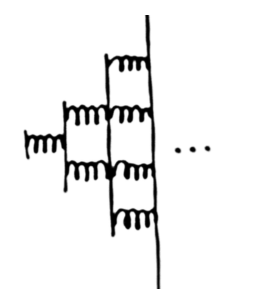 Infinite layered spring assembly
Topic: Oscillations & Waves, Newtonian Mechanics Metodi: Hooke’s Law, Approximation & Series Expansion Competenze: Mathematical Modeling, Physical Reasoning Objects: Spring Fonte: Testo (PDF) — p.3
Considerate l’organizzazione delle sorgenti mostrata qui sotto. Tutte le sorgenti mostrate hanno una costante sorgente . Il primo strato contiene 1 molla, le prossime 2 molle, le prossime 4 e così via, con il th strato contenente molle. Qual è il valore della costante di molla di tutto l’assemblaggio nel limite in cui il numero di strati va all’infinito ()?
(A)
(B)
(C)
(D)
(E)
Assemblazione di molla a strati infiniti
Topic: Oscillations & Waves, Newtonian Mechanics Metodi: Hooke’s Law, Approximation & Series Expansion Competenze: Mathematical Modeling, Physical Reasoning Objects: Spring Fonte: Testo (PDF) — p.3
Knowing that Toronto’s coordinates are , , what is the ratio of the solar power through a horizontal surface at noon on the shortest day of the year to the solar power through the same horizontal surface at noon on the longest day of the year? (The tilt of the Earth is about )
(A) 0.21
(B) 0.33
(C) 0.42
(D) 0.62
Topic: Astrophysics, Order-of-Magnitude Estimation Metodi: Approximation & Series Expansion, Dimensional Analysis Competenze: Estimation & Approximation, Mathematical Modeling Objects: Planet Fonte: Testo (PDF) — p.3
Sapendo che le coordinate di Toronto sono , , qual è il rapporto tra l’energia solare attraverso una superficie orizzontale al mezzogiorno nel giorno più breve dell’anno e l’energia solare attraverso la stessa superficie orizzontale al mezzogiorno nel giorno più lungo dell’anno? (L’inclinazione della Terra è di circa )
(A) 0.21
(B) 0.33
(C) 0.42
(D) 0.62
Topic: Astrophysics, Order-of-Magnitude Estimation Metodi: Approximation & Series Expansion, Dimensional Analysis Competenze: Estimation & Approximation, Mathematical Modeling Objects: Planet Fonte: Testo (PDF) — p.3
Two rods of the length and are held between two rigid walls apart. Let and be the thermal coefficient of expansion, Young modulus, and the area of each rod respectively. Which of the following conditions guarantees that the joint between the rods will move left if the temperature of the system is increased? (Assume that both rods preserve their cylindrical shapes)
(A)
(B)
(C)
(D)
(E)
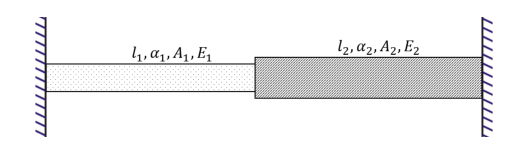 Two rods between rigid walls
Topic: Elasticity & Materials, Thermodynamics Metodi: Stress-Strain Analysis, Free-Body Diagram Competenze: Physical Reasoning, Mathematical Modeling Objects: Rod Fonte: Testo (PDF) — p.3
Due bastone di lunghezza e sono tenute tra due pareti rigide separate. Let and be the thermal coefficient of expansion, Young modulus, and the area of each rod respectively. Quale delle seguenti condizioni garantisce che l’articolazione tra le barre si muova a sinistra se la temperatura del sistema è aumentata? (Supponiamo che entrambe le barre conservino le loro forme cilindriche)
(A)
(B)
(C)
(D)
(E)
Due barre tra pareti rigide
Topic: Elasticity & Materials, Thermodynamics Metodi: Stress-Strain Analysis, Free-Body Diagram Competenze: Physical Reasoning, Mathematical Modeling Objects: Rod Fonte: Testo (PDF) — p.3
A positive charge is placed in front of two semi-infinite conducting walls as shown below. The walls are grounded. Which arrow best represents the direction of the force on the charge , if ?
(A)
(B)
(C)
(D)
(E)
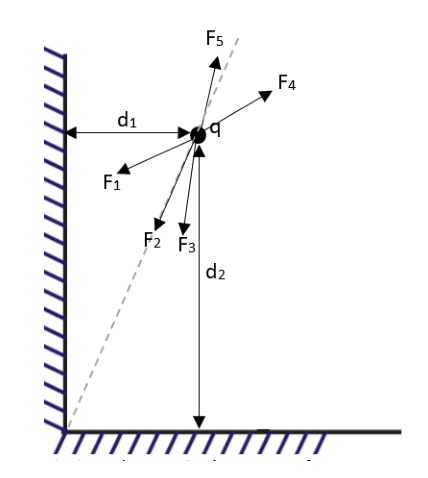 Charge q near two grounded conducting walls
Topic: Electrostatics Metodi: Coulomb’s Law, Symmetry Argument Competenze: Physical Reasoning, Diagrammatic Reasoning Objects: Point Charge Fonte: Testo (PDF) — p.3
Una carica positiva viene posta davanti a due muri di conduttore semipermanenti come mostrato di seguito. Le pareti sono a terra. Quale freccia rappresenta meglio la direzione della forza sulla carica , se ?
(A)
(B)
(C)
(D)
(E)
Carica q vicino a due muri di conduttori a terra
Topic: Electrostatics Metodi: Coulomb’s Law, Symmetry Argument Competenze: Physical Reasoning, Diagrammatic Reasoning Objects: Point Charge Fonte: Testo (PDF) — p.3
A person is knitting a sweater using a spherical ball of yarn with an initial radius of 15 cm (at ). The radius of the ball of yarn is 10 cm after 5 hours () of knitting. What is the radius of the ball of yarn at time , assuming that the person is knitting at a constant rate?
(A) 8 cm
(B) 7.07 cm
(C) 6.16 cm
(D) 3.68 cm
(E) 0 cm (the yarn would run out)
Topic: Newtonian Mechanics, Order-of-Magnitude Estimation Metodi: Kinematic Equations, Dimensional Analysis Competenze: Mathematical Modeling, Estimation & Approximation Objects: Sphere Fonte: Testo (PDF) — p.4
Una persona sta tricotando un maglione con una sfera di fila con un raggio iniziale di 15 cm (a ). Il raggio della sfera di fila è di 10 cm dopo 5 ore () di magliatura. Qual è il raggio della sfera di filato a tempo , se si suppone che la persona stia intrecciando a velocità costante?
(A) 8 cm
(B) 7.07 cm
(C) 6.16 cm
(D) 3.68 cm
(E) 0 cm (il filato si esaurirebbe)
Topic: Newtonian Mechanics, Order-of-Magnitude Estimation Metodi: Kinematic Equations, Dimensional Analysis Competenze: Mathematical Modeling, Estimation & Approximation Objects: Sphere Fonte: Testo (PDF) — p.4
The pump shown below is used to inflate a ball and is made of two compartments with volumes and and two one-way valves shown as and . A one-way valve is a valve with two modes of operation:
Mode 1: the valve is open and there is a flow in the direction shown in the figure. For this mode: .
Mode 2: the valve is closed and flow is stopped since .
Note: the one-way valve assures that .
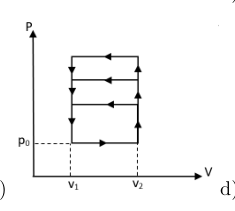
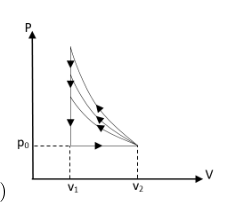
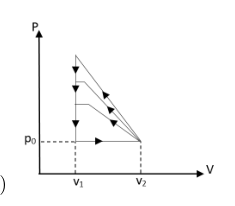
Which of the figures below best represents the – diagram of the air in the pump as the ball is inflated?
(A) (B) (C) (D)
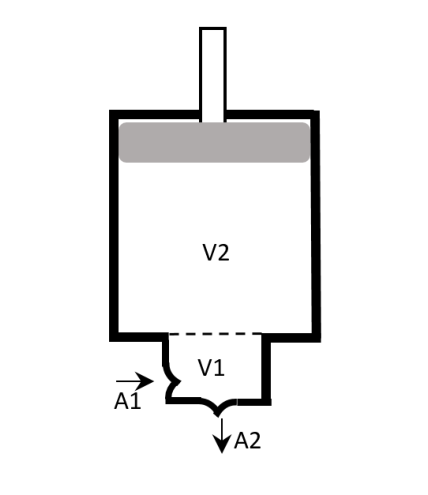 Pump with two compartments and one-way valves
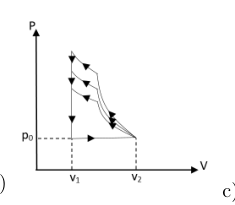 P-V diagram option (A)
 P-V diagram option (B)
 P-V diagram option (C)
 P-V diagram option (D)
Topic: Thermodynamics, Fluid Mechanics Metodi: Thermodynamic Cycle Analysis, First Law of Thermodynamics Competenze: Physical Reasoning, Diagrammatic Reasoning Objects: Piston, Gas, Ball Fonte: Testo (PDF) — p.4
La pompa mostrata di seguito è utilizzata per gonfiare una palla ed è costituita da due comparti con volumi e e due valvole unidirezionali mostrate come e . Valvola a senso unico è una valvola con due modalità di funzionamento:
**Modo 1: ** la valvola è aperta e vi è un flusso nella direzione indicata nella figura. Per questa modalità: .
**Modo 2: ** la valvola è chiusa e il flusso è fermo da .
Nota: la valvola a senso unico garantisce che .
Qual è la figura seguente che rappresenta meglio il diagramma P$$V dell’aria nella pompa mentre la palla viene gonfiata?
(A) (B) (C) (D)
Pompina con due comparti e valvole a senso unico
*opzione di diagramma P-V (A) *
*opzione di diagramma P-V (B) *
*opzione di diagramma P-V (C) *
*opzione di diagramma P-V (D) *
Topic: Thermodynamics, Fluid Mechanics Metodi: Thermodynamic Cycle Analysis, First Law of Thermodynamics Competenze: Physical Reasoning, Diagrammatic Reasoning Objects: Piston, Gas, Ball Fonte: Testo (PDF) — p.4
As shown in the figure below, two balls of radii and , and with masses fall from a height . Ignoring friction, assuming that all impacts are perfectly elastic and that the initial distance between the balls is small, which of the choices below is closest to the maximum height of ball 2 after one bounce?
(A) 1 m
(B) 2 m
(C) 3 m
(D) 4 m
(E) 9 m
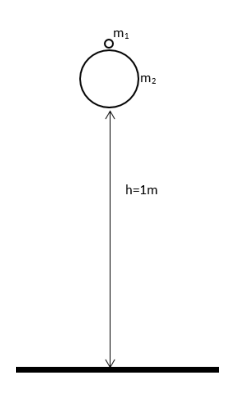 Small ball on top of large ball, falling
Topic: Newtonian Mechanics, Conservation of Momentum Metodi: Conservation of Momentum, Conservation of Energy Competenze: Physical Reasoning, Mathematical Modeling Objects: Ball Fonte: Testo (PDF) — p.4
Come mostrato nella figura seguente, due sfere di radii e , e con masse cadono da un’altezza . Ignorando l’attrito, supponendo che tutti gli impatti siano perfettamente elastici e che la distanza iniziale tra le palle sia piccola, quale delle scelte di seguito è più vicino all’altezza massima della palla 2 dopo un salto?
(A) 1 m
(B) 2 m
(C) 3 m
(D) 4 m
(E) 9 m
*Piccola palla sopra palla grande, cadente *
Topic: Newtonian Mechanics, Conservation of Momentum Metodi: Conservation of Momentum, Conservation of Energy Competenze: Physical Reasoning, Mathematical Modeling Objects: Ball Fonte: Testo (PDF) — p.4
A ball is dropped from the top of a building with no initial speed. After 1 s, a second ball is thrown downward with an initial vertical speed of 26 m/s. What is the minimum height of the building if the second ball hits the ground earlier than the first ball?
(A) 0.45 m
(B) 4.91 m
(C) 6.93 m
(D) 8.33 m
(E) 12.65 m
Topic: Newtonian Mechanics Metodi: Kinematic Equations, Free-Body Diagram Competenze: Mathematical Modeling, Physical Reasoning Objects: Ball Fonte: Testo (PDF) — p.5
Una palla viene lanciata dalla cima di un edificio senza velocità iniziale. Dopo 1 s, una seconda palla viene lanciata verso il basso con una velocità verticale iniziale di 26 m/s. Qual è l’altezza minima dell’edificio se la seconda palla colpisce il terreno prima della prima?
(A) 0.45 m
(B) 4.91 m
(C) 6.93 m
(D) 8.33 m
(E) 12.65 m
Topic: Newtonian Mechanics Metodi: Kinematic Equations, Free-Body Diagram Competenze: Mathematical Modeling, Physical Reasoning Objects: Ball Fonte: Testo (PDF) — p.5
A current of 12 mA passes through a red LED diode with a forward voltage of 3 V. Which of the following is a good estimate for the number of photons per second this LED produces?
(A)
(B)
(C)
(D)
(E)
Topic: Modern-Quantum Physics, Electromagnetism Metodi: Photon Energy Relation, Order-of-Magnitude Estimation Competenze: Estimation & Approximation, Physical Reasoning Objects: Photon Fonte: Testo (PDF) — p.5
Una corrente di 12 mA passa attraverso un diodo LED rosso con una tensione anteriore di 3 V. Quale delle seguenti è una buona stima del numero di fotoni al secondo che questo LED produce?
(A)
(B)
(C)
(D)
(E)
Topic: Modern-Quantum Physics, Electromagnetism Metodi: Photon Energy Relation, Order-of-Magnitude Estimation Competenze: Estimation & Approximation, Physical Reasoning Objects: Photon Fonte: Testo (PDF) — p.5
A ball is thrown upwards. Which of the following free body diagrams best describes the forces acting on the ball when it is in the air moving upwards. Assume that air drag (friction) is proportional to speed.
(A) (B) (C) (D)
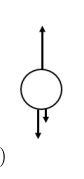 FBD option (A): forces on ball moving up
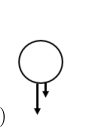 FBD option (B): forces on ball moving up
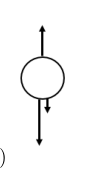 FBD option (C): forces on ball moving up
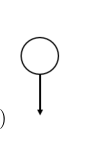 FBD option (D): forces on ball moving up
Topic: Newtonian Mechanics Metodi: Free-Body Diagram, Kinematic Equations Competenze: Diagrammatic Reasoning, Physical Reasoning Objects: Ball Fonte: Testo (PDF) — p.5
Una palla viene lanciata verso l’alto. Quale dei seguenti diagrammi del corpo libero descrive meglio le forze che agiscono sulla palla quando è in aria in movimento verso l’alto. Supponiamo che la resistenza all’aria (friczione) sia proporzionale alla velocità.
(A) (B) (C) (D)
Opzione FBD (A): forze sulla palla che si muove in su
FBD opzione (B): forze sulla palla che si muove in su
Opzione FBD (C): forze sulla palla che si muove in su
Opzione FBD (D): forze sulla palla che si muove in su
Topic: Newtonian Mechanics Metodi: Free-Body Diagram, Kinematic Equations Competenze: Diagrammatic Reasoning, Physical Reasoning Objects: Ball Fonte: Testo (PDF) — p.5
While the ball in the previous question is still going upwards, the magnitude of the net force acting on the ball in the previous problem is:
(A) Increasing
(B) Decreasing
(C) Remains constant with the height of the ball
Topic: Newtonian Mechanics Metodi: Free-Body Diagram, Kinematic Equations Competenze: Physical Reasoning, Mathematical Modeling Objects: Ball Fonte: Testo (PDF) — p.5
Mentre la palla nella domanda precedente va ancora verso l’alto, la grandezza della forza netta che agisce sulla palla nel problema precedente è:
A) Aumento
B) Diminuzione
(C) Rimane costante con l’altezza della palla
Topic: Newtonian Mechanics Metodi: Free-Body Diagram, Kinematic Equations Competenze: Physical Reasoning, Mathematical Modeling Objects: Ball Fonte: Testo (PDF) — p.5
Relative to an inertial frame at the centre of the Earth, approximately how fast is a person in Vancouver (latitude ) moving due to the Earth’s rotation around its axis?
(A) 700 m/s
(B) 300 m/s
(C) 450 m/s
(D) 400 m/s
Topic: Newtonian Mechanics, Order-of-Magnitude Estimation Metodi: Kinematic Equations, Order-of-Magnitude Estimation Competenze: Estimation & Approximation, Mathematical Modeling Objects: Planet Fonte: Testo (PDF) — p.5
Relativamente a un quadro inerziale al centro della Terra, quanto veloce si muove una persona a Vancouver (latitudine ) a causa della rotazione della Terra intorno al suo asse?
(A) 700 m/s
(B) 300 m/s
(C) 450 m/s
(D) 400 m/s
Topic: Newtonian Mechanics, Order-of-Magnitude Estimation Metodi: Kinematic Equations, Order-of-Magnitude Estimation Competenze: Estimation & Approximation, Mathematical Modeling Objects: Planet Fonte: Testo (PDF) — p.5
Which is more likely: that a single throw of a die will result in ‘1’, or that three throws of a die will each result in an odd number?
(A) Single die throw resulting in ‘1’ is more likely
(B) Three throws each resulting in an odd number is more likely
(C) These two events have the same probability
Topic: Order-of-Magnitude Estimation Metodi: Statistical Averaging, Order-of-Magnitude Estimation Competenze: Mathematical Modeling, Physical Reasoning Objects: — Fonte: Testo (PDF) — p.5
Che cosa è più probabile: che un solo lancio di un dado comporterà un ‘1’, o che tre lanci di un dado comporteranno ciascuno un numero impar?
(A) È più probabile che un lancio di un solo dado con il risultato di “1”
(B) Tre lanci che producono un numero imparato sono più probabili
(C) Questi due eventi hanno la stessa probabilità
Topic: Order-of-Magnitude Estimation Metodi: Statistical Averaging, Order-of-Magnitude Estimation Competenze: Mathematical Modeling, Physical Reasoning Objects: — Fonte: Testo (PDF) — p.5
Collision of cosmic-rays entering the upper atmosphere of the Earth produce large numbers of particles called muons. These muons move vertically through the atmosphere at very high speed (comparable to the speed of light, ), forming a beam of flux . Because muons decay into other particles, the flux changes with time according to the exponential decay law , where is the average lifetime in the rest frame of the muon, is the muon flux at time , and is measured in the rest frame of the muon. If we place a detector at a height of 10 km above the ground, we detect a muon flux of . If we place the same detector on the ground, we detect a muon flux of . Assuming that the muons in the beam are all moving at the same relativistic speed, what is that speed?
(A)
(B)
(C)
(D)
(E)
Topic: Special Relativity, Modern-Quantum Physics Metodi: Lorentz Transformation, Radioactive Decay Law, Relativistic Energy-Momentum Competenze: Mathematical Modeling, Physical Reasoning Objects: Particle Beam Fonte: Testo (PDF) — p.5
La collisione dei raggi cosmici che entrano nell’atmosfera superiore della Terra produce un gran numero di particelle chiamate muoni. Questi muoni si muovono verticalmente attraverso l’atmosfera a velocità molto elevata (comparabile alla velocità della luce, ), formando un fascio di flusso . Poiché i muoni si decompongono in altre particelle, il flusso cambia con il tempo secondo la legge di decomposizione esponenziale , dove è la durata media del muone nel frame di riposo, è il flusso di muone nel tempo , e è misurato nel frame di riposo del muone. Se posizioniamo un rilevatore ad un’altezza di 10 km sopra il suolo, rilevamo un flusso di muoni di . Se posizioniamo lo stesso rilevatore a terra, rilevamo un flusso di muoni di . Supponendo che i muoni del raggio si muovano tutti alla stessa velocità relativistica, qual è quella velocità?
(A)
(B)
(C)
(D)
(E)
Topic: Special Relativity, Modern-Quantum Physics Metodi: Lorentz Transformation, Radioactive Decay Law, Relativistic Energy-Momentum Competenze: Mathematical Modeling, Physical Reasoning Objects: Particle Beam Fonte: Testo (PDF) — p.5
You want to launch a projectile from a cannon into deep space from the Moon, and are able to launch at different angles with respect to the ground. At what angle would you need the lowest velocity to make the projectile escape Moon’s gravity? (Neglect the rotational speed of the moon.)
(A)
(B)
(C)
(D)
(E) Minimum velocity does not depend on
Topic: Gravitation, Newtonian Mechanics Metodi: Conservation of Energy, Newton’s Law of Gravitation Competenze: Physical Reasoning, Mathematical Modeling Objects: Projectile, Planet Fonte: Testo (PDF) — p.6
Vuoi lanciare un proiettile da un cannone nello spazio profondo dalla Luna, e sei in grado di lanciare da angoli diversi rispetto al suolo. A quale angolo avresti bisogno della velocità più bassa per far scappare il proiettile dalla gravità della Luna? (Non si deve considerare la velocità di rotazione della luna.)
(A)
(B)
(C)
(D)
(E) La velocità minima non dipende da
Topic: Gravitation, Newtonian Mechanics Metodi: Conservation of Energy, Newton’s Law of Gravitation Competenze: Physical Reasoning, Mathematical Modeling Objects: Projectile, Planet Fonte: Testo (PDF) — p.6
Given the circuit below, which light bulb do you have to unplug so that (i.e. )? The four light bulbs are identical.
(A) Light bulb 1
(B) Light bulb 2
(C) Light bulb 3
(D) Light bulb 4
(E) None of the above
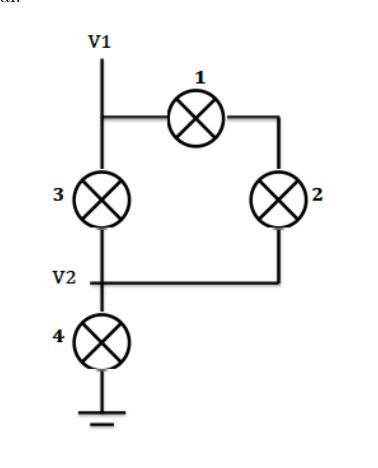 Circuit with four identical light bulbs
Topic: Circuits Metodi: Kirchhoff’s Laws, Equivalent Circuit Reduction Competenze: Physical Reasoning, Diagrammatic Reasoning Objects: Resistor, Battery Fonte: Testo (PDF) — p.6
Dato il circuito di seguito, quale lampadina deve essere distaccata in modo che (cioè )? Le quattro lampadine sono identiche.
(A) lampadina 1
(B) lampadina 2
(C) lampadina 3
D) lampadina 4
(E) Nessuna delle seguenti
Circuito con quattro lampadine identiche
Topic: Circuits Metodi: Kirchhoff’s Laws, Equivalent Circuit Reduction Competenze: Physical Reasoning, Diagrammatic Reasoning Objects: Resistor, Battery Fonte: Testo (PDF) — p.6
A pulsar is a highly magnetized, rotating neutron star (or white dwarf), with high density and short, regular rotating period. You have just discovered a new pulsar that spins around its axis 20 times per second. Assuming that the object is spherical, what is its minimum density?
(A)
(B)
(C)
(D)
(E)
Topic: Astrophysics, Rotational Dynamics Metodi: Newton’s Law of Gravitation, Torque & Angular Momentum Analysis Competenze: Mathematical Modeling, Physical Reasoning Objects: Star Fonte: Testo (PDF) — p.6
Un pulsare è una stella di neutroni altamente magnetizzata e rotante (o nana bianca), con alta densità e breve periodo di rotazione regolare. Avete appena scoperto un nuovo pulsar che ruota attorno al suo asse 20 volte al secondo. Supponendo che l’oggetto sia sferico, qual è la sua densità minima?
(A)
(B)
(C)
(D)
(E)
Topic: Astrophysics, Rotational Dynamics Metodi: Newton’s Law of Gravitation, Torque & Angular Momentum Analysis Competenze: Mathematical Modeling, Physical Reasoning Objects: Star Fonte: Testo (PDF) — p.6
A radioactive substance decays, and an emitted particle passes through a uniform magnetic field pointing into the page, as shown. Which labeling is correct?
(A) 1=alpha; 2=beta; 3=gamma
(B) 1=alpha; 3=beta; 2=gamma
(C) 2=alpha; 1=beta; 3=gamma
(D) 2=alpha; 3=beta; 1=gamma
(E) 3=alpha; 1=beta; 2=gamma
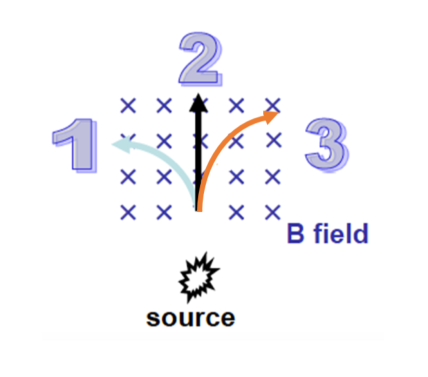 Three decay particle tracks in magnetic field
Topic: Nuclear & Particle Physics, Magnetism Metodi: Lorentz Force Analysis, Radioactive Decay Law Competenze: Physical Reasoning, Diagrammatic Reasoning Objects: Nucleus Fonte: Testo (PDF) — p.6
Una sostanza radioattiva si decompone e una particella emessa passa attraverso un campo magnetico uniforme che punta nella pagina, come mostrato. Quale etichettatura è corretta?
(A) 1 = alfa; 2 = beta; 3 = gamma
(B) 1 = alfa; 3 = beta; 2 = gamma
(C) 2 = alfa; 1 = beta; 3 = gamma
(D) 2 = alfa; 3 = beta; 1 = gamma
(E) 3 = alfa; 1 = beta; 2 = gamma
Tre tracce di particelle di decomposizione nel campo magnetico
Topic: Nuclear & Particle Physics, Magnetism Metodi: Lorentz Force Analysis, Radioactive Decay Law Competenze: Physical Reasoning, Diagrammatic Reasoning Objects: Nucleus Fonte: Testo (PDF) — p.6
If you push with force on either the heavy box () or the light box (), in which of these two cases is the contact force between the two boxes smaller? Ignore friction.
(A) case A
(B) case B
(C) same in both cases
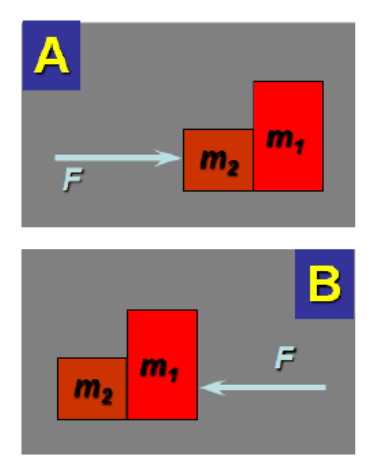 Force F on two-box system, two cases
Topic: Newtonian Mechanics Metodi: Free-Body Diagram, Kinematic Equations Competenze: Physical Reasoning, Diagrammatic Reasoning Objects: Block Fonte: Testo (PDF) — p.6
Se si spinge con forza sulla scatola pesante () o sulla scatola leggera (), in quale di questi due casi la forza di contatto tra le due scatole è più piccola? Ignora gli attriti.
A) caso A
B) caso B
C) lo stesso in entrambi i casi
Forza F su sistema a due scatole, due casse
Topic: Newtonian Mechanics Metodi: Free-Body Diagram, Kinematic Equations Competenze: Physical Reasoning, Diagrammatic Reasoning Objects: Block Fonte: Testo (PDF) — p.6
Consider an infinite wave moving to the right on a non-stretchy string, as shown below. What is the direction of the velocity of a particle at the point labeled ?
(A) (B) (C) (D) (E) velocity is zero
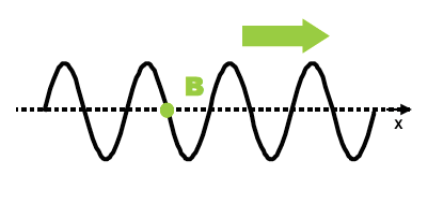 Transverse wave on string, point B marked
Topic: Oscillations & Waves Metodi: Wave Equation, Simple Harmonic Motion Analysis Competenze: Physical Reasoning, Diagrammatic Reasoning Objects: String Fonte: Testo (PDF) — p.7
Considera un’onda infinita che si muove a destra su una corda non allungata, come mostrato di seguito. Qual è la direzione della velocità di una particella al punto etichettato ?
La velocità è zero .
onda trasversale su una corda, punto B segnato
Topic: Oscillations & Waves Metodi: Wave Equation, Simple Harmonic Motion Analysis Competenze: Physical Reasoning, Diagrammatic Reasoning Objects: String Fonte: Testo (PDF) — p.7
A person is moving away from two speakers and along the direction as shown in the figure below. The speakers are in phase with each other and emit a sound wave with wavelength 6 cm. As the person moves away from speaker , they mark the points on the axis where there is no sound. Which of the plots below shows the position of the marked points correctly?
(A) (B) (C) (D)
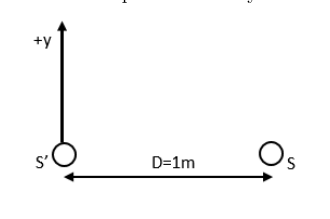 Two speakers S and S’ with person on y-axis
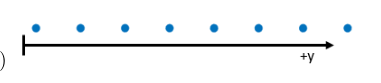 Node position plot option (A)
 Node position plot option (B)
 Node position plot option (C)
 Node position plot option (D)
Topic: Oscillations & Waves, Wave Optics Metodi: Interference & Diffraction Analysis, Superposition Principle Competenze: Physical Reasoning, Mathematical Modeling Objects: — Fonte: Testo (PDF) — p.7
Una persona si allontana da due altoparlanti e lungo la direzione come mostrato nella figura seguente. Gli altoparlanti sono in fase l’uno con l’altro e emettono un’onda sonora con una lunghezza d’onda di 6 cm. Quando la persona si allontana dal altoparlante , si controllano i punti sull’asse dove non c’è suono. Quale delle strisce di seguito mostra correttamente la posizione dei punti segnati?
(A) (B) (C) (D)
Due altoparlanti S e S’ con persona sull’asse y
*opzione di grafico di posizione del nodo (A) *
*opzione di grafico di posizione del nodo (B) *
*Opzione di grafico di posizione del nodo (C) *
*Opzione di grafico di posizione del nodo (D) *
Topic: Oscillations & Waves, Wave Optics Metodi: Interference & Diffraction Analysis, Superposition Principle Competenze: Physical Reasoning, Mathematical Modeling Objects: — Fonte: Testo (PDF) — p.7
A closed 5-litre cylinder containing 0.25 g of a substance in solid and liquid forms was slowly heated using a constant power. A graph of the temperature as a function of time is shown below. The heat capacity of the liquid is 2.43 J/(g·K), the latent heat of melting is 105 J/g, and the molar density is 46 g/mol.
a) What is the melting point of the substance?
b) What is the boiling point of the substance?
c) How much of the substance was solid at the beginning?
d) What is the latent heat of evaporation of the substance?
e) What is the specific heat of the gaseous state of the substance?
f) What is the pressure in the container at ?
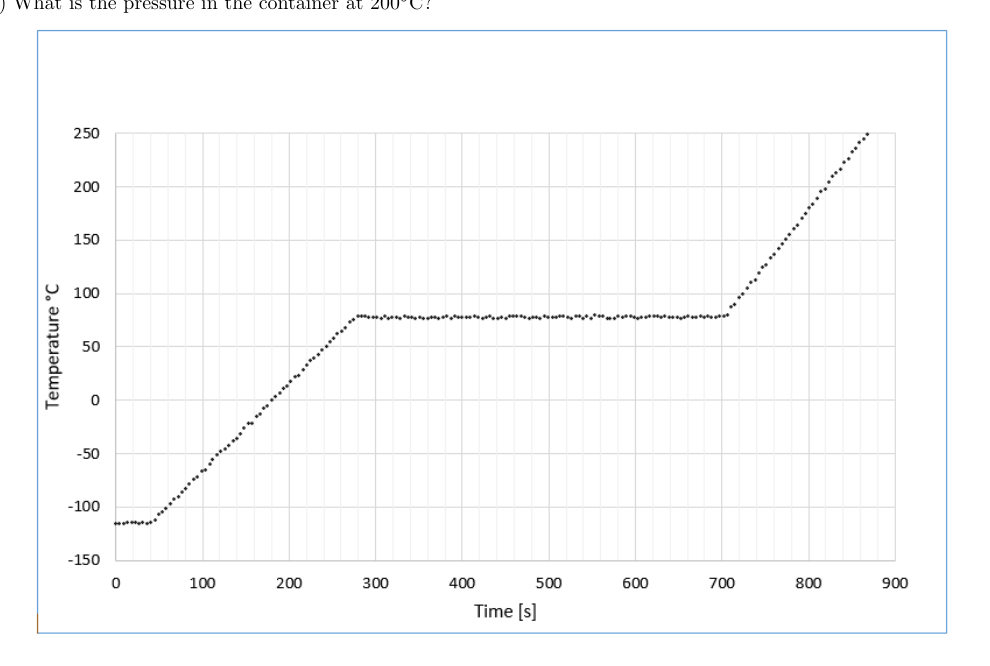 Temperature vs time graph, constant power heating
Topic: Thermodynamics, Kinetic Theory Metodi: First Law of Thermodynamics, Ideal Gas Law, Experimental Data Analysis Competenze: Experimental Data Analysis, Mathematical Modeling Objects: Container, Gas Fonte: Testo (PDF) — p.8
Un cilindro chiuso di 5 litri contenente 0,25 g di sostanza in forma solida e liquida è stato lentamente riscaldato con una potenza costante. Un grafico della temperatura in funzione del tempo è mostrato qui sotto. La capacità termica del liquido è di 2,43 J/(g·K), il calore latente della fusione è di 105 J/g e la densità molare è di 46 g/mol.
a) Qual è il punto di fusione della sostanza?
b) Qual è il punto di ebollizione della sostanza?
c) Quanta sostanza era solida all’inizio?
d) Qual è il calore latente di evaporazione della sostanza?
e) Qual è il calore specifico dello stato gassoso della sostanza?
f) Qual è la pressione del contenitore a ?
*Temperatura vs grafico temporale, riscaldamento costante *
Topic: Thermodynamics, Kinetic Theory Metodi: First Law of Thermodynamics, Ideal Gas Law, Experimental Data Analysis Competenze: Experimental Data Analysis, Mathematical Modeling Objects: Container, Gas Fonte: Testo (PDF) — p.8
A ball of mass is hung in the middle of a horizontal elastic cord of length , attached to the ceiling, as shown in figure below. The elastic constant of the cord is .
a) What is the distance from the ceiling to the center of the ball, assuming that the cord was not stretched when it was horizontal?
b) Calculate the period of very small oscillations from the equilibrium point.
c) Prove or disprove: when we pull the ball up to the ceiling and let it go, the resulting oscillations will be exactly described by simple harmonic motion.
 Ball hung at midpoint of horizontal elastic cord
Topic: Oscillations & Waves, Newtonian Mechanics Metodi: Hooke’s Law, Simple Harmonic Motion Analysis, Free-Body Diagram Competenze: Mathematical Modeling, Physical Reasoning Objects: Ball, String Fonte: Testo (PDF) — p.9
Una palla di massa è appesa al centro di un cordone elastico orizzontale di lunghezza , attaccato al soffitto, come mostrato nella figura seguente. La costante elastica del cavo è .
a) Qual è la distanza dal soffitto al centro della palla, se si suppone che il cordone non fosse esteso quando era orizzontale?
b) Calcolare il periodo di oscillazioni molto piccole dal punto di equilibrio.
c) Prove o refute: quando tiramo la palla al soffitto e la lasciamo andare, le oscillazioni risultanti saranno descritte esattamente da un semplice movimento armonico.
Palla appesa al punto medio del cavo elastico orizzontale
Topic: Oscillations & Waves, Newtonian Mechanics Metodi: Hooke’s Law, Simple Harmonic Motion Analysis, Free-Body Diagram Competenze: Mathematical Modeling, Physical Reasoning Objects: Ball, String Fonte: Testo (PDF) — p.9
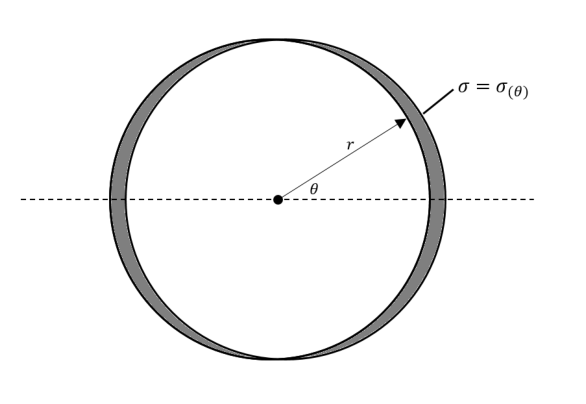
The charge distribution shown below has three regions with charge densities of , 0, and . The system can be thought of as the superposition of two spheres of the same radius and opposite charge density and , with their centers placed at a distance from each other, with .
a) What is the electric field in the overlapping region?
b) Assume that . We can approximate the charge distribution by a surface charge density distributed on the surface of the sphere at radius . Find as a function of , , , and .
c) Using the charge distribution found in part b and the corresponding electric field from part a, find the surface charge distribution of a neutral conducting sphere in a constant electric field .
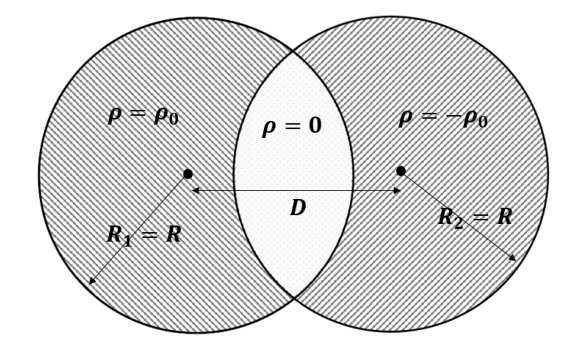 Two overlapping spheres with opposite charge densities
 Conducting sphere in uniform electric field
Topic: Electrostatics, Electromagnetism Metodi: Gauss’s Law, Superposition Principle, Electric Potential Method Competenze: Mathematical Modeling, Physical Reasoning Objects: Sphere, Conducting Sphere Fonte: Testo (PDF) — p.10
La distribuzione della carica mostrata di seguito ha tre regioni con densità di carica di , 0, e . Il sistema può essere pensato come la sovrapposizione di due sfere dello stesso raggio e di densità di carica opposta e , con i loro centri posizionati a una distanza l’una dall’altra, con .
a) Qual è il campo elettrico nella regione che si sovrappone?
b) Supponiamo che . Possiamo approssimare la distribuzione della carica da una densità di carica superficiale distribuita sulla superficie della sfera al raggio . Trova come funzione di , , e .
c) Sfruttando la distribuzione della carica trovata nella parte b e il corrispondente campo elettrico della parte a, si trova la distribuzione della carica superficiale di una sfera di conduttore neutrale in un campo elettrico costante .
Due sfere che si sovrappongono con densità di carica opposte
Sfera di condotta in campo elettrico uniforme
Topic: Electrostatics, Electromagnetism Metodi: Gauss’s Law, Superposition Principle, Electric Potential Method Competenze: Mathematical Modeling, Physical Reasoning Objects: Sphere, Conducting Sphere Fonte: Testo (PDF) — p.10