- Which of the following graphs best shows the velocity versus time of an object originally moving upward in the presence of air friction? (A) (B) 0 2 4 6 8 10 0 10 20 t (s) v (m/s) 0 2 4 6 8 10 0 10 20 t (s) v (m/s) (C) (D) 0 2 4 6 8 10 0 10 20 t (s) v (m/s) 0 2 4 6 8 10 0 10 20 t (s) v (m/s) (E) 0 2 4 6 8 10 0 10 20 t (s) v (m/s)
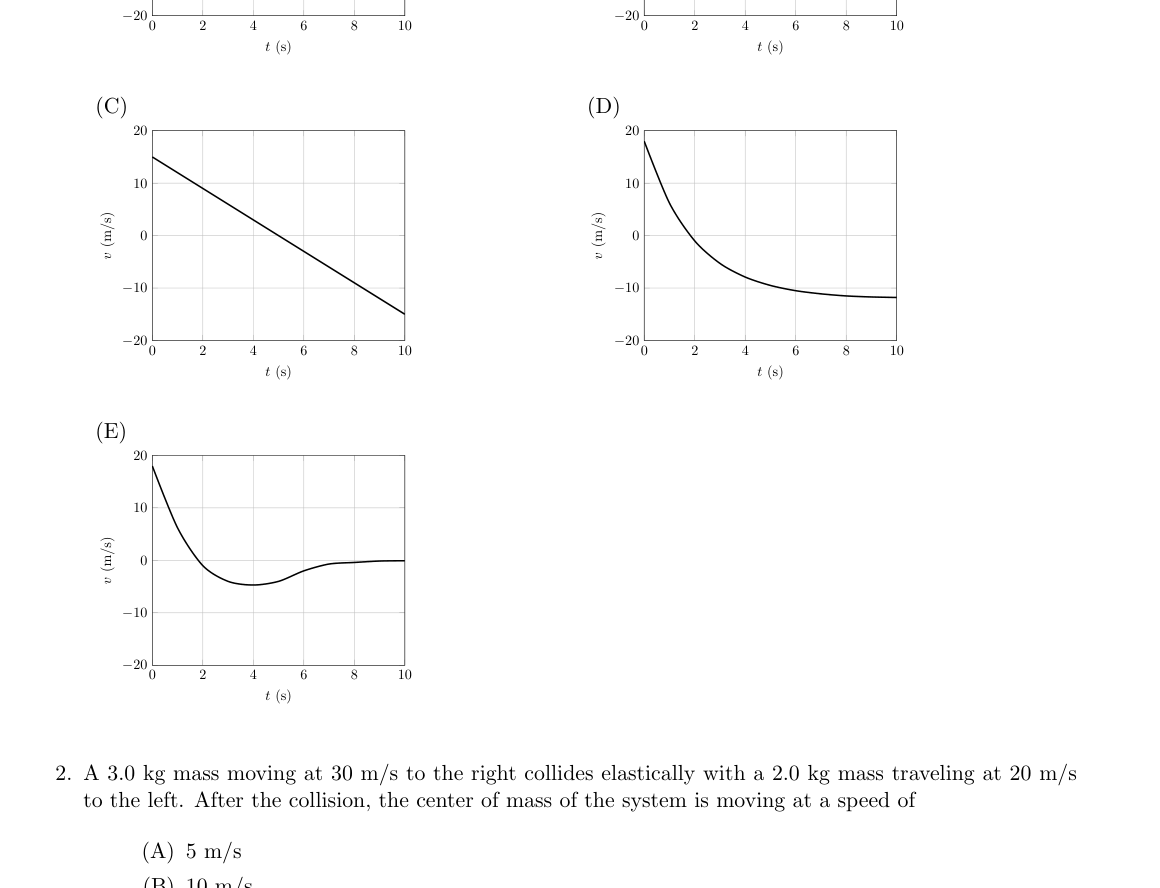 cinque grafici v-t con attrito dell’aria
Topic: Newtonian Mechanics Metodi: Free-Body Diagram, Kinematic Equations Competenze: Diagrammatic Reasoning, Physical Reasoning Objects: — Fonte: Testo (PDF) — p.2
- Quale dei grafici seguenti mostra meglio la velocità contro il tempo di un oggetto che si muove originariamente verso l’alto in presenza di attrito atmosferico? (A) (B) 0 2 4 6 8 10 0 10 20 t (s) v (m/s) 0 2 4 6 8 10 0 10 20 t (s) v (m/s) (C) (D) 0 2 4 6 8 10 0 10 20 t (s) v (m/s) 0 2 4 6 8 10 0 10 20 t (s) v (m/s) (E) 0 2 4 6 8 10 0 10 20 t (s) v (m/s)
*cinque grafici v-t con attrito dell’aria *
Topic: Newtonian Mechanics Metodi: Free-Body Diagram, Kinematic Equations Competenze: Diagrammatic Reasoning, Physical Reasoning Objects: — Fonte: Testo (PDF) — p.2
- A 3.0 kg mass moving at 30 m/s to the right collides elastically with a 2.0 kg mass traveling at 20 m/s to the left. After the collision, the center of mass of the system is moving at a speed of
- A. 5 m/s
- B. 10 m/s
- C. 20 m/s
- D. 24 m/s
- E. 26 m/s
Topic: Conservation of Momentum Metodi: Conservation of Momentum, Conservation Laws Competenze: Physical Reasoning, Mathematical Modeling Objects: Block Fonte: Testo (PDF) — p.2
- Una massa di 3,0 kg che si muove a 30 m/s a destra si schianta elasticamente con una massa di 2,0 kg che si muove a 20 m/s
- A sinistra. Dopo la collisione, il centro di massa del sistema si muove a una velocità di
- A. 5 m/s
- B. 10 m/s
- C. 20 m/s
- D. 24 m/s
- E. 26 m/s
Topic: Conservation of Momentum Metodi: Conservation of Momentum, Conservation Laws Competenze: Physical Reasoning, Mathematical Modeling Objects: Block Fonte: Testo (PDF) — p.2
- Ball 1 traveling in the positive direction strikes an equal mass ball 2 that is originally at rest. All of the following must be true after the collision, except
- A. The total final momentum in the direction equals the initial momentum of ball 1.
- B. The total kinetic energy after the collision equals the initial kinetic energy of ball 1.
- C. The final momentum of the two balls in the direction adds to zero.
- D. The final speed of the center of mass of the two balls is equal to half the initial speed of ball 1.
- E. The balls can’t both be at rest after the collision.
Topic: Conservation of Momentum, Conservation of Energy Metodi: Conservation of Momentum, Conservation of Energy, Conservation Laws Competenze: Physical Reasoning, Mathematical Modeling Objects: Ball Fonte: Testo (PDF) — p.3
- La palla 1 che si muove nella direzione positiva colpisce una palla di massa uguale a 2 che è originariamente in riposo. Tutti dopo la collisione deve verificarsi la seguente verità, salvo:
- A. Il momento finale totale nella direzione è uguale al momento iniziale della palla 1.
- B. L’energia cinetica totale dopo la collisione è uguale all’energia cinetica iniziale della palla 1.
- C. Il momento finale delle due palle nella direzione si aggiunge a zero.
- D. La velocità finale del centro di massa delle due palle è pari alla metà della velocità iniziale della palla 1.
- E. Le palle non possono restare entrambe in riposo dopo la collisione.
Topic: Conservation of Momentum, Conservation of Energy Metodi: Conservation of Momentum, Conservation of Energy, Conservation Laws Competenze: Physical Reasoning, Mathematical Modeling Objects: Ball Fonte: Testo (PDF) — p.3
- A satellite is following an elliptical orbit around the Earth. Its engines are capable of providing a one-time impulse of a fixed magnitude. In order to maximize the energy of the satellite, the impulse should be perigee apogee Earth
- A. directed along the satellite’s velocity and applied when the satellite is in its perigee.
- B. directed along the satellite’s velocity and applied when the satellite is in apogee.
- C. directed toward the Earth and applied when the satellite is in perigee.
- D. directed toward the Earth and applied when the satellite is in apogee.
- E. directed away from the Earth and applied when the satellite is in apogee.
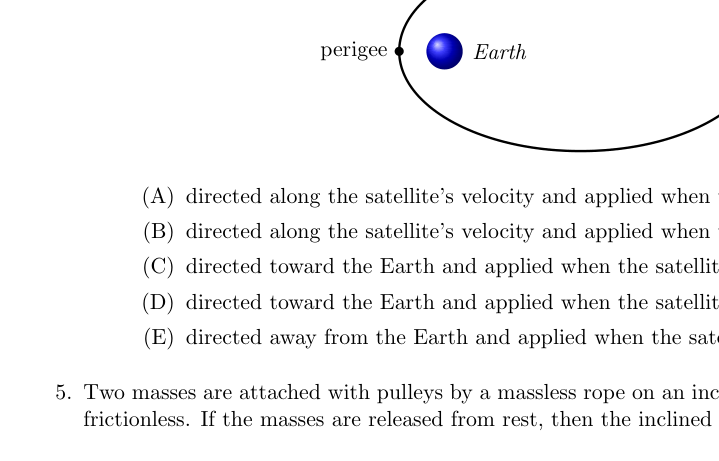 orbita ellittica satellite attorno alla Terra
Topic: Gravitation, Conservation of Energy Metodi: Newton’s Law of Gravitation, Kepler’s Laws, Energy Conservation Method Competenze: Physical Reasoning, Mathematical Modeling Objects: Satellite, Planet Fonte: Testo (PDF) — p.3
- Un satellite sta seguendo un’orbita ellittica intorno alla Terra. I suoi motori sono in grado di fornire un’unica volta impulso di magnitudo fissa. Per massimizzare l’energia del satellite, l’impulso dovrebbe essere perigeo apogee Terra
- A. diretto lungo la velocità del satellite e applicato quando il satellite è nel suo perigeo.
- B. diretto lungo la velocità del satellite e applicato quando il satellite è in apoggio.
- C. diretto verso la Terra e applicato quando il satellite è in perigeo.
- D. diretto verso la Terra e applicato quando il satellite è in apoggio.
- E. diretto lontano dalla Terra e applicato quando il satellite è in apoggio.
orbita ellittica satellite attorno alla Terra
Topic: Gravitation, Conservation of Energy Metodi: Newton’s Law of Gravitation, Kepler’s Laws, Energy Conservation Method Competenze: Physical Reasoning, Mathematical Modeling Objects: Satellite, Planet Fonte: Testo (PDF) — p.3
- Two masses are attached with pulleys by a massless rope on an inclined plane as shown. All surfaces are frictionless. If the masses are released from rest, then the inclined plane
- A. accelerates to the left if
- B. accelerates to the right if
- C. accelerates to the left regardless of the masses
- D. accelerates to the right regardless of the masses
- E. does not move
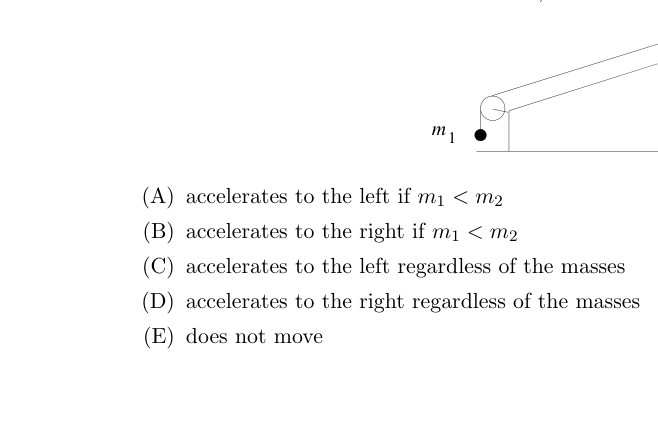 piano inclinato con carrucola e due masse
Topic: Newtonian Mechanics Metodi: Free-Body Diagram, Vector Decomposition, Conservation of Momentum Competenze: Diagrammatic Reasoning, Physical Reasoning Objects: Block, Pulley, String, Inclined Plane Fonte: Testo (PDF) — p.3
- Due masse sono attaccate con polli da una corda senza massa su un piano inclinato come mostrato. Tutte le superfici sono
- Senza attrito. Se le masse vengono rilasciate dal riposo, allora il piano inclinato
- A. si accelera a sinistra se
- B. si accelera a destra se
- C. accelera a sinistra indipendentemente dalle masse
- D. accelera a destra indipendentemente dalle masse
- E. non si muove
Piano inclinato con carrocola e massa dovuta
Topic: Newtonian Mechanics Metodi: Free-Body Diagram, Vector Decomposition, Conservation of Momentum Competenze: Diagrammatic Reasoning, Physical Reasoning Objects: Block, Pulley, String, Inclined Plane Fonte: Testo (PDF) — p.3
- A packing crate with mass is slid up a 5.00 m long ramp which makes an angle of with respect to the horizontal by an applied force of N directed parallel to the ramp’s incline. A frictional force of magnitude N resists the motion. If the crate starts from rest, what is its speed at the top of the ramp?
- A. 4.24 m/s
- B. 5.11 m/s
- C. 7.22 m/s
- D. 8.26 m/s
- E. 9.33 m/s
Topic: Newtonian Mechanics, Conservation of Energy Metodi: Free-Body Diagram, Energy Conservation Method, Kinematic Equations Competenze: Mathematical Modeling, Physical Reasoning Objects: Block, Inclined Plane Fonte: Testo (PDF) — p.4
- Una scatola di imballaggio con massa è scivolata su una rampa lunga 5,00 m che fa un angolo di con rispetto all’orizzontale con una forza applicata di N orientata parallela all’inclinazione delle rampe. Una forza di attrito di magnitudo N resiste al movimento. Se la scatola inizia dal riposo, cosa è la sua velocità in cima alla rampa?
- A. 4.24 m/s
- B. 5.11 m/s
- C. 7.22 m/s
- D. 8.26 m/s
- E. 9.33 m/s
Topic: Newtonian Mechanics, Conservation of Energy Metodi: Free-Body Diagram, Energy Conservation Method, Kinematic Equations Competenze: Mathematical Modeling, Physical Reasoning Objects: Block, Inclined Plane Fonte: Testo (PDF) — p.4
- A car has a maximum acceleration of and a minimum acceleration of . The shortest possible time for the car to begin at rest, then arrive at rest at a point a distance away is
- A.
- B.
- C.
- D.
- E.
Topic: Newtonian Mechanics Metodi: Kinematic Equations, Physical Modeling Competenze: Mathematical Modeling, Physical Reasoning Objects: Cart Fonte: Testo (PDF) — p.4
- Un’auto ha un’accelerazione massima di e un’accelerazione minima di . Il tempo più breve possibile per l’auto iniziare a riposo, poi arrivare a riposo in un punto a distanza
- A.
- B.
- C.
- D.
- E.
Topic: Newtonian Mechanics Metodi: Kinematic Equations, Physical Modeling Competenze: Mathematical Modeling, Physical Reasoning Objects: Cart Fonte: Testo (PDF) — p.4
- A disk of radius rolls uniformly without slipping around the inside of a fixed hoop of radius . If the period of the disc’s motion around the hoop is , what is the instantaneous speed of the point on the disk opposite to the point of contact? R r
- A.
- B.
- C.
- D.
- E.
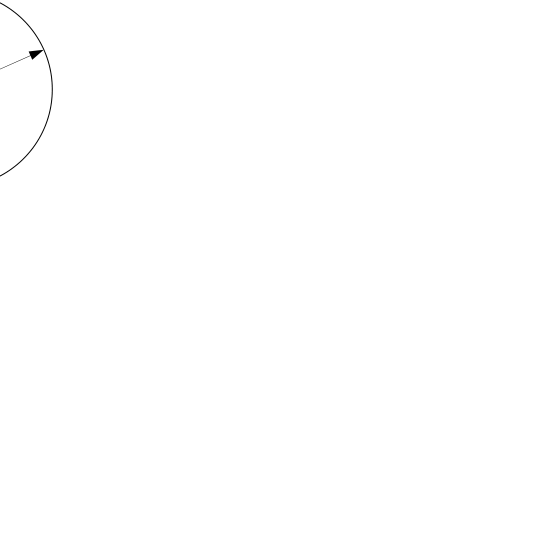 disco di raggio r che rotola dentro cerchio R
Topic: Rotational Dynamics Metodi: Torque & Angular Momentum Analysis, Physical Modeling Competenze: Mathematical Modeling, Physical Reasoning Objects: Disk Fonte: Testo (PDF) — p.4
- Un disco di raggio ruota uniformemente senza scivolare intorno all’interno di un cerchio fisso di raggio . Se il periodo del movimento del disco intorno al cerchio è , qual è la velocità istantanea del punto sul cerchio disco opposto al punto di contatto? R r
- A.
- B.
- C.
- D.
- E.
Disco di raggio r che rotola dentro cerchio R
Topic: Rotational Dynamics Metodi: Torque & Angular Momentum Analysis, Physical Modeling Competenze: Mathematical Modeling, Physical Reasoning Objects: Disk Fonte: Testo (PDF) — p.4
- A uniform stick of mass is originally on a horizontal surface. One end is attached to a vertical rope, which pulls up with a constant tension force so that the center of the mass of the stick moves upward with acceleration . The normal force of the ground on the other end of the stick shortly after the right end of the stick leaves the surface satisfies F m
- A.
- B.
- C.
- D.
- E.
Topic: Rigid Body Statics, Rotational Dynamics Metodi: Free-Body Diagram, Torque & Angular Momentum Analysis Competenze: Diagrammatic Reasoning, Physical Reasoning Objects: Rod, String Fonte: Testo (PDF) — p.5
- Un bastone uniforme di massa è originariamente su una superficie orizzontale. Una estremità è attaccata a una corda verticale. che si stacca con una forza di tensione costante in modo che il centro della massa del bastone si muova verso l’alto con accelerazione . La forza normale del terreno all’altra estremità del bastone poco dopo la parte destra del bastone lascia la superficie soddisfa F m
- A.
- B.
- C.
- D.
- E.
Topic: Rigid Body Statics, Rotational Dynamics Metodi: Free-Body Diagram, Torque & Angular Momentum Analysis Competenze: Diagrammatic Reasoning, Physical Reasoning Objects: Rod, String Fonte: Testo (PDF) — p.5
- Which of the following graphs best shows the acceleration versus time of an object originally moving upward in the presence of air friction? (A) (B) 0 2 4 6 8 10 0 10 20 t (s) (m/s) 0 2 4 6 8 10 0 10 20 t (s) (m/s) (C) (D) 0 2 4 6 8 10 0 10 20 t (s) (m/s) 0 2 4 6 8 10 0 10 20 t (s) (m/s) (E) 0 2 4 6 8 10 0 10 20 t (s) (m/s)
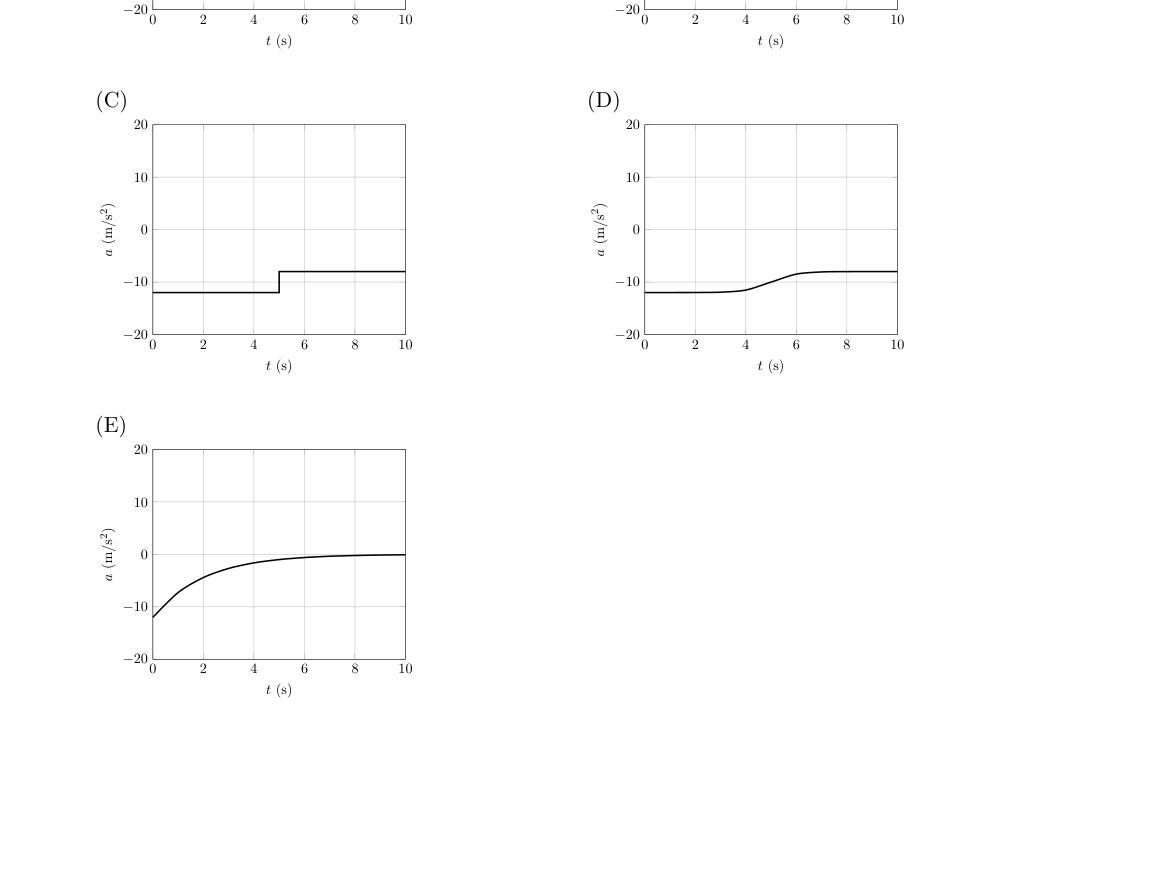 cinque grafici a-t con attrito dell’aria
Topic: Newtonian Mechanics Metodi: Free-Body Diagram, Kinematic Equations Competenze: Diagrammatic Reasoning, Physical Reasoning Objects: — Fonte: Testo (PDF) — p.6
- Quale dei grafici seguenti mostra meglio l’accelerazione rispetto al tempo di un oggetto in movimento originario in salita in presenza di attrito atmosferico? (A) (B) 0 2 4 6 8 10 0 10 20 t (s) (m/s) 0 2 4 6 8 10 0 10 20 t (s) (m/s) (C) (D) 0 2 4 6 8 10 0 10 20 t (s) (m/s) 0 2 4 6 8 10 0 10 20 t (s) (m/s) (E) 0 2 4 6 8 10 0 10 20 t (s) (m/s)
Sotto il profilo del settore
Topic: Newtonian Mechanics Metodi: Free-Body Diagram, Kinematic Equations Competenze: Diagrammatic Reasoning, Physical Reasoning Objects: — Fonte: Testo (PDF) — p.6
- A light, uniform, ideal spring is fixed at one end. If a mass is attached to the other end, the system oscillates with angular frequency . Now suppose the spring is fixed at the other end, then cut in half. The mass is attached between the two half springs. The new angular frequency of oscillations is
- A.
- B.
- C.
- D.
- E.
Topic: Oscillations & Waves Metodi: Simple Harmonic Motion Analysis, Hooke’s Law Competenze: Physical Reasoning, Mathematical Modeling Objects: Spring Fonte: Testo (PDF) — p.7
- Una sorgente leggera, uniforme e ideale è fissata ad una estremità. Se un’altra estremità è collegata ad una massa, il sistema oscilla con frequenza angolare . Supponiamo che la sorgente sia fissata all’altra estremità, e poi tagliata a metà. La massa è attaccata tra le due semi-sorgenti. La nuova frequenza angolare delle oscillazioni è
- A.
- B.
- C.
- D.
- E.
Topic: Oscillations & Waves Metodi: Simple Harmonic Motion Analysis, Hooke’s Law Competenze: Physical Reasoning, Mathematical Modeling Objects: Spring Fonte: Testo (PDF) — p.7
- A group of students wish to measure the acceleration of gravity with a simple pendulum. They take one length measurement of the pendulum to be m. They then measure the period of a single swing to be s. Assume that all uncertainties are Gaussian. The computed acceleration of gravity from this experiment illustrating the range of possible values should be recorded as
- A. m/s
- B. m/s
- C. m/s
- D. m/s
- E. m/s
Topic: Oscillations & Waves Metodi: Simple Harmonic Motion Analysis, Error Propagation Competenze: Error Propagation, Mathematical Modeling Objects: Pendulum Fonte: Testo (PDF) — p.7
- Un gruppo di studenti vuole misurare l’accelerazione della gravità con un semplice pendolo. Ne prendono uno. misurazione della lunghezza del pendolo a m. Poi misurano il tempo di un solo giorno swing a s. Supponiamo che tutte le incertezze siano gaussiane. L’accelerazione calcolata La gravità di questo esperimento che illustra la gamma di valori possibili deve essere registrata come
- A. m/s
- B. m/s
- C. m/s
- D. m/s
- E. m/s
Topic: Oscillations & Waves Metodi: Simple Harmonic Motion Analysis, Error Propagation Competenze: Error Propagation, Mathematical Modeling Objects: Pendulum Fonte: Testo (PDF) — p.7
- A massless cable of diameter 2.54 cm (1 inch) is tied horizontally between two trees 18.0 m apart. A tightrope walker stands at the center of the cable, giving it a tension of 7300 N. The cable stretches and makes an angle of with the horizontal. The Young’s modulus is defined as the ratio of stress to strain, where stress is the force applied per unit area and strain is the fractional change in length . The cable’s Young’s modulus is
- A. N/m
- B. N/m
- C. N/m
- D. N/m
- E. N/m
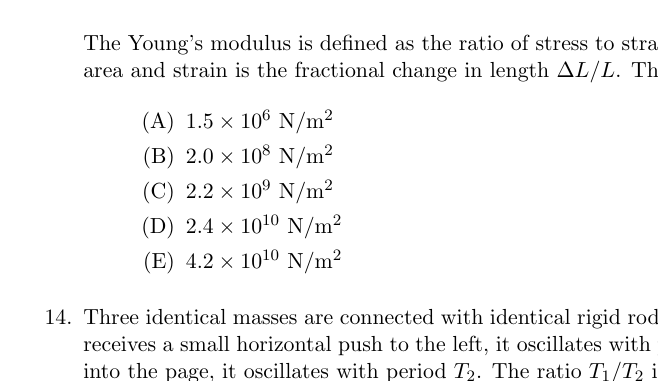 fune orizzontale inclinata di 1,5 gradi
Topic: Elasticity & Materials Metodi: Stress-Strain Analysis, Free-Body Diagram Competenze: Mathematical Modeling, Physical Reasoning Objects: String Fonte: Testo (PDF) — p.8
- Un cavo senza massa di diametro di 2,54 cm è legato orizzontalmente tra due alberi a 18,0 m di distanza. A il stropper di corda sta al centro del cavo, dando una tensione di 7300 N. Il cavo si estende e fa un angolo di con l’orizzontale. Il modulo Young è definito come il rapporto tra tensione e tensione, dove la tensione è la forza applicata per unità area e tensione è la variazione frazionaria di lunghezza . Il modulo Young del cavo è
- A. N/m
- B. N/m
- C. N/m
- D. N/m
- E. N/m
*fune orizzontale inclinata di 1,5 gradi *
Topic: Elasticity & Materials Metodi: Stress-Strain Analysis, Free-Body Diagram Competenze: Mathematical Modeling, Physical Reasoning Objects: String Fonte: Testo (PDF) — p.8
- Three identical masses are connected with identical rigid rods and pivoted at point . If the lowest mass receives a small horizontal push to the left, it oscillates with period . If it instead receives a small push into the page, it oscillates with period . The ratio is A
- A.
- B.
- C.
- D.
- E.
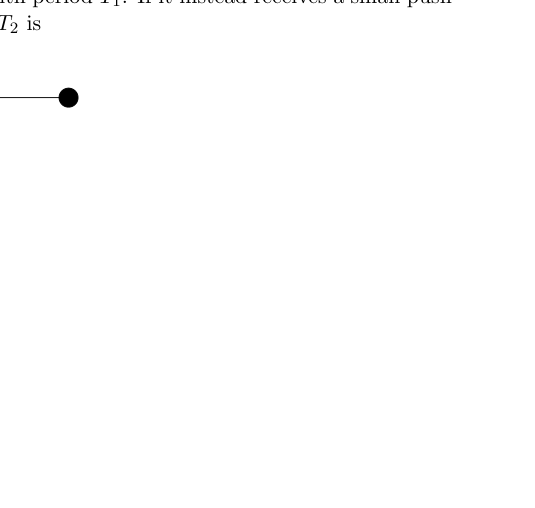 tre masse su aste rigide incernierate in A
Topic: Oscillations & Waves, Rotational Dynamics Metodi: Simple Harmonic Motion Analysis, Torque & Angular Momentum Analysis, Physical Modeling Competenze: Mathematical Modeling, Physical Reasoning Objects: Rod, Pendulum Fonte: Testo (PDF) — p.8
- Tre masse identiche sono collegate con barre rigide identiche e rotate al punto . Se la massa più bassa riceve una piccola spinta orizzontale a sinistra, oscilla con il periodo . Se invece riceve una piccola spinta nella pagina, oscilla con il periodo . Il rapporto è A
- A.
- B.
- C.
- D.
- E.
*tre masse su ast ast rigide incerniate in A *
Topic: Oscillations & Waves, Rotational Dynamics Metodi: Simple Harmonic Motion Analysis, Torque & Angular Momentum Analysis, Physical Modeling Competenze: Mathematical Modeling, Physical Reasoning Objects: Rod, Pendulum Fonte: Testo (PDF) — p.8
- A satellite is in a circular orbit about the Earth. Over a long period of time, the effects of air resistance decrease the satellite’s total energy by 1 J. The kinetic energy of the satellite
- A. increases by 1 J.
- B. remains unchanged.
- C. decreases by J.
- D. decreases by 1 J.
- E. decreases by 2 J.
Topic: Gravitation, Conservation of Energy Metodi: Newton’s Law of Gravitation, Energy Conservation Method, Kepler’s Laws Competenze: Physical Reasoning, Mathematical Modeling Objects: Satellite, Planet Fonte: Testo (PDF) — p.9
- Un satellite è in orbita circolare attorno alla Terra. Nel corso di un lungo periodo, gli effetti della resistenza all’aria diminuire l’energia totale del satellite di 1 J. L’energia cinetica del satellite
- A. aumenta di 1 J.
- B. rimane invariato.
- C. diminuisce di J.
- D. diminuisce di 1 J.
- E. diminuisce di 2 J.
Topic: Gravitation, Conservation of Energy Metodi: Newton’s Law of Gravitation, Energy Conservation Method, Kepler’s Laws Competenze: Physical Reasoning, Mathematical Modeling Objects: Satellite, Planet Fonte: Testo (PDF) — p.9
- A cylindrical space station produces ‘artificial gravity’ by rotating with angular frequency . Consider working in the reference frame rotating with the space station. In this frame, an astronaut is initially at rest standing on the floor, facing in the direction that the space station is rotating. The astronaut jumps up vertically relative to the floor of the space station, with an initial speed less than that of the speed of the floor. Just after leaving the floor, the motion of the astronaut, relative to the space station floor, (A) always has a component of acceleration directed toward the floor, and they land at the same point they jumped from. (B) always has a component of acceleration directed toward the floor, and they land in front of the point they jumped from. (C) always has a component of acceleration directed toward the floor, and they land behind the point they jumped from. (D) has a component of acceleration directed away from the floor, and they land behind the point they jumped from. (E) has a zero acceleration relative to the floor, and the astronaut never reaches the floor again.
Topic: Rotational Dynamics, Newtonian Mechanics Metodi: Torque & Angular Momentum Analysis, Free-Body Diagram, Physical Modeling Competenze: Physical Reasoning, Diagrammatic Reasoning Objects: Cylinder Fonte: Testo (PDF) — p.9
- Una stazione spaziale cilindrica produce gravitazione artificiale rotando con frequenza angolare . Considerate funzionare nel quadro di riferimento che ruota con la stazione spaziale. In questo quadro, un astronauta è inizialmente a riposare in piedi sul pavimento, rivolto nella direzione in cui la stazione spaziale ruota. L’astronauta salta in alto verticalmente rispetto al pavimento della stazione spaziale, con una velocità iniziale inferiore a quella della velocità di
- Il pavimento. Appena uscito dal pavimento, il movimento dell’astronauta, rispetto al pavimento della stazione spaziale, (A) ha sempre una componente di accelerazione diretta verso il pavimento, e atterrano allo stesso tempo Da dove sono saltati. (B) ha sempre una componente di accelerazione diretta verso il pavimento, e atterrano di fronte a Il punto da cui hanno saltato. (C) ha sempre una componente di accelerazione diretta verso il pavimento, e atterrano dietro la Da dove sono saltati. (D) ha una componente di accelerazione diretta lontano dal pavimento, e atterrano dietro il punto
- Hanno saltato. (E) ha un’accelerazione zero rispetto al pavimento e l’astronauta non raggiunge mai più il pavimento.
Topic: Rotational Dynamics, Newtonian Mechanics Metodi: Torque & Angular Momentum Analysis, Free-Body Diagram, Physical Modeling Competenze: Physical Reasoning, Diagrammatic Reasoning Objects: Cylinder Fonte: Testo (PDF) — p.9
- A stream of sand is dropped out of a helicopter initially moving at a constant speed to the right. The helicopter suddenly turns and begins moving a constant speed to the left. Neglecting air resistance on the sand, what is the shape of the stream of sand, as viewed from the ground? The black dot represents the helicopter. (A) (B) x (arbitrary units) y (arbitrary units) x (arbitrary units) y (arbitrary units) (C) (D) x (arbitrary units) y (arbitrary units) x (arbitrary units) y (arbitrary units) (E) x (arbitrary units) y (arbitrary units)
Topic: Newtonian Mechanics Metodi: Kinematic Equations, Physical Modeling Competenze: Diagrammatic Reasoning, Physical Reasoning Objects: — Fonte: Testo (PDF) — p.10
- Un flusso di sabbia viene scaricato da un elicottero inizialmente in movimento a velocità costante a destra. Il l’elicottero si gira improvvisamente e inizia a spostarsi a sinistra a velocità costante . Negliore della resistenza dell’aria la sabbia, quale è la forma del torrente di sabbia, visto dal terreno? Il punto nero rappresenta l’elicottero. (A) (B) x (unità arbitrarie) y (unità arbitrarie) x (unità arbitrarie) y (unità arbitrarie) (C) (D) x (unità arbitrarie) y (unità arbitrarie) x (unità arbitrarie) y (unità arbitrarie) (E) x (unità arbitrarie) y (unità arbitrarie)
Topic: Newtonian Mechanics Metodi: Kinematic Equations, Physical Modeling Competenze: Diagrammatic Reasoning, Physical Reasoning Objects: — Fonte: Testo (PDF) — p.10
- A mass is attached to a thin rod of length so that it can freely spin in a vertical circle with period . The difference in the tensions in the rod when the mass is at the top and the bottom of the circle is
- A.
- B.
- C.
- D.
- E.
Topic: Newtonian Mechanics, Rotational Dynamics Metodi: Free-Body Diagram, Kinematic Equations, Physical Modeling Competenze: Mathematical Modeling, Physical Reasoning Objects: Rod Fonte: Testo (PDF) — p.10
- Una massa è attaccata a una sottile canna di lunghezza in modo da poter girare liberamente in un cerchio verticale con periodo . La differenza delle tensioni nella canna quando la massa è in cima e in fondo al cerchio è
- A.
- B.
- C.
- D.
- E.
Topic: Newtonian Mechanics, Rotational Dynamics Metodi: Free-Body Diagram, Kinematic Equations, Physical Modeling Competenze: Mathematical Modeling, Physical Reasoning Objects: Rod Fonte: Testo (PDF) — p.10
- Raindrops with a number density of drops per cubic meter and radius hit the ground with a speed . The resulting pressure on the ground from the rain is . If the number density is doubled, the drop radius is halved, and the speed is halved, the new pressure will be
- A.
- B.
- C.
- D.
- E.
Topic: Newtonian Mechanics Metodi: Impulse-Momentum Theorem, Dimensional Analysis, Physical Modeling Competenze: Mathematical Modeling, Physical Reasoning Objects: Droplet Fonte: Testo (PDF) — p.11
- I ghiacci di pioggia con una densità di di piccole gocce per metro cubo e di raggio colpiscono il terreno con velocità . La pressione che si verifica sul suolo a causa della pioggia è . Se la densità dei numeri è raddoppiata, la caduta il raggio è dimezzato, e la velocità è dimezzata, la nuova pressione sarà
- A.
- B.
- C.
- D.
- E.
Topic: Newtonian Mechanics Metodi: Impulse-Momentum Theorem, Dimensional Analysis, Physical Modeling Competenze: Mathematical Modeling, Physical Reasoning Objects: Droplet Fonte: Testo (PDF) — p.11
- A spring stretched to double its unstretched length has a potential energy . If the spring is cut in half, and each half spring is stretched to double its unstretched length, then the total potential energy stored in the two half springs will be
- A.
- B.
- C.
- D.
- E.
Topic: Conservation of Energy Metodi: Hooke’s Law, Energy Conservation Method Competenze: Physical Reasoning, Mathematical Modeling Objects: Spring Fonte: Testo (PDF) — p.11
- Una molla estesa al doppio della sua lunghezza non estesa ha un’energia potenziale . Se la sorgente viene tagliata a metà, e ogni mezza primavera è estesa per raddoppiare la sua lunghezza non estesa, quindi l’energia potenziale totale immagazzinata nelle due sorgenti,
- A.
- B.
- C.
- D.
- E.
Topic: Conservation of Energy Metodi: Hooke’s Law, Energy Conservation Method Competenze: Physical Reasoning, Mathematical Modeling Objects: Spring Fonte: Testo (PDF) — p.11
- A ping-pong ball (a hollow spherical shell) with mass is placed on the ground with initial velocity and zero angular velocity at time . The coefficient of friction between the ping-pong ball and the ground is . The time the ping-pong ball begins to roll without slipping is
- A.
- B.
- C.
- D.
- E.
Topic: Rotational Dynamics, Newtonian Mechanics Metodi: Torque & Angular Momentum Analysis, Free-Body Diagram, Kinematic Equations Competenze: Mathematical Modeling, Physical Reasoning Objects: Ball Fonte: Testo (PDF) — p.11
- Una palla da ping-pong (un guscio sferico vuoto) di massa viene posta sul terreno con velocità iniziale e velocità angolare zero al tempo . Il coefficiente di attrito tra la palla di ping-pong e il il terreno è . Il momento in cui la palla di ping-pong inizia a rotolare senza scivolare è
- A.
- B.
- C.
- D.
- E.
Topic: Rotational Dynamics, Newtonian Mechanics Metodi: Torque & Angular Momentum Analysis, Free-Body Diagram, Kinematic Equations Competenze: Mathematical Modeling, Physical Reasoning Objects: Ball Fonte: Testo (PDF) — p.11
- A small hole is punched into the bottom of a rectangular boat, allowing water to enter the boat. As the boat sinks into the water, which of the following graphs best shows how the rate water flows through the hole varies with time? Assume that the boat remains horizontal as it sinks. water level outside boat water level inside hole (A) (B) 0 2 4 6 8 10 0 10 20 30 t (hours) Leak Rate (liters/min) 0 2 4 6 8 10 0 10 20 30 t (hours) Leak Rate (liters/min) (C) (D) 0 2 4 6 8 10 0 10 20 30 t (hours) Leak Rate (liters/min) 0 2 4 6 8 10 0 10 20 30 t (hours) Leak Rate (liters/min) (E) 0 2 4 6 8 10 0 10 20 30 t (hours) Leak Rate (liters/min)
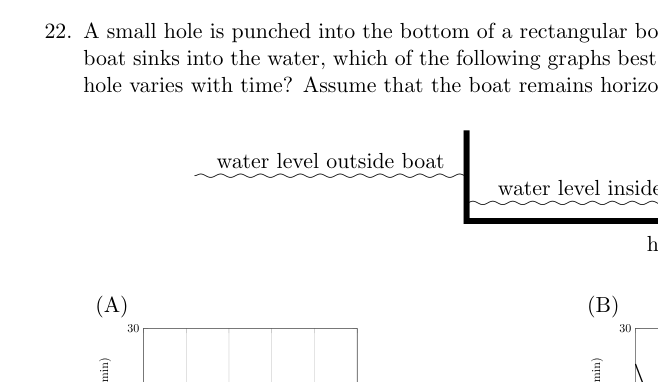 barca che affonda con foro e livelli d’acqua
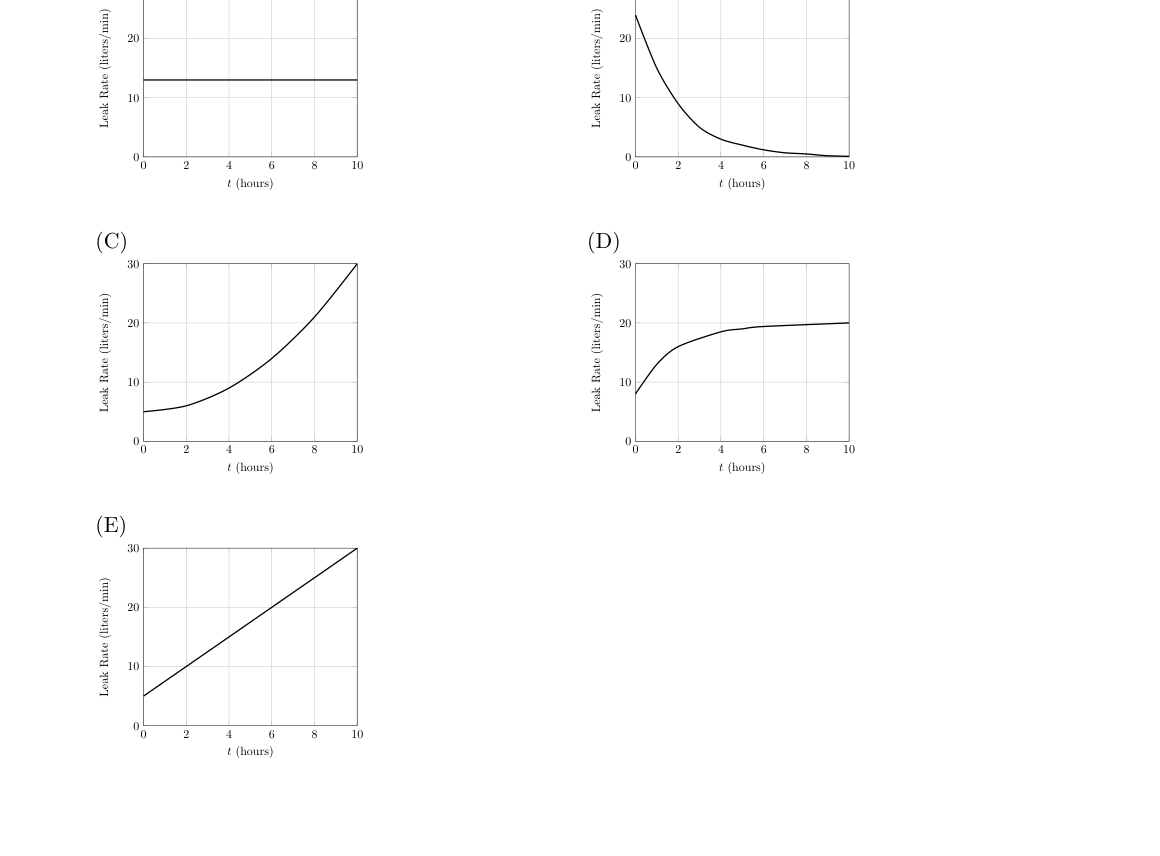 cinque grafici portata di perdita vs tempo
Topic: Fluid Mechanics Metodi: Bernoulli’s Equation, Hydrostatic Equilibrium, Physical Modeling Competenze: Diagrammatic Reasoning, Physical Reasoning Objects: Container Fonte: Testo (PDF) — p.12
- Un piccolo buco viene perforato nel fondo di una barca rettangolare, permettendo all’acqua di entrare nella barca. Come il La velocità di scarica dell’acqua attraverso il mare è indicata in una delle seguenti grafiche: Il buco varia con il tempo? Supponiamo che la barca rimanga orizzontale mentre affonda. livello dell’acqua fuori dal peschereccio livello di acqua all’interno buco (A) (B) 0 2 4 6 8 10 0 10 20 30 t (orari) Tasso di perdita (litrino/min) 0 2 4 6 8 10 0 10 20 30 t (orari) Tasso di perdita (litrino/min) (C) (D) 0 2 4 6 8 10 0 10 20 30 t (orari) Tasso di perdita (litrino/min) 0 2 4 6 8 10 0 10 20 30 t (orari) Tasso di perdita (litrino/min) (E) 0 2 4 6 8 10 0 10 20 30 t (orari) Tasso di perdita (litrino/min)
*barche che affondano con i livelli d’acqua *
cinque grafici portata di perdita vs tempo
Topic: Fluid Mechanics Metodi: Bernoulli’s Equation, Hydrostatic Equilibrium, Physical Modeling Competenze: Diagrammatic Reasoning, Physical Reasoning Objects: Container Fonte: Testo (PDF) — p.12
- The coefficients of static and kinetic friction between a ball and an ramp are . The ball is released from rest at the top of the ramp. Which of the following graphs best shows the rotational acceleration of the ball about its center of mass as a function of the angle of the ramp? (A) (B) 0 20 40 60 80 0 Ramp angle (degrees) Angular acceleration 0 20 40 60 80 0 Ramp angle (degrees) Angular acceleration (C) (D) 0 20 40 60 80 0 Ramp angle (degrees) Angular acceleration 0 20 40 60 80 0 Ramp angle (degrees) Angular acceleration (E) 0 20 40 60 80 0 Ramp angle (degrees) Angular acceleration
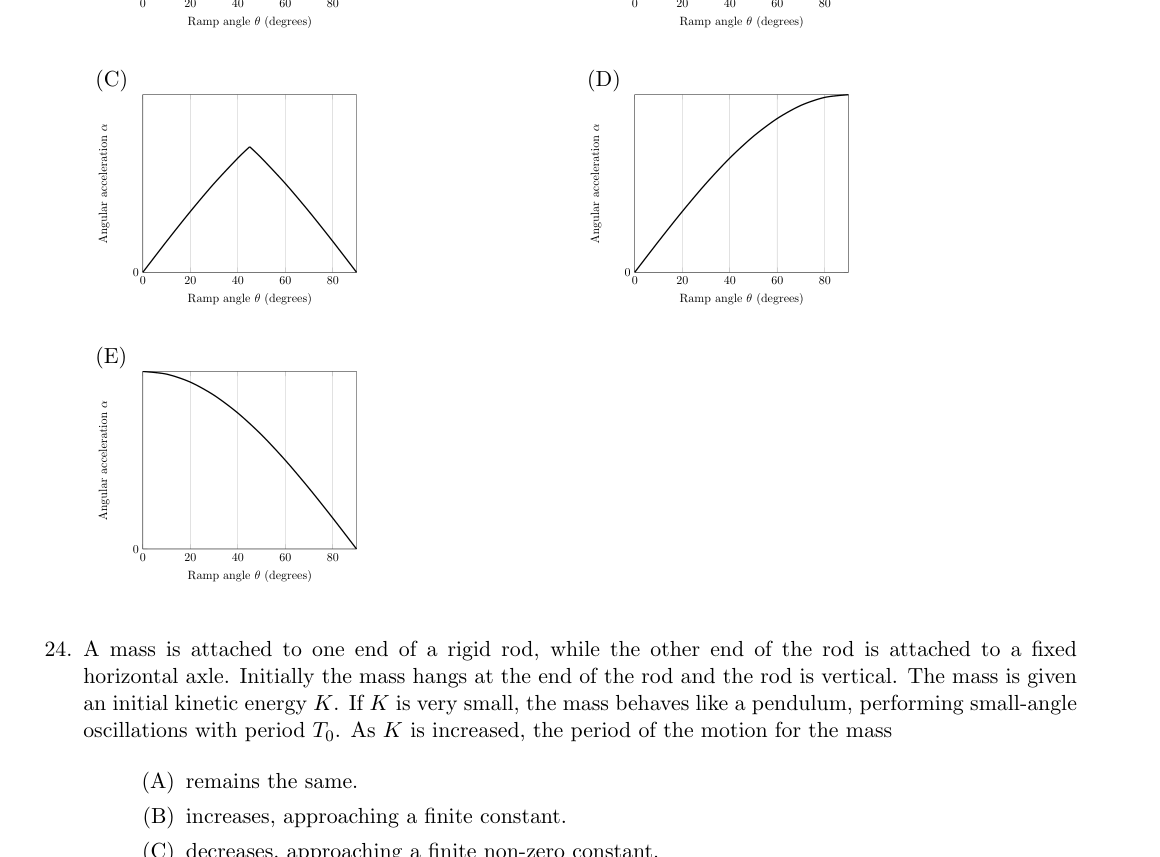 cinque grafici accelerazione angolare vs angolo rampa
Topic: Rotational Dynamics, Newtonian Mechanics Metodi: Torque & Angular Momentum Analysis, Free-Body Diagram, Vector Decomposition Competenze: Diagrammatic Reasoning, Mathematical Modeling Objects: Ball, Inclined Plane Fonte: Testo (PDF) — p.13
- I coefficienti di attrito statico e cinetico tra una palla e una rampa sono . La palla viene rilasciato dal riposo in cima alla rampa. Quale dei grafici seguenti mostra meglio la rotazione l’accelerazione della palla intorno al suo centro di massa in funzione dell’angolo della rampa? (A) (B) 0 20 40 60 80 0 Angolo di rampione (gradi) Accelerazione angolare 0 20 40 60 80 0 Angolo di rampione (gradi) Accelerazione angolare (C) (D) 0 20 40 60 80 0 Angolo di rampione (gradi) Accelerazione angolare 0 20 40 60 80 0 Angolo di rampione (gradi) Accelerazione angolare (E) 0 20 40 60 80 0 Angolo di rampione (gradi) Accelerazione angolare
cinque grafici accelerazione angolare vs angolo rampa
Topic: Rotational Dynamics, Newtonian Mechanics Metodi: Torque & Angular Momentum Analysis, Free-Body Diagram, Vector Decomposition Competenze: Diagrammatic Reasoning, Mathematical Modeling Objects: Ball, Inclined Plane Fonte: Testo (PDF) — p.13
- A mass is attached to one end of a rigid rod, while the other end of the rod is attached to a fixed horizontal axle. Initially the mass hangs at the end of the rod and the rod is vertical. The mass is given an initial kinetic energy . If is very small, the mass behaves like a pendulum, performing small-angle oscillations with period . As is increased, the period of the motion for the mass
- A. remains the same.
- B. increases, approaching a finite constant.
- C. decreases, approaching a finite non-zero constant.
- D. decreases, approaching zero.
- E. initially increases, then decreases.
Topic: Oscillations & Waves, Conservation of Energy Metodi: Simple Harmonic Motion Analysis, Energy Conservation Method, Physical Modeling Competenze: Physical Reasoning, Mathematical Modeling Objects: Rod, Pendulum Fonte: Testo (PDF) — p.13
- Una massa è attaccata ad una estremità di una canna rigida, mentre l’altra estremità della canna è attaccata ad una asse orizzontale. Inizialmente la massa si appende alla fine della canna e la canna è verticale. La massa è data un’energia cinetica iniziale . Se è molto piccolo, la massa si comporta come un pendolo, con un angolo piccolo oscillazioni con periodo . Con l’aumento di , il periodo di movimento della massa
- A. rimane lo stesso.
- B. aumenta, avvicinandosi a una costante finita.
- C. diminuisce, avvicinandosi a una costante finita non-zero.
- D. diminuisce, avvicinandosi a zero.
- E. inizia ad aumentare, poi diminuisce.
Topic: Oscillations & Waves, Conservation of Energy Metodi: Simple Harmonic Motion Analysis, Energy Conservation Method, Physical Modeling Competenze: Physical Reasoning, Mathematical Modeling Objects: Rod, Pendulum Fonte: Testo (PDF) — p.13
- Alice and Bob are working on a lab report. Alice measures the period of a pendulum to be s, while Bob independently measures the period to be s. Alice and Bob can combine their measurements in several ways. 1: Keep Alice’s result and ignore Bob’s 2: Average Alice’s and Bob’s results 3: Perform a weighted average of Alice’s and Bob’s results, with Alice’s result weighted 4 times more than Bob’s How are the uncertainties of these results related?
- A. Method 1 has the lowest uncertainty, and method 2 has the highest
- B. Method 3 has the lowest uncertainty, and method 2 has the highest
- C. Method 2 has the lowest uncertainty, and method 1 has the highest
- D. Method 3 has the lowest uncertainty, and method 1 has the highest
- E. Method 1 has the lowest uncertainty, and method 3 has the highest
Topic: Oscillations & Waves Metodi: Error Propagation, Physical Modeling Competenze: Error Propagation, Experimental Data Analysis Objects: Pendulum Fonte: Testo (PDF) — p.14
- Alice e Bob stanno lavorando a un rapporto di laboratorio. Alice misura il periodo di un pendolo a s, mentre Bob misura indipendentemente il periodo a s. Alice e Bob possono combinare i loro misurazioni in vari modi. 1: Tieni il risultato di Alice e ignora Bob. 2: risultati medi di Alice e Bob 3: eseguire una media ponderata dei risultati di Alice e Bob, con il risultato di Alice ponderato 4 volte più di bobs Come sono collegate le incertezze di questi risultati?
- A. Il metodo 1 ha la minore incertezza e il metodo 2 la più alta
- B. Il metodo 3 ha la minore incertezza e il metodo 2 la più alta
- C. Il metodo 2 ha la minore incertezza e il metodo 1 la più alta
- D. Il metodo 3 ha la minore incertezza e il metodo 1 la più alta
- E. Il metodo 1 ha la minore incertezza e il metodo 3 la più alta
Topic: Oscillations & Waves Metodi: Error Propagation, Physical Modeling Competenze: Error Propagation, Experimental Data Analysis Objects: Pendulum Fonte: Testo (PDF) — p.14