- A large lump of clay is dropped off of a wall and lands on the ground. Which graph best represents the acceleration of the center of mass of the clay as a function of time? (A) (B) 0 0 time (arbitrary units) acceleration (arbitrary units) 0 0 time (arbitrary units) acceleration (arbitrary units) (C) (D) 0 0 time (arbitrary units) acceleration (arbitrary units) 0 0 time (arbitrary units) acceleration (arbitrary units) (E) 0 0 time (arbitrary units) acceleration (arbitrary units)
Topic: Newtonian Mechanics Metodi: Free-Body Diagram, Physical Modeling Competenze: Physical Reasoning, Diagrammatic Reasoning Objects: — Fonte: Testo (PDF) — p.2
- Un grosso pezzo di argilla viene gettato dalla parete e atterra’ a terra. Quale grafico rappresenta meglio il l’accelerazione del centro di massa dell’argilla in funzione del tempo? (A) (B) 0 0 tempo (unità arbitrarie) accelerazione (unità arbitrarie) 0 0 tempo (unità arbitrarie) accelerazione (unità arbitrarie) (C) (D) 0 0 tempo (unità arbitrarie) accelerazione (unità arbitrarie) 0 0 tempo (unità arbitrarie) accelerazione (unità arbitrarie) (E) 0 0 tempo (unità arbitrarie) accelerazione (unità arbitrarie)
Topic: Newtonian Mechanics Metodi: Free-Body Diagram, Physical Modeling Competenze: Physical Reasoning, Diagrammatic Reasoning Objects: — Fonte: Testo (PDF) — p.2
- A uniform block of mass 10 kg is released at rest from the top of an incline with length 10 m and inclination , and slides to the bottom. The coefficients of static and kinetic friction are . How much energy is dissipated due to friction?
- A. 0 J
- B. 22 J
- C. 43 J
- D. 87 J
- E. 164 J
Topic: Newtonian Mechanics, Conservation of Energy Metodi: Free-Body Diagram, Vector Decomposition, Energy Conservation Method Competenze: Diagrammatic Reasoning, Mathematical Modeling, Physical Reasoning Objects: Block, Inclined Plane Fonte: Testo (PDF) — p.2
- Un blocco uniforme di massa di 10 kg viene rilasciato in riposo dalla parte superiore di una pendenza di lunghezza di 10 m e inclinamento , e scivola verso il basso. I coefficienti di attrito statico e cinetico sono . Quanto energia viene dissipata a causa della frizione?
- A. 0 J
- B. 22 J
- C. 43 J
- D. 87 J
- E. 164 J
Topic: Newtonian Mechanics, Conservation of Energy Metodi: Free-Body Diagram, Vector Decomposition, Energy Conservation Method Competenze: Diagrammatic Reasoning, Mathematical Modeling, Physical Reasoning Objects: Block, Inclined Plane Fonte: Testo (PDF) — p.2
- A 3.0 kg mass moving at 40 m/s to the right collides with and sticks to a 2.0 kg mass traveling at 20 m/s to the right. After the collision, the kinetic energy of the system is closest to
- A. 600 J
- B. 1200 J
- C. 2600 J
- D. 2800 J
- E. 3400 J
Topic: Conservation of Momentum, Conservation of Energy Metodi: Conservation of Momentum, Conservation of Energy, Conservation Laws Competenze: Mathematical Modeling, Physical Reasoning Objects: — Fonte: Testo (PDF) — p.3
- Una massa di 3,0 kg che si muove a 40 m/s a destra si schianta e si attacca a una massa di 2,0 kg che si muove a 20 m/s
- A destra. Dopo la collisione, l’energia cinetica del sistema è più vicina a
- A. 600 J
- B. 1200 J
- C. 2600 J
- D. 2800 J
- E. 3400 J
Topic: Conservation of Momentum, Conservation of Energy Metodi: Conservation of Momentum, Conservation of Energy, Conservation Laws Competenze: Mathematical Modeling, Physical Reasoning Objects: — Fonte: Testo (PDF) — p.3
- A basketball is released from rest and bounces on the ground. Considering only the ball just before and just after the bounce, which of the following statements must be true?
- A. The momentum and the total energy of the ball are conserved.
- B. The momentum of the ball is conserved, but not the kinetic energy.
- C. The total energy of the ball is conserved, but not the momentum.
- D. The kinetic energy of the ball is conserved, but not the momentum.
- E. Neither the kinetic energy of the ball nor the momentum is conserved.
Topic: Conservation of Momentum, Conservation of Energy Metodi: Conservation Laws, Impulse-Momentum Theorem Competenze: Physical Reasoning Objects: Ball Fonte: Testo (PDF) — p.3
- Una pallacanestro viene rilasciata dal riposo e rimbalza sul terreno. Considerando solo la palla appena prima e subito dopo il rimbalzo, quale delle seguenti affermazioni deve essere vera?
- A. Il momento e l’energia totale della palla sono conservati.
- B. Il momento della palla è conservato, ma non l’energia cinetica.
- C. L’energia totale della palla è conservata, ma non l’impulso.
- D. L’energia cinetica della palla è conservata, ma non l’impulso.
- E. Né l’energia cinetica della palla né il momento sono conservati.
Topic: Conservation of Momentum, Conservation of Energy Metodi: Conservation Laws, Impulse-Momentum Theorem Competenze: Physical Reasoning Objects: Ball Fonte: Testo (PDF) — p.3
- The hard disk in a computer will spin up to speed within 10 rotations, but when turned off will spin through 50 rotations before coming to a stop. Assuming the hard disk has constant angular acceleration and angular deceleration , the ratio is
- A. 1/5
- B.
- C.
- D. 5
- E. 25
Topic: Rotational Dynamics Metodi: Kinematic Equations, Torque & Angular Momentum Analysis Competenze: Mathematical Modeling, Physical Reasoning Objects: Disk Fonte: Testo (PDF) — p.3
- Il disco rigido di un computer si spingerà fino a una velocità di 10 rotazioni, ma quando si spegne si spingerà attraverso 50 rotazioni prima di fermarsi. Supponendo che il disco rigido abbia un’accelerazione angolare costante e decelerazione angolare , il rapporto è
- A. 1/5
- B.
- C.
- D. 5
- E. 25
Topic: Rotational Dynamics Metodi: Kinematic Equations, Torque & Angular Momentum Analysis Competenze: Mathematical Modeling, Physical Reasoning Objects: Disk Fonte: Testo (PDF) — p.3
- A massless beam of length L is fixed on one end. A downward force F is applied to the free end of the beam, deflecting the beam downward by a distance x. The deflection x is linear in F and is inversely proportional to the cross-section moment I, which has units . The deflection is also dependent on Young’s modulus E, which has units . Then x depends on L according to
- A.
- B.
- C.
- D.
- E.
Topic: Elasticity & Materials Metodi: Dimensional Analysis, Physical Modeling Competenze: Mathematical Modeling, Physical Reasoning Objects: Beam Fonte: Testo (PDF) — p.3
- Un fascio senza massa di lunghezza L è fissato su un’estremità. Una forza verso il basso F viene applicata alla fine libera del il fascio, che devia il fascio verso il basso per una distanza x. La deflessione x è lineare in F ed è inversa proporzionale al momento di sezione trasversale I, che ha unità . La deviazione dipende anche da Youngs modulo E, che ha unità . Quindi x dipende da L secondo
- A.
- B.
- C.
- D.
- E.
Topic: Elasticity & Materials Metodi: Dimensional Analysis, Physical Modeling Competenze: Mathematical Modeling, Physical Reasoning Objects: Beam Fonte: Testo (PDF) — p.3
with frequency ω and a fixed amplitude for a fixed time.
- A pendulum of length L oscillates inside a box. A person picks up the box and gently shakes it vertically with frequency and a fixed amplitude for a fixed time. To maximize the final amplitude of the pendulum, should satisfy
- A.
- B.
- C.
- D.
- E. there will be no significant effect on the pendulum amplitude for any value of
Topic: Oscillations & Waves Metodi: Simple Harmonic Motion Analysis, Physical Modeling Competenze: Physical Reasoning, Mathematical Modeling Objects: Pendulum Fonte: Testo (PDF) — p.4
con frequenza ω e amplitudine fissa per un tempo determinato.
- Un pendolo di lunghezza L oscilla all’interno di una scatola. Una persona prende la scatola e la scuote delicatamente verticalmente con frequenza e amplitudine fissa per un tempo determinato. Per massimizzare l’ampiezza finale del pendolo, deve soddisfare
- A.
- B.
- C.
- D.
- E. non vi sarà alcun effetto significativo sull’ampiezza del pendolo per qualsiasi valore di
Topic: Oscillations & Waves Metodi: Simple Harmonic Motion Analysis, Physical Modeling Competenze: Physical Reasoning, Mathematical Modeling Objects: Pendulum Fonte: Testo (PDF) — p.4
- The coefficients of static and kinetic friction between a ball and a horizontal plane are . The ball is given a horizontal speed but no rotational velocity about its center of mass. Which of the following graphs best shows the rotational velocity of the ball about its center of mass as a function of time? (A) (B) 0 0 time t rotational velocity 0 0 time t rotational velocity (C) (D) 0 0 time t rotational velocity 0 0 time t rotational velocity (E) 0 0 time t rotational velocity
Topic: Newtonian Mechanics, Rotational Dynamics Metodi: Free-Body Diagram, Torque & Angular Momentum Analysis, Kinematic Equations Competenze: Diagrammatic Reasoning, Mathematical Modeling Objects: Ball Fonte: Testo (PDF) — p.4
- I coefficienti di attrito statico e cinetico tra una palla e un piano orizzontale sono . Il alla palla viene data una velocità orizzontale ma nessuna velocità di rotazione intorno al centro di massa. Qual è di seguito indicato: I grafici mostrano meglio la velocità di rotazione della palla intorno al suo centro di massa come funzione del tempo? (A) (B) 0 0 tempo t velocità di rotazione 0 0 tempo t velocità di rotazione (C) (D) 0 0 tempo t velocità di rotazione 0 0 tempo t velocità di rotazione (E) 0 0 tempo t velocità di rotazione
Topic: Newtonian Mechanics, Rotational Dynamics Metodi: Free-Body Diagram, Torque & Angular Momentum Analysis, Kinematic Equations Competenze: Diagrammatic Reasoning, Mathematical Modeling Objects: Ball Fonte: Testo (PDF) — p.4
- A 3.0 kg ball moving at 10 m/s east collides elastically with a 2.0 kg ball moving 15 m/s west. Which of the following statements could be true after the collision?
- A. The two balls are both moving directly east.
- B. The 3.0 kg ball moves directly west at 15 m/s.
- C. The 2.0 kg ball moves directly north at 10 m/s.
- D. The 3.0 kg ball is at rest.
- E. The 2.0 kg ball moves directly south at 15 m/s.
Topic: Conservation of Momentum Metodi: Conservation of Momentum, Conservation Laws, Impulse-Momentum Theorem Competenze: Physical Reasoning, Mathematical Modeling Objects: Ball Fonte: Testo (PDF) — p.5
- Una palla di 3,0 kg in movimento a 10 m/s a est si schianta elasticamente con una palla di 2,0 kg in movimento a 15 m/s a ovest. Qual è il numero di le seguenti affermazioni potrebbero essere vere dopo la collisione? Le due palle si muovono direttamente ad est.
- ** B.** La palla di 3,0 kg si muove direttamente ad ovest a 15 m/s.
- C. La palla da 2,0 kg si muove direttamente a nord a 10 m/s.
- D. La palla da 3,0 kg è in riposo.
- E. La palla di 2,0 kg si muove direttamente a sud a 15 m/s.
Topic: Conservation of Momentum Metodi: Conservation of Momentum, Conservation Laws, Impulse-Momentum Theorem Competenze: Physical Reasoning, Mathematical Modeling Objects: Ball Fonte: Testo (PDF) — p.5
- A balloon filled with air submerged in water at a depth h experiences a buoyant force . The balloon is moved to a depth of 2h, where it experiences a buoyant force B. Assuming the water is incompressible and the balloon and air are compressible, the buoyant force B satisfies
- A.
- B.
- C.
- D.
- E. it depends on the compressibility of the balloon and air
Topic: Fluid Mechanics Metodi: Hydrostatic Equilibrium, Physical Modeling Competenze: Physical Reasoning, Mathematical Modeling Objects: Bubble Fonte: Testo (PDF) — p.5
- Un pallone pieno di aria immerso in acqua a una profondità h sperimenta una forza galleggiante . Il palloncino è Si è spostata a una profondità di 2 ore, dove si sperimenta una forza galleggiante B. Supponendo che l’acqua sia incompressibile e il palloncino e l’aria sono compressibili, la forza galleggiante B soddisfa
- A.
- B.
- C.
- D.
- E. dipende dalla compressibilità del palloncino e dell’aria
Topic: Fluid Mechanics Metodi: Hydrostatic Equilibrium, Physical Modeling Competenze: Physical Reasoning, Mathematical Modeling Objects: Bubble Fonte: Testo (PDF) — p.5
- A circle of rope is spinning in outer space with an angular velocity . Transverse waves on the rope have speed , as measured in a rotating reference frame where the rope is at rest. If the angular velocity of the rope is doubled, the new speed of transverse waves, as measured in a rotating reference frame where the rope is at rest, will be
- A.
- B.
- C.
- D.
- E.
Topic: Oscillations & Waves, Rotational Dynamics Metodi: Wave Equation, Torque & Angular Momentum Analysis, Physical Modeling Competenze: Mathematical Modeling, Physical Reasoning Objects: String Fonte: Testo (PDF) — p.5
- Un cerchio di corda ruota nello spazio esterno con una velocità angolare . Le onde trasversali sulla corda hanno velocità , misurata in un quadro di riferimento rotante in cui la corda è a riposo. Se la velocità angolare di la corda è raddoppiata, la nuova velocità delle onde trasversali, misurata in un quadro di riferimento rotante, dove La corda è in riposo, sarà
- A.
- B.
- C.
- D.
- E.
Topic: Oscillations & Waves, Rotational Dynamics Metodi: Wave Equation, Torque & Angular Momentum Analysis, Physical Modeling Competenze: Mathematical Modeling, Physical Reasoning Objects: String Fonte: Testo (PDF) — p.5
- A child in a circular, rotating space station tosses a ball in such a way so that once the station has rotated through one half rotation, the child catches the ball. From the child’s point of view, which plot shows the trajectory of the ball? The child is at the bottom of the space station in the diagrams below, but only the initial location of the ball is shown. (A) (B) (C) (D) (E)
Topic: Newtonian Mechanics, Rotational Dynamics Metodi: Physical Modeling, Free-Body Diagram Competenze: Physical Reasoning, Diagrammatic Reasoning Objects: Ball Fonte: Testo (PDF) — p.6
- Un bambino in una stazione spaziale rotante e circolare lancia una palla in modo tale che una volta che la stazione è rotata attraverso una metà di rotazione, il bambino cattura la palla. Dal punto di vista del bambino, quale traccia mostra la traiettoria della palla? Il bambino è in fondo alla stazione spaziale nei diagrammi di seguito, ma solo la posizione iniziale della palla è indicata. (A) (B) (C) (D) (E)
Topic: Newtonian Mechanics, Rotational Dynamics Metodi: Physical Modeling, Free-Body Diagram Competenze: Physical Reasoning, Diagrammatic Reasoning Objects: Ball Fonte: Testo (PDF) — p.6
- Two blocks of masses kg and kg are stacked together on top of a frictionless table as shown. The coefficient of static friction between the blocks is . What is the minimum horizontal force that must be applied to the top block to make it slide across the bottom block?
- A. 4.0 N
- B. 6.0 N
- C. 8.0 N
- D. 12.0 N
- E. The top block will not slide across the bottom block
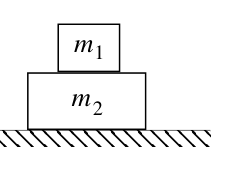 Due blocchi sovrapposti su piano
Topic: Newtonian Mechanics Metodi: Free-Body Diagram, Vector Decomposition, Kinematic Equations Competenze: Diagrammatic Reasoning, Mathematical Modeling Objects: Block Fonte: Testo (PDF) — p.7
- Due blocchi di massa kg e kg sono impilati insieme su un tavolo senza attrito come
- E’ stato mostrato. Il coefficiente di attrito statico tra i blocchi è . Qual è la minima orizzontale la forza che deve essere applicata al blocco superiore per farlo scivolare attraverso il blocco inferiore?
- A. 4.0 N
- B. 6.0 N
- C. 8.0 N
- D. 12.0 N
- E. Il blocco superiore non scivola attraverso il blocco inferiore
Due blocchi sovrapposti su pianoforte
Topic: Newtonian Mechanics Metodi: Free-Body Diagram, Vector Decomposition, Kinematic Equations Competenze: Diagrammatic Reasoning, Mathematical Modeling Objects: Block Fonte: Testo (PDF) — p.7
- A spool is made of a cylinder with a thin disc attached to either end of the cylinder, as shown. The cylinder has radius r = 0.75 cm and the discs each have radius R = 1.00 cm. A string is attached to the cylinder and wound around the cylinder a few times. At what angle above the horizontal can the string be pulled so that the spool will slip without rotating? 2R 2r side−view
- A.
- B.
- C.
- D.
- E.
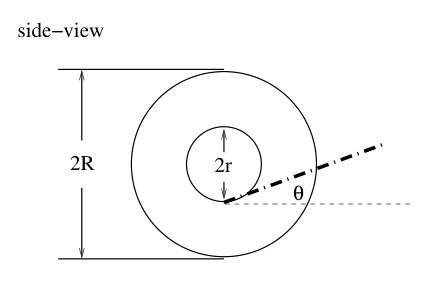 Bobina con spola e angolo theta
Topic: Newtonian Mechanics, Rigid Body Statics Metodi: Free-Body Diagram, Torque & Angular Momentum Analysis, Vector Decomposition Competenze: Diagrammatic Reasoning, Mathematical Modeling Objects: Cylinder, Disk, String Fonte: Testo (PDF) — p.7
- Una bobina è costituita da un cilindro con un disco sottile attaccato a entrambe le estremità del cilindro, come mostrato. Il il cilindro ha un raggio r = 0,75 cm e i dischi hanno un raggio R = 1,00 cm. Una corda è attaccata alla cilindro e rotolo intorno al cilindro qualche volta. A quale angolo sopra l’orizzontale la corda può essere tirato in modo che la bobina scivoli senza ruotare? 2R 2r vista laterale
- A.
- B.
- C.
- D.
- E.
Bobina con spola e angolo theta
Topic: Newtonian Mechanics, Rigid Body Statics Metodi: Free-Body Diagram, Torque & Angular Momentum Analysis, Vector Decomposition Competenze: Diagrammatic Reasoning, Mathematical Modeling Objects: Cylinder, Disk, String Fonte: Testo (PDF) — p.7
- You are standing on a weight scale that reads 700 Newtons while holding a large physics textbook that is originally at rest. At time t = 1 seconds you begin moving the textbook upward so that by time t = 2 seconds the textbook is now half a meter higher and once again at rest. Which of the following graphs best illustrates how the reading on the scale might vary with time? (A) (B) 0 0.5 1 1.5 2 2.5 3 690 695 700 705 710 time (seconds) weight (Newtons) 0 0.5 1 1.5 2 2.5 3 690 695 700 705 710 time (seconds) weight (Newtons) (C) (D) 0 0.5 1 1.5 2 2.5 3 690 695 700 705 710 time (seconds) weight (Newtons) 0 0.5 1 1.5 2 2.5 3 690 695 700 705 710 time (seconds) weight (Newtons) (E) 0 0.5 1 1.5 2 2.5 3 690 695 700 705 710 time (seconds) weight (Newtons)
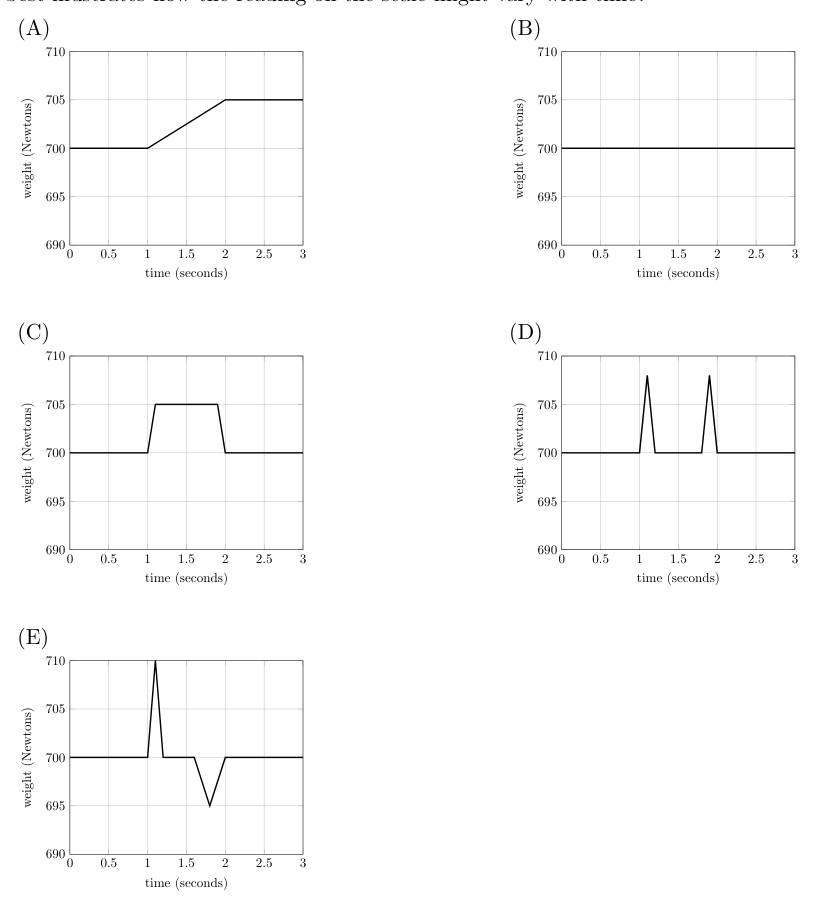 Cinque grafici peso vs tempo
Topic: Newtonian Mechanics Metodi: Free-Body Diagram, Kinematic Equations Competenze: Physical Reasoning, Diagrammatic Reasoning Objects: — Fonte: Testo (PDF) — p.8
- Stai in piedi su una scala di peso che legge 700 Newton mentre tieni un grande libro di fisica che è originariamente in riposo. Al tempo t = 1 secondo si inizia a spostare il libro di testo verso l’alto in modo che per il tempo t = 2 Secondi il libro di testo è ora mezzo metro più alto e ancora una volta a riposo. Qual è il grafico seguente il miglior esempio di come la lettura sulla scala potrebbe variare nel tempo? (A) (B) 0 0.5 1 1.5 2 2.5 3 690 695 700 705 710 tempo (secondi) peso (Newtons) 0 0.5 1 1.5 2 2.5 3 690 695 700 705 710 tempo (secondi) peso (Newtons) (C) (D) 0 0.5 1 1.5 2 2.5 3 690 695 700 705 710 tempo (secondi) peso (Newtons) 0 0.5 1 1.5 2 2.5 3 690 695 700 705 710 tempo (secondi) peso (Newtons) (E) 0 0.5 1 1.5 2 2.5 3 690 695 700 705 710 tempo (secondi) peso (Newtons)
Cinque grafici peso vs tempo
Topic: Newtonian Mechanics Metodi: Free-Body Diagram, Kinematic Equations Competenze: Physical Reasoning, Diagrammatic Reasoning Objects: — Fonte: Testo (PDF) — p.8
- A plane can fly by tilting the trailing edge of the wings downward by a small angle , called the angle of attack. In still air, a plane with ground speed v will have a lift force proportional to and a drag force is proportional to . Consider a plane initially in level flight in still air with constant ground speed v. If the plane enters a region with a tailwind with speed w < v (the wind is blowing in the same direction that the plane wants to fly), how must the engine power and the angle of attack change for the plane to maintain level flight at the same ground speed?
- A. The engine power decreases and the angle of attack decreases
- B. The engine power decreases and the angle of attack stays the same
- C. The engine power decreases and the angle of attack increases
- D. The engine power increases and the angle of attack decreases
- E. The engine power increases and the angle of attack increases
Topic: Fluid Mechanics, Newtonian Mechanics Metodi: Physical Modeling, Dimensional Analysis Competenze: Physical Reasoning, Mathematical Modeling Objects: — Fonte: Testo (PDF) — p.9
- Un piano può volare inclinando il bordo di allevamento delle ali verso il basso con un angolo piccolo , chiamato angolo di attacco. In aria ferma, un aereo con velocità a terra v avrà una forza di sollevamento proporzionale a e una forza di trazione è proporzionale a . Considerate un aereo inizialmente in volo a livello in aria ferma con velocità di terra costante v. Se l’aereo entra in un regione con un vento a coda con velocità w < v (il vento soffia nella stessa direzione che l’aereo vuole per volare), come devono cambiare la potenza del motore e l’angolo di attacco per mantenere il volo a livello alla stessa velocità del suolo?
- A. La potenza del motore diminuisce e l’angolo di attacco diminuisce
- B. La potenza del motore diminuisce e l’angolo di attacco rimane lo stesso
- C. La potenza del motore diminuisce e l’angolo di attacco aumenta
- D. La potenza del motore aumenta e l’angolo di attacco diminuisce
- E. Aumenta la potenza del motore e aumenta l’angolo di attacco
Topic: Fluid Mechanics, Newtonian Mechanics Metodi: Physical Modeling, Dimensional Analysis Competenze: Physical Reasoning, Mathematical Modeling Objects: — Fonte: Testo (PDF) — p.9
- A pogo stick is modeled as a massless spring of spring constant k attached to the bottom of a block of mass m. The pogo stick is dropped with the spring pointing downward and hits the ground with speed v. At the moment of the collision, the free end of the spring sticks permanently to the ground. m v k During the subsequent oscillations, the maximum speed of the block is
- A.
- B.
- C.
- D.
- E.
Topic: Oscillations & Waves, Conservation of Energy Metodi: Energy Conservation Method, Simple Harmonic Motion Analysis, Conservation Laws Competenze: Mathematical Modeling, Physical Reasoning Objects: Spring, Block Fonte: Testo (PDF) — p.9
- Un palo di pogo è modellato come una sorgente senza massa di costante di primavera k attaccata al fondo di un blocco di massa m. Il palo di pogo viene abbassato con la molla puntata verso il basso e colpisce il terreno con velocità v. Nel momento della collisione, l’estremità libera della molla si attacca permanentemente al terreno. m v k Durante le oscillazioni successive, la velocità massima del blocco è
- A.
- B.
- C.
- D.
- E.
Topic: Oscillations & Waves, Conservation of Energy Metodi: Energy Conservation Method, Simple Harmonic Motion Analysis, Conservation Laws Competenze: Mathematical Modeling, Physical Reasoning Objects: Spring, Block Fonte: Testo (PDF) — p.9
- A spring of relaxed length and spring constant is placed ‘in parallel’ with a spring of relaxed length and spring constant . A force F is applied to each end. Spring 1 Spring 2 F F The combination of the springs acts like a single spring with spring constant k and relaxed length where (A) and (B) and (C) and (D) and (E) and
Topic: Oscillations & Waves, Newtonian Mechanics Metodi: Hooke’s Law, Physical Modeling, Superposition Principle Competenze: Mathematical Modeling, Physical Reasoning Objects: Spring Fonte: Testo (PDF) — p.10
- Una molla di lunghezza rilassata e una costante di molla sono posizionate in parallelo con una molla di lunghezza rilassata e costante di primavera . Una forza F viene applicata a ciascuna estremità. Primavera 1 Primavera 2 F F La combinazione delle molle agisce come una sola molla con una costante molla k e una lunghezza rilassata , dove (A) e (B) e (C) e (D) e (E) e
Topic: Oscillations & Waves, Newtonian Mechanics Metodi: Hooke’s Law, Physical Modeling, Superposition Principle Competenze: Mathematical Modeling, Physical Reasoning Objects: Spring Fonte: Testo (PDF) — p.10
- In an experiment to determine the speed of sound, a student measured the distance that a sound wave traveled to be cm, and found the time it took the sound wave to travel this distance to be ms. Assume the uncertainties are Gaussian. The computed speed of sound should be recorded as
- A. m/s
- B. m/s
- C. m/s
- D. m/s
- E. m/s
Topic: Oscillations & Waves Metodi: Error Propagation, Experimental Data Analysis Competenze: Error Propagation, Experimental Data Analysis, Significant Figures Objects: — Fonte: Testo (PDF) — p.10
- In un esperimento per determinare la velocità del suono, uno studente ha misurato la distanza che un’onda sonora traveled to be cm, and found the time it took the sound wave to travel this distance to be ms. Supponiamo che le incertezze siano gaussiane. La velocità del suono calcolata deve essere registrata as
- A. m/s
- B. m/s
- C. m/s
- D. m/s
- E. m/s
Topic: Oscillations & Waves Metodi: Error Propagation, Experimental Data Analysis Competenze: Error Propagation, Experimental Data Analysis, Significant Figures Objects: — Fonte: Testo (PDF) — p.10
- A massive, uniform, flexible string of length L is placed on a horizontal table of length L/3 that has a coefficient of friction , so equal lengths L/3 of string hang freely from both sides of the table. The string passes over the edges of the table on smooth, frictionless, curved surfaces. Now suppose that one of the hanging ends of the string is pulled a distance x downward, then released at rest. Neither end of the string ever touches the ground in this problem. The maximum value of x so that the string does not slip off of the table is
- A. L/42
- B. L/21
- C. L/14
- D. 2L/21
- E. 3L/14
Topic: Newtonian Mechanics, Conservation of Energy Metodi: Free-Body Diagram, Energy Conservation Method, Conservation Laws Competenze: Mathematical Modeling, Physical Reasoning Objects: String Fonte: Testo (PDF) — p.10
- Una stringa massiccia, uniforme e flessibile di lunghezza L è posizionata su una tavola orizzontale di lunghezza L/3 che ha un il coefficiente di attrito , quindi le lunghezze uguali L/3 della corda appendono liberamente da entrambi i lati della tavola. La corda passa sui bordi del tavolo su superfici curve lisce, senza attrito. Ora supponiamo che una delle estremità appese della corda sia tirata una distanza x verso il basso, quindi rilasciata
- In riposo. Nessuna estremità della corda tocca il terreno in questo problema. Il valore massimo di x così che la corda non scivola dal tavolo è
- A. L/42
- B. L/21
- C. L/14
- D. 2L/21
- E. 3L/14
Topic: Newtonian Mechanics, Conservation of Energy Metodi: Free-Body Diagram, Energy Conservation Method, Conservation Laws Competenze: Mathematical Modeling, Physical Reasoning Objects: String Fonte: Testo (PDF) — p.10
- A uniform bar of length L and mass M is supported by a fixed pivot a distance x from its center. The bar is released from rest from a horizontal position. The period of the resulting oscillations is minimal when
- A.
- B.
- C.
- D.
- E.
Topic: Oscillations & Waves, Rotational Dynamics Metodi: Simple Harmonic Motion Analysis, Torque & Angular Momentum Analysis, Calculus-Integration Competenze: Mathematical Modeling, Physical Reasoning Objects: Rod Fonte: Testo (PDF) — p.11
- Una barra uniforme di lunghezza L e massa M è sostenuta da un pivot fisso a una distanza x dal suo centro. Il la barra viene rilasciata dal riposo da una posizione orizzontale. Il periodo delle oscillazioni risultanti è minimo quando
- A.
- B.
- C.
- D.
- E.
Topic: Oscillations & Waves, Rotational Dynamics Metodi: Simple Harmonic Motion Analysis, Torque & Angular Momentum Analysis, Calculus-Integration Competenze: Mathematical Modeling, Physical Reasoning Objects: Rod Fonte: Testo (PDF) — p.11
- Two particles of mass m are connected by pulleys as shown. v m m The mass on the left is given a small horizontal velocity, and oscillates back and forth. The mass on the right
- A. remains at rest
- B. oscillates vertically, and with a net upward motion
- C. oscillates vertically, and with a net downward motion
- D. oscillates vertically, with no net motion
- E. oscillates horizontally, with no net motion
Topic: Newtonian Mechanics, Oscillations & Waves Metodi: Free-Body Diagram, Physical Modeling, Conservation Laws Competenze: Physical Reasoning, Diagrammatic Reasoning Objects: Pulley Fonte: Testo (PDF) — p.11
- Due particelle di massa m sono collegate da pollice come mostrato. v m m La massa a sinistra ha una piccola velocità orizzontale e oscilla avanti e indietro. La massa del Giusto
- A. rimane in riposo
- B. oscilla verticalmente, con un movimento netto verso l’alto
- C. oscilla verticalmente, con un movimento netto verso il basso
- D. oscilla verticalmente, senza movimento netto
- E. oscilla orizzontalmente, senza movimento netto
Topic: Newtonian Mechanics, Oscillations & Waves Metodi: Free-Body Diagram, Physical Modeling, Conservation Laws Competenze: Physical Reasoning, Diagrammatic Reasoning Objects: Pulley Fonte: Testo (PDF) — p.11
- Two particles with mass and are connected by a massless rigid rod of length L and placed on a horizontal frictionless table. At time t = 0, the first mass receives an impulse perpendicular to the rod, giving it speed v. At this moment, the second mass is at rest. The next time the second mass is at rest is
- A.
- B.
- C.
- D.
- E.
Topic: Newtonian Mechanics, Rotational Dynamics Metodi: Impulse-Momentum Theorem, Torque & Angular Momentum Analysis, Conservation Laws Competenze: Mathematical Modeling, Physical Reasoning Objects: Rod Fonte: Testo (PDF) — p.11
- Due particelle di massa e sono collegate da una barra rigida senza massa di lunghezza L e collocate su una tavolo senza attrito orizzontale. Al tempo t = 0, la prima massa riceve un impulso perpendicolare alla canna,
- E’ la velocità V. In questo momento, la seconda massa è in riposo. La prossima volta che la seconda massa si riposa è
- A.
- B.
- C.
- D.
- E.
Topic: Newtonian Mechanics, Rotational Dynamics Metodi: Impulse-Momentum Theorem, Torque & Angular Momentum Analysis, Conservation Laws Competenze: Mathematical Modeling, Physical Reasoning Objects: Rod Fonte: Testo (PDF) — p.11
- A particle of mass m is placed at the center of a hemispherical shell of radius R and mass density , where has dimensions of . m R The gravitational force of the shell on the particle is
- A.
- B.
- C.
- D.
- E.
Topic: Gravitation Metodi: Newton’s Law of Gravitation, Calculus-Integration, Symmetry Argument Competenze: Mathematical Modeling, Physical Reasoning Objects: Sphere Fonte: Testo (PDF) — p.12
- Una particella di massa m è collocata al centro di una conchiglia emisferica di raggio R e densità di massa , dove ha dimensioni di . m R La forza gravitazionale della conchiglia sulla particella è
- A.
- B.
- C.
- D.
- E.
Topic: Gravitation Metodi: Newton’s Law of Gravitation, Calculus-Integration, Symmetry Argument Competenze: Mathematical Modeling, Physical Reasoning Objects: Sphere Fonte: Testo (PDF) — p.12
- A student is measuring the surface area of a cylindrical wire. The student measures the radius of the wire to be cm using a ruler and the length of the wire to be m using a meter-stick. The precision of their result can be increased in several ways. 1: Upgrade the ruler to a caliper with uncertainty 0.01 cm. 2: Upgrade the meter-stick to a tape measure with uncertainty 0.001 m. 3: Repeat the measurement independently ten times and average the results. How do the resulting uncertainties of the measurements compare?
- A. Method 3 has the lowest uncertainty, while methods 1 and 2 have the same uncertainty
- B. Method 3 has the highest uncertainty, while methods 1 and 2 have the same uncertainty
- C. Method 1 has the highest uncertainty, and method 2 has the lowest
- D. Method 2 has the highest uncertainty, and method 1 has the lowest
- E. Method 2 has the highest uncertainty, and method 3 has the lowest
Topic: Oscillations & Waves Metodi: Error Propagation, Experimental Data Analysis Competenze: Error Propagation, Experimental Data Analysis, Measurement & Instrumentation Objects: Wire, Cylinder Fonte: Testo (PDF) — p.12
- Uno studente sta misurando la superficie di un filo cilindrico. Lo studente misura il raggio di il filo deve essere cm utilizzando una regola e la lunghezza del filo deve essere m utilizzando un bastone di misura. La precisione del loro risultato può essere aumentata in diversi modi. 1: Aggiornare la regolazione a un calibro con incertezza di 0,01 cm. 2: Aggiornare il bastone di misurazione a un nastro di misura con un’incertezza di 0,001 m. 3: Ripetere la misurazione indipendentemente dieci volte e media i risultati. Come si confrontano le incertezze risultanti dalle misurazioni?
- A. Il metodo 3 ha la minore incertezza, mentre i metodi 1 e 2 hanno la stessa incertezza
- B. Il metodo 3 ha la maggiore incertezza, mentre i metodi 1 e 2 hanno la stessa incertezza
- C. Il metodo 1 ha la maggiore incertezza e il metodo 2 la più bassa
- D. Il metodo 2 ha la maggiore incertezza e il metodo 1 la più bassa
- E. Il metodo 2 ha la maggiore incertezza e il metodo 3 la più bassa
Topic: Oscillations & Waves Metodi: Error Propagation, Experimental Data Analysis Competenze: Error Propagation, Experimental Data Analysis, Measurement & Instrumentation Objects: Wire, Cylinder Fonte: Testo (PDF) — p.12