Question A1
a. Suppose you drop a block of mass vertically onto a fixed ramp with angle with coefficient of static and kinetic friction . The block is dropped in such a way that it does not rotate after colliding with the ramp. Throughout this problem, assume the time of the collision is negligible.
i. Suppose the block’s speed just before it hits the ramp is and the block slides down the ramp immediately after impact. What is the speed of the block right after the collision? ii. What is the minimum such that the speed of the block right after the collision is 0?
b. Now suppose you drop a sphere with mass , radius and moment of inertia vertically onto the same fixed ramp such that it reaches the ramp with speed .
i. Suppose the sphere immediately begins to roll without slipping. What is the new speed of the sphere in this case? ii. What is the minimum coefficient of friction such that the sphere rolls without slipping immediately after the collision?
 Block dropped onto inclined ramp angle theta
Topic: Newtonian Mechanics, Rotational Dynamics Metodi: Impulse-Momentum Theorem, Torque & Angular Momentum Analysis, Free-Body Diagram Competenze: Physical Reasoning, Mathematical Modeling Objects: Block, Inclined Plane, Sphere Fonte: Testo (PDF) — p.3
La domanda A1
a. Supponiamo di abbassare verticalmente un blocco di massa su una rampa fissa con angolo con coefficiente di attrito statico e cinetico . Il blocco è caduto in modo tale che non ruota dopo aver colpito la rampa. Durante tutto questo problema, supponiamo che l’ora della collisione sia trascurabile.
i. Supponiamo che la velocità del blocco appena prima di colpire la rampa sia e il blocco scivoli giù la rampa immediatamente dopo l’impatto. Qual è la velocità del blocco subito dopo la collisione? ii. Qual è il minimo tale che la velocità del blocco subito dopo la collisione sia di 0?
b. Ora supponiamo di abbassare una sfera con massa , raggio e momento di inerzia verticalmente sulla stessa rampa fissa in modo che raggiunga la rampa con velocità .
i. Supponiamo che la sfera comincia immediatamente a rotolare senza scivolare. Qual è la nuova velocità della sfera in questo caso? ii. Qual è il coefficiente minimo di attrito tale che la sfera ruoli senza scivolare immediatamente dopo la collisione?
Block caduto su angolo di rampa inclinato theta
Topic: Newtonian Mechanics, Rotational Dynamics Metodi: Impulse-Momentum Theorem, Torque & Angular Momentum Analysis, Free-Body Diagram Competenze: Physical Reasoning, Mathematical Modeling Objects: Block, Inclined Plane, Sphere Fonte: Testo (PDF) — p.3
Question A2
For this problem, graphical answers should be drawn on the answer sheets graphs provided. Supporting work is to be written on blank answer sheets. Incorrect graphs without supporting work will receive no partial credit.
The current as a function of voltage for a certain electrical device is
where is the magnitude of the charge on an electron, is Boltzmann’s constant, and is the absolute temperature. and are non-zero positive constants. Throughout this problem assume low temperature values .
a. On the answer sheets, sketch a graph of the current versus voltage for low temperature values , clearly indicating any asymptotic behavior.
Shown is a schematic for the device. Positive voltage means that the electric potential of the left hand side of the device is higher than the right hand side. For this device, and .
Below is a circuit made up of these elements. The voltage supplied the circuit is sinusoidal, , and is also shown on answer sheets. The resistance is and .
b. Sketch the potential difference as a function of time on the answer sheet. For your convenience, is shown in light gray. Assume that has been running for a long time.
A capacitor is connected to the circuit as shown below. The capacitance is .
c. Sketch the new potential difference as a function of time on the answer sheet. For your convenience, is shown in light gray. Assume that has been running for a long time.
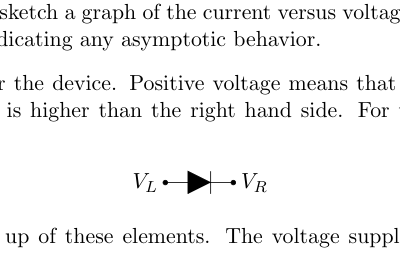 Schematic of nonlinear I-V device
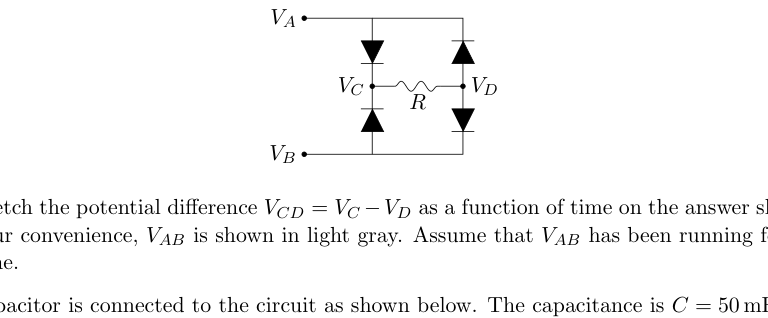 Rectifier circuit with resistance R
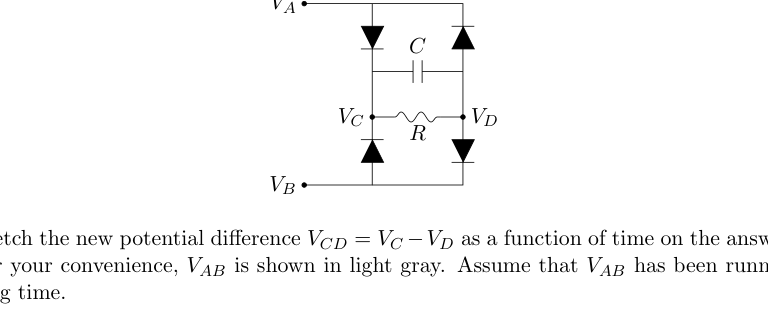 Rectifier circuit with capacitor C and R
Topic: Circuits, Electrostatics Metodi: Kirchhoff’s Laws, Equivalent Circuit Reduction, Electric Potential Method Competenze: Diagrammatic Reasoning, Physical Reasoning Objects: Resistor, Capacitor Fonte: Testo (PDF) — p.4
La domanda A2
Per questo problema, le risposte grafiche dovrebbero essere disegnate sui grafici delle schede di risposta fornite. Il lavoro di supporto deve essere scritto su fogli di risposte in bianco. Grafici errati senza lavoro di supporto non riceveranno alcun credito parziale.
La corrente in funzione della tensione per un determinato dispositivo elettrico è
dove è la magnitudine della carica su un elettrone, è la costante di Boltzmann e è la temperatura assoluta. e sono costanti positive non zero. In tutto questo problema si assumono valori di bassa temperatura .
a. Sulla scheda delle risposte, disegnare un grafico della corrente contro la tensione per i valori a bassa temperatura , indicando chiaramente qualsiasi comportamento asimptotico.
Si vede un schema per il dispositivo. La tensione positiva significa che il potenziale elettrico del lato sinistro del dispositivo è superiore al lato destro. Per questo dispositivo, e .
Di seguito è riportato un circuito composto da questi elementi. La tensione fornita al circuito è sinusoidale, , ed è anche indicata sulle schede di risposta. La resistenza è e .
b. Segnare la differenza potenziale in funzione del tempo sulla scheda delle risposte. Per la vostra comodità, è indicato in grigio chiaro. Supponiamo che sia in funzione da molto tempo.
Un condensatore è collegato al circuito come mostrato di seguito. La capacità è .
c. Segnare la nuova differenza di potenziale in funzione del tempo nella scheda delle risposte. Per la vostra comodità, è indicato in grigio chiaro. Supponiamo che sia in funzione da molto tempo.
Schematica del dispositivo I-V non lineare
Circuito di rettifica con resistenza R
Circuito di rettifica con condensatore C e R
Topic: Circuits, Electrostatics Metodi: Kirchhoff’s Laws, Equivalent Circuit Reduction, Electric Potential Method Competenze: Diagrammatic Reasoning, Physical Reasoning Objects: Resistor, Capacitor Fonte: Testo (PDF) — p.4
Question A3
A vacuum system consists of a chamber of volume connected to a vacuum pump that is a cylinder with a piston that moves left and right. The minimum volume in the pump cylinder is , and the maximum volume in the cylinder is . You should assume that .
The cylinder has two valves. The inlet valve opens when the pressure inside the cylinder is lower than the pressure in the chamber, but closes when the piston moves to the right. The outlet valve opens when the pressure inside the cylinder is greater than atmospheric pressure , and closes when the piston moves to the left. A motor drives the piston to move back and forth. The piston moves at such a rate that heat is not conducted in or out of the gas contained in the cylinder during the pumping cycle. One complete cycle takes a time . You should assume that is a very small quantity, but is finite. The gas in the chamber is ideal monatomic and remains at a fixed temperature of .
Start with the assumption that and there are no leaks in the system.
a. At the pressure inside the chamber is . Find an equation for the pressure at a later time .
b. Find an expression for the temperature of the gas as it is emitted from the pump cylinder into the atmosphere. Your answer may depend on time.
For the remainder of this problem .
c. Find an expression for the minimum possible pressure in the chamber, .
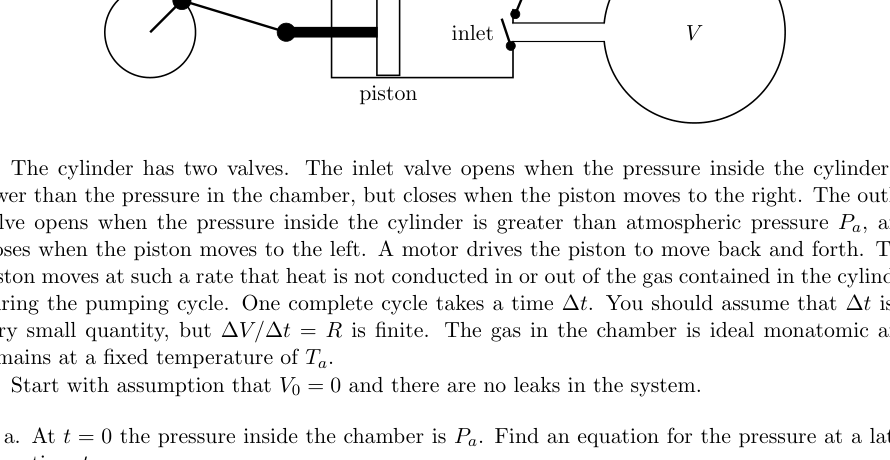 Vacuum pump cylinder piston chamber diagram
Topic: Thermodynamics, Kinetic Theory Metodi: Ideal Gas Law, First Law of Thermodynamics, Differential Equations Competenze: Physical Reasoning, Mathematical Modeling Objects: Gas, Cylinder, Piston Fonte: Testo (PDF) — p.5
La domanda A3
Un sistema di vuoto è costituito da una camera di volume collegata a una pompa a vuoto che è un cilindro con un pistone che si muove a sinistra e a destra. Il volume minimo del cilindro della pompa è e il volume massimo del cilindro è . Dovresti supporre che .
Il cilindro ha due valvole. La valvola di ingresso si apre quando la pressione all’interno del cilindro è inferiore alla pressione nella camera, ma si chiude quando il pistone si muove a destra. La valvola di uscita si apre quando la pressione all’interno del cilindro è superiore alla pressione atmosferica e si chiude quando il pistone si sposta a sinistra. Un motore guida il pistone a muoversi avanti e indietro. Il pistone si muove a tale velocità che il calore non entra o esce dal gas contenuto nel cilindro durante il ciclo di pompaggio. Un ciclo completo richiede un tempo . Si dovrebbe supporre che sia una quantità molto piccola, ma è finita. Il gas nella camera è monatomico ideale e rimane a una temperatura fissa di .
Iniziamo con l’ipotesi che e non ci siano perdite nel sistema.
a. A la pressione all’interno della camera è . Trova un’equazione per la pressione in un momento successivo .
b. Trova un’espressione della temperatura del gas quando viene emesso dalla pompa in atmosfera. La risposta dipende dal tempo.
Per il resto di questo problema .
c. Trova un’espressione per la pressione minima possibile nella camera, .
*Diagramma della camera del piston della pompa a vuoto *
Topic: Thermodynamics, Kinetic Theory Metodi: Ideal Gas Law, First Law of Thermodynamics, Differential Equations Competenze: Physical Reasoning, Mathematical Modeling Objects: Gas, Cylinder, Piston Fonte: Testo (PDF) — p.5
Question B1
The electric potential at the center of a cube with uniform charge density and side length is
You do not need to derive this. For the entirety of this problem, any computed numerical constants should be written to three significant figures.
a. What is the electric potential at a corner of the same cube? Write your answer in terms of , , , and any necessary numerical constants.
b. What is the electric potential at the tip of a pyramid with a square base of side length , height , and uniform charge density ? Write your answer in terms of , , , and any necessary numerical constants.
c. What is the electric potential due to a square plate with side length of uniform charge density at a height above its center? Write your answer in terms of , , , and any necessary numerical constants.
d. Let be the electric field at a height above the center of a square with charge density and side length . If the electric potential at the center of the square is approximately , estimate by assuming that is linear in for . Write your answer in terms of , , , and any necessary numerical constants.
Topic: Electrostatics Metodi: Electric Potential Method, Symmetry Argument, Superposition Principle Competenze: Mathematical Modeling, Physical Reasoning Objects: — Fonte: Testo (PDF) — p.7
La domanda B1
Il potenziale elettrico al centro di un cubo con densità di carica uniforme e lunghezza laterale è
Non devi derivare questo. Per l’intera composizione di questo problema, tutte le costanti numeriche calcolate dovrebbero essere scritte a tre cifre significative.
a. Qual è il potenziale elettrico in un angolo dello stesso cubo? Scrivi la tua risposta in termini di , , e di eventuali costanti numeriche necessarie.
b. Qual è il potenziale elettrico della punta di una piramide con base quadrata di lunghezza laterale , altezza e densità di carica uniforme ? Scrivi la tua risposta in termini di , , e di eventuali costanti numeriche necessarie.
c. Qual è il potenziale elettrico dovuto a una piastra quadrata con lunghezza laterale di densità di carica uniforme ad un’altezza sopra il suo centro? Scrivi la tua risposta in termini di , , e di eventuali costanti numeriche necessarie.
d. Il campo elettrico è a un’altezza sopra il centro di un quadrato con densità di carica e lunghezza laterale . Se il potenziale elettrico al centro del quadrato è approssimativamente , stima supponendo che sia lineare in per . Scrivi la tua risposta in termini di , , e di eventuali costanti numeriche necessarie.
Topic: Electrostatics Metodi: Electric Potential Method, Symmetry Argument, Superposition Principle Competenze: Mathematical Modeling, Physical Reasoning Objects: — Fonte: Testo (PDF) — p.7
Question B2
In this problem, use a particle-like model of photons: they propagate in straight lines and obey the law of reflection, but are subject to the quantum uncertainty principle. You may use small-angle approximations throughout the problem.
A photon with wavelength has traveled from a distant star to a telescope mirror, which has a circular cross-section with radius and a focal length . The path of the photon is nearly aligned to the axis of the mirror, but has some slight uncertainty . The photon reflects off the mirror and travels to a detector, where it is absorbed by a particular pixel on a charge-coupled device (CCD).
Suppose the telescope mirror is manufactured so that photons coming in parallel to each other are focused to the same pixel on the CCD, regardless of where they hit the mirror. Then all small cross-sectional areas of the mirror are equally likely to include the point of reflection for a photon.
a. Find the standard deviation of the distribution for , the distance from the center of the telescope mirror to the point of reflection of the photon.
b. Use the uncertainty principle, , to place a bound on how accurately we can know the angle of the photon from the axis of the telescope. Give your answer in terms of and . If you were unable to solve part a, you may also give your answer in terms of .
c. Suppose we want to build a telescope that can tell with high probability whether a photon it detected from Alpha Centauri A came the left half or right half of the star. Approximately how large would a telescope have to be to achieve this? Alpha Centauri A is approximately from Earth and has a radius approximately . Assume visible light with .
Topic: Modern-Quantum Physics, Wave Optics Metodi: Small-Angle Approximation, Approximation & Series Expansion, Physical Modeling Competenze: Physical Reasoning, Estimation & Approximation Objects: Photon, Mirror, Star Fonte: Testo (PDF) — p.8
La domanda B2
In questo problema, utilizzare un modello di fotoni simile a particelle: si propagano in linee rette e obbediscono alla legge della riflessione, ma sono soggetti al principio di incertezza quantistica. Potreste usare approssimazioni a piccolo angolo durante tutto il problema.
Un fotone con lunghezza d’onda è passato da una stella lontana a uno specchio telescopico, che ha una sezione incrociata circolare con raggio e distanza focale . Il percorso del fotone è quasi allineato all’asse dello specchio, ma presenta una leggera incertezza . Il fotone si riflette dallo specchio e si sposta verso un rilevatore, dove viene assorbito da un particolare pixel su un dispositivo accoppiato a carica (CCD).
Supponiamo che lo specchio del telescopio sia fabbricato in modo che i fotoni che vengono paralleli l’uno all’altro siano focalizzati sullo stesso pixel sul CCD, indipendentemente da dove colpiscono lo specchio. Quindi tutte le piccole aree di sezione trasversale dello specchio hanno ugualmente probabilità di includere il punto di riflessione per un fotone.
a. Trova la deviazione standard della distribuzione per , la distanza dal centro dello specchio del telescopio al punto di riflessione del fotone.
b. Utilizzare il principio di incertezza, , per stabilire un limite su quanto accuratamente possiamo conoscere l’angolo del fotone dall’asse del telescopio. Rispondi in termini di e . Se non è stato possibile risolvere la parte a, è possibile fornire la risposta anche in termini di .
c. Supponiamo che vogliamo costruire un telescopio che possa dire con alta probabilità se un fotone che ha rilevato da Alpha Centauri A è venuto dalla metà sinistra o la metà destra della stella. Quanti dimensioni circa dovrebbe avere un telescopio per raggiungere questo obiettivo? Alpha Centauri A è circa dalla Terra e ha un raggio di circa . Assumiamo la luce visibile con .
Topic: Modern-Quantum Physics, Wave Optics Metodi: Small-Angle Approximation, Approximation & Series Expansion, Physical Modeling Competenze: Physical Reasoning, Estimation & Approximation Objects: Photon, Mirror, Star Fonte: Testo (PDF) — p.8
Question B3
Radiation pressure from the sun is responsible for cleaning out the inner solar system of small particles.
a. The force of radiation on a spherical particle of radius is given by , where is the radiation pressure and is a dimensionless quality factor that depends on the relative size of the particle and the wavelength of light . Throughout this problem assume that the sun emits a single wavelength ; unless told otherwise, leave your answers in terms of symbolic variables.
i. Given that the total power radiated from the sun is given by , find an expression for the radiation pressure a distance from the sun. ii. Assuming that the particle has a density , derive an expression for the ratio in terms of , mass of sun , , particle radius , and quality factor . iii. The quality factor is given by one of the following: - If , - If , - If ,
Considering the three possible particle sizes, which is most likely to be blown away by the solar radiation pressure?
b. The Poynting-Robertson effect acts as another mechanism for cleaning out the solar system.
i. Assume that a particle is in a circular orbit around the sun. Find the speed of the particle in terms of , distance from sun , and any other fundamental constants. ii. Because the particle is moving, the radiation force is not directed directly away from the sun. Find the torque on the particle because of radiation pressure. You may assume that . iii. Since , the angular momentum of the particle changes with time. As such, develop a differential equation to find , the rate of change of the radial location of the particle. You may assume the orbit is always quasi-circular. iv. Develop an expression for the time required to remove particles of size and density originally in circular orbits at a distance , and use the numbers below to simplify your expression.
Some useful constants include:
Topic: Astrophysics, Newtonian Mechanics Metodi: Newton’s Law of Gravitation, Differential Equations, Conservation of Energy Competenze: Physical Reasoning, Mathematical Modeling Objects: Star Fonte: Testo (PDF) — p.9
La domanda B3
La pressione delle radiazioni del sole è responsabile della pulizia del sistema solare interno di piccole particelle.
a. La forza di radiazione su una particella sferica di raggio è data da , dove è la pressione di radiazione e è un fattore di qualità dimensionato che dipende dalla dimensione relativa della particella e dalla lunghezza d’onda della luce . Durante tutto questo problema, supponiamo che il sole emetta una singola lunghezza d’onda ; a meno che non si dica diversamente, lasciate le vostre risposte in termini di variabili simboliche.
i. Poiché la potenza totale irradiata dal sole è data da , si trova un’espressione per la pressione di radiazione a una distanza dal sole. ii. Supponendo che la particella abbia una densità , si derivi un’espressione per il rapporto in termini di , massa del sole , , raggio di particella e fattore di qualità . iii. Il fattore di qualità è dato da una delle seguenti caratteristiche: - If , - If , - If ,
Considerando le tre dimensioni possibili delle particelle, che probabilmente saranno respinte dalla pressione della radiazione solare?
b. L’effetto Poynting-Robertson agisce come un altro meccanismo per la pulizia del sistema solare.
i. Supponiamo che una particella sia in orbita circolare attorno al Sole. Trova la velocità della particella in termini di , la distanza dal sole e qualsiasi altra costante fondamentale. ii. Poiché la particella si muove, la forza della radiazione non è diretta direttamente lontano dal sole. Trova la coppia sulla particella a causa della pressione radiologica. Si può supporre che . iii. Dal momento che , la dinamica angolare della particella cambia con il tempo. Come tale, sviluppare un’equazione differenziale per trovare , il tasso di cambiamento della posizione radiale della particella. Si può supporre che l’orbita sia sempre quasi circolare. iv. Sviluppare un’espressione per il tempo necessario per rimuovere particelle di dimensioni e densità originariamente in orbite circolari a una distanza , e utilizzare i numeri di seguito per semplificare l’espressione.
Alcune costanti utili includono:
Topic: Astrophysics, Newtonian Mechanics Metodi: Newton’s Law of Gravitation, Differential Equations, Conservation of Energy Competenze: Physical Reasoning, Mathematical Modeling Objects: Star Fonte: Testo (PDF) — p.9