Problema 1 El piloto de un avión quiere ir en línea recta entre dos ciudades (A y B). Las ciudades distan una de otra y se encuentran sobre el mismo meridiano. La ciudad desde donde parte el avión (ciudad A) está al norte de la ciudad de destino (ciudad B).
El avión tiene una velocidad, respecto al aire en calma, de . Al momento del despegue, se le informa al piloto que existe un fuerte viento de en dirección este-oeste.
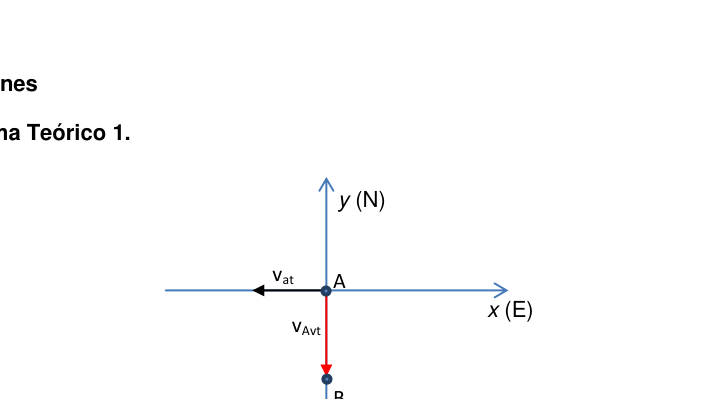
a) Realice un diagrama de la situación planteada. En el mismo indique el sistema de coordenadas a utilizar, la ubicación de las ciudades A y B, la velocidad del viento y la velocidad del avión respecto a tierra.
b) Escriba una expresión para la velocidad del avión respecto de tierra en función de la velocidad del avión respecto del aire y de la velocidad del viento.
c) ¿Cuál es la dirección en que el piloto debe apuntar el avión a fin que pueda realizar el viaje como lo desea?
d) ¿Cuánto tarda en realizar el viaje entre ambas ciudades?
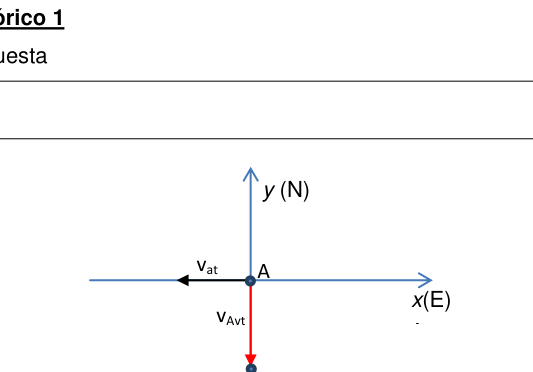 Diagramma vettori velocità A e B
 Vettori velocità avion, vat, vAvt
Vettori velocità con scomposizione vAva
Topic: Newtonian Mechanics Metodi: Vector Decomposition, Kinematic Equations, Free-Body Diagram Competenze: Diagrammatic Reasoning, Mathematical Modeling Objects: — Fonte: Testo (PDF) — p.2
Il problema 1 Il pilota di un aereo vuole andare in linea retta tra due città (A e B). Le città Distanza tra loro e si trovano sul medesimo meridiano. La città da dove parte l’aeroplano (città A) è a nord della città di destinazione (città B).
L’aereo ha una velocità, ** rispetto all’aria calma, ** di . Al momento del quando il volo è in partenza, il pilota è informato che vi è un forte vento di in direzione est-ovest.
a) Sviluppa un diagramma della situazione. In esso indicare il sistema di coordinate da utilizzare, la posizione delle città A e B, la velocità del vento e la velocità dell’aereo rispetto alla terra.
b) Scrivi un’espressione per la velocità dell’aereo rispetto alla terra in funzione la velocità dell’aereo rispetto all’aria e la velocità del vento.
(c) Qual è la direzione in cui il pilota deve puntare l’aereo per poter fare il viaggio come vuoi?
d) Quanto tempo ci vuole per fare il viaggio tra le due città?
Diagramma vettori velocità A e B
Vettori velocità avion, vat, vAvt
Vettori velocità con scomposizione vAva
Topic: Newtonian Mechanics Metodi: Vector Decomposition, Kinematic Equations, Free-Body Diagram Competenze: Diagrammatic Reasoning, Mathematical Modeling Objects: — Fonte: Testo (PDF) — p.2
The problem is 1 The pilot of an airplane wants to go in a straight line between two cities (A and B). The cities They are from each other and are on the same meridian. The city since where the aircraft departs (city A) is north of the destination city (city B).
The aircraft has a speed, ** with respect to calm air, ** of . At the time of the take-off, the pilot is informed that there is a strong east-west wind of .
(a) Draw a diagram of the situation. In the same, indicate the system of Coordinates to be used, location of cities A and B, wind speed and the plane’s speed relative to the ground.
(b) Write an expression for the plane’s speed relative to the ground as a function the speed of the aircraft relative to the air and the speed of the wind.
(c) What direction should the pilot point the aircraft in order to be able to Do you want to make the trip as you wish?
(d) How long does it take to travel between the two cities?
The following table shows the results of the tests:
The following is the list of the aircraft types used in the production of the aircraft:
The following table shows the results of the tests:
Topic: Newtonian Mechanics Metodi: Vector Decomposition, Kinematic Equations, Free-Body Diagram Competenze: Diagrammatic Reasoning, Mathematical Modeling Objects: — Fonte: Testo (PDF) — p.2
Problema 2 Dos resortes idénticos, ambos de constante y longitud natural , están fijos en los extremos opuestos de una pista plana como se muestra en la figura.
Se empuja un bloque de contra el resorte izquierdo comprimiéndolo . El bloque, inicialmente en reposo, se suelta.
La pista no tiene fricción, excepto en el tramo AB. Si el coeficiente de fricción dinámico es y la longitud AB es , encuentre:
- A. la velocidad del bloque en A.
- B. la velocidad del bloque en B.
- C. la compresión máxima del resorte de la derecha.
Luego de comprimir el resorte de la derecha, el bloque vuelve a pasar por el tramo AB y rebota en el resorte de la izquierda,
d) ¿Cuánto tiempo tarda en detenerse desde que empieza a transitar el tramo AB por tercera vez? e) Respecto del punto A, ¿dónde se detiene el bloque?
Considere
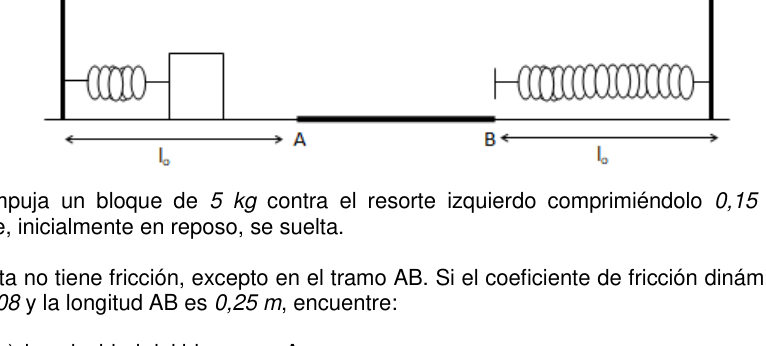 Due molle e blocco su piano con attrito
Topic: Conservation of Energy, Newtonian Mechanics Metodi: Energy Conservation Method, Free-Body Diagram, Kinematic Equations Competenze: Physical Reasoning, Mathematical Modeling Objects: Spring, Block Fonte: Testo (PDF) — p.3
Problema 2 Due sorgenti identiche, sia di costante che di lunghezza naturale , sono fissate in le estremità opposte di una pista piana come mostrato nella figura.
Un blocco di viene spinto contro la sorgente sinistra compresso . El blocco, inizialmente a riposo, si rilascia.
La pista non ha attrito, tranne che nel tratto AB. Se il coefficiente di attrito dinamico è e la lunghezza AB è , trovi:
- A. velocità del blocco in A.
- B. velocità del blocco in B.
- C. la compressione massima della molla destra.
Dopo aver compresso la sorgente a destra, il blocco passa di nuovo attraverso il tratto AB e Rilassato nella primavera di sinistra,
d) Quanto tempo ci vuole per fermarsi dopo che il tratto AB ha iniziato a passare Per la terza volta? e) Per quanto riguarda il punto A, dove si ferma il blocco?
Considera
Due molle e blocco il suo pianoforte con attrito
Topic: Conservation of Energy, Newtonian Mechanics Metodi: Energy Conservation Method, Free-Body Diagram, Kinematic Equations Competenze: Physical Reasoning, Mathematical Modeling Objects: Spring, Block Fonte: Testo (PDF) — p.3
Problem 2 Two identical springs, both of constant and natural length , are fixed at the opposite ends of a flat track as shown in Figure 1.
A block is pushed against the left spring by compressing it . El block, initially at rest, is released.
The track has no friction except on the AB section. If the dynamic friction coefficient is and the length AB is , find:
- A. the block speed in A.
- B. the block speed in B.
- C. the maximum spring compression on the right.
After compressing the spring on the right, the block goes through the AB stretch again and bounces off the spring on the left,
(d) How long does it take to stop after the AB section starts to transit For the third time? (e) With regard to point A, where does the block stop?
Consider the
I’ll just take your piano and block it with friction.
Topic: Conservation of Energy, Newtonian Mechanics Metodi: Energy Conservation Method, Free-Body Diagram, Kinematic Equations Competenze: Physical Reasoning, Mathematical Modeling Objects: Spring, Block Fonte: Testo (PDF) — p.3
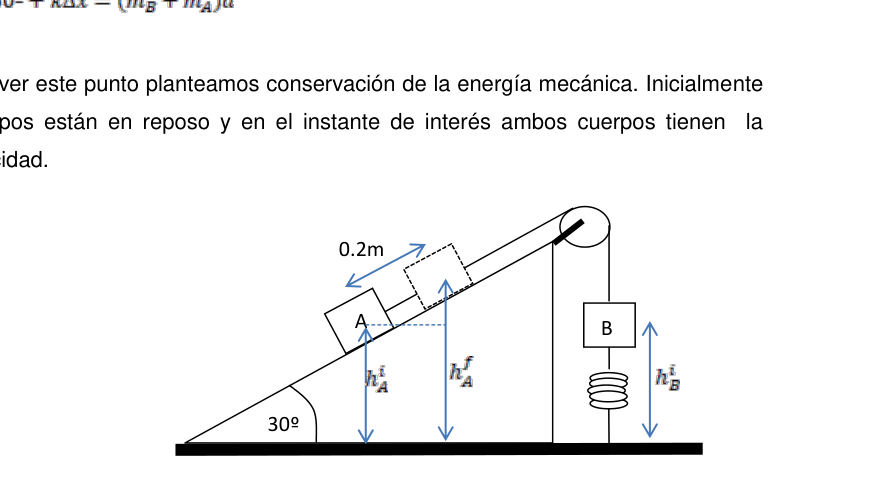
Problema 3 Un bloque A de se conecta a otro bloque B de por medio de una cuerda inextensible sin masa. La cuerda pasa por una polea sin fricción como se muestra en la figura.
El bloque B está conectado a un resorte que tiene una masa despreciable, una longitud natural de y una constante de fuerza de . El plano sobre el cual está apoyado el bloque A no presenta fricción. Inicialmente el bloque B está en reposo a del piso. Cuando el bloque B es liberado, ambos bloques comienzan a oscilar.
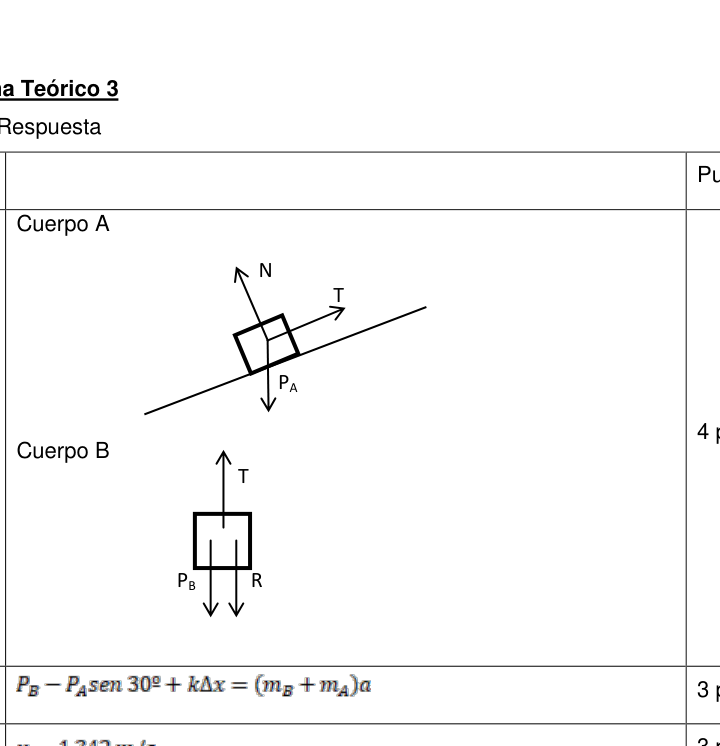
- A. Haga un diagrama aislado de fuerzas para cada bloque.
- B. Plantee las ecuaciones de movimiento.
- C. Calcule la velocidad de los bloques cuando el bloque B se encuentra a del piso (es decir, cuando el resorte no está deformado).
Considere Problema Teórico 1 Hoja de Respuesta Inciso
Puntaje a)
b)
d)
e) Problema Teórico 2 Hoja de Respuesta Inciso
Puntaje a)
b)
c)
d)
e) Problema Teórico 3 Hoja de Respuesta Inciso
Puntaje a)
b)
c) Olimpíada Argentina de Física
Pruebas Preparatorias Primera Prueba: Mecánica Parte Experimental
Nombre: …
D.N.I.: …
Escuela: …
- Antes de comenzar a resolver la prueba lea cuidadosamente TODO el enunciado de la misma.
- Escriba su nombre y su número de D.N.I. en el sitio indicado. No escriba su nombre en ningún otro sitio de la prueba.
- No escriba respuestas en las hojas del enunciado pues no serán consideradas.
- Escriba en un solo lado de las hojas. Radio de giro. La energía cinética de un cuerpo rígido se puede escribir como
donde es la velocidad del centro de masa, es la velocidad angular y e son la masa y el momento de inercia respecto del centro de masa del cuerpo, respectivamente.
Considere un cilindro de radio y masa ubicado sobre un plano inclinado (ver la figura). Suponga que inicialmente el cuerpo está en reposo en la posición que se indica en la figura.
Si se libera al cilindro, permitiendo que descienda “rodando sin deslizar” () por el plano inclinado, la conservación de la energía mecánica se puede escribir de la forma:
donde es la aceleración de la gravedad, es la altura que se indica en la figura y el tiempo en el que el cilindro recorre la distancia . Luego, se puede escribir,
donde es el radio de giro.
Objetivo Determinar el radio de giro de un cuerpo cilíndrico
Materiales
- Cuerpo cilíndrico (lata vacía -de durazno, atún-, pila, etc.).
- Plano inclinado (madera, carpeta rígida, etc.).
- Cronómetro.
- Regla.
- Papel.
Procedimiento
- Determine el perímetro del cuerpo cilíndrico.
- En el plano inclinado, marque una distancia (mayor o igual a ).
- Para la altura (ver figura), mida el tiempo en el cual el cuerpo cilíndrico recorre la distancia . Repita la medición al menos 5 (cinco) veces.
- Repita el punto c) para, al menos, 5 (cinco) valores diferentes de .
Consignas
- A. A partir de la medición de , determine .
- B. Reporte las mediciones realizadas en una tabla.
- C. A partir de las magnitudes medidas y de la ecuación 3, elija dos variables ( e ) de manera tal de obtener una relación lineal entre las mismas. Realice un gráfico de las variables elegidas. d) Haga un ajuste lineal de los puntos graficados, y determine la pendiente y la ordenada al origen. e) A partir de la ecuación 3 y de los valores obtenidos del ajuste, determine el radio de giro del cuerpo cilíndrico. Problema Experimental Hoja de respuestas.
Inciso
Puntaje a)
b)
c)
d)
e) Problema Teórico 1 Hoja de Respuesta Inciso
Puntaje a)
es la velocidad del avión respecto a tierra y es la velocidad del aire respecto a tierra (viento). 2 ptos b)
es la velocidad del avión respecto al aire. 2 ptos d) o respecto del eje x (dirección Oeste – Este) 3 ptos e) 3 ptos
x(E) A y (N) B A Problema Teórico 2 Hoja de Respuesta Inciso
Puntaje a) 2 ptos b) 2 ptos c) 2 ptos d) 2 ptos e) 2 ptos Problema Teórico 3 Hoja de Respuesta Inciso
Puntaje a) Cuerpo A
Cuerpo B
4 ptos b)
3 ptos c)
3 ptos
N T PA PB R T Soluciones Problema Teórico 1. a)
b) Por la ley de adición de velocidades de Galileo podemos escribir:
donde es la velocidad del avión respecto a tierra, es la velocidad del avión respecto al aire y es la velocidad del aire respecto a tierra (viento).
c) Con los datos del problema podemos escribir: ya que el viento sopla de Este a Oestey que la velocidad del avión respecto a tierra debe ser en dirección Norte-Sur. Además, como el módulo de la velocidad del avión respecto al aire es podemos escribir: donde nos da la dirección en la que el piloto debe apuntar. Gráficamente:
B A x (E) y (N) B A Resolviendo las ecuaciones en componentes resulta: (1) (2) De la ec. (1) resulta: o
d) De la ec. (2) se obtiene que: Como: Problema Teórico 2.
a)Por conservación de la energía mecánica: 2 2 1 1 2 2 A k x mv
2000.15 / 0.949 / 5 A k v x m s m s m
b) Entre los puntos A y B la energía cinética no se conserva porque hay rozamiento. Por lo tanto se cumple que la variación de energía es igual al trabajo hecho por la fuerza de rozamiento. 2 2 1 1 0.08(50)0.25 1 2 2 B A AB mv mv mgd J J
2 2 2 5 B A J v v Kg
2 2 2 0.949 0.4 0.708 / 5 B A J v v m s Kg
c) Nuevamente planteamos conservación de la energía entre la posición B y la de máxima compresión del resorte de la derecha:
2 2 1 1 2 2 B mv k x
2 0.112 B m x v m k
d)Nuevamente en el tramo AB se pierde energía por rozamiento: 2 2 1 1 0.08(50)0.25 1 2 2 A B AB mv mv mgd J J
2 2 2 5 A B J v v Kg
2 2 2 0.708 0.4 0.318 / 5 A B J v v m s Kg
Después de rebotar en el resorte de la izquierda, no tiene energía suficiente para atravesar la zona rugosa, pues el radicando es menor que cero: 2 2 2 0.318 0.4 0.101 0.4 5 B A J v v Kg Para encontrar donde se detiene, tenemos que plantear un movimiento uniformemente desacelerado (por el rozamiento) con velocidad inicial 0.318 / Ai v m s
2 0.8 / x F mg a g m s m m
Por lo tanto: 0.318 0.8 x Ai x v v a t t
Cuando se detiene vx = 0 por lo tanto el tiempo que tarda en detenerse es: 0 0.318 0.8t
0.318 0.3975 0.8 t s s
e) Tomando x = 0 en A resulta que el cuerpo se detiene en: 2 2 0.318(0.3975) 0.4(0.3975) 0.063 2 x Ai a t x v t m
Por energía Problema Teórico 3. a) Cuerpo A
: Peso de A. : Tensión de la cuerda sobre A. : Fuerza que hace la plataforma sobre A. Cuerpo B
: Peso de B. : Tensión de la cuerda sobre B. : Fuerza restitutiva del resorte.
b) Del diagrama de cuerpo aislado, Cuerpo A:
Cuerpo B:
Donde pues las cuerdas son inextensibles y sin masas. Usando los sistemas de coordenadas indicado en cada diagrama de cuerpo aislado, Cuerpo A: x)
y)
Cuerpo B: N TA PA y x PB R TB x x)
Combinando estas ecuaciones, resulta que la ecuación de movimiento es:
c)Para resolver este punto planteamos conservación de la en
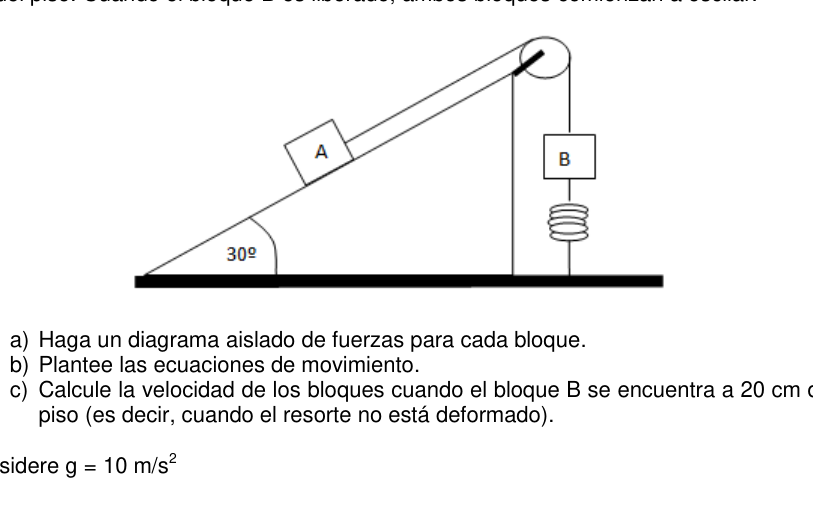 Blocchi A e B su piano inclinato con carrucola
 Diagrammi corpo libero blocchi A e B
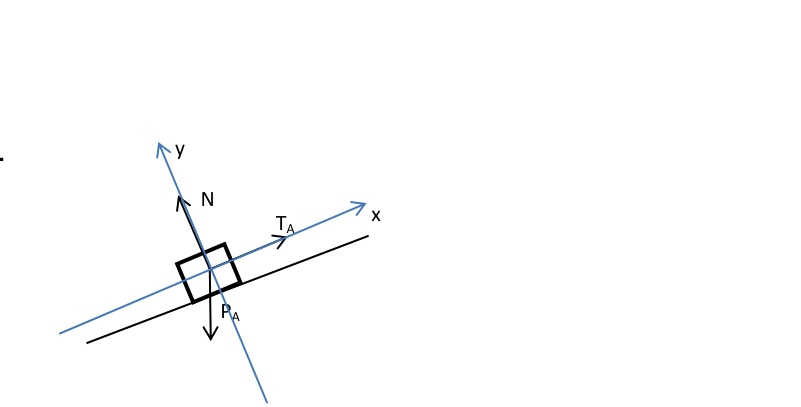 Diagramma corpo libero cuerpo A inclinato
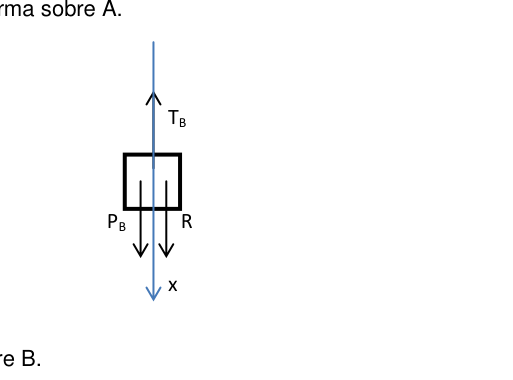 Diagramma corpo libero cuerpo B verticale
 Apparato blocchi A e B su piano inclinato
Topic: Oscillations & Waves, Newtonian Mechanics Metodi: Free-Body Diagram, Conservation of Energy, Differential Equations Competenze: Diagrammatic Reasoning, Mathematical Modeling, Physical Reasoning Objects: Block, String, Pulley, Spring, Cylinder Fonte: Testo (PDF) — p.4
Figure
Figure
Figure
Figure
Figure
Figure
Figure
Figure
Figure
Figure
Figure
Figure
Figure
Figure
p.9 — Cilindro su piano inclinato con d, h, theta
p.23 — Grafico y vs x con barre di errore
Problema 3 Un blocco A di è collegato ad un altro blocco B di tramite una corda inextensible senza massa. La corda passa attraverso una polea senza attrito come mostrato nella
- Figura.
Il blocco B è collegato ad una sorgente che ha una massa dispregiata, una lunghezza un’intensità di e una costante di forza di . Il piano su cui è supporto del blocco A non presenta attrito. Inizialmente il blocco B è a riposo a
-
dal pavimento. Quando il blocco B viene rilasciato, entrambi i blocchi iniziano a oscillare.
-
A. Fa’ un diagramma isolato delle forze per ogni blocco.
-
B. Sosteni le equazioni di movimento.
-
C. Calcola la velocità dei blocchi quando il blocco B è a del Piano (cioè quando la molla non è deformata).
Considera Problema teorico 1 Pagina di risposta Inciso
Punteggio a)
b)
d)
e) Problema teorico 2 Pagina di risposta Inciso
Punteggio a)
b)
c)
d)
e) Problema teorico 3 Pagina di risposta Inciso
Punteggio a)
b)
c) Olimpiada Argentina di Fisica
Prove di preparazione Primo test: meccanica Parte sperimentale
Nome: … (di cui sopra)
D.N.I.: …
Scuola: …
- Prima di iniziare a risolvere il test, leggi attentamente TUTTO la sua frase.
- Scrivi il tuo nome e il tuo numero di D.N.I. al posto indicato. No non scriva il suo nome in nessun altro posto della prova.
- Non scrivere risposte sui fogli della frase, perché non saranno considerate.
- Scrivi su un solo lato delle foglie. Radiosciamiglia. L’energia cinetica di un corpo rigido può essere scritta come
dove è la velocità del centro di massa, è la velocità angolare e e sono la velocità angolare massa e momento di inerzia rispetto al centro di massa del corpo, rispettivamente.
Considera un cilindro di radio e massa situato su un piano inclinato (vedi figura). Supponiamo che inizialmente il corpo sia a riposo nella posizione indicata nella
- Figura.
Se si libera il cilindro, permettendo di scendere senza scivolare () per il per il piano inclinato, la conservazione dell’energia meccanica può essere scritta così:
dove è l’accelerazione della gravità, è l’altezza indicata nella figura e è l’altezza indicata nella figura tempo in cui il cilindro percorre la distanza . Poi si può scrivere,
dove è il raggio di rotazione.
Obiettivo Determinare il raggio di rotazione di un corpo cilindrico
Materiali
- corpo cilindrico (lattina vuota - di durazzo, tonno, pila, ecc.).
- Piano inclinato (legno, cartellone rigido, ecc.).
- Un cronometro.
- Regola.
- Papero.
Procedura
- Determina il perimetro del corpo cilindrico.
- Nel piano inclinato, segna una distanza (più o pari a ).
- Per l’altezza (vedi figura), misurare il tempo in cui il corpo cilindrico percorre la Distanza . Ripettere la misurazione almeno 5 volte.
- Ripetere il punto c) per almeno 5 (cinque) valori diversi da .
Consigne
- A. Dalla misurazione di , determinare .
- B. Segnalare le misure effettuate in una tabella.
- **C.**Sulla base delle magnitudini misurate e dell’equazione 3, scegli due variabili ( e ) di La relazione tra le due parti è stata definita in modo lineare. Rendi un grafico delle variabili scelte. d) Aggiusta linealmente i punti graficati e determina la pendenza e la ordinato all’origine. e) A partire da Equation 3 e dai valori ottenuti dall’aggiustamento, determinare il raggio di giro del corpo cilindrico. Problema sperimentale Pagina di risposte.
Inciso
Punteggio a)
b)
c)
d)
e) Problema teorico 1 Pagina di risposta Inciso
Punteggio a)
è la velocità dell’aeromobile rispetto alla terra e è la velocità dell’aria rispetto alla terra (vento). 2 punti b)
è la velocità dell’aeromobile rispetto all’aria. 2 punti d) o rispetto all’asse x (direzione ovest est) 3 punti e) 3 punti
x(E) A y (N) B A Problema teorico 2 Pagina di risposta Inciso
Punteggio a) 2 punti b) 2 punti c) 2 punti d) 2 punti e) 2 punti Problema teorico 3 Pagina di risposta Inciso
Punteggio a) Corpo A
Corpo B
4 punti b)
3 punti c)
3 punti
N T PA PB R T Soluzioni Problema teorico 1. a)
b) Per la legge di aggiunta delle velocità di Galileo possiamo scrivere:
dove è la velocità dell’aeromobile rispetto alla terra, è la velocità dell’aeromobile rispetto alla terra aereo e è la velocità dell’aria rispetto alla terra (vento).
c) Con i dati del problema possiamo scrivere: Poiché il vento soffia da est a ovest, la velocità dell’aereo rispetto alla terra deve essere essere in direzione Nord-Sud. Inoltre, come il modulo di velocità dell’aereo rispetto al aria è possiamo scrivere: dove ci dà l’indirizzo in cui il pilota deve puntare. Graficamente:
B A x (E) y (N) B A Risolvendo le equazioni in componenti si ottiene: (1) (2) De la ec. (1) risulta: o
d) De la ec. (2) si ottiene che: Come: Problema teorico 2.
a) Per la conservazione dell’energia meccanica: 2 2 1 1 2 2 A k x mv
2000.15 / 0.949 / 5 A k v x m s m s m
b) Tra i punti A e B l’energia cinetica non viene conservata perché c’è ruggine. Per La variazione di energia è pari al lavoro fatto dalla forza di
- Raggiudicazione. 2 2 1 1 0.08(50)0.25 1 2 2 B A AB mv mv mgd J J
2 2 2 5 B A J v v Kg
2 2 2 0.949 0.4 0.708 / 5 B A J v v m s Kg
c) Noi abbiamo di nuovo posto la conservazione dell’energia tra la posizione B e quella massima compressione della sorgente destra:
2 2 1 1 2 2 B mv k x
2 0.112 B m x v m k
d) Ritorna la perdita di energia per la rottura nel tratto AB: 2 2 1 1 0.08(50)0.25 1 2 2 A B AB mv mv mgd J J
2 2 2 5 A B J v v Kg
2 2 2 0.708 0.4 0.318 / 5 A B J v v m s Kg
Dopo aver rimbalzato nella primavera sinistra, non ha abbastanza energia per attraversare la zona rugosa, poiché il radicando è inferiore a zero: 2 2 2 0.318 0.4 0.101 0.4 5 B A J v v Kg Per trovare dove si ferma, dobbiamo mettere in atto un movimento uniforme Raggiunto il livello di velocità di rottura 0.318 / Ai v m s
2 0.8 / x F mg a g m s m m
Quindi: 0.318 0.8 x Ai x v v a t t
Quando si ferma vx = 0 quindi il tempo necessario per fermarsi è: 0 0.318 0.8t
0.318 0.3975 0.8 t s s
e) Prendendo x = 0 in A si ottiene che il corpo si ferma in: 2 2 0.318(0.3975) 0.4(0.3975) 0.063 2 x Ai a t x v t m
Per energia Problema teorico 3. a) Corpo A
: Peso di A. : Tensione della corda su A. : Forza che fa la piattaforma su A. Corpo B
: Peso di B. : Tensione della corda su B. : Forza restitutiva della primavera.
b) Il diagramma del corpo isolato, Corpo A:
Corpo B:
Dove perché le corde sono estensibili e non hanno massa. Usando i sistemi di coordinate indicati in ogni diagramma di corpo isolato, Corpo A: x)
y)
Corpo B: N TA PA y x PB R TB x x)
Combinando queste equazioni, si scopre che l’equazione di movimento è:
(c) Per risolvere questo punto, abbiamo proposto la conservazione della
Blocchi A e B il suo pianoforte inclinato con carrocola
*Diagrammi corpo libero blocchi A e B *
Diagramma corpo libero corpo A inclinato
Diagramma corpo libero corpo B verticale
Apparatto blocchi A e B il suo pianoforte inclinato
Topic: Oscillations & Waves, Newtonian Mechanics Metodi: Free-Body Diagram, Conservation of Energy, Differential Equations Competenze: Diagrammatic Reasoning, Mathematical Modeling, Physical Reasoning Objects: Block, String, Pulley, Spring, Cylinder Fonte: Testo (PDF) — p.4
Figurare
Figurare
Figurare
Figurare
Figurare
Figurare
Figurare
Figurare
Figurare
Figurare
Figurare
Figurare
Figurare
Figurare
**p.9 ** Cilencro il suo pianoforte inclinato con d, h, theta
p.23 Grafico e vs x con barre di errore
The problem is 3 A block A of is connected to another block B of by a rope Unattainable without mass. The rope passes through a frictionless pulley as shown in the It’s a figure.
Block B is connected to a spring that has a despicable mass, a length a natural and a force constant of . The plane on which it is The supporting block A does not have friction. Initially block B is resting at From the floor. When block B is released, both blocks begin to oscillate.
- A Draw an isolated force diagram for each block.
- B. Set the equations of motion.
- C. Calculate the block speed when block B is at of the floor (i.e. when the spring is not deformed).
Consider the Theoretical problem 1 Answering sheet Incise
Score a)
b)
d)
e) Theoretical problem 2 Answering sheet Incise
Score a)
b)
c)
d)
e) Theoretical problem 3 Answering sheet Incise
Score a)
b)
c) Argentine Olympic Games in Physics
Preparatory tests First test: mechanics The experimental part
The following is the list of the countries of the European Union:
D.N.I.: …
School: … is not a school
- Before you start solving the test read it carefully The statement of it.
- Write your name and D.N.I. number. in the appropriate place. No Write your name anywhere else on the test.
- Don’t write answers on the statement sheets because they won’t be Considered.
- Write on one side of the leaves. Turn radio. The kinetic energy of a rigid body can be written as
where is the center of mass velocity, is the angular velocity and and are the mass and moment of inertia relative to the body’s centre of mass, respectively.
Consider a radius cylinder and mass located on an inclined plane (see figure). Suppose that the body is initially resting in the position indicated in the It’s a figure.
If it is released into the cylinder, allowing it to descend by rolling without sliding () through the cylinder In the slope plane, the conservation of mechanical energy can be written as:
where is the acceleration of gravity, is the height indicated in the figure and is the time the cylinder travels the distance . Then you can write,
where is the radius of spin.
Objective Determine the radius of spin of a cylindrical body
Other materials
- cylindrical body (empty - of hardwood, tuna, pile, etc.)
- The slope of the plane (wood, rigid folder, etc.).
- It’s a timekeeper.
- It’s a rule.
- Paper. - What?
The procedure
- Determine the perimeter of the cylindrical body.
- On the slope, mark a distance (greater than or equal to ).
- For the height (see figure), measure the time in which the cylindrical body travels through the The distance . Repeat the measurement at least 5 (five) times.
- Repeat point (c) for at least 5 (five) different values of .
Consignments
- A. From the measurement of , determine .
- B. Report the measurements made in a table.
- C. From the measured magnitudes and equation 3, choose two variables ( and ) of The method of deriving a linear relationship between the two is as follows: Make a graph of the the variables chosen. (d) Linear adjustment of the graphed points, and determination of slope and slope ordered to origin. (e) From equation 3 and the values obtained from the adjustment, determine the radius of The cylindrical body is rotated . The experimental problem Answer sheet.
Incise
Score a)
b)
c)
d)
e) Theoretical problem 1 Answering sheet Incise
Score a)
is the aircraft’s speed relative to the ground and is the speed of the air with respect to the land (wind). 2 points b)
is the aircraft speed relative to the air. 2 points d) or with respect to the x-axis (Western direction East) 3 points e) 3 points
x(E) A y (N) B A Theoretical problem 2 Answering sheet Incise
Score a) 2 points b) 2 points c) 2 points d) 2 points e) 2 points Theoretical problem 3 Answering sheet Incise
Score a) Body A
Body B
4 points b)
3 points c)
3 points
N T PA PB R T The Commission Theoretical problem one. a)
(b) By the law of the addition of velocities of Galileo we can write:
where is the aircraft speed relative to the ground, is the aircraft speed relative to the ground the air and is the air velocity with respect to land (wind).
c) With the problem data we can write: Since the wind blows from east to west the plane’s speed with respect to land must be be in a north-south direction. In addition, as the plane speed module with respect to the air is we can write: where gives us the direction the pilot should aim. Graphically:
B A x (E) y (N) B A Solving the equations in components results in: (1) (2) De la ec. (1) results in: o
d) De la ec. (2) it is obtained that: Like: Theoretical problem two.
(a) For conservation of mechanical energy: 2 2 1 1 2 2 A k x mv
2000.15 / 0.949 / 5 A k v x m s m s m
(b) between points A and B the kinetic energy is not conserved because there is friction. By Thus the energy variation is equal to the work done by the force of The roasting. 2 2 1 1 0.08(50)0.25 1 2 2 B A AB mv mv mgd J J
2 2 2 5 B A J v v Kg
2 2 2 0.949 0.4 0.708 / 5 B A J v v m s Kg
(c) We again consider conservation of energy between position B and maximum Right spring compression:
2 2 1 1 2 2 B mv k x
2 0.112 B m x v m k
(d) Energy is again lost in the AB section by friction: 2 2 1 1 0.08(50)0.25 1 2 2 A B AB mv mv mgd J J
2 2 2 5 A B J v v Kg
2 2 2 0.708 0.4 0.318 / 5 A B J v v m s Kg
After bouncing in the left spring, he doesn’t have enough energy to pass through the rough zone, since the root is less than zero: 2 2 2 0.318 0.4 0.101 0.4 5 B A J v v Kg To find where it stops, we have to make a uniform motion. Slowing (by friction) at initial speed 0.318 / Ai v m s
2 0.8 / x F mg a g m s m m
Therefore: 0.318 0.8 x Ai x v v a t t
When vx = 0 stops, the time it takes to stop is: 0 0.318 0.8t
0.318 0.3975 0.8 t s s
e) Taking x = 0 in A results in the body stopping at: 2 2 0.318(0.3975) 0.4(0.3975) 0.063 2 x Ai a t x v t m
By energy Theoretical problem three. a) Body A
: Weight of A. : String tension over A. : Force that makes the platform over A. Body B
: Weight of B. : String tension over B. : The force of the spring.
(b) The isolated body diagram, Body A:
B-body:
Where Because the strings are inextensible and massless. Using the coordinate systems indicated in each isolated body diagram, Body A: x)
y)
B-body: N TA PA y x PB R TB x x)
Combining these equations, it turns out that the equation of motion is:
(c) To resolve this point we propose conservation of the
Blocchi A and B his inclined piano with carriage
The Commission has also adopted a number of proposals for the implementation of the new rules.
The following table shows the results of the calculations:
The following table shows the results of the calculations:
The instrument blocchi A and B his piano inclined
Topic: Oscillations & Waves, Newtonian Mechanics Metodi: Free-Body Diagram, Conservation of Energy, Differential Equations Competenze: Diagrammatic Reasoning, Mathematical Modeling, Physical Reasoning Objects: Block, String, Pulley, Spring, Cylinder Fonte: Testo (PDF) — p.4
Figure
Figure
Figure
Figure
Figure
Figure
Figure
Figure
Figure
Figure
Figure
Figure
Figure
Figure
Cylinder his piano inclined with d, h, theta
p.23 Graph and vs x with error bar