Qu 1. General questions
(a) In 1927 a famous conference on Photons and Electrons was held in Bruxelles, the 5th Solvay Conference. The leading physicists of the day, in the rapidly developing field of Quantum Mechanics, attended. A photo of the conference delegates is shown in Figure 1 below. Write down as many names of the physicists from that era who you think might be in the photo. You may include relevant names, even if you may not be able to recognise them in the photo.
(b) In Figs 2a and 2b are two pictures taken of the same lens resting on a sheet of newsprint. The camera used was held many focal lengths above the lens. What can you deduce about the lens from these observations. No calculations are required, but diagrams may be helpful.
(c) Estimate the mass of a patch of mist which forms on a cold window when you breathe on it.
(d) An interesting paradoxical two terminal circuit formed from passive components can be seen in the following example. Two resistors and two zener diodes, and , are connected in a manner known as a Wheatstone bridge, in Figure 3a. (A typical diode will not conduct in the reverse direction, but a zener diode will conduct in the reverse direction if the potential difference across it is greater than a specified voltage; e.g. an ideal zener diode will conduct perfectly in the forward direction, and will also conduct perfectly in reverse if the reverse the potential across it is greater than .)
(i) In Figure 3a, a potential from a power supply is connected to point A. What current flows through each branch of the circuit down to earth?
(ii) In Figure 3b, a zener diode, , is connected as shown. The same potential from a power supply connected to point A. What current now flows through the left and right hand arms of the circuit (i.e. paths and )?
(iii) In Figure 3a, a power supply connected to the arrangement shown. A current of flows into the circuit at A and flows down to earth. What are the potentials at points A, B and C?
(iv) In Figure 3b, the zener diode is connected as shown. The current from the supply is maintained at . What are the potentials at points A, B and C now?
(v) Comment on what you might see as the paradox in this circuit.
(e) A small bead of mass can slide along a loop of wire bent in the form of two curves joined by a straight section, shown in Fig. 4. Gravity does not apply here. As the bead slides, it is only slowed down by a contact frictional force given by , where is the normal force as it goes round the curve. If the bead has an initial speed and , what would be its speed after it exits the second bend in the wire? The radius of the bead is much smaller than the radius of a bend.
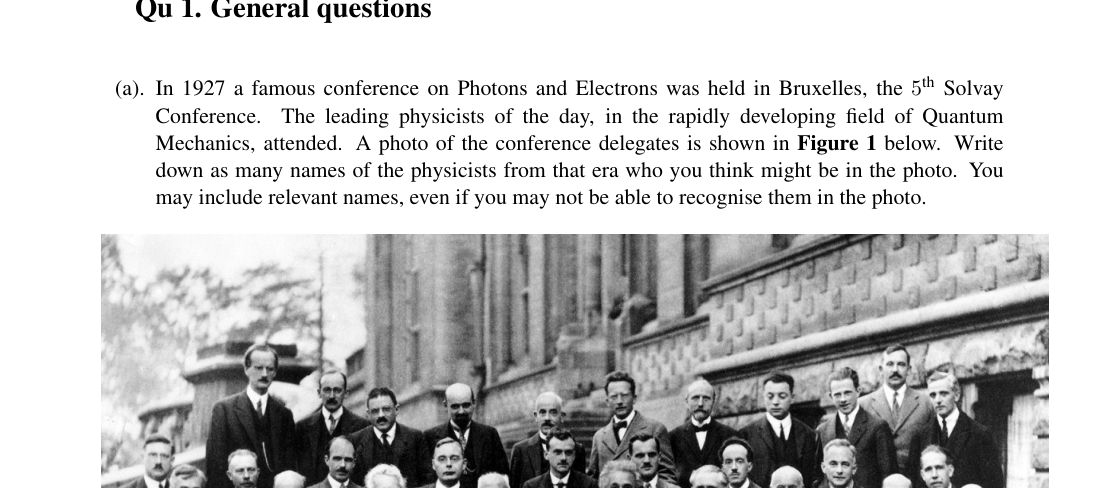 5th Solvay Conference 1927 photo
 Lens on newsprint, two sides
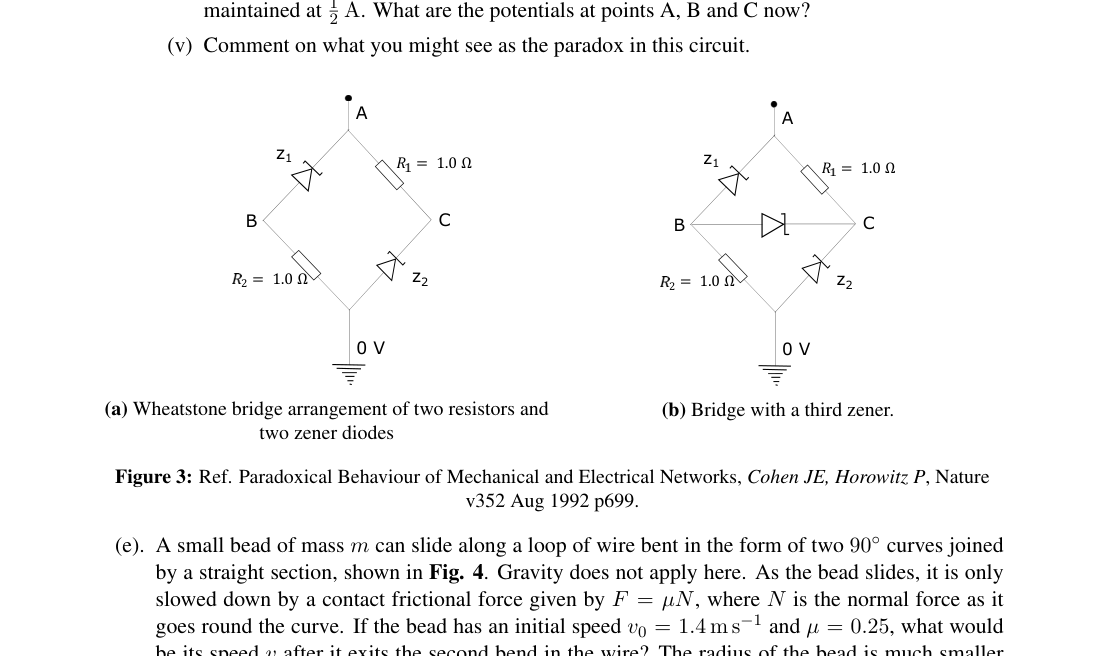 Wheatstone bridge with zener diodes
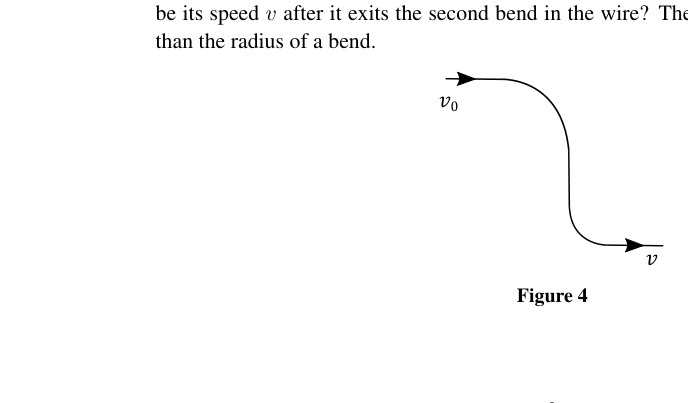 Wire loop with two 90-degree bends
Topic: Geometric Optics, Circuits, Newtonian Mechanics Metodi: Kirchhoff’s Laws, Free-Body Diagram, Order-of-Magnitude Estimation Competenze: Physical Reasoning, Estimation & Approximation Objects: Lens, Resistor, Wire, Droplet Fonte: Testo (PDF) — p.4
Qu 1. Domande generali
Nel 1927 si è tenuta a Bruxelles una famosa conferenza sui fotoni ed elettroni, la V Conferenza Solvay. I principali fisici dell’epoca, nel campo della meccanica quantistica in rapida evoluzione, parteciparono. La figura 1 di seguito mostra una foto dei delegati alla conferenza. Scrivi quanti nomi possiedono essere i fisici di quell’epoca che pensi siano nella foto. Potete inserire nomi pertinenti, anche se non riuscite a riconoscerli nella foto.
Le figure 2a e 2b presentano due immagini della stessa lente che si appoggiano su un foglio di carta. La fotocamera usata era tenuta a molte lunghezze focali sopra l’obiettivo. Cosa puoi dedurre di questa lente da queste osservazioni? Non sono necessari calcoli, ma i diagrammi possono essere utili.
**(c) ** Calcolare la massa di un pezzo di nebbia che si forma su una finestra fredda quando si respira su di essa.
Un interessante circuito paradossale a due terminali formato da componenti passivi può essere visto nell’esempio seguente. Due resistori e due diodi zener , e , sono collegati in modo noto come ponte di Wheatstone, nella figura 3a. (Un diodo tipico non si guiderà nella direzione inversa, ma un diodo zener si guiderà nella direzione inversa se la differenza potenziale attraverso di esso è maggiore di una tensione specificata; ad esempio: un diodo zener ideale si condurrà perfettamente in direzione anteriore e si condurrà perfettamente anche in senso inverso se il potenziale inverso attraverso di esso è maggiore di .)
(i) Nella figura 3a, un potenziale di un alimentatore è collegato al punto A. Che corrente scorre attraverso ogni ramo del circuito fino alla terra?
(ii) Nella figura 3b, è collegata una diode zener , , come mostrato. Lo stesso potenziale di un alimentatore collegato al punto A. Qual è la corrente che scorre ora attraverso i bracci sinistro e destro del circuito (cioè i percorsi e )?
- nella figura 3a, una alimentazione elettrica collegata all’impianto illustrato. Una corrente di scorre nel circuito a A e scende sulla terra. Quali sono i potenziali dei punti A, B e C?
(iv) Nella figura 3b, il diodo zener è collegato come mostrato. La corrente proveniente dall’alimentazione è mantenuta a . Quali sono i potenziali dei punti A, B e C?
(v) Commenta ciò che potresti considerare il paradosso in questo circuito.
**(e) ** Una piccola manciata di massa può scivolare lungo un circuito di filo piegato sotto forma di due curve unite da una sezione retta, come mostrato nella figura. 4. La gravità non si applica qui. Quando la perla scivola, essa viene rallentata solo da una forza di attrito di contatto data da , dove è la forza normale mentre gira intorno alla curva. Se la mancia ha una velocità iniziale e , quale sarebbe la sua velocità dopo aver lasciato la seconda curva del filo? Il raggio della perla è molto più piccolo del raggio di una curva.
La quinta conferenza di Solvay del 1927 foto
Lenti su carta di stampa, a due lati
ponte di pietra di grano con diodi zener
Luglio di fili con due curve di 90 gradi
Topic: Geometric Optics, Circuits, Newtonian Mechanics Metodi: Kirchhoff’s Laws, Free-Body Diagram, Order-of-Magnitude Estimation Competenze: Physical Reasoning, Estimation & Approximation Objects: Lens, Resistor, Wire, Droplet Fonte: Testo (PDF) — p.4
Qu 2. Gravitational Waves
Gravitational waves were first detected on the 14th September 2015 by the LIGO collaboration using two sets of large detectors based on the interference of waves. In this question we investigate some of the physics involved, using a combination of approximating the relativistic physics classically and dimensional analysis. The observed event, called GW150914, occurred as a result of a binary black hole pair merging to form a single black hole whilst simultaneously releasing a lot of energy in the form of gravitational waves.
(a) Before the two black holes merge, they can be modelled as two point masses and that rotate about their common centre of mass with radii and , respectively. Assume that the binary black holes obey Newtonian mechanics and gravity. Show that the angular frequency of the motion satisfies where is Newton’s universal gravitational constant.
(b) Find the total energy of the black hole system and express this in terms of the masses of the black holes and the angular frequency of the motion.
Unlike Newtonian gravity, Einstein’s general relativity predicts that accelerating objects will radiate gravitational waves and thus the binary black hole system will lose energy and the black holes will spiral into each other. The rate of radiation depends on the quadruple moment of the system. For our purposes, the quadruple moment can be considered as the same as the moment of inertia of the system about its centre of mass. The radiated power is proportional to and also depends on the angular frequency , and on the fundamental constants and , the speed of light. We shall use dimensional analysis to determine the rate of loss in terms of these quantities.
(c) Find the moment of inertia of the black hole system about its centre of mass.
(d) The radiated power loss can be written as Find the exponents , and . More detailed analysis shows that .
(e) Find the rate of change in the angular frequency in terms of constants, and the chirp mass The quadruple moment is symmetric under rotations by and so the frequency of the gravitational waves is twice that of the orbital frequency.
(f) By integrating your answer to (e), show that over any interval of time the observed frequencies and satisfy
(g) Using the data from LIGO, given in Figure 5, estimate the chirp mass , expressing your answer in terms of Solar masses .
(h) Deduce the lower bound on the total mass of the black holes before coalescence using your estimate of .
(i) Assume that the two black holes begin to merge when the separation of their centres is equal to the sum of their Schwarzschild radii. The Schwarzschild radius of a black hole of mass is . Show that the highest frequency attained by the chirp is Using the data from Figure 5 estimate the individual masses , of the black holes and their sum in terms of Solar masses.
(j) Finally, estimate the total energy radiated during the collision, stating any necessary assumptions, expressed in terms of mass equivalent to Solar masses.
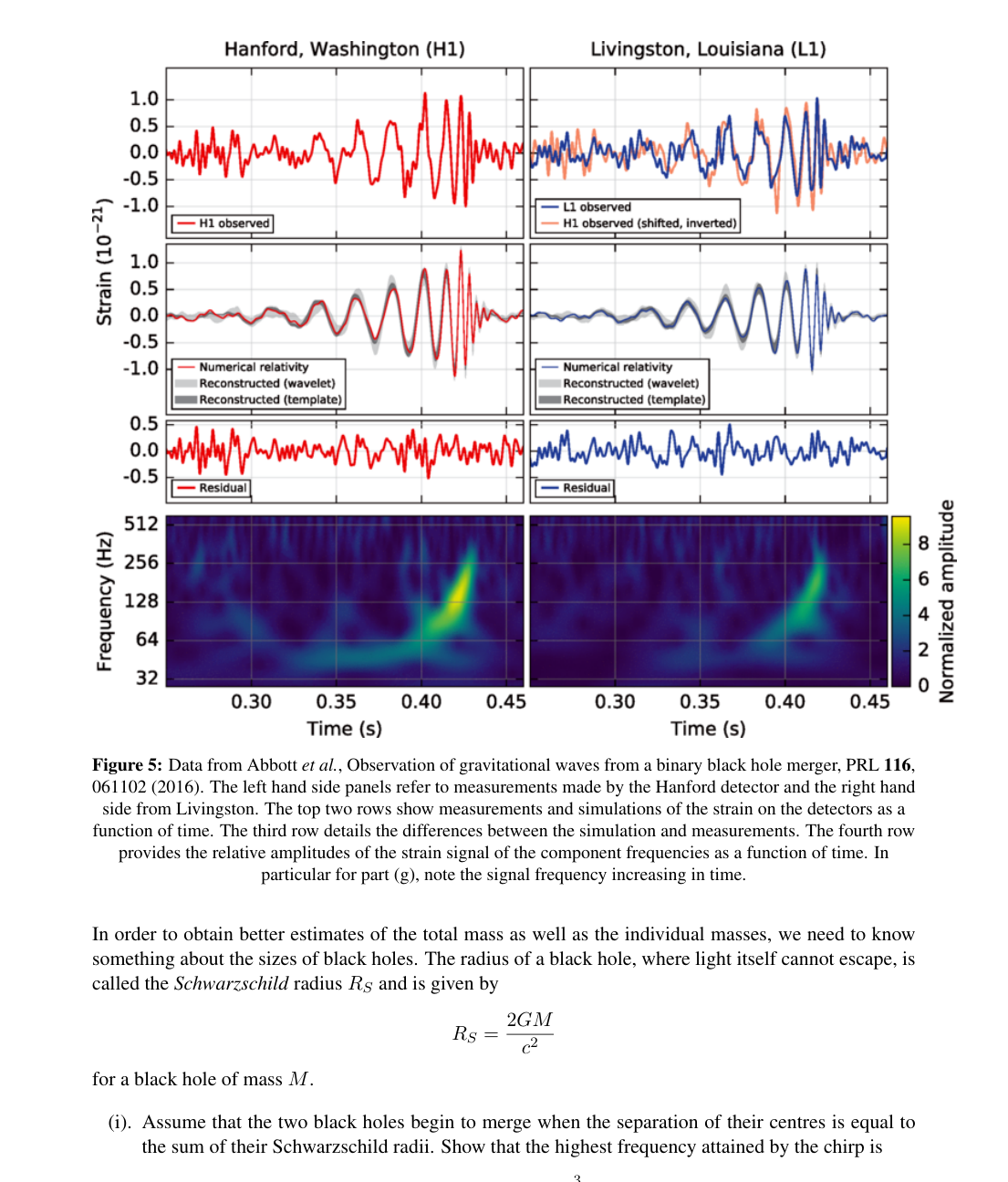 LIGO GW150914 strain data and spectrogram
Topic: Gravitation, Special Relativity, Astrophysics Metodi: Newton’s Law of Gravitation, Dimensional Analysis, Calculus-Integration Competenze: Mathematical Modeling, Physical Reasoning Objects: Black Hole Fonte: Testo (PDF) — p.6
Qu 2. onde gravitazionali
Le onde gravitazionali sono state rilevate per la prima volta il 14 settembre 2015 dalla collaborazione LIGO utilizzando due serie di grandi rilevatori basati sull’interferenza delle onde. In questa domanda indaghiamo alcune delle fisiche coinvolte, usando una combinazione di approssimazione della fisica relativistica in modo classico e analisi dimensionale. L’evento osservato, chiamato GW150914, si è verificato a seguito di una coppia di buchi neri binari che si sono fusi per formare un unico buco nero, rilasciando contemporaneamente molta energia sotto forma di onde gravitazionali.
**(a) ** Prima della fusione dei due buchi neri, possono essere modellati come due masse puntate e che ruotano intorno al loro centro di massa comune con i radii e , rispettivamente. Supponiamo che i buchi neri binari obbediscano alla meccanica e alla gravità newtoniana. Indicare che la frequenza angolare del movimento soddisfa dove è la costante gravitazionale universale di Newton.
**(b) ** Trova l’energia totale del sistema dei buchi neri e esprimela in termini di masse dei buchi neri e di frequenza angolare del movimento.
A differenza della gravità newtoniana, la relatività generale di Einstein prevede che gli oggetti acceleranti irradieranno onde gravitazionali e quindi il sistema binario dei buchi neri perderà energia e i buchi neri si spingeranno l’uno contro l’altro. La velocità di radiazione dipende dal momento quadruplo del sistema. Per i nostri scopi, il momento quadruplo può essere considerato come lo stesso del momento di inerzia del sistema intorno al suo centro di massa. La potenza irradiata è proporzionale a e dipende anche dalla frequenza angolare e dalle costanti fondamentali e , la velocità della luce. Utilizziamo l’analisi dimensionale per determinare il tasso di perdita in termini di queste quantità.
**(c) ** Trova il momento di inerzia del sistema dei buchi neri intorno al suo centro di massa.
**(d) ** La perdita di potenza irradiata può essere scritta come Trova gli esponenti , e . Una analisi più dettagliata mostra che .
**(e) ** Trova il tasso di variazione della frequenza angolare in termini di costanti, e della massa chirp Il momento quadruple è simmetrico sotto rotazioni e quindi la frequenza delle onde gravitazionali è il doppio della frequenza orbitale.
**(f) ** Integrando la risposta a (e), dimostrare che in qualsiasi intervallo di tempo le frequenze osservate e soddisfano
**(g) ** Usando i dati di LIGO, riportati nella figura 5, stimare la massa di chirp , esprimendo la risposta in termini di masse solari .
**(h) ** Riduci il limite inferiore della massa totale dei buchi neri prima della coalescenza utilizzando la tua stima di .
**i) ** Supponiamo che i due buchi neri iniziino a fondere quando la separazione dei loro centri è uguale alla somma dei loro raggi Schwarzschild. Il raggio di Schwarzschild di un buco nero di massa è . Mostra che la frequenza più alta raggiunta dal chirp è Usando i dati della figura 5, si stima la massa individuale , dei buchi neri e la loro somma in termini di massa solare.
**(j) ** Infine, calcolare l’energia totale irradiata durante la collisione, indicando eventuali ipotesi necessarie, espresse in termini di massa equivalente a massa solare.
Dati e spettrogrammi di ceppi di LIGO GW150914
Topic: Gravitation, Special Relativity, Astrophysics Metodi: Newton’s Law of Gravitation, Dimensional Analysis, Calculus-Integration Competenze: Mathematical Modeling, Physical Reasoning Objects: Black Hole Fonte: Testo (PDF) — p.6
Qu 3. Phase Space Physics
In cases involving multiparticle systems, it can be an advantage to consider an abstract space called phase space. In a particle accelerator such as the LHC at CERN, managing to produce a finer and denser beam of particles at a discrete energy, reducing the phase space of the beam, has been one of the keys to its success.
In 1-D, for a moving particle, the phase space trajectory is a line on a graph. The line shows the momentum versus position on a versus graph. For a free particle of mass , moving at constant speed in the positive -direction, the trajectory in phase space as it passes through the origin is shown in the graph of Fig. 6.
(a) By calculation, or otherwise, determine the behaviour of a particle with the trajectory in phase space given by the graph in Fig. 7.
(b) A simple pendulum consists of a light, rigid rod of length , with mass attached at the end, as shown in Fig. 8. It swings freely under gravity.
(i) Write down an expression for the total energy of the pendulum in terms of , the magnitude of the momentum and , the angle of displacement of the rod from the vertical.
(ii) For small amplitude oscillations, it executes simple harmonic motion (SHM). Using a small angle approximation for , and expressing the total energy in terms of angular variables and , where , sketch the phase space trajectory on a graph. Include arrows on the trajectory. Show the limits on your axes, in terms of , , , .
(iii) On your graph, sketch a trajectory corresponding to a pendulum which has twice the initial amplitude of swing (but still SHM). How will this change the area of phase space enclosed by the trajectory?
(iv) If the pendulum loses of its energy each swing, what will be the percentage area of phase space remaining enclosed by the trajectory after 400 swings?
(v) For the phase space trajectory of a simple harmonic oscillator, give a physical interpretation of the angles at which the trajectory crosses the horizontal and vertical axes.
(vi) If the pendulum has a small amount of viscous damping due to air resistance, what will be the trajectory in phase space as the pendulum slows down to very small amplitudes? Can it be said that the pendulum will ever stop swinging?
(vii) If the pendulum is damped by contact friction at the support, sketch the phase space trajectory as the pendulum reduces to very small amplitude swings.
(viii) If the pendulum has a large total energy, its motion will not be oscillatory but continuous rotation, with the kinetic energy term greater than the potential energy term. Sketch a new graph which has trajectories for the pendulum (small KE term) and the circulating rod (large KE term).
(c) A linear, elastic collision takes place between particles of mass and , with initial velocities and , resulting in final velocities of and respectively.
(i) Show that the velocities after collision can be expressed in terms of those before, in the form
(ii) Determine the coefficients , , and in terms of the masses and .
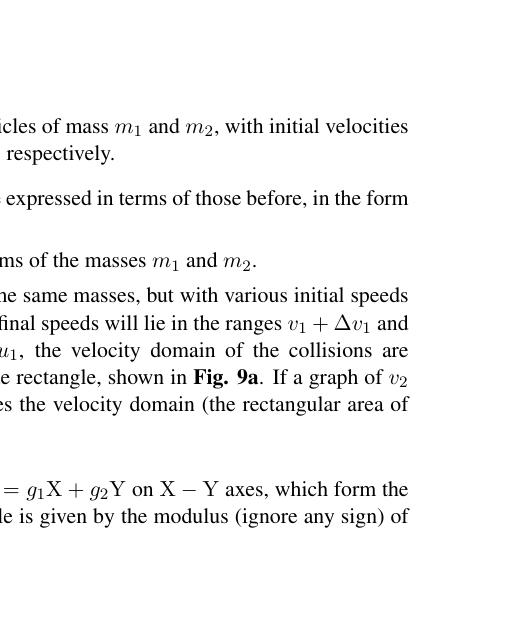
(iii) If many repeated collisions are made using the same masses, but with various initial speeds in the ranges and , then final speeds will lie in the ranges and . On graph axes of against , the velocity domain of the collisions are represented by the scatter of points within the rectangle, shown in Fig. 9a. If a graph of against is plotted, as in Fig. 9b, how does the velocity domain (the rectangular area of Fig. 9a) transform onto the new axes?
Hint: for two vectors and on axes, which form the two sides of a triangle, the area of the triangle is given by the modulus (ignore any sign) of .
(d) The time development of particles in phase space can be seen if a set of particles, each of mass , have a range of momenta, and are distributed in the shaded, square region of phase space shown in the graph of Fig. 10. After a time later, what will be the possible distribution of the particles in phase space if they do not interact? Sketch your result on a copy of the graph of vs. .
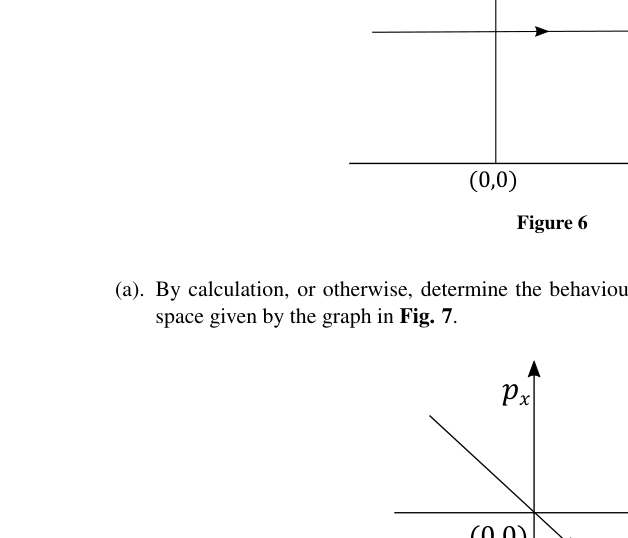 Phase space trajectory free particle Fig 6
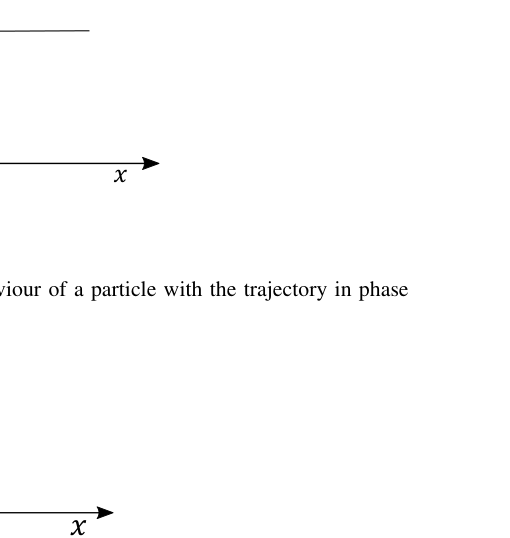 Phase space trajectory Fig 7
 Simple pendulum diagram Fig 8
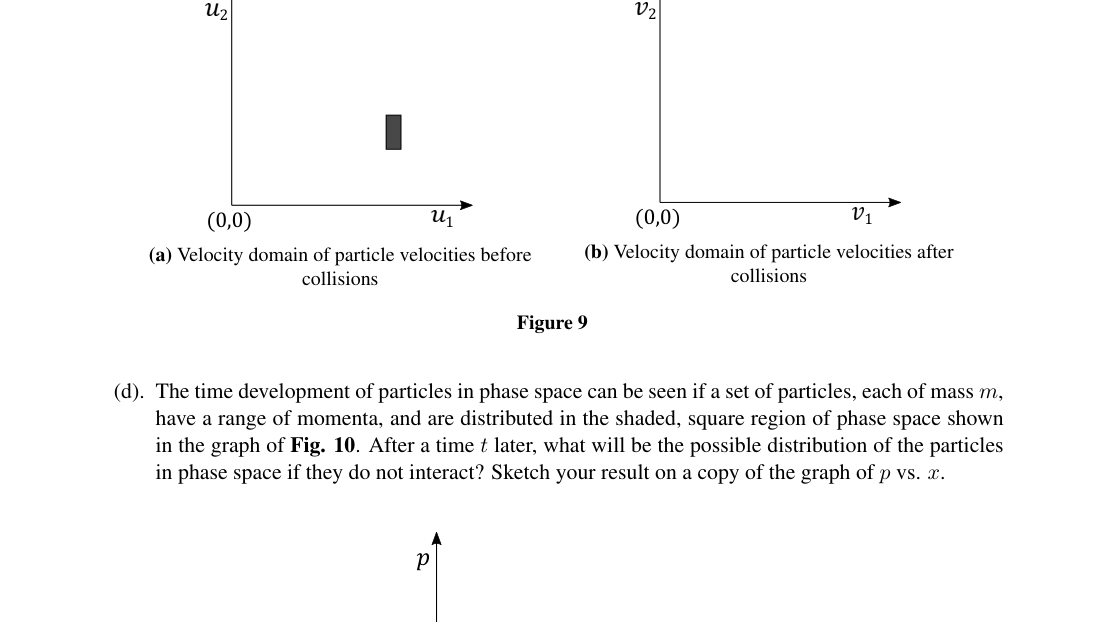 Velocity domain rectangles before and after collision
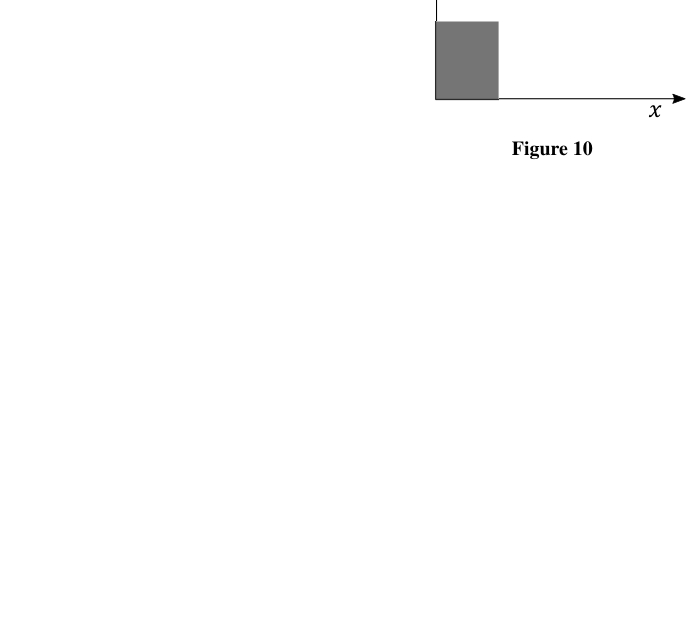 Phase space square distribution Fig 10
Topic: Oscillations & Waves, Conservation of Momentum, Newtonian Mechanics Metodi: Simple Harmonic Motion Analysis, Conservation of Momentum, Conservation of Energy Competenze: Diagrammatic Reasoning, Mathematical Modeling Objects: Pendulum, Rod, Particle Beam Fonte: Testo (PDF) — p.8
Qu 3. Fisica dello spazio di fase
Nei casi in cui si applicano sistemi multiparticellari, può essere vantaggioso considerare uno spazio astratto chiamato spazio di fase. In un acceleratore di particelle come il LHC al CERN, riuscire a produrre un fascio di particelle più sottile e denso ad un’energia discreta, riducendo lo spazio di fase del fascio, è stata una delle chiavi del suo successo.
In 1-D, per una particella in movimento, la traiettoria dello spazio di fase è una linea su un grafico. La linea mostra il momento contro la posizione su un grafico contro . Per una particella libera di massa , che si muove a velocità costante nella direzione positiva , la traiettoria nello spazio di fase mentre attraversa l’origine è mostrata nel grafico della figura. 6.
**(a) ** Determina, mediante calcolo o altro, il comportamento di una particella con la traiettoria nello spazio di fase data dal grafico di cui alla figura. 7.
**(b) ** Un semplice pendolo è costituito da una barra leggera e rigida di lunghezza , con massa attaccata alla fine, come mostrato alla figura. 8. Svingia liberamente sotto la gravità.
(i) Scrivere un’espressione per l’energia totale del pendolo in termini di , la magnitudine del momento e , l’angolo di spostamento della canna dalla verticale.
(ii) Per le oscillazioni di piccola amplitudine, esegue un semplice movimento armonico (SHM). Utilizzando un’approssimazione a piccola angolazione per , e esprimendo l’energia totale in termini di variabili angolari e , dove , disegnare la traiettoria dello spazio di fase su un grafico . Includi frecce sulla traiettoria. Indicare i limiti sui propri assi in termini di , , , .
(iii) Spetta al grafico di disegnare una traiettoria corrispondente a un pendolo che ha il doppio dell’ampiezza iniziale di swing (ma ancora SHM). Come cambierà questo l’area dello spazio di fase circondata dalla traiettoria?
(iv) Se il pendolo perde della sua energia ad ogni svolta, quale sarà la superficie percentuale dello spazio di fase rimanente circondato dalla traiettoria dopo 400 svolture?
(v) Per la traiettoria di uno spazio di fase di un semplice oscillatore armonico, dare un’interpretazione fisica degli angoli con cui la traiettoria attraversa gli assi orizzontali e verticali.
(vi) Se il pendolo ha una piccola quantità di attenuazione viscosa a causa della resistenza all’aria, quale sarà la traiettoria nello spazio di fase quando il pendolo rallenta a amplitudini molto piccoli? Si può dire che il pendolo smetterà mai di oscillare?
(vii) Se il pendolo è ammortizzato da attrito di contatto al supporto, disegnare la traiettoria dello spazio di fase mentre il pendolo si riduce a piccole oscillazioni di amplitudine.
(viii) Se il pendolo ha una grande energia totale, il suo movimento non sarà oscillatorio ma di rotazione continua, con un termine di energia cinetica superiore al termine di energia potenziale. Segna un nuovo grafico che contiene le traiettorie del pendolo (termine KE piccolo) e della canna circolante (termine KE grande).
**(c) ** Si verifica una collisione lineare elastica tra particelle di massa e , con velocità iniziali e , con conseguente velocità finali rispettivamente e .
(i) Mostra che le velocità dopo la collisione possono essere espresse in termini di quelle precedenti, nella forma
ii) Determinare i coefficienti , , e in termini di masse e .
(iii) Se vengono effettuate molte collisioni ripetute utilizzando le stesse masse, ma con diverse velocità iniziali nelle fasce e , le velocità finali si trovano nelle fasce e . Su assi grafici di contro , il dominio di velocità delle collisioni è rappresentato dalla dispersione dei punti all’interno del rettangolo, mostrata nella figura. 9a. Se è tracciato un grafico di contro , come nella figura. 9b, come si svolge il dominio di velocità (l’area rettangolare di Fg. 9a) si trasforma sui nuovi assi?
Insigno: per due vettori e sugli assi , che formano i due lati di un triangolo, l’area del triangolo è data dal modulo (ignorare qualsiasi segno) di .
**(d) ** Il tempo di sviluppo delle particelle nello spazio di fase può essere visto se un insieme di particelle, ciascuna di massa , ha una gamma di momenti e sono distribuite nella regione ombrata e quadrata dello spazio di fase mostrata nel grafico di Figura. 10. Dopo un tempo , qual sarà la possibile distribuzione delle particelle nello spazio di fase se non interagiscono? Sketta il risultato su una copia del grafico di vs. .
Passi libera di tragittoria spaziale di fase Fig 6
Passi spaziali trajectoria Figura 7
Semplice diagramma di pendolo Figura 8
Rettangoli del dominio di velocità prima e dopo la collisione
Distribuzione quadrata dello spazio di fase Figura 10
Topic: Oscillations & Waves, Conservation of Momentum, Newtonian Mechanics Metodi: Simple Harmonic Motion Analysis, Conservation of Momentum, Conservation of Energy Competenze: Diagrammatic Reasoning, Mathematical Modeling Objects: Pendulum, Rod, Particle Beam Fonte: Testo (PDF) — p.8
Qu 4. Solar Sail
It has been proposed that tiny probes could be sent to other stars by accelerating them away from Earth using a powerful laser.
(a) To push the probe hard enough for it to reach other solar systems will require a large laser focused on the sail of a small probe. One way of focusing the laser is to make use of existing optics by using a telescope in reverse. Given a telescope of diameter emitting a laser beam of wavelength , and a probe sail of diameter , what is the distance the probe can get before less than 90% of the light hits the sail? How far is this for a sail of size , a telescope diameter of and a laser wavelength of ?
(b) Assume that when the monochromatic laser light hits the sail of the probe at right angles it has power . What is the force exerted on a black (perfectly absorbing) sail and a silvered (perfectly reflective) sail? What is another major change in using a reflective sail?
(c) Using your previous expression, find the time it would take a probe of mass to travel a distance . For simplification, you may assume that the probe feels the full force of the laser beam up to distance , and nothing after that, and that it has a perfectly reflective sail. The proposal calls for the probe to have mass of , the laser power to be and for the probe to go to Alpha Proxima which is light years away. Using the optics described in the first part, how long will this take?
(d) One way of reducing this time considerably is to increase by using a different optical set up. Rather than using one telescope, several telescopes could be used together in order to create an interference pattern. What is the maximum possible effective diameter of such a setup? What would be the travel time to Alpha Centauri under this setup? Comment on the validity of any extra approximations you had to make in this case.
Topic: Wave Optics, Geometric Optics, Newtonian Mechanics Metodi: Interference & Diffraction Analysis, Ray Tracing, Kinematic Equations Competenze: Physical Reasoning, Mathematical Modeling Objects: Star Fonte: Testo (PDF) — p.11
Qu 4. Velo solare
È stato proposto che le piccole sonde possano essere inviate ad altre stelle accelerandole lontano dalla Terra utilizzando un potente laser.
Per spingere la sonda abbastanza forte da raggiungere altri sistemi solari occorre un grande laser focalizzato sulla vela di una piccola sonda. Un modo per focalizzare il laser è quello di utilizzare l’ottica esistente utilizzando un telescopio al contrario. Dato che un telescopio di diametro emette un fascio laser di lunghezza d’onda e una vela di sonda di diametro , quale è la distanza che la sonda può raggiungere prima che meno del 90% della luce colpisca la vela? Quanto è questa distanza per una vela di dimensioni , di un diametro telescopico e di una lunghezza d’onda laser ?
**(b) ** Supponiamo che quando la luce laser monocromatica colpisce la vela della sonda ad angoli retti essa abbia potenza . Qual è la forza esercitata su una vela nera (perfettamente assorbita) e su una vela argento (perfettamente riflettente)? Qual è un altro importante cambiamento nell’uso di una vela riflettente?
**(c) ** Usando la tua espressione precedente, trova il tempo necessario per un’indagine di massa per percorrere una distanza . Per semplificazione, si può presumere che la sonda percepisca la forza completa del fascio laser fino alla distanza , e che non si possa fare nulla dopo di ciò, e che abbia una vela perfettamente riflettente. La proposta prevede che la sonda abbia una massa di , la potenza del laser di e che la sonda vada ad Alpha Proxima, che è a anni luce di distanza. Usando l’ottica descritta nella prima parte, quanto tempo ci vorrà?
Un modo per ridurre considerevolmente questo tempo è aumentare il tempo di utilizzando una configurazione ottica diversa. Invece di usare un solo telescopio, diversi telescopi potrebbero essere utilizzati insieme per creare un modello di interferenza. Qual è il massimo diametro effettivo possibile di tale sistema? Qual e’ il tempo di viaggio verso Alpha Centauri in base a questa impostazione? Commenta la validità delle approssimative supplementari che dovesse fare in questo caso.
Topic: Wave Optics, Geometric Optics, Newtonian Mechanics Metodi: Interference & Diffraction Analysis, Ray Tracing, Kinematic Equations Competenze: Physical Reasoning, Mathematical Modeling Objects: Star Fonte: Testo (PDF) — p.11
Qu 5. Particle Physics
The Zero Momentum Frame (ZMF) is a frame of reference in which the total momentum of a collection of particles is zero.
(a) Consider two particles of masses and with velocities and along a line.
(i) Show that the addition of a velocity to both particles transforms the system to a new frame of reference in which the total momentum is zero.
(ii) A particle of mass , moving with velocity in a straight line, collides elastically head on with an identical stationary particle. Using the ZMF, or otherwise, find the velocities of the two particles after the collision.
(iii) In a game of pool, the white cue ball collides elastically with a red ball. At the instant of collision, the cue ball is moving with speed at an angle to the line connecting the centres of the two balls as shown in Figure 11. By transforming to a ZMF parallel to the line of centres, or otherwise, find the angle between their directions of motion after the collision. You may assume that the two pool balls are perfectly smooth.
(b) The energy and momentum of a particle travelling at speeds approaching the speed of light may be written as where is the mass of the particle, is its velocity and is the relativistic factor
(i) Show that and check that this gives the usual formulas both for massive particles at rest, and for massless particles.
(ii) When an electron annihilates with a positron (the antiparticle of an electron, having all the same properties as an electron but opposite charge), photons are produced. Explain why it is not possible for this process to produce a single photon only, and if exactly two photons are produced, how will they be emitted in the ZMF?
(iii) A positron moving with velocity in the positive -direction annihilates with a stationary electron, producing two identical photons. By using the ZMF, or otherwise, find the angle between the emitted photons in terms of . What is the angle in the limit ?
You may find the following information helpful: When transforming to a new frame of reference with velocity relative to the original frame, the momentum of a particle in the new frame, , is related to the momentum and energy in the original frame by where .
Hint: In the ZMF consider the photons to be emitted parallel to the -direction.
(iv) Fluorine-18 undergoes beta-plus decay and is commonly used in positron emission tomography. Positrons are emitted with a range of kinetic energies up to a maximum of . If a positron were to immediately annihilate with an electron, producing two photons, what would be the minimum angle between them?
(v) Pair production is the process by which a photon may interact with a nucleus to produce an electron–positron pair. Show that this process will not occur in free space, i.e. that the process depicted in Figure 12 is forbidden.
Hint: Consider the relationship between Energy and Momentum for the photon.
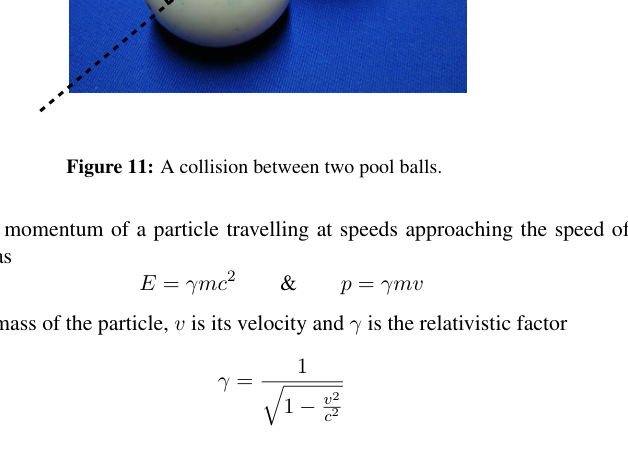 Pool ball collision angle diagram Fig 11
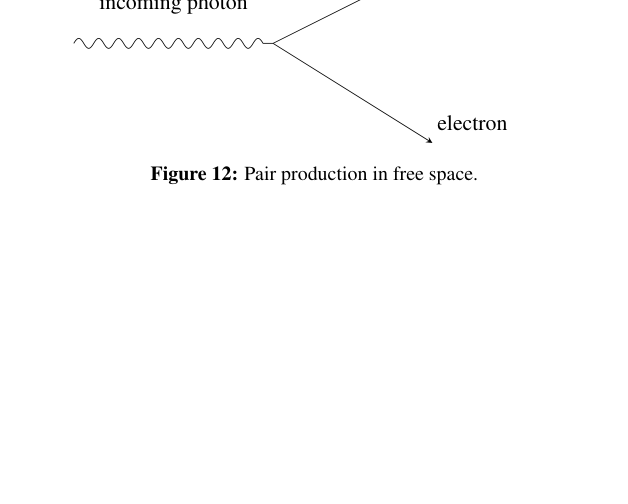 Pair production in free space Fig 12
Topic: Special Relativity, Nuclear & Particle Physics, Conservation of Momentum Metodi: Relativistic Energy-Momentum, Conservation of Momentum, Lorentz Transformation Competenze: Mathematical Modeling, Physical Reasoning Objects: Ball, Photon, Electron, Nucleus Fonte: Testo (PDF) — p.12
Qu 5. Fisica delle particelle
Il quadro di momento zero (ZMF) è un quadro di riferimento in cui la dinamica totale di una collezione di particelle è zero.
**(a) ** Considerate due particelle di massa e con velocità e lungo una linea.
(i) Mostra che l’aggiunta di una velocità per entrambe le particelle si trasforma il sistema in un nuovo quadro di riferimento in cui il momento totale è zero.
(ii) Una particella di massa , in movimento a velocità in linea retta, si schianta elasticamente di fronte ad una particella fissa identica. Usando la ZMF, o altrimenti, trovare le velocità delle due particelle dopo la collisione.
(iii) In un gioco di biliardo, la palla bianca colpisce elasticamente una palla rossa. Al momento della collisione, la palla di segnale si muove a velocità in un angolo verso la linea che collega i centri delle due palle come mostrato alla figura 11. Trasformandosi in un ZMF parallelo alla linea dei centri, o altrimenti, trovare l’angolo tra le loro direzioni di movimento dopo la collisione. Potresti pensare che le due palline di piscina siano perfettamente lisce.
**(b) ** L’energia e il momento di una particella che viaggia a velocità che si avvicinano alla velocità della luce possono essere scritti come dove è la massa della particella, è la sua velocità e è il fattore relativistico
(i) Mostrare che e verificare che questo dà le solite formule sia per le particelle massicce in riposo, e per le particelle senza massa.
(ii) Quando un elettrone annihila con un positrone (l’anticimmontaggio di un elettrone, che ha tutte le stesse proprietà di un elettrone ma una carica opposta), si producono fotoni. Spiegate perché non è possibile produrre un solo fotone in questo processo e, se vengono prodotti esattamente due fotoni, come saranno emessi nella ZMF?
(iii) Un positrone in movimento con velocità nella direzione positiva annientano con un elettrone stazionario, producendo due fotoni identici. Usando la ZMF o altrimenti, trovare l’angolo tra i fotoni emessi in termini di . Qual è l’angolo del limite ?
Potresti trovare utili le seguenti informazioni: Quando si trasforma in un nuovo quadro di riferimento con velocità rispetto al quadro originale, il momento di una particella nel nuovo quadro, , è correlato al momento e all’energia nel quadro originale da dove .
Signal: nella ZMF si consideri che i fotoni siano emessi paralleli alla direzione .
(iv) Il fluoruro-18 subisce decadimento beta-plus ed è comunemente usato nella tomografia a emissione di positroni. I positroni sono emessi con un intervallo di energie cinetiche fino a un massimo di . Se un positrone si annientasse immediatamente con un elettrone, producendo due fotoni, quale sarebbe l’angolo minimo tra di loro?
(v) La produzione di coppie è il processo mediante il quale un fotone può interagire con un nucleo per produrre una coppia di elettronipositroni. Mostrare che questo processo non si svolgerà nello spazio libero, cioè che il processo descritto alla figura 12 è vietato.
Signore: Considera la relazione tra energia e momento per il fotone.
Diagramma dell’angolo di collisione delle palline da piscina Figura 11
Prodotta in coppia in spazio libero Figura 12
Topic: Special Relativity, Nuclear & Particle Physics, Conservation of Momentum Metodi: Relativistic Energy-Momentum, Conservation of Momentum, Lorentz Transformation Competenze: Mathematical Modeling, Physical Reasoning Objects: Ball, Photon, Electron, Nucleus Fonte: Testo (PDF) — p.12