The Milky Way galaxy has a period of rotation of years. The Sun is light years from the centre of the galaxy. How fast is the Sun moving with respect to the centre of the galaxy, given in units of m s?
A light year is the distance that light travels in one year of 365.25 days.
Topic: Astrophysics, Newtonian Mechanics Metodi: Kinematic Equations, Dimensional Analysis Competenze: Physical Reasoning, Unit Conversion Objects: Star Fonte: Testo (PDF) — p.3
La Via Lattea ha un periodo di rotazione di anni. Il Sole è anni luce dal centro della galassia. Quanto veloce si muove il Sole rispetto al centro della galassia, data in unità di m s?
Un anno luce è la distanza che la luce percorre in un anno di 365,25 giorni.
Topic: Astrophysics, Newtonian Mechanics Metodi: Kinematic Equations, Dimensional Analysis Competenze: Physical Reasoning, Unit Conversion Objects: Star Fonte: Testo (PDF) — p.3
A smooth sphere of radius 6.0 cm is suspended from a thread of length 9.0 cm attached to a smooth wall as shown in Figure 1. If the mass of the sphere is 0.5 kg, calculate the tension, , in the thread.
(Figure 1: sphere hanging from thread against wall)
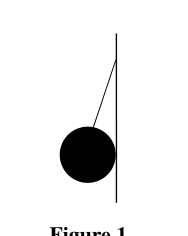 Sphere on thread against smooth wall
Topic: Newtonian Mechanics, Rigid Body Statics Metodi: Free-Body Diagram, Vector Decomposition Competenze: Physical Reasoning, Diagrammatic Reasoning Objects: Sphere, String Fonte: Testo (PDF) — p.3
Una sfera liscia di raggio di 6,0 cm è sospesa da un filo di lunghezza di 9,0 cm attaccato a una parete liscia come mostrato alla figura 1. Se la massa della sfera è di 0,5 kg, calcolare la tensione, , nel filo.
(Figura 1: sfera appesa al filo contro la parete)
Sfera su filo contro parete lisce
Topic: Newtonian Mechanics, Rigid Body Statics Metodi: Free-Body Diagram, Vector Decomposition Competenze: Physical Reasoning, Diagrammatic Reasoning Objects: Sphere, String Fonte: Testo (PDF) — p.3
The displacement of an object is determined by the following function:
where is the displacement in metres, and the time elapsed in seconds. Determine
(i) the times when the object comes to rest,
(ii) the time when the acceleration is zero,
(iii) the object’s velocity when its acceleration is zero,
(iv) the object’s accelerations when its velocity is zero.
Topic: Newtonian Mechanics Metodi: Kinematic Equations, Calculus-Integration Competenze: Mathematical Modeling, Physical Reasoning Objects: — Fonte: Testo (PDF) — p.3
Il spostamento di un oggetto è determinato dalla seguente funzione:
dove è il spostamento in metri e il tempo trascorso in secondi. Determinazione
-
i tempi in cui l’oggetto si riposa,
-
il momento in cui l’accelerazione è zero,
-
la velocità dell’oggetto quando la sua accelerazione è zero,
(iv) le accelerazioni dell’oggetto quando la sua velocità è zero.
Topic: Newtonian Mechanics Metodi: Kinematic Equations, Calculus-Integration Competenze: Mathematical Modeling, Physical Reasoning Objects: — Fonte: Testo (PDF) — p.3
The distance in which a train can be stopped is given by:
where is the stopping distance, the initial velocity, and and are constants. When moving at 40 km hr, the train can be stopped in 100 m, and at 80 km hr it can be stopped in 280 m.
Find the greatest speed such that the train can be stopped in 500 m.
Topic: Newtonian Mechanics Metodi: Kinematic Equations, Physical Modeling Competenze: Mathematical Modeling, Physical Reasoning Objects: — Fonte: Testo (PDF) — p.3
La distanza in cui un treno può essere fermato è indicata da:
se è la distanza di arresto, la velocità iniziale e e sono costanti. When moving at 40 km hr, the train can be stopped in 100 m, and at 80 km hr it can be stopped in 280 m.
Trova la massima velocità tale da fermare il treno in 500 m.
Topic: Newtonian Mechanics Metodi: Kinematic Equations, Physical Modeling Competenze: Mathematical Modeling, Physical Reasoning Objects: — Fonte: Testo (PDF) — p.3
Two planes set out at the same time from an aerodrome. The first flies north at 360 km h, the second south-east at 300 km h. After 40 minutes they both turn and fly towards each other. Calculate
(i) the bearing, and
(ii) the distance
of the meeting point from the aerodrome.
Topic: Newtonian Mechanics Metodi: Vector Decomposition, Kinematic Equations Competenze: Mathematical Modeling, Physical Reasoning Objects: — Fonte: Testo (PDF) — p.4
Due aerei partono contemporaneamente da un aerodromo. Il primo vola a nord a 360 km h, il secondo a sud-est a 300 km h. Dopo 40 minuti, si girano e volano l’uno verso l’altro. Calcolo
-
il cuscinetto;
-
la distanza
del punto di incontro dall’aeroporto.
Topic: Newtonian Mechanics Metodi: Vector Decomposition, Kinematic Equations Competenze: Mathematical Modeling, Physical Reasoning Objects: — Fonte: Testo (PDF) — p.4
A neutron moving through heavy water strikes an isolated and stationary deuteron (the nucleus of an isotope of hydrogen) head-on in an elastic collision.
(i) Assuming the mass of the neutron is equal to half that of the deuteron, find the ratio of the final speed of the deuteron to the initial speed of the neutron.
(ii) What percentage of the initial kinetic energy is transferred to the deuteron?
(iii) How many such collisions would be needed to slow the neutron down from 10 MeV to 0.01 eV?
Topic: Conservation of Momentum, Conservation of Energy, Nuclear & Particle Physics Metodi: Conservation of Momentum, Conservation of Energy Competenze: Mathematical Modeling, Physical Reasoning Objects: Nucleus Fonte: Testo (PDF) — p.4
Un neutrone che si muove attraverso acqua pesante colpisce un deuteron isolato e stazionario (il nucleo di un isotopo di idrogeno) di testa in testa in una collisione elastica.
(i) Supponendo che la massa del neutrone sia pari alla metà di quella del deuteron, si trova il rapporto tra la velocità finale del deuteron e la velocità iniziale del neutrone.
(ii) Quale percentuale dell’energia cinetica iniziale viene trasferita al Deuteron?
(iii) Quante collisioni di questo tipo sarebbero necessarie per rallentare il neutrone da 10 MeV a 0,01 eV?
Topic: Conservation of Momentum, Conservation of Energy, Nuclear & Particle Physics Metodi: Conservation of Momentum, Conservation of Energy Competenze: Mathematical Modeling, Physical Reasoning Objects: Nucleus Fonte: Testo (PDF) — p.4
A uniform chain of mass per unit length, , is suspended from one end above a table, with the lower end just touching the surface. The chain is released, falls and comes to rest on the table without bouncing.
(i) Determine an expression, in terms of and the gravitational field strength , for the reaction force exerted by the table on the chain as a function of time, .
Hint: you might consider in the form .
(ii) In terms of the total weight of the chain, what is the maximum reaction force exerted by the table, and at what time during the fall does this occur?
Topic: Newtonian Mechanics, Conservation of Momentum Metodi: Impulse-Momentum Theorem, Free-Body Diagram, Conservation of Energy Competenze: Physical Reasoning, Mathematical Modeling Objects: String Fonte: Testo (PDF) — p.4
Una catena uniforme di massa per unità di lunghezza, , è sospesa da un’estremità sopra una tavola, con l’estremità inferiore che tocca solo la superficie. La catena viene rilasciata, cade e si riposa sul tavolo senza saltare.
(i) Determinare un’espressione, in termini di e di forza di campo gravitazionale , per la forza di reazione esercitata dalla tavola sulla catena come funzione del tempo, .
Suggerimento: si potrebbe considerare nel modulo .
(ii) In terms of the total weight of the chain, what is the maximum reaction force exerted by the table, and at what time during the fall does this occur?
Topic: Newtonian Mechanics, Conservation of Momentum Metodi: Impulse-Momentum Theorem, Free-Body Diagram, Conservation of Energy Competenze: Physical Reasoning, Mathematical Modeling Objects: String Fonte: Testo (PDF) — p.4
A small particle of mass can slide without friction round the inside of a cylindrical hole of radius , in a rectangular shaped object of mass . The rectangular object is held between rigid walls by small wheels so that it can slide up and down without friction, as shown in Figure 2. If the small particle is initially at rest at the bottom of the cylindrical hole, and is then given an impulse to give it a speed , what is the minimum speed needed to just lift the rectangular mass off the ground?
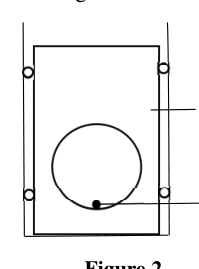 Rectangular block with cylindrical hole, walls
Topic: Newtonian Mechanics, Conservation of Energy Metodi: Conservation of Energy, Free-Body Diagram, Simple Harmonic Motion Analysis Competenze: Physical Reasoning, Mathematical Modeling Objects: Block, Cylinder Fonte: Testo (PDF) — p.4
Una piccola particella di massa può scivolare senza attrito intorno all’interno di un buco cilindrico di raggio , in un oggetto rettangolare di massa . L’oggetto rettangolare è tenuto tra le pareti rigide da piccole ruote in modo da poter scivolare su e giù senza attrito, come mostrato nella Figura 2. Se la piccola particella è inizialmente in riposo in fondo al buco cilindrico, e viene quindi forzata per dare una velocità , qual è la velocità minima necessaria per sollevare semplicemente la massa rettangolare dal suolo?
Blocco rettangolare con buco cilindrico, pareti
Topic: Newtonian Mechanics, Conservation of Energy Metodi: Conservation of Energy, Free-Body Diagram, Simple Harmonic Motion Analysis Competenze: Physical Reasoning, Mathematical Modeling Objects: Block, Cylinder Fonte: Testo (PDF) — p.4
Two resistors and two cells are connected in the circuit shown in Figure 3. One cell has an e.m.f. of 2.0 V and an internal resistance of 1.0 , the other an e.m.f. of 1.5 V and an internal resistance of 0.5 . The resistors are connected in series and the point between them is at earth, i.e. zero potential. Calculate
(i) the current through the cells,
(ii) the potential difference across each cell, and
(iii) the potential, relative to earth, at points A and B.
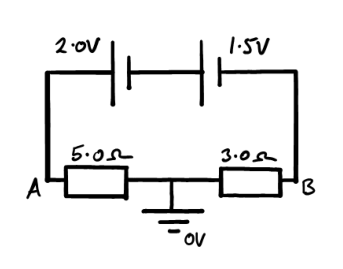 Circuit with two cells and two resistors
Topic: Circuits Metodi: Kirchhoff’s Laws, Equivalent Circuit Reduction Competenze: Physical Reasoning, Mathematical Modeling Objects: Resistor, Battery Fonte: Testo (PDF) — p.5
Due resistori e due celle sono collegati nel circuito mostrato alla figura 3. Una cellula ha un’EMF. di 2,0 V e una resistenza interna di 1,0 , l’altra un e.m.f. di 1,5 V e una resistenza interna di 0,5 . Le resistenze sono collegate in serie e il punto tra di esse è la terra, cioè Potenzialmente zero. Calcolo
-
la corrente attraverso le celle,
-
la differenza potenziale tra ciascuna cellula;
-
il potenziale, rispetto alla terra, nei punti A e B.
Circuito con due celle e due resistori
Topic: Circuits Metodi: Kirchhoff’s Laws, Equivalent Circuit Reduction Competenze: Physical Reasoning, Mathematical Modeling Objects: Resistor, Battery Fonte: Testo (PDF) — p.5
A thick-bottomed, cylindrical glass beaker is placed on a bench. Water and oil are poured into the beaker and form discrete layers, as shown in Figure 4. The bottom of the beaker is 1.8 cm thick, the water is 1.2 cm deep, and the oil layer is 0.8 cm deep.
(i) Draw a diagram showing the path of a ray at a small angle to the normal, travelling from the underside of the beaker and being refracted through the layers.
(ii) Assuming the angles of deviation of the ray are small, calculate the apparent vertical displacement of the lab bench when viewed from above.
The refractive indices are 1.5, 1.3 and 1.1 for the glass, water and oil respectively.
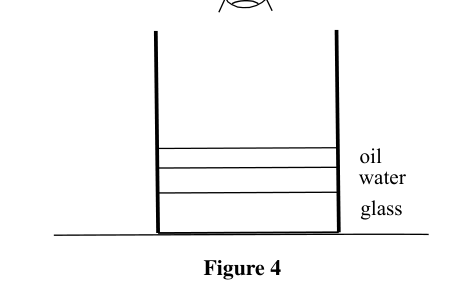 Beaker layers: glass, water, oil with eye above
Topic: Geometric Optics Metodi: Snell’s Law, Small-Angle Approximation, Ray Tracing Competenze: Physical Reasoning, Diagrammatic Reasoning Objects: Container Fonte: Testo (PDF) — p.5
Si colloca su una panchina una coppa di vetro cilindrica con il fondo spessore. L’acqua e l’olio vengono versati nel bicchiere e formano strati discreti, come mostrato alla figura 4. Il fondo della coppa è di 1,8 cm di spessore, l’acqua è di 1,2 cm di profondità e lo strato di olio è di 0,8 cm di profondità.
(i) Disegnare un diagramma che mostri il percorso di un raggio in un angolo piccolo rispetto al normale, che viaggia dalla parte inferiore del bicchiere e si rifracta attraverso gli strati.
- Supponendo che gli angoli di deviazione del raggio siano piccoli, calcolare il spostamento verticale apparente della panchina di laboratorio quando vista dall’alto.
Gli indici di rifrazione sono rispettivamente di 1,5, 1,3 e 1,1 per il vetro, l’acqua e l’olio.
Lei del bicchiere: vetro, acqua, olio con occhio sopra
Topic: Geometric Optics Metodi: Snell’s Law, Small-Angle Approximation, Ray Tracing Competenze: Physical Reasoning, Diagrammatic Reasoning Objects: Container Fonte: Testo (PDF) — p.5
A person might reasonably expect to jump a height of 1 m on Earth. On a planet with a density two thirds that of Earth, and radius twice that of the Earth, to what height might the person jump? Assume that they supply the same energy to make the jump.
Topic: Gravitation, Newtonian Mechanics Metodi: Newton’s Law of Gravitation, Conservation of Energy, Dimensional Analysis Competenze: Physical Reasoning, Estimation & Approximation Objects: Planet Fonte: Testo (PDF) — p.5
Una persona potrebbe ragionevolmente aspettarsi di saltare di 1 metro sulla Terra. Su un pianeta con una densità due terzi superiore a quella della Terra, e un raggio doppio di quello della Terra, a che altezza potrebbe saltare la persona? Supponiamo che forniscano la stessa energia per fare il salto.
Topic: Gravitation, Newtonian Mechanics Metodi: Newton’s Law of Gravitation, Conservation of Energy, Dimensional Analysis Competenze: Physical Reasoning, Estimation & Approximation Objects: Planet Fonte: Testo (PDF) — p.5
A pond containing water of density is covered to a depth by oil of density . A long wood block of square cross section , with the same density as the oil, floats in the pond, as shown in Figure 5. What fraction of the wood block is immersed below the top of the surface oil level?
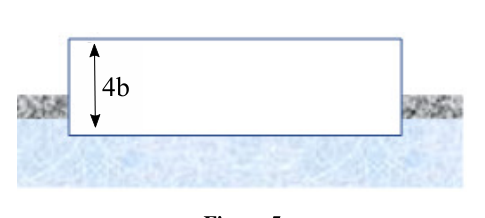 Wood block floating in oil-covered pond
Topic: Fluid Mechanics Metodi: Hydrostatic Equilibrium, Physical Modeling Competenze: Physical Reasoning, Mathematical Modeling Objects: Block Fonte: Testo (PDF) — p.6
Un stagno contenente acqua di densità è coperto fino a una profondità da olio di densità . Un lungo blocco di legno di sezione quadrata , con la stessa densità dell’olio, galleggia nell’acque, come mostrato alla figura 5. Quale frazione del blocco di legno è immersa sotto la superficie del livello di olio?
Blocco di legno galleggiante in stagno ricoperto di olio
Topic: Fluid Mechanics Metodi: Hydrostatic Equilibrium, Physical Modeling Competenze: Physical Reasoning, Mathematical Modeling Objects: Block Fonte: Testo (PDF) — p.6
A volume of 80 cm of water in a copper calorimeter of mass 150 g takes 12 minutes to cool from 40C to 15C in a cold room. The same volume of ethanol of density 0.8 g cm takes 8 minutes to cool also from 40C to 15C in the same calorimeter in the same circumstances. Calculate the specific heat capacity of ethanol.
The specific heat capacity of copper = 400 J kg C and of water = 4200 J kg C.
The density of water, g cm.
Topic: Thermodynamics Metodi: First Law of Thermodynamics, Physical Modeling Competenze: Physical Reasoning, Mathematical Modeling Objects: Calorimeter Fonte: Testo (PDF) — p.6
A volume of 80 cm of water in a copper calorimeter of mass 150 g takes 12 minutes to cool from 40C to 15C in a cold room. Lo stesso volume di etanolo di densità 0,8 g cm richiede 8 minuti per raffreddarsi anche da 40 C a 15 C nello stesso caloriometro nelle stesse circostanze. Calcolare la capacità termico specifica dell’etanolo.
La capacità termica specifica del rame = 400 J kg C e dell’acqua = 4200 J kg C.
La densità dell’acqua, g cm .
Topic: Thermodynamics Metodi: First Law of Thermodynamics, Physical Modeling Competenze: Physical Reasoning, Mathematical Modeling Objects: Calorimeter Fonte: Testo (PDF) — p.6
A steel girder is planted securely between two sides of a ravine in order to provide a bridge. The total cross-sectional area of the girder is 30 cm, and the length of the girder is 4.0 m.
Installed at a temperature of 5C, the temperature now rises to 20C.
Calculate the force exerted by the girder due to the change in temperature, assuming the ends do not move.
Young modulus of steel = Pa
Linear expansivity of steel (fractional expansion per unit temperature rise) = C at 5C.
Topic: Elasticity & Materials, Thermodynamics Metodi: Stress-Strain Analysis, Hooke’s Law Competenze: Physical Reasoning, Mathematical Modeling Objects: Beam Fonte: Testo (PDF) — p.6
Una cintura in acciaio è piantata saldamente tra i due lati di un baratro per fornire un ponte. La superficie totale della fascia è di 30 cm e la lunghezza della fascia è di 4,0 m.
Installato a una temperatura di 5C, la temperatura aumenta ora a 20C.
Calcolare la forza esercitata dalla cintura a causa del cambiamento di temperatura, supponendo che le estremità non si muovano.
Modulo giovane di acciaio = Pa
Espansività lineare dell’acciaio (espansione frazionaria per aumento di temperatura unitario) = C a 5C.
Topic: Elasticity & Materials, Thermodynamics Metodi: Stress-Strain Analysis, Hooke’s Law Competenze: Physical Reasoning, Mathematical Modeling Objects: Beam Fonte: Testo (PDF) — p.6
A narrow beam of monochromatic light falls on a diffraction grating of 1200 lines mm, and two diffracted beams of successive orders are observed at 14 and 73 to the normal, both of them on the same side of the normal. The incident beam of light is not along the normal to the grating.
(i) Sketch a diagram to show the path difference between rays passing through adjacent slits, for a ray incident on the diffraction grating at angle , and for the corresponding ray emerging from the grating at angle , with respect to the normal.
(ii) Derive an equation relating the angles and to the order of diffraction, , and the wavelength, .
Determine:
(iii) The wavelength of the light used.
(iv) The angle of incidence of the beam on the grating.
(v) The angle of diffraction of a third transmitted beam.
Topic: Wave Optics Metodi: Interference & Diffraction Analysis, Superposition Principle Competenze: Physical Reasoning, Diagrammatic Reasoning Objects: Diffraction Grating Fonte: Testo (PDF) — p.6
Un raggio stretto di luce monocromatica cade su una griglia di diffrazione di 1200 linee mm, e due raggi diffratti di ordini successivi sono osservati a 14 e 73 della norma, entrambi sullo stesso lato della norma. Il fascio di luce incidente non è lungo il normale fino alla griglia.
(i) Segnare un diagramma per mostrare la differenza di percorso tra i raggi che attraversano le fessure adiacenti, per un incidente di raggi sulla griglia di diffrazione all’angolo , e per il raggi corrispondente che emerge dalla griglia all’angolo , rispetto al normale.
(ii) Derivare un’equazione che relaziona gli angoli e all’ordine di diffrazione, , e la lunghezza d’onda, .
Determinazione:
(iii) L’onda della luce utilizzata.
(iv) L’angolo di incidenza del fascio sulla griglia.
V) L’angolo di diffrazione di un terzo raggio trasmesso.
Topic: Wave Optics Metodi: Interference & Diffraction Analysis, Superposition Principle Competenze: Physical Reasoning, Diagrammatic Reasoning Objects: Diffraction Grating Fonte: Testo (PDF) — p.6
Two identical spherical glass containers are joined by a narrow tube, whose volume is negligible compared to the spheres. The spheres contain air at 100C. One of the spheres is then heated by 50C whilst the other is cooled by 50C. This produces a small change in pressure, from to , of the air in the system. What common temperature of the two spheres could produce the same final pressure ?
Topic: Thermodynamics, Kinetic Theory Metodi: Ideal Gas Law, Approximation & Series Expansion Competenze: Physical Reasoning, Mathematical Modeling Objects: Sphere, Tube, Gas Fonte: Testo (PDF) — p.7
Due contenitori di vetro sferici identici sono collegati da un tubo stretto, il cui volume è trascurabile rispetto alle sfere. Le sfere contengono aria a 100 C. Una delle sfere viene quindi riscaldata a 50 C mentre l’altra viene raffreddata a 50 C. Ciò produce un piccolo cambiamento di pressione, da a , dell’aria nel sistema. Qual è la temperatura comune delle due sfere che potrebbe produrre la stessa pressione finale ?
Topic: Thermodynamics, Kinetic Theory Metodi: Ideal Gas Law, Approximation & Series Expansion Competenze: Physical Reasoning, Mathematical Modeling Objects: Sphere, Tube, Gas Fonte: Testo (PDF) — p.7
A simple pendulum consists of a small mass on the end of a light, inextensible string, as shown in Figure 6. It swings from an initial angle , for which it would have a period , but it hits a wall elastically, which is at angle to the vertical. What is the new period of oscillation in terms of ?
(, are small angles such that and ).
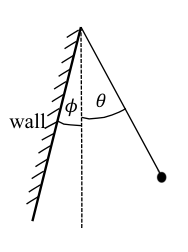 Pendulum swinging against a wall at angle phi
Topic: Oscillations & Waves, Newtonian Mechanics Metodi: Simple Harmonic Motion Analysis, Small-Angle Approximation Competenze: Physical Reasoning, Mathematical Modeling Objects: Pendulum Fonte: Testo (PDF) — p.7
Un semplice pendolo è costituito da una piccola massa all’estremità di una corda leggera, inestensibile, come mostrato alla figura 6. Si oscilla da un angolo iniziale , per il quale avrebbe un periodo , ma colpisce elasticamente una parete, che è all’angolo verso la verticale. Qual è il nuovo periodo di oscillazione in termini di ?
(, sono angoli piccoli come e ).
Pendolo oscilla contro una parete all’angolo phi
Topic: Oscillations & Waves, Newtonian Mechanics Metodi: Simple Harmonic Motion Analysis, Small-Angle Approximation Competenze: Physical Reasoning, Mathematical Modeling Objects: Pendulum Fonte: Testo (PDF) — p.7
Four charges are placed at the corners of a square of side 10 cm, as shown in Figure 7.
(i) Calculate the magnitude and direction of the electric field strength at the centre of the square.
(ii) Calculate the work done taking an electron from the centre to the mid-point of side CD.
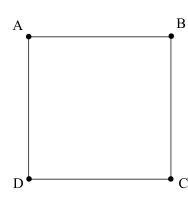 Square with four corner charges A, B, C, D
Topic: Electrostatics Metodi: Coulomb’s Law, Electric Potential Method, Superposition Principle Competenze: Physical Reasoning, Mathematical Modeling Objects: Point Charge, Electron Fonte: Testo (PDF) — p.7
Quattro cariche sono posizionate negli angoli di un quadrato di lato di 10 cm, come mostrato alla figura 7.
-
Calcolare la magnitudine e la direzione della forza del campo elettrico al centro del quadrato.
-
Calcolare il lavoro svolto prendendo un elettrone dal centro al centro del CD laterale.
Quadrato con cariche a quattro angoli A, B, C, D
Topic: Electrostatics Metodi: Coulomb’s Law, Electric Potential Method, Superposition Principle Competenze: Physical Reasoning, Mathematical Modeling Objects: Point Charge, Electron Fonte: Testo (PDF) — p.7