- Which of the following expressions has the correct units to represent the ground state energy of the electron in a Hydrogen atom? ( below)
(A)
(B)
(C)
(D)
Topic: Modern-Quantum Physics, Electrostatics Metodi: Dimensional Analysis, Bohr Model & Quantization Competenze: Estimation & Approximation, Unit Conversion Objects: Atom, Electron Fonte: Testo (PDF) — p.2
- Quale delle seguenti espressioni ha le corrette unità per rappresentare l’energia di stato di base dell’elettrone in un atomo di idrogeno? ( di seguito)
(A)
(B)
(C)
(D)
Topic: Modern-Quantum Physics, Electrostatics Metodi: Dimensional Analysis, Bohr Model & Quantization Competenze: Estimation & Approximation, Unit Conversion Objects: Atom, Electron Fonte: Testo (PDF) — p.2
- A Boeing 747 with mass 400 000 kg, engine thrust (force pushing the plane) of 1000 kN and cross section area of 158 m² is circling at constant speed of 500 km/h with the radius of 4 km at constant elevation. The acceleration of the plane and the drag force of the air is:
(A) ,
(B) ,
(C) ,
(D) ,
(E) ,
Topic: Newtonian Mechanics Metodi: Free-Body Diagram, Kinematic Equations Competenze: Physical Reasoning, Unit Conversion Objects: — Fonte: Testo (PDF) — p.2
- Un Boeing 747 di massa 400 000 kg, spinta motoria (forza di spinta) di 1000 kN e superficie di sezione trasversale di 158 m2 circola a velocità costante di 500 km/h con raggio di 4 km ad elevazione costante. L’accelerazione del piano e la forza di trazione dell’aria sono:
(A) ,
(B) ,
(C) ,
(D) ,
(E) ,
Topic: Newtonian Mechanics Metodi: Free-Body Diagram, Kinematic Equations Competenze: Physical Reasoning, Unit Conversion Objects: — Fonte: Testo (PDF) — p.2
- The International Space Station orbits 435 km above the Earth’s surface about 15.5 times a day. Every day it covers a distance of about:
(A) 42 000 km
(B) 660 000 km
(C) 21 000 km
(D) 330 000 km
(E) 620 000 km
Topic: Gravitation, Order-of-Magnitude Estimation Metodi: Kinematic Equations, Order-of-Magnitude Estimation Competenze: Estimation & Approximation, Physical Reasoning Objects: Satellite, Planet Fonte: Testo (PDF) — p.2
- La Stazione Spaziale Internazionale orbita 435 km sopra la superficie terrestre circa 15,5 volte al giorno. Ogni giorno copre una distanza di circa:
(A) 42 000 km
(B) 660 000 km
(C) 21 000 km
(D) 330 000 km
(E) 620 000 km
Topic: Gravitation, Order-of-Magnitude Estimation Metodi: Kinematic Equations, Order-of-Magnitude Estimation Competenze: Estimation & Approximation, Physical Reasoning Objects: Satellite, Planet Fonte: Testo (PDF) — p.2
- Two identical cars equipped with rubber bumpers in front and back collide. In the first collision, one of them moves with velocity 4 km/h and hits the other one, which moves in the same direction at 2 km/h. In the second collision they move with the same speeds but with directions opposite to each other. Assume the collisions are elastic and ignore the forces coming from the engine. Assuming that the collisions take the same time, the maximum force on the rubber bumper is:
(A) The same in both collisions
(B) 2 times bigger in the second one
(C) 3 times bigger in the second one
(D) 4 times bigger in the second one
(E) 9 times bigger in the second one
(F) Not enough information
Topic: Newtonian Mechanics, Conservation of Momentum Metodi: Conservation of Momentum, Impulse-Momentum Theorem Competenze: Physical Reasoning, Mathematical Modeling Objects: Cart Fonte: Testo (PDF) — p.3
- Due auto identiche dotate di paraurti di gomma davanti e dietro si scontrano. Nella prima collisione, uno di essi si muove a velocità di 4 km/h e colpisce l’altro, che si muove nella stessa direzione a 2 km/h. Nella seconda collisione si muovono con le stesse velocità ma in direzioni opposte. Supponiamo che le collisioni siano elastiche e ignoriamo le forze provenienti dal motore. Supponendo che le collisioni richiedano lo stesso tempo, la forza massima sul paraurti in gomma è:
(A) Lo stesso in entrambe le collisioni
(B) Due volte più grande nella seconda
C) 3 volte più grande nella seconda
(D) 4 volte più grande nella seconda
(E) 9 volte più grande nella seconda
F) Insufficienti informazioni
Topic: Newtonian Mechanics, Conservation of Momentum Metodi: Conservation of Momentum, Impulse-Momentum Theorem Competenze: Physical Reasoning, Mathematical Modeling Objects: Cart Fonte: Testo (PDF) — p.3
- A woman with mass standing on a weight measuring platform repeatedly throws a ball with mass up in the air and catches it. The ball is up in the air for half of each throw and catch cycle. What is the time averaged weight measured over many periods? Ignore air drag.
(A)
(B)
(C)
(D)
(E) Not enough information to find out.
Topic: Newtonian Mechanics Metodi: Conservation of Momentum, Free-Body Diagram Competenze: Physical Reasoning, Mathematical Modeling Objects: Ball Fonte: Testo (PDF) — p.3
- Una donna di massa in piedi su una piattaforma di misura del peso lancia ripetutamente in aria una palla di massa e la cattura. La palla è in aria per la metà di ogni lancio e cattura ciclo. Qual è il peso medio di tempo misurato per molti periodi? Ignora la resistenza dell’aria.
(A)
(B)
(C)
(D)
(E) Non ci sono informazioni sufficienti per scoprirlo.
Topic: Newtonian Mechanics Metodi: Conservation of Momentum, Free-Body Diagram Competenze: Physical Reasoning, Mathematical Modeling Objects: Ball Fonte: Testo (PDF) — p.3
- A woman riding on a bus suspends a ball of mass from the ceiling using a massless string while the bus is moving at constant speed on a horizontal road. When the bus is accelerating, with its engine off, down a hill inclined downward with a slope , what is the change of the angle at which the ball is suspended as observed by the woman on the bus?
(A) 0
(B) to the front of the bus
(C) to the back of the bus
(D) to the front of the bus
(E) to the back of the bus
Topic: Newtonian Mechanics Metodi: Free-Body Diagram, Vector Decomposition Competenze: Physical Reasoning, Mathematical Modeling Objects: Pendulum, String Fonte: Testo (PDF) — p.3
- Una donna che si trova su un autobus sospende dal soffitto una palla di massa con una corda senza massa mentre l’autobus si muove a velocità costante su una strada orizzontale. Quando l’autobus si accelera, con il motore spento, giù per una collina inclinata verso il basso con una pendenza , quale è il cambiamento dell’angolo in cui la palla è sospesa come osservato dalla donna sull’autobus?
(A) 0
(B) verso l’anteriore dell’autobus
(C) alla parte posteriore dell’autobus
(D) verso l’anteriore dell’autobus
(E) alla parte posteriore dell’autobus
Topic: Newtonian Mechanics Metodi: Free-Body Diagram, Vector Decomposition Competenze: Physical Reasoning, Mathematical Modeling Objects: Pendulum, String Fonte: Testo (PDF) — p.3
- The drag force (air resistance) of an object moving with velocity having the cross section perpendicular to the velocity depends only on , , air density and a dimensionless constant describing the shape of an object. is close to 0.5 for a sphere. Which graph below best describes the dependence of the drag force on the velocity for the 10 cm diameter ball?
(A) (B) (C) (D) — see figure on page 3.
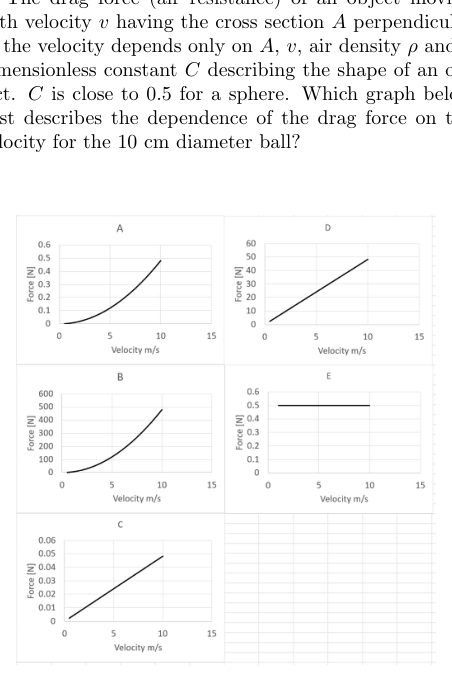 Drag force vs velocity graph options
Topic: Newtonian Mechanics, Fluid Mechanics Metodi: Dimensional Analysis Competenze: Diagrammatic Reasoning, Physical Reasoning Objects: Ball Fonte: Testo (PDF) — p.3
- La forza di resistenza (resistenza all’aria) di un oggetto in movimento a velocità con la sezione trasversale perpendicolare alla velocità dipende solo da , , densità dell’aria e da una costante senza dimensioni che descrive la forma di un oggetto. è vicino a 0,5 per una sfera. Quale grafico di seguito descrive meglio la dipendenza della forza di trazione dalla velocità della palla di 10 cm di diametro?
(A) (B) (C) (D) vedere figura a pagina 3.
Opzioni grafica forza di trazione vs velocità
Topic: Newtonian Mechanics, Fluid Mechanics Metodi: Dimensional Analysis Competenze: Diagrammatic Reasoning, Physical Reasoning Objects: Ball Fonte: Testo (PDF) — p.3
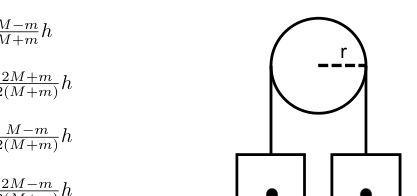
- Two men of the same mass are each standing inside a massless box, and the boxes are connected to each other through a massless, frictionless pulley system. Each man is holding a heavy ball of mass , so that they balance each other, and the system is at rest. When standing on earth, the man on the right can throw the ball vertically upward to a height above the point at which the ball leaves his hand. To what height, with respect to himself, can he throw the ball when he is standing inside the box? Assume that the ceiling of the box is high enough that the ball can’t reach it, and ignore any effect from the mass of the man’s hand and arm when throwing the ball. Assume also that the man on the left remains motionless inside his box.
(A)
(B)
(C)
(D)
(E)
Topic: Newtonian Mechanics, Conservation of Energy Metodi: Conservation of Energy, Conservation of Momentum, Free-Body Diagram Competenze: Physical Reasoning, Mathematical Modeling Objects: Pulley, Ball Fonte: Testo (PDF) — p.4
- Due uomini della stessa massa sono entrambi all’interno di una scatola senza massa e le scatole sono collegate tra loro attraverso un sistema di pollice senza massa e senza attrito. Ognuno di loro tiene una pesante palla di massa , in modo che si bilanciano tra loro, e il sistema è in riposo. Quando si trova in terra, l’uomo a destra può lanciare la palla verticalmente verso l’alto fino ad una altezza sopra il punto in cui la palla lascia la sua mano. A che altezza, rispetto a se stesso, può lanciare la palla mentre è in piedi all’interno della scatola? Supponiamo che il soffitto della scatola sia abbastanza alto da non poterlo raggiungere, e ignoriamo qualsiasi effetto della massa della mano e del braccio dell’uomo quando lancia la palla. Supponiamo anche che l’uomo sulla sinistra rimanga immobile dentro la sua scatola.
(A)
(B)
(C)
(D)
(E)
Topic: Newtonian Mechanics, Conservation of Energy Metodi: Conservation of Energy, Conservation of Momentum, Free-Body Diagram Competenze: Physical Reasoning, Mathematical Modeling Objects: Pulley, Ball Fonte: Testo (PDF) — p.4
- Three spatial points A, B and C are placed collinearly with an unknown negative charge as shown. Point B is in the middle between A and C. If we set the electric potential at A to be the reference (i.e. potential at A is 0), what are the possible potential at C and B respectively?
(A) B = 10 V, C = 15 V
(B) B = 5 V, C = 15 V
(C) B = 20 V, C = 10 V
(D) B = −15 V, C = −10 V
(E) B = −15 V, C = −5 V
(F) B = −20 V, C = −10 V
 Collinear points A, B, C with charge
Topic: Electrostatics Metodi: Electric Potential Method, Coulomb’s Law Competenze: Physical Reasoning, Mathematical Modeling Objects: Point Charge Fonte: Testo (PDF) — p.4
- Tre punti spaziali A, B e C sono posizionati in collinearità con una carica negativa sconosciuta come mostrato. Il punto B è nel mezzo tra A e C. Se impostare il potenziale elettrico a A per essere il riferimento (cioè Potenzialmente, il potenziale di A è 0), quali sono i potenziali possibili di C e B rispettivamente?
(A) B = 10 V, C = 15 V
(B) B = 5 V, C = 15 V
(C) B = 20 V, C = 10 V
(D) B = −15 V, C = −10 V
(E) B = −15 V, C = −5 V
(F) B = −20 V, C = −10 V
*Punti collineari A, B, C con carico *
Topic: Electrostatics Metodi: Electric Potential Method, Coulomb’s Law Competenze: Physical Reasoning, Mathematical Modeling Objects: Point Charge Fonte: Testo (PDF) — p.4
- Two identical metal spheres A and B carry charges and respectively. They are separated from each other in vacuum space. The force between them is . Now a third identical sphere C which initially carries a charge touches the sphere A and then the sphere B, after which the sphere C is immediately removed. What is the force between sphere A and B now?
(A)
(B)
(C)
(D)
(E)
(F)
Topic: Electrostatics Metodi: Coulomb’s Law Competenze: Physical Reasoning, Mathematical Modeling Objects: Conducting Sphere Fonte: Testo (PDF) — p.4
- Due sfere metalliche identiche A e B portano cariche e rispettivamente. Sono separati l’uno dall’altro nello spazio a vuoto. La forza tra loro è . Ora una terza sfera identica C che inizia con una carica tocca la sfera A e poi la sfera B, dopo di che la sfera C viene immediatamente rimossa. Qual è la forza tra la sfera A e la sfera B?
(A)
(B)
(C)
(D)
(E)
(F)
Topic: Electrostatics Metodi: Coulomb’s Law Competenze: Physical Reasoning, Mathematical Modeling Objects: Conducting Sphere Fonte: Testo (PDF) — p.4
- As in the following figure, four wires are passing through the page at the corners of a square. Wires at A and C both carry current flowing into the page. Currents at B and D are flowing out of the page. If the net force on the wire at B is zero, what current is flowing out of the page at D?
(A)
(B)
(C)
(D)
(E) Not enough information
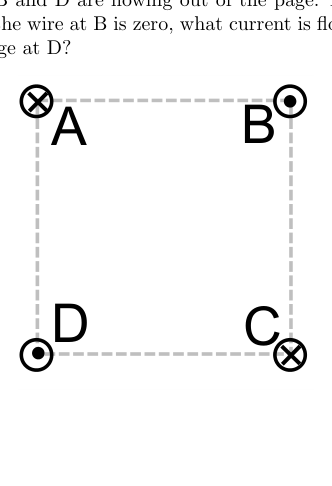 Four wires at square corners ABCD
Topic: Magnetism, Electromagnetism Metodi: Biot-Savart Law, Superposition Principle Competenze: Physical Reasoning, Mathematical Modeling Objects: Wire Fonte: Testo (PDF) — p.4
- Come nella figura seguente, quattro fili passano attraverso la pagina negli angoli di un quadrato. I fili A e C portano entrambi corrente che scorre nella pagina. Le correnti di B e D stanno scorrendo dalla pagina. Se la forza netta sul filo a B è zero, quale corrente sta fluendo fuori dalla pagina a D?
(A)
(B)
(C)
(D)
(E) Insufficienti informazioni
Quattro fili a angoli quadrati ABCD
Topic: Magnetism, Electromagnetism Metodi: Biot-Savart Law, Superposition Principle Competenze: Physical Reasoning, Mathematical Modeling Objects: Wire Fonte: Testo (PDF) — p.4
- An electron with velocity enters the uniform electric field and uniform magnetic field which are perpendicular to each other. The electron’s velocity can stay constant if the velocity is:
(A) Perpendicular to and parallel to and it has magnitude .
(B) Perpendicular to and it has magnitude .
(C) Parallel to and it has magnitude .
(D) Perpendicular to and and it has magnitude .
Topic: Electromagnetism, Magnetism Metodi: Lorentz Force Analysis Competenze: Physical Reasoning, Mathematical Modeling Objects: Electron Fonte: Testo (PDF) — p.4
- Un elettrone con velocità entra nel campo elettrico uniforme e nel campo magnetico uniforme che sono perpendicolari tra loro. La velocità dell’elettrone può rimanere costante se la velocità è:
(A) Perpendicolare a e parallela a e di magnitudo .
(B) Perpendicolare a e di magnitudo .
(C) Parallelamente a e ha una magnitudine .
(D) Perpendicolare a e e di magnitudo .
Topic: Electromagnetism, Magnetism Metodi: Lorentz Force Analysis Competenze: Physical Reasoning, Mathematical Modeling Objects: Electron Fonte: Testo (PDF) — p.4
- A proton (charge ) in an external electric field moves along the path shown below. Which of the following electric fields is the one that gives this path?
(A) (B) (C) (D) — see figure on page 5.
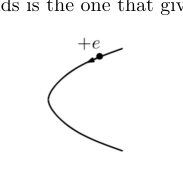 Proton path in electric field
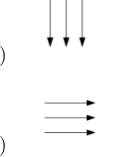 Field option A
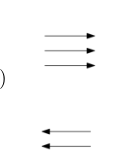 Field option B
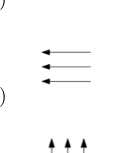 Field option C
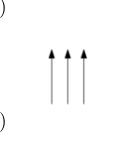 Field option D
Topic: Electrostatics, Newtonian Mechanics Metodi: Free-Body Diagram, Kinematic Equations Competenze: Diagrammatic Reasoning, Physical Reasoning Objects: Point Charge Fonte: Testo (PDF) — p.5
- Un protone (carica ) in un campo elettrico esterno si muove lungo il percorso indicato di seguito. Quale dei seguenti campi elettrici dà questo percorso?
(A) (B) (C) (D) vedere figura a pagina 5.
Costruzione del percorso dei protoni nel campo elettrico
Opzione campo A
Opzione campo B
Opzione campo C
Opzione campo D
Topic: Electrostatics, Newtonian Mechanics Metodi: Free-Body Diagram, Kinematic Equations Competenze: Diagrammatic Reasoning, Physical Reasoning Objects: Point Charge Fonte: Testo (PDF) — p.5
- A charged particle with mass and charge which is affected by the force of gravity and electric force, is moving in a horizontal direction with a steady acceleration . What is the magnitude of the electric force?
(A)
(B)
(C)
(D)
Topic: Electrostatics, Newtonian Mechanics Metodi: Free-Body Diagram, Vector Decomposition Competenze: Physical Reasoning, Mathematical Modeling Objects: Point Charge Fonte: Testo (PDF) — p.5
- Una particella carica con massa e carica che è influenzata dalla forza di gravità e dalla forza elettrica si muove in direzione orizzontale con un’accelerazione costante . Qual è la magnitudine della forza elettrica?
(A)
(B)
(C)
(D)
Topic: Electrostatics, Newtonian Mechanics Metodi: Free-Body Diagram, Vector Decomposition Competenze: Physical Reasoning, Mathematical Modeling Objects: Point Charge Fonte: Testo (PDF) — p.5
- Two identical coils are suspended from a string and are swinging forth and back as pendula as shown below. Coil 1 swings in the plane of the coil, coil 2 swings in the plane perpendicular to the coil. A current can be induced:
(A) In both coils as they swing in Earth’s magnetic field.
(B) Only in coil 1
(C) Only in coil 2
(D) In neither coil
(E) It depends on the direction of the Earth field relative to the coils
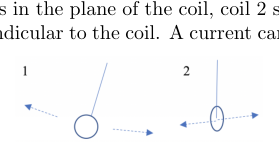 Two pendulum coils swinging
Topic: Electromagnetic Induction Metodi: Faraday’s Law of Induction, Lenz’s Law Competenze: Physical Reasoning, Diagrammatic Reasoning Objects: Coil, Pendulum Fonte: Testo (PDF) — p.5
- Due bobine identiche sono sospese da una corda e si svolgono avanti e indietro come pendola come mostrato di seguito. La bobina 1 oscilla nel piano della bobina, la bobina 2 oscilla nel piano perpendicolare alla bobina. Una corrente può essere indotta:
(A) In entrambe le bobine mentre oscilano nel campo magnetico terrestre.
(B) Solo in bobina 1
C) Solo in bobina 2
(D) In nessuna delle bobine
(E) Dipende dalla direzione del campo terrestre rispetto alle bobine
Due bobine pendolare in oscillazione
Topic: Electromagnetic Induction Metodi: Faraday’s Law of Induction, Lenz’s Law Competenze: Physical Reasoning, Diagrammatic Reasoning Objects: Coil, Pendulum Fonte: Testo (PDF) — p.5
- What is the average translational kinetic energy of an air molecule at room temperature (i.e. )?
(A)
(B)
(C)
(D)
(E) Not enough information
Topic: Kinetic Theory, Thermodynamics Metodi: Kinetic Theory of Gases, Statistical Averaging Competenze: Physical Reasoning, Mathematical Modeling Objects: Gas Fonte: Testo (PDF) — p.5
- Qual è l’energia cinetica traslazionale media di una molecola d’aria a temperatura ambiente (cioè )?
(A)
(B)
(C)
(D)
(E) Insufficienti informazioni
Topic: Kinetic Theory, Thermodynamics Metodi: Kinetic Theory of Gases, Statistical Averaging Competenze: Physical Reasoning, Mathematical Modeling Objects: Gas Fonte: Testo (PDF) — p.5
- The equation of state for some gases can be approximately expressed in the following way:
where is pressure, is volume, is the number of moles of a substance, is molar volume, is temperature, is the gas constant, is the substance-specific van der Waals constant in units of .
The following diagram shows the pressure of carbon disulphide gas in terms of volume per mole at temperature of 300 K. What is the van der Waals constant for this gas?
(A) 1300
(B) 2000
(C) 850
(D) 1150
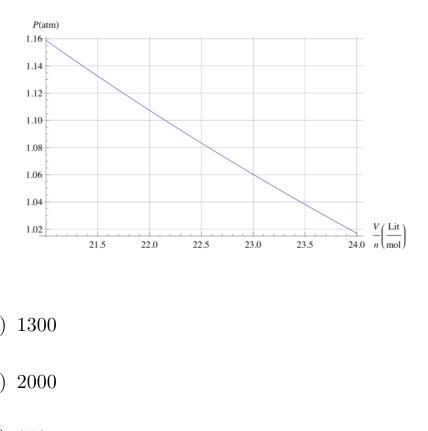 P vs molar volume for CS2 at 300 K
Topic: Thermodynamics, Kinetic Theory Metodi: Ideal Gas Law, Experimental Data Analysis Competenze: Graph Linearization, Experimental Data Analysis Objects: Gas Fonte: Testo (PDF) — p.5
- L’equazione di stato per alcuni gas può essere espressa in modo approssimativo come segue:
se è pressione, è volume, è numero di mole di una sostanza, è volume molare, è temperatura, è costante del gas, è costante di van der Waals specifica per la sostanza in unità di .
Il diagramma seguente mostra la pressione del gas disulfuro di carbonio in termini di volume per mol a temperatura di 300 K. Qual è la costante di van der Waals per questo gas?
(A) 1300
(B) 2000
(C) 850
(D) 1150
P vs volume molare per CS2 a 300 K
Topic: Thermodynamics, Kinetic Theory Metodi: Ideal Gas Law, Experimental Data Analysis Competenze: Graph Linearization, Experimental Data Analysis Objects: Gas Fonte: Testo (PDF) — p.5
- A system can be described by three thermodynamic variables: pressure, volume, and temperature. In an ideal gas system, the volume-temperature graph is as below:
[See figure — V–T graph on page 6]
Which one of the following diagrams is the Pressure-Volume graph corresponding to this process?
(A) (B) (C) (D) — see options on page 6.
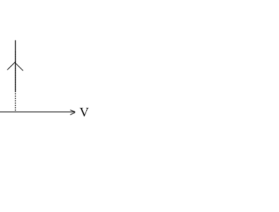 Volume-Temperature graph of ideal gas process
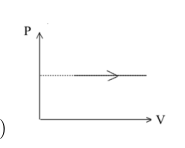 P-V graph option A
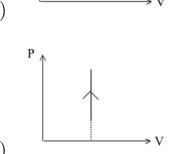 P-V graph option B
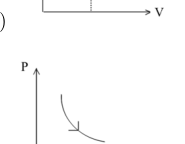 P-V graph option C
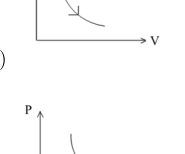 P-V graph option D
Topic: Thermodynamics Metodi: Ideal Gas Law, Thermodynamic Cycle Analysis Competenze: Diagrammatic Reasoning, Physical Reasoning Objects: Gas Fonte: Testo (PDF) — p.6
- Un sistema può essere descritto da tre variabili termodinamiche: pressione, volume e temperatura. In un sistema di gas ideale, il grafico volume-temperatura è il seguente:
[Vedi figura VT grafico a pagina 6]
Quale dei seguenti diagrammi è il grafico di pressione-volume corrispondente a questo processo?
(A) (B) (C) (D) vedere le opzioni a pagina 6.
Grafico volume-temperatura del processo di gas ideale
Opzione grafica P-V A
Opzione grafica P-V B
Opzione grafica P-V C
Opzione grafica P-V D
Topic: Thermodynamics Metodi: Ideal Gas Law, Thermodynamic Cycle Analysis Competenze: Diagrammatic Reasoning, Physical Reasoning Objects: Gas Fonte: Testo (PDF) — p.6
- A Carnot cycle operates using a heat reservoir at a temperature and a cold reservoir at temperature . How will the operation efficiency change if we decrease and by the same amount?
(A) It increases.
(B) It decreases.
(C) It doesn’t change.
(D) It depends on how much we change and .
Topic: Thermodynamics Metodi: Thermodynamic Cycle Analysis Competenze: Physical Reasoning, Mathematical Modeling Objects: Heat Engine Fonte: Testo (PDF) — p.6
- Un ciclo Carnot opera utilizzando un serbatoio di calore a temperatura e un serbatoio di freddo a temperatura . Come cambierà l’efficienza di funzionamento se diminuiremo e della stessa quantità?
(A) Si aumenta.
(B) diminuisce.
(C) Non cambia.
D) Dipende da quanto cambiamo e .
Topic: Thermodynamics Metodi: Thermodynamic Cycle Analysis Competenze: Physical Reasoning, Mathematical Modeling Objects: Heat Engine Fonte: Testo (PDF) — p.6
- Two soap bubbles combine, forming a bigger one. After the temperature stabilizes to become the same ambient temperature as before, is the volume of the gas inside the bigger bubble:
(A) The same as the sum of the volumes of the smaller bubbles
(B) Larger than the sum of the volumes of the smaller bubbles
(C) Smaller than the sum of the volumes of the smaller bubbles
(D) Not enough information to find out.
Topic: Thermodynamics, Fluid Mechanics Metodi: Ideal Gas Law, Hydrostatic Equilibrium Competenze: Physical Reasoning, Mathematical Modeling Objects: Bubble, Gas Fonte: Testo (PDF) — p.6
- Due bolle di sapone si uniscono formando una più grande. Dopo che la temperatura si stabilizza per diventare la stessa temperatura ambientale di prima, si trova il volume del gas all’interno della bolla più grande:
(A) Lo stesso che la somma dei volumi delle bolle più piccole
B) Più grande della somma dei volumi delle bolle più piccole
C) Più piccolo della somma dei volumi delle bolle più piccole
D) Non ci sono informazioni sufficienti per scoprirlo.
Topic: Thermodynamics, Fluid Mechanics Metodi: Ideal Gas Law, Hydrostatic Equilibrium Competenze: Physical Reasoning, Mathematical Modeling Objects: Bubble, Gas Fonte: Testo (PDF) — p.6
- A mercury thermometer was just put into a glass of water. If the thermometer reads 20°C, we can be certain that:
(A) The temperature of the water is 20°C.
(B) The temperature of the mercury in the thermometer is 20°C.
(C) Both A and B
(D) Neither A nor B
Topic: Thermodynamics Metodi: Physical Modeling Competenze: Physical Reasoning, Measurement & Instrumentation Objects: — Fonte: Testo (PDF) — p.6
- Un termometro a mercurio è stato appena messo in un bicchiere d’acqua. Se il termometro dice 20°C, possiamo essere certi che:
A) La temperatura dell’acqua è 20°C.
B) La temperatura del mercurio nel termometro è 20°C.
(C) Sia A che B
(D) Né A né B
Topic: Thermodynamics Metodi: Physical Modeling Competenze: Physical Reasoning, Measurement & Instrumentation Objects: — Fonte: Testo (PDF) — p.6
- Alice and Bob are travelling at two different constant velocities. In Alice’s frame of reference, two explosions occur 1 second apart in time and 2 light seconds apart in space. If these two explosions occur time apart and distance apart in Bob’s frame of reference, which statement is necessarily correct?
(A)
(B)
(C) it is possible that
(D) it is possible that
(E) more than one of the options above is correct
Topic: Special Relativity Metodi: Lorentz Transformation Competenze: Physical Reasoning, Mathematical Modeling Objects: — Fonte: Testo (PDF) — p.6
- Alice e Bob viaggiano a due velocità costanti diverse. Nel quadro di riferimento di Alice, due esplosioni si verificano a un secondo di distanza nel tempo e a due secondi luce nello spazio. Se queste due esplosioni si verificano tempo separati e distanza separati nel quadro di riferimento di Bob, quale dichiarazione è necessariamente corretta?
(A)
(B)
(C) è possibile che
D) è possibile che
(E) più di una delle opzioni di cui sopra è corretta
Topic: Special Relativity Metodi: Lorentz Transformation Competenze: Physical Reasoning, Mathematical Modeling Objects: — Fonte: Testo (PDF) — p.6
- The following graphs show the energy emitted by two LEDs as a function of wavelength. These are both 0.2 W LEDs (they take 0.2 W of electricity when connected). Which one is the most efficient visible light source and what is approximately its efficiency?
(A) Diode 1, 50%
(B) Diode 2, 40%
(C) Diode 1, 25%
(D) Diode 2, 20%
(E) Both have the same efficiency, 50%
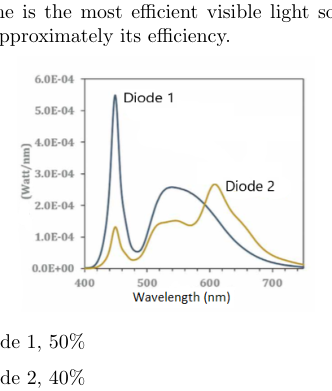 Emission spectra of two LEDs vs wavelength
Topic: Modern-Quantum Physics, Wave Optics Metodi: Experimental Data Analysis, Photon Energy Relation Competenze: Experimental Data Analysis, Graph Linearization Objects: Photon Fonte: Testo (PDF) — p.6
- I grafici seguenti mostrano l’energia emessa da due LED in funzione della lunghezza d’onda. Entrambi sono LED da 0,2 W (consuma 0,2 W di elettricità quando collegati). Quale è la fonte di luce visibile più efficiente e quale è approssimativamente la sua efficienza?
(A) Diodo 1, 50%
(B) Diodo 2, 40%
(C) Diodo 1, 25%
D) Diodo 2, 20%
(E) Entrambe hanno la stessa efficienza, il 50%
Spettrini di emissioni di due LED vs lunghezza d’onda
Topic: Modern-Quantum Physics, Wave Optics Metodi: Experimental Data Analysis, Photon Energy Relation Competenze: Experimental Data Analysis, Graph Linearization Objects: Photon Fonte: Testo (PDF) — p.6
- A man is walking at speed in front of an ambulance travelling towards him at speed . The siren on the ambulance is emitting a sound at speed . Since the ambulance is moving faster than the man (i.e. ), it overtakes the man later. What is the ratio of wavelength of the sound perceived by the man when the ambulance is approaching him to that when it is leaving him?
(A)
(B)
(C)
(D)
(E)
Topic: Oscillations & Waves Metodi: Wave Equation Competenze: Physical Reasoning, Mathematical Modeling Objects: — Fonte: Testo (PDF) — p.7
- Un uomo cammina a velocità davanti ad un’ambulanza che si dirige verso di lui a velocità . La sirena dell’ambulanza emette un suono a velocità . Poiché l’ambulanza si muove più velocemente dell’uomo (cioè ), raggiunge l’uomo più tardi. Qual è il rapporto tra la lunghezza d’onda del suono percepito dall’uomo quando l’ambulanza si avvicina a lui e quello che lo sta lasciando?
(A)
(B)
(C)
(D)
(E)
Topic: Oscillations & Waves Metodi: Wave Equation Competenze: Physical Reasoning, Mathematical Modeling Objects: — Fonte: Testo (PDF) — p.7
- Compare the photon emitted when an electron drops from the to the state to the photon emitted when an electron drops from to . Which photon has the longer wavelength? Electron’s ground state energy is . ()
(A) The photon emitted in the to transition
(B) The photon emitted in the to transition
(C) Both have same wavelength
(D) Not enough information given
Topic: Modern-Quantum Physics Metodi: Bohr Model & Quantization, Photon Energy Relation Competenze: Physical Reasoning, Mathematical Modeling Objects: Photon, Electron Fonte: Testo (PDF) — p.7
- Confronta il fotone emesso quando un elettrone scende dallo stato allo stato con il fotone emesso quando un elettrone scende da a . Quale fotone ha la lunghezza d’onda più lunga? L’energia di stato di base dell’elettrone è . ()
(A) Il fotone emesso nella transizione a
(B) Il fotone emesso nella transizione a
(C) Entrambi hanno la stessa lunghezza d’onda
D) Non sono state fornite informazioni sufficienti
Topic: Modern-Quantum Physics Metodi: Bohr Model & Quantization, Photon Energy Relation Competenze: Physical Reasoning, Mathematical Modeling Objects: Photon, Electron Fonte: Testo (PDF) — p.7
Section B — Problem 1
A golfer is playing golf facing an inclined plane of inclination angle as shown in the figure. When he strikes the ball, the ball flies towards the inclined plane. The ball left the ground at an angle relative to the inclined plane.
What is the value of at which the ball can land the farthest distance along the incline? Neglect air resistance and assume the inclined plane is infinitely long.
 Golf ball launched at angle φ above incline θ
Topic: Newtonian Mechanics Metodi: Kinematic Equations, Calculus-Integration, Vector Decomposition Competenze: Mathematical Modeling, Physical Reasoning Objects: Ball, Inclined Plane, Projectile Fonte: Testo (PDF) — p.8
Sezione B Problema 1
Un golfista sta giocando a golf con un piano inclinato di angolo di inclinazione come mostrato nella figura. Quando colpisce la palla, la palla vola verso il piano inclinato. La palla ha lasciato il terreno ad un angolo rispetto al piano inclinato.
Qual è il valore di al quale la palla può atterrare la distanza più lontana lungo l’inclinazione? Ignorate la resistenza dell’aria e pensate che il piano inclinato sia infinitamente lungo.
Ballina da golf lanciata all’angolo φ sopra inclinazione θ
Topic: Newtonian Mechanics Metodi: Kinematic Equations, Calculus-Integration, Vector Decomposition Competenze: Mathematical Modeling, Physical Reasoning Objects: Ball, Inclined Plane, Projectile Fonte: Testo (PDF) — p.8
Section B — Problem 2
A water bottle with diameter of 6.5 cm, made of transparent material, is left lying sideways on the wooden floor on the terrace, which is fully exposed to the sun during the whole day.
- Show that it can start a fire on the wood floor.
- How far away from the line along which the bottle touches the floor will the fire start?
- What will be the angular position of the sun above the horizon?
State clearly all the assumptions and approximations you made.
The solar constant (the amount of solar radiation energy hitting the square meter surface) at the Earth surface is about . Ignition temperature of wood is about .
The object at temperature emits the energy where is the surrounding temperature, and is the emitting surface. Assume emissivity of wood . Ignore the heat conductivity of wood.
You might find the following lens equations useful (which also approximately apply to thick and cylindrical lenses):
where is distance from lens to object, is the distance from lens to image, is the focal length, and are the sizes of the image and object, and is the magnification.
The lens made of material with index of refraction with the surfaces of the radii and has a focal length :
The ratio for the sun is about . Index of refraction of water .
Topic: Geometric Optics, Thermodynamics Metodi: Thin Lens & Mirror Equation, Ray Tracing, Energy Conservation Method Competenze: Physical Reasoning, Estimation & Approximation Objects: Cylinder, Lens Fonte: Testo (PDF) — p.9
Sezione B Problema 2
Una bottiglia d’acqua di 6,5 cm di diametro, in materiale trasparente, viene lasciata sdraiata lateralmente sul pavimento in legno della terrazza, completamente esposta al sole durante tutto il giorno.
- Mostrate che può accendere un fuoco sul pavimento in legno.
- Quanto lontano dalla linea lungo la quale la bottiglia tocca il pavimento si accenderà il fuoco?
- Qual sarà la posizione angolare del sole sopra l’orizzonte?
Indicate chiaramente tutte le ipotesi e le approssimazioni che avete fatto.
La costante solare (la quantità di energia della radiazione solare che colpisce la superficie del metro quadrato) sulla superficie terrestre è di circa . La temperatura di accensione del legno è di circa .
L’oggetto a temperatura emette l’energia , dove è la temperatura circostante, e è la superficie emettente. Supponiamo l’emissività del legno . Ignorare la conductività termico del legno.
Potreste trovare utili le seguenti equazioni di lente (che si applicano anche approssimativamente alle lenti spesse e cilindriche):
se è la distanza da obiettivo all’oggetto, è la distanza da obiettivo all’immagine, è la distanza focale, e sono le dimensioni dell’immagine e dell’oggetto, e è l’ingrandimento.
L’obiettivo è realizzato in materiale con indice di rifrazione con le superfici dei raggi e e ha una distanza focale :
Il rapporto per il sole è di circa . Indice di rifrazione dell’acqua .
Topic: Geometric Optics, Thermodynamics Metodi: Thin Lens & Mirror Equation, Ray Tracing, Energy Conservation Method Competenze: Physical Reasoning, Estimation & Approximation Objects: Cylinder, Lens Fonte: Testo (PDF) — p.9
Section B — Problem 3
A proton (mass ) can be turned into a new particle called delta (, mass ) when it absorbs a photon (denoted with , massless):
In such a relativistic process, energy and momentum are necessarily conserved. The total relativistic energy of a particle depends on its momentum and mass through
where is the speed of light. For a massless particle, this simplifies to .
Consider an ultra-relativistic proton, whose speed is close to the speed of light and whose momentum is much larger than , absorbing a very low energy (long wavelength) photon in a head-on collision.
(a) Determine the total relativistic energy of the proton in terms of the (small) energy of the photon . Clearly state and justify all approximations made.
(b) If the absorbed photon has wavelength , what must be the energy of the proton so that it is possible to produce a delta particle in such a head-on collision?
- C. If this photon were to collide with the proton at a different angle, would your answer to part
- B. be larger or smaller?
Topic: Special Relativity, Nuclear & Particle Physics, Modern-Quantum Physics Metodi: Relativistic Energy-Momentum, Conservation Laws, Approximation & Series Expansion Competenze: Mathematical Modeling, Physical Reasoning Objects: Photon, Nucleus Fonte: Testo (PDF) — p.10
Sezione B Problema 3
Un protone (massa ) può essere trasformato in una nuova particella chiamata delta (, massa ) quando assorbe un fotone (indicato con , senza massa):
In un tale processo relativistico, l’energia e l’impulso sono necessariamente conservati. L’energia relativistica totale di una particella dipende dal suo impulso e dalla massa
dove è la velocità della luce. Per una particella senza massa, questo si semplifica a .
Considera un protone ultra-relativistico, la cui velocità è vicina alla velocità della luce e il cui impulso è molto più grande di , assorbendo un fotone di energia molto bassa (lunghe lunghezza d’onda) in una collisione frontale.
(a) Determinare l’energia relativistica totale del protone in termini di energia (piccola) del fotone . Esprimere chiaramente e giustificare tutte le approssimative effettuate.
b) Se il fotone assorbito ha una lunghezza d’onda , quale deve essere l’energia del protone per poter produrre una particella delta in una collisione frontale?
Se questo fotone colpisce il protone da un angolo diverso, la risposta alla parte
- B. essere più grande o più piccolo?
Topic: Special Relativity, Nuclear & Particle Physics, Modern-Quantum Physics Metodi: Relativistic Energy-Momentum, Conservation Laws, Approximation & Series Expansion Competenze: Mathematical Modeling, Physical Reasoning Objects: Photon, Nucleus Fonte: Testo (PDF) — p.10