- SATELLITE (8 points) — Taavet Kalda. A solar powered satellite with starting velocity is launched from Earth onto an elliptical heliocentric orbit with the intent of gathering as much solar energy as possible. The angle of departure can be freely changed. i) (1 point) What is the minimal required launching speed for the satellite to reach any heliocentric orbit? ii) (2 points)What is the speed of the satellite just after exiting Earthʼs gravitational field? iii) (2.5 points)Express the long-time-average solar irradiance of the satellite in terms of its semi-major axis , angular momentum , orbital period and mass . iv) (2.5 points) What is the maximal average solar irradiance the satellite can gather and what is the needed launch angle relative to Earthʼs motion? The Sunʼs mass is , Earthʼs orbital radius , free fall acceleration on Earth , Earthʼs radius and Sunʼs luminosity .
Topic: Gravitation, Conservation of Energy, Newtonian Mechanics Metodi: Kepler’s Laws, Energy Conservation Method, Conservation Laws, Torque & Angular Momentum Analysis Competenze: Mathematical Modeling, Physical Reasoning, Diagrammatic Reasoning Objects: Satellite, Star, Planet Fonte: Testo (PDF) — p.1
- SATELITE (8 punti) Taavet Kalda. A satelliti a energia solare con velocità di partenza viene lanciato dalla Terra su un’ellittica orbite eliocentrica con l’intento di raccogliere il maggior numero possibile di energia solare. Il L’angolo di partenza può essere modificato liberamente. i) (1 punto) Qual è il minimo richiesto velocità di lancio per raggiungere il satellite Qualsiasi orbita eliocentrica? (ii) (2 punti) Qual è la velocità del satellite appena dopo aver lasciato il campo gravitazionale terrestre? iii) (2.5 punti) Esprimere la media a lungo termine irradiazione solare del satellite in termini di il suo asse semimejor , il suo momento angolare , Periodo orbitale e massa . iv) (2,5 punti) Qual è la media massima la radiazione solare che il satellite può raccogliere e quale è l’angolo di lancio necessario rispetto a Il movimento della Terra? La massa del Sole è , il raggio orbitale della Terra , l’accelerazione della caduta libera sulla Terra , Il raggio di radio della Terra e la luminosità del Sole .
Topic: Gravitation, Conservation of Energy, Newtonian Mechanics Metodi: Kepler’s Laws, Energy Conservation Method, Conservation Laws, Torque & Angular Momentum Analysis Competenze: Mathematical Modeling, Physical Reasoning, Diagrammatic Reasoning Objects: Satellite, Star, Planet Fonte: Testo (PDF) — p.1
ROLLER (8 points) — Lasse Frantti (iv,v: Jaan Kalda). A roller consists of a solid homogeneous cylinder of mass and radius ; it rests on a horizontal table and is attached to a wall via a helical spring of spring constant (see figure). The spring can be assumed to be of a negligible mass and ideal, i.e. the Hookeʼs law remains valid for arbitrarily large deformations. i) (1 point) At first, let as assume that there is no friction between the cylinder and the table. The roller is pushed aside and released; find the period of oscillations . ii) (1 point) From now on, the coefficient of friction between the roller and the table is no longer neglected. The roller is pushed aside and starts to roll back and forth. For small oscillation amplitudes, there is no slipping between the roller and the surface. Find the new period of oscillations . iii) (2 points) If the initial oscillation amplitude (measured as the deformation of the spring) is larger than a certain critical value , the amplitude of oscillations starts decreasing in time. Express in terms of , , , the free fall acceleration , and. iv) (2 points) Assuming that the initial amplitude is much larger than , what is the maximal angular speed of the cylinder during , where is the time elapsed since releasing the roller? v) (2 points) Assuming that , sketch a qualitative graph showing the dependance of and as functions of time; here and denote the angular acceleration and linear acceleration of the roller, respectively.
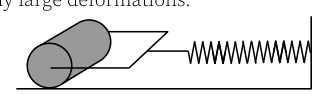 cilindro su piano con molla
Topic: Newtonian Mechanics, Rotational Dynamics, Oscillations & Waves Metodi: Free-Body Diagram, Simple Harmonic Motion Analysis, Torque & Angular Momentum Analysis, Hooke’s Law Competenze: Mathematical Modeling, Diagrammatic Reasoning, Physical Reasoning Objects: Cylinder, Spring Fonte: Testo (PDF) — p.1
ROLLER (8 punti) Lasse Frantti (iv, v: Jaan Kalda). un rulli è costituito da un cilindro solido omogeneo di massa e di raggio ; si poggia su una tavola orizzontale e è attaccata per un muro attraverso una molla a elica di costante molla (vedere figura). La sorgente può essere considerata di massa e di ideale trascurabile, i.e. La legge di Hooke rimane valida per deformazioni arbitrariamente grandi. I) (1 punto) Innanzitutto, supponiamo che ci sia un non si verifica attrito tra il cilindro e il
- Il tavolo. Il rulli viene spinto da parte e rilasciato; trovare il periodo di oscillazioni . (ii) (1 punto) Da ora in poi, il coefficiente di frizione tra il rulli e la tavola non è più trascurato. Il rulli è spinto si allontana e inizia a rotolare avanti e indietro. Per le piccole amplitudini di oscillazione, non vi è alcuna scivolatura tra il rulli e la superficie. Trova il nuovo periodo di oscillazioni . iii) (2 punti) Se l’ampiezza iniziale di oscillazione (misurata come la deformazione del Primavera) è superiore a un certo valore critico , l’ampiezza delle oscillazioni inizia a diminuire nel tempo. Esprimere in termini di , , , l’accelerazione di caduta libera , e. iv) (2 punti) Supponendo che l’ampiezza iniziale sia molto maggiore di , quale è il valore di velocità angolare massima del cilindro durante , dove è il tempo trascorso Da quando hai rilasciato il rulliere? V) (2 punti) Supponendo che , disegno un grafico qualitativo che mostra la dipendenza di e come funzioni temporali; qui e indica l’accelerazione angolare e lineare l’accelerazione del rulli, rispettivamente.
- cilindro su pianoforte con molla *
Topic: Newtonian Mechanics, Rotational Dynamics, Oscillations & Waves Metodi: Free-Body Diagram, Simple Harmonic Motion Analysis, Torque & Angular Momentum Analysis, Hooke’s Law Competenze: Mathematical Modeling, Diagrammatic Reasoning, Physical Reasoning Objects: Cylinder, Spring Fonte: Testo (PDF) — p.1
- MOTION IN (8 points) — Andréas Sundström, Joonas Kalda (ii,iii). Particles with mass and charge are launched from the origin with speed , parallel to the -axis. There is a screen at . i) (1 point)The first particle is launched when there is an homogeneous electric field parallel to the -axis, and there is no magnetic field. What should be the strength of the electric field so that the particle would never reach the screen? ii) (2 points) Next, the electric field is turned off, a homogeneous -directional magnetic field in region is swithced on, and the second particle is launched. Knowing that particleʼs speed is just big enough to reach the screen, sketch the trajectory and find the magnetic fied strength . iii) (2 points) Finally, an electric field lying in the -plane is turned on while is kept unchanged. Third particle is fired from the origin, still parallel to the -axis, but possibly with a different speed. It is observed that the particle travels without deviation. Further, the time it takes for it to reach the screen is the same as for the second particle. Find the magnitude of the electric field . iv) (3 points) Unrelated to the previous tasks, let us study now a weakly inhomogeneous magnetic field: the magnetic field lines have a radius of curvature which is much larger than the radius of curvature of the particleʼs trajectory. It appears that in that case, the so-called adiabatic invariant of a particle in magnetic field is conserved: the magnetic flux embraced by the particleʼs helixshaped trajectory remains constant with an extremely good precision along the trajectory. Consider a very simplified model for how a solar wind particles interact with the Earthʼs magnetic field. The strength of the Earthʼs magnetic field on its magnetic axis can be expressed as , where T is the field strength at the Earthʼs surface on the magnetic pole, km is the radius of the Earth and is measured from the center of the Earth. An electron of charge C and mass kg is approaching the Earth with speed km/s and hits the Earthʼs magnetic field right on its axis at a distance with an angle and starts spiraling in towards the Earth. If is too large, the particle will be reflected by the increasing magnetic field strength as the particle approaches Earth. Find the condition on for the particle to reach the surface of the Earth. You can neglect any gravitational and/or relativistic effects.
Topic: Electromagnetism, Magnetism, Astrophysics Metodi: Lorentz Force Analysis, Energy Conservation Method, Conservation Laws, Symmetry Argument Competenze: Mathematical Modeling, Physical Reasoning, Diagrammatic Reasoning Objects: Point Charge, Electron, Screen Fonte: Testo (PDF) — p.1
- MOTION IN (8 points) — Andréas Sundström, Joonas Kalda (ii,iii). Particelle con La massa e la carica vengono lanciate dal origine con velocità , parallela all’asse . C’è uno schermo a . i) (1 punto) La prima particella viene lanciata quando c’è un campo elettrico omogeneo parallelo all’asse e non c’è alcun campo magnetico campo. Qual è la forza del campo elettrico in modo che la particella non si raggiungere lo schermo? ii) (2 punti) Successivamente, il campo elettrico viene girato off, a homogeneous -directional magnetic il campo nella regione è inserito, e la seconda particella viene lanciata. Conoscere che la velocità della particella è abbastanza grande da raggiungere lo schermo, disegnare la traiettoria e trovare la resistenza del fiod magnetico . (iii) (2 punti) Infine, un campo elettrico che si trova in in piano è acceso mentre è mantenuto
- Inalterato. La terza particella viene sparata dalla origine, ancora parallela all’asse , ma possibilmente con una velocità diversa. Si osserva che il la particella viaggia senza deviazioni. Ulteriormente, il tempo necessario per raggiungere lo schermo è lo stesso che per la seconda particella. Trova il grandezza del campo elettrico . iv) (3 punti) Non correlati ai compiti precedenti, studiamo ora un’inomogeneità debole campo magnetico: le linee di campo magnetico hanno un raggio di curvatura molto più grande che il raggio di curvatura delle particelle
- La traiettoria. In tal caso, sembra che il il cosiddetto invariante adiabatico di una particella nel campo magnetico si conservano: Il flusso magnetico abbracciato dalla traiettoria a forma di elica della particella rimane costante con un
- Precisione estremamente buona lungo la traiettoria. Considerate un modello molto semplificato per come le particelle del vento solare interagiscono con il Il campo magnetico terrestre. La forza della Il campo magnetico terrestre sul suo asse magnetico può essere espressa come , dove T è la resistenza del campo al La superficie della Terra sul polo magnetico, km is the radius of the Earth and is misurata dal centro della Terra. Un elettrone di carica C e la massa kg si avvicina la Terra con velocità km/s e colpi Il campo magnetico terrestre proprio sul suo asse a Distanza con angolo e partenza in spirale verso la Terra. Se è troppo grande, la particella sarà riflessa dall’aumento della forza del campo magnetico quando la particella si avvicina alla Terra. Trova il condizione su per la particella di raggiungere il la superficie della Terra. Puoi trascurare qualsiasi cosa effetti gravitazionali e/o relativistici.
Topic: Electromagnetism, Magnetism, Astrophysics Metodi: Lorentz Force Analysis, Energy Conservation Method, Conservation Laws, Symmetry Argument Competenze: Mathematical Modeling, Physical Reasoning, Diagrammatic Reasoning Objects: Point Charge, Electron, Screen Fonte: Testo (PDF) — p.1
RETROREFLECTIVE FILM (12 points) — Eero Uustalu and Jaan Kalda. You are given the following tools: a retroreflective film an enlarged bottom view of which is shown in the first figure; stand, ruler, laser pointer, screen, graph paper, protractor. While the top surface of the film is flat, the bottom surface is a periodic array of slanted triangular faces. Six such faces are shown enlarged in the seond figure; the faces 1, 3 and 5 are perpendicular to each other and form a corner of a cube, and the faces 2, 4 and 6 are also perpendicular to each other. On the right of the second figure, a crosssection of the film is shown. The filmʼs material between the slanted faces and the flat surface form microprisms. The refracting angles of these microprisms are denoted by , (the index numbers correspond to those of the faces). Among the anlges , some may be equal to each other. cross-section line 1 2 3 4 5 6 cross-section When light falls onto the flat surface close to perpendicular incidence, it undergoes total internal reflections on the slanted faces, and as a result, its direction of propagation is rotated by . However, the microprisms can also serve as prisms diverting a light beam by an angle . The angle depends on the angle of incidence, and on the prism angle . Let denote the minimal deflection angle for a fixed prism angle . i) (2 points)Perform experiment to relate the prism angles (with relating to the face number as shown in the figure) with equalities and inequalities. You may use the deduced equalities throughout this problem (reducing thereby the number of unknown angles). Note that the face corresponding to the index “1” can be chosen arbitrarily. ii) (2 points) Determine the minimal deflection angles , . iii) (4 points) Determine the prism angles , . iv) (1 point) Due to the fact that the faces 1, 3 and 5 are perpendicular to each other, the following equality holds: . Similarly, . Use these equalities to adjust the result for the prism angles by adding and/or subtracting the same small value from your previously obtained anglesʼ values. v) (3 points) Determine the refraction coefficient of the filmʼs material.
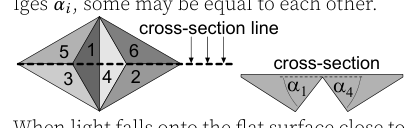 sezione prismi retroriflettente esagonale
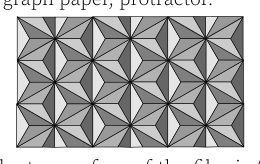 superficie periodica a facce triangolari
Topic: Geometric Optics, Wave Optics, Electromagnetism Metodi: Snell’s Law, Ray Tracing, Experimental Data Analysis, Thin Lens & Mirror Equation Competenze: Experimental Data Analysis, Measurement & Instrumentation, Mathematical Modeling Objects: Prism, Screen Fonte: Testo (PDF) — p.1
FILM RETRORIFLETTIVO (12 punti) — Eero Uustalu e Jaan Kalda. Ti sono date I seguenti strumenti: un film retroreflettivo e di cui la vista inferiore estesa è mostrata in la prima figura; supporto, reggente, puntatore laser, schermo, carta grafica, prolungatore. Mentre la superficie superiore del film è piatta, la la superficie inferiore è un’arricchetta periodica di inclinati volti triangolari. Sono mostrati sei volti di questo tipo. ingranditi nella figura di seond; le facce 1, 3 e 5 sono perpendicolari l’uno all’altro e formano un angolo di un cubo, e le facce 2, 4 e 6 sono anche perpendicolari l’uno all’altro. Nella seconda figura, a destra, è mostrata una sezione trasversale del film. Il materiale del film tra le facce inclinate e il piano la superficie forma microprismi. La rifrazione gli angoli di questi microprismi sono indicati da , (i numeri dell’indice corrispondono a quelli delle facce). Tra gli elementi , alcuni possono essere uguali l’uno all’altro. linea di sezione trasversale 1 2 3 4 5 6 sezione trasversale Quando la luce cade sulla superficie piatta vicino a incidenza perpendicolare, subisce un totale riflessioni interne sui volti inclinati e di conseguenza, la sua direzione di propagazione è rotata da . Tuttavia, i microprismi possono servono anche come prismi che deviano un raggio di luce con un angolo . L’angolo dipende dalla angolo di incidenza e sull’angolo del prisma . indichi la deviazione minima angolo per un angolo di prisma fisso . I) (2 punti) eseguire un esperimento per correlare i angoli di prisma (con relativi a il numero di faccia come mostrato nella figura) con Le parità e le disuguaglianze. Potete usare equalità dedotte in tutto il problema (riducendo così il numero di sconosciuti) angolazioni). Si noti che il volto corrispondente a l’indice 1 può essere scelto arbitrariamente. ii) (2 punti) Determinare gli angoli di deviazione minimi , . iii) (4 punti) Determinare gli angoli del prisma , . iv) (1 punto) A causa del fatto che le facce 1, 3 e 5 sono perpendicolari l’uno all’altro, le seguenti condizioni di uguaglianza: . Allo stesso modo, . Utilizzare Le condizioni di riferimento di un’equazione di angoli di prisma aggiungendo e/o sottraendo lo stesso valore di valore inferiore rispetto al precedente i valori degli angoli ottenuti. v) (3 punti) Determinare il coefficiente di rifrazione del materiale del film.
*sezione prismi retroriflettente esagonale *
superficie periodica a facce triangolari
Topic: Geometric Optics, Wave Optics, Electromagnetism Metodi: Snell’s Law, Ray Tracing, Experimental Data Analysis, Thin Lens & Mirror Equation Competenze: Experimental Data Analysis, Measurement & Instrumentation, Mathematical Modeling Objects: Prism, Screen Fonte: Testo (PDF) — p.1
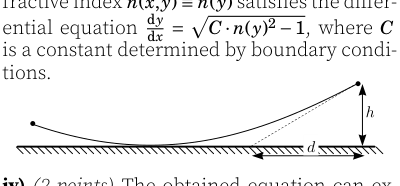
- BRACHISTOCHRONE (10 points) — Rūdolf Treilis. Consider points A and B separated by height in the vertical direction and distance in the horizontal direction, placed in a gravitational field as shown in the figure below. A point mass can slide along a rail of fixed shape frictionlessly (including taking -turns) from A to B. The brachistochrone curve is the curve minimizing the total travel time. i) (2 points)Calculate the total travel time for the “maximal speed” and “shortest path” trajectories. Find the ratio for which the two are equal. ii) (2 points) According to Fermatʼs principle, light ray travels from one point to another along the path of shortest travel time. Suppose that in a certain medium, a light ray can propagate from A to B along the brachistochrone curve shown in the figure above. Find the refractive index as a function of the coordinates and for this medium if . iii) (2 points) Show that the path of a light ray traveling in a medium with a variable refractive index satisfies the differential equation , where is a constant determined by boundary conditions. iv) (2 points) The obtained equation can explain mirages, which occur when the index of refraction increases with height. Consider a light ray coming from the sky that grazes the surface of the Earth () and hits the eye of an observer at height (for this task choose the -axis in the opposite direction - bottom of the page to top). If the refractive index varies as with and constant, find an expression for the apparent distance that the ray of light is emanating from . v) (2 points) Solving the equations derived in parts ii) and iii), one may show that the brachistochrone curve is actually a segment of a cycloid. A cycloid is the curve traced by a fixed point on the rim of a circular wheel as it rolls along a straight line without slipping. For the special case find the minimum travel time between A and B.
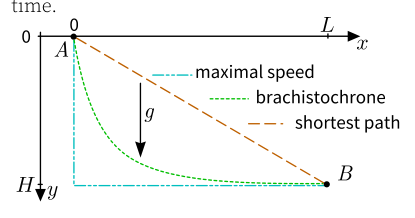 grafico brachistocrona velocità massima percorso breve
Topic: Newtonian Mechanics, Geometric Optics, Conservation of Energy Metodi: Energy Conservation Method, Snell’s Law, Differential Equations, Calculus-Integration Competenze: Mathematical Modeling, Physical Reasoning, Diagrammatic Reasoning Objects: — Fonte: Testo (PDF) — p.2
- BRACHISTOCHRONE (10 punti) Rūdolf Treilis. Considerate i punti A e B separati per altezza nella direzione verticale e distanza nella direzione orizzontale, collocata in un campo gravitazionale come mostrato nella figura
- Qui sotto. Una massa puntaria può scivolare lungo una rotaia di forma fissa senza attrito (compresi i prodotti di -torsioni) da A a B. Il brachistocrono curva è la curva che riduce al minimo il viaggio totale
- Il tempo. i) (2 punti) Calcolare il tempo di viaggio totale per Le trajectorie velocità massima e percorso più breve. Trova il rapporto per il quale le due sono uguali. ii) (2 punti) Secondo il principio di Fermat, Il raggio di luce viaggia da un punto all’altro lungo il percorso del tempo di viaggio più breve. Supponiamo che in un certo mezzo, un raggio di luce può propagarsi da A a B lungo la curva del brachistocrono mostrata nella figura sopra. Trova l’indice di rifrazione come funzione delle coordinate e per questo mezzo se . iii) (2 punti) Mostra che il percorso di una luce il raggio che viaggia in un mezzo con un indice di rifrazione variabile soddisfa l’equazione differenziale , dove è una costante determinata dalle condizioni di confine. (iv) (2 punti) L’equazione ottenuta può spiegare i miraggi, che si verificano quando l’indice è di rifrazione aumenta con l’altezza. Considerate un raggio di luce che viene dal cielo che pascola la superficie terrestre () e colpisce il occhio di un osservatore ad altezza (per questo compito scegliere l’asse nella direzione opposta - (Sito di pagina in basso). Se la rifrazione l’indice varia come con e Costante , trovare un’espressione per la distanza apparente che il raggio di luce emana da . V) (2 punti) Risoluzione delle equazioni derivate da Le parti ii) e iii) possono dimostrare che la curva del brachistocrono è in realtà un segmento di un cicloide. Una cicloide è la curva tracciata da una punto fisso sul bordo di una ruota circolare come si rulla lungo una linea retta senza scivolare. Per il caso speciale si trova il minimo tempo di viaggio tra A e B.
*grafico brachistocrona velocità massima percorso breve *
Topic: Newtonian Mechanics, Geometric Optics, Conservation of Energy Metodi: Energy Conservation Method, Snell’s Law, Differential Equations, Calculus-Integration Competenze: Mathematical Modeling, Physical Reasoning, Diagrammatic Reasoning Objects: — Fonte: Testo (PDF) — p.2
SELF-GRAVITATING GAS (10 points) — Eero Vaher (v: Jaan Kalda). Consider a ball of monoatomic ideal gas at temperature which keeps a spherically symmetric mechanically stable stationary shape due to its own gravity field. Let the total mass of the gas be , and its molar mass . We shall describe the radial mass distribution in terms of the total mass inside a sphere of radius , and the pressure as a function of distance from the centre of the spherical gas cloud. i) (2 points)State the mechanical equilibrium condition for a small parcel of gas of mass and volume at distance from the centre of the cloud in terms of the local pressure gradient , the local value of , and the appropriate constants of nature. Simplify your expression by noticing that is the local density of the gas. ii) (2 points) Show that the total thermal energy of the gas can be expressed as where , and is a numerical factor, and the integral is taken from the centre of the cloud, to very far distances from the centre, where the pressure is negligibly small. Find the value of . iii) (3 points) Based on your previous results, show that , where is the gravitational potential enery of the gas, and is a positive numerical factor. Find the value of . iv) (1 point) How will the temperature and characteristic radius of the cloud change in time due to heat radiation? Give a qualitative motivated answer. (The characteristic radius can be defined as such a radius that half of the mass of the cloud is inside the sphere of radius .) v) (2 points) Consider now a similar fully ionized plasma cloud. Assume that plasma is a macroscopically neutral mixture of electrons and protons. What is the proportionality factor between the total gravitational energy and total thermal energy for the plasma cloud?
Topic: Gravitation, Thermodynamics, Fluid Mechanics Metodi: Hydrostatic Equilibrium, Ideal Gas Law, Newton’s Law of Gravitation, Calculus-Integration Competenze: Mathematical Modeling, Physical Reasoning, Estimation & Approximation Objects: Gas, Star Fonte: Testo (PDF) — p.2
GASS auto-gravitatori (10 punti) — Eero Vaher (v: Jaan Kalda). Considerate una palla . di gas ideale monoatomico a temperatura che mantiene una forma fermata, meccanicamente stabile e simmetrica, a causa della sua campo gravitazionale. La massa totale della gas e la sua massa molare . Descriveremo la distribuzione di massa radial in termini di massa totale all’interno di una sfera di raggio e di pressione come funzione di distanza dal centro della Nuvola di gas sferica. i) (2 punti) Indicare l’equilibrio meccanico condizione per un piccolo pezzo di gas di massa e volume a distanza dal centro di nuvola in termini di pressione locale gradiente , valore locale di , e le appropriate costanti di natura. Semplifica l’espressione notando che è la densità locale del gas. (ii) (2 punti) Indicare che l’energia termica totale del gas può essere espressa come in cui e sono fattori numerici, e l’integrale viene preso dal centro di nuvole, a distanze molto lontane da il centro, dove la pressione è trascurabile
- Piccolo. Trova il valore di . iii) (3 punti) Sulla base dei risultati precedenti, indicare che , dove è l’energia potenziale gravitazionale del gas, e è un fattore numerico positivo. Trova il valore of . (I) (1 punto) Come si svilupperà la temperatura e la temperatura variazione del raggio caratteristico della nuvola in tempo dovuto alla radiazione termico? - Una valutazione qualitativa una risposta motivata. (Il raggio caratteristico può essere definito come un raggio che della massa della nuvola è all’interno della sfera di raggio .) v) (2 punti) Considerate ora un simile Nuvola di plasma ionizzata. Supponiamo che il plasma è una miscela macroscopicamente neutrale di elettroni e protoni. Qual è il fattore di proporzionalità tra l’energia gravitazionale totale e l’energia termica totale del plasma Nuvola?
Topic: Gravitation, Thermodynamics, Fluid Mechanics Metodi: Hydrostatic Equilibrium, Ideal Gas Law, Newton’s Law of Gravitation, Calculus-Integration Competenze: Mathematical Modeling, Physical Reasoning, Estimation & Approximation Objects: Gas, Star Fonte: Testo (PDF) — p.2
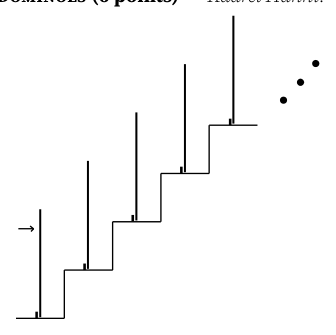
- DOMINOES (6 points) — Kaarel Hänni. David stands at the bottom of an infinite staircase with both step width and height being equal to . The corner of each step is slightly rounded. In the middle of each step, there is initially an upright domino of length and negligible thickness. Behind the base of each domino, there is a small ridge that prevents it from sliding backward. David gives the first domino some initial angular velocity, and the dominoes start falling into each other. All collisions are perfectly inelastic, and there is no friction between two dominoes. David notices that after a while, all dominoes have equal initial angular velocity . Find .
 domino inclinato su piano con h e d
 dominoes su scala a gradini
Topic: Rotational Dynamics, Conservation of Momentum, Newtonian Mechanics Metodi: Torque & Angular Momentum Analysis, Conservation of Momentum, Impulse-Momentum Theorem, Energy Conservation Method Competenze: Mathematical Modeling, Diagrammatic Reasoning, Physical Reasoning Objects: — Fonte: Testo (PDF) — p.2
- DOMINOES (6 punti) Kaarel Hänni. David si trova al fondo di una scala infinita con ampiezza e altezza di gradini pari a . L’angolo di ogni passo è leggermente
- Rondo. Nel mezzo di ogni passo, c’è è inizialmente un domino verticale di lunghezza e spessore trascurabile. Dietro la base di Ogni domino, c’è una piccola cresta che impedisce di scivolare indietro. David dà il primo domino una velocità angolare iniziale, e i domino iniziano a cadere in ciascuna altri. Tutte le collisioni sono perfettamente inelasche. e non c’è attrito tra due dominò. David si accorge che dopo un po’, tutti i dominosi hanno la stessa velocità angolare iniziale . Trova .
*domino inclinato su piano con h e d *
domino su scala a gradini
Topic: Rotational Dynamics, Conservation of Momentum, Newtonian Mechanics Metodi: Torque & Angular Momentum Analysis, Conservation of Momentum, Impulse-Momentum Theorem, Energy Conservation Method Competenze: Mathematical Modeling, Diagrammatic Reasoning, Physical Reasoning Objects: — Fonte: Testo (PDF) — p.2
- FOUR RESISTORS (10 points) — Jaan Kalda and Eero Uustalu. Tools: four almost identical resistors (of resistance slightly more than ) labelled with letters A–D and the set number, multimeter, voltage source with adjustable output voltage, wires. Do not use the ammeter function of the multimeter; if you still do use, and burn the multimeter, you will not be given another multimeter. The multimeter has a four-digit display, but the first digit can be only 0, 1, 2 or 3. When the multimeter is used as ohmmeter, the uncertainty is 1.0% of the reading plus 4 times the smallest digit value. When the multimeter is used as voltmeter, the uncertainty is 0.6% of the reading plus 4 times the smallest digit value. i) (2 points)Write down your set number. Determine the average resistance of the four resistors as precisely as possible and state the uncertainty. Draw the circuit you used. ii) (2 points)Determine the harmonic average resistance of the four resistors as precisely as possible (harmonic average is the reciprocal of the average of reciprocals) and state the uncertainty. Draw the circuit you used. iii) (1 point)Arrange the resistors A, B, C and D in increasing order of resistances. Draw the circuit you used. iv) (5 points) Determine , , , and as precisely as possible and state the uncertainty (, , , and denote the resistances of the respective resistors). Draw the circuit you used.
Topic: Circuits Metodi: Kirchhoff’s Laws, Equivalent Circuit Reduction, Error Propagation Competenze: Experimental Data Analysis, Error Propagation, Measurement & Instrumentation Objects: Resistor, Battery, Wire Fonte: Testo (PDF) — p.2
- Quattro resistenti (10 punti) Jaan Kalda E Eero Uustalu. Strumenti: quattro quasi identici resistenti (di resistenza leggermente superiore a ) etichettati con le lettere AD e il numero di set, un multimetro, fonte di tensione con regolabile tensione di uscita, fili. Non utilizzare la funzione di ammetro del multimetro; se
- E’ un’operazione di controllo. non verrà dato un altro multimetro. Il Il multimetro ha un display a quattro cifre, ma il la prima cifra può essere solo 0, 1, 2 o 3. Quando il Il multimetro viene utilizzato come ommetro, l’incertezza è di 1,0% della lettura più 4 volte il valore di cifra più piccola. Quando il multimetro è utilizzato come voltmeter, l’incertezza è dello 0,6% della lettura più 4 volte la cifra più piccola
- Il valore. i) (2 punti) Scrivi il tuo numero di set. Determina la resistenza media dei quattro le resistenze con la massima precisione possibile e indicare l’incertezza. Disegna il circuito che hai usato. ii) (2 punti)Determare la media armonica resistenza dei quattro resistori come precisione se possibile (la media armonica è la reciproca della media delle reciprocità) e stato l’incertezza. Disegna il circuito che hai usato. iii) (1 punto) Arrangere le resistenze A, B, C e D in ordine crescente di resistenza. Scatta Il circuito che hai usato. iv) (5 punti) Determinazione , , , e con la massima precisione possibile e con la massima l’incertezza (, , e indicano le resistenze dei rispettivi resistori). Disegna il circuito che hai usato.
Topic: Circuits Metodi: Kirchhoff’s Laws, Equivalent Circuit Reduction, Error Propagation Competenze: Experimental Data Analysis, Error Propagation, Measurement & Instrumentation Objects: Resistor, Battery, Wire Fonte: Testo (PDF) — p.2